10-Year Treasury Yield Tops 5% as Bond Market Reshapes the Investment Landscape

The U.S. bond market is sending one of its clearest signals in years that borrowing costs may remain elevated for longer than investors had hoped.

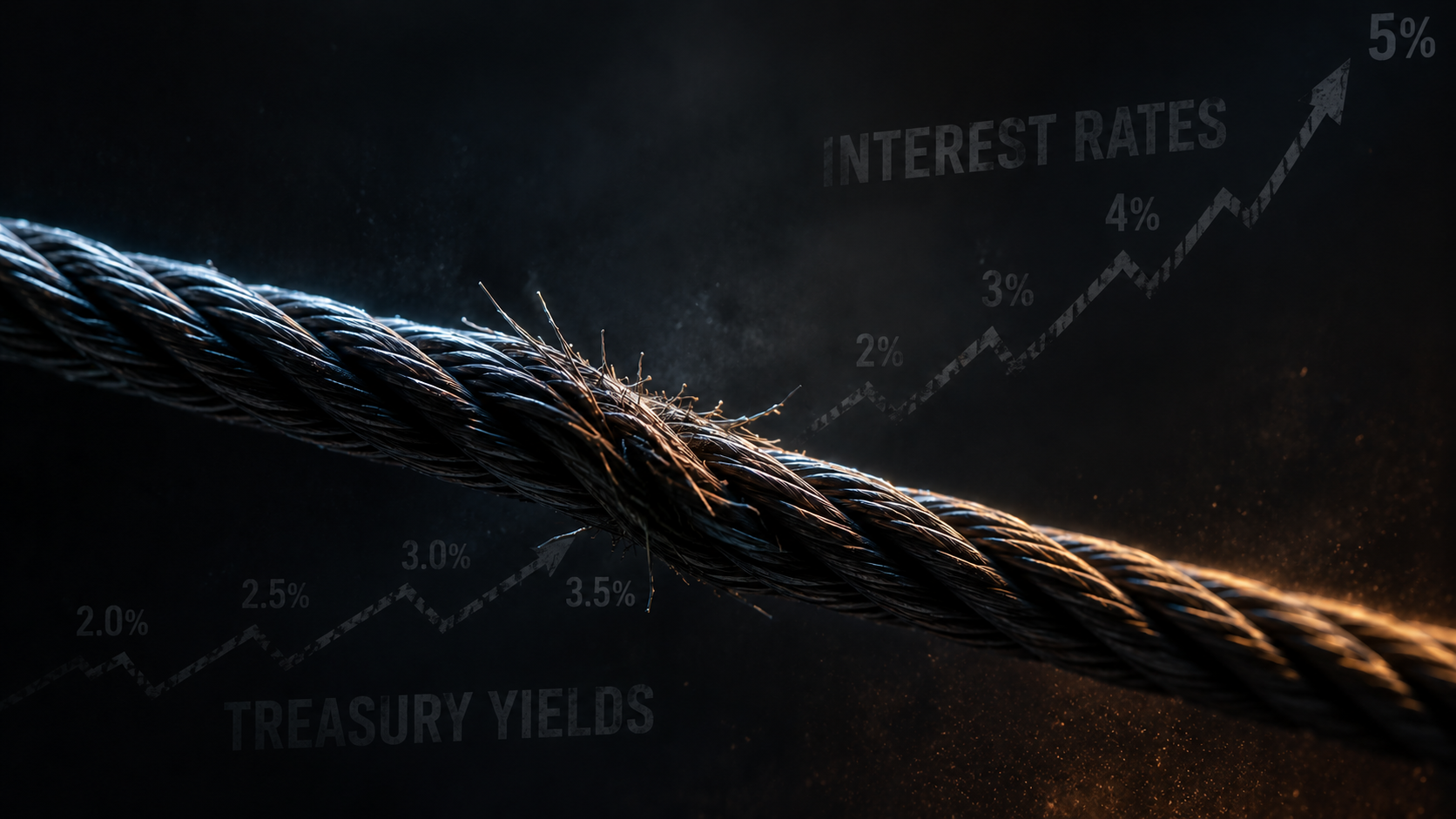
The benchmark 10-year Treasury yield climbed above 5%, while the 30-year Treasury yield pushed to its highest level since 2007, extending a sharp selloff in government bonds as investors contend with persistent inflation, rising energy prices, elevated federal borrowing and expectations for tighter Federal Reserve policy.

For investors, 5% is more than a psychological milestone. Treasury yields help establish the cost of money throughout the U.S. economy, influencing everything from mortgages and corporate borrowing to equity valuations and merger financing. At the same time, government bonds yielding around 5% provide investors with a considerably more competitive alternative to stocks than they had for much of the post-financial-crisis era. The result is a financial environment in which the bond market is again playing a central role in determining where capital flows and what investors are willing to pay for risk.

Why Treasury Yields Are Moving Higher

Several forces are pushing long-term rates in the same direction. Inflation remains one of the most immediate concerns. Consumer prices were 3.4% higher in August than a year earlier, with energy becoming an increasingly important source of pressure. Rising oil prices tied to continuing Middle East instability have strengthened concerns that inflation could remain above the Federal Reserve’s 2% target for longer, potentially limiting policymakers’ ability to ease financial conditions.

Energy is particularly important because its impact extends beyond the gasoline pump. Higher crude prices can raise transportation, freight, manufacturing and airline costs, creating the possibility that an initially concentrated energy shock eventually spreads into other parts of the economy. That concern has contributed to expectations that the Federal Reserve may need to maintain — or potentially increase — restrictive policy.

Government borrowing is another important part of the equation. Investors continue to focus on the size of federal deficits and the large amount of Treasury debt that must be issued to finance them. As bond supply increases, buyers may demand higher yields to absorb the additional issuance, particularly when uncertainty around inflation and future interest rates is already elevated. That dynamic contributes to what economists call the term premium — the additional compensation investors demand for holding longer-term bonds when future inflation, interest rates and fiscal conditions are uncertain.

Why 5% Is Historically Significant

A 5% Treasury yield is not extraordinary when viewed across several decades, but it represents a dramatic departure from the environment investors became accustomed to after the 2008 financial crisis. The 10-year Treasury regularly traded around or above 5% during portions of 2006 and 2007. After the financial crisis, however, weak growth, low inflation, quantitative easing and eventually the pandemic helped push long-term borrowing costs dramatically lower. In late 2021, the 10-year Treasury yield averaged less than 1.5%.

The subsequent reversal has been substantial. The 10-year approached 5% during the 2023 bond-market selloff before retreating, while the latest move has pushed it through that threshold again. The 30-year Treasury has followed a similar trajectory and is now trading at levels not seen since before the financial crisis. That shift matters because low rates provided a structural tailwind for financial assets for much of the past 15 years. Investors could borrow cheaply, companies could refinance debt at attractive rates and low bond yields made equities comparatively more appealing. A sustained return to 5% long-term Treasury yields would represent a meaningfully different investment backdrop.

Why Higher Yields Matter for Stocks

The connection between bonds and equities begins with valuation. Investors value companies partly by estimating the present value of future earnings and cash flows. When the risk-free rate rises, those future earnings are discounted more heavily, reducing the amount investors may be willing to pay for them today. The effect can be particularly pronounced for companies whose valuations depend heavily on profits expected many years into the future.

That is one reason technology and other high-growth stocks can be especially sensitive to sharp increases in long-term interest rates. A company trading at a high earnings multiple must now compete for investor capital against a Treasury security yielding approximately 5% with substantially less risk. That does not automatically make stocks unattractive. Equities offer earnings growth and capital appreciation that fixed-income securities do not. But a 5% government yield raises the return investors can earn without assuming corporate or equity-market risk, effectively increasing the hurdle rate stocks must clear. Higher yields can therefore pressure valuation multiples even when company fundamentals remain healthy.

The Pressure Reaches the Real Economy

The effects extend well beyond Wall Street. Mortgage rates tend to move with long-term Treasury yields, although the relationship is not one-for-one. Persistently elevated Treasury yields can therefore keep mortgage rates high, adding further pressure to a housing market already struggling with affordability. Higher monthly payments reduce purchasing power, while homeowners who secured mortgages at much lower rates have less incentive to move, limiting transaction activity and housing inventory turnover.

Businesses face similar challenges. Corporate bonds, bank loans and other forms of credit must compete with Treasury securities for investor capital, meaning higher government yields typically translate into more expensive financing for companies as well. That can become particularly important when older debt matures. Companies that borrowed at 3% or 4% several years ago may now need to refinance at considerably higher rates, increasing interest expense and potentially reducing funds available for investment, hiring or acquisitions. Smaller and middle-market companies can be especially sensitive because they often have fewer financing options and less balance-sheet flexibility than the largest public companies.

Higher Rates Can Change the M&A Equation

The same dynamics can influence merger and acquisition activity. Acquisitions frequently rely on debt financing, and higher interest rates can reduce the price a buyer can economically justify paying for a target. Private equity transactions are particularly rate-sensitive because leveraged buyouts typically depend on substantial borrowing to generate returns.

Higher financing costs do not mean M&A disappears. Strategic buyers with significant cash reserves can remain active, and valuation resets can create attractive acquisition opportunities for well-capitalized companies. Companies facing refinancing or capital constraints may also become more willing sellers. In that sense, a higher-rate environment can reshape dealmaking rather than simply stop it. Buyers with strong balance sheets may find themselves in a more advantageous position as financing becomes more difficult for competitors.

Could Higher Yields Create Opportunities in Small Caps?

Small-cap stocks are often viewed as particularly vulnerable to rising rates, and there are legitimate reasons for that concern. Smaller companies tend to rely more heavily on external financing, generally have higher borrowing costs than large corporations and often carry a greater proportion of floating-rate or shorter-duration debt. But the effect is not uniform across the small-cap universe.

Financials, industrials and healthcare represent significant portions of major small-cap indexes, and some companies within those sectors can benefit from the economic conditions accompanying higher yields. Regional and community banks are one example. If longer-term yields rise while short-term rates remain relatively contained, a steeper yield curve can improve the spread between what banks pay for funding and what they earn on loans. Smaller industrial companies can also benefit if higher yields partly reflect continued economic strength rather than simply deteriorating inflation. Many small-cap businesses are more domestically focused than the largest multinational corporations, leaving them relatively exposed to U.S. capital spending, infrastructure investment and economic activity.

That distinction is important. A 5% Treasury yield caused primarily by accelerating inflation and tightening credit would be much more problematic for small caps than a 5% yield accompanied by healthy growth, strong corporate earnings and functioning credit markets. Higher rates may also create greater separation between individual companies. Businesses with excessive debt, weak cash flow or repeated financing needs may struggle, while companies with healthy balance sheets, strong free cash flow and limited refinancing requirements could become more attractive by comparison. For small-cap investors, that could make company selection increasingly important. A higher-rate environment may be less forgiving, but it can also create valuation differences and opportunities that were harder to find when cheap money lifted a much broader range of companies.

The Fed Faces a Difficult Policy Balance

The Federal Reserve now faces an unusually complicated setup. Ordinarily, weakening financial conditions and pressure in rate-sensitive areas such as housing would strengthen the argument for easier monetary policy. But inflation remains above target, while higher energy costs threaten to place renewed upward pressure on consumer prices. That leaves policymakers balancing two competing risks: allowing inflation expectations to become entrenched or tightening financial conditions enough to weaken the economy unnecessarily.

There is another complication. The Fed directly controls short-term interest rates, but long-term Treasury yields are determined by the market. Even if policymakers eventually begin lowering short-term rates, the 10-year and 30-year yields could remain elevated if investors continue demanding higher compensation for inflation risk, government borrowing or fiscal uncertainty. In other words, a future Fed rate cut would not necessarily guarantee an immediate return to cheap long-term borrowing.

What Investors Should Watch Next

The immediate focus is on Federal Reserve policy, but the Treasury market itself may prove equally important. Investors will be watching whether oil prices and inflation remain elevated, how Treasury markets absorb continued government debt issuance and whether higher financing costs begin materially slowing economic growth. Credit spreads will also be worth monitoring, particularly for smaller and lower-rated companies, because a significant widening would indicate that investors are becoming more concerned about corporate default risk in addition to higher underlying interest rates.

The reason behind the rise in yields may ultimately matter as much as the level itself. Elevated yields driven by resilient economic growth and strong nominal activity can coexist with healthy corporate earnings and opportunities in cyclical sectors. A sustained increase driven by worsening inflation expectations or fiscal concerns would create a more challenging environment. That nuance is especially important for equity investors. Higher yields are clearly a tightening of financial conditions, but they do not automatically imply negative outcomes for every company or sector. Banks benefiting from improved lending economics, businesses with strong balance sheets and domestically oriented companies supported by continued economic activity may still perform well.

For investors, the question is therefore not simply whether Treasury yields are high, but why they are high, how long they remain elevated and which companies are best positioned to operate in that environment. The last time long-term Treasury yields consistently traded near these levels, the financial system looked very different. Whether today’s move proves temporary or signals a more durable higher-rate regime remains uncertain.

What is already clear is that the bond market can no longer be treated as background noise. With the benchmark 10-year Treasury yield around 5%, the cost of money is once again one of the most important forces shaping valuations, financing decisions and investment opportunities across the market.

The 10-Year Treasury Just Hit Its Highest Level Since 2023

The 10-year Treasury yield touched 4.814% Wednesday, its highest level since November 2023, before easing slightly to 4.77%. The 30-year yield sat at 5.26%, still hovering near the multi-decade highs that rattled markets last month. This is not a new, isolated story. It is the direct convergence of three separate threads that have each been building independently over recent weeks.

The first is oil. Crude prices pushed toward $95 a barrel this week after fresh US strikes on Iran, extending the renewed escalation we covered when fighting resumed after the earlier ceasefire lapsed. Elevated energy prices continue feeding directly into inflation expectations, and rising inflation expectations are one of the most reliable drivers of higher long-term bond yields.

The second is the Fed itself. Chair Kevin Warsh’s hawkish tone at his debut Jackson Hole speech last week set the stage, and Fed Governor Michelle Barr reinforced that posture Tuesday, stating the central bank should raise rates in September if inflation does not show sufficient signs of moderating. Prediction markets responded accordingly, with odds of a September rate hike on Polymarket climbing to 56% following Warsh’s initial remarks, up meaningfully from where they stood before Jackson Hole.

The third thread is less obvious but genuinely important. Rising yields are not only about oil and Fed policy, they also reflect growing investor concern over government debt levels and expanding fiscal deficits, alongside a separate but related dynamic in corporate debt markets. Technology companies building out AI infrastructure are increasingly turning to bond markets to fund that buildout, since the scale of spending required has outpaced what free cash flow alone can cover, a dynamic we detailed closely when BlackRock priced its $12.3 billion data center bond offering for Meta and when CoreWeave raised its own capital expenditure guidance earlier this summer. That wave of new corporate debt issuance adds further supply pressure to long-term bond markets at the exact moment government borrowing is already elevated, a combination that tends to push yields higher independent of any single catalyst.

The market reaction Wednesday reflected this convergence clearly. Rate-sensitive technology and growth stocks sold off sharply, with several names in the AI infrastructure and networking space falling double digits on the day, a pattern consistent with what happens whenever long-term borrowing costs move decisively higher.

For companies operating below the $2 billion market cap threshold, this is precisely the kind of environment worth watching closely. Small and microcap companies carry disproportionately more variable-rate debt than large cap peers, and when oil, Fed policy expectations, and corporate debt supply are all pushing in the same direction simultaneously, the resulting pressure on borrowing costs tends to be more durable and harder to reverse with any single piece of good news. The individual pieces of this story are all familiar. What matters now is that they are no longer moving independently, they are compounding.

30-Year Treasury Yields Just Hit Their Highest Level Since 2007. Four Forces Are Colliding at Once.

The 30-year US Treasury yield climbed to 5.327% on Tuesday, its highest level in 19 years, as stalled talks to end the US-Iran war and renewed fears of escalation pushed oil prices above $90 a barrel and reignited inflation concerns across global markets. The benchmark 10-year yield rose to 4.739%. The selloff was not contained to US markets either, spreading to Japan, where the 10-year government bond yield hit a 30-year peak, and to Europe, where Germany’s 10-year Bund yield touched its highest level since 2011 and France’s 10-year yield reached a 17-year high.

The proximate trigger is the same conflict that has driven energy markets and inflation expectations for much of the year. Iran told officials it would shift to a fully offensive military posture after negotiations toward a permanent end to the war stalled, while Washington has ruled out extending the ceasefire agreement reached in June. With the Strait of Hormuz still effectively shut, the best-case scenario according to strategists covering the region is a prolonged standoff that continues restricting crude flows, while the worst case is a resumption of active fighting.

This Is Not Just an Oil Story

What makes this move genuinely notable is that oil and geopolitics are only part of the explanation. Analysts covering global rates point to at least three additional structural forces pushing long-term yields higher independent of the Iran conflict. The surge in borrowing from AI hyperscalers, whose capital expenditure plans have accelerated sharply throughout 2026, is forcing bond buyers to demand higher returns to absorb the flood of new debt hitting markets. A rising US budget deficit is compounding that pressure, with recent Treasury auctions drawing unusual attention, a 10-year note auction clearing at 4.683%, its highest yield in 19 years, and a 30-year bond auction stopping at 5.216%, a 25-year peak.

Notably, one strategist covering the move specifically named Federal Reserve Chair Kevin Warsh’s shift toward a more opaque communication style as a contributing factor to rising yields, a shift in tone that has drawn scrutiny ahead of his upcoming Jackson Hole address and the market confusion that followed his July press conference. Reduced clarity from the Fed appears to be compounding, rather than easing, the uncertainty already priced into long-duration debt.

For companies operating below the $2 billion market cap threshold, this combination of forces is directly consequential. Small and microcap companies carry disproportionately more variable-rate debt than large cap peers, and a 30-year yield at its highest level since 2007 signals that the higher-cost-of-capital environment weighing on smaller businesses is not easing, it is intensifying. One market strategist noted that for much of the past 15 years, investors operated in a market where stable-to-falling rates consistently supported higher stock prices, but recent Treasury auctions suggest that landscape is genuinely shifting, with investors increasingly focused on the growing scale of US debt and questions about fiscal discipline. For small cap investors, that shift deserves close attention heading into the fall.

The 30-Year Treasury Just Paid Its Highest Yield Since 2007. Here’s What the Auction Actually Showed

The U.S. government sold $25 billion of 30-year Treasury bonds yesterday at a yield of 5.058%, the richest rate on a long bond auction since 2007. That headline number is drawing attention, but the full picture from this week’s auctions is more balanced than the yield alone suggests.

Start with the demand side. Pre-auction trading had the 30-year yield sitting at 5.061% just before the bidding deadline, meaning the final result actually came in slightly better than the market was pricing, a sign that buyers stepped in rather than stepped back. That is generally read as a healthy outcome, not a warning sign. Context matters here too. Existing 30-year bonds have already traded as high as 5.20% earlier this year, so yesterday’s print sits within a range the market has already absorbed rather than representing new, uncharted territory.

A day earlier, the Treasury auctioned $42 billion of 10-year notes, and that result was cleaner still. The auction cleared at 4.58% with a bid-to-cover ratio of 2.59, comfortably above the 2.5 level traders typically use as a benchmark for solid demand. No stress signals, no last-minute yield spike, no indication that investors are hesitant to hold U.S. government debt at current levels. Between the two auctions, the government raised $67 billion this week alone as part of a broader $119 billion week of coupon issuance, and both sales found willing buyers.

The interesting nuance is why the 30-year yield moved more than the 10-year. When the long end of the curve carries a higher premium relative to shorter maturities, it typically reflects investors asking for more compensation to hold debt across multiple decades rather than any concern about near-term credit risk. That’s consistent with straightforward supply and demand dynamics: more long-duration issuance generally requires a higher yield to clear the market, independent of the government’s underlying fiscal position.

The practical relevance for investors runs in a few directions. The 10-year yield is the direct reference point for 30-year mortgage rates, so a 4.58% clearing yield keeps the housing affordability conversation roughly where it has been. For companies that borrow against Treasury benchmarks, and smaller, more leveraged businesses in particular tend to feel rate moves more directly, the cost of long-term borrowing is shaped as much by auction dynamics like these as by anything the Federal Reserve decides at its policy meetings. The Fed sets the front end of the curve through its rate decisions. The long end responds to a separate set of forces, including how much duration the market is being asked to absorb and at what price investors are willing to hold it.

Taken together, this week’s auctions showed a market that is functioning and finding demand, just at a higher price for long-duration debt than it has required in nearly two decades. Whether that becomes a durable new range or eases as issuance patterns shift is something the next several auction cycles will help clarify.

The 30-Year Treasury Just Hit a 19-Year High

The bond market just sent one of its loudest warnings in nearly two decades. The 30-year US Treasury yield climbed to 5.12% on Friday — its highest level since June 2007 — while the 10-year benchmark yield rose to 4.57%, breaching the key 4.5% psychological threshold for the first time since May 2025. For equity investors, and small cap investors in particular, this is not background noise. It is a direct threat to valuations, borrowing costs, and earnings growth at the exact segment of the market least equipped to absorb the pressure.

What’s Driving the Move

The Treasury selloff is the product of several converging forces, all pointing in the same inflationary direction. Consumer prices rose 3.8% year over year in April according to the latest CPI print, driven heavily by surging energy costs tied to the ongoing US-Iran war. The Producer Price Index followed a day later, showing wholesale prices climbed 6% annually — a number that signals upstream cost pressures have not peaked and are still working their way through the supply chain.

The Trump-Xi summit, which many investors had hoped would produce pressure on Iran to reopen the Strait of Hormuz, ended without a concrete agreement on the conflict. Oil prices rose Friday as Trump departed Beijing, removing one of the few potential near-term relief valves for energy-driven inflation. The result: bond traders are not just pricing out Fed rate cuts — they are beginning to price in rate hikes. According to CME’s FedWatch tool, traders now see nearly a 50% chance the Fed raises rates before year-end, with a June hold near certain.

This is a significant repricing of the rate environment, and it happened fast.

Why Small Caps Bear the Most Risk

The 5% zone on the 30-year Treasury has historically acted as a tightening mechanism for financial conditions — and the companies that feel that tightening first and hardest are small and microcap names. Unlike large caps with investment-grade credit ratings and access to long-term fixed-rate financing, smaller companies disproportionately carry variable-rate debt. When rates rise, their interest expense rises with them — directly and immediately compressing earnings.

Beyond debt costs, rising yields create a valuation headwind. Higher risk-free rates reduce the present value of future cash flows, and smaller growth companies — many of which trade on forward earnings expectations — see multiple compression accelerate in high-yield environments. The Russell 2000 fell 1.63% Friday, underperforming the broader market in a pattern that is consistent with what history shows when long yields spike.

A Global Problem

The bond selloff is not isolated to US markets. Japan’s 30-year yield hit 4% Friday and the UK 10-year gilt climbed to 5.14%, signaling that the inflationary and fiscal pressures driving yields higher are a global phenomenon. Coordinated tightening of financial conditions across major economies raises recession risk and historically compresses small cap valuations more severely than large cap equivalents.

The 5% level on the long bond is not just a number. It is a threshold that has historically forced portfolio reallocation away from equities and toward fixed income — and when that rotation happens, small caps are rarely the last ones standing.

Investors in the sub-$2 billion market cap space should be watching yields as closely as earnings right now. The bond market is telling a story that equity markets haven’t fully priced yet.

10-Year Treasury Yield Climbs After Strong GDP Data as Fed Decision Looms

U.S. Treasury yields rose on Wednesday as stronger-than-expected economic growth reinforced expectations that the Federal Reserve will maintain its current interest rate stance, even amid growing political pressure and global market sensitivities.

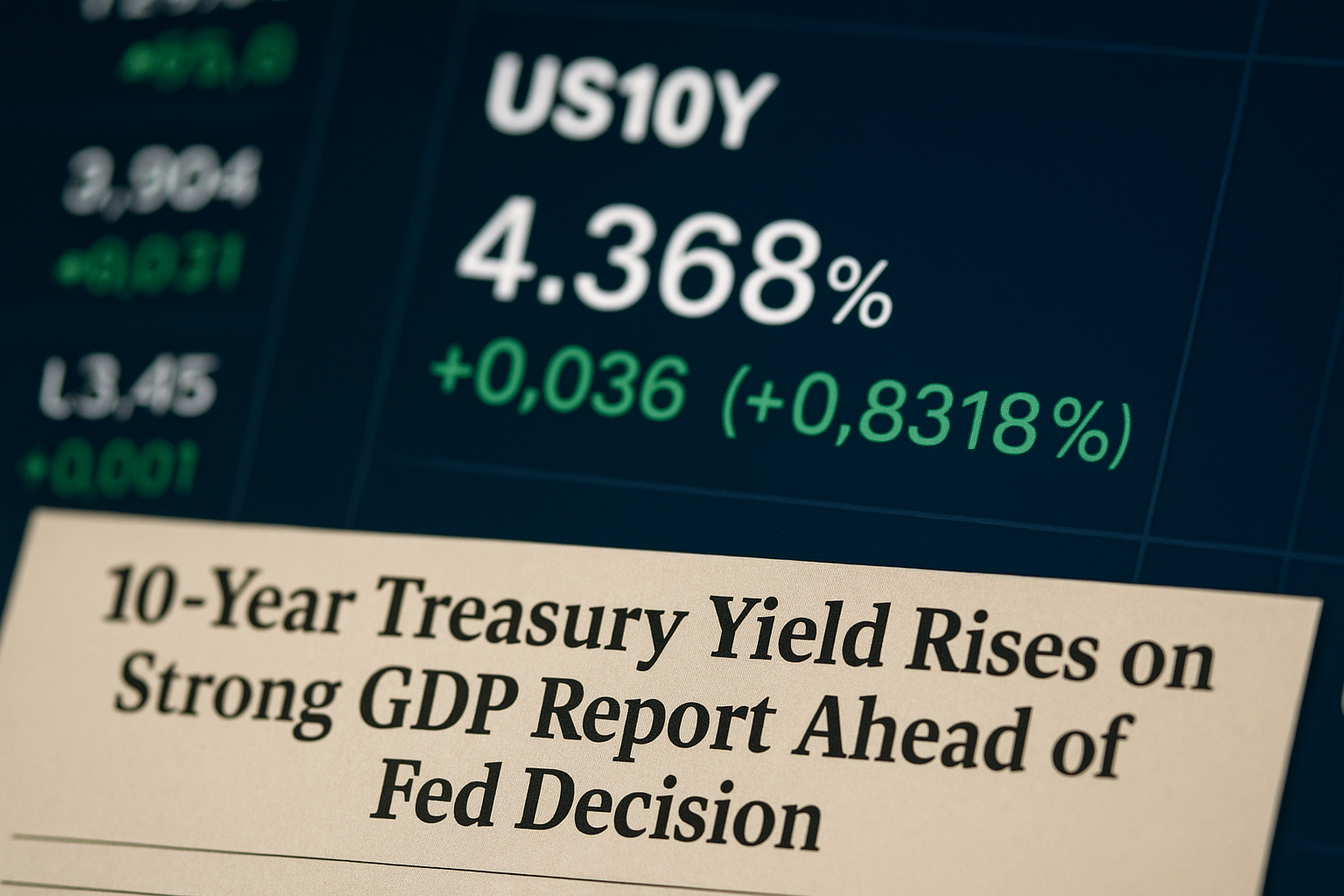
The benchmark 10-year Treasury yield climbed to 4.368%, reflecting rising investor confidence in the strength of the U.S. economy. The 2-year and 30-year yields also increased, closing at 3.904% and 4.904%, respectively. The moves followed a sharp rebound in second-quarter GDP, which showed the economy growing at an annualized rate of 3% — well above forecasts and reversing a 0.5% decline from the first quarter.

This robust data supports the case for keeping rates steady, at least in the near term, as the Federal Reserve continues to weigh inflation trends, labor market resilience, and long-term growth prospects. The Fed is widely expected to hold its benchmark interest rate between 4.25% and 4.5% during today’s announcement, but all eyes are on Chair Jerome Powell’s comments for insight into what comes next.

Adding complexity to the current environment is an ongoing effort by former President Donald Trump to pressure the Fed into lowering interest rates. Trump has criticized Powell’s leadership and floated the idea of replacing him in a potential second term. Despite this political noise, bond markets appear to be looking past the rhetoric, focusing instead on macroeconomic fundamentals. The continued rise in the 10-year yield suggests investors believe any leadership changes at the Fed would have little immediate impact on market direction.

Moreover, foreign holders of U.S. Treasuries could react to political instability or aggressive fiscal policy by offloading U.S. debt. This would push yields even higher, particularly if confidence in long-term economic or monetary policy erodes. The bond market’s sensitivity to global sentiment means that political pressure campaigns are unlikely to meaningfully influence interest rates without broader structural changes.

Adding further pressure is the threat of new tariffs, a cornerstone of Trump’s proposed economic agenda. Tariffs on imported goods would likely raise costs across the board, fueling inflation and reducing purchasing power domestically. As the U.S. imports many essential goods, any significant tariffs would shift costs onto consumers and businesses. This could complicate the Fed’s effort to keep core inflation within its 2% to 2.5% target range and delay any potential interest rate cuts.

For now, financial markets are signaling confidence in the Fed’s ability to manage the current environment, even if political rhetoric intensifies. Investors appear to be aligning their expectations with strong economic indicators and current inflation data rather than political speculation.

As the Federal Reserve’s decision looms, the upward movement in Treasury yields reflects not just optimism about U.S. growth, but also a more complex web of factors — from global capital flows and inflation expectations to political interference and international trade risks. The road ahead for monetary policy remains uncertain, but the market’s message is clear: economic fundamentals, not politics, will drive yields.

Mortgage Rates Jump Over 7% as Tariff-Driven Bond Rout Shakes Markets

Key Points:
– Mortgage rates surged to 7.1%, the highest level since February, following a sell-off in bonds.
– The bond market experienced one of its sharpest weekly moves since the early 1980s.
– Rising rates could weigh on economic growth, housing, and investor sentiment heading into Q2.

Mortgage rates jumped sharply on Friday, climbing to 7.1% for the 30-year fixed loan — their highest level since mid-February — as bond markets reeled from tariff-induced volatility. The move marked a 13-basis-point spike in a single day and capped what analysts are calling one of the most dramatic weeks in the Treasury market since 1981.

The spike followed a roller-coaster week in rates, largely driven by President Trump’s sweeping new tariffs on dozens of countries. Yields surged mid-week when the full tariff regime kicked in, then dipped after a partial rollback was announced, only to rebound on Friday. Notably, 10-year yields jumped 66 basis points from Monday’s lows, a move rarely seen outside of crisis periods.

Mortgage rates tend to track the 10-year Treasury, which helps explain the immediate impact on home financing costs. But broader bond market dislocations are now raising alarm bells across asset classes.

Matthew Graham, COO at Mortgage News Daily, described the moment as historic. “Unless your career began before 1981,” he noted, “this was likely the worst week you’ve ever seen in terms of 10-year yield volatility.” Traders and economists alike are grappling with the inflationary potential of tariffs and their longer-term implications for rates, risk, and the real economy.

Higher mortgage rates couldn’t come at a worse time for the housing market. The spring season is typically the most active for homebuying, but consumers now face steeper monthly payments just as concerns mount about job security and cost-of-living pressures. A Friday report from the University of Michigan showed consumer inflation expectations jumped from 5% to 6.7% — the highest since 1981.

In parallel, investors are also digesting early signs of an economic slowdown. GDP estimates for Q1 have been revised downward, and analysts note that consumer spending, outside of motor vehicles, was modest in March. Retail data released Friday did beat expectations, but economists caution that pre-tariff panic buying may have temporarily inflated the numbers.

For small-cap investors, the impact of higher rates is often magnified. These companies typically rely more heavily on short-term debt and floating-rate loans, making them more vulnerable to rising borrowing costs. Additionally, a potential slowdown in consumer demand could disproportionately impact the growth assumptions embedded in many small-cap valuations.

The bond market sell-off has also drawn attention to broader inflation expectations, with some economists now questioning whether the Federal Reserve will have the flexibility to cut rates as previously anticipated. If rate cuts are delayed or pared back, sectors sensitive to interest rates — from housing to tech — could feel the strain.

As the dust settles, markets will look to upcoming Fed commentary and earnings season for signals. But for now, mortgage rate watchers and equity investors alike are navigating a landscape that’s become far more uncertain in just one week.

Bond Market Surge Jolts Wall Street, But Small-Caps Could Find Upside Amid the Turbulence

Key Points:
– Bond yields spiked sharply this week, raising concerns about higher borrowing costs for small-cap companies.
– Small-caps are more rate-sensitive, but the sell-off may be overdone and could present buying opportunities.
– Long-term investors may benefit from focusing on quality small-cap names with strong fundamentals and domestic exposure.

A dramatic spike in long-term bond yields shook financial markets this week, sending investors scrambling as the 10-year Treasury yield soared past 4.5%, marking its biggest weekly surge since 2021. The 30-year yield rose even more sharply, posting its largest weekly gain since 1982. The sell-off was driven by a mix of sticky inflation, trade policy uncertainty, and a volatile geopolitical landscape — all amplified by President Trump’s ongoing tariff saga.

Yet while the headlines have centered on fear, especially around rising borrowing costs and global capital flows, there’s more nuance in the story for small-cap stocks.

It’s true that small-caps are uniquely exposed to changes in financial conditions. Many of these companies carry floating-rate debt and operate on thinner margins, making them more vulnerable to interest rate shocks. As bond yields rise, funding gets more expensive — and for firms that rely on access to capital markets, that’s a real pressure point.

But it’s also true that small-caps tend to be early-cycle performers. Historically, when markets reprice aggressively like this, they often overshoot. And while volatility can punish smaller names in the short term, it also tends to present opportunity — especially for companies with solid fundamentals and nimble management teams that can adapt quickly to shifting economic conditions.

The Russell 2000, the primary small-cap index, has already fallen more than 20% from its November highs, technically entering a bear market. But that also means much of the negative sentiment may already be priced in — a potential setup for a bounce once bond markets stabilize and investor focus shifts back to fundamentals.

Additionally, while the bond market’s sharp move has understandably rattled equity investors, some of the pressure may prove temporary. If the Federal Reserve sees the spike in yields as overdone — or if inflation data continues to soften — rate cuts could be back on the table. Futures markets are still pricing in up to four cuts by year-end, which could ease financial conditions and provide meaningful support to small-cap valuations.

For long-term investors, this is a time to stay alert but not panicked. Small-cap stocks still represent some of the most innovative and growth-oriented businesses in the U.S. economy. Many are domestically focused, potentially shielding them from global trade disruptions, and offer exposure to sectors — like biotech, software, and manufacturing — that could benefit as the policy environment evolves.

The current environment is undoubtedly challenging, but small-caps have weathered worse and bounced back stronger. If volatility persists, it could open the door to selectively adding quality small-cap names at compelling valuations.

US Bond Investors Assess Convexity Risk as Treasury Yields Decline

Key Points:
– Falling Treasury yields have triggered increased convexity hedging by mortgage investors and insurers.
– The spread between 10-year swap rates and Treasury yields has tightened, indicating rising demand for fixed-rate protection.
– Convexity-driven market activity may amplify rate movements and impact broader financial markets.

The recent decline in U.S. Treasury yields has sparked renewed interest in “convexity” hedging, a strategy employed by mortgage portfolio managers, insurance companies, and institutional investors to adjust their risk exposure. As yields have dropped to their lowest levels since October, analysts suggest that significant convexity-related buying has played a role in accelerating the decline.

The benchmark U.S. 10-year Treasury yield, which serves as a key barometer for borrowing costs across the economy, bottomed at 4.10% on March 4 after a notable 56-basis-point drop since early February. While the yield has stabilized in recent weeks, it fell again by 18 basis points from March 13 to 4.17% on March 20, raising speculation about continued hedging activity.

Convexity refers to how changes in interest rates disproportionately affect bond prices and portfolio durations. Mortgage-backed securities (MBS) are particularly sensitive to convexity risks because mortgage holders tend to refinance their loans when rates fall, leading to an increase in early repayments. This shortens the expected duration of mortgage bonds, reducing their yield and leaving investors with less exposure to fixed income than they initially planned.

To counterbalance this effect, institutional investors—such as insurance firms, pension funds, and mortgage servicers—purchase Treasuries, Treasury futures, or interest rate swaps to maintain their portfolio durations. This rush to hedge can create a feedback loop, pushing Treasury yields lower and further increasing the need for convexity hedging.

Recent data indicates that convexity hedging has intensified, influencing key financial indicators:

  • Tightening Swap Spreads: The spread between 10-year interest rate swaps and 10-year Treasury yields has become more negative, with swap rates declining due to increased demand for fixed-rate protection. As of March 25, U.S. 10-year swap spreads had narrowed to -44 basis points from -38.3 basis points on February 14.
  • Increased Options Market Activity: Short-term implied volatility on longer-dated swaps has risen sharply, with three-month implied volatility on 10-year swap rates hitting a four-month high of 27.71 basis points on March 10 before settling at 25 basis points.
  • Hedging Demand from Mortgage Investors: While 64% of outstanding U.S. mortgages are locked in at rates below 4%, about 16% have rates above 6% and could be refinanced quickly if interest rates continue to fall, increasing the need for further hedging.

Convexity hedging can create self-reinforcing cycles that amplify rate moves. When Treasury yields fall sharply, increased buying by mortgage investors and insurers can push them even lower. Conversely, if rates rise unexpectedly, convexity hedging could shift in the opposite direction, triggering selling pressure that accelerates rate increases.

For insurance companies, falling yields present a profitability challenge, as lower rates reduce returns on their fixed-income investments. This can impact both policyholder returns and shareholder earnings.

Moreover, heightened market volatility—particularly around the Trump administration’s evolving trade and tariff policies—has contributed to elevated uncertainty in interest rate markets. Investors are closely watching Federal Reserve policy signals, as unexpected rate cuts or macroeconomic shifts could further accelerate convexity-driven market moves.

While active convexity hedging has declined from its peak in the early 2000s—when 27% of mortgage investors actively adjusted their portfolios compared to just 6% today—it still plays a meaningful role in driving short-term Treasury yield fluctuations. With continued uncertainty over economic growth and inflation trends, convexity hedging is likely to remain a key factor influencing fixed-income markets in the months ahead.

Treasury Rally Pushes Yields Below 4% as Inflation Shows Signs of Cooling

Key Points:
– Short-term Treasury yields fell under 4% as inflation cooled and GDP forecasts weakened, boosting rate-cut expectations.
– Traders anticipate a July rate cut and over 60 basis points of relief by year-end, driving a strong February rally.
– Softer data and policy shifts have investors prioritizing economic slowdown risks over inflation fears.

A powerful rally in U.S. Treasuries has slashed short-term bond yields below 4% for the first time since October, sparked by cooling inflation and shaky economic growth signals. Investors are piling into bets that the Federal Reserve will soon lower interest rates, possibly as early as midyear, giving the bond market a jolt of momentum.

The rally gained steam on Friday as yields on two- and three-year Treasury notes dropped by up to six basis points. This followed a disappointing January personal spending report and a steep revision in the Atlanta Fed’s first-quarter GDP estimate, which nosedived to -1.5% from a prior 2.3%. Even the less volatile 10-year Treasury yield dipped to 4.22%, its lowest since December, signaling broad market confidence in a softer economic outlook.

This month, Treasuries are poised for their biggest gain since July, with a key bond index climbing 1.7% through Thursday. That’s the strongest yearly start since 2020, up 2.2% so far. Analysts attribute the surge to a wave of lackluster economic data over the past week, flipping the script on expectations that the Fed might hold rates steady indefinitely.

Market players are now anticipating a quarter-point rate cut by July, with over 60 basis points of easing baked in by December. The latest personal consumption expenditures data for January, showing inflation easing as expected, has fueled this shift. Investors see it as a green light for the Fed to pivot toward supporting growth rather than just wrestling price pressures.

Still, some warn it’s early days. The GDP snapshot won’t be finalized until late April, leaving room for surprises. For now, two-year yields sit below 4%, and 10-year yields hover under 4.24%. Experts say the rally’s staying power hinges on upcoming heavy-hitters like next week’s jobs report—if it flags a slowdown, the case for rate cuts strengthens.

A week ago, 10-year yields topped 4.5%, with fears of tariff-fueled inflation looming large. But recent tariff threats and talk of federal job cuts have shifted focus to growth risks instead. Investors are shedding bearish positions, and some are even betting yields could sink below 4% if hiring falters and unemployment climbs.

The Fed, meanwhile, is stuck in a tricky spot with inflation still above its 2% goal. If push comes to shove, many believe it’ll lean toward bolstering growth—a move the market’s already pricing in. As February closes, index fund buying could nudge yields lower still, amplifying the rally.

This swift turnaround underscores the bond market’s sensitivity to shifting winds. With jobs data on deck, all eyes are on whether this Treasury boom has legs.

Yields Ease, Markets Steady as Investors Await Key Inflation Data

Key Points:
– U.S. Treasury yields declined slightly after lower-than-expected December producer price index (PPI) data.
– Stock markets showed minimal movement as focus remained on upcoming consumer price index (CPI) data and policy uncertainty tied to President-elect Donald Trump.
– Oil prices fell from recent highs, while the dollar index softened.

Treasury yields in the United States edged down on Tuesday following a report showing that producer prices increased just 0.2% month-on-month in December, underperforming the expected 0.3% rise. This marks a slowdown from November’s 0.4% gain. While the PPI data eased immediate inflation concerns, market attention remains fixed on the consumer price index (CPI) report due on Wednesday.

CPI figures are anticipated to reveal consistent monthly inflation at 0.3% for December, with an annual increase to 2.9%, up from 2.7% in November. Market sentiment has been shaped by fears of persistent inflation, amplified by uncertainty surrounding President-elect Trump’s proposed trade and tax policies. Speculation about tariffs ranging from 2% to 5% monthly has added to concerns about potential inflationary pressures.

Market Performance
Stock market activity was muted as traders digested the PPI data. The Dow Jones Industrial Average added 0.10%, closing at 42,339.90, while the S&P 500 and Nasdaq Composite slipped 0.15% and 0.21%, respectively. The Russell 2000 index, a key indicator for smaller U.S. companies, has seen a decline of roughly 11% since its peak in November.

Internationally, MSCI’s global stock index inched up by 0.14%, while Europe’s STOXX 600 index dipped by 0.11%. With U.S. corporate earnings season kicking off, major banks are expected to report strong quarterly results, driven by increased dealmaking and trading activities.

Treasury Yields and Dollar Movement
The yield on the 10-year Treasury note eased slightly to 4.790%, staying close to its recent 14-month high of 4.805%. Higher yields have weighed on equities, as they make bonds more attractive and raise borrowing costs for companies.

In currency markets, the dollar index fell by 0.1% to 109.31. The euro gained 0.46% to $1.0292, while the dollar strengthened against the yen, rising 0.25% to 157.87.

Oil and Asian Markets
Oil prices retreated after reaching multi-month highs earlier this week. U.S. crude dropped 1.23% to $77.84 per barrel, while Brent crude declined 0.93% to $80.27 per barrel. In Asia, Japan’s Nikkei index fell 1.8%, dragged down by chip stocks and speculation about a potential interest rate hike by the Bank of Japan (BoJ). Deputy Governor Ryozo Himino hinted at a possible rate increase during the central bank’s next policy meeting on January 24, adding to market uncertainty.

With inflation and policy concerns dominating the narrative, investors are likely to remain cautious. The upcoming CPI data and the direction of Trump’s economic agenda are poised to play pivotal roles in shaping market sentiment in the coming weeks.

Treasury Yields Edge Higher Amid Geopolitical and Economic Uncertainty

Key Points:
– 10-year Treasury yield rises to 4.41% amid geopolitical and inflation concerns.
– Putin lowers nuclear strike threshold; U.S. embassy closures signal heightened tensions.
– Federal Reserve official warns of stalled inflation progress despite near-full employment.

U.S. Treasury yields rose on Wednesday as investors grappled with the dual challenges of escalating geopolitical tensions and evolving domestic economic conditions. The yield on the 10-year Treasury climbed 3 basis points to 4.41%, while the 2-year yield increased by the same amount to 4.302%. These moves reflect heightened investor caution as uncertainties cloud both global and U.S. economic outlooks.

At the forefront of global concerns is the ongoing Russia-Ukraine conflict. The United States closed its embassy in Kyiv on Wednesday, citing the risk of a significant air attack, signaling heightened tensions in the region. Compounding the situation, Russian President Vladimir Putin announced changes to Russia’s nuclear doctrine, reducing the threshold for a nuclear strike. This alarming shift follows Ukraine’s use of U.S.-made long-range ballistic missiles to target Russian territory, introducing a new layer of unpredictability to the geopolitical landscape. Such developments have rippled through financial markets, prompting investors to weigh their exposure to riskier assets and seek refuge in safer options like Treasuries, despite rising yields.

Domestically, Federal Reserve Governor Michelle Bowman provided a sobering perspective on inflation. Speaking in West Palm Beach, Florida, Bowman stated that progress toward the Fed’s 2% inflation target has stalled, even as the labor market remains robust. She highlighted the delicate balance the Fed must strike between achieving price stability and maintaining full employment, cautioning that labor market conditions could deteriorate in the near term. This acknowledgment has fueled speculation that the Fed may maintain its higher-for-longer interest rate stance, adding further pressure to bond yields.

Economic data due later this week could shed light on these dynamics. October’s flash purchasing managers’ index (PMI) reports from S&P Global are anticipated to provide critical insights into the health of the manufacturing and services sectors. A decline in PMI figures could reinforce concerns about an economic slowdown, while stronger-than-expected data might reignite inflation fears. Investors are also paying close attention to remarks from Federal Reserve officials later in the week, which could offer clues about the central bank’s next moves.

Adding to the uncertainty, the transition to a new Treasury Secretary under President-elect Donald Trump has become a focal point for market participants. Speculation about potential candidates has raised concerns about their experience and ability to navigate complex fiscal challenges. With geopolitical risks, inflation pressures, and evolving monetary policy already in play, the choice of Treasury Secretary will likely influence investor confidence and fiscal strategy in the months ahead.

As these factors converge, the bond market remains a key barometer of investor sentiment. Rising yields reflect a balancing act between risk and return as markets digest the interplay of global turmoil, domestic policy signals, and economic data. Investors will continue to watch these developments closely, with each data release or policy announcement potentially reshaping market dynamics.

Treasury Yields Drop Ahead of Election and Fed Decision

Key Points:
– U.S. Treasury yields declined as investors shifted to safer assets amid election and Fed uncertainty.
– Polls show Kamala Harris and Donald Trump in a dead heat, raising concerns about congressional control and potential policy impacts.
– A quarter-point rate cut is widely expected from the Federal Reserve this week, aimed at stimulating economic growth.

US Treasury yields fell on Monday as investors braced for a high-stakes week, with the upcoming U.S. presidential election and a key Federal Reserve rate decision poised to influence the economy and markets. The 10-year Treasury yield dropped nine basis points to 4.27%, while the 2-year yield decreased by over six basis points to 4.14%. These declines come as investors shift focus to safer assets amid election uncertainty and expected economic shifts. Yields, which move inversely to bond prices, reflected some caution as traders weigh potential election outcomes and their economic implications.

Polls indicate a tight race between Vice President Kamala Harris and former President Donald Trump, with NBC News showing the candidates locked at 49% each. Investors are particularly attentive to which party will control Congress, as this could dictate future policy moves, ranging from government spending to tax reforms. A split Congress would likely mean legislative gridlock, whereas a unified government might lead to significant policy changes. The election results could potentially impact stock markets, which experienced a volatile Monday, with the Dow Jones Industrial Average falling by 225 points or 0.5%, and both the S&P 500 and Nasdaq dipping by 0.2%.

In addition to the election, the Federal Reserve’s policy meeting on Thursday could mark another pivotal moment for markets. Analysts widely anticipate a quarter-point rate cut following the Fed’s recent 50 basis point cut in September. Traders are pricing in a 99% probability of this move, as tracked by CME Group’s FedWatch Tool. A rate cut could reduce borrowing costs and stimulate economic growth, potentially offsetting some of the anticipated volatility tied to the election.

Also weighing on markets were economic data points, with September factory orders down 0.5% in line with expectations. The Purchasing Managers Index (PMI) is due on Tuesday, and these indicators may provide additional insight into the economy’s current health as markets prepare for Fed Chair Jerome Powell’s comments on Thursday. Analysts suggest Powell’s statements could hint at the Fed’s future outlook for rates, as the central bank navigates a gradually slowing economy.

The shift towards Treasurys reflects a defensive stance by investors seeking stability amid looming uncertainties. Michael Zezas, a strategist at Morgan Stanley, suggested patience will be crucial for investors as they navigate potential market noise surrounding the election. The Treasury market’s reaction indicates some investors are bracing for turbulence in stocks if the election results lead to unexpected outcomes. The safe-haven nature of U.S. bonds offers a buffer for investors looking to mitigate risk in a potentially volatile environment.

Adding to market dynamics, Nvidia shares climbed 2% on Monday after it was announced the company would replace Intel in the Dow Jones Industrial Average, a change reflecting Nvidia’s year-to-date rise of 178% as it capitalizes on the AI sector. This development underscores a broader trend where technology and AI stocks remain central to market sentiment.

As election day approaches, financial markets are set to respond not only to the presidential outcome but also to shifts in Congress. With the Fed’s decision and further economic indicators expected this week, both equities and bond markets may experience heightened volatility, particularly if post-election policy signals lead to significant shifts in fiscal or monetary policy.