Microcaps Are Beating the S&P 500 by Double in 2026. Most Investors Still Haven’t Noticed

While Wall Street’s attention has been fixed on Nvidia earnings, Fed chair transitions, and Iran ceasefire negotiations, something quieter has been happening at the smaller end of the market. The Russell Microcap Index is up 17.55% year to date. The S&P 500 is up 8.72%. Microcap stocks have more than doubled the return of the 500 largest companies in America through the first five months of 2026, and the story behind that performance is one that most mainstream financial coverage has almost entirely missed.

The Numbers in Full

The 2026 outperformance is not a short-term blip. It is the continuation of a trend that began building in the spring of 2025. Over the past twelve months, the Russell Microcap Index has gained more than 57%, compared to approximately 27% for the S&P 500 over the same period. Microcaps have now outperformed major large cap indices for four consecutive quarters, a streak that Franklin Templeton research confirmed through the end of Q1 2026.

The first quarter told a particularly clear story. Energy was the standout sector within the Russell 2000, delivering a gain of 38.2% — far outpacing every other sector as oil prices surged on the Iran conflict. Small cap value outperformed small cap growth. Higher quality, lower leverage companies outperformed. Dividend-paying names outperformed non-payers. This was not speculative froth driving microcaps higher. It was fundamentals.

Why the Headlines Keep Missing It

The reason this story stays under the radar is structural. The S&P 500 is increasingly a story of extreme concentration. The top ten companies in that index now account for approximately 40% of its total weighting. Last week specifically, just five companies — Nvidia, Micron, Apple, AMD, and Intel — accounted for 75% of the entire index’s weekly gain. When those five companies perform well, the S&P 500 performs well, and every headline reflects that. When they stumble, the index stumbles, even if hundreds of smaller companies are quietly compounding.

That concentration dynamic is precisely what makes the microcap outperformance this year so significant. It is happening despite the noise, not because of it.

The Valuation Story Has Not Closed

Despite the strong performance, microcap and small cap stocks remain historically cheap relative to large caps. The Russell 2000’s weight within the Russell 3000 — a broad measure of how much of total market capitalization small caps represent — sits at 4.6%, compared to a historical average of 7.6%. On a forward price-to-earnings basis, small caps trade at a 30% discount to the S&P 500, a gap that remains near its widest level in over two decades. EV/EBIT valuations for the Russell Microcap Index relative to large caps are near their lowest point in 25 years according to Royce Investment Partners.

Consensus earnings growth estimates for the Russell 2000 are considerably higher than those for the Russell 1000 in 2026. The fundamentals are improving, the valuations remain attractive, and the performance is already reflecting both.

The rotation is not a prediction anymore. It is already underway. The investors who noticed it early are two quarters ahead of the ones still watching the Magnificent Seven.

The Russell Reconstitution 2026 Preliminary List

The preliminary list of stocks to be included in the Russell Reconstitution, and also which Russell Index, is a significant day for many stock investors and the impacted companies as well. This year, it occurred on Friday, May 22. The list, although preliminary and subject to refinements each Friday through June, includes the stocks believed to meet the requirements based on valuations taken on April 30. This is the first official filing from the popular index provider, and it gives the investor public an early look at what to expect when the indexes are reconstituted. The reconstitution can be expected to impact prices as index fund managers readjust their holdings. The event also, for many, redefines the market-cap levels that are considered small-cap, mid-cap, and large-cap. This year carries an added dimension: for the first time since 1989, FTSE Russell has moved to a semi-annual reconstitution schedule. That means the June event will be followed by a second reconstitution in December.

Background

The Russell Reconstitution reconfigures the membership of the Russell indexes by defining the top 3,000 stocks based on market cap (Russell 3000), then the top 1,000 stocks (Russell 1000), and reclassifying the remaining 2,000 stocks to form the Russell 2000 Small Cap Index. These serve as a benchmark for many institutional investors, as the indexes reflect the performance of the U.S. equity market across different market-cap classifications. An estimated $11 trillion in assets are benchmarked to the Russell Indexes, which makes the annual reconstitution process one of the most consequential events in the equity markets each year. By adding, removing, and reweighting stocks, the reconstitution process ensures the indexes accurately represent the market.

The Preliminary List, published after the market closed on May 22, 2026, is a critical step in the market cap reclassification process. It gives market participants an initial look at potential additions and deletions from the indexes. Stocks on this preliminary roster often experience increased attention from investors, since the list signals where buying or selling pressure could build once the final reconstitution is completed.

The June 2026 reconstitution reflects a U.S. equity market with continued strength among mega-cap leaders and improving breadth in small-cap segments. Technology and Industrials led movement into the Russell 1000, while companies across several industries replenished the Russell 2000, reinforcing its role as a pipeline for emerging companies.

The newly reconstituted indexes become live after the market close on June 26, 2026.

Implications for Investors

The release of the Russell Preliminary List on May 22 could provide opportunities for investors, including:

Enhanced Market Visibility. Companies listed on the Preliminary List may experience increased trading volumes and heightened market attention, or even scrutiny, as investors evaluate their potential inclusion in the Russell indexes.

Potential Price Movements. Stocks slated for addition or deletion from the indexes can experience price volatility as market participants adjust their positions ahead of the anticipated reconstitution changes.

Portfolio Adjustments. Active managers who track the Russell indexes may need to realign their portfolios to reflect the new index constituents, which can trigger buying or selling activity in affected stocks.

Semi-Annual Impact. The move to a twice-yearly reconstitution schedule in 2026 means these dynamics will now play out two times per year. Investors and IR teams should start preparing for a December reconstitution cycle as well, with a second rank day expected in the fall.

Investor Considerations

Stock market participants should keep the following in mind when analyzing the Preliminary List and its potential impact:

Upcoming Update Dates. Following the May 22 preliminary release, updated lists will be posted after 6 PM ET on May 29, June 5, June 12, and June 18. The reconstitution becomes final after the close of U.S. equity markets on June 26, 2026. Watching these updates is the best way to track actual index membership changes as they develop.

Final Reconstitution. The Preliminary List is subject to changes before the final reconstitution. Updates may occur due to faulty data or significant corporate changes, such as a merger, that took place after the April 30 market cap snapshot.

Fundamental Analysis. The fundamentals and financial health of the companies should always be among the most important factors for non-index investors to consider. Historically, potential additions have often presented attractive investment opportunities, while potential deletions may result in a stock receiving less attention from the broader market.

Take Away

The Preliminary List released on May 22, 2026, is an important early step in the Russell Reconstitution process. This year it also marks a structural change in how the reconstitution works, with the shift to semi-annual rebalancing adding a new layer of relevance for investors and companies alike. The stocks listed may experience increased market visibility and price movement in the weeks ahead, but the list remains subject to changes through June 18. The final reconstitution takes effect after market close on June 26. As always, thorough fundamental analysis, including earnings, growth potential, and liquidity, should guide investment decisions. For more information to evaluate small-cap names, look to Channelchek as a source of data on over 6,000 small-cap companies

The Russell 2000 Is Leading Again. Is This Time Different?

Small caps are back in front. The Russell 2000 climbed 1.70% Tuesday, outpacing the Nasdaq’s 1.16% gain, the S&P 500’s 0.73% advance, and the Dow’s modest 0.17% move, as markets returned from the Memorial Day holiday weekend and immediately pushed toward record territory. The outperformance did not happen in a vacuum. It happened despite fresh escalations in both the Iran conflict and the war in Ukraine, two headlines that would have rattled markets badly just a few months ago.

The fact that investors are actively choosing to ignore those risks and rotate into the smallest, most domestically exposed names in the market says something worth paying attention to.

Going into Memorial Day, the narrative around small caps had been running dark. The Russell 2000 spent three consecutive weeks underperforming large cap indices as Treasury yields hit 19-year highs, traders priced in a near 50% probability of Fed rate hikes by year-end, and consumer sentiment fell to an all-time record low. Small caps carry disproportionately more variable-rate debt and have less balance sheet flexibility to absorb a prolonged higher-rate environment, which meant they bore the brunt of that anxiety more than any other segment of the market.

Tuesday’s session is the first indication that the selling pressure may have been overdone.

To understand why today matters, the short-term volatility needs to be placed inside the larger story building all year. The Russell 2000 entered 2026 trading at a 31% discount to the S&P 500 on a forward price-to-earnings basis, a valuation gap that had reached its widest level in over 25 years. In January, the index staged a historic 15-session winning streak against the S&P 500, the longest period of small cap dominance since May 1996, as institutional capital began rotating out of overextended large cap technology and into domestic-focused companies.

That rotation stalled in March and April as the Iran conflict sent oil surging, Treasury yields spiked, and rate cut expectations evaporated. But the fundamental case never went away. Russell 2000 companies generate approximately 80% of their revenue domestically, making them direct beneficiaries of the onshoring trend and fiscal provisions in the One Big Beautiful Bill Act. Consensus earnings growth estimates for the Russell 2000 sit at 44.9% year over year for Q1, the highest forward bar since mid-2025. The fundamentals have not deteriorated. The sentiment did.

Whether today represents the start of a sustained rotation or a post-holiday bounce will be answered in the sessions ahead. If the 30-year yield retreats from its 5.12% recent peak and rate hike probabilities fade, the conditions for a durable small cap rally fall into place. If yields hold and Fed Chair Kevin Warsh signals a hawkish June, today’s move fades just as quickly.

The underlying case remains intact. The Russell 2000 does not need perfection to move higher. It needs the rate picture to stop getting worse. Today, at least, that is exactly what the market decided to believe.

The Numbers Don’t Lie: Small Caps Are Outrunning the S&P 500 — and the Institutional Money Is Finally Catching Up

For years, the story of the U.S. equity market was written by a handful of mega-cap technology names. That story is being rewritten in 2026, and small-cap investors are the ones holding the pen.

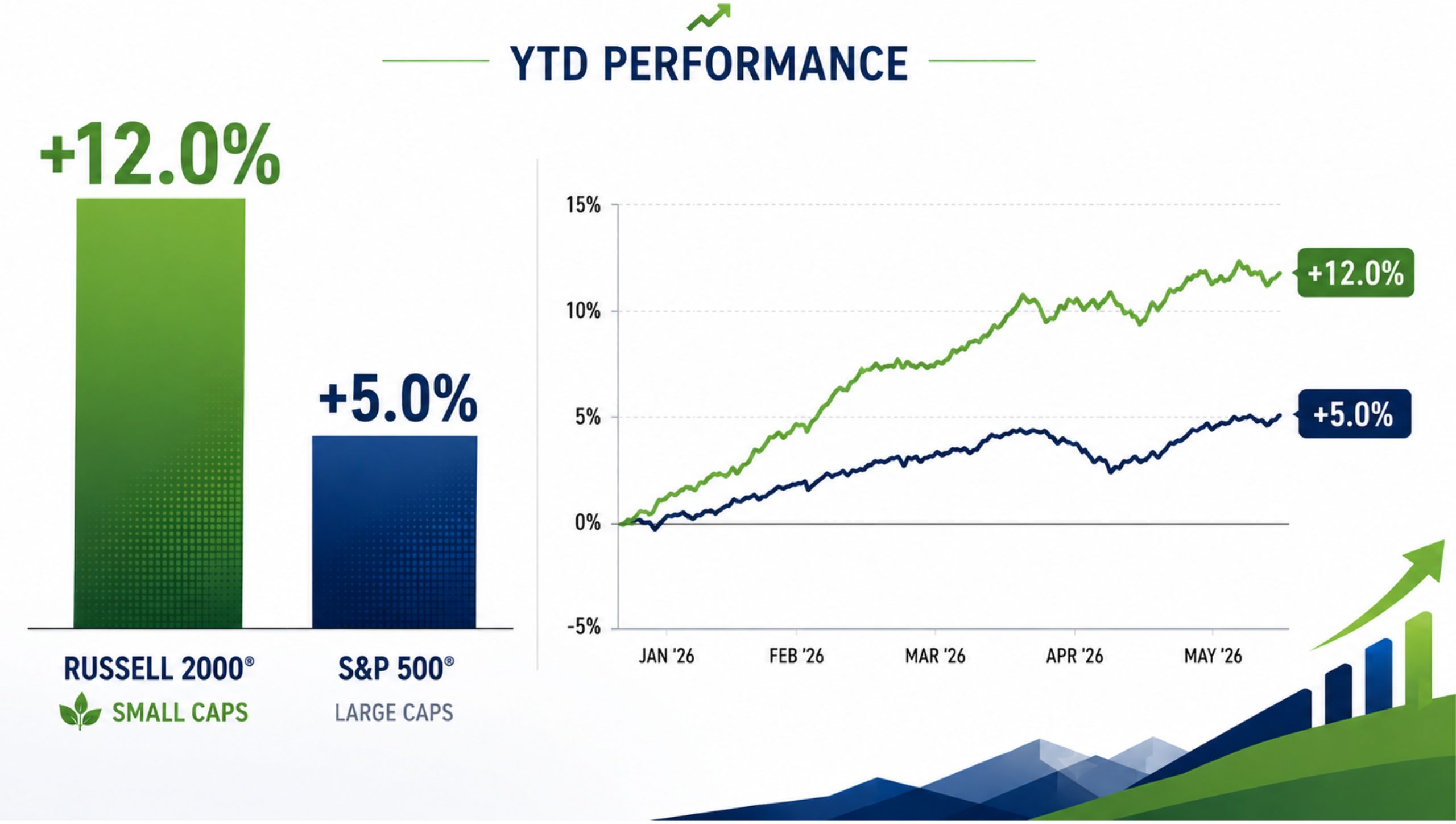
The Russell 2000 is up approximately 12% year-to-date, more than double the S&P 500’s roughly 5% gain over the same period. That gap isn’t noise — it reflects a meaningful structural shift in where capital is flowing and why.

The earnings picture is the starting point. Small-cap companies are projected to deliver 18% to 22% earnings growth for the full year in 2026, compared to roughly 13% for large caps. Analyst forecasts extend that outperformance into 2027 as well, with another 17–18% growth expected — suggesting this isn’t a one-quarter anomaly but the early stage of a sustained cycle.

The valuation argument reinforces the case. The S&P 500 currently trades near 28 times earnings. The Russell 2000 trades around 18 times. The S&P 600 — widely considered the higher-quality small-cap benchmark — sits near 16 times forward earnings. That’s a discount of roughly 40% to large caps. Historically, gaps of that magnitude don’t persist; they close, and when they do, small-cap investors collect outsized returns.

The macro setup has been equally supportive. The Federal Reserve’s rate-cutting cycle throughout 2025, which brought the federal funds rate to the 3.50%–3.75% range, disproportionately benefited smaller companies that carry more floating-rate debt. As interest expense declined, margins expanded — and earnings started to catch up to valuations.

M&A activity is amplifying the opportunity. U.S. transaction volume for deals over $100 million is up 25% by deal count and 43% by value in early 2026, with private equity firms deploying capital after years of sitting on record dry powder. For small-cap shareholders, that dealmaking environment creates a meaningful premium opportunity — acquisitions of quality small-cap targets at 30–40% premiums are not uncommon in the current environment.

Domestic revenue exposure is adding another layer of appeal. In an environment where tariff uncertainty and global supply chain risk remain real considerations, companies with predominantly U.S.-focused revenue streams are commanding renewed investor attention. Many small and microcap companies fit that profile by nature.

None of this means every small-cap stock is a buy. The rotation is rewarding companies with strong balance sheets, reliable cash flow, and a defensible market position. Those carrying excessive debt or lacking a clear path to profitability are being bypassed. The quality filter is real.

But for investors who track the small and microcap space — the roughly $250 million to $2 billion market cap range where institutional coverage is thin and price discovery is still happening — the current setup represents one of the more compelling opportunities in recent memory. The window doesn’t stay open indefinitely.

Small Caps Surge 3% as Iran Talks Spark One of the Market’s Best Single-Day Reversals

The small-cap market opened Monday in the crosshairs of a global selloff, only to stage one of its most dramatic single-session recoveries in recent memory — all within the span of a few hours. The whipsaw move underscores just how vulnerable smaller, domestic-focused companies have become to the escalating conflict in the Middle East, and how quickly sentiment can shift on a presidential comment.

Going into this week, the Russell 2000 — the primary benchmark for small-cap equities — had already shed more than 7% in March alone, entering official correction territory last Friday with a decline exceeding 10% from its recent peak. The index, which had started the year as a market leader riding optimism around rate cuts and a rotation away from mega-cap tech, has now given back virtually all of those gains. As of last Thursday, the index’s year-to-date return had collapsed to less than 1%.

The catalyst for the unraveling has been the ongoing U.S.-Israel conflict with Iran. Since military operations began, Brent crude futures surged more than 40%, briefly touching $119 per barrel before pulling back. The ripple effects have been severe for small caps specifically. Unlike large-cap multinationals with diversified revenue streams and investment-grade credit, smaller companies are more exposed to rising input costs, tighter credit markets, and slowing consumer demand — the exact cocktail that an oil shock delivers.

The pain goes deeper than sentiment. Analysts now estimate that between 41% and 46% of Russell 2000 companies are unable to cover their interest expenses with operating income. These so-called zombie companies face a $368 billion debt maturity wall in 2026, and with the 10-year Treasury yield spiking to 4.38% by Friday — up sharply from the mid-3% range at the start of the year — refinancing that debt is significantly more expensive. The Federal Reserve’s decision to hold rates steady at 3.50%–3.75% at its March 18th meeting, while revising its inflation outlook upward, effectively removed any near-term cushion the market was counting on.

Then came Monday’s reversal.

Overnight, global markets were in freefall. South Korea’s KOSPI dropped over 6%, Japan’s Nikkei fell more than 3%, and European equities opened deep in the red. U.S. futures pointed to a fifth consecutive down week for American stocks. But within the first hour of trading, the picture changed completely. President Trump signaled he was postponing threatened strikes on Iranian power infrastructure, citing productive negotiations. Brent crude fell more than 10% on the news. U.S. equities surged, with the Russell 2000 climbing more than 3% intraday — one of the index’s strongest single-day moves of the year — reclaiming the 2,500 level.

For small-cap investors, this session captures exactly what makes the asset class both compelling and treacherous. Bank of America has noted that while the Russell 2000 tends to sell off more sharply than large caps in risk-off environments, it also tends to recover faster — historically outpacing large caps by more than a percentage point within three months of a geopolitical shock.

The Iran situation is far from resolved. But today’s action is a reminder that in small caps, the most dangerous moments often precede the most significant opportunities.

Why Elevated U.S. Tariffs Are Becoming a Long-Term Reality — and What It Means for Small-Cap Stocks

U.S. tariff policy has undergone a dramatic transformation in 2025, reshaping the economic backdrop that investors will carry into the new year. Average tariff rates that once hovered near historic lows have surged above 15%, marking one of the sharpest shifts toward protectionism in decades. As 2026 approaches, market analysts widely expect these levels to remain largely intact, creating a new operating environment for companies—especially small-cap firms that are more sensitive to input costs and domestic demand.

Policy expectations across Wall Street suggest that the current tariff framework is no longer temporary. Multiple economic models now assume an average tariff rate near 15% through at least the first half of 2026. While limited exemptions may be granted on select goods, few observers see a broad rollback on the horizon. The implication is that businesses, investors, and consumers must adjust to tariffs as a structural feature of the U.S. economy rather than a short-term negotiating tactic.

Legal challenges to the administration’s authority to impose sweeping tariffs could introduce volatility, but most experts believe these efforts will not materially change the outcome. Even if courts restrict certain tariff powers, alternative statutory tools remain available to maintain similar rate levels. For markets, this means that any legal disruption is likely to be brief and tactical, not transformational.

Political incentives further reinforce the durability of current tariff policy. Trade protection has become a cornerstone of the administration’s broader economic agenda, tied to reshoring manufacturing, strengthening supply chains, and generating government revenue. Tariff collections in 2025 have already reached historically high levels, strengthening the case for maintaining the policy despite concerns over rising costs.

For small-cap companies, the persistence of elevated tariffs presents a mixed picture. On one hand, firms that rely heavily on imported inputs face margin pressure as higher costs work their way through supply chains. Many companies were able to temporarily cushion the impact by building inventory ahead of tariff increases, but those buffers are now thinning. As restocking occurs at higher tariff rates, pricing decisions will become more difficult—particularly for smaller businesses with limited pricing power.

On the other hand, small-cap stocks with domestic production, localized supply chains, or exposure to U.S. manufacturing could benefit from a more protected competitive landscape. Tariffs may reduce foreign competition in certain sectors, allowing domestic players to capture market share or stabilize pricing. For investors focused on small caps, this dynamic makes sector selection increasingly important.

Looking ahead, 2026 is shaping up to be the year when the economic consequences of tariffs become more visible. While some easing could occur around politically sensitive consumer goods, analysts do not expect a meaningful decline in overall rates. Instead, the emphasis is likely to shift toward managing the downstream effects on inflation, corporate earnings, and consumer spending.

For small-cap investors, clarity may be the most valuable takeaway. With tariff policy appearing set for the foreseeable future, markets can move past speculation and focus on fundamentals. Companies that adapt efficiently—by reshoring production, renegotiating supplier contracts, or passing through costs strategically—may emerge stronger. In a higher-tariff world, resilience and adaptability could become defining traits of the next generation of small-cap winners.

Can Warren Buffett’s Investment Style Be Applied to Small-Cap Stocks?

Warren Buffett’s name is synonymous with long-term, value-based investing. His classic strategy — identifying quality companies with durable advantages and buying them at fair prices — has stood the test of time. But can this approach be adapted to today’s small-cap investing landscape?

The answer is yes — but with important modifications.

What Buffett’s Style Is All About

Buffett’s investment principles, especially in his early career, revolved around:

  • Buying high-quality businesses at undervalued or fair prices
  • Focusing on companies with strong returns on capital
  • Identifying durable competitive advantages (or “moats”)
  • Prioritizing capable and ethical management
  • Holding for the long term to allow value to compound

These timeless ideas can work well with small-cap companies — in fact, Buffett himself built much of his early wealth in this space.

Why Small-Caps Offer Unique Opportunities

Small-cap stocks are often overlooked and underfollowed by analysts, creating inefficiencies that patient, disciplined investors can exploit. Many of these companies operate in niche markets and still have room to grow, which means they may offer significantly higher upside potential than their large-cap counterparts.

What’s more, investors often have more direct access to management in small-caps, which enhances due diligence and helps gauge leadership quality — something Buffett emphasized early in his career.

But There Are Risks

Applying Buffett’s approach to small-caps also comes with new challenges:

  • Higher volatility: Small-caps are more sensitive to economic swings.
  • Weaker moats: Many are still building their competitive edge.
  • Limited financial history: Often, small-caps don’t have years of consistent performance to analyze.
  • Liquidity issues: Thin trading volumes can make it harder to enter or exit positions efficiently.

How to Adapt Buffett’s Style for Small-Cap Investing

To use Buffett’s playbook in the small-cap space, investors must tailor their approach:

  • Focus on management quality: In small companies, the CEO often is the business. Their vision and execution ability can make or break your investment.
  • Use a longer time horizon: Value in small-caps often takes time to be realized. Impatient investors are likely to miss out.
  • Demand a margin of safety: Given the risks, buying well below intrinsic value is essential.
  • Look for early moats: These might not be fully formed yet, but signs of customer loyalty, unique positioning, or intellectual property are promising indicators.
  • Stick to your circle of competence: Understanding the business and industry is even more critical when the data is sparse.

Final Thought

Buffett’s philosophy isn’t limited to blue-chip giants. In fact, it may shine brightest where the market is least efficient. The key to applying his principles to small-caps lies in disciplined research, patience, and a sharp eye for leadership. If you’re willing to do the work, small-cap investing — Buffett-style — can be a powerful path to wealth.

Bond Market Surge Jolts Wall Street, But Small-Caps Could Find Upside Amid the Turbulence

Key Points:
– Bond yields spiked sharply this week, raising concerns about higher borrowing costs for small-cap companies.
– Small-caps are more rate-sensitive, but the sell-off may be overdone and could present buying opportunities.
– Long-term investors may benefit from focusing on quality small-cap names with strong fundamentals and domestic exposure.

A dramatic spike in long-term bond yields shook financial markets this week, sending investors scrambling as the 10-year Treasury yield soared past 4.5%, marking its biggest weekly surge since 2021. The 30-year yield rose even more sharply, posting its largest weekly gain since 1982. The sell-off was driven by a mix of sticky inflation, trade policy uncertainty, and a volatile geopolitical landscape — all amplified by President Trump’s ongoing tariff saga.

Yet while the headlines have centered on fear, especially around rising borrowing costs and global capital flows, there’s more nuance in the story for small-cap stocks.

It’s true that small-caps are uniquely exposed to changes in financial conditions. Many of these companies carry floating-rate debt and operate on thinner margins, making them more vulnerable to interest rate shocks. As bond yields rise, funding gets more expensive — and for firms that rely on access to capital markets, that’s a real pressure point.

But it’s also true that small-caps tend to be early-cycle performers. Historically, when markets reprice aggressively like this, they often overshoot. And while volatility can punish smaller names in the short term, it also tends to present opportunity — especially for companies with solid fundamentals and nimble management teams that can adapt quickly to shifting economic conditions.

The Russell 2000, the primary small-cap index, has already fallen more than 20% from its November highs, technically entering a bear market. But that also means much of the negative sentiment may already be priced in — a potential setup for a bounce once bond markets stabilize and investor focus shifts back to fundamentals.

Additionally, while the bond market’s sharp move has understandably rattled equity investors, some of the pressure may prove temporary. If the Federal Reserve sees the spike in yields as overdone — or if inflation data continues to soften — rate cuts could be back on the table. Futures markets are still pricing in up to four cuts by year-end, which could ease financial conditions and provide meaningful support to small-cap valuations.

For long-term investors, this is a time to stay alert but not panicked. Small-cap stocks still represent some of the most innovative and growth-oriented businesses in the U.S. economy. Many are domestically focused, potentially shielding them from global trade disruptions, and offer exposure to sectors — like biotech, software, and manufacturing — that could benefit as the policy environment evolves.

The current environment is undoubtedly challenging, but small-caps have weathered worse and bounced back stronger. If volatility persists, it could open the door to selectively adding quality small-cap names at compelling valuations.

Understanding Stock Buybacks: A Strategic Tool for Small Cap Companies in Today’s Market

Key Points:
– Stock buybacks are a powerful tool for small cap companies to boost shareholder value, signal confidence, and optimize capital allocation—especially in today’s cautious market environment.
– Buybacks offer flexibility compared to dividends and can help correct market undervaluation by improving earnings per share (EPS) and supporting the stock price.
– Noble Capital Markets’ trading desk provides specialized, compliant, and strategic execution of buyback programs tailored to small and microcap companies.

In today’s volatile and uncertain market environment, many small and microcap companies are turning to stock buybacks as a strategic lever to enhance shareholder value. While often associated with large-cap firms, stock repurchase programs are increasingly being utilized by emerging growth companies as a way to signal confidence, support their stock price, and optimize capital allocation.

So, what exactly is a stock buyback? Simply put, a buyback occurs when a company repurchases its own shares from the open market. These repurchased shares are either retired or held as treasury stock, effectively reducing the total number of shares outstanding. This reduction in share count can lead to higher earnings per share (EPS) and, in many cases, a stronger stock price performance over time.

For small cap companies, this strategy can be especially impactful. Many of these firms trade at valuations that don’t reflect their underlying fundamentals, often due to limited analyst coverage or lack of investor awareness. A well-timed and well-executed buyback program can help correct this disconnect by demonstrating to the market that the company believes its shares are undervalued. Moreover, it signals financial discipline and a commitment to returning value to shareholders.

In the current climate—marked by inflationary pressures, tighter capital markets, and cautious investor sentiment—stock buybacks can also offer an attractive alternative to dividends. Unlike dividends, which establish an expectation for recurring payouts, buybacks provide flexibility. Companies can scale buybacks based on available cash flow without committing to long-term distributions.

However, executing a buyback program, especially for smaller public companies, requires careful planning and compliance with regulatory frameworks such as Rule 10b-18 under the Securities Exchange Act of 1934. This is where the expertise of an experienced trading desk becomes essential.

Noble Capital Markets’ trading desk specializes in supporting small and microcap companies with customized buyback solutions. With decades of experience and deep market insight, Noble helps companies structure and implement repurchase programs that are efficient, compliant, and aligned with strategic objectives. From navigating trading volume restrictions to maintaining anonymity in the market, Noble’s trading professionals act as an extension of a company’s finance team, ensuring each transaction is executed with precision and discretion.

Noble’s focus on the emerging growth space makes them uniquely positioned to understand the challenges and opportunities facing smaller public companies. Their trading desk doesn’t just facilitate transactions—they provide strategic guidance on timing, liquidity management, and market perception. For companies considering a buyback, having a trusted partner like Noble Capital Markets can make all the difference in achieving desired outcomes.

Stock buybacks are more than just a capital return mechanism—they’re a signal of strength, confidence, and long-term vision. For small cap companies looking to enhance shareholder value in a complex market, partnering with an experienced trading desk like Noble’s is a smart and strategic move.

Are Small-Caps Oversold? Why Now Might Be the Time to Start Your Shopping List

The current market sentiment is one of extreme fear, with widespread selling across many small-cap stocks, especially those in the Russell 2000 index. A variety of factors, including tariffs and broader market uncertainty, have led to this wholesale selling, and as a result, many fundamentally strong small companies are being punished. However, for those willing to take a closer look, this fear-induced market drop may present some excellent investment opportunities.

On Friday, the Russell 2000 was down 27%, a sharp decline that reflects how smaller companies, particularly those in this index, are feeling the brunt of the market’s volatility. The Russell 2000 is made up of small-cap companies, which are inherently more volatile and have less liquidity than larger companies. As a result, they tend to experience more extreme price swings in response to broader market movements. This has created a situation where many small-cap stocks are now trading at huge discounts.

Take, for example, FreightCar America (RAIL). Just last December, this stock was trading at around $14. Now, it’s hovering around $4.50. Despite the severe decline, this is a stock that is fundamentally sound. The company is exempt from tariffs, has improved its financials with a successful refinancing deal in December, and has a solid business model. Yet, the stock continues to trade lower because of the broader market selloff affecting the Russell 2000 ETF. This creates a disconnect between the company’s true value and its current price.

Similarly, Graham (GHM), a defense manufacturer, was trading at $52 just a few months ago. Today, it’s at $27, representing a 50% discount on a fundamentally strong company. The Trump administration’s push to build more ships should actually work in Graham’s favor, making this steep decline even more perplexing. The fear in the market has led to excessive selling, but for long-term investors, this represents a buying opportunity.

And then there’s Eledon Pharmaceuticals (ELDN), a biopharmaceutical company whose stock has dropped from $5.50 to $2.80. This is a company with improving fundamentals, particularly positive patient data, yet the stock price has fallen sharply. This disconnect between price and performance highlights how the selloff has been more about broader market panic than about the company’s intrinsic value.

The bottom line is that there are real bargains out there in small-cap stocks for individual investors who are willing to look past the short-term fear. The Russell 2000 index has been hit harder than other indexes due to the smaller size and lower liquidity of the companies involved. As a result, the impact of impulsive, panic-driven selling is more pronounced in this index than in the larger ones.

For investors with staying power, particularly those with a 2-3 year horizon, the current market turmoil presents a significant opportunity. Many of these companies, which are being unfairly dragged down by the broader market, have strong fundamentals and the potential to rebound once market sentiment stabilizes. As the market continues to digest these challenges, patient investors may see significant returns as these companies recover and grow.

Russell 2000 Enters Bear Market as Tariffs and Economic Fears Weigh on Small Caps

Key Points:
– The Russell 2000 has officially entered a bear market, dropping over 20% from its record high.
– New tariffs and economic uncertainty have triggered a sell-off in small-cap stocks.
– The Federal Reserve’s interest rate decisions and economic conditions will be crucial for potential recovery.

The Russell 2000, a key benchmark for small-cap stocks, officially entered bear market territory on Thursday, marking a significant downturn in U.S. equities. The index has plummeted over 20% from its record high in late November 2024, making it the first major U.S. stock measure to reach this threshold. The sell-off was fueled by ongoing economic uncertainty, aggressive new tariffs introduced by the Trump administration, and rising concerns over an economic slowdown.

Following President Donald Trump’s latest tariff announcement, financial markets were hit with fresh waves of volatility. The sweeping trade measures, which raised tariffs on key trading partners, have rattled investors, particularly in small-cap stocks that rely more heavily on domestic revenues and supply chains. The Russell 2000 fell nearly 6% on Thursday alone, accelerating its decline into bear market territory.

Historically, small-cap stocks have been seen as beneficiaries of pro-business policies, including deregulation and tax cuts. However, the new tariffs have increased uncertainty, particularly for companies that depend on imported goods and materials. This has led to a sharp drop in stock values, with retail and manufacturing firms taking the brunt of the sell-off.

Another factor contributing to the downturn is the growing concern over a slowing economy. Analysts warn that higher tariffs could dampen consumer spending and business investment, leading to weaker earnings growth across multiple sectors. Small-cap companies, which typically have higher debt levels and less financial flexibility than large-cap counterparts, are particularly vulnerable in times of economic stress.

The Federal Reserve’s interest rate policy is also playing a role. Traders are anticipating potential rate cuts later in the year, with speculation that the Fed could step in if economic conditions worsen. Lower interest rates could provide some relief to small businesses, making borrowing costs more manageable, but the overall market sentiment remains bearish in the near term.

While small caps have suffered sharp losses, some analysts believe a turnaround could be on the horizon. Historically, small-cap stocks tend to outperform when economic conditions stabilize and interest rates decline. If the Federal Reserve implements rate cuts and trade tensions ease, investors may find new opportunities in the Russell 2000.

For now, however, volatility remains high, and concerns over tariffs, economic growth, and corporate earnings continue to weigh on investor sentiment. The broader market, including the S&P 500 and Nasdaq Composite, has also faced steep declines, though neither index has yet reached bear market territory.

As traders look ahead, the next few months will be critical in determining whether small-cap stocks can recover or if further losses are on the horizon. The direction of trade policy, Federal Reserve decisions, and economic data will play key roles in shaping market performance through the rest of 2025.

The Power of Patient Investing: Small Caps, Big Returns

Key Points:
– Patient small cap investors view market downturns as chances to acquire quality businesses at discounted prices.
– Thorough analysis of small cap companies can uncover exceptional businesses with strong fundamentals before they attract mainstream attention.
– The greatest advantage in small cap investing comes from maintaining conviction during periods of underperformance that drive away less patient investors.

In a market often dominated by mega-cap tech stocks and headline-grabbing trends, small cap investing remains a powerful avenue for those willing to embrace patience as their primary strategy. While these smaller companies may lack the immediate name recognition of their larger counterparts, they offer distinct advantages to investors who can weather short-term volatility in pursuit of long-term gains.

The Virtue of Patience in Small Cap Investing

The true edge in small cap investing isn’t found in rapid trading or timing market swings—it’s discovered through patient capital deployment and a steadfast focus on fundamentals. Small cap stocks, typically defined as companies with market capitalizations between $300 million and $2 billion, often experience greater price volatility than large caps. This volatility, rather than representing inherent risk, actually creates opportunities for patient investors.

When market sentiment shifts and institutional investors flee to perceived safety, small caps frequently bear the brunt of the selling pressure. This creates temporary dislocations between price and value that patient investors can explore. While others panic during downturns, disciplined small cap investors recognize these moments as rare opportunities to acquire ownership in quality businesses at discounted prices.

Filtering the Noise to Find Value

Today’s financial ecosystem bombards investors with constant commentary, predictions, and “expert” opinions. Patient small cap investors develop the crucial skill of filtering this noise to identify genuine value. They understand that short-term price movements often reflect temporary factors rather than fundamental business changes.

The ability to separate market noise from meaningful information allows these investors to maintain conviction in their small cap holdings through inevitable periods of underperformance. They recognize that small companies need time to execute their business plans, expand their market presence, and ultimately deliver value to shareholders.

The Power of Thorough Equity Research

In the small cap universe, thorough equity research becomes an invaluable competitive advantage. While large caps are constantly scrutinized by hundreds of analysts, dedicated research into smaller companies can uncover hidden gems before they appear on the institutional radar. Patient investors who commit to comprehensive due diligence often identify promising businesses with robust fundamentals that remain undervalued.

This research advantage becomes especially powerful when investors develop expertise in specific sectors or industries. By understanding the competitive landscape, technological trends, and regulatory environments that shape small cap businesses, patient investors can accurately assess both risks and growth catalysts that casual market participants might miss. This deep research foundation also provides the conviction necessary to hold positions through inevitable market fluctuations.

Embracing the Long View

The most successful small cap investors share a common trait: they evaluate investments through a multi-year lens rather than quarterly results. They understand that compound growth in small businesses can eventually translate into extraordinary investment returns. A company growing earnings at 15-20% annually will double its profits approximately every four years—a powerful driver of long-term stock performance that patient investors can capture.

The Psychological Challenge

Perhaps the greatest challenge in small cap investing isn’t analytical but psychological. It requires the fortitude to remain invested when markets turn negative, when positions move against you, and when the temptation to chase better-performing assets becomes strongest. Patient investors understand that their edge comes precisely from accepting short-term discomfort that others refuse to endure.

For those willing to cultivate patience, small cap investing continues to offer one of the most compelling risk-reward propositions in public markets. By focusing on long-term business value rather than short-term price fluctuations, investors can position themselves to achieve returns that make the occasional storms worth weathering.

Small-Cap Surge: Why the Russell 2000 Is Leading the Post-Election Market Rally

In the weeks following the U.S. elections, a clear market leader has emerged: the Russell 2000. This index of small-cap stocks has outpaced major benchmarks such as the S&P 500, Dow Jones, and Nasdaq, signaling a rotation in investor sentiment toward higher growth opportunities. As investors search for areas with the most potential, small-cap stocks are standing out as a prime destination for future growth.

Since November 6, the Russell 2000 has demonstrated a significant recovery, outpacing its larger-cap peers by a notable margin. Historically, small-cap stocks have been among the biggest beneficiaries of economic optimism, thanks to their reliance on U.S. domestic growth and their ability to adapt to changing market conditions.

IndexPerformance (Nov 6 – Nov 29)
Russell 2000 (RTY)+12.5%
S&P 500 (SPX)+6.8%
Dow Jones (INDU)+7.2%
Nasdaq Composite (CCMP)+5.9%

Why Investors Are Turning to Small Caps

Small-cap stocks are poised for the most growth in the current market environment. Here’s why they’re becoming a key focus for investors:

  1. Explosive Growth Potential: Smaller companies typically have more room to expand, making them attractive to investors seeking high returns during periods of economic recovery.
  2. Policy Favorability: Market participants are betting on pro-business policies, which are expected to stimulate domestic-focused companies.
  3. Valuation Advantages: After years of underperformance compared to large-cap tech stocks, many small-cap stocks are trading at attractive valuations, creating opportunities for long-term gains.
  4. Sector Diversity: The Russell 2000 spans a variety of sectors, including financials, energy, and consumer services, which are positioned to benefit from economic resilience.

The outperformance of the Russell 2000 reflects a broader trend: small caps are not only catching up but are also laying the groundwork for sustained growth. With the U.S. economy showing signs of stabilization and a renewed focus on innovation and entrepreneurship, small-cap stocks offer investors a rare chance to capitalize on their agility and growth prospects.

For investors looking to explore the potential of small-cap stocks and connect with the companies leading this charge, Noble Capital Markets is hosting its flagship event, NobleCon20, this week.

Starting tomorrow, December 2, NobleCon20 will bring together industry leaders, small-cap innovators, and investors for a one-of-a-kind event. Held over three days, the conference will feature:

  • Live Panels: Including a must-see AI panel headlined by Zack Kass, who will delve into cutting-edge advancements in artificial intelligence and their impact on markets.
  • A Shark Tank Experience: A live pitch competition judged by the ‘Sharks,’ offering insight into innovative small-cap ventures.
  • Networking Opportunities: Connect with executives, investors, and thought leaders from a range of industries.

Whether you’re a seasoned investor or just starting to diversify your portfolio, NobleCon20 provides an invaluable opportunity to gain insights into small-cap growth stories and identify market-leading opportunities.

Registration is still open for NobleCon20, and attendance is free for qualified investors. Don’t miss your chance to engage with small-cap executives and industry professionals who are shaping the future of the market.

Register now at NobleCon20.com to secure your spot at the premier small-cap event of the year.

As the Russell 2000’s recent performance demonstrates, small caps are positioned for growth in the current economic and market landscape. Investors looking to capitalize on this momentum should pay attention to the opportunities in this space.

With NobleCon20 starting tomorrow, now is the perfect time to immerse yourself in the small-cap story and discover the companies driving innovation and expansion. Join us and take the first step toward seizing the opportunities in this exciting segment of the market.