The Numbers Don’t Lie: Small Caps Are Outrunning the S&P 500 — and the Institutional Money Is Finally Catching Up

For years, the story of the U.S. equity market was written by a handful of mega-cap technology names. That story is being rewritten in 2026, and small-cap investors are the ones holding the pen.

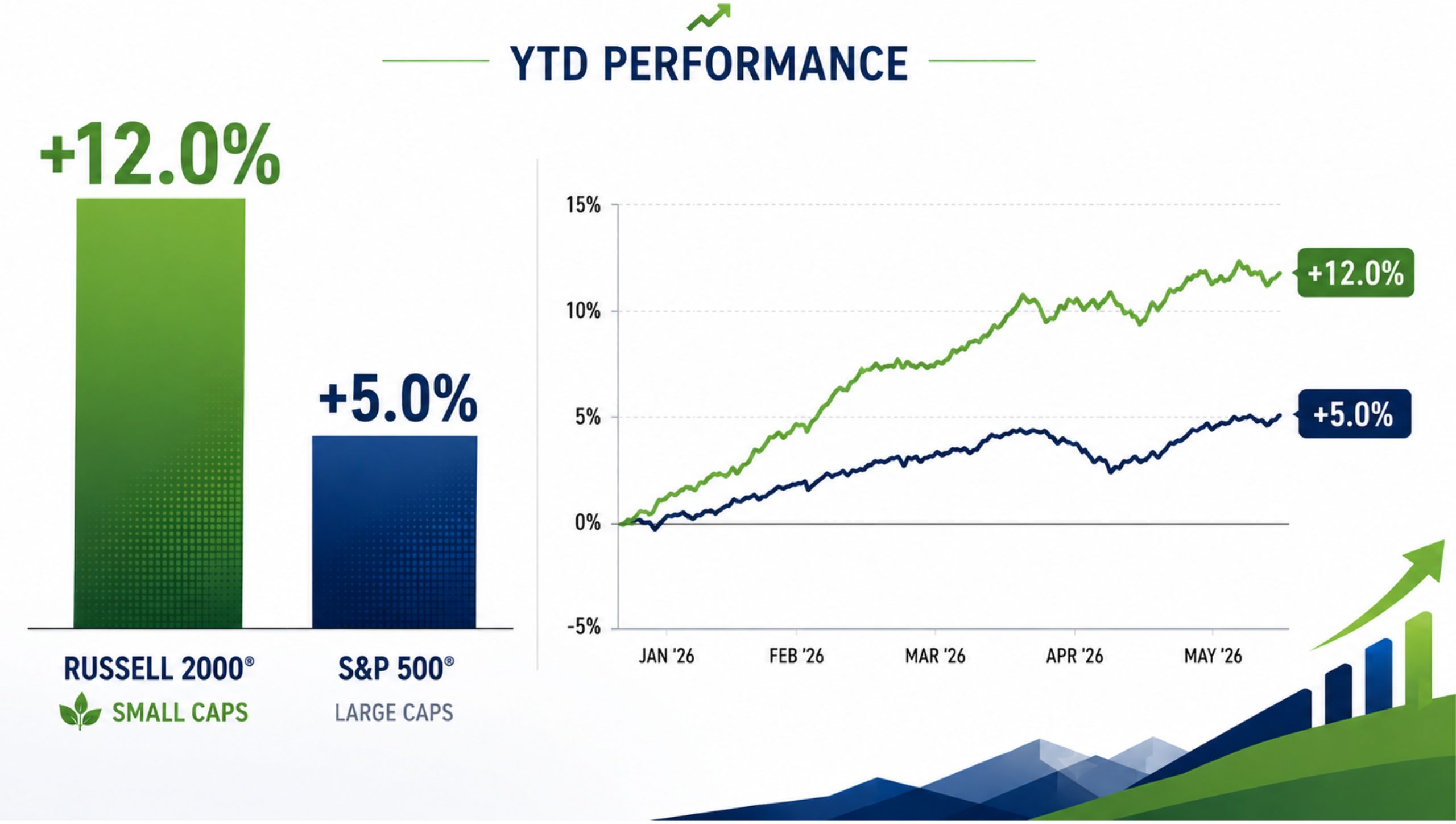
The Russell 2000 is up approximately 12% year-to-date, more than double the S&P 500’s roughly 5% gain over the same period. That gap isn’t noise — it reflects a meaningful structural shift in where capital is flowing and why.

The earnings picture is the starting point. Small-cap companies are projected to deliver 18% to 22% earnings growth for the full year in 2026, compared to roughly 13% for large caps. Analyst forecasts extend that outperformance into 2027 as well, with another 17–18% growth expected — suggesting this isn’t a one-quarter anomaly but the early stage of a sustained cycle.

The valuation argument reinforces the case. The S&P 500 currently trades near 28 times earnings. The Russell 2000 trades around 18 times. The S&P 600 — widely considered the higher-quality small-cap benchmark — sits near 16 times forward earnings. That’s a discount of roughly 40% to large caps. Historically, gaps of that magnitude don’t persist; they close, and when they do, small-cap investors collect outsized returns.

The macro setup has been equally supportive. The Federal Reserve’s rate-cutting cycle throughout 2025, which brought the federal funds rate to the 3.50%–3.75% range, disproportionately benefited smaller companies that carry more floating-rate debt. As interest expense declined, margins expanded — and earnings started to catch up to valuations.

M&A activity is amplifying the opportunity. U.S. transaction volume for deals over $100 million is up 25% by deal count and 43% by value in early 2026, with private equity firms deploying capital after years of sitting on record dry powder. For small-cap shareholders, that dealmaking environment creates a meaningful premium opportunity — acquisitions of quality small-cap targets at 30–40% premiums are not uncommon in the current environment.

Domestic revenue exposure is adding another layer of appeal. In an environment where tariff uncertainty and global supply chain risk remain real considerations, companies with predominantly U.S.-focused revenue streams are commanding renewed investor attention. Many small and microcap companies fit that profile by nature.

None of this means every small-cap stock is a buy. The rotation is rewarding companies with strong balance sheets, reliable cash flow, and a defensible market position. Those carrying excessive debt or lacking a clear path to profitability are being bypassed. The quality filter is real.

But for investors who track the small and microcap space — the roughly $250 million to $2 billion market cap range where institutional coverage is thin and price discovery is still happening — the current setup represents one of the more compelling opportunities in recent memory. The window doesn’t stay open indefinitely.


Stock Market Today: S&P 500 Sets New 2025 Record as Wall Street Extends Winning Streak

U.S. stocks closed higher on Tuesday, pushing the S&P 500 to a fresh all-time high and extending Wall Street’s winning streak to four consecutive sessions, as investors looked past stronger-than-expected economic data and adjusted expectations around interest rate cuts.

The S&P 500 rose 0.46% to a record close of 6,909.79, marking its latest milestone in 2025. The tech-heavy Nasdaq Composite added 0.57%, while the Dow Jones Industrial Average gained a more modest 0.16%. The steady advance comes as equities rebound from recent volatility, with markets finding renewed momentum heading into the final trading days before the Christmas holiday.

Tuesday’s rally unfolded despite data showing the U.S. economy grew at a surprisingly robust pace over the summer. According to the first read on third-quarter gross domestic product, the economy expanded at a 4.3% annualized rate—well above the 3.3% economists had expected. The report, delayed earlier by government shutdown disruptions, also highlighted resilient consumer spending, reinforcing the view that economic activity remains strong even as borrowing costs stay elevated.

That strength prompted traders to dial back expectations for near-term interest rate cuts. Markets are now pricing in more than an 85% probability that the Federal Reserve will leave rates unchanged at its January meeting, up from roughly 75% just a week ago. While investors still anticipate two rate cuts by the end of next year, the timing appears less certain as economic data continues to show resilience.

Adding nuance to the outlook, December consumer confidence data from the Conference Board showed sentiment falling for a fifth straight month. The decline underscores a disconnect between hard economic data and consumer perceptions, suggesting households remain uneasy about inflation, interest rates, and the broader cost of living despite strong growth figures.

Beyond equities, commodities were a major highlight. Gold and silver prices continued their powerful rally, putting both precious metals on track for their strongest annual performance in more than 40 years. Copper also surged to a new record above $12,000 per ton, reflecting ongoing demand tied to infrastructure spending, electrification, and global supply constraints.

Corporate news added to the bullish tone. Shares of Novo Nordisk jumped after the Danish pharmaceutical giant received official U.S. approval to market its Wegovy weight-loss drug, reinforcing investor enthusiasm around the booming obesity treatment market. In the technology sector, megacap names led gains, with semiconductor stocks climbing and artificial intelligence heavyweight Nvidia helping lift the broader Nasdaq. Alphabet shares also advanced, contributing to the tech sector’s leadership.

Looking ahead, trading volumes are expected to thin as markets head into the holiday break. U.S. stock markets will close early on Wednesday and remain shut on Thursday for Christmas. Still, with the S&P 500 at record highs and investor optimism returning, attention is turning to whether a traditional “Santa Claus rally” could carry stocks into the new year, even as questions around interest rates and economic momentum remain firmly in focus.

New Highs Across Markets Signal Bull Run For Investors

The stock market is heating up and signaling the return of the bulls, as evidenced by fresh all-time highs in the S&P 500 and a rally across risk assets like Bitcoin and gold. Fueled by booming innovation in artificial intelligence, speculative capital is flowing back into equities in a big way. For investors, it may be time to go hunting for the next big investments.

The S&P 500 broke out to new records this week, finally surpassing the previous highs set back in January 2022 before last year’s punishing bear market. The large-cap index closed at 5233 on Thursday, up over 28% year-to-date. This demonstrates that the decade-plus bull run that began after the 2008 financial crisis may have refreshed legs under it.

The strength comes as AI mania has gripped Wall Street and Main Street. The smash success of OpenAI’s ChatGPT triggered a cascade of investors plowing capital into AI startups and tech giants racing to deploy advanced language models and machine learning systems. Cathie Wood’s Ark Invest funds, which load up on disruptive innovation plays, have surged over 30% in 2023.

Even the traditionally cautious money managers are piling in. Just this week, e-commerce juggernaut Amazon announced a staggering $4 billion investment into AI research firm Anthropic. It shows the FANG giants remain at the vanguard of cutting-edge tech adoption and are more than willing to spend big to stay ahead of the curve.

The AI buzz has spurred a speculative frenzy not seen since the meme stock and SPAC manias of 2021. The heavy inflows, plus robust economic data, have pushed U.S. stock indexes to their most overbought levels since the rally out of the pandemic lows. Technical indicators suggest more volatility and pullbacks could be in store, but the trend remains firmly bullish for now.

The buying spree has spilled over into other risk assets like cryptocurrencies and gold. Bitcoin soared above $70,000 recently to its highest levels ever. The original crypto has rallied over 70% in 2023 as institutions warm back up to the space and the AI buzz rekindles visions of decentralized Web3 applications and business models.

Not to be outdone, gold has surpassed $2,200 per ounce and is trading at levels far greater than what was seen in 2020 during the pandemic turmoil. Bullion is benefiting from growing concerns over persistent inflation and fears the Federal Reserve could push the economy into recession as it keeps raising interest rates aggressively. The yellow metal is increasingly seen as a haven in times of economic and banking system stress.

Combined, the advancing prices and frothy trading action point to the return of the animal spirits last seen at the height of the Robinhood/Reddit meme stock craze from two years ago. Caution is certainly warranted, as downside risk remains with growing chances of an economic hard landing from the Fed’s inflation fight.

But the market often climbs a wall of worry, and the blowout action indicates speculators are back in full force. For investors able to navigate the volatility, this may be an ideal time to put capital to work and research the next big opportunities to ride the bull’s coattails.

As ARK’s Cathie Wood stated, “Given the breakthroughs in AI broadly, we believe we are living in the most profound period of commercial invention ever.” Profound invention tends to create extreme investment returns for those with the foresight to invest early in transformative technologies.

For investors searching for the potential 100-baggers of tomorrow across sectors like AI, quantum computing, biotech, fintech, and cybersecurity, buying dips and dollar-cost averaging into high-conviction positions could pay massive dividends down the road. The market mania may only be just beginning.