ICE Just Paid $6 Billion to Fix One of Finance’s Last Analog Corners

Intercontinental Exchange announced this morning it will acquire MarketAxess Holdings for $167 per share in cash, a 33% premium that values the fixed income trading platform at roughly $6 billion in equity value and $5.7 billion in total enterprise value. It’s a deal aimed squarely at a problem that has persisted through decades of financial market modernization: the bond market still trades like it’s 1995.

That is not an exaggeration. The global fixed income market carries an estimated $145.1 trillion in outstanding debt, dwarfing the equity markets in size, yet bond trading remains disproportionately manual, conducted bilaterally over phone calls and instant messages between dealers, with wide bid-ask spreads and limited price transparency. Stocks solved this problem years ago through centralized, electronic exchanges. Bonds never fully did, and that gap is exactly what ICE is paying to close.

MarketAxess brings the piece ICE has been missing. The platform connects roughly 2,100 institutional investors and broker-dealers across more than 90 countries, enabling electronic trading in corporate bonds, municipal debt, emerging market bonds, and U.S. Treasuries. ICE, meanwhile, has spent years building out the surrounding infrastructure, a retail and wealth-focused bond trading franchise, fixed income data and analytics, and a global index business, without ever owning the institutional execution network to tie it all together. ICE Chair and CEO Jeff Sprecher framed the deal as a continuation of a strategy the company has run for two decades: find the largest, least efficient corners of finance and rebuild them with better technology, the same playbook ICE has already applied to energy markets, credit default swaps, and mortgage technology.

The financial structure of the deal is worth noting for what it signals about ICE’s confidence in the combination. The transaction is being financed entirely in cash through newly issued debt, a mix of bonds, a term loan, and commercial paper, and ICE is simultaneously increasing its quarterly share repurchase baseline to $400 million from $350 million rather than pausing buybacks to conserve cash. The company expects the deal to be accretive to adjusted earnings per share in its first full year, with $100 million in annual run-rate cost synergies expected within three years. ICE’s gross leverage will begin at 3.4 times pro forma EBITDA, with a target of returning to 3.0 times or below within 18 to 24 months, a timeline that suggests management views the combined business as strongly cash generative even while absorbing new debt.

For a deal of this size in market infrastructure, the strategic logic is straightforward enough that it barely needs translation. Consolidated liquidity pools tend to produce tighter pricing and lower transaction costs for everyone trading on them, which is the same network effect that has driven exchange consolidation across asset classes for years. MarketAxess CEO Chris Concannon pointed to the complementary nature of the two businesses, MarketAxess brings the institutional trading network, ICE brings retail protocols, data, and connectivity, as the combination’s core rationale.

The deal still requires MarketAxess shareholder approval and customary regulatory clearances, with closing targeted for the first half of 2027. Boards at both companies have already approved it unanimously.

Grant Thornton Just Paid a 54% Premium to Buy CBIZ. It Is the Biggest Accounting Deal in 25 Years

Grant Thornton Advisors announced Wednesday it has entered into a definitive agreement to acquire CBIZ (NYSE: CBZ), a professional services firm listed on the New York Stock Exchange, in an all-cash transaction with an enterprise value of $5 billion. Under the terms of the deal, CBIZ shareholders will receive $55.00 per share, representing a 54% premium to the company’s 30-day volume-weighted average price and roughly an 18% premium to CBIZ’s most recent closing price. The transaction is described as the largest of its kind in more than 25 years.

The deal is backed by New Mountain Capital, which previously led a May 2024 investment in Grant Thornton Advisors and has now committed $5.2 billion in financing to support this acquisition as well. CBIZ’s board unanimously approved the transaction and is recommending shareholders vote in favor of it. Closing is targeted for the fourth quarter of 2026, subject to shareholder and regulatory approval.

A Genuine Industry Heavyweight

The combination reshapes the upper tier of the professional services industry. CBIZ currently ranks No. 8 on Accounting Today’s 2026 Top 100 Firms list with $2.8 billion in revenue, while Grant Thornton sits at No. 9 with $2.5 billion. Once combined, the merged firm is expected to become the fifth-largest professional services provider in the United States, generating more than $5 billion in domestic revenue and nearly $7.5 billion globally, operating across more than 20 countries with a workforce exceeding 34,500 professionals.

CBIZ President and CEO Jerry Grisko called it a historic combination with a strong cultural and strategic fit, framing the deal as one that creates new opportunity for employees while delivering significant value to shareholders.

What the Deal Is Actually Built Around

The stated strategic rationale centers on three areas: expanding Grant Thornton’s AI-enabled service delivery capabilities, growing its multinational footprint, and deepening industry specialization across both firms’ combined client base. As part of the restructuring, CBIZ’s Benefits and Insurance Services segment will be spun off as an independent, growth-oriented company, a signal that the combined entity intends to sharpen its focus on core advisory, tax, and accounting services rather than retain every existing business line.

The deal includes a go-shop period running through August 27, 2026, during which CBIZ may solicit superior competing proposals, alongside standard no-shop and termination provisions once that window closes. CBIZ’s board also adopted change-in-control severance, retention, and transaction bonus programs the same day the deal was announced, a customary step designed to retain key personnel through the transition.

The Numbers Behind the Timing

The announcement landed alongside CBIZ’s own second quarter results. For the first half of 2026, the company reported revenue of $1.53 billion, up modestly year over year, with net income rising 4.1% to $171.4 million and adjusted diluted earnings per share increasing 3.6% to $3.44. CBIZ also repurchased approximately 2.5 million shares for roughly $70 million during the period, while reducing net leverage to 3.4 times, down from the prior year.

Why This Matters Beyond Accounting

For investors tracking consolidation trends across professional and business services, this deal reinforces a pattern playing out broadly this year. Private equity-backed platforms are aggressively pursuing scale in fragmented service industries, betting that combining AI capability, specialized talent, and multinational reach creates durable competitive advantages that smaller, standalone firms increasingly struggle to match on their own.

Stripe and Advent Just Offered $53 Billion for PayPal

The biggest potential acquisition in fintech history is now on the table. Stripe, the privately held payments giant valued at $159 billion, and private equity firm Advent International have submitted a joint offer to acquire PayPal Holdings (Nasdaq: PYPL) for $60.50 per share in a deal valued at more than $53 billion. The offer represents a 28% premium to PayPal’s closing price on July 14 and is backed by approximately $50 billion in committed bank financing. PayPal shares surged roughly 18% on the news.

PayPal has not formally responded to the proposal. Stripe and Advent are reportedly pushing to advance discussions over the coming weeks. Under the terms of the offer, the two firms would share ownership of PayPal on an equal basis, with no plans to break up or dismantle the company.

How PayPal Got Here

The offer arrives at a moment of profound vulnerability for a company that once defined digital payments. At its 2021 peak, PayPal commanded a market capitalization of approximately $360 billion. By early 2026, that figure had fallen to as low as $36 billion, a decline of roughly 90% driven by years of slowing growth, intensifying competition from Apple Pay, Google Pay, and a new generation of embedded payment platforms, and repeated failed turnaround attempts that left investors skeptical of the company’s ability to reclaim relevance.

The current leadership team, led by new CEO Enrique Lores who replaced Alex Chriss earlier this year, has launched a restructuring built around a three-unit organizational model and announced plans to cut approximately 20% of the workforce, roughly 4,760 positions, as part of an effort to generate at least $1.5 billion in gross run-rate savings. The company’s full-year 2026 adjusted profit guidance calls for a low-single-digit percentage decline, a forecast that does not inspire confidence in a rapid recovery.

At roughly eight times projected 2026 earnings, PayPal trades at a multiple well below most of its fintech peers, a discounted valuation that has made it an increasingly obvious target for a strategic acquirer with the scale and resources to execute what current management has not been able to deliver.

Why Stripe Wants PayPal

Stripe has built a dominant position in merchant payments infrastructure, powering the backend payment processing for millions of businesses globally. What it lacks is a large-scale consumer payments brand. PayPal, despite its struggles, still maintains one of the most recognized consumer payment platforms in the world, with hundreds of millions of active accounts and deeply embedded relationships with both consumers and merchants across global e-commerce.

Combining the two would create a payments entity spanning both sides of the transaction, merchant infrastructure and consumer wallet, with combined processing volume that would rival any player in the industry. Both companies have also been prominent in bringing stablecoin capabilities onto traditional payment rails, positioning the combined entity at the intersection of legacy digital payments and next-generation blockchain-based settlement.

What It Signals for Smaller Fintech Companies

For investors tracking fintech companies in the small and microcap space, a $53 billion deal for PayPal sends an unmistakable signal about where consolidation pressure is headed. When the largest private payments company in the world moves to acquire the most recognizable consumer payments brand, the competitive dynamics for every smaller player in the ecosystem shift. Niche payment processors, vertical-specific fintech platforms, and emerging stablecoin infrastructure companies either become more attractive acquisition targets themselves or face a combined competitor with unprecedented scale.

The Nuvei-Payoneer combination we covered last month was a $2.75 billion deal built around the same thesis: payments consolidation around platforms that can handle the full transaction lifecycle across borders. The Stripe-PayPal proposal takes that logic and multiplies it by a factor of twenty. The fintech M&A cycle is not winding down. It is escalating to a scale the industry has never seen.

Wall Street Is Finally Noticing Small Caps

JPMorgan announced this week that it is building a new investment banking team dedicated entirely to small-cap dealmaking, targeting companies valued between $100 million and $500 million. The team will sit alongside the bank’s existing middle-market group, which covers companies between $500 million and $1 billion and already employs nearly 400 bankers. According to an internal memo reported by Yahoo Finance, the new group will be based in New York, Los Angeles, Dallas, Chicago, and Atlanta, with plans to hire more than 75 bankers in the near term. It will start by focusing on diversified industries, consumer and retail, and business services, led by new hire Michael Flynn, a veteran middle-market banker.

It is a notable move for a bank of JPMorgan’s size. But for investors who have been paying attention to small and micro caps all year, this is a confirmation, not a discovery.

The Russell 2000 gained nearly 22% in the first half of 2026, its best first-half performance since 1991, outpacing the S&P 500 and Dow’s roughly 9% gains and the Nasdaq’s 13% rise. Every sector in the index finished the first half in positive territory, led by technology, industrials, financials, and healthcare. Analysts have pointed to easing financial conditions, a healthier credit backdrop, and valuations that remain meaningfully discounted relative to large caps as reasons the rally has legs. Small caps also tend to benefit disproportionately once a rate-cutting cycle takes hold, since a larger share of their balance sheets rely on variable or shorter-term financing.

What JPMorgan’s move really signals is that the largest pools of capital are starting to reposition toward a part of the market that has been overlooked for the better part of a decade. Big banks do not build out dedicated coverage teams on a whim. They do it when deal flow, IPO activity, and client demand justify the headcount, and that kind of infrastructure typically follows smart money into a space rather than leading it there.

That kind of institutional attention tends to arrive with real consequences for pricing. More bankers covering the space usually means more IPOs, more M&A activity, more equity research, and ultimately more liquidity flowing into names that have traded at a discount simply because fewer people were watching them closely. Small caps have historically underperformed for years at a time before snapping back sharply once capital rotates in, and that rotation is often driven by exactly this kind of institutional repositioning rather than a single catalyst.

For investors, the takeaway is straightforward. Institutional capital chasing small caps tends to compress the valuation gap that made the space attractive in the first place. Getting positioned ahead of that convergence, rather than after it, is where the real opportunity sits. With small caps already outperforming and now drawing this kind of attention from a bank the size of JPMorgan, the window to act on that discount looks like it will not stay open indefinitely.

Robinhood Cuts 10% of Its Workforce as the Efficiency Wave Reaches Fintech

Robinhood announced Tuesday it will cut approximately 10% of its full-time workforce — roughly 290 jobs — as the commission-free trading platform moves to flatten its organizational structure and operate more efficiently. The stock slipped approximately 1.5% in early trading following the news. The reduction is the latest example of a broad corporate trend that has accelerated through 2026: companies across sectors are aggressively scrutinizing headcount and management layers, even when their underlying businesses are performing well.

The Robinhood cuts are notable precisely because the company is not in distress. Its prediction markets business, anchored by the Rothera exchange, accounted for approximately 10% of total revenue in the first quarter of 2026, and the platform has continued to expand its product offering across crypto, retirement accounts, and event-based trading. This is not a retrenchment driven by weakness. It is a deliberate move to reduce organizational layers and improve operating leverage.

The Pattern Across the Market

Robinhood is not operating in isolation. The “efficiency” wave has become one of the defining corporate themes of 2026. Earlier this year, Intuit announced it would cut roughly 17% of its workforce despite beating earnings estimates. Cisco laid off approximately 4,000 employees as part of an AI-focused restructuring. The common thread connecting these decisions is a recognition that artificial intelligence and automation are changing the calculus around how many people a company actually needs to operate at scale.

Executives across industries are increasingly arguing that flatter organizations with fewer management layers move faster, make decisions more efficiently, and deploy capital more effectively. In many cases, AI tools are explicitly cited as the enabler — automating functions that previously required dedicated headcount and allowing companies to maintain or grow output with smaller teams.

What It Means for Smaller Companies

For investors in the small and microcap space, the efficiency wave carries a dual implication worth thinking through carefully.

On one hand, the trend validates a structural shift that benefits smaller, leaner companies. A startup or small cap company that was always going to operate with a lean team is now competing in an environment where its larger rivals are voluntarily shrinking toward that same operating model. The structural cost advantage that large companies historically held through scale is being partially eroded as AI levels the operational playing field.

On the other hand, the broad-based nature of these workforce reductions is a signal worth monitoring for what it says about the labor market and consumer spending. When profitable companies across multiple sectors simultaneously decide they need fewer workers, it has downstream implications for the consumer-facing small caps whose revenue depends on employed consumers with discretionary income. The May jobs report was strong, but corporate efficiency decisions made today show up in employment data months later.

The efficiency wave is reshaping how companies of every size think about headcount, technology, and operating leverage. For smaller companies, it is simultaneously a competitive opportunity and a macro signal that deserves attention. Robinhood is healthy, growing, and cutting jobs anyway. That combination is the story of corporate America in 2026.

Nuvei to Acquire Payoneer for $2.75 Billion in a Bet on the Future of Cross-Border Payments

The global payments consolidation wave just produced one of its most significant transactions of 2026. Nuvei, the Montreal-based payment technology company, announced Monday it has entered into a definitive agreement to acquire Payoneer Global (Nasdaq: PAYO) for $2.75 billion in an all-cash deal. Under the terms of the agreement, Nuvei will acquire all outstanding Payoneer shares for $7.40 per share in cash, with the boards of directors of both companies having unanimously approved the transaction. The deal is expected to close in mid-2027, subject to shareholder approval, regulatory clearances, and customary closing conditions.

The acquisition combines two complementary players in digital payments to create a single platform capable of supporting the full transaction lifecycle for businesses operating across local and international markets.

The Scale of the Combined Company

The numbers behind the merger illustrate why the deal matters. At close, the combined company is expected to generate approximately $3 billion in annual revenue and process more than $500 billion in annual payment volume for over 2.4 million customers. The merged entity will give businesses a single partner to accept, hold, and move money — including stablecoin transactions — across more than 190 countries and territories.

That last detail is worth pausing on. The explicit inclusion of stablecoin transaction capabilities signals that Nuvei views digital asset rails as a core component of the future cross-border payments infrastructure rather than a peripheral feature. As businesses increasingly seek faster and lower-cost mechanisms for moving money internationally, stablecoin settlement has emerged as a genuine alternative to traditional correspondent banking networks, and the combined company is positioning to serve that demand directly.

What Each Company Brings

Nuvei contributes its payment processing and merchant acquiring capabilities — the infrastructure that allows businesses to accept payments from customers across channels and geographies. Payoneer brings its extensive cross-border payments network, which serves businesses in 190 countries and territories and specializes in international payouts, treasury services, and embedded financial products. Payoneer reported strong first quarter 2026 results ahead of the announcement, posting earnings per share of $0.06 against a forecast of $0.04 and revenue of $261.6 million, above the anticipated $255.08 million, driven by strength in its business-to-business segment.

The strategic logic is the creation of a unified platform. Rather than businesses stitching together separate providers for payment acceptance, international payouts, card issuance, treasury management, and foreign exchange, the combined Nuvei-Payoneer entity aims to offer all of those capabilities through a single integrated relationship.

Goldman Sachs is serving as lead financial advisor to Nuvei, with Barclays also advising. Qatalyst Partners is acting as exclusive financial advisor to Payoneer. Committed financing is being provided by BMO Capital Markets, RBC Capital Markets, Barclays, UBS, and Wells Fargo.

The Fintech Consolidation Signal

For investors tracking financial technology companies in the small and microcap space, the Nuvei-Payoneer deal reinforces a clear theme. Payments and fintech infrastructure companies with established cross-border networks, recurring revenue, and clean regulatory positioning across multiple jurisdictions are commanding strategic premiums as the industry consolidates around scale.

The $7.40 per share price represents a premium to Payoneer’s market capitalization prior to the announcement, and the deal continues a pattern of larger payment platforms acquiring specialized capabilities rather than building them organically. As global commerce shifts further toward digital and cross-border channels, the companies that own the infrastructure connecting those flows — particularly those incorporating next-generation rails like stablecoin settlement — remain among the most actively pursued acquisition targets in fintech.

QuoteMedia Inc. (QMCI) – First Quarter Reinforces Scalable Growth Story


Monday, May 18, 2026

Michael Kupinski, Director of Research, Equity Research Analyst, Digital, Media & Technology , Noble Capital Markets, Inc.

Jacob Mutchler, Research Associate, Noble Capital Markets, Inc.

Refer to the full report for the price target, fundamental analysis, and rating.

Q1 in line with revenue expectations. QuoteMedia reported Q1 revenue of $5.53 million, representing a 14.6% YoY increase from the $4.82 million reported in Q1 2025, reflecting solid top-line momentum. However, adj. EBITDA declined to $243,000, down from $368,000 reported in Q1 2025 and below our $660,000 expectation.

Favorable revenue momentum. Revenue growth was led by Corporate Quotestream (+16.6% YoY) and Interactive Content & Data APIs (+16% YoY), benefiting from a growing customer base, higher ARCP, and continued cross-selling of data and SaaS, while earnings were pressured by higher expensing of development costs (vs. capitalization), which impacted reported profitability but not cash flow.


Get the Full Report

Equity Research is available at no cost to Registered users of Channelchek. Not a Member? Click ‘Join’ to join the Channelchek Community. There is no cost to register, and we never collect credit card information.

This Company Sponsored Research is provided by Noble Capital Markets, Inc., a FINRA and S.E.C. registered broker-dealer (B/D).

*Analyst certification and important disclosures included in the full report. NOTE: investment decisions should not be based upon the content of this research summary. Proper due diligence is required before making any investment decision. 

Release – QuoteMedia Reports 15% Revenue Growth for Q1 2026

Primary Logo

Research News and Market Data on QMCI

PHOENIX, May 14, 2026 (GLOBE NEWSWIRE) — QuoteMedia, Inc. (OTCQB: QMCI), a leading provider of financial data solutions, today announced its financial results for the quarter ended March 31, 2026, highlighted by a 15% increase in quarterly revenue to $5.5 million.

QuoteMedia provides banks, brokerage firms, private equity firms, financial planners and sophisticated investors with a more economical, higher quality alternative source of stock market data and related research information. We compete with several larger legacy organizations and a modest community of other smaller companies.  QuoteMedia provides comprehensive market data services, including streaming data feeds, on-demand request-based data (XML/JSON), web content solutions (financial content for website integration) and applications such as Quotestream Professional desktop and mobile. 

Highlights for Q1 2026 include the following:

  • Quarterly revenue increased by $705,916 (15%) to $5,530,272 in Q1 2026 from $4,824,356 in Q1 2025.
  • Adjusted EBITDA(1) for Q1 2026 was $42,904 compared to $368,269 in Q1 2025, a reduction of $325,365.
  • Our net loss for Q1 2026 was $620,612, compared to a net loss of $499,811 in Q1 2025, a decrease in profitability of $120,801

Management Commentary

“We are excited by the continued growth reflected in our quarterly performance” said Robert J. Thompson, Chairman of the Board at QuoteMedia. “Our revenue increased 15% and we completed several significant new agreements that we expect to contribute to revenue for the remainder of in 2026, and in future periods. We are also in advanced negotiations for additional large-scale deployments that we expect will continue our momentum and growth.”

Despite our impressive revenue growth, earnings and EBITDA declined in comparison to the comparative quarter, primarily due to the accounting for capitalized development costs:

  • As we shift towards refinements and maintenance of our product line, a smaller proportion of development costs were capitalized compared to prior quarters, resulting in a higher level of immediate expense recognition.
  • As capitalized development costs are amortized over a three-year period, amortization expense remains elevated due to investments made in prior periods, temporarily reducing net income.
  • While these factors negatively impacted reported earnings and EBITDA, they had no effect on cash flow.

Outlook

“We began 2026 with solid momentum and expect it will continue through the remainder of the year and beyond,” added Robert J. Thompson. “Our sales and development pipelines continue to be strong, and we’re proud of our team’s consistent success in securing and executing strategic high-value agreements.”

Conference Call Details

QuoteMedia will host a conference call on Friday, May 15, 2026, at 2:00 PM Eastern Time to discuss our Q1 2026 financial results and provide a business update.

Conference Call Details:

Date: May 15, 2026

Time: 2:00 PM Eastern

Conference Link “Dial Me”: https://link.meetingpanel.com/?id=quotemedia-q1-results

Dial-in numbers: 888-999-3182 Primary, 848-280-6330 Alternate

Conference ID: 3818457 PIN: 2420

An audio rebroadcast of the call will be available later at: www.quotemedia.com

About QuoteMedia

QuoteMedia is a leading software developer and cloud-based syndicator of financial market information and streaming financial data solutions to media, corporations, online brokerages, and financial services companies. The Company licenses interactive stock research tools such as streaming real-time quotes, market research, news, charting, option chains, filings, corporate financials, insider reports, market indices, portfolio management systems, and data feeds. QuoteMedia provides industry leading market data solutions and financial services for companies such as the Nasdaq Stock Exchange, TMX Group (TSX Stock Exchange), Canadian Securities Exchange (CSE), London Stock Exchange Group, FIS, U.S. Bank, Bank of Montreal (BMO), Broadridge Financial Systems, JPMorgan Chase, Scotiabank, CI Financial, Canaccord Genuity Corp., Hilltop Securities, Zacks Investment Research, General Electric, Boeing, Bombardier, Telus International, Business Wire, PR Newswire, The Goldman Sachs Group, Regal Securities, ChoiceTrade, Cetera Financial Group, Dynamic Trend, Inc., Credential Qtrade Securities, CNW Group, iA Private Wealth, Ally Invest, Inc., Suncor, Leede Jones Gable, Firstrade Securities, Charles Schwab, First Financial, Stock-Trak, Mergent, Cision and others. Quotestream®, QModTM and Quotestream ConnectTM are trademarks of QuoteMedia. For more information, please visit www.quotemedia.com.

Statements about QuoteMedia’s future expectations, including future revenue, earnings, and transactions, as well as all other statements in this press release other than historical facts are “forward-looking statements” within the meaning of the Private Securities Litigation Reform Act of 1995. QuoteMedia intends that such forward-looking statements be subject to the safe harbors created thereby. These statements involve risks and uncertainties that are identified from time to time in the Company’s SEC reports and filings and are subject to change at any time. QuoteMedia’s actual results and other corporate developments could differ materially from that which has been anticipated in such statements.

Below are the specific forward-looking statements included in this press release:

  • Our revenue increased 15% and we completed several significant new agreements that we expect to contribute to revenue for the remainder of in 2026, and in future periods. We are also in advanced negotiations for additional large-scale deployments that we expect will continue our momentum and growth.
  • We began 2026 with solid momentum and expect it will continue through the remainder of the year and beyond.

QuoteMedia Investor Relations

Dave Shworan
Email: [email protected]
Call: (250) 954-3216 ext. 2101

Note 1 on Non-GAAP Financial Measures

We believe that Adjusted EBITDA, as a non-GAAP pro forma financial measure, provides meaningful information to investors in terms of enhancing their understanding of our operating performance and results, as it allows investors to more easily compare our financial performance on a consistent basis compared to the prior year periods. This non-GAAP financial measure also corresponds with the way we expect investment analysts to evaluate and compare our results. Any non-GAAP pro forma financial measures should be considered only as supplements to, and not as substitutes for or in isolation from, or superior to, our other measures of financial information prepared in accordance with GAAP, such as net income attributable to QuoteMedia, Inc.

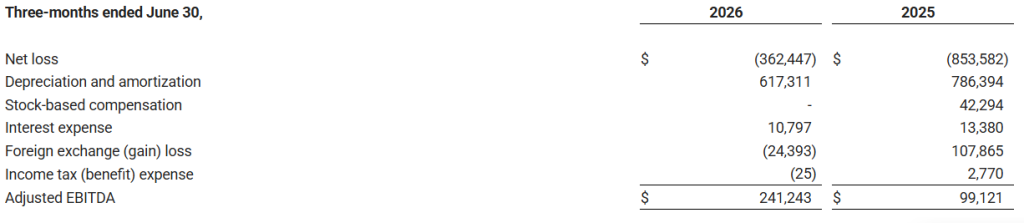
We define and calculate Adjusted EBITDA as net income attributable to QuoteMedia, Inc., plus: 1) depreciation and amortization, 2) stock compensation expense, 3) interest expense, 4) foreign exchange loss (or minus a foreign exchange gain), and 5) income tax expense. We disclose Adjusted EBITDA because we believe it is a useful metric by which to compare the performance of our business from period to period. We understand that measures similar to Adjusted EBITDA are broadly used by analysts, rating agencies, investors and financial institutions in assessing our performance. Accordingly, we believe that the presentation of Adjusted EBITDA provides useful information to investors. The table below provides a reconciliation of Adjusted EBITDA to net income attributable to QuoteMedia, Inc., the most directly comparable GAAP financial measure.

View full release here.

News Provided by GlobeNewswire via QuoteMedia

Conduent (CNDT) – Operational Reset Begins to Take Shape


Tuesday, May 12, 2026

Michael Kupinski, Director of Research, Equity Research Analyst, Digital, Media & Technology , Noble Capital Markets, Inc.

Jacob Mutchler, Research Associate, Noble Capital Markets, Inc.

Refer to the full report for the price target, fundamental analysis, and rating.

Q1 results. Q1 revenue of $723 million was modestly below our estimate of $743 million, driven by ongoing softness in the Commercial segment, while adj. EBITDA of $49 million exceeded our estimate of $38 million, driven by improved cost performance, resulting in a 6.8% adj. EBITDA margin.

Action oriented CEO. In the brief time since Harsha V. Agadi has taken over as CEO, the company has simplified its leadership structure, launched a company-wide cost review, identified $100 million in potential cost reductions, restructured sales incentives, narrowed Commercial focus to healthcare and financial services, accelerated AI deployment, and initiated its portfolio optimization strategy. Furthermore, the company is focused on faster implementation cycles, tighter financial discipline, and improved pipeline conversion.


Get the Full Report

Equity Research is available at no cost to Registered users of Channelchek. Not a Member? Click ‘Join’ to join the Channelchek Community. There is no cost to register, and we never collect credit card information.

This Company Sponsored Research is provided by Noble Capital Markets, Inc., a FINRA and S.E.C. registered broker-dealer (B/D).

*Analyst certification and important disclosures included in the full report. NOTE: investment decisions should not be based upon the content of this research summary. Proper due diligence is required before making any investment decision. 

Kelly Services (KELYA) – Some Green Shoots?


Friday, April 24, 2026

Joe Gomes, CFA, Managing Director, Equity Research Analyst, Generalist , Noble Capital Markets, Inc.

Refer to the full report for the price target, fundamental analysis, and rating.

Some Positives? The Federal Reserve’s Beige Book data is showing temp staffing jobs have been rising for the past six months after falling sharply over the prior four years. Historically, this is often a leading indicator that broader hiring is coming. However, the Iran conflict, AI impacts, and a still uncertain economy appear to be moderating hiring trends.

A Split Market. While layoffs and unemployment remain relatively low, hiring has fallen to levels last seen during the early pandemic. This has resulted in an unprecedented split: a stable job market for people who have jobs and recession-like for those trying to find one. Increased confidence in the economy should result in a hiring surge, in our view, with resulting benefits to staffing companies.


Get the Full Report

Equity Research is available at no cost to Registered users of Channelchek. Not a Member? Click ‘Join’ to join the Channelchek Community. There is no cost to register, and we never collect credit card information.

This Company Sponsored Research is provided by Noble Capital Markets, Inc., a FINRA and S.E.C. registered broker-dealer (B/D).

*Analyst certification and important disclosures included in the full report. NOTE: investment decisions should not be based upon the content of this research summary. Proper due diligence is required before making any investment decision. 

Release – Bitcoin Depot Appoints New Compliance Officer, Tony Gagliardi

Research News and Market Data on BTM

April 13, 2026 8:00 AM EDTDownload as PDF

Seasoned compliance executive to support continued investment in industry-leading consumer protection and regulatory programs

ATLANTA, April 13, 2026 (GLOBE NEWSWIRE) — Bitcoin Depot (NASDAQ: BTM), a U.S.-based Bitcoin ATM (“BTM”) operator and leading fintech company, today announced the appointment of Tony Gagliardi as Chief Compliance Officer, effective April 8, 2026.

In this role, Gagliardi will manage all aspects of Bitcoin Depot’s compliance program, overseeing the continued evolution of the Company’s compliance framework as regulatory expectations and state and federal requirements continue to develop. He will oversee the Company’s anti-money laundering (“AML”) and Know-Your-Customer programs, licensing and state-by-state regulatory compliance strategies, transaction monitoring, risk management, and the advancement of Bitcoin Depot’s consumer protection initiatives. Gagliardi will report directly to CEO Alex Holmes.

“Tony joins Bitcoin Depot during a pivotal period as we continue to enhance our compliance and consumer protection capabilities in a rapidly evolving regulatory environment,” said Holmes. “His expertise in regulatory matters and governance, along with his proven track record across financial services and digital assets, position him well to guide our compliance strategy as we further strengthen our leadership in responsible BTM operations.”

Gagliardi brings more than 15 years of experience building and leading compliance programs across banking, payments, fintech, and regulated digital assets. He has led global AML, fraud, and sanctions programs across both traditional finance and digital asset organizations and has navigated more than 12 major regulatory remediations. Prior to joining Bitcoin Depot, he held senior global compliance roles at leading regulated cryptocurrency firms, serving as Global Head of Sanctions at OKX, Director of Compliance Oversight at Paxos, and Global Head of Financial Crimes Compliance Governance at Coinbase. He brings additional experience from global financial institutions including HSBC and Standard Chartered.

“Bitcoin Depot has taken a proactive approach to compliance and consumer protection, and I’m excited to join the team at such an important time for the industry,” said Gagliardi. “I look forward to building on the Company’s strong foundation and continuing to enhance its compliance programs as the regulatory landscape evolves while supporting the Company’s continued growth and commitment to its customers.”

Gagliardi’s appointment reflects Bitcoin Depot’s continued focus on strengthening its compliance infrastructure and preventing fraud and other illicit activity. In February 2026, the Company initiated a phased rollout of a compliance enhancement requiring customer identification for every transaction at its kiosks. This initiative strengthens safeguards against potential misuse and positions Bitcoin Depot as the first major operator to implement per-transaction ID verification.

For more information, visit https://bitcoindepot.com.

About Bitcoin Depot 
Bitcoin Depot Inc. (Nasdaq: BTM) was founded in 2016 with the mission to connect those who prefer to use cash to the broader, digital financial system. Bitcoin Depot provides its users with simple, efficient and intuitive means of converting cash into Bitcoin, which users can deploy in the payments, spending and investing space. Users can convert cash to bitcoin at Bitcoin Depot kiosks in 47 states and at thousands of name-brand retail locations in 31 states through its BDCheckout product. The Company has the largest market share in North America and operates over 9,000 kiosk locations globally as of August 2025. Learn more at www.bitcoindepot.com.

Cautionary Note Regarding Forward-Looking Statements
This press release and any oral statements made in connection herewith include “forward-looking statements” within the meaning of Section 27A of the Securities Act of 1933, as amended, and Section 21E of the Exchange Act. Forward-looking statements are any statements other than statements of historical fact, and include, but are not limited to, statements regarding the expectations of plans, business strategies, objectives and growth and anticipated financial and operational performance, including our growth strategy and ability to increase deployment of our products and services, the anticipated effects of the Agreement. These forward-looking statements are based on management’s current beliefs, based on currently available information, as to the outcome and timing of future events. Forward-looking statements are often identified by words such as “anticipate,” “appears,” “approximately,” “believe,” “continue,” “could,” “designed,” “effect,” “estimate,” “evaluate,” “expect,” “forecast,” “goal,” “initiative,” “intend,” “may,” “objective,” “outlook,” “plan,” “potential,” “priorities,” “project,” “pursue,” “seek,” “should,” “target,” “when,” “will,” “would,” or the negative of any of those words or similar expressions that predict or indicate future events or trends or that are not statements of historical matters, although not all forward-looking statements contain such identifying words. In making these statements, we rely upon assumptions and analysis based on our experience and perception of historical trends, current conditions, and expected future developments, as well as other factors we consider appropriate under the circumstances. We believe these judgments are reasonable, but these statements are not guarantees of any future events or financial results. These forward-looking statements are provided for illustrative purposes only and are not intended to serve as, and must not be relied on by any investor as, a guarantee, an assurance, a prediction or a definitive statement of fact or probability. Actual events and circumstances are difficult or impossible to predict and will differ from assumptions. Many actual events and circumstances are beyond our control.

These forward-looking statements are subject to a number of risks and uncertainties, including changes in domestic and foreign business, market, financial, political and legal conditions; failure to realize the anticipated benefits of the business combination; future global, regional or local economic and market conditions; the development, effects and enforcement of laws and regulations; our ability to manage future growth; our ability to develop new products and services, bring them to market in a timely manner and make enhancements to our platform; the effects of competition on our future business; our ability to issue equity or equity-linked securities; the outcome of any potential litigation, government and regulatory proceedings, investigations and inquiries; and those factors described or referenced in filings with the Securities and Exchange Commission. If any of these risks materialize or our assumptions prove incorrect, actual results could differ materially from the results implied by these forward-looking statements. There may be additional risks that we do not presently know or that we currently believe are immaterial that could also cause actual results to differ from those contained in the forward-looking statements. In addition, forward-looking statements reflect our expectations, plans or forecasts of future events and views as of the date of this press release. We anticipate that subsequent events and developments will cause our assessments to change.

We caution readers not to place undue reliance on forward-looking statements. Forward-looking statements speak only as of the date they are made, and we undertake no obligation to update publicly or otherwise revise any forward-looking statements, whether as a result of new information, future events, or other factors that affect the subject of these statements, except where we are expressly required to do so by law. All written and oral forward-looking statements attributable to us are expressly qualified in their entirety by this cautionary statement.

Contacts:
Investors & Media
Gateway Group, Inc. 
949-574-3860 
[email protected]

Primary Logo

Source: Bitcoin Depot Inc.

Released April 13, 2026

QuoteMedia Inc. (QMCI) – Entering a Multi-Year Growth Phase


Thursday, April 09, 2026

Michael Kupinski, Director of Research, Equity Research Analyst, Digital, Media & Technology , Noble Capital Markets, Inc.

Refer to the full report for the price target, fundamental analysis, and rating.

Q4 exceeds revenue expectations. QuoteMedia reported Q4 revenue of $5.35M (+14% y/y) and FY2025 revenue of $20.3M (+8% y/y), reflecting solid top-line momentum, while profitability declined with Adjusted EBITDA of $1.0M (vs. $1.8M prior year) and a net loss of $2.3M, driven by investment and accounting treatment of development costs.

Revenue Drivers & Earnings Dynamics. Growth was led by Corporate Quotestream (enterprise), benefiting from larger contracts, higher ARPC, and cross-selling of data and SaaS solutions, while earnings were pressured by higher expensing of development costs (vs. capitalization), which impacted reported profitability but not cash flow.


Get the Full Report

Equity Research is available at no cost to Registered users of Channelchek. Not a Member? Click ‘Join’ to join the Channelchek Community. There is no cost to register, and we never collect credit card information.

This Company Sponsored Research is provided by Noble Capital Markets, Inc., a FINRA and S.E.C. registered broker-dealer (B/D).

*Analyst certification and important disclosures included in the full report. NOTE: investment decisions should not be based upon the content of this research summary. Proper due diligence is required before making any investment decision. 

QuoteMedia Inc. (QMCI) – Revenue Momentum Picks Up


Wednesday, April 08, 2026

Michael Kupinski, Director of Research, Equity Research Analyst, Digital, Media & Technology , Noble Capital Markets, Inc.

Refer to the full report for the price target, fundamental analysis, and rating.

Exceeds Q4 revenue expectations. QuoteMedia reported Q4 revenue of $5.35M (+14% y/y) and FY2025 revenue of $20.3M (+8% y/y), reflecting solid top-line momentum. Profitability declined in the full year 2025, with Adjusted EBITDA of $1.0M (vs. $1.8M prior year) and a net loss of $2.3 million, driven by investment and accounting treatment of development costs.

Key growth drivers. Revenue growth was led by Corporate Quotestream (enterprise), benefiting from larger contracts, higher ARPC, and cross-selling of data and SaaS solutions. Interactive Content revenue increased a strong 18.3%, better than our 8% growth estimate. Earnings were pressured by higher expensing of development costs (vs. capitalization), which impacted reported profitability.


Get the Full Report

Equity Research is available at no cost to Registered users of Channelchek. Not a Member? Click ‘Join’ to join the Channelchek Community. There is no cost to register, and we never collect credit card information.

This Company Sponsored Research is provided by Noble Capital Markets, Inc., a FINRA and S.E.C. registered broker-dealer (B/D).

*Analyst certification and important disclosures included in the full report. NOTE: investment decisions should not be based upon the content of this research summary. Proper due diligence is required before making any investment decision.