Why Oracle Stock Has Lost Half Its Value in Six Weeks

Nine months ago, Oracle was the hottest stock in enterprise technology. On September 10, 2025, shares surged 36% in a single session after reports surfaced that OpenAI had committed to a $300 billion, five-year cloud computing deal with the company. The stock hit a record high of $345.72. The narrative was irresistible: Oracle had reinvented itself as an AI infrastructure company, and the biggest name in artificial intelligence had just bet hundreds of billions on that transformation.

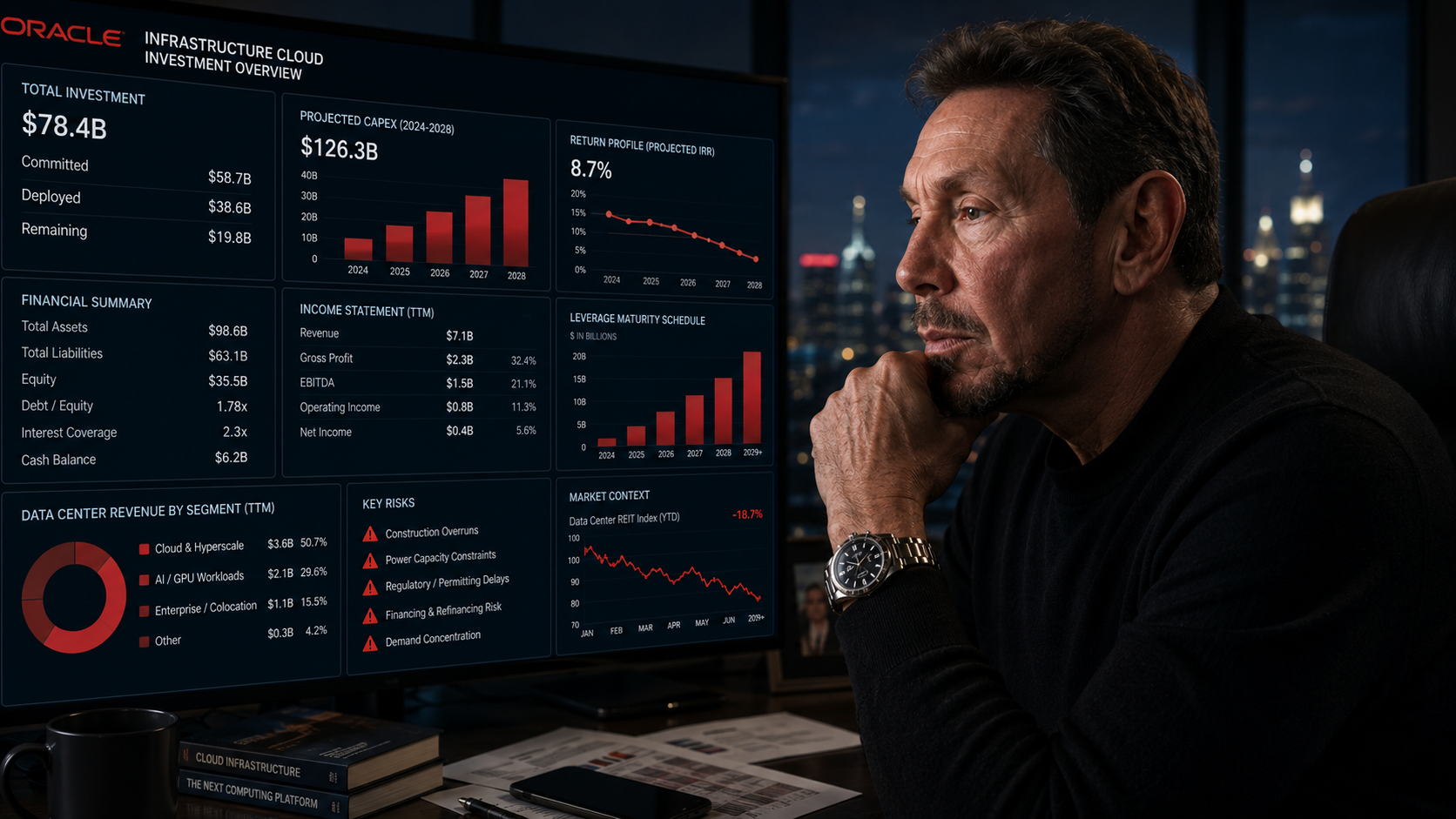
Today, Oracle trades below $140. The stock has fallen more than 50% from its June 2026 high and roughly 62% from last September’s peak. What happened in between is a story about what goes wrong when a company takes on enormous financial risk to chase AI demand that may not materialize as quickly, or as reliably, as the contracts suggest.

The Numbers That Spooked the Market

Oracle’s fiscal 2026 results, released in June, contained strong headline numbers. Revenue grew. Earnings beat estimates. Cloud infrastructure revenue surged 93% year over year in Q4. Under normal circumstances, those would be the kind of results that lift a stock. Instead, shares fell more than 12% in a single session after the report because of what the financial statements revealed underneath the growth.

Capital expenditures for the fiscal year surged to approximately $56 billion, a 162% increase from the prior year. That spending pushed Oracle into negative free cash flow of roughly $24 billion. Total debt swelled to approximately $130 billion. Management indicated that spending would remain elevated, with approximately $70 billion in capex planned for fiscal 2027, and floated the possibility of additional debt and equity raises to fund the buildout. The company’s CFO warned that gross margins would decline in fiscal 2027 as new data center projects ramp up.

The OpenAI Concentration Problem

The risk that has rattled investors most is customer concentration. Oracle ended fiscal 2026 with $638 billion in remaining performance obligations, a 363% increase from $138 billion a year earlier. That figure represents signed contracts for services not yet delivered, and on its face it looks like an extraordinary demand signal. The concern is who those contracts belong to.

Approximately $300 billion of Oracle’s RPO is reportedly attributable to OpenAI alone. OpenAI generates roughly $25 billion in annualized revenue and continues to operate at a significant loss, relying on outside investors to fund its operations. When OpenAI announced earlier this summer that it would delay its IPO from 2026 to 2027, Oracle shares dropped 9% in a single week because the delay raised questions about whether OpenAI would have the financial capacity to honor the scale of its commitments.

Oracle’s own annual report contained unusually thorough risk disclosures about the possibility that its largest AI infrastructure customers might not be able to fulfill their obligations. For a company carrying $130 billion in debt to build data centers designed to serve those exact customers, that warning landed with force.

What This Tells the Broader Market

For investors tracking the AI infrastructure buildout, Oracle’s decline is not an indictment of AI demand itself. It is a case study in concentration risk, leverage, and the gap between signed contracts and delivered revenue. The demand for AI compute capacity is real and growing. But the financial structures being built to serve that demand carry meaningful risk when they depend heavily on a small number of customers whose own economics remain unproven.

Smaller cloud infrastructure, data center, and AI services companies with more diversified customer bases and conservative balance sheets face a fundamentally different risk profile. The AI infrastructure buildout is not slowing down. But Oracle’s 50% decline is a reminder that how a company finances its participation in that buildout matters as much as the demand itself.

Apple Is Suing OpenAI for Trade Secret Theft. The Fallout Could Reshape the AI Hardware Race and Delay the Biggest IPO of the Fall

What was once one of the most high-profile partnerships in technology has turned into one of its most explosive legal battles. Apple filed a federal trade secret lawsuit against OpenAI on July 10 in the Northern District of California, alleging that the AI company orchestrated a systematic campaign to steal confidential hardware designs, supplier information, and product specifications through former Apple employees. The complaint also names io Products, the hardware design firm co-founded by former Apple design chief Jony Ive that OpenAI acquired last year.

The allegations are not subtle. Apple’s filing describes a coordinated effort at every level of OpenAI’s organization to acquire proprietary information about unreleased Apple hardware products. The two former employees at the center of the case are Tang Tan, who served as a vice president at Apple before becoming OpenAI’s Chief Hardware Officer, and engineer Chang Liu, who Apple alleges departed with an unreturned company laptop and exploited a software bug that gave him continued access to Apple’s internal file servers after his departure. Apple further claims that OpenAI interviewers encouraged job candidates to bring Apple prototypes and physical components to interviews as part of the hiring process.

OpenAI has denied the allegations, stating that the company has no interest in other companies’ trade secrets and remains focused on building its own technology.

From Partners to Adversaries

The lawsuit represents a dramatic reversal in the relationship between the two companies. As recently as mid-2025, Apple and OpenAI were working together to integrate ChatGPT into Apple’s software platforms and Siri digital assistant. That partnership has since dissolved entirely. In January 2026, Apple announced it was turning to Google for its Apple Intelligence initiatives, and the companies have been moving in increasingly competitive directions ever since, particularly in the emerging AI hardware device market.

The timing of Apple’s filing is significant for reasons beyond the legal merits. OpenAI confidentially filed for an IPO earlier this summer at a reported valuation of $730 billion to $850 billion, with Goldman Sachs and Morgan Stanley leading the offering. A trade secret lawsuit of this magnitude, filed by the most valuable company in the world, introduces material uncertainty into that process. Discovery alone could force OpenAI to disclose internal communications and hardware development timelines that it would strongly prefer to keep private during a pre-IPO quiet period.

The Three-Way AI Rivalry Deepens

The Apple-OpenAI conflict does not exist in isolation. It is playing out against the backdrop of an intensifying three-way rivalry between Apple, OpenAI, and SpaceX, whose CEO Elon Musk co-founded OpenAI before leaving and eventually launching the competing xAI platform. Musk weighed in immediately after the lawsuit was filed, and the public back-and-forth between Musk and OpenAI CEO Sam Altman escalated over the weekend as both companies simultaneously released competing AI models.

SpaceX completed its record $75 billion IPO in June and is pursuing a $60 billion acquisition of AI coding company Cursor. OpenAI is preparing its own public offering. Apple is navigating a CEO transition as Tim Cook prepares to step down later this year. All three companies are competing aggressively for AI talent, hardware capabilities, and market positioning at the same time.

What It Means for the Broader AI Ecosystem

For investors tracking the AI sector, particularly smaller companies operating in the hardware, semiconductor, and AI infrastructure space, the Apple-OpenAI dispute carries practical implications. If the lawsuit slows or disrupts OpenAI’s hardware ambitions, the competitive landscape for AI device development shifts. Smaller companies building AI edge hardware, consumer AI devices, and specialized components could find themselves operating in a market where one of the most well-funded competitors is legally constrained from executing its product roadmap on the original timeline.

The AI hardware race just became a legal battle. How it resolves will shape competitive dynamics across the sector for years.

Anthropic-Pentagon Clash Puts AI Ethics — and Hype — Under the Small-Cap Spotlight

The escalating dispute between Anthropic and the U.S. Department of Defense is quickly becoming more than a policy debate. It’s a flashpoint for how artificial intelligence companies — public and private — balance rapid commercialization with ethical guardrails.

And for small-cap investors, the episode is a reminder that regulatory and reputational risk can reshape capital flows overnight.

Last week, the Trump administration ordered government agencies to stop using Anthropic’s chatbot, Claude, and labeled the company a supply chain risk after CEO Dario Amodei declined to loosen safeguards preventing use of its models in autonomous weapons and mass surveillance. Anthropic has indicated it plans to challenge the decision once formal notice is received.

The market reaction has been swift.

According to Sensor Tower, Claude surged past ChatGPT in U.S. app downloads over the weekend. Meanwhile, OpenAI faced consumer backlash after announcing a Pentagon agreement to replace Anthropic in classified environments. ChatGPT’s one-star reviews spiked sharply in Apple’s app store following the news, prompting CEO Sam Altman to acknowledge the rollout was mishandled.

The episode highlights a widening divide in AI strategy: aggressive government integration versus caution around high-stakes use cases.

But beneath the headlines lies a more structural issue — readiness.

Missy Cummings, director of the robotics and automation center at George Mason University and a former Navy fighter pilot, recently argued that generative AI systems should not control or guide weapons due to persistent reliability issues. Large language models, she noted, are prone to “hallucinations” and remain unsuitable for environments where errors could cost lives.

Anthropic’s leadership has echoed similar concerns, stating that frontier AI systems are not yet reliable enough to power fully autonomous weapons.

For investors, particularly in small- and mid-cap technology names, the debate underscores a key theme for 2026: execution risk tied to real-world deployment.

Government contracts can provide validation and revenue visibility. But they also introduce political exposure, regulatory scrutiny, and headline volatility. Private AI leaders like Anthropic and OpenAI may dominate public discourse, but publicly traded players — from Palantir (PLTR), which has longstanding defense ties, to Apple (AAPL), whose app ecosystem reflects consumer sentiment in real time — are often the ones absorbing market swings.

The situation also revives questions about what some critics have called the industry’s “hype cycle.” Years of bold claims around AI autonomy and decision-making capabilities helped accelerate defense adoption. Now, as policymakers confront the technology’s limitations, that enthusiasm is meeting institutional caution.

For small-cap investors, this dynamic matters.

Emerging AI infrastructure providers, cybersecurity firms, data analytics companies, and niche software developers frequently market defense or government pathways as long-term growth drivers. Yet this episode illustrates that capital access and contract durability can hinge on shifting ethical standards and public perception — not just technological performance.

It also reinforces a broader capital markets takeaway: reputational capital is financial capital.

Anthropic’s consumer download surge suggests ethical positioning can resonate with users. But legal challenges and lost government business could weigh on enterprise relationships. Conversely, OpenAI’s Pentagon alignment may strengthen federal revenue prospects while pressuring brand perception.

As AI migrates from consumer chatbots into mission-critical systems, readiness — technical, regulatory, and ethical — will increasingly define winners and laggards.

For small-cap investors, the lesson is clear: in emerging technologies, policy risk is no longer a side variable. It’s central to valuation.

OpenAI Lands $840 Billion Valuation as Amazon, Nvidia, SoftBank Double Down on AI Arms Race

OpenAI has secured one of the largest private capital raises in history, reaching an $840 billion valuation as Amazon, Nvidia, and SoftBank anchor a massive $110 billion funding round.

The blockbuster raise underscores that, despite 2026’s volatility in technology stocks and growing talk of an AI valuation bubble, capital formation in artificial intelligence remains robust. For investors, the message is clear: the AI infrastructure race is accelerating, not slowing.

According to Reuters, SoftBank committed $30 billion in the round, Nvidia invested $30 billion, and Amazon pledged $50 billion. Additional investors are expected to participate as the financing progresses. The funding comes ahead of OpenAI’s anticipated mega-IPO later this year, with Wall Street expecting further capital raises before a public debut.

Compute Is the New Oil

The capital injection is designed primarily to secure advanced chips and computing infrastructure.

OpenAI said it will deploy Nvidia’s latest Rubin systems, representing five gigawatts of computing capacity — enough energy to power millions of U.S. households. That scale highlights a defining theme of the AI cycle: frontier models now require industrial-level energy and hardware commitments.

For Nvidia (NVDA), the $30 billion investment deepens its financial ties to one of its largest customers. However, shareholders have recently pressured the chipmaker over its decision to reinvest heavily into the AI ecosystem rather than prioritize capital returns.

The interdependence has also revived concerns about “circular financing,” in which companies invest in key customers while simultaneously securing supply agreements. Critics argue such structures can blur the line between organic demand and strategically supported revenue.

Amazon Expands Strategic AI Footprint

Amazon (AMZN) is pairing capital with infrastructure.

Alongside its $50 billion commitment — beginning with an initial $15 billion investment — OpenAI will utilize two gigawatts of computing capacity powered by Amazon’s proprietary Trainium AI chips. The companies are also expanding a previously signed $38 billion cloud agreement, with OpenAI planning to spend an additional $100 billion on Amazon Web Services over eight years.

AWS will become the exclusive third-party cloud provider for OpenAI Frontier, the company’s enterprise AI platform for building and running agents. Importantly, OpenAI’s relationship with Microsoft remains intact, with Azure continuing as the exclusive cloud provider for its APIs.

The multi-cloud, multi-chip strategy reflects how hyperscalers are competing not just for AI workloads, but for long-term ecosystem control.

Competition Is Intensifying

The raise comes as Alphabet’s Google strengthens its AI position following the launch of Gemini 3, and as Anthropic continues to gain traction in enterprise AI applications. OpenAI, which has yet to turn a profit, is reportedly targeting approximately $600 billion in total compute spending through 2030.

At the same time, technology stocks have faced sharp declines in 2026 as investors question whether AI investments will generate returns sufficient to justify soaring valuations.

Still, OpenAI’s scale is formidable. The company reports more than 900 million weekly active users for ChatGPT and over 50 million consumer subscribers, with early 2026 pacing as its strongest period for new subscriber growth.

Why It Matters for Investors

This deal reinforces several market themes:

  • AI capital intensity is rising dramatically.
  • Infrastructure partnerships are becoming equity-linked.
  • Hyperscalers are competing for exclusive compute relationships.
  • Pre-IPO valuations are stretching toward trillion-dollar territory.

Whether these commitments ultimately deliver sustainable returns remains a key question for public markets. But for now, the AI capital formation cycle remains firmly in expansion mode.

Mistral Unveils New AI Models as Europe’s Rising Lab Races to Keep Pace with OpenAI and Google

French artificial intelligence startup Mistral has introduced a new suite of advanced AI models, marking its most ambitious step yet as it races to remain competitive with global heavyweights like OpenAI, Google, and DeepSeek. The release comes at a pivotal moment in the AI ecosystem, where rapid innovation cycles and aggressive commercialization strategies are reshaping the landscape.

Mistral’s updated portfolio includes a new large multimodal model, which the company describes as the “world’s best open-weight multimodal and multilingual.” Designed for enterprise-grade performance, this model targets use cases such as AI assistants, scientific workloads, retrieval-augmented generation (RAG) systems, and complex agentic workflows. By pushing for open-weight access, Mistral continues to position itself as a key proponent of transparent and customizable AI—an increasingly important stance among European enterprises wary of closed-source dominance from U.S. labs.

Alongside the flagship model, the company launched Ministral 3, a compact, highly efficient model engineered for robotics, autonomous drones, consumer devices, and on-device intelligence. Its smaller footprint allows it to run on a single GPU, reducing operational costs and making it attractive for companies seeking scalable, low-latency AI without heavy cloud dependency. According to Mistral, smaller models offer major advantages in real-world applications, where speed, cost efficiency, and domain-specific tuning outperform size alone.

The launches build on a year of rapid growth for the Paris-based startup. Founded in 2023, Mistral raised 1.7 billion euros in September, reaching a valuation of 11.7 billion euros. The round was led by global semiconductor leader ASML, which invested 1.3 billion euros, with additional backing from Nvidia, Microsoft, and Andreessen Horowitz. This massive inflow of capital reflects Europe’s mounting urgency to develop AI champions capable of competing with U.S. and Chinese giants.

Mistral’s momentum extends beyond research. On Monday, the company announced a major commercial agreement with HSBC, granting the global bank access to its models for tasks such as financial forecasting, language translation, and automation. The startup has already secured additional enterprise contracts worth hundreds of millions of dollars, signaling growing trust from large organizations seeking alternatives to entrenched U.S. players.

Still, the competitive backdrop is intense. Rivals such as Anthropic and OpenAI are aggressively expanding into Europe, opening new offices and securing colossal funding rounds that dwarf those of European firms. With Anthropic now valued at $183 billion and OpenAI reportedly priced at nearly $500 billion through secondary sales, Mistral faces an uphill battle to match the scale of global rivals.

Nonetheless, the company maintains that the next era of AI will be defined not only by size, but by speed, adaptability, on-device intelligence, and openness. With its new models, Mistral aims to position itself at the forefront of this shift—advancing its vision of a globally distributed AI ecosystem that blends cutting-edge research with practical enterprise deployment.

Wall Street Boosts S&P 500 Targets on AI Momentum and Earnings Strength

Wall Street’s bullish sentiment is gaining momentum as the S&P 500 hovers near record highs ahead of earnings season. Despite political uncertainty in Washington and lingering concerns about an “AI bubble,” several top strategists are raising their forecasts, pointing to what they describe as “fundamental strength” across corporate earnings and continued support from Federal Reserve rate cuts.

Ed Yardeni of Yardeni Research lifted his S&P 500 target to 7,000, calling the ongoing rally a “slow-motion melt-up” fueled by resilient profits and Fed easing. Similarly, Evercore ISI’s Julian Emanuel maintained a 7,750 base-case target for 2026, assigning a 30% probability to a “bubble scenario” that could propel the index to 9,000 if AI-driven capital investment accelerates.

Signs of that exuberance are already visible. On Monday, OpenAI revealed a multibillion-dollar deal with AMD, granting the ChatGPT maker rights to acquire up to 10% of the chip giant as part of what executives have dubbed “the world’s most ambitious AI buildout.” The announcement sparked renewed optimism in semiconductor and software names, reinforcing the view that AI investment remains the market’s primary growth engine.

Yet, opinions remain divided. Amazon’s Jeff Bezos recently described the AI boom as a “good kind of bubble” that could fuel long-term innovation and economic expansion. In contrast, Goldman Sachs CEO David Solomon urged caution, suggesting that some capital deployed in the AI race may not yield the expected returns, potentially setting up a correction in the next year or two.

That debate is playing out against elevated valuations. The S&P 500 is trading near 25 times expected 2025 earnings, a level DataTrek Research says “reflects complete confidence” that companies will deliver. Analysts project 13% earnings growth in 2026 and another 10% in 2027, driven primarily by the same mega-cap technology stocks that have led markets higher this year.

Big Tech now represents nearly half of the S&P 500’s market cap, with Alphabet, Amazon, Meta, Tesla, and other AI-focused firms comprising 48% of the index. Analysts note that “multiple expansion” in these names is the foundation of the bull case, with a record number of tech giants issuing positive earnings guidance last quarter — a signal that earnings momentum remains intact heading into Q3 results.

Goldman Sachs strategists led by David Kostin argue that Wall Street’s current earnings forecasts are too conservative, citing strong macro data and robust AI-driven demand. Morgan Stanley’s Mike Wilson echoed that optimism, noting that lower labor costs and pent-up demand could spark a return of “positive operating leverage” — where profits grow faster than revenues — not seen since 2021.

While some investors remain wary of inflation’s potential return, Wilson believes it could be a tailwind rather than a threat, with the Fed likely to tolerate higher prices as long as growth remains solid.

As earnings season begins, the question for investors is not whether the rally can continue — but whether it is still being driven by fundamentals or increasingly by momentum.

OpenAI’s Record $500 Billion Valuation: What Small Cap Investors Should Watch

OpenAI has become the world’s most valuable startup, eclipsing SpaceX after a secondary share sale valued the ChatGPT developer at $500 billion. The deal allowed current and former employees to sell $6.6 billion worth of stock to a group of major investors—a milestone that signals not just enthusiasm for artificial intelligence, but also fast-rising competition in global tech.

Why This Matters for Small Cap Investors

While OpenAI itself is not a small cap, surging valuations and investor demand for AI companies can create ripple effects across the market. The AI boom is leading to massive investment in data centers, cloud infrastructure, and semiconductor supply chains. Small cap companies—especially those in tech, chip manufacturing, data management, or specialized software—may find new opportunities and challenges, as larger firms race to build out AI capabilities.

OpenAI’s multibillion-dollar partnerships with Oracle and SK Hynix, among others, illustrate how the AI sector’s expansion could push demand down the supply chain. Small caps that supply hardware, data services, or niche AI solutions could see increased interest and valuations. Investors might want to look for companies linked to these large infrastructure projects or those with potential for strategic collaborations.

What the Secondary Sale Reveals

The secondary share sale let employees cash out stock without a public offering, a sign of strong investor appetite in the sector. OpenAI capped the sale at $10 billion, but only $6.6 billion changed hands—possibly reflecting employee belief in the company’s long-term prospects despite generous offers from competitors like Meta. For small cap investors, this speaks to the broader narrative: in a high-growth sector, early stakeholders may choose patience over liquidity, betting on future gains.

Strategic Shifts: Implications for Rivals and Partners

OpenAI’s rumoured shift toward a public benefit corporation and its ongoing governance debates with board members and investors suggest a business model evolution typical of high-growth, high-stakes tech startups. Smaller players often emulate these changes, or become attractive acquisition targets as legacy giants update their strategies. As the AI sector matures, small cap investors can benefit by tracking governance shifts—these often precede market-wide impacts.

Trends and Sectors to Monitor

  • AI infrastructure and hardware
  • Data management and analytics
  • Specialized software companies
  • Semiconductor manufacturers
  • Small tech firms entering strategic partnerships

The unprecedented capital flow into generative AI signals that more companies—big and small—will compete for a share of this rapidly expanding market. Tracking small caps that play a critical supporting role in AI’s supply chain could provide early exposure to growth as the sector matures.

Bottom Line

OpenAI’s $500 billion valuation is more than headline news: it’s a signal that the AI sector is entering a new phase, with opportunities extending beyond the headline giants. For small cap investors, paying attention to the companies beneath the surface—those building, supplying, and adapting to the needs of AI leaders—could be the key to capturing upside in this evolving landscape.

OpenAI Expands Employee Share Sale to $10.3 Billion at $500B Valuation

OpenAI is expanding its latest secondary share sale, allowing current and former employees to sell up to $10.3 billion worth of stock. The transaction values the artificial intelligence company at $500 billion, reinforcing its position as one of the most highly valued private startups globally. The expanded sale, up from the $6 billion originally targeted, provides employees an opportunity to realize gains without forcing the company into a near-term public listing.

For staff who have held shares for more than two years, the window to participate runs through the end of September, with the transaction expected to close in October. Major institutional investors including SoftBank, Dragoneer Investment Group, Thrive Capital, Abu Dhabi’s MGX, and T. Rowe Price are expected to purchase the shares, according to people familiar with the offering.

The offering follows a sharp rise in OpenAI’s valuation. Earlier in 2025, the company raised capital at a $300 billion valuation. The new $500 billion figure reflects investor confidence in OpenAI’s revenue growth trajectory, driven by enterprise adoption of its AI models and partnerships with major cloud providers.

The $200 billion valuation jump in less than a year highlights both market enthusiasm for AI and the scarcity of opportunities to invest directly in sector leaders. With OpenAI remaining private, secondary sales represent one of the few avenues for institutional investors to gain exposure at scale.

Secondary share sales have become a preferred mechanism for late-stage startups to provide liquidity to employees while avoiding the volatility of public markets. By giving staff the ability to convert equity into cash, companies like OpenAI can retain talent in an increasingly competitive industry.

Other major startups, including SpaceX, Stripe, and Databricks, have employed similar strategies to balance growth with employee satisfaction. For investors, these transactions provide a controlled entry point into companies with high valuations, while founders and leadership avoid the pressure of quarterly earnings scrutiny.

For outside investors, OpenAI’s decision underscores the strength of demand for exposure to artificial intelligence platforms. With public-market alternatives limited to large tech incumbents, institutional capital continues to flow into private leaders despite lofty valuations.

Still, some analysts caution that these valuations hinge on sustained revenue expansion and market share gains in a sector that is evolving rapidly. For now, OpenAI’s positioning at the forefront of generative AI makes it one of the most closely watched private companies in the world.

OpenAI Reverses Course: Nonprofit to Retain Control Amid Legal and Public Pressure

In a major strategic shift, OpenAI announced Monday that it will no longer pursue a full for-profit transformation and will instead maintain its original nonprofit governance structure. The decision, which follows months of internal and external pressure, reaffirms the organization’s commitment to building artificial general intelligence (AGI) for the benefit of humanity — not just shareholders.

The announcement came in a letter from CEO Sam Altman, who cited conversations with civic leaders and discussions with the Attorneys General of California and Delaware as key factors behind the change. “We made the decision for the nonprofit to stay in control,” Altman wrote, emphasizing a renewed focus on public interest and ethical stewardship of AI technologies like ChatGPT.

OpenAI was originally founded in 2015 as a nonprofit with the ambitious goal of ensuring that AGI — artificial intelligence that can outperform humans across a broad range of tasks — would be developed safely and equitably. Over time, however, the organization layered on a “capped-profit” arm to attract commercial investment and scale operations. That for-profit entity will now be restructured into a public benefit corporation (PBC) — a legally recognized business type that must weigh public impact alongside financial returns.

Bret Taylor, chair of OpenAI’s nonprofit board, clarified that this new structure aims to balance mission and market. “The public benefit corporation model ensures we can grow while staying true to our founding purpose,” he said.

The move comes as OpenAI faces intensifying legal, political, and ethical scrutiny. One major flashpoint is an ongoing lawsuit filed by co-founder Elon Musk, who accused the company and Altman of straying from its original principles. While a federal judge recently dismissed several of Musk’s claims, parts of the case will proceed to trial next year. The lawsuit has amplified a broader debate over whether cutting-edge AI development should be governed by public-interest frameworks or private market incentives.

In addition to legal pressure, OpenAI has come under the microscope from the Attorneys General of California and Delaware — the two jurisdictions where the company operates and is incorporated. Advocacy groups and former employees had petitioned both states’ top law enforcement officials to intervene, arguing that OpenAI’s planned restructuring posed a risk to its charitable mission.

Critics feared a future in which OpenAI — armed with the capability to develop superhuman AI — could shift its focus toward profit maximization at the expense of public safety. These concerns, coupled with growing public reliance on ChatGPT (which now boasts over 400 million weekly users), helped fuel a backlash against the proposed governance changes.

Ultimately, the reversal signals that OpenAI is listening. By recommitting to nonprofit oversight, the company aims to rebuild trust and reinforce its identity as a mission-driven organization — even as it operates at the forefront of one of the world’s most powerful technological revolutions.

Whether this hybrid model can withstand the pressures of a $300 billion valuation and commercial demand remains to be seen. But for now, OpenAI has chosen public accountability over private control — a move that may shape the future of AI governance for years to come.

Nvidia and Tech Stocks Rally After Trump’s $500 Billion Stargate AI Announcement

Key Points:
– Nvidia shares rose over 4%, pushing its market cap to $3.58 trillion after the Stargate AI project announcement.
– The $500 billion initiative aims to secure U.S. dominance in AI infrastructure and job creation.
– Tech stocks rallied broadly, with Microsoft, Oracle, Arm, and SoftBank posting significant gains.

Nvidia stock surged by more than 4% on Wednesday, marking a significant leap following President Donald Trump’s announcement of the massive $500 billion Stargate AI initiative. The project, set to revolutionize the U.S. artificial intelligence landscape, represents one of the largest investments in AI infrastructure to date. Stargate is backed by industry giants including SoftBank, OpenAI, Oracle, and MGX, with OpenAI naming Nvidia, Microsoft, and chip designer Arm as key technology partners. The project aims to deploy $100 billion immediately, with a staggering $500 billion planned over the next four years, primarily to build colossal data centers that will power next-generation AI technologies.

The announcement catalyzed a rally across the technology sector, with Nvidia’s market capitalization climbing to $3.58 trillion, surpassing Apple’s $3.35 trillion valuation. Other major players in the industry followed suit, with Microsoft shares gaining 3.71%, Oracle increasing by 5.5%, and Arm surging by over 15%. SoftBank, a major financial backer of Stargate, saw its stock jump nearly 11%. Companies closely tied to Nvidia’s ecosystem, such as server manufacturers Dell and Super Micro Computer, also posted substantial gains of 7% and 6%, respectively. The broader tech-heavy Nasdaq responded positively, with futures climbing 1.4%, signaling widespread investor enthusiasm for the project.

President Trump highlighted the significance of the Stargate initiative, describing the forthcoming data centers as “colossal structures” that will provide thousands of jobs while strengthening America’s technological edge. He emphasized the need to maintain U.S. leadership in AI development, particularly amid rising competition with China. The announcement comes in the wake of executive orders from the Biden administration aimed at curbing AI chip exports to China and accelerating the domestic buildout of AI infrastructure. The Stargate project is seen as a direct response to these geopolitical challenges, positioning the U.S. as a leader in both innovation and economic growth driven by AI.

Despite the optimism, the initiative is not without challenges. Nvidia recently faced hurdles when major clients, including Amazon, Google, and Meta, canceled orders for its Blackwell AI chips due to issues such as glitches and overheating. This, combined with U.S. government restrictions on the export of AI chips, has raised questions about the company’s ability to maintain its growth trajectory. Furthermore, Tesla CEO Elon Musk expressed doubts about OpenAI’s financial capacity to support the ambitious Stargate project. In a post on his social media platform X, Musk noted that OpenAI reported a $5 billion loss in 2024 despite generating $3.7 billion in revenue.

Analysts, however, remain optimistic about the long-term impact of Stargate. Dan Ives of Wedbush described the project as a “critical juncture” for AI development in the U.S. and a strategic move in the high-stakes competition with China. The Stargate initiative not only promises to reshape the AI landscape but also underscores the growing importance of artificial intelligence in geopolitics and global economic strategy. With plans to build advanced infrastructure and create thousands of jobs, the project has the potential to drive significant innovation and solidify the U.S.’s position as a global leader in technology.

Unlocking the Potential of AI at NobleCon20: A Spotlight on the AI Panel

As NobleCon20 approaches, excitement is building for an event packed with innovative discussions, strategic networking, and industry insights. Among the many highlights of this year’s conference is the AI panel, featuring Zack Kass as the keynote speaker, alongside a lineup of distinguished panelists. Scheduled for Tuesday, December 3rd, this panel promises to provide an unmissable deep dive into the transformative power of artificial intelligence (AI) and its implications across industries.

A Keynote That Defines the Future

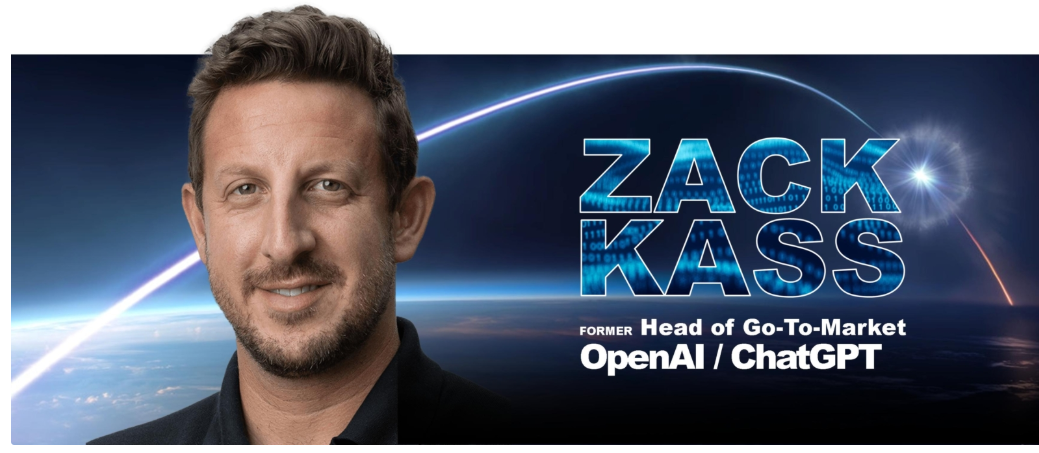
The AI panel kicks off with a keynote address by Zack Kass, the former Head of Go-To-Market at OpenAI, the pioneering organization behind ChatGPT. Kass has been at the forefront of AI innovation, contributing to the development and adoption of generative AI technologies that are reshaping the way we live and work. With over 14 years of experience in emerging technologies, he brings a unique perspective on how AI is catalyzing a new industrial revolution, akin to a modern renaissance.

In his keynote, Kass will explore the practical applications of AI, moving beyond the theoretical “art of the possible” to the tangible “world of the practical.” From empowering businesses to enabling breakthroughs in various fields, Kass will offer valuable insights into how AI is not only a tool but a transformative force poised to redefine humanity’s future.

The Panelists: Experts at the Intersection of AI and Industry

Following his keynote, Kass will join a moderated panel of AI leaders, including:

  • Vin Singh, Chairman & CEO of BullfrogAI Holdings, Inc. Singh’s company leverages causal AI to streamline drug development, reducing clinical trial failure rates and advancing therapeutics. His work showcases AI’s potential to revolutionize healthcare and biotechnology.
  • Jonathan Cohen, Head of Life Sciences Industry Go-To-Market at ServiceNow. Cohen specializes in using AI to drive digital transformation in life sciences. His career spans roles at industry leaders like Wipro Limited, Medidata Solutions, and McKinsey & Company, making him a key voice in the integration of AI into enterprise operations.
  • Elycia Morris, CEO of Synergist Technology. Morris leads the way in AI governance and compliance through Synergist’s AFFIRM platform, helping organizations navigate the complex regulatory landscape of AI deployment. With a background that includes leadership roles at the Pentagon, Apple, and General Electric, she brings unmatched expertise in operational efficiency and technological innovation.

Why This Panel Matters

AI’s rapid advancement is changing the global landscape, and its influence is inescapable. This panel aims to demystify AI for non-technologists while offering strategic insights to C-suite executives, entrepreneurs, and investors. The discussion will delve into pressing topics such as:

  • The gap between AI potential and practical implementation
  • Strategies for data monetization and overcoming common hurdles
  • The moral and economic implications of AI adoption
  • Governance frameworks to ensure ethical AI growth

As organizations struggle to achieve their AI aspirations—nearly 73% fail to meet their data strategy goals—this panel provides a roadmap to success. From understanding the hype versus reality to preparing for AI-driven change, attendees will leave equipped with actionable knowledge to stay ahead in the AI era.

NobleCon20: A Platform for Growth and Innovation

This year marks Noble’s 40th anniversary and the 20th NobleCon, held at the state-of-the-art COBEE facility at Florida Atlantic University. Known for its integration of business, education, and investing, NobleCon continues to be the premier event for showcasing emerging growth companies and thought leaders.

The AI panel is just one of many reasons why NobleCon20 is the “orchard” for discovering the next game-changing opportunities. Whether you’re a high-net-worth individual, institutional investor, or entrepreneur, this conference is designed to inspire, inform, and connect.

Mark your calendars for December 3rd, and don’t miss the chance to gain invaluable insights from the brightest minds in AI. At NobleCon20, the future of business, technology, and humanity converges.

Click here to register for NobleCon20

OpenAI Moves Beyond Software with Robotics-Focused Hire and $400M Investment

Key Points:
– Former Meta AR head Caitlin Kalinowski joins OpenAI to lead its robotics and hardware division.
– OpenAI invests in Physical Intelligence, a $2.4 billion robotics startup, as part of its hardware push.
– Kalinowski’s hire underscores OpenAI’s move to embed AI into consumer-facing, physical devices.

OpenAI has taken a major step in its robotics and hardware ambitions by hiring Caitlin “CK” Kalinowski, former head of Meta’s Orion augmented reality glasses project, to lead the company’s robotics and consumer hardware initiatives. Kalinowski, an experienced hardware engineer and executive, announced her new role on LinkedIn and X on Monday, stating that her initial focus at OpenAI will be “bringing AI into the physical world” through robotics work and strategic partnerships.

The move comes as OpenAI, best known for its chatbot ChatGPT, increasingly signals its intention to expand beyond software into physical technology. Kalinowski’s background includes nearly two and a half years at Meta leading the development of Orion, a pioneering AR glasses project initially known as Project Nazare, as well as nine years working on VR headsets for Meta’s Oculus division. Before her time at Meta, Kalinowski spent nearly six years at Apple, contributing to the design of MacBook Pro and MacBook Air models.

The timing of Kalinowski’s hiring aligns with OpenAI’s recent investment in Physical Intelligence, a robotics startup based in San Francisco that raised $400 million in funding. The investment round also saw contributions from high-profile investors including Amazon founder Jeff Bezos, Thrive Capital, Lux Capital, and Bond Capital, and the startup’s post-money valuation now stands at $2.4 billion. Physical Intelligence aims to bring general-purpose AI into real-world applications, using large-scale AI models and algorithms to power autonomous robots.

This latest move reflects OpenAI’s strategic push to establish itself as a leading force in consumer hardware, with a focus on embedding its AI capabilities into physical devices. This aligns with its recent partnership with Jony Ive, former Apple design chief, to conceptualize and develop an AI-driven consumer device. These developments indicate that OpenAI is not only aiming to develop software but is also working toward integrating its advanced AI capabilities into everyday, tangible products.

With the addition of Kalinowski, OpenAI gains expertise from a seasoned professional with a strong background in both augmented reality and consumer hardware, positioning the company to bring its AI advancements to life in ways that go beyond the digital realm. As OpenAI enters this new territory, Kalinowski’s experience in AR, VR, and consumer technology will likely be instrumental in helping the company transition its AI models from conceptual applications to real-world, user-friendly products.

Kalinowski’s start date at OpenAI is Tuesday, Nov. 5, marking the beginning of a new chapter for OpenAI as it takes significant strides toward expanding its footprint in robotics and consumer hardware.

OpenAI Secures $6.5 Billion in Funding, Valued at Over $150 Billion

Key Points:
– OpenAI closes a $6.5 billion funding round, valuing the company at over $150 billion.
– Thrive Capital led the investment, with participation from other global investors.
– OpenAI solidifies its position as one of the largest venture-backed startups alongside SpaceX and ByteDance.

OpenAI has successfully raised over $6.5 billion in new funding, placing the artificial intelligence company at a staggering $150 billion valuation. This major deal, one of the largest private investments in tech history, further cements OpenAI’s dominance in the rapidly growing AI sector, alongside other tech giants like Elon Musk’s SpaceX and TikTok’s parent company, ByteDance.

The funding round, spearheaded by Thrive Capital, the venture firm headed by Josh Kushner, attracted significant interest from global investors, reflecting the industry’s confidence in AI’s transformative potential. OpenAI’s latest financial boost comes amid increased competition in the development of generative AI technologies. With this capital infusion, the company is well-positioned to further innovate and expand its technological capabilities.

This investment also highlights the industry’s willingness to back costly AI research, which powers advancements in generative AI. As the technology behind AI becomes increasingly expensive and complex, OpenAI’s ability to attract such high levels of funding showcases its pivotal role in shaping the future of artificial intelligence.

OpenAI’s recent funding round follows a turbulent year for the company. In November of last year, the company’s board made the surprising decision to fire and then quickly reinstate Chief Executive Officer Sam Altman. Despite the internal shake-up, including the loss of key leaders like Chief Technology Officer Mira Murati and Sutskever, OpenAI has remained a dominant force in the AI space. It has revamped its board and expanded its team, hiring hundreds of new employees to strengthen its foundation.

Thrive Capital’s role in leading the funding round is a testament to the venture capital firm’s belief in AI’s potential to revolutionize industries. OpenAI’s continued growth and its hefty valuation reinforce the broader tech sector’s commitment to pushing the boundaries of AI research, development, and application.