Oracle’s 10% Surge Is a Signal, Not Just a Stock Move — Here’s What Investors Should Watch

Oracle (NYSE: ORCL) is one of the few names flashing green in a market defined by red this Monday. While the Dow shed hundreds of points on the news of a U.S. naval blockade of the Strait of Hormuz, Oracle surged roughly 10% — moving from deeply oversold territory toward $153 a share on volume running well above its daily average. The catalyst is a combination of new AI product launches, a fresh cloud infrastructure expansion, and a broader rotation back into beaten-down enterprise software names. For small and microcap investors watching from the sidelines, the move carries a message worth decoding.

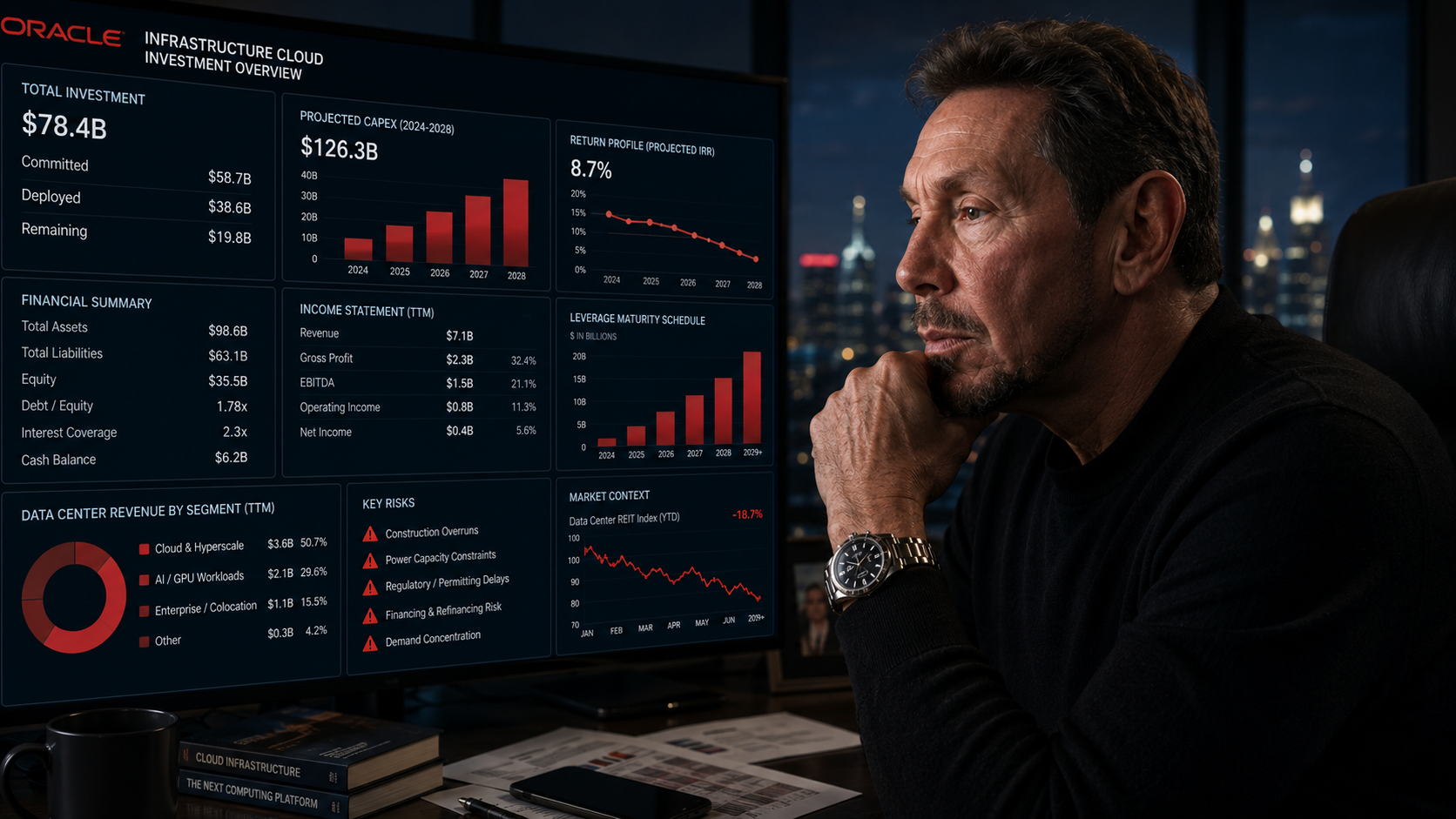
The immediate triggers are concrete. Oracle rolled out AI-powered upgrades to its Utilities Industry Suite and Aconex project management platform today, targeting utility operators looking to cut costs and improve grid reliability. The company also launched a new public cloud region in Casablanca, Morocco — the latest milestone in an aggressive global infrastructure buildout that has pushed its capital expenditure to levels unseen in the company’s history. Underlying all of it is a backlog that has grown 325% year over year, reaching $553 billion in committed future business as of Oracle’s most recent quarter. Revenue in Q3 fiscal 2026 rose 22% year over year, with cloud revenue up 44%.

What makes today’s rally notable is its context. Oracle is still down roughly 54% from its 52-week high of $345.72 set last September. The stock has been punished by investor skepticism around its aggressive AI infrastructure spending, rising debt levels, and a recent round of layoffs across its SaaS and NetSuite divisions. Today’s move suggests that at current valuations, the market is beginning to reassess whether the selloff overshot — particularly as renewed momentum around large-scale AI infrastructure deals involving OpenAI, Meta, and Anthropic reinforces demand signals for the cloud and compute buildout Oracle is betting on.

That reassessment matters beyond Oracle itself. The AI infrastructure trade has been one of the most crowded and most brutalized in the market over the past several months. Large-cap names absorbed the most visible damage, but smaller cloud-adjacent and AI infrastructure companies have been hit just as hard, often harder, with far less coverage and liquidity to cushion the fall. When sentiment begins to shift at the top of the market cap spectrum, it historically filters down — and the small and microcap companies building the picks-and-shovels layer of the AI stack are typically the last to recover, and sometimes the most dramatically when they do.

The risk to that thesis is execution. Oracle’s rally today is a sentiment-driven repricing, not a fundamental re-rating. A company carrying Oracle’s level of capital expenditure and debt in a $100-plus oil environment faces real cost pressures that don’t disappear because a stock bounces 10% in a session. The AI infrastructure buildout remains a long-duration bet, and the geopolitical backdrop continues to add inflation risk that could delay the rate relief many levered tech companies are counting on.

But the signal embedded in today’s move is worth taking seriously. When a company sitting on over half a trillion dollars in committed backlog starts getting bought aggressively on a down-market day, the market is telling you something about where conviction is quietly returning — and in AI infrastructure, that conviction tends to travel down the size spectrum faster than most expect.

Oracle Shares Surge as Cloud Giant Joins Investor Group to Run TikTok’s U.S. Business

Oracle (ORCL) shares jumped roughly 8% Friday after the cloud computing company confirmed it will join a group of investors set to lead TikTok’s U.S. operations, a move that eases national security concerns and removes a major overhang for the popular social media platform. The rally marked a sharp reversal for Oracle stock, which has faced heightened volatility in recent weeks amid broader uncertainty around artificial intelligence infrastructure spending.

According to an internal memo sent to employees, TikTok’s U.S. business will be operated through a new joint venture that includes Oracle, private equity firm Silver Lake, and Abu Dhabi-based investment group MGX. The deal is expected to close on January 22 and is designed to comply with U.S. legislation requiring ByteDance, TikTok’s China-based parent company, to divest control of the app’s U.S. operations.

The agreement effectively prevents a potential shutdown or ban of TikTok in the United States, which had loomed after President Joe Biden signed legislation mandating divestiture over national security concerns. President Donald Trump previously extended deadlines for a deal multiple times and approved a potential framework through an executive order earlier this year, setting the stage for the current agreement.

Under the terms outlined in the memo, Oracle will play a critical role in ensuring compliance with U.S. national security requirements. The company will be responsible for auditing and validating that TikTok adheres to agreed-upon safeguards, including how sensitive U.S. user data is handled and stored. Oracle’s cloud infrastructure will house this data, reinforcing the company’s position as a trusted enterprise technology provider.

While China has not formally confirmed the transaction, reports from Chinese state media suggest the deal is expected to move forward. Commentary cited by CNBC indicates the structure aligns with Chinese regulations and does not constitute a sale of TikTok’s core recommendation algorithm, a key sticking point in past negotiations.

Investors responded positively to the announcement, viewing it as both a strategic win and a stabilizing development for Oracle. In a note to clients, Evercore ISI described the move as a “nice win” for the cloud provider, highlighting potential upside as the market reassesses Oracle’s longer-term growth outlook. The firm suggested that the recent pullback in shares may present an attractive entry point for investors with a six- to twelve-month time horizon.

The TikTok news arrives after a turbulent period for Oracle stock. Shares have been pressured by concerns over the sustainability of the artificial intelligence trade and the capital intensity required to build out large-scale AI data centers. Earlier this week, Oracle shares slid following reports that negotiations over a $10 billion data center deal with Blue Owl Capital had stalled, amplifying investor anxiety about funding risks tied to AI infrastructure expansion.

Despite Friday’s rally, Oracle stock remains down more than 20% over the past month, reflecting the market’s reassessment of high-multiple tech names. Year to date, however, shares are still up about 8%, underscoring the company’s ability to rebound when strategic clarity emerges.

Oracle’s involvement in TikTok’s U.S. operations reinforces its growing role at the intersection of cloud computing, data security, and large-scale digital platforms. While questions around AI spending persist, the TikTok partnership offers a timely boost to sentiment and highlights Oracle’s relevance in high-profile, mission-critical technology deals.

Nvidia and Tech Stocks Rally After Trump’s $500 Billion Stargate AI Announcement

Key Points:
– Nvidia shares rose over 4%, pushing its market cap to $3.58 trillion after the Stargate AI project announcement.
– The $500 billion initiative aims to secure U.S. dominance in AI infrastructure and job creation.
– Tech stocks rallied broadly, with Microsoft, Oracle, Arm, and SoftBank posting significant gains.

Nvidia stock surged by more than 4% on Wednesday, marking a significant leap following President Donald Trump’s announcement of the massive $500 billion Stargate AI initiative. The project, set to revolutionize the U.S. artificial intelligence landscape, represents one of the largest investments in AI infrastructure to date. Stargate is backed by industry giants including SoftBank, OpenAI, Oracle, and MGX, with OpenAI naming Nvidia, Microsoft, and chip designer Arm as key technology partners. The project aims to deploy $100 billion immediately, with a staggering $500 billion planned over the next four years, primarily to build colossal data centers that will power next-generation AI technologies.

The announcement catalyzed a rally across the technology sector, with Nvidia’s market capitalization climbing to $3.58 trillion, surpassing Apple’s $3.35 trillion valuation. Other major players in the industry followed suit, with Microsoft shares gaining 3.71%, Oracle increasing by 5.5%, and Arm surging by over 15%. SoftBank, a major financial backer of Stargate, saw its stock jump nearly 11%. Companies closely tied to Nvidia’s ecosystem, such as server manufacturers Dell and Super Micro Computer, also posted substantial gains of 7% and 6%, respectively. The broader tech-heavy Nasdaq responded positively, with futures climbing 1.4%, signaling widespread investor enthusiasm for the project.

President Trump highlighted the significance of the Stargate initiative, describing the forthcoming data centers as “colossal structures” that will provide thousands of jobs while strengthening America’s technological edge. He emphasized the need to maintain U.S. leadership in AI development, particularly amid rising competition with China. The announcement comes in the wake of executive orders from the Biden administration aimed at curbing AI chip exports to China and accelerating the domestic buildout of AI infrastructure. The Stargate project is seen as a direct response to these geopolitical challenges, positioning the U.S. as a leader in both innovation and economic growth driven by AI.

Despite the optimism, the initiative is not without challenges. Nvidia recently faced hurdles when major clients, including Amazon, Google, and Meta, canceled orders for its Blackwell AI chips due to issues such as glitches and overheating. This, combined with U.S. government restrictions on the export of AI chips, has raised questions about the company’s ability to maintain its growth trajectory. Furthermore, Tesla CEO Elon Musk expressed doubts about OpenAI’s financial capacity to support the ambitious Stargate project. In a post on his social media platform X, Musk noted that OpenAI reported a $5 billion loss in 2024 despite generating $3.7 billion in revenue.

Analysts, however, remain optimistic about the long-term impact of Stargate. Dan Ives of Wedbush described the project as a “critical juncture” for AI development in the U.S. and a strategic move in the high-stakes competition with China. The Stargate initiative not only promises to reshape the AI landscape but also underscores the growing importance of artificial intelligence in geopolitics and global economic strategy. With plans to build advanced infrastructure and create thousands of jobs, the project has the potential to drive significant innovation and solidify the U.S.’s position as a global leader in technology.

Tech Titans Regain Their Luster as Oracle Stock Surges Toward Record

The once high-flying tech giants are back in vogue on Wall Street. After years of being written off as passé in the face of disruptive upstarts, the established behemoths are reminding investors why their cash-gushing businesses should never be counted out.

On Tuesday, it was Oracle’s turn to shine. Shares of the legacy database software provider spiked more than 12% in trading, putting Oracle stock on pace for a record high close above $127. The surge came just a day after the company reported fiscal third-quarter results that handily beat earnings estimates, fueled by blistering growth in its cloud computing segment.

Oracle’s blockbuster performance adds to the growing buzz around technology’s old guard in 2024. After watching shares of Microsoft, Apple, Amazon and Alphabet get pummeled last year, investors have been re-embracing these highly profitable tech titans thanks to their prodigious free cash flows, resilient business models and aggressive capital return programs.

The renaissance has been particularly striking given how deeply unfashionable these names were just a year ago. Investors had been obsessing over the latest buzzworthy upstarts in areas like artificial intelligence, cloud computing, cybersecurity and electric vehicles. The established giants were dismissed as stodgy has-beens.

But with recession fears mounting, markets have been gravitating back toward these cash-rich juggernauts and their ability to keep generating profits. Microsoft shares are up nearly 20% year-to-date, while Apple is up around 25%. Even former whipping boy IBM has staged an impressive comeback, surging over 15% in 2024.

“The big tech gorillas are back in control,” said King Lip, chief investment strategist at Bakerie Capital. “When the economy gets shaky, investors want to hide out in companies generating boatloads of cash with little risk. That’s exactly what these giants provide.”

Oracle, Microsoft and several other tech stalwarts have also been riding a bullish cloud computing wave, as businesses ramp up spending to modernize their legacy systems and brace for an AI boom many expect will require powerful cloud infrastructure.

In its earnings report on Monday, Oracle said revenue from its cloud services and license support segment jumped 12% in the latest quarter. CEO Safra Catz touted the company’s cloud infrastructure business as having “great leverage” for artificial intelligence workloads.

Several Wall Street analysts raised their price targets on Oracle stock on Tuesday, citing enthusiasm over the company’s cloud momentum and strong positioning for an AI-driven renaissance in database migration.

“We’re encouraged Oracle’s massive installed base could act as a catalyst for AI cloud adoption, leading to a re-acceleration in its cloud growth trajectory over the next 12-24 months,” analysts at investment firm Maxim wrote on Tuesday.

While Oracle currently trails the cloud infrastructure leaders like Amazon Web Services, Microsoft Azure and Google Cloud, many expect rising demand for AI applications to be a boon for all major cloud platforms in coming years.

Microsoft has been an early leader in this space, striking partnerships with OpenAI, Anthropic and others to embed intelligent capabilities into its Office productivity suite and cloud services. Google Cloud has also made AI a key focus area under new CEO Thomas Kurian.

Within the semiconductor space, Nvidia shares have already more than doubled this year as investors bet on surging demand for its high-powered chips from cloud providers building out AI infrastructure. AMD has also been a big winner for similar reasons.

Of course, the rekindled passion for big tech could easily flame out if macroeconomic conditions deteriorate more than expected and cash flows get crunched. Valuations are hardly bargain-basement across this segment of the market.

But for now, investors seem more than happy to ride the cash flow train with these entrenched players as they gear up for an AI-driven future likely to boost their cloud-related business lines. After so many years of being shunned for fresh new faces, the elder statesmen of tech have re-established their importance in an uncertain economic climate.