Conduent Incorporated (Nasdaq: CNDT), a global technology-driven business solutions and services company, today announced it is expanding its enterprise AI strategy by collaborating with Google Cloud and integrating Google’s Gemini models into Conduent’s Viewpoint™ platform. The collaboration represents another milestone in Conduent’s strategy to embed GenAI across its technology platforms, helping clients modernize complex, essential workflows while improving speed, quality and operational efficiency.
Corporate legal departments are under increasing pressure to review growing volumes of structured and unstructured information while controlling costs, reducing risk and meeting tighter deadlines. By combining Conduent’s decades of legal operations expertise with Google Cloud’s AI technologies, organizations can analyze complex datasets faster, improve decision-making and deliver more defensible outcomes across eDiscovery and data breach response.
“Enterprise AI is not about replacing expertise, it is about amplifying it,” said George Wehbe, President, Commercial Solutions, Conduent. “Legal professionals are being asked to review exponentially more information with the same resources. By combining Conduent’s legal operations expertise with Google Cloud’s AI capabilities, we’re helping clients make faster, better-informed decisions while maintaining the governance, transparency and defensibility these matters demand.”
Driving Faster, Smarter Legal Outcomes At the core of the collaboration is Enhanced Review, a GenAI-powered capability within Viewpoint, which applies user-defined protocols to identify relevant content, detect legal issues, and surface high-risk documents early in the review process.
Enabled by Google’s Gemini models, Enhanced Review delivers consistent, explainable results with transparent reasoning that helps legal teams understand not just what was identified, but why.
By embedding GenAI, Enhanced Review enables:
Faster insights — key case questions answered in minutes, not days
Lower costs — 30–60% reduction in document-intensive analysis effort
Reduced risk — improved accuracy, auditability, and defensibility
Extending AI Across the Legal Workflow Beyond document review, Conduent’s collaboration with Google Cloud helps extend GenAI across the broader legal lifecycle. Viewpoint Apps use AI-powered analysis to convert large volumes of unstructured documents into structured, review-ready outputs, including chronologies, privilege logs and case reports, to accelerate insight while reducing manual effort.
In addition, Conduent’s CyberMine®, integrated with Viewpoint Data Breach Analyzer, automates breach response workflows by extracting participant data at scale, often spanning millions of records, deduplicating entries, and generating audit-ready notification lists, significantly reducing both response time and operational burden.
Built for Scale, Security, and Choice Unlike cloud-only platforms, Viewpoint gives organizations full control over how and where their data is managed. Clients can deploy the full solution as SaaS on Google Cloud, on-premises or through managed services, ensuring alignment with regulatory, security and operational requirements. This flexibility, combined with Google Cloud’s global, high-performance infrastructure, enables organizations to scale eDiscovery operations without compromising data sovereignty or control.
Advancing Innovation in Legal and Compliance Conduent’s collaboration with Google Cloud reflects a commitment to co-innovation and expanding the role of AI across legal and compliance workflows. Current capabilities focus on eDiscovery and data breach response, with planned expansion into areas such as contract analytics and investigations.
About Conduent Conduent delivers digital business solutions and services spanning the commercial, government and transportation spectrum – creating valuable outcomes for its clients and the millions of people who count on them. The Company leverages cloud computing, artificial intelligence, machine learning, automation and advanced analytics to deliver mission-critical solutions. Through a dedicated global team of approximately 48,000 associates, process expertise and advanced technologies, Conduent’s solutions and services digitally transform its clients’ operations to enhance customer experiences, improve performance, increase efficiencies and reduce costs. Conduent adds momentum to its clients’ missions in many ways including disbursing approximately $80 billion in government payments annually, enabling approximately 2.0 billion customer service interactions annually, empowering millions of employees through HR services every year and processing over 14 million tolling transactions every day. Learn more at www.conduent.com .
Trademarks Conduent is a trademark of Conduent Incorporated in the United States and/or other countries. Other names may be trademarks of their respective owners.
ATLANTA, Aug. 18, 2026 (GLOBE NEWSWIRE) — DLH Holdings Corp. (NASDAQ: DLHC) (“DLH” or the “Company”), a leading provider of digital transformation and cybersecurity, systems engineering and integration, and science research and development, today announced it has been awarded a multiple-award indefinite delivery/indefinite quantity (“MAC ID/IQ”) contract to provide technical services in support of cyberspace activities for the U.S. Navy. The Cyberspace Science, Research, Engineering and Technology Integration Unrestricted Multiple Award Contract is administered by Naval Information Warfare Center (“NIWC”) Pacific.
Through task orders to be competed under this contract, DLH will have the opportunity to support the architecture, engineering, functionality, interface, and interoperability of cyberspace systems, services, and capabilities at the tactical, operational, and strategic levels, including all enabling technologies. Services may include technology assessment, systems engineering, software and hardware development and prototyping, modeling and simulation, training support, and cybersecurity.
DLH is one of 29 prime awardees of the contract, which includes a base period of five years and one option period of two additional years. The contract has a total ceiling for all awardees of $400 million. Task orders are expected to be released under the contract, for which DLH expects to compete.
“DLH leverages speed, agility, world-class engineering services, and leading-edge technology, including artificial intelligence and machine learning, to deliver mission-critical cyber support,” said Billy Burnett, President of DLH’s Defense & Security business group. “This award expands the avenues available to our company to support Navy customers.”
About DLH
DLH (NASDAQ: DLHC) enhances technology, public health, and cyber security readiness missions through science, technology, cyber, and engineering solutions and services. Our experts solve some of the most complex and critical missions faced by federal customers, leveraging digital transformation, artificial intelligence, advanced analytics, cloud-based applications, telehealth systems, and more. With a world-class workforce dedicated to the idea that “Your Mission is Our Passion,” DLH brings a unique combination of government sector experience, proven methodology, and unwavering commitment to innovative solutions to improve the lives of millions. For more information, visit www.DLHcorp.com.
Safe Harbor Statement under the Private Securities Litigation Reform Act of 1995:
This press release may contain forward-looking statements within the meaning of the Private Securities Litigation Reform Act of 1995. These statements relate to future events or DLH`s future financial performance. Any statements that refer to expectations, projections or other characterizations of future events or circumstances or that are not statements of historical fact (including without limitation statements to the effect that the Company or its management “believes”, “expects”, “anticipates”, “plans”, “intends” and similar expressions) should be considered forward-looking statements that involve risks and uncertainties which could cause actual events or DLH’s actual results to differ materially from those indicated by the forward-looking statements. Forward-looking statements in this release include, among others, statements regarding the anticipated use of proceeds. These statements reflect our belief and assumptions as to future events that may not prove to be accurate. Our actual results may differ materially from such forward-looking statements due to a variety of factors, including: the failure to achieve the anticipated benefits of any future acquisition (including anticipated future financial operating performance and results); the inability to retain employees and customers; contract awards in connection with re-competes for present business and/or competition for new business; our ability to manage our debt obligations; compliance with bank financial and other covenants; changes in client budgetary priorities; government contract procurement (such as bid and award protests, small business set asides, loss of work due to organizational conflicts of interest, etc.) and termination risks; significant delays or reductions in appropriations for our programs and broader changes in U.S. government funding and spending patterns; legislation that amends or changes discretionary spending levels or budget priorities; legal, regulatory, and political changes from the federal government that could result in economic uncertainty; the impact of inflation and higher interest rates; and other risks described in our SEC filings. For a discussion of such risks and uncertainties which could cause actual results to differ from those contained in the forward-looking statements, see “Risk Factors” in the Company’s periodic reports filed with the SEC, including our Annual Report on Form 10-K for the fiscal year ended September 30, 2025, as well as interim quarterly filings thereafter. The forward-looking statements contained herein are not historical facts, but rather are based on current expectations, estimates, assumptions and projections about our industry and business.
Such forward-looking statements are made as of the date hereof and may become outdated over time. The Company does not assume any responsibility for updating forward-looking statements.
Michael Kupinski, Director of Research, Equity Research Analyst, Digital, Media & Technology , Noble Capital Markets, Inc.
Jacob Mutchler, Research Analyst, Noble Capital Markets, Inc.
Refer to the full report for the price target, fundamental analysis, and rating.
Initiating coverage with an Outperform rating and a $5 price target. Our constructive view reflects the company’s multiyear transformation through the Lexmark acquisition, expansion of IT Solutions and Digital Services, and continued focus on operating efficiency. We believe these initiatives can moderate revenue declines, improve profitability and cash generation, and ultimately support a multiyear earnings recovery and valuation re-rating.
Lexmark Integration Positioned to Drive Significant Profit Growth. The acquisition of Lexmark expands Xerox’s global scale and is expected to generate at least $350 million in gross cost synergies by the end of 2027. In our view, it provides a clear path toward ameaningful improvement in operating leverage and competitive positioning.
Equity Research is available at no cost to Registered users of Channelchek. Not a Member? Click ‘Join’ to join the Channelchek Community. There is no cost to register, and we never collect credit card information.
This Research is provided by Noble Capital Markets, Inc., a FINRA and S.E.C. registered broker-dealer (B/D).
*Analyst certification and important disclosures included in the full report. NOTE: investment decisions should not be based upon the content of this research summary. Proper due diligence is required before making any investment decision.
PHOENIX, Aug. 14, 2026 (GLOBE NEWSWIRE) — QuoteMedia, Inc. (OTCQB: QMCI), a provider of financial market data and technology solutions, today announced financial results for the quarter ended June 30, 2026. Revenue increased 11% to $5.45 million, compared with $4.93 million for the same period in 2025.
For more than two decades, QuoteMedia has focused on becoming the market data and technology partner financial institutions can rely on for comprehensive solutions, responsive service and compelling value.
Today, banks, brokerage firms, wealth managers, private equity firms and other financial organizations are increasingly seeking flexible, cost-effective alternatives to traditional market data providers. QuoteMedia addresses that demand through a broad suite of streaming market data feeds, XML/JSON APIs, financial content and analytics, and desktop and mobile applications including Quotestream Professional.
Our technology platform is designed to support organizations ranging from emerging financial firms to large-scale enterprise deployments. The breadth of our solutions allows clients to consolidate services with a single provider while giving QuoteMedia opportunities to expand those relationships as client requirements grow.
Highlights for Q2 2026 include the following:
Quarterly revenue increased 11%, or $520,916, to $5,450,127 in Q2 2026 from $4,929,211 in Q2 2025.
Gross margin improved to 50%, compared with 46% in the same quarter last year.
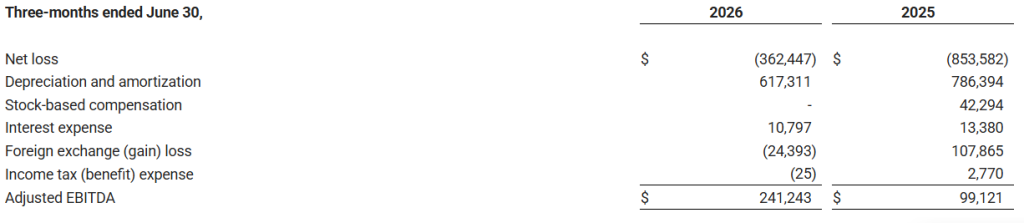
Adjusted EBITDA(1) increased $142,122 to $241,243 in Q2 2026, compared with $99,121 in Q2 2025.
Net loss decreased by $491,135 to $362,447 in Q2 2026, compared with a net loss of $853,582 in Q2 2025.
Management Commentary
“Our second-quarter results reflect the continued strengthening of our business and growing demand for QuoteMedia’s market data and technology solutions,” said Robert J. Thompson, Chairman of the Board at QuoteMedia. “Revenue increased 11% year over year, while Adjusted EBITDA improved significantly. We also completed several important new agreements during the quarter that we expect will contribute to revenue throughout the remainder of 2026 and beyond. Combined with a strong pipeline of additional enterprise opportunities, these developments reinforce our confidence in QuoteMedia’s growth trajectory.”
Reported earnings continue to reflect the accounting impact of development expenditures made in prior periods. As our development efforts increasingly shift toward refinement and maintenance of our existing product suite, a greater proportion of current development costs are recognized as expenses rather than capitalized. At the same time, amortization associated with previously capitalized development costs remains elevated. These accounting effects reduced reported earnings and EBITDA during the quarter but did not affect cash flow.
Outlook
“We have had a strong first half of 2026 and expect the solid momentum will continue through the remainder of the year and beyond,” added Robert J. Thompson. “Our sales and development pipelines remain robust, and our team continues to successfully identify, secure, and deliver high-value strategic opportunities that support our long-term growth.”
Conference Call Details
QuoteMedia will host a conference call on Monday, August 17, 2026, at 2:00 PM Eastern Time to discuss our Q2 2026 financial results and provide a business update.
An audio rebroadcast of the call will be available later at: www.quotemedia.com
About QuoteMedia
QuoteMedia is a leading software developer and cloud-based syndicator of financial market information and streaming financial data solutions to media, corporations, online brokerages, and financial services companies. The Company licenses interactive stock research tools such as streaming real-time quotes, market research, news, charting, option chains, filings, corporate financials, insider reports, market indices, portfolio management systems, and data feeds. QuoteMedia provides industry leading market data solutions and financial services for companies such as the Nasdaq Stock Exchange, TMX Group (TSX Stock Exchange), Canadian Securities Exchange (CSE), London Stock Exchange Group, FIS, U.S. Bank, Bank of Montreal (BMO), Broadridge Financial Systems, JPMorgan Chase, Scotiabank, CI Financial, Canaccord Genuity Corp., Hilltop Securities, Zacks Investment Research, Bombardier, Telus International, Business Wire, PR Newswire, The Goldman Sachs Group, Regal Securities, ChoiceTrade, Cetera Financial Group, Dynamic Trend, Inc., Credential Qtrade Securities, CNW Group, iA Private Wealth, Ally Invest, Inc., Suncor, Leede Jones Gable, Firstrade Securities, Charles Schwab, First Financial, Stock-Trak, Mergent, Cision and others. Quotestream®, QModTM and Quotestream ConnectTM are trademarks of QuoteMedia. For more information, please visit www.quotemedia.com.
Forward-Looking Statements
Statements about QuoteMedia’s future expectations, including future revenue, earnings, growth trajectory, pipeline opportunities, product development, and all other statements in this press release other than historical facts are “forward-looking statements” within the meaning of the Private Securities Litigation Reform Act of 1995. QuoteMedia intends that such forward-looking statements be subject to the safe harbors created thereby. These statements are based on current expectations, estimates, and projections about the company’s business based, in part, on assumptions made by management. These statements are not guarantees of future performance and involve risks, uncertainties, and assumptions that are difficult to predict. Therefore, actual outcomes and results may differ materially from what is expressed or forecasted in such forward-looking statements due to numerous factors, including those described from time to time in the Company’s SEC reports and filings, which are available at www.sec.gov. All forward-looking statements speak only as of the date on which they are made, and the Company does not undertake any obligation to update any forward-looking statement to reflect events or circumstances after the date of this release.
Below are the specific forward-looking statements included in this press release:
We also completed several important new agreements during the quarter that we expect will contribute to revenue throughout the remainder of 2026 and beyond. Combined with a strong pipeline of additional enterprise opportunities, these developments reinforce our confidence in QuoteMedia’s growth trajectory.
We have had a very strong first half of 2026 and expect the solid momentum will continue through the remainder of the year and beyond.
QuoteMedia Investor Relations
Dave Shworan Email: [email protected] Call: (250) 954-3216 ext. 2101
Note 1 on Non-GAAP Financial Measures
We believe that Adjusted EBITDA, as a non-GAAP financial measure, provides meaningful information to investors in terms of enhancing their understanding of our operating performance and results, as it allows investors to more easily compare our financial performance on a consistent basis compared to the prior year periods. This non-GAAP financial measure also corresponds with the way we expect investment analysts to evaluate and compare our results. Any non-GAAP pro forma financial measures should be considered only as supplements to, and not as substitutes for or in isolation from, or superior to, our other measures of financial information prepared in accordance with GAAP, such as net income attributable to QuoteMedia, Inc.
We define and calculate Adjusted EBITDA as net income attributable to QuoteMedia, Inc., plus: 1) depreciation and amortization, 2) stock compensation expense, 3) interest expense, 4) foreign exchange loss (or minus a foreign exchange gain), and 5) income tax expense. We disclose Adjusted EBITDA because we believe it is a useful metric by which to compare the performance of our business from period to period. We understand that measures similar to Adjusted EBITDA are broadly used by analysts, rating agencies, investors and financial institutions in assessing our performance. Accordingly, we believe that the presentation of Adjusted EBITDA provides useful information to investors. The table below provides a reconciliation of Adjusted EBITDA to net income attributable to QuoteMedia, Inc., the most directly comparable GAAP financial measure.
QuoteMedia, Inc. Adjusted EBITDA Reconciliation to Net Loss:
Flock Safety, the license plate reader company at the center of a spreading privacy controversy, unveiled new privacy guardrails Thursday in response to months of backlash over allegations its technology enables mass surveillance. CEO Garrett Langley addressed the criticism directly, stating the company is not Big Brother and is focused on protecting people.
The changes are specific. Flock is cutting its default data retention window from 30 days down to seven, giving customers control over which offense types can be searched, and making case codes mandatory rather than optional for every search. The company is also adding mandatory audit logs and a feature that automatically blocks users when the system detects abnormal search patterns, pending review. Flock says these changes exceed what most states currently require by law.
Why Flock Is Making These Changes Now
The backlash has been building for months. A Washington Post investigation published earlier this month found at least 50 law enforcement officers had been charged with or accused of misusing license plate reader systems, including using the technology to stalk women without their knowledge or consent, with 46 of those cases involving Flock’s system specifically. The EFF and ACLU have both raised formal concerns, with EFF describing the technology as susceptible to grave abuses, including tracking protesters and targeting people by immigration status. Some communities have cancelled contracts outright, and in more extreme cases, citizens have covered or destroyed cameras. Last month, Flock removed a feature that detected human screaming following a nine-month EFF pressure campaign.
The Business Is Growing Despite the Controversy
Here is what makes this genuinely relevant for investors. Flock’s revenue is accelerating even as the backlash intensifies. Langley disclosed the company’s annual revenue run rate climbed to $500 million in June, up from $300 million in January, more than 65% growth in six months. More than half of that growth is coming from newer product lines beyond license plate cameras, including surveillance drones, mobile security trailers, and audio detection systems for gunshots and crashes.
Langley was candid about the strategy. The core license plate reader market is largely fixed, since Flock does not add new cities very often once a market matures. Growth going forward depends on drones, trailers, and software, not the camera network itself. Flock, backed by more than $1 billion from Andreessen Horowitz and other venture investors, recently raised $200 million in equity and $300 million in venture debt at an $8.3 billion valuation.
A Public Company in the Same Space Just Had a Rough Day
Flock has no public ticker, but Cellebrite (Nasdaq: CLBT), which makes digital forensics software for law enforcement, saw its stock plunge nearly 32% Thursday after missing revenue estimates, cutting guidance, and announcing an abrupt CEO change. That drop was driven by company-specific factors rather than the Flock controversy directly. Still, Cellebrite’s management cited new procurement and data-sovereignty requirements as a factor delaying deals, echoing the broader regulatory scrutiny now facing government surveillance technology generally.
What It Means for Investors
Together, these stories show the same dynamic from different angles. Flock is proactively building governance guardrails to get ahead of political backlash before it costs more contracts. Cellebrite’s guidance cut shows how quickly new compliance requirements can delay revenue even for an established public player. For investors evaluating companies in this space, contract renewal risk and public trust are becoming financially material factors, not separate from growth metrics.
CoreWeave (Nasdaq: CRWV) reported second quarter 2026 earnings Tuesday evening that beat Wall Street expectations on both revenue and profitability, sending shares up as much as 14% to 18% in after-hours and premarket trading. The AI cloud infrastructure provider posted revenue of $2.58 billion, up 112% year over year, edging past the $2.56 billion analyst consensus. Adjusted loss per share came in at $1.03, better than the $1.20 loss analysts had expected.
What Drove CoreWeave’s Stock Price Higher This Week
The revenue beat alone was modest, exceeding consensus by less than 1%, typically not enough on its own to justify a double-digit stock move. The real surprise came further down the income statement. CoreWeave’s adjusted operating income reached $128 million, more than double the company’s own guided midpoint of $60 million and well above the top end of its $30 million to $90 million guidance range. That margin outperformance, arriving after six weeks of intense credit market scrutiny around the company’s debt load, was the detail that convinced investors CoreWeave’s massive infrastructure buildout is beginning to generate real operating leverage rather than just top-line growth.
CoreWeave Raises Full-Year 2026 Revenue and Capex Guidance
Management raised full-year 2026 revenue guidance to a range of $12.4 billion to $13.2 billion, up from its prior forecast, and lifted adjusted operating income guidance to $960 million to $1.15 billion. Alongside that upgrade, the company raised its full-year 2026 capital expenditure guidance to $35 billion to $39 billion, up from a prior range of $31 billion to $35 billion. At the $37 billion midpoint, that spending level represents approximately 2.9 times CoreWeave’s projected annual revenue, up from roughly 2.6 times previously, a ratio that underscores just how capital intensive the AI infrastructure buildout remains even for one of its fastest-growing players.
Importantly, management chose to raise its capex guidance rather than pull back, a signal that leadership views current demand as strong enough to justify accelerating the buildout rather than moderating it.
CoreWeave’s $104 Billion Backlog and What It Means for Revenue Visibility
Perhaps the most closely watched figure in the report was CoreWeave’s contracted revenue backlog, which climbed to $104 billion, roughly 8.1 times the midpoint of the company’s full-year revenue guidance. That backlog grew by nearly $30 billion in just six weeks, driven in part by new business disclosed with Anthropic and Meta during the quarter. A backlog of that size gives investors meaningfully more confidence in CoreWeave’s multi-year revenue trajectory than quarterly results alone can provide, though it does not eliminate near-term financing and execution risk tied to actually building out the physical infrastructure required to deliver on those contracts.
The Risk Side of the Story
The growth is not without real cost. CoreWeave’s net loss widened to $626 million from $290 million a year earlier, driven primarily by a surge in interest expense as the company raised $13.46 billion in gross debt during the quarter alone. Active power capacity grew to 1.5 gigawatts, with management guiding toward a path to at least 8 gigawatts by 2030, but each gigawatt of buildout requires enormous ongoing capital that must be financed through debt, equity, or a combination of both. Shares are up roughly 26% year to date, outperforming the broader S&P 500’s approximately 13% gain, but the stock has also seen significant volatility this year as investors debate whether the company’s growth model is sustainable at its current pace of spending.
What CoreWeave’s Results Mean for Small Cap AI Infrastructure Stocks
CoreWeave’s report landed alongside a broader rally across the AI infrastructure supply chain Tuesday, with data center operators including IREN, WULF, CORZ, CIFR, and HUT all trading higher, along with optical networking company Lumentum and server manufacturer Super Micro, both of which posted strong results of their own. As we detailed in our recent coverage of the broader US data center construction boom, roughly 40% of the nearly $700 billion in projected 2026 data center spending flows into physical infrastructure and power buildout rather than compute hardware alone. CoreWeave’s results are a direct, real-time confirmation of that thesis, and the sector-wide rally in smaller data center and infrastructure names Tuesday illustrates how closely tied the fortunes of these companies remain to the health of the largest AI infrastructure buyers.
SKYX Reports over $27.7 Million in Cash and Cash Equivalents as of June 30, 2026, Management Believes It Has Sufficient Cash to Achieve Its Goals Including Becoming Cash Flow Positive as It Exits 2026
39% Reduction in Cash Used in Operating Activities to $3.7 million in Q-2 of 2026 from $6.0 million in Q-1 of 2026
Gross Profit Continues to Grow with 4% Increase to $7.3 Million in Q-2 of 2026 Compared to Q-2 of 2025 and a 10% Increase to $13.9 Million for the First Half of 2026 Compared to $12.7 Million for the First Half of 2025
SKYX Recently Announced it Will Supply Its Technologies During a Renovation of a Marriott City Center Hotel in Durham, NC
In May 2026 SKYX Announced Its Technology Will Become Brand Standard for European Hotel Developers Group OTT, Developer Over 250 Hotels and Buildings Across Europe In May 2026 SKYX Announced Its First European Hotel in France During a Renovation of an Historical Architectural Preservation Hotel, The Grand Hotel du Parc (formerly The Grand Medicis Hotel)
In June 2026 SKYX Announced It Will Deploy Its Technologies to Its Second European Hotel During a Renovation of 5-Star Accor Hospitality Group Hotel Mozart Prague
SKYX Signed Additional Agreement with Group OTT Heritage Hospitality Group to Deploy and Market Its Technologies to Vast European Hotel Market of Over 132,000 Hotels
In May 2026 SKYX Signed a Licensing Agreement for Its Advanced Technologies with U.S., Canada, and Global Leading Lighting Company Eurofase
SKYX Is Expected to Deploy Over 1-Million Units of Its Products including Its Advanced Smart Home Plug-and-Play Technologies During the Course of Its Projects and to Over 100,000 Units/Homes by the End of 2026 Through Its Pro and Retail Segments
SKYX’s Future Projects in the U.S. and Globally Include Projects in North Carolina, Austin, San Antonio, South Florida (Including Miami’s New $4 Billion Smart City), New York, Europe, Saudi Arabia, and Egypt
Despite One of the Hottest Summers on Record, SKYX’s Sales of Its Patented Turbo Heater Fan are Continuing to Grow and Company Expects Sales to Significantly Grow Towards Fall and Winter Seasons and Will Provide Additional Products in New Designs and Larger Sizes
SKYX’s Technology Expansion Provides Additional Opportunities for Future Recurring Revenues Through Interchangeability, Upgrades, AI Services, Monitoring, Subscriptions, and More
SKYX’s Enhanced Safety Code Standardization Team Continues Its Progress Toward Its Goal of a Safety-Mandated Standardization in Homes/Buildings of Its Life-Saving Ceiling Outlet/Receptacle Technology
MIAMI, Aug. 12, 2026 (GLOBE NEWSWIRE) — SKYX Platforms Corp. (NASDAQ: SKYX) (d/b/a SKYX Technologies) (the “Company” or “SKYX”), a highly disruptive advanced smart home and AI platform technology company with over 100 pending and issued patents globally and 60 lighting and home décor websites, with a mission to make homes and buildings become safe and smart as the new standard, today reported its financial and operational results for the second quarter ended June 30, 2026.
SKYX will hold a conference call today, August 12, 2026, at 4:30 pm, Eastern Time, to discuss the results. See below for dial-in information.
Second Quarter 2026 Highlights and Recent Events
Generated an increase of 14% in revenues to a record $25.3 million in second quarter 2026 compared to $22.1 million in revenues in first quarter 2026 and an increase of 10% compared to $23.1 million for the second quarter of 2025.
As of June 30, 2026, Company reported $27.7 million in total cash, cash equivalents, and restricted cash compared to $10.1 million as of December 31, 2025.
Reporting 10 consecutive YoY quarters of growth.
Revenues for the six months ended June 30, 2026, increased 10% to a record $47.4 million compared to $43.2 million for the six months ended June 30, 2025.
SKYX continues to leverage the rapid conversion of its e-commerce sales into cash, advancing it’s cash position often referred to as the “Dell Working Capital Model”, lowering its cost of capital.
Management believes it has sufficient cash to achieve its goals including becoming cash flow positive exiting 2026.
The gross profit for the second quarter ending June 30, 2026, increased comparatively to the second quarter of 2025 by 4% to $7.3 million. Gross profit for the six months ended June 30, 2026, increased comparatively by 10% to $13.9 million, compared to $12.7 million for the six months ended June 30, 2025.
Net loss decreased by $0.6 million to $8.2 million in the second quarter of 2026 compared to $8.8 million in the second quarter of 2025 and decreased by $1.1 million sequentially compared to $9.3 million in the first quarter of 2026.
Net loss per share was $0.06 per share in the second quarter of 2026 compared to $0.08 in the second quarter of 2025.
Adjusted EBITDA loss, a non-GAAP measure, improved sequentially to $3.5 million in the second quarter of 2026 from $3.9 million in the first quarter of 2026, as compared to $2.6 million in the second quarter of 2025.
Net cash used in operating activities was reduced by 39% to $3.7 million in the second quarter of 2026 from $6.0 million in the first quarter of 2026.
The Company reduced interest-bearing debt by $2.0 million as of June 30, 2026.
The Company maintains a structurally favorable working capital profile, with customers paying in advance of supplier payment obligations. This results in a net working capital deficit representing 9.8% of revenues and supports rapid conversion of e-commerce sales into operating cash flow.
Builder / Hotel Segments and General Market Acceptance
SKYX Is Expected to Deploy Over 1-Million Units of Its Products including Its Advanced Smart Home Plug-and-Play Technologies During the Course of Its Projects and to Over 100,000 Units/Homes by the End of 2026 Through Its Pro and Retail Segments.
SKYX’s Future Projects in the U.S. and Globally Include Projects in North Carolina, Austin, San Antonio, South Florida (Including Miami’s New $4 Billion Smart City), New York, Europe, Saudi Arabia, and Egypt.
SKYX announced the launch of its patented advanced SKYFAN and Turbo Heater to the leading U.S. retailer The Home Depot, including a new SkyPlug branding page on HomeDepot.com.
SKYX recently announced the launch of its Turbo Heater fan at leading U.S. retailers Target, Walmart, and Lowe’s, and on its e-commerce platform across 60 websites.
Based on the Growing Sales of its patented Turbo Heater fan, SKYX is expanding the category of the “All-Season Ceiling Fan” — heat in winter and cool in summer — to provide additional products in new designs and larger sizes.
Technology Roadmap
SKYX’s technologies expansion provides additional opportunities for future recurring revenues through interchangeability, upgrades, AI services, monitoring, subscriptions, and more.
SKYX will be launching a new AI-driven system and infrastructure for its e-commerce platform of 60 websites, expected to significantly increase its conversion rate and sales.
The Company secured U.S. and global strategic manufacturing partnerships with premier manufacturers including in the U.S., Vietnam, Taiwan, China, and Cambodia.
SKYX announced a collaboration with the NVIDIA AI Ecosystem Connect Program. SKYX expects to grow its collaboration with NVIDIA through its existing and future smart home projects.
Safety Standardization Mandatory Code and Insurance Exposure
SKYX’s Safety Code Standardization Team is receiving support from a new significant prominent leader with its government safety agency’s process for a safety mandatory standardization of its electrical ceiling outlet/receptacle technology.
SKYX’s code team is led by industry veterans Mark Earley, former head of the National Electrical Code (NEC), and Eric Jacobson, former President and CEO of the American Lighting Association (ALA). The Company’s Safety Code Standardization team believes it will garner assistance from additional safety organizations with its code mandatory safety standardization efforts based on the product’s significant safety aspects. Mr. Earley and Mr. Jacobson were instrumental in numerous code and safety changes in both the electrical and lighting industries. Both strongly believe that, considering the Company’s standardization progress including its product specification approval voting for by ANSI / NEMA (American National Standardization Institute / National Electrical Manufacturers Association) and being voted into 10 segments in the NEC Code Book, it has met the necessary safety conditions for becoming a ceiling safety standardization requirement for homes and buildings.
The Company strongly believes its products can save insurance companies many billions of dollars annually by minimizing risks (e.g., reducing fires, ladder fall injuries, and electrocutions). Management expects that insurance companies will use the Company’s range and variations of its safe advanced plug & play products to reduce its exposure and minimize its risks.
Financing Highlights
SKYX cash, cash equivalents and restricted cash increased to $27.7 million as of June 30, 2026, as compared to $10.1 million as of December 31, 2025, as we raised $29 million in straight equity, with no warrants during January 2026 through two fundamental institutional investors, $25 million at $2.50 per share and $4 million at $2.00 per share.
In 2025 we extended $13.5 million in notes coming due with maturity out to 5 years until 2030.
Second Quarter 2026 Financial Results
The Company’s financial statements for the quarter ended June 30, 2026, are filed with the SEC and are available on the Company’s investor relations website. https://ir.skyplug.com/sec-filings/
Management Commentary
Company’s Management, Board members, and Senior Advisors include former CEO’s and executives from Fortune 100 companies including Nielsen, Microsoft, Disney, GE, The Home Depot, Office Depot, Chrysler, among others.
The Company is trending positively, generating record second quarter 2026 revenues of $25.3 million representing a 14% increase compared to $22.1 million and a 10% increase as compared to $23.1 million for the second quarter of 2025, and record first half 2026 revenues of $47.4 million as compared to $43.2 million for the first half of 2025. The Company generated a gross profit for the second quarter ending June 30, 2026, increasing by 4% to $7.3 million, compared to the second quarter ending June 30, 2025, and a 9% increase to $13.9 million for the first half of 2026 compared to $12.7 million for the first half of 2025. We believe our positive trends will continue to accelerate through the balance of 2026 as we build out and execute on our channel strategy.
We are encouraged by the recently announced initiatives where we could supply hundreds of thousands of units in Europe, the Middle East including Saudi Arabia and Egypt, the $4 billion mixed-use smart city development in the Little River District in the heart of Miami, and projects in Pittsford, New York; North Carolina; Austin, Texas; and San Antonio, Texas. We continue to address the builder/commercial segments, large online and brick-and-mortar retail partners as well as our future potential to realize incremental licensing, subscription, and AI/data aggregation revenues.
Furthermore, our e-commerce website platform with 60 websites enhances the acceleration of marketing and distribution channels, collaborations, licensing, and sales to both professional and retail segments. Our websites include banners, videos, and educational materials regarding the simplicity, cost savings, time-saving, and life-saving aspects of the Company’s patented technologies.
We have accelerated our pace of sales and strategic initiatives with a robust gross margin profile, notably reducing the net loss, the adjusted EBITDA loss, and the net cash used in operating activities of SKYX on a sequential quarterly basis. Our e-commerce platform with 60 websites is expected to continue to provide additional cash flow to the Company.
About SKYX Platforms Corp.
As electricity is a standard in every home and building, our mission is to make homes and buildings become safe-advanced and smart as the new standard. SKYX has a series of highly disruptive advanced smart home and AI platform technologies, with over 100 U.S. and global patents and patent pending applications. Additionally, the Company owns 60 lighting and home decor websites for both retail and commercial segments. Our technologies place an emphasis on high quality and ease of use, while significantly enhancing both safety and lifestyle in homes and buildings. We believe that our products are a necessity in every room in both homes and other buildings in the U.S. and globally. For more information, please visit our website at https://skyplug.com/ or follow us on LinkedIn.
Forward-Looking Statements
Certain statements made in this press release are not based on historical facts but are forward-looking statements. These statements can be identified by the use of forward-looking terminology such as “aim,” “anticipate,” “believe,” “can,” “could,” “continue,” “estimate,” “expect,” “evaluate,” “forecast,” “guidance,” “intend,” “likely,” “may,” “might,” “objective,” “ongoing,” “outlook,” “plan,” “potential,” “predict,” “probable,” “project,” “seek,” “should,” “target” “view,” “will,” or “would,” or the negative thereof or other variations thereon or comparable terminology, although not all forward-looking statements contain these words. These statements reflect the Company’s reasonable judgment with respect to future events and are subject to risks, uncertainties and other factors, many of which have outcomes difficult to predict and may be outside our control, that could cause actual results or outcomes to differ materially from those in the forward-looking statements. Such risks and uncertainties include statements relating to the Company’s ability to successfully launch, commercialize, develop additional features and achieve market acceptance of its products and technologies and integrate its products and technologies with First-party platforms or technologies; the Company’s efforts and ability to drive the adoption of its products and technologies as a standard feature, including their use in homes, hotels, offices and cruise ships; the Company’s ability to capture market share; the Company’s estimates of its potential addressable market and demand for its products and technologies; the Company’s ability to raise additional capital to support its operations as needed, which may not be available on acceptable terms or at all; the Company’s ability to continue as a going concern; the Company’s ability to execute on any sales and licensing or other strategic opportunities; the possibility that any of the Company’s products will become National Electrical Code (NEC)-code or otherwise code mandatory in any jurisdiction, or that any of the Company’s current or future products or technologies will be adopted by any state, country, or municipality, within any specific timeframe or at all; risks arising from mergers, acquisitions, joint ventures and other collaborations; the Company’s ability to attract and retain key executives and qualified personnel; guidance provided by management, which may differ from the Company’s actual operating results; the potential impact of unstable market and economic conditions, including recent measures adopted by the federal government, on the Company’s business, financial condition, and stock price; and other risks and uncertainties described in the Company’s filings with the Securities and Exchange Commission, including its periodic reports on Form 10-K and Form 10-Q. There can be no assurance as to any of the foregoing matters. Any forward-looking statement speaks only as of the date of this press release, and the Company undertakes no obligation to update or revise any forward-looking statements, whether as a result of new information, future events or otherwise, except as required by U.S. federal securities laws.
Non-GAAP Financial Measures
Management considers earnings (loss) before interest, taxes, depreciation and amortization, or EBITDA, as adjusted, an important indicator in evaluating the Company’s business on a consistent basis across various periods. Due to the significance of non-recurring items, EBITDA, as adjusted, enables management to monitor and evaluate the business on a consistent basis. The Company uses EBITDA, as adjusted, as a primary measure, among others, to analyze and evaluate financial and strategic planning decisions regarding future operating investments and potential acquisitions. The Company believes that EBITDA, as adjusted, eliminates items that are not part of the Company’s core operations, such as interest expense and amortization expense associated with intangible assets, or items that do not involve a cash outlay, such as share-based payments and non-recurring items, such as transaction costs. EBITDA, as adjusted, should be considered in addition to, rather than as a substitute for, pre-tax income (loss), net income (loss) and cash flows used in operating activities. This non-GAAP financial measure excludes significant expenses that are required by GAAP to be recorded in the Company’s financial statements and is subject to inherent limitations. Investors should review the reconciliation of this non-GAAP financial measure to the comparable GAAP financial measure. Investors should not rely on any single financial measure to evaluate the Company’s business.
Participants may use the dial-in numbers above and be assisted by an operator or use the Call me™ link for instant telephone access. The Call me™ link will become active 15 minutes before the scheduled start time.
Please connect at least 10 minutes before the start of the call to ensure timely participation.
Telephone Replay
A telephone replay is expected to be available approximately three hours after the conference call and will remain available through Friday, September 11, 2026, at 11:59 p.m. Eastern Time.
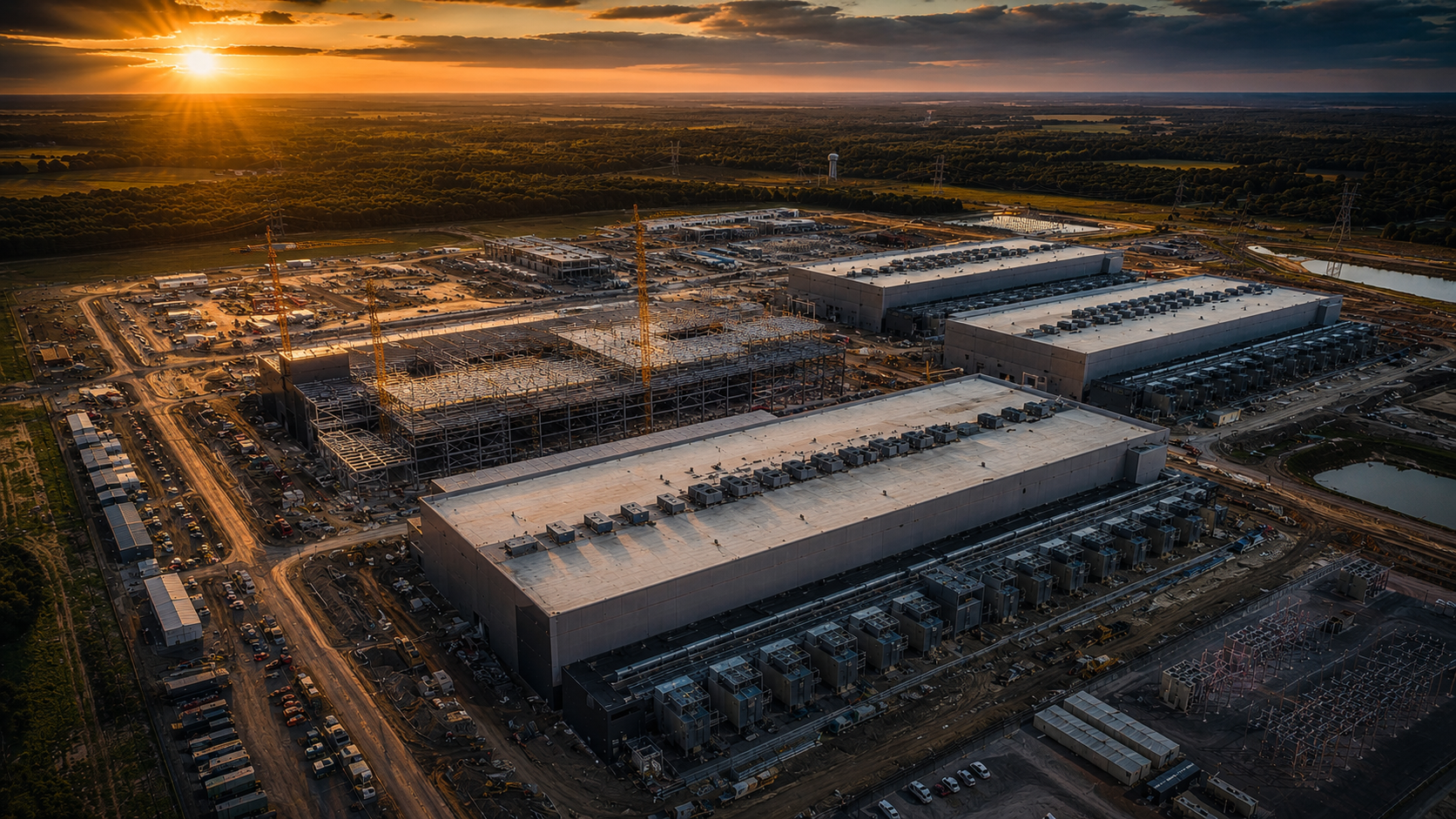
Data center construction and AI infrastructure spending in the United States are on pace to hit approximately $700 billion in 2026, an 81% increase over 2025, making this the largest single-category construction boom in the country. Data center construction starts totaled just $14.9 billion in 2023. By 2025, that figure had exploded to $77.7 billion, a 190% year-over-year increase. To put the scale of 2026 spending in perspective, the entire US Interstate Highway System cost roughly $530 billion in today’s dollars and took decades to build. The data center industry is now spending more than that in a single year.
How Fast Is Data Center Construction Growing in 2026?
The pace of growth in 2026 has genuinely surprised even industry veterans. Year-to-date spending through April reached $49.5 billion, compared to just $13.6 billion over the same period the prior year, nearly four times the pace. Q1 2026 alone saw $44.7 billion in data center investment, up 28% year over year. January 2026 brought a record $25.2 billion in new groundbreakings in a single month. A rolling $9.8 billion monthly moving average through April 2026, more than 300% above year-ago levels, suggests this is a sustained structural shift in how capital is being allocated across the American construction industry, not a short-term spike tied to one or two megaprojects.
The scale of individual commitments underscores the point. Hyperscale technology companies including Microsoft, Amazon, Google, and Meta have collectively committed over $500 billion to AI infrastructure this year. That figure builds directly on what we covered in Amazon’s recent earnings report, where AWS alone raised its own capital expenditure guidance to approximately $220 billion for the year. Vantage committed $25 billion to a single Texas campus, and Meta broke ground on a 900 megawatt facility in Wisconsin specifically to leverage nearby hydropower access, a facility that will also require exactly the kind of specialized bond financing we detailed in our recent coverage of BlackRock’s data center bond offering for Meta.
Which States Are Leading the Data Center Construction Boom?
The geography of this boom has shifted quickly. Virginia led all states with $15.3 billion in data center construction starts in 2025, followed closely by Louisiana at $15.0 billion, Mississippi at $13.9 billion, and Texas at $13.4 billion. States that once competed aggressively over auto manufacturing plants are now competing over server farms, offering tax incentives, expedited permitting, and utility rate structures designed specifically to attract hyperscale campuses.
Why Data Center Demand Shows No Sign of Slowing
Global data center occupancy has reached a record 97%, a figure that reflects genuine capacity scarcity rather than speculative overbuilding. Nearly 100 gigawatts of new data center capacity is anticipated to come online globally between 2026 and 2030, effectively doubling total global capacity in five years. Roughly $7 trillion in global capital expenditures on data center infrastructure is projected by 2030, with more than 40% of that spending expected to occur in the United States specifically.
Construction costs have climbed alongside demand. Standard data center builds now cost between $10 million and $12 million per megawatt of capacity, while AI-ready facilities designed for the density and cooling requirements of advanced chip clusters run $20 million or more per megawatt. That capital intensity is precisely the dynamic we explored in our coverage of Oracle’s debt-funded AI buildout, where the gap between committed spending and near-term returns became a genuine investor concern.
Small Cap Data Center Stocks: Where the Opportunity Lies in the Supply Chain
For investors tracking small and microcap companies, this buildout represents far more than a story about a handful of hyperscale technology giants. Roughly 60% of total data center investment flows into the technology and hardware required to run these facilities, but the remaining 40% is split between land and building construction and, critically, power generation and cooling infrastructure, which alone accounts for approximately 25% of total spend.
That power and cooling category is where the opportunity for smaller companies becomes most direct. Electrical contractors, specialized cooling system providers, power management component manufacturers, backup generation equipment makers, and grid infrastructure companies are all seeing sustained demand growth from a construction category that contractors themselves rank as the single strongest growth segment in the industry, with 65% of contractors surveyed expecting increased data center spending in 2026, the highest expectation across every category of construction tracked.
With 76 individual data center projects totaling more than $88 billion scheduled to begin construction in just the next six months, and roughly 2,788 additional facilities already announced or under construction across the country, the supply chain feeding this buildout is likely to remain one of the more durable growth stories in the American economy well into the next decade.
OVERLAND PARK, Kan.–(BUSINESS WIRE)– SelectQuote, Inc. (NYSE: SLQT), a leading distributor of Medicare insurance policies and owner of a rapidly growing healthcare services platform, today announced it will release its fourth quarter and full year 2026 financial results before market open on Tuesday, August 25, 2026. Chief Executive Officer, Tim Danker, and Chief Financial Officer, Ryan Clement, will host a conference call on the day of the release (August 25, 2026) at 8:30 am ET to discuss the results.
For those interested in dialing into the conference call, please register using this link. After registering, confirmation will be sent via email, including dial in details and unique conference call codes for entry. Registration is open through the live call, but to ensure you are connected for the full call, we suggest registering a day in advance or at least 10 minutes before the start of the call.
About SelectQuote:
Founded in 1985, SelectQuote (NYSE: SLQT) pioneered the model of providing unbiased comparisons from multiple, highly rated insurance companies, allowing consumers to choose the policy and terms that best meet their unique needs. Two foundational pillars underpin SelectQuote’s success: a strong force of highly trained and skilled agents who provide a consultative needs analysis for every consumer, and proprietary technology that sources and routes high-quality leads. Today, the Company operates an ecosystem offering high touchpoints for consumers across insurance, pharmacy, and virtual care.
With an ecosystem offering engagement points for consumers across insurance, Medicare, pharmacy, and value-based care, the company now has three core business lines: SelectQuote Senior, SelectQuote Healthcare Services, and SelectQuote Life. SelectQuote Senior serves the needs of a demographic that sees around 10,000 people turn 65 each day with a range of Medicare Advantage and Medicare Supplement plans. SelectQuote Healthcare Services is comprised of the SelectRx Pharmacy, a Patient-Centered Pharmacy Home™ (PCPH) accredited pharmacy, SelectPatient Management, a provider of chronic care management services, and Healthcare Select, which proactively connects consumers with a wide breadth of healthcare services supporting their needs.
Company to Provide Corporate Update and Second Quarter 2026 Overview and Financial Results; Conference Call to be Held on Wednesday, August 12, 2026, at 4:30 p.m. Eastern Time
MIAMI, Aug. 10, 2026 (GLOBE NEWSWIRE) — SKYX Platforms Corp. (NASDAQ: SKYX) (d/b/a SKYX Technologies) (the “Company” or “SKYX”), an award winning highly disruptive advanced smart home and AI platform technology company with over 100 U.S. and global pending and issued patents and a portfolio of 60 lighting and home décor websites, with a mission to make homes and buildings become advanced-safe-smart instantly as the new standard, today announced that it will host its second quarter 2026 earnings conference call on Wednesday, August 12, 2026, at 4:30 p.m. Eastern Time. Management will provide a corporate update and discuss the Company’s second quarter 2026 financial results.
Participating Management
SKYX Participating Members will Include:
Rani Kohen, Founder and Executive Chairman
Lenny Sokolow, CEO
Steve Schmidt, SKYX President (former CEO of Nielsen Data Corporation and former President of Office Depot International)
Marc Boisseau, CFO
Conference Call and Webcast Details
Event
SKYX Platforms Corp. Second Quarter 2026 Earnings Conference Call
Date
Wednesday, August 12, 2026
Time
4:30 p.m. Eastern Time
Participant dial-in
1-877-407-0792 (U.S./Canada) or 1-201-689-8263 (International)
Participants may use the dial-in numbers above and be assisted by an operator or use the Call me™ link for instant telephone access. The Call me™ link will become active 15 minutes before the scheduled start time.
Please connect at least 10 minutes before the start of the call to ensure timely participation.
Telephone Replay
A telephone replay is expected to be available approximately three hours after the conference call and will remain available through Friday, September 11, 2026, at 11:59 p.m. Eastern Time.
Replay dial-in: 1-844-512-2921 or 1-412-317-6671
Access ID: 13762196
About SKYX Platforms Corp.
As electricity is a standard in every home and building, our mission is to make homes and buildings become safe-advanced and smart as the new standard. SKYX has a series of highly disruptive advanced, safe, smart and AI platform technologies, with over 100 U.S. and global patents and patent pending applications. Additionally, the Company owns 60 lighting and home decor websites for both retail and commercial segments. Our technologies place an emphasis on high quality and ease of use, while significantly enhancing both safety and lifestyle in homes and buildings. We believe that our products are a necessity in every room in both homes and other buildings in the U.S. and globally. For more information, please visit our website at https://www.skyx.com/ or follow us on LinkedIn.
Forward-Looking Statements
Certain statements made in this press release are not based on historical facts, but are forward-looking statements. These statements can be identified by the use of forward-looking terminology such as “aim,” “anticipate,” “believe,” “can,” “could,” “continue,” “estimate,” “expect,” “evaluate,” “forecast,” “guidance,” “intend,” “likely,” “may,” “might,” “objective,” “ongoing,” “outlook,” “plan,” “potential,” “predict,” “probable,” “project,” “seek,” “should,” “target” “view,” “will,” or “would,” or the negative thereof or other variations thereon or comparable terminology, although not all forward-looking statements contain these words. These statements reflect the Company’s reasonable judgment with respect to future events and are subject to risks, uncertainties and other factors, many of which have outcomes difficult to predict and may be outside our control, that could cause actual results or outcomes to differ materially from those in the forward-looking statements. Such risks and uncertainties include statements relating to the Company’s ability to successfully launch, commercialize, develop additional features and achieve market acceptance of its products and technologies and integrate its products and technologies with third-party platforms or technologies; the Company’s ability to achieve positive cash flows; the Company’s efforts and ability to drive the adoption of its products and technologies as a standard feature, including their use in homes, hotels, offices and cruise ships; the Company’s ability to capture market share; the Company’s estimates of its potential addressable market and demand for its products and technologies; the Company’s ability to raise additional capital to support its operations as needed, which may not be available on acceptable terms or at all; the Company’s ability to continue as a going concern; the Company’s ability to execute on any sales and licensing or other strategic opportunities; the possibility that any of the Company’s products will become National Electrical Code (NEC)-code or otherwise code mandatory in any jurisdiction, or that any of the Company’s current or future products or technologies will be adopted by any state, country, or municipality, within any specific timeframe or at all; risks arising from mergers, acquisitions, joint ventures and other collaborations; the Company’s ability to attract and retain key executives and qualified personnel; guidance provided by management, which may differ from the Company’s actual operating results; the potential impact of unstable market and economic conditions on the Company’s business, financial condition, and stock price; and other risks and uncertainties described in the Company’s filings with the Securities and Exchange Commission, including its periodic reports on Form 10-K and Form 10-Q. There can be no assurance as to any of the foregoing matters. Any forward-looking statement speaks only as of the date of this press release, and the Company undertakes no obligation to update or revise any forward-looking statements, whether as a result of new information, future events or otherwise, except as required by U.S. federal securities laws.
Signed divestitures expected to generate $234M in gross proceeds
Revenue: $531M from Continuing Operations
Pre-tax Income (Loss) from Continuing Operations: $(57)M
Adj. EBITDA from Continuing Operations(1) : $16M
Adj. EBITDA Margin from Continuing Operations(1): 3.0%
New Business Signings ACV from Continuing Operations(2): $99M
FLORHAM PARK, N.J., Aug. 10, 2026 — Conduent Incorporated (Nasdaq: CNDT), a global technology-driven business process solutions and services company, today announced its second quarter 2026 financial results.
Harsha V. Agadi, Chief Executive Officer, stated: “Six months into our transformation, we are making significant progress against the priorities we established at the beginning of the year. We are simplifying the organization, strengthening financial discipline and taking structural costs out of the business, while making good progress against our approximately $100 million annualized cost-savings program. We also took significant steps this quarter to reshape our portfolio and sharpen our focus on the markets where we believe Conduent is best positioned to compete and grow. The announced sales of our Transit and Tolling businesses are expected to generate approximately $234 million in gross proceeds, plus a 7% equity interest in the Tolling buyer, exceeding the commitment we made in the first quarter to generate at least $200 million through portfolio actions. We intend to use the majority of these proceeds to reduce debt and further strengthen our balance sheet.”
“At the same time, we are seeing encouraging momentum in our go-to-market execution. Our qualified new business pipeline continues to grow, supported by new wins and expansions across both Commercial and Government. We are also investing in our go-forward portfolio and differentiated technology capabilities, including AI, to help clients modernize complex, mission-critical operations and position Conduent to capture opportunities in the large and growing markets we serve.”
“While our second-quarter financial results do not yet reflect the full impact of the actions underway, we are building a simpler, more focused and higher-performing Conduent. We remain focused on disciplined execution, converting our pipeline into profitable growth, and building a stronger cost structure. I am confident that the actions we are taking today position us to improve financial performance and create sustainable, long-term value for our clients and shareholders.”
Key Financial Q2 2026 Results
($ in millions, except margin and per share data)
Q2 2026
Q2 2025
Current Quarter Y/Y B/(W)
Revenue
$531
$603
(11.9)%
GAAP Net Income (Loss)
$(116)
$(40)
(190.0)%
Adjusted EBITDA from Continuing Operations(1)
$16
$23
(30.4)%
Adjusted EBITDA Margin from Continuing Operations(1)
3.0%
3.8%
-80 bps
GAAP Income (Loss) Before Income Tax from Continuing Operations
$(57)
$(43)
(32.6)%
GAAP Diluted EPS from Continuing Operations
$(0.46)
$(0.27)
$(0.19)
Adjusted Diluted EPS from Continuing Operations(1)
$(0.18)
$(0.16)
$(0.02)
Cash Flow from Operating Activities
$7
$(15)
146.7%
Adjusted Free Cash Flow(1)
$(8)
$(30)
73.3%
Performance Commentary Cash flow from operating activities improved by $22 million year‑over‑year, primarily due to favorable working capital results, which included, among other things, the effects of the realization of some of our long-term projects in the Government and former Transportation segments.
Q2 2026 pre-tax income (loss) from continuing operations was $(57) million versus $(43) million in the prior year period. This unfavorable variance was primarily caused by higher restructuring-related costs in the current year related to our transformation plan.
Q2 2026 Adjusted EBITDA of $16 million and Adjusted EBITDA margin of 3.0% decreased, respectively, versus the prior year, due to lower profitability in our Government segment.
Key Achievements and Industry Accolades
Portfolio Optimization & Strategic Transformation
Entered into agreements to sell the Public Transit business to Modaxo for $164 million and the Tolling business to Quarterhill Inc. for $70 million, plus a 7% equity interest in Quarterhill, further simplifying Conduent’s portfolio, strengthening financial flexibility and increasing focus on core growth opportunities.
Business Execution & Contract Wins
Signed a pension risk transfer administration engagement with Securian, expanding Conduent’s retirement administration capabilities.
Selected by Trillium Health Resources to deploy the Health Services Plus platform for claims processing, provider data management, and member services.
Implemented a modernized Medicaid platform for the State of New Mexico, replacing a 24-year-old legacy system and supporting approximately 900,000 Medicaid members.
Awarded a multi-year contract renewal by the Commonwealth of Virginia to continue operating and modernizing its Medicaid platform, serving approximately 1.6 million members.
Expanded the EBT EMV implementation following the Alabama rollout, with four states expected to be live with chip-enabled EBT cards by year-end 2026, helping strengthen payment security and protect beneficiaries from card fraud.
Innovation & Technology Investment
Introduced an AI-powered next-generation Customer Experience platform featuring real-time translation, AI-assisted training, and voice enhancement capabilities to improve customer experiences and agent performance.
Investing in next-generation Medicaid technology to modernize provider enrollment and management, with the first client implementation planned for a U.S. state, expanding Conduent’s Government Healthcare capabilities and supporting continued modernization of state Medicaid programs.
Leadership & Governance
Appointed Adam Demuyakor to the Board of Directors, adding expertise in artificial intelligence, digital transformation, innovation and enterprise technology.
FY 2026 Outlook(3)
FY 2026 Outlook(3)
Revenue
$2,150M – $2,250M
Adj. EBITDA from Continuing Operations(1)
$140M – $170M
(1)
Refer to the Appendix for definition and complete non-GAAP reconciliations of Adjusted EBITDA, Adjusted EBITDA Margin, Adjusted Diluted EPS and Adjusted Free Cash Flow.
(2)
Refer to the Appendix for definition.
(3)
Refer to the Appendix for additional information regarding non-GAAP outlook.
Conference Call Management will present the results during a conference call and webcast on August 10, 2026 at 9:00 a.m. ET.
The call will be available by live audio webcast along with the news release and online presentation slides at https://investor.conduent.com/.
The conference call will also be available by calling 877-407-4019 toll-free. If requested, the conference ID for this call is 13761624.
The international dial-in is 1-201-689-8337. The international conference ID is also 13761624.
A recording of the conference call will be available by calling 1-877-660-6853 three hours after the conference call concludes. The replay ID is 13761624.
The telephone recording will be available until Aug 24, 2026.
About Conduent Conduent delivers digital business solutions and services spanning the commercial, government and transportation spectrum – creating valuable outcomes for its clients and the millions of people who count on them. The Company leverages cloud computing, artificial intelligence, machine learning, automation and advanced analytics to deliver mission-critical solutions. Through a dedicated global team of approximately 46,000(1) associates, process expertise and advanced technologies, Conduent’s solutions and services digitally transform its clients’ operations to enhance customer experiences, improve performance, increase efficiencies and reduce costs. Conduent adds momentum to its clients’ missions in many ways including disbursing approximately $80 billion in government payments annually, enabling approximately 2.0 billion customer service interactions annually, empowering millions of employees through HR services every year and processing over 14 million tolling transactions every day. Learn more at www.conduent.com.
(1) Approximately 46,000 employees globally, including approximately 3,500 within the Transportation business.
Non-GAAP Financial Measures We have reported our financial results in accordance with accounting principles generally accepted in the U.S. (U.S. GAAP). In addition, we have discussed our financial results using non-GAAP measures from our Continuing Operations only, unless otherwise noted. We believe these non-GAAP measures allow investors to better understand the trends in our business and to better understand and compare our results. Accordingly, we believe it is necessary to adjust several reported amounts, determined in accordance with U.S. GAAP, to exclude the effects of certain items as well as their related tax effects. Management believes that these non-GAAP financial measures provide an additional means of analyzing the results of the current period against the corresponding prior period. However, these non-GAAP financial measures should be viewed in addition to, and not as a substitute for, our reported results prepared in accordance with U.S. GAAP. Our non-GAAP financial measures are not meant to be considered in isolation or as a substitute for comparable U.S. GAAP measures and should be read only in conjunction with our Consolidated Financial Statements prepared in accordance with U.S. GAAP. Our management regularly uses our non-GAAP financial measures internally to understand, manage and evaluate our business and make operating decisions. Providing such non-GAAP financial measures to investors allows for a further level of transparency as to how management reviews and evaluates our business results and trends. These non-GAAP measures are among the primary factors management uses in planning for and forecasting future periods. Compensation of our executives is based in part on the performance of our business based on certain of these non-GAAP measures. Refer to the “Non-GAAP Financial Measures” and “Non-GAAP Reconciliations” sections attached to this release for a discussion of these non-GAAP measures and their reconciliation to the reported U.S. GAAP measures.
Forward-Looking Statements
This press release, any exhibits or attachments to this release, and other public statements we make may contain “forward-looking statements” as defined in the Private Securities Litigation Reform Act of 1995. The words “anticipate,” “believe,” “estimate,” “expect,” “expectations,” “in front of us,” “plan,” “intend,” “will,” “aim,” “should,” “could,” “forecast,” “target,” “may,” “continue to,” “looking to continue,” “endeavor,” “if,” “growing,” “projected,” “potential,” “likely,” “see,” “ahead,” “further,” “going forward,” “on the horizon,” “as we progress,” “going to,” “path from here forward,” “think,” “path to deliver,” “from here,” “on track,” “remain” and similar expressions (including the negative and plural forms of such words and phrases), as they relate to us, are intended to identify forward-looking statements, but the absence of these words does not mean that a statement is not forward-looking. All statements other than statements of historical fact included in this press release or any attachment to this press release are forward-looking statements, including, but not limited to, statements regarding our financial results, condition and outlook; changes in our operating results; general and market and economic conditions; and our projected financial performance, including all statements made under the section captioned “FY 2026 Outlook” within this release. Unless otherwise noted, the discussion of our results is on a continuing operations basis and does not include discontinued operations. These statements are based on our beliefs and reflect our current views with respect to future events using currently available information and are subject to certain risks, uncertainties and assumptions, many of which are outside of our control, that could cause actual results to differ materially from those expected or implied by such forward-looking statements contained in this press release, any exhibits to this press release and other public statements we make.
Important factors and uncertainties that could cause our actual results to differ materially from those in our forward-looking statements include, but are not limited to: risks related to recently announced divestitures including the sale of the Company’s (i) Public Transit business and (ii) Tolling business, including but not limited to our ability to realize the benefits anticipated from such transactions, as well as unexpected costs, liabilities or delays associated with such transactions; competitive restrictions applicable to the Company and its affiliates under the definitive transaction agreements; risks related to the equity interest in Quarterhill Inc. to be received as partial consideration in the Tolling transaction, including fluctuations in the value of such interest; government appropriations and termination rights contained in our government contracts; the impact of changes in government spending levels, budget priorities or efficiency initiatives, including federal cost-reduction programs, on demand for our government solutions and services; the competitiveness of the markets in which we operate and our ability to renew commercial and government contracts, including contracts awarded through competitive bidding processes; our ability to recover capital and other investments in connection with our contracts; the impact of geopolitical events and geopolitical tensions (such as the war in Ukraine and conflict in the Middle East), macroeconomic conditions, natural disasters and other factors in a particular country or region on our workforce, customers and vendors; the impact of changes in trade policies, tariffs or export controls on our cost structure, supply chain and business operations; our reliance on third-party providers; our ability to deliver on our contractual obligations properly and on time; changes in continued interest in outsourced business process services; the adverse effect of claims of infringement of third-party intellectual property rights; our ability to estimate the scope of work or the costs of performance in our contracts; the loss of key senior management and our ability to attract and retain necessary technical personnel and qualified subcontractors; our failure to develop new service offerings and protect our intellectual property rights; our ability to modernize our information technology infrastructure and consolidate data centers; expectations relating to environmental, social and governance considerations; utilization of our stock repurchase program; the effects related to our use of artificial intelligence on our business; the failure to comply with laws relating to individually identifiable information and personal health information; the failure to comply with laws relating to processing certain financial transactions, including payment card transactions and debit or credit card transactions; breaches of our information systems or security systems or any service interruptions; risks related to hacking or other cybersecurity threats to our data systems, information systems and network infrastructure and other service interruptions, including relating to the previously disclosed cyber event that took place in January 2025 (the “January 2025 Cyber Event”), including Conduent’s investigation of such incident and mitigation and remediation efforts, the nature and extent of such incident, the potential disruption to our business or operations, the potential impact on Conduent’s reputation, and Conduent’s assessments of the likely financial and operational impacts of such incident; our ability to comply with data security standards; developments in various contingent liabilities that are not reflected on our balance sheet, including those arising as a result of being involved in a variety of claims, lawsuits, investigations and proceedings; the impact of potential goodwill and other asset impairments on our results of operations; our significant indebtedness and the terms of such indebtedness; our failure to obtain or maintain a satisfactory credit rating and financial performance; our ability to obtain adequate pricing for our services and to improve our cost structure; our ability to collect our receivables, including those for unbilled services; a decline in revenues from, or a loss of, or a reduction in business from or failure of significant clients; fluctuations in our non-recurring revenue; increases in the cost of voice and data services or significant interruptions in such services; our ability to receive dividends or other payments from our subsidiaries; and other factors that are set forth in the “Risk Factors” section, the “Legal Proceedings” section, the “Management’s Discussion and Analysis of Financial Condition and Results of Operations” section and other sections in our 2025 Annual Report on Form 10-K, as well as in our Quarterly Reports on Form 10-Q and Current Reports on Form 8-K filed with or furnished to the Securities and Exchange Commission. Any forward-looking statements made by us in this release speak only as of the date on which they are made. We are under no obligation to, and expressly disclaim any obligation to, update or alter our forward-looking statements, whether because of new information, subsequent events or otherwise, except as required by law.
Conduent Incorporated (Nasdaq: CNDT), a global technology-driven business solutions and services company, today announced that the Virginia Department of Medical Assistance Services (DMAS) has awarded the company a contract to continue operating, and modernize, the Commonwealth’s systems that support Virginia Medicaid. The contract, which spans up to 14 years, extends Conduent’s relationship with Virginia’s Medicaid program that began in 2001.
Under the new agreement, Conduent will use its modular Conduent Medicaid Suite (CMdS) to modernize Virginia’s Medicaid Enterprise Systems and Fiscal Agent Services Solution. These entail claims processing, finance, call center services, reporting, and other core functions. This transition to an integrated, dynamic solution will help DMAS improve access to information, reduce fraud risks, and strengthen program performance. Members, providers, and staff will benefit from enhanced user experiences, supporting better health outcomes for the approximately 1.6 million Virginians enrolled in Medicaid.
Conduent will also deploy Conduent CXNow , its cloud-based Customer Experience-as-a-Service platform used by government agencies and commercial clients. Powered by AI, automation, and analytics, CXNow will streamline customer interactions across phone and chat, expand self-service options, and improve overall service quality. For the Commonwealth, these enhancements will drive additional cost savings and operational efficiency.
“We are honored to continue our long-standing collaboration with Virginia to enhance Medicaid outcomes through modernization, advanced technologies, and improved business processes,” said Anna Sever, President, Government Solutions at Conduent. “Through strong collaboration and teamwork, we are committed to delivering exceptional value to the Commonwealth and improving the lives of Virginians.”
The new contract includes a two-year design and implementation phase, followed by a six-year base term and six one-year options. It also includes continued management of incoming and outgoing mail services supporting the Medicaid program.
Conduent’s Government Solutions supports government healthcare programs across the country, delivering a range of innovative solutions such as Medicaid management and provider services, pharmacy benefits management, eligibility and enrollment support, and case management solutions. The business also provides agencies with government payments and child support services. In 2025 alone, Conduent processed over 454 million Medicaid claims and disbursed approximately $80 billion in government benefit payments.
About Conduent
Conduent delivers digital business solutions and services spanning the commercial, government and transportation spectrum – creating valuable outcomes for its clients and the millions of people who count on them. The Company leverages cloud computing, artificial intelligence, machine learning, automation and advanced analytics to deliver mission-critical solutions. Through a dedicated global team of approximately 48,000 associates, process expertise and advanced technologies, Conduent’s solutions and services digitally transform its clients’ operations to enhance customer experiences, improve performance, increase efficiencies and reduce costs. Conduent adds momentum to its clients’ missions in many ways including disbursing approximately $80 billion in government payments annually, enabling approximately 2.0 billion customer service interactions annually, empowering millions of employees through HR services every year and processing over 14 million tolling transactions every day. Learn more at www.conduent.com .
Conduent is a trademark of Conduent Incorporated in the United States and/or other countries. Other names may be trademarks of their respective owners.
Joe Gomes, CFA, Managing Director, Equity Research Analyst, Generalist , Noble Capital Markets, Inc.
Refer to the full report for the price target, fundamental analysis, and rating.
Overview. Information Services Group had a very strong second quarter, generating the highest quarterly revenue since 2023. Growth in the quarter was led by Europe, up 10%, and the Americas, up 7%, while recurring revenues reached a new quarterly high of $30 million, driven by the Company’s AI-centered research and governance services.
2Q26 Results. Reported revenues for the second quarter were $65.5 million, up 6.4% from $61.6 million in the prior year, and above our $63 million projection. Second-quarter adjusted EBITDA was $9.4 million, up 13% y-o-y. Adjusted EBITDA margin was 14.3%, compared with 13.5% in the prior year’s second quarter. We were at $8.45 million and 13.4%, respectively. ISG reported adjusted net income for 2Q26 of $5.0 million, or $0.10 per share, compared with adjusted net income of $4.1 million, or $0.08 per share, in 2Q25. We had projected $4.4 million and $0.09/sh.
Equity Research is available at no cost to Registered users of Channelchek. Not a Member? Click ‘Join’ to join the Channelchek Community. There is no cost to register, and we never collect credit card information.
This Company Sponsored Research is provided by Noble Capital Markets, Inc., a FINRA and S.E.C. registered broker-dealer (B/D).
*Analyst certification and important disclosures included in the full report. NOTE: investment decisions should not be based upon the content of this research summary. Proper due diligence is required before making any investment decision.