SpaceX Opens at $150, Makes Elon Musk the World’s First Trillionaire, and Sends Smaller Space Stocks Reeling

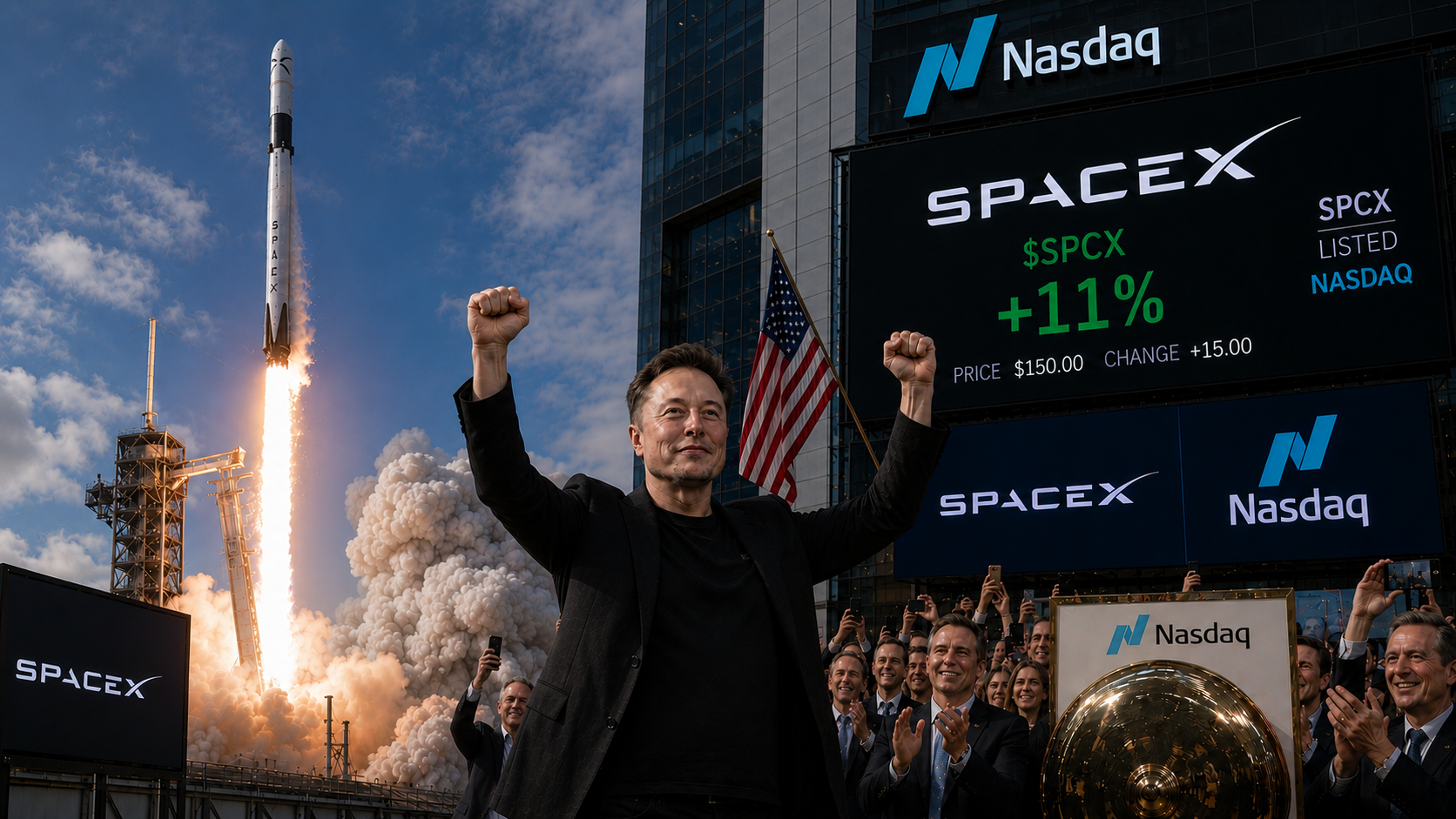
History was made on Wall Street Friday morning. SpaceX (Nasdaq: SPCX) began trading on the Nasdaq at $150 per share — 11% above its $135 IPO price — in the largest public market debut in history. Shares immediately surged to an intraday high of $168.40, pushing the company’s market capitalization above $2 trillion and lifting Elon Musk’s net worth to an estimated $1.3 trillion or more, making him the first person in human history to achieve trillionaire status on paper.

The milestone is as much a reflection of what SpaceX has built over 24 years as it is of the scale of investor demand that greeted the stock on its first day of public trading.

The Numbers Behind the Debut

The SpaceX IPO officially priced at $135 per share Thursday evening, raising approximately $75 billion — the largest capital raise in IPO history — and assigning the company a market capitalization of $1.77 trillion from day one. The offering was oversubscribed four times, meaning institutional investors who wanted allocations did not receive them and are now buying shares in the open market, providing additional upward price support on the first trading day.

The demand dynamic is amplified by an unusually small public float. Only approximately 4% of SpaceX shares are available for public trading, with early investors, employees, and insiders holding the remaining 96% subject to lock-up restrictions. That combination of overwhelming institutional demand against a tiny available float is the primary mechanical driver of today’s opening price action.

The IPO is also one of the largest single wealth creation events in venture capital history. Founders Fund, which invested $600 million in SpaceX and holds approximately a 3% stake, is sitting on estimated returns of more than $50 billion at the $135 IPO price. Andreessen Horowitz’s stake is valued at more than $10 billion. Sequoia’s position is worth over $20 billion. Approximately 4,400 current and former SpaceX employees are expected to become millionaires as a result of the listing, with roughly 400 reaching centimillionaire status.

The Index Inclusion Catalyst Is Days Away

One of the most consequential structural factors supporting SPCX in the near term is not investor enthusiasm — it is mandatory index buying. SpaceX successfully lobbied multiple major indexes, including the Nasdaq-100, to change their inclusion eligibility rules ahead of the IPO. Under the revised Fast Entry rule that took effect May 1, SpaceX will join those indexes in a matter of days rather than the months the prior process would have required. Once included, every ETF and passive fund benchmarked to those indexes will be required to purchase SPCX at whatever price the market sets — creating a structural buyer with no price sensitivity arriving imminently.

What Is Happening to Smaller Space Stocks Today

While SPCX trades sharply higher, virtually every small and microcap space company that had been rallying in anticipation of today’s debut is selling off hard in the same session. York Space Systems is down more than 16%. Firefly Aerospace has fallen over 16%. EchoStar is off nearly 15%. Voyager Technologies is down more than 13%. AST SpaceMobile has declined more than 12%.

The pattern is a textbook “sell the news” rotation. Investors who accumulated positions in smaller space names as proxies for SpaceX IPO excitement are now rotating directly into SPCX. Capital that had been parked in accessible small cap space vehicles while SpaceX remained private is moving into the real thing now that it is publicly available.

The Question That Matters Going Forward

The more important question for investors in smaller space companies is not what happens today. It is what happens over the next six to eighteen months as SpaceX operates as a public company with $75 billion in fresh capital and a publicly traded stock as acquisition currency. The company’s vertical integration across launch, satellite connectivity, AI, and lunar operations means it competes with or could potentially acquire virtually every other company in the space technology sector.

For some smaller names, a well-capitalized public SpaceX validates and accelerates the sector’s commercial development. For others, it is a better-funded competitor now operating with full public transparency. The index buying wave arriving in the coming days will be the next major price catalyst to watch — both for SPCX and for the smaller companies trading in its orbit.

Elon Musk gave SpaceX less than a 10% chance of success when he founded it in 2002. On Friday June 12, 2026, the market assigned it a $2 trillion valuation. The 24-year wait is over.
SpaceX Prices Tomorrow and Lists Thursday. For Smaller Space Tech Companies, the Ripple Effects Are Just Beginning

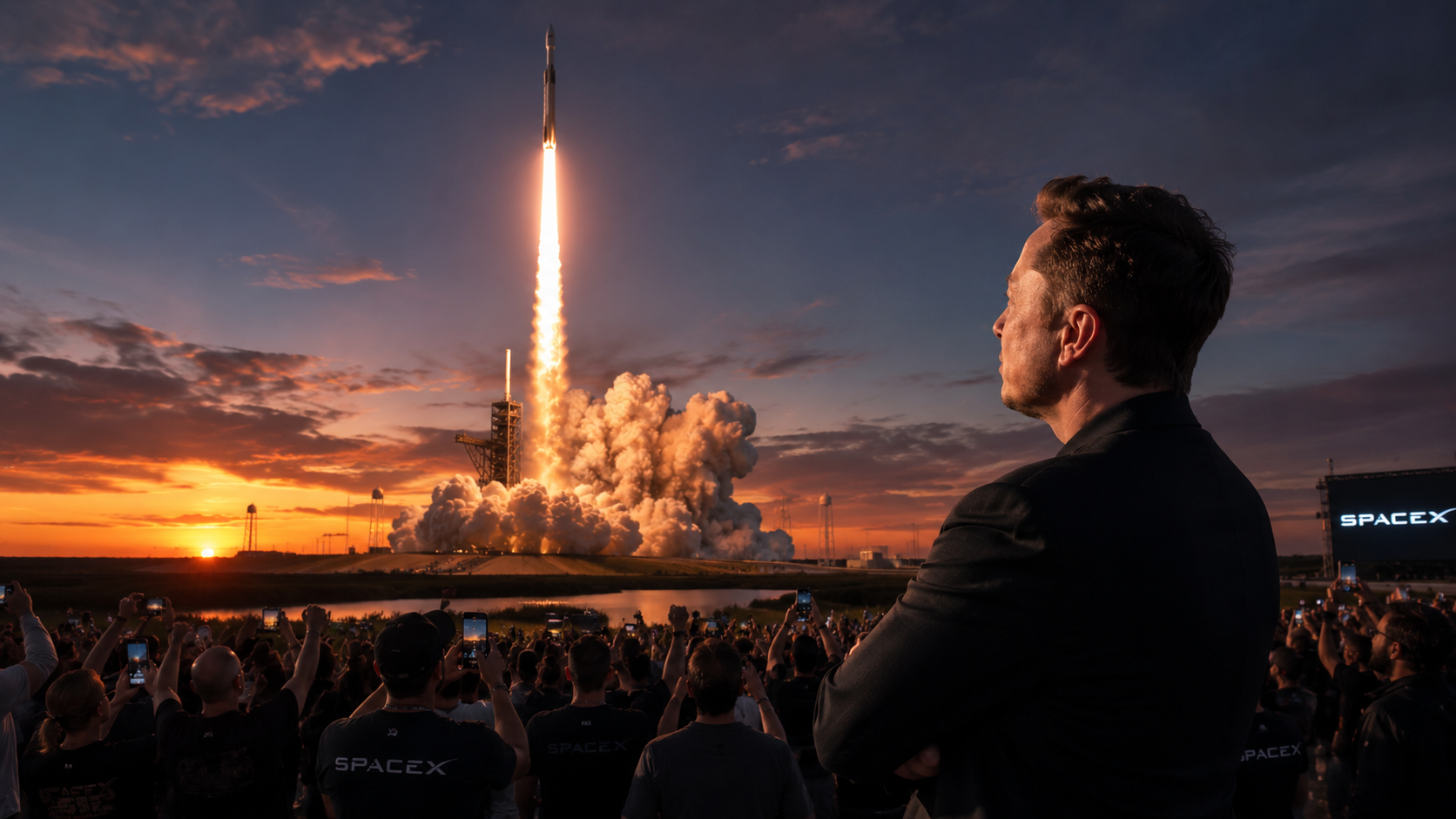
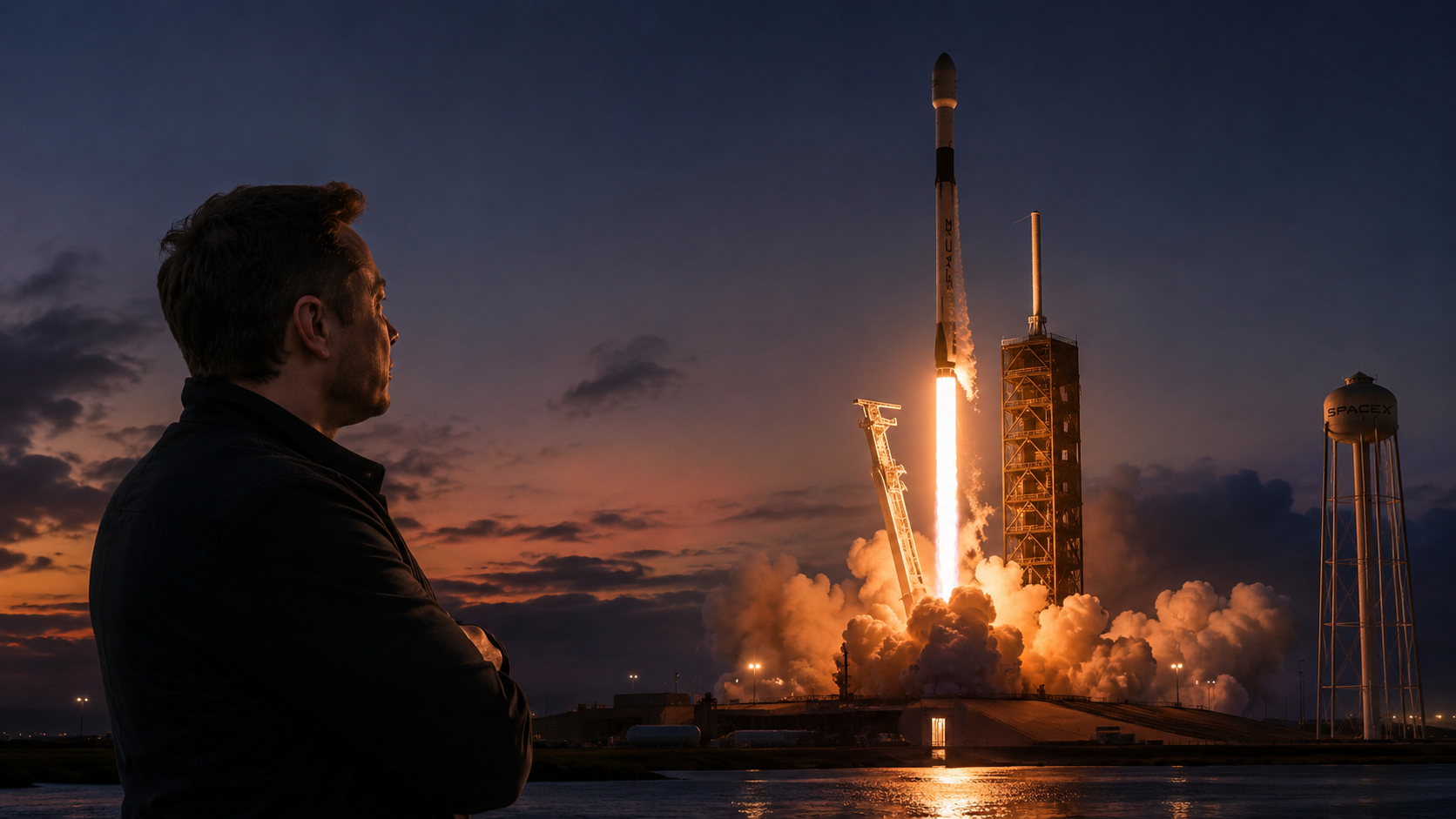
Twenty-four years after Elon Musk founded SpaceX with $100 million of his own capital and a stated goal of making humanity multiplanetary, the company is hours away from becoming a publicly traded stock. SpaceX prices its shares tomorrow evening June 11 at a fixed $135 per share, targeting a $1.75 trillion valuation and a $75 billion raise — the largest initial public offering in the history of global capital markets. Trading begins Thursday June 12 on the Nasdaq under the ticker SPCX.

The headline numbers are almost impossible to contextualize. The $75 billion raise is more than double Saudi Aramco’s 2019 record of $29 billion, itself the prior all-time high. At $1.75 trillion, SpaceX would debut as roughly the seventh largest US company by market capitalization, above Tesla’s current valuation. The offering is backed by 21 underwriting banks in a syndicate internally codenamed Project Apex and carries one of the largest retail allocations in IPO history — with up to 30% of shares reserved for individual investors, compared to the 5% to 10% typical of standard large deals. A dedicated retail investor event takes place tomorrow for approximately 1,500 participants before pricing locks in.

What the S-1 Actually Shows

Beyond the valuation, the S-1 prospectus filed last month confirmed the financial reality behind the ambition. SpaceX generated $18.67 billion in total revenue in 2025. Starlink, its satellite internet business, posted $1.19 billion in operating profit in Q1 2026 alone and now serves 10.3 million subscribers globally, making it the primary earnings engine of the combined company. The balance sheet carries $25.45 billion in contractual commitments, with 95% of that volume scheduled for delivery in 2026 and 2027 — a forward revenue visibility profile that most public companies would envy. The company also holds 18,712 Bitcoin valued at approximately $1.45 billion.

SpaceX is not yet consistently GAAP profitable, reflecting the capital intensity of the launch and satellite infrastructure businesses. The $1.75 trillion valuation implies roughly 93 to 116 times trailing revenue — a multiple that prices in Starlink’s long-term subscriber growth trajectory rather than current earnings.

What Thursday’s Listing Means for Smaller Space Companies

For investors tracking the small and microcap companies operating in SpaceX’s orbit, Thursday is not just a spectacle. It is a structural event with direct implications for how the space technology sector gets valued, funded, and acquired going forward.

When the anchor company in any sector goes public at a generational valuation, the effects flow downstream through the entire ecosystem. Institutional capital that had limited mechanisms to access the space sector will now have a liquid, large-cap benchmark around which to build broader space technology allocations. That reallocation historically draws attention and investment dollars toward smaller companies operating in adjacent parts of the same value chain.

The names most directly positioned to benefit include smaller launch vehicle companies, satellite infrastructure providers, space data and analytics platforms, and defense-adjacent space technology operators — many of which trade well below $2 billion in market cap and have been rallying in anticipation of exactly this moment. Rocket Lab, Momentus, Redwire, AST SpaceMobile, Planet Labs, and Voyager Technologies have all moved meaningfully higher in the weeks leading into the SpaceX debut as the sector’s profile has risen with the roadshow.

There is also an acquisition dimension worth monitoring. SpaceX entering the public markets with $75 billion in fresh capital and a publicly traded stock as acquisition currency creates conditions under which smaller space technology companies with complementary capabilities become strategically attractive targets. The company has already demonstrated an appetite for vertical integration across launch, connectivity, and AI through the xAI merger earlier this year.

The Nasdaq-100 Fast Entry rule change that took effect May 1 adds another mechanical layer. If SpaceX qualifies for the Nasdaq-100 after just 15 trading days of trading — which its market cap almost certainly ensures — index funds tracking that benchmark will be required to purchase shares at whatever price the market sets in late June. That creates a structural buyer with no price sensitivity, a dynamic that has historically supported the broader sector in the weeks following a major index inclusion event.

Thursday marks the end of SpaceX’s life as a private company. For the smaller companies that have been building in its shadow for years, it may mark the beginning of their most visible chapter yet.

SpaceX Is Targeting the Largest IPO in History

The IPO market is about to face its most consequential test in decades. SpaceX, Elon Musk’s aerospace, satellite, and artificial intelligence conglomerate, is targeting a June 12 Nasdaq debut under the ticker SPCX — aiming to raise as much as $75 billion at a valuation approaching $1.75 trillion. If it prices at that level, it would shatter Saudi Aramco’s 2019 record of $35.4 billion as the largest initial public offering ever completed.

The timeline is now concrete. SpaceX is expected to file its S-1 prospectus publicly this week, with a roadshow scheduled to begin June 4 and share pricing targeted for June 11. A 5-for-1 stock split is completing by May 22, adjusting the internal per-share value from $526.59 to approximately $105.32 — a move widely interpreted as lowering the entry price ahead of listing to broaden retail accessibility. Musk has reportedly directed that up to 30% of IPO shares be reserved for individual investors, an unusually high retail allocation for a deal of this magnitude.

What SpaceX Actually Is Now

SpaceX merged with Musk’s AI venture xAI in February, creating a combined entity that now encompasses the Falcon 9 rocket program, the Starlink satellite internet service, the Starship development program, and xAI’s artificial intelligence platform. The company generated between $15 billion and $16 billion in revenue in 2025, with Starlink — which now serves more than 9 million users globally — serving as the primary growth engine. At the targeted $1.75 trillion valuation, the deal implies a revenue multiple of approximately 109 to 116 times trailing sales — a figure that reflects growth expectations rather than current fundamentals.

BlackRock is reportedly in discussions to invest between $5 billion and $10 billion in the offering, which would represent one of the largest anchor commitments in IPO history. The deal’s dual-class share structure will preserve Musk’s voting control following the listing.

The Context: A Record That Puts Everything Else in Perspective

SpaceX’s targeted raise of $75 billion is more than double Aramco’s record. It is more than the combined IPO proceeds of the ten largest US technology listings in the past decade. The valuation of $1.75 trillion would immediately place SPCX among the ten most valuable publicly traded companies in the world on its first day of trading.

The deal follows Cerebras Systems’ blockbuster Nasdaq debut last week, which saw shares surge nearly 90% on the first day of trading and briefly pushed the company’s market cap above $100 billion. That listing, itself the largest US tech IPO since Uber in 2019, now looks like a warm-up act.

What It Means for Smaller Investors and the Broader Market

For small and microcap investors the SpaceX IPO is relevant on two levels. First, the deal’s scale and the retail allocation represent a genuine opportunity for individual investors to participate in a listing that institutional capital will compete aggressively to access. Second, a successful SpaceX debut at or near the targeted valuation would validate the current wave of AI and space technology investment theses — and create a rising tide for smaller companies operating in adjacent spaces.

Domestic satellite technology providers, aerospace component manufacturers, launch infrastructure companies, and AI hardware suppliers in the sub-$2 billion market cap range have historically seen multiple expansion in the wake of high-profile sector listings. SpaceX going public at $1.75 trillion would be the most powerful sector validation signal the space and AI technology markets have ever received.

OpenAI and Anthropic are both reportedly preparing IPO filings for later in 2026. The window is open and the market is paying attention.

xAI Hits $200 Billion Valuation After $10 Billion Raise

Elon Musk’s artificial intelligence venture, xAI, has secured a massive $10 billion funding round that values the startup at $200 billion, according to reports from CNBC. The raise highlights the continued investor enthusiasm in the artificial intelligence sector, even as questions swirl about tech spending and long-term sustainability.

The new valuation more than doubles the company’s $75 billion mark from just two months earlier, underscoring the accelerating pace of capital flowing into AI. With this milestone, xAI now ranks among the world’s most valuable private technology companies, sitting alongside global heavyweights such as OpenAI, ByteDance, and Musk’s own SpaceX.

Expanding AI Infrastructure

Much of the funding is expected to be deployed toward data centers powered by advanced Nvidia and AMD graphics processors, a crucial component in developing and training next-generation AI systems. Analysts note that GPU-driven clusters are the backbone of today’s AI race, as firms compete to push the boundaries of model performance, scalability, and reliability.

xAI has already made headlines for Colossus, its supercomputer cluster in Memphis, Tennessee, which the company claims is the largest of its kind worldwide. The expansion of this infrastructure signals Musk’s intent to ensure that xAI can rival established leaders like OpenAI and Anthropic in the high-stakes competition to dominate the AI landscape.

The funding round arrives at a time when competitors are also securing significant backing. Earlier this month, Anthropic raised $13 billion at a valuation of $183 billion, while OpenAI is reportedly in talks for a stock sale that could value the company at around $500 billion. ByteDance, meanwhile, is preparing a new employee share buyback program at a valuation of more than $330 billion.

By entering the $200 billion valuation club, xAI not only signals its arrival among elite AI firms but also highlights the fierce battle for both talent and infrastructure. Much of the new capital is expected to go toward recruiting top AI researchers and engineers—an area where costs continue to rise as demand far exceeds supply.

Building Toward the Future

Musk’s AI ambitions go beyond technology alone. xAI acquired the social media platform X (formerly Twitter) earlier this year, giving it a unique advantage in terms of training data and user integration. By combining large-scale data resources with cutting-edge compute infrastructure, xAI is positioning itself as a long-term challenger to the sector’s biggest players.

The latest valuation leap reflects not just investor confidence in xAI, but also broader optimism that AI technologies will remain central to economic and business growth for years to come. With infrastructure rapidly scaling and capital continuing to pour in, xAI’s next steps will be closely watched as it attempts to shape the future of artificial intelligence.

Is Elon Musk Transforming Tesla Into an AI Company?

In the rapidly evolving world of technology, Elon Musk and Tesla are shaking things up with what appears to be a strategic shift towards artificial intelligence (AI) and robotics. As electric vehicle (EV) demand cools in 2024, Tesla seems to be pivoting its focus to autonomy, Full Self-Driving (FSD), and its hotly anticipated robotaxi program. This potential redirection has piqued the interest of investors, particularly those hunting for undervalued and overlooked opportunities among small and micro-cap stocks.

The signs of transformation at Tesla have been mounting. Most notably, the company recently announced layoffs impacting over 10% of its global workforce, with key executives departing in what Musk framed as part of the “next phase of growth.” Compounding the speculation, reports emerged that Tesla shelved plans for its $25,000 next-generation Model 2 vehicle to prioritize the robotaxi initiative instead.

Musk himself has stoked the flames, proclaiming on Twitter that “Tesla is an AI/robotics and sustainable energy company.” This bold statement marks a clear departure from Tesla’s automotive roots, signaling that a broader pivot to artificial intelligence may be underway.

Analysts tracking the company have been sounding alarms. Emmanuel Rosner at Deutsche Bank believes Tesla’s future now hinges on “cracking the code on full driverless autonomy” – a formidable challenge layered with significant technological, regulatory and operational hurdles. Morgan Stanley’s Adam Jonas went so far as to say “it seems” Tesla is exiting the traditional EV auto industry altogether, though he doesn’t expect vehicle production to cease immediately.

For investors, particularly those scouring small and micro-cap stocks for overlooked gems, Tesla’s AI ambitions could foreshadow seismic shifts ahead. Analysts warn of a “potentially painful transition in ownership base” as dyed-in-the-wool electric vehicle investors may “throw in the towel” and be replaced by tech funds with far longer investment horizons suited for frontier AI bets.

If Tesla does successfully reinvent itself as an AI juggernaut, sector valuations and comparable companies would be turned on their head. Traditional automotive benchmarks may no longer apply, forcing investors to reimagine their investment theses from scratch.

To be sure, the rewards of being at the vanguard of automated driving and machine intelligence could be immense. But the associated risks are equally daunting as Tesla stares down imposing technological barriers, regulatory quicksand, and operational growing pains. For nimble investors, the transformation could open doors to diversify into AI and robotics through an established player boasting visionary leadership and deep pockets.

When Tesla reports first quarter earnings next week, all eyes will be glued to Elon Musk for clarity and insight into precisely where he plans to steer this potential AI metamorphosis. The report could prove revelatory in glimpsing the future trajectory of a company that may be in the midst of redefining itself as the vanguard of a new technological epoch.

For small and micro-cap investors perpetually searching for the next undervalued, under-the-radar opportunity, Tesla’s AI aspirations warrant close scrutiny. While hazards abound, the potential rewards of getting in on the ground floor of a transformative technology upstart could be nothing short of game-changing.

Tesla Slashes Workforce by Over 10% as Demand Softens

In a move that has sent shockwaves through the electric vehicle industry, Tesla Inc. announced plans to lay off more than 10% of its global workforce. The decision, confirmed by CEO Elon Musk in an internal memo, comes on the heels of a disappointing first-quarter delivery report that missed analyst estimates and left the company with an excess inventory of over 46,000 vehicles.

The layoffs, which are expected to impact at least 14,000 employees out of Tesla’s 140,000-strong workforce, are part of a broader effort to cut costs and increase productivity as the company prepares for its “next phase of growth,” according to Musk’s memo. The move underscores the challenges facing Tesla amid a slowdown in EV demand, both in the United States and globally.

“As we prepare the company for our next phase of growth, it is extremely important to look at every aspect of the company for cost reductions and increasing productivity,” Musk wrote in the memo. “As part of this effort, we have done a thorough review of the organization and made the difficult decision to reduce our headcount by more than 10% globally. There is nothing I hate more, but it must be done.”

The announcement has sent shockwaves through the industry, with analysts offering mixed reactions to the news. Dan Ives, a noted Tesla bull at Wedbush Securities, described the layoffs as an “ominous signal” that speaks to tough times ahead for the company. “Demand has been soft globally, and this is an unfortunately necessary move for Tesla to cut costs with a softer growth outlook,” Ives said, adding that the move signals that Musk is navigating a “Category 5 storm.”

However, not all analysts view the layoffs as a negative development. Garrett Nelson, an analyst at CFRA, sees the move as consistent with actions undertaken by other automakers – and particularly EV pure-plays such as Rivian and Lucid – amid slowing EV growth rates. “We view the announcement as a sign of the times, but the fact Tesla is taking action to reduce costs amid the slowdown should be positive for the bottom line,” Nelson said.

The layoffs come at a critical juncture for Tesla, which has long been hailed as a pioneer in the electric vehicle space. After years of breakneck growth and ambitious expansion plans, the company now finds itself grappling with a rapidly changing market landscape. Rising interest rates and higher overall prices have dampened consumer demand for electric vehicles, while increased competition from legacy automakers and upstart EV manufacturers has intensified pressure on Tesla to maintain its competitive edge.

Musk has repeatedly emphasized the importance of affordability in driving EV adoption, fueling speculation that Tesla was working on a next-generation vehicle that would start at around $25,000. However, recent reports suggesting that the company had canceled the project were met with a swift denial from Musk, who instead teased the debut of a Tesla robotaxi on August 8.

As Tesla prepares to report its first-quarter earnings on April 23, all eyes will be on the company’s ability to weather the current storm and chart a course for long-term growth. The layoffs, while painful, may be a necessary step in ensuring Tesla’s long-term competitiveness in an increasingly crowded and challenging market.

Neuralink’s First Human Implant Could Spark Tech Stock Volatility

Elon Musk’s brain-computer interface company Neuralink announced this week it has conducted the first-ever implant of its device in a human subject. While details remain scant, the news serves as a milestone for a technology some believe could transform human capability. For tech investors, Neuralink’s progress stokes excitement but also uncertainty around the winners and losers in an era of enhanced humans.

Neuralink aims to develop a brain implant allowing paralyzed patients to control devices with their thoughts and able-bodied people to digitally communicate at speeds faster than speech. The first implant surgery comes after years of animal testing and brings the possibilities closer to reality.

According to Musk, the anonymous volunteer patient is “recovering well” and initial results show “promising neuron spike detection” from the 1024 electrode threads inserted by a surgical robot. The goal is for the implants to interpret brain signals, replacing the need for physical movement to operate computers or smartphones.

While the current trial is focused on quadriplegic patients, the ultimate vision is a technology so seamless it augments natural brain function. With the ability to download information directly into the brain, Neuralink promises a future where humans can achieve computer-like efficiency.

Leaps Forward, Ethical Debates

To technologists, successfully reading and transmitting neural signals brings humanity to the brink of a productivity revolution. Brain enhancement could elevate human potential and economic output, feeding into further innovation and growth.

However, developers must tread carefully given sobering lessons from the smartphone era’s negative effects on mental health. Addictive potential and unintended consequences abound when tampering with humanity’s most complex organ.

Investing Implications

For stocks, Neuralink’s progress exemplifies the promise and peril of emerging technologies. Huge opportunity exists as brain-computer interfaces enable new industries and services. But ethical debates or setbacks could also derail optimism.

The saga of Meta’s metaverse ambitions is instructive. Despite billions invested, underwhelming VR technology and idealistic vision have sunk the stock. Neuralink requires immense scientific progress to become reality. Any stumbles or loss of faith in the vision could rapidly deflate hype.

Yet some secular growth trends appear inevitable. Neuralink-inspired advances will boost artificial intelligence capabilities, a priority for giants like Alphabet and Amazon. Cloud infrastructure and high-performance computing demands will accelerate. Medical device makers and chip developers enabling products like Neuralink will see new markets open.

Mark your calendars for the upcoming Noble Capital Markets’ Emerging Growth Virtual Healthcare Equity Conference from April 17-18, 2024. The premier small-cap event will feature presentations from over 50 public emerging growth companies in the space.

But more speculative ideas or overvalued stocks could crumble on the slightest speedbump. Investors must differentiate between progress and promotional hype. In biotech, this means focusing on companies with robust, diversified drug pipelines rather than single-product moonshot bets.

Betting on Musk himself is dubious given the seesawing markets have experienced around Tesla and Twitter. While his cult of personality propels cash into his ventures, realistic timeframes and execution risks are higher than perceived.

Ultimately, Neuralink is emblematic of both the transformative potential and inherent volatility of disruptive technology. Its first human application sparks excitement, but a measured approach accounts for hurdles ahead. Investors can embrace futuristic optimism while grounding in reality.