SpaceX Opens at $150, Makes Elon Musk the World’s First Trillionaire, and Sends Smaller Space Stocks Reeling

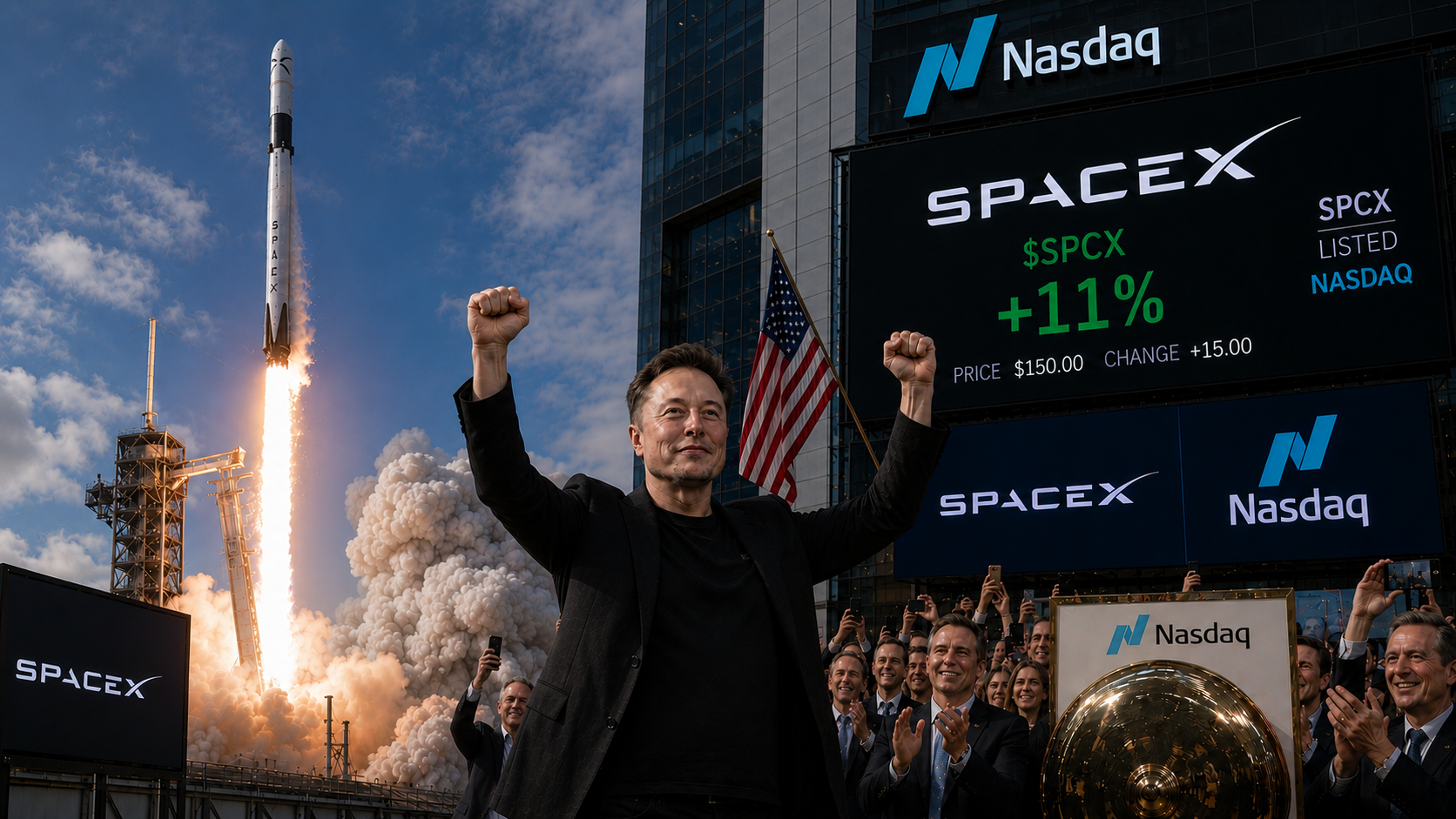
History was made on Wall Street Friday morning. SpaceX (Nasdaq: SPCX) began trading on the Nasdaq at $150 per share — 11% above its $135 IPO price — in the largest public market debut in history. Shares immediately surged to an intraday high of $168.40, pushing the company’s market capitalization above $2 trillion and lifting Elon Musk’s net worth to an estimated $1.3 trillion or more, making him the first person in human history to achieve trillionaire status on paper.

The milestone is as much a reflection of what SpaceX has built over 24 years as it is of the scale of investor demand that greeted the stock on its first day of public trading.

The Numbers Behind the Debut

The SpaceX IPO officially priced at $135 per share Thursday evening, raising approximately $75 billion — the largest capital raise in IPO history — and assigning the company a market capitalization of $1.77 trillion from day one. The offering was oversubscribed four times, meaning institutional investors who wanted allocations did not receive them and are now buying shares in the open market, providing additional upward price support on the first trading day.

The demand dynamic is amplified by an unusually small public float. Only approximately 4% of SpaceX shares are available for public trading, with early investors, employees, and insiders holding the remaining 96% subject to lock-up restrictions. That combination of overwhelming institutional demand against a tiny available float is the primary mechanical driver of today’s opening price action.

The IPO is also one of the largest single wealth creation events in venture capital history. Founders Fund, which invested $600 million in SpaceX and holds approximately a 3% stake, is sitting on estimated returns of more than $50 billion at the $135 IPO price. Andreessen Horowitz’s stake is valued at more than $10 billion. Sequoia’s position is worth over $20 billion. Approximately 4,400 current and former SpaceX employees are expected to become millionaires as a result of the listing, with roughly 400 reaching centimillionaire status.

The Index Inclusion Catalyst Is Days Away

One of the most consequential structural factors supporting SPCX in the near term is not investor enthusiasm — it is mandatory index buying. SpaceX successfully lobbied multiple major indexes, including the Nasdaq-100, to change their inclusion eligibility rules ahead of the IPO. Under the revised Fast Entry rule that took effect May 1, SpaceX will join those indexes in a matter of days rather than the months the prior process would have required. Once included, every ETF and passive fund benchmarked to those indexes will be required to purchase SPCX at whatever price the market sets — creating a structural buyer with no price sensitivity arriving imminently.

What Is Happening to Smaller Space Stocks Today

While SPCX trades sharply higher, virtually every small and microcap space company that had been rallying in anticipation of today’s debut is selling off hard in the same session. York Space Systems is down more than 16%. Firefly Aerospace has fallen over 16%. EchoStar is off nearly 15%. Voyager Technologies is down more than 13%. AST SpaceMobile has declined more than 12%.

The pattern is a textbook “sell the news” rotation. Investors who accumulated positions in smaller space names as proxies for SpaceX IPO excitement are now rotating directly into SPCX. Capital that had been parked in accessible small cap space vehicles while SpaceX remained private is moving into the real thing now that it is publicly available.

The Question That Matters Going Forward

The more important question for investors in smaller space companies is not what happens today. It is what happens over the next six to eighteen months as SpaceX operates as a public company with $75 billion in fresh capital and a publicly traded stock as acquisition currency. The company’s vertical integration across launch, satellite connectivity, AI, and lunar operations means it competes with or could potentially acquire virtually every other company in the space technology sector.

For some smaller names, a well-capitalized public SpaceX validates and accelerates the sector’s commercial development. For others, it is a better-funded competitor now operating with full public transparency. The index buying wave arriving in the coming days will be the next major price catalyst to watch — both for SPCX and for the smaller companies trading in its orbit.

Elon Musk gave SpaceX less than a 10% chance of success when he founded it in 2002. On Friday June 12, 2026, the market assigned it a $2 trillion valuation. The 24-year wait is over.
SpaceX Prices Tomorrow and Lists Thursday. For Smaller Space Tech Companies, the Ripple Effects Are Just Beginning

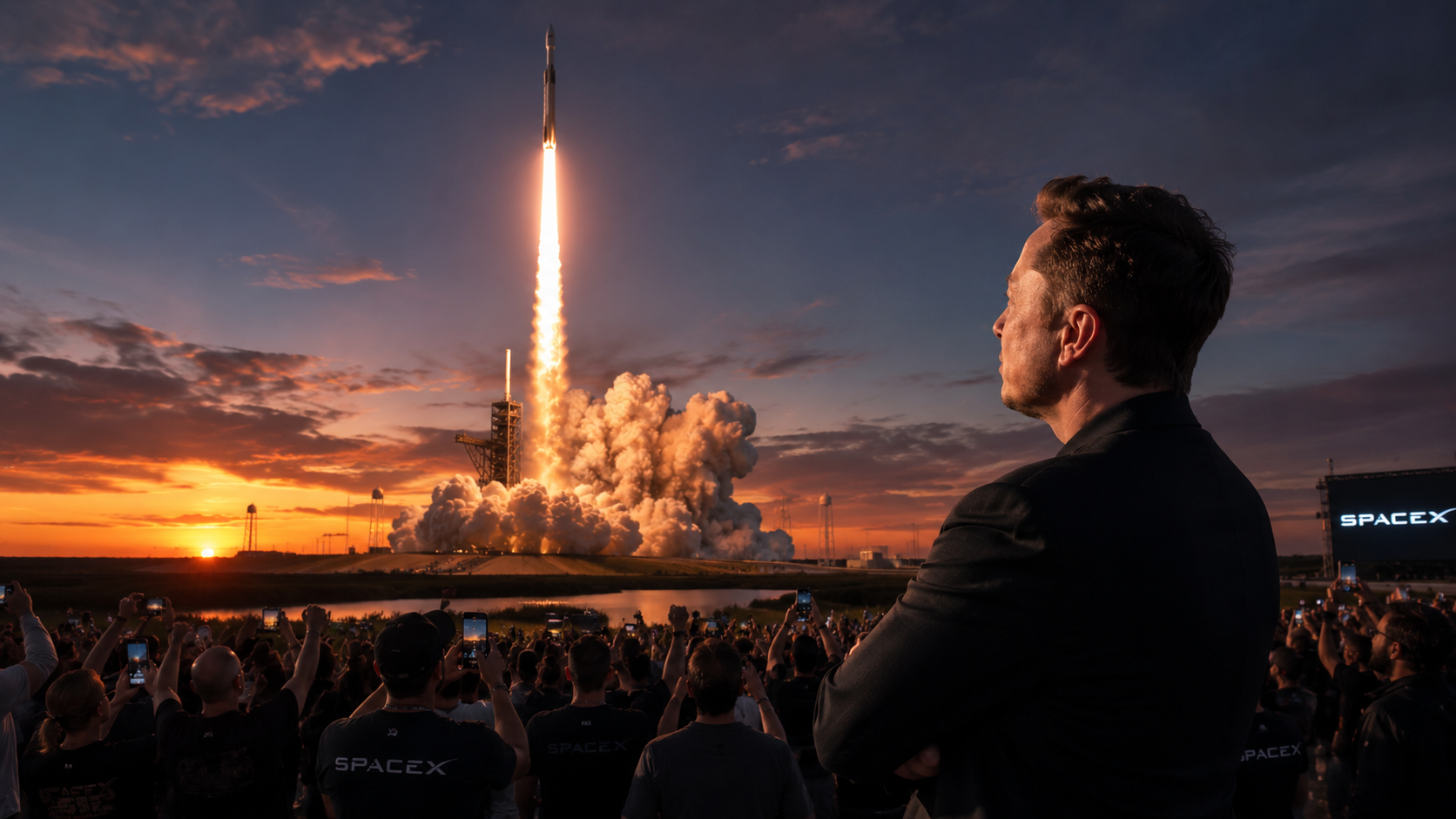
Twenty-four years after Elon Musk founded SpaceX with $100 million of his own capital and a stated goal of making humanity multiplanetary, the company is hours away from becoming a publicly traded stock. SpaceX prices its shares tomorrow evening June 11 at a fixed $135 per share, targeting a $1.75 trillion valuation and a $75 billion raise — the largest initial public offering in the history of global capital markets. Trading begins Thursday June 12 on the Nasdaq under the ticker SPCX.

The headline numbers are almost impossible to contextualize. The $75 billion raise is more than double Saudi Aramco’s 2019 record of $29 billion, itself the prior all-time high. At $1.75 trillion, SpaceX would debut as roughly the seventh largest US company by market capitalization, above Tesla’s current valuation. The offering is backed by 21 underwriting banks in a syndicate internally codenamed Project Apex and carries one of the largest retail allocations in IPO history — with up to 30% of shares reserved for individual investors, compared to the 5% to 10% typical of standard large deals. A dedicated retail investor event takes place tomorrow for approximately 1,500 participants before pricing locks in.

What the S-1 Actually Shows

Beyond the valuation, the S-1 prospectus filed last month confirmed the financial reality behind the ambition. SpaceX generated $18.67 billion in total revenue in 2025. Starlink, its satellite internet business, posted $1.19 billion in operating profit in Q1 2026 alone and now serves 10.3 million subscribers globally, making it the primary earnings engine of the combined company. The balance sheet carries $25.45 billion in contractual commitments, with 95% of that volume scheduled for delivery in 2026 and 2027 — a forward revenue visibility profile that most public companies would envy. The company also holds 18,712 Bitcoin valued at approximately $1.45 billion.

SpaceX is not yet consistently GAAP profitable, reflecting the capital intensity of the launch and satellite infrastructure businesses. The $1.75 trillion valuation implies roughly 93 to 116 times trailing revenue — a multiple that prices in Starlink’s long-term subscriber growth trajectory rather than current earnings.

What Thursday’s Listing Means for Smaller Space Companies

For investors tracking the small and microcap companies operating in SpaceX’s orbit, Thursday is not just a spectacle. It is a structural event with direct implications for how the space technology sector gets valued, funded, and acquired going forward.

When the anchor company in any sector goes public at a generational valuation, the effects flow downstream through the entire ecosystem. Institutional capital that had limited mechanisms to access the space sector will now have a liquid, large-cap benchmark around which to build broader space technology allocations. That reallocation historically draws attention and investment dollars toward smaller companies operating in adjacent parts of the same value chain.

The names most directly positioned to benefit include smaller launch vehicle companies, satellite infrastructure providers, space data and analytics platforms, and defense-adjacent space technology operators — many of which trade well below $2 billion in market cap and have been rallying in anticipation of exactly this moment. Rocket Lab, Momentus, Redwire, AST SpaceMobile, Planet Labs, and Voyager Technologies have all moved meaningfully higher in the weeks leading into the SpaceX debut as the sector’s profile has risen with the roadshow.

There is also an acquisition dimension worth monitoring. SpaceX entering the public markets with $75 billion in fresh capital and a publicly traded stock as acquisition currency creates conditions under which smaller space technology companies with complementary capabilities become strategically attractive targets. The company has already demonstrated an appetite for vertical integration across launch, connectivity, and AI through the xAI merger earlier this year.

The Nasdaq-100 Fast Entry rule change that took effect May 1 adds another mechanical layer. If SpaceX qualifies for the Nasdaq-100 after just 15 trading days of trading — which its market cap almost certainly ensures — index funds tracking that benchmark will be required to purchase shares at whatever price the market sets in late June. That creates a structural buyer with no price sensitivity, a dynamic that has historically supported the broader sector in the weeks following a major index inclusion event.

Thursday marks the end of SpaceX’s life as a private company. For the smaller companies that have been building in its shadow for years, it may mark the beginning of their most visible chapter yet.