Mark Reichman, Managing Director, Equity Research Analyst, Natural Resources, Noble Capital Markets, Inc.
Refer to the full report for the price target, fundamental analysis, and rating.
Unique within the junior mining space. Nicola Mining (NASDAQ: NICM, TSX.V: NIM) combines near-term cash flow generation with significant exploration upside across a portfolio of gold, silver, and copper assets in British Columbia. A key strategic asset is the fully permitted Merritt Mill, the only facility in British Columbia allowed to process third-party gold and silver ore, with expansion plans underway to increase throughput capacity. Nicola seeks to leverage its mill by providing milling services under profit-sharing agreements to third parties and consolidating small high-grade gold and silver projects in British Columbia, while advancing its New Craigmont Copper, Treasure Mountain Silver, and Dominion Creek Gold projects.
Advancing multiple avenues of growth. Nicola’s flagship New Craigmont Copper Project is a significant value driver, with ongoing drilling targeting a potential large-scale porphyry copper system adjacent to the Highland Valley Copper Mine. Nicola is also advancing the high-grade Treasure Mountain Silver Project and the Dominion Creek Gold Project, both of which are expected to see increased exploration and development activity later this year.
Equity Research is available at no cost to Registered users of Channelchek. Not a Member? Click ‘Join’ to join the Channelchek Community. There is no cost to register, and we never collect credit card information.
This Company Sponsored Research is provided by Noble Capital Markets, Inc., a FINRA and S.E.C. registered broker-dealer (B/D).
*Analyst certification and important disclosures included in the full report. NOTE: investment decisions should not be based upon the content of this research summary. Proper due diligence is required before making any investment decision.
Mark Reichman, Managing Director, Equity Research Analyst, Natural Resources, Noble Capital Markets, Inc.
Refer to the full report for the price target, fundamental analysis, and rating.
A Major Expansion and Upgrading of Mineral Resources. First Phosphate released the results of its updated Mineral Resource Estimate (MRE) for the Begin-Lamarche project in Saguenay-Lac-Saint Jean, Quebec, Canada. The updated MRE reflects the success of the company’s 2025 to 2026 drilling campaign, resulting in a 378% increase in indicated resources compared to the previous estimate completed two years ago. The significant upgrade is important because it advances a significant portion of the resource into the indicated and measured categories, which are required to move the project toward a feasibility study targeted for December 2026.
Longer Potential Mine Life. The ability to upgrade existing resources and classify newly discovered extensions directly into the indicated category demonstrates the strong continuity, consistency, and quality of the deposit. The increased tonnage is also expected to support a longer potential mine life, while the deposit remains open at depth, providing additional exploration upside and long-term growth potential.
Equity Research is available at no cost to Registered users of Channelchek. Not a Member? Click ‘Join’ to join the Channelchek Community. There is no cost to register, and we never collect credit card information.
This Research is provided by Noble Capital Markets, Inc., a FINRA and S.E.C. registered broker-dealer (B/D).
*Analyst certification and important disclosures included in the full report. NOTE: investment decisions should not be based upon the content of this research summary. Proper due diligence is required before making any investment decision.
Saguenay, Quebec–(Newsfile Corp. – May 26, 2026) – First Phosphate Corp (CSE: PHOS) (OTCQX: FRSPF) (OTCQX ADR: FPHOY) (FSE: KD0) (“First Phosphate” or the “Company”) is pleased to announce the results of its updated Mineral Resource Estimate (“MRE”) for its Bégin-Lamarche project in Saguenay-Lac-Saint-Jean, Québec, Canada. The updated MRE includes results from the 2025-2026 drilling program described in the Company’s press release dated April 27, 2026.
The updated MRE includes a 378% increase in Indicated Mineral Resources over the Company’s Initial MRE dated September 9, 2024.
Measured pit-constrained Mineral Resource: 6.2 Mt @ 7.70% P2O5 (phosphate).
Indicated pit-constrained Mineral Resource: 198.5 Mt @ 6.00% P2O5.
Inferred pit-constrained Mineral Resource: 89.5 Mt @ 6.16% P2O5.
The Deposit remains open at depth.
Metallurgical test work indicates an anticipated apatite concentrate grade of 40.4% P2O5 at an 88% process recovery rate, with very low levels of potentially deleterious elements, and has been qualified for production of battery-grade phosphoric acid for lithium iron phosphate (“LFP”) battery with a conversion ratio of 91.1%.
The Deposit is located next to existing road and hydroelectric infrastructure and at only 70 km driving distance from the deep-sea Port of Saguenay.
The Deposit benefits from definitive, long-term, partially prepaid offtake from an existing, creditworthy partner.
Apatite (phosphorus, phosphate) is listed on the critical minerals lists of Québec, Canada, the United States and the European Union.
“We are pleased with the results of our 2025-2026 drilling exploration program and the quantity and quality upgrade provided to our Mineral Resources,” says First Phosphate CEO, John Passalacqua. “We are now able to continue to move the project forward with great confidence in our Mineral Resources.”
The updated MRE, with an effective date of May 1, 2026, was carried out by Mr. Antoine Yassa, P.Geo., of P&E Mining Consultants Inc., who is an Independent Qualified Person within the meaning of Canadian Securities Administrators’ National Instrument 43-101: Standards of Disclosure for Mineral Projects (“NI 43-101”).
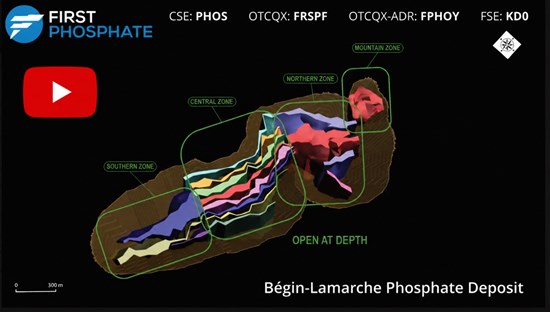
The Bégin-Lamarche Phosphate Deposit contains a significant phosphate Mineral Resource that is associated with well-defined oxide-apatite peridotite (OAP) intrusions within the large Lac-Saint-Jean anorthosite suite (LSJAS). The LSJAS is the largest phosphate-mineralized anorthosite worldwide. The phosphate Deposit is comprised of four mineralized zones which are continuous, only separated by faults within the Deposit and extend over a length of 2,750 m (Figure 1). The Mountain Zone is a single phosphate-bearing mass having a diameter of up to 200 m and a length of 250 m. The Northern zone is comprised of four phosphate layers ranging from 30 m to 200 m in thickness and a length of 625 m. The Central Zone bears eight phosphate layers, one of them having up to 50 m in thickness and extending to 900 m. The Southern Zone bears three phosphate layers, one of them having up to 125 m in thickness and extending to 725 m.
Figure 1 – The Bégin-Lamarche Deposit Updated Optimized Pit Shell
The Bégin-Lamarche Deposit mineralized wireframes boundaries were determined from lithology, structure, and grade boundary interpretation based on visual inspection of drill hole cross-sections. Four mineralized wireframe zones were developed and referred to as the Mountain, Northern, Central and Southern Zones. The mineralized wireframes were constructed on 50 m spaced vertical cross-sections, with on-screen digitized polylines on drill hole cross-sections in GEMS™. The mineralized wireframe outlines were influenced by the selection of mineralized material above 2.5% P2O5 that demonstrated a lithological and structural zonal continuity along strike and down dip. In some cases, mineralization <2.5% P2O5 was included for the purpose of maintaining mineralized zone continuity. The minimum constrained width for mineralized wireframe interpretation was 3 m of drill core length.
The Bégin-Lamarche Mineral Resource Estimate is based on 276 drill holes totalling 68,345 m. The database contained 20,682 analyses for percentage of P2O5. The Mineral Resource Estimate is presented in Table 1.
Table 1 Pit-Constrained Mineral Resource Estimate(1-4) at 2.5% P2O5 Cut-Off
Classification
Zone
Tonnes (M)
P2O5 (%)
P2O5 (Mt)
Measured
Mountain
6.2
7.70
0.47
Total
6.2
7.7
0.47
Indicated
Mountain
5.3
8.45
0.45
Northern
78.3
6.69
5.24
Central
71.0
5.50
3.91
Southern
43.9
5.26
2.31
Total
198.5
6.00
11.91
Measured & Indicated
Mountain
11.5
8.04
0.92
Northern
78.3
6.69
5.24
Central
71.0
5.50
3.91
Southern
43.9
5.26
2.31
Total
204.7
6.05
12.38
Inferred
Mountain
0.5
9.09
0.04
Northern
30.7
7.33
2.25
Central
31.8
5.67
1.80
Southern
26.5
5.32
1.41
Total
89.5
6.16
5.50
Note: P2O5 = phosphorus pentoxide.
1. Mineral Resources, which are not Mineral Reserves, do not have demonstrated economic viability.
2. The estimate of Mineral Resources may be materially affected by environmental, permitting, legal, title, taxation, socio-political, marketing, or other relevant issues.
3. The Inferred Mineral Resource in this estimate has a lower level of confidence than that applied to an Indicated Mineral Resource and must not be converted to a Mineral Reserve. The Company expects that the majority of the Inferred Mineral Resource may be upgraded to an Indicated Mineral Resource with continued exploration.
4. The Mineral Resources in this press release were estimated using the Canadian Institute of Mining, Metallurgy and Petroleum (CIM), CIM Standards on Mineral Resources and Reserves, Definitions (2014) and Best Practices Guidelines (2019) prepared by the CIM Standing Committee on Reserve Definitions and adopted by the CIM Council.
The Bégin-Lamarche Mineral Resource Estimate was derived from applying a 2.5% P2O5 cut-off value to the pit-constrained block model and reporting the resulting tonnes and grades for potentially mineable areas. The following parameters were used to calculate the cut-off value that determines the open pit potentially economic portion of the constrained mineralization (Table 2).
The P2O5 cut-off value is calculated with parameters below:
Mining Cost: C$2.75/t (mineralized material and waste)
Pit Slopes: 45°
Accordingly, the P2O5 cut-off of potential open pit mining is calculated to be = 2.5%.
The optimized pit-constrained Mineral Resource Estimate is moderately sensitive to the selection of reporting P2O5 cut-off values, as demonstrated in Table 2.
Table 2 Pit-Constrained Mineral Resource Estimate Sensitivity to P2O5 Cut-Off
Class
Cut-off
Tonnes
P2O5
P2O5
P2O5 %
(M)
(%)
(Mt)
Measured
5.0
4.9
8.67
0.4
4.5
5.2
8.43
0.4
4.0
5.5
8.22
0.5
3.5
5.8
8.02
0.5
3.0
6.0
7.84
0.5
2.5
6.2
7.70
0.5
2.0
6.3
7.57
0.5
Indicated
5.0
119.0
7.41
8.8
4.5
138.0
7.05
9.7
4.0
156.8
6.71
10.5
3.5
172.9
6.44
11.1
3.0
186.7
6.20
11.6
2.5
198.5
6.00
11.9
2.0
207.6
5.83
12.1
Inferred
5.0
55.5
7.49
4.2
4.5
65.0
7.09
4.6
4.0
73.6
6.75
5.0
3.5
80.9
6.49
5.2
3.0
86.0
6.29
5.4
2.5
89.5
6.16
5.5
2.0
92.0
6.05
5.6
Metallurgical Testwork has been successfully conducted by SGS at their Québec City facility with additional support by SGS Lakefield Ontario. Recent test results have confirmed that an apatite concentrate can be obtained analyzing 40.4% P2O5 and at 88% recovery.
First Phosphate’s Bégin-Lamarche Deposit is located approximately 50 km driving distance north of the City of Saguenay, Québec’s sixth-largest city, which hosts daily flights to Montréal, a skilled industrial workforce, strong local infrastructure, and which is 30 km driving distance from the deep-sea Port of Saguenay.
The geological and drilling work was planned, carried out and supervised by Laurentia Exploration Inc. The drill core was logged at Lamarche near the Deposit and at Laurentia Exploration’s offices. The drill core was sawed and sampled at Laurentia Exploration’s offices in Jonquière.
Qualified Persons
The scientific and technical disclosure for First Phosphate included in this News Release have been reviewed and approved by Steeve Lavoie, P.Geo. Mr. Lavoie is Chief Geologist of the Company and a Qualified Person under National Instrument 43-101 Standards of Disclosure of Mineral Projects (“NI 43-101”).
The Qualified Person independent of the issuer, responsible for estimating the Mineral Resources of the Begin-Lamarche Property, within the meaning of NI 43-101, is Mr. Antoine Yassa, P.Geo., of the firm P&E Mining Consultants Inc. Mr. Yassa has read and approved the scientific and technical information in this press release for accuracy and compliance with NI 43-101.
P&E Mining Consultants Inc., an associate group of 20 geological and mine engineering professionals established in 2004, provides geological and mine engineering consulting reports, Mineral Resource and Mineral Reserve Estimates, NI 43-101 Technical Reports, Preliminary Economic Assessments, Pre-Feasibility and Feasibility Studies.
Laurentia Exploration inc. is a firm of consulting geologists based in Jonquière, Saguenay Lac-St-Jean. It has 80 employees, mainly geology professionals who are members in good standing of a professional order. The firm was founded in 2017 and carries out projects throughout Québec and Ontario.
About First Phosphate Corp.
First Phosphate (CSE: PHOS) (OTCQX: FRSPF) (OTCQX ADR: FPHOY) (FSE: KD0) is a mineral exploration and development and clean technology company dedicated to building and reshoring a vertically integrated mine-to-market supply chain for the production of LFP batteries in North America. Target markets include energy storage, data centers, robotics, mobility, and national security.
First Phosphate’s flagship Bégin-Lamarche property, located in Saguenay-Lac-Saint-Jean, Québec, Canada, represents a rare North American igneous phosphate resource producing high-purity phosphate characterized by very low levels of impurities.
Forward-Looking Information and Cautionary StatementThis news release contains certain statements and information that may be considered “forward-looking statements” and “forward looking information” within the meaning of applicable securities laws. In some cases, but not necessarily in all cases, forward-looking statements and forward-looking information can be identified by the use of forward-looking terminology such as “plans”, “targets”, “expects” or “does not expect”, “is expected”, “an opportunity exists”, “is positioned”, “estimates”, “intends”, “assumes”, “anticipates” or “does not anticipate” or “believes”, or variations of such words and phrases or statements that certain actions, events or results “may”, “could”, “would”, “might”, “will” or “will be taken”, “occur” or “be achieved” and other similar expressions. In addition, statements in this news release that are not historical facts are forward looking statements, including, among other things: the Company’s planned exploration and production activities; the properties and composition of any extracted phosphate; and the calculation of mineral resources at the project and the possibility of eventual economic extraction of minerals from the project. Although the Company believes the expectations expressed in such forward-looking statements are based on reasonable assumptions, such statements are not guarantees of future performance and actual results or developments may differ materially from those forward-looking statements. Factors that could cause actual results to differ materially from those in forward-looking statements include development and exploration successes, continued availability of capital and financing, and general economic, market or business conditions. These statements are based on a number of assumptions including, among other things: that engineering and construction timetables and capital costs for the Company’s, exploration, development and expansion projects are correctly estimated and not affected by unforeseen circumstances; the ability to obtain financing for its proposed operations on acceptable terms; no material deterioration in general business and economic conditions; no material delays in obtaining permits and other approvals; no significant disruptions affecting the activities of the Company or its ability to access required project equipment and services, and operating supplies in sufficient quantities and on a timely basis; inflation and prices for Company project inputs being approximately consistent with anticipated levels; the ability to complete the exploration and development programs consistent with the Company’s expectations; commodity price expectations including assumptions for P2O5; the Company’s relationship with local municipalities and First Nations remaining consistent with the Company’s expectations; the Company’s relationship with other third-party partners and suppliers remaining consistent with the Company’s expectations; and government relations and actions being consistent with Company expectations. Investors are cautioned that any such statements are not guarantees of future performance and actual results or developments may differ materially from those projected in the forward-looking statements. Accordingly, readers should not place undue reliance on the forward-looking information contained in this press release. The Company does not assume any obligation to update or revise its forward-looking statements, whether because of new information, future events or otherwise, except as required by applicable law. All forward-looking
Mark Reichman, Managing Director, Equity Research Analyst, Natural Resources, Noble Capital Markets, Inc.
Refer to the full report for the price target, fundamental analysis, and rating.
Strong Early Indicators. Resolution Minerals reported encouraging results from the first three holes of its 2026 Golden Gate drilling program in Idaho, with all holes intersecting sulphide mineralization associated with strong alteration, shearing, brecciation, and quartz veining. The mineralized zones contain pyrite and arsenopyrite within altered granites that share geological features observed in previous high-grade gold and tungsten intercepts at Golden Gate North and South, supporting the potential for additional mineralized extensions.
Deploying a Second Drill Rig. The company has completed 763 meters of drilling across three holes and is accelerating exploration activities with the arrival of a second diamond core rig. The broader 2026 campaign includes up to 13,700 meters of planned drilling across 45 holes and is designed to evaluate the scale and continuity of gold and tungsten mineralization throughout the Golden Gate system, including extensions near historical mining areas and coincident gold and tungsten soil anomalies.
Equity Research is available at no cost to Registered users of Channelchek. Not a Member? Click ‘Join’ to join the Channelchek Community. There is no cost to register, and we never collect credit card information.
This Research is provided by Noble Capital Markets, Inc., a FINRA and S.E.C. registered broker-dealer (B/D).
*Analyst certification and important disclosures included in the full report. NOTE: investment decisions should not be based upon the content of this research summary. Proper due diligence is required before making any investment decision.
CALGARY, AB, May 20, 2026 /CNW/ – InPlay Oil Corp. (TSX: IPO) (TASE: IPO) (OTCQX: IPOOF) (“InPlay” or the “Company“) is pleased to announce that the Toronto Stock Exchange (“TSX“) has accepted InPlay’s notice of intention to make a normal course issuer bid (the “NCIB“).
Under the NCIB, InPlay may purchase for cancellation, from time to time, as InPlay considers advisable, up to a maximum of 1,793,976 common shares (“Common Shares“), which represents 10% of the Company’s public float of 17,939,761 Common Shares as at May 14, 2026. As of the same date, InPlay had 28,006,416 Common Shares issued and outstanding. Purchases of Common Shares may be made on the open market through the facilities of the TSX and through other alternative Canadian trading systems at the prevailing market price at the time of such transaction. The actual number of Common Shares that may be purchased for cancellation and the timing of any such purchases will be determined by InPlay, subject to a maximum daily purchase limitation of 23,004 Common Shares which equates to 25% of InPlay’s average daily trading volume on the TSX of 92,017 Common Shares for the six months ended April 30, 2026. InPlay may make one block purchase per calendar week which exceeds the daily repurchase restrictions. Any Common Shares that are purchased by InPlay under the NCIB will be cancelled.
InPlay has entered into an automatic share purchase plan (“ASPP“) with a broker to facilitate repurchases of the Common Shares. Under the Corporation’s ASPP, the broker may repurchase Common Shares under the NCIB during the Corporation’s self-imposed blackout periods. Purchases will be made by the broker based upon the parameters prescribed by the TSX and applicable securities laws, as well as the terms of the ASPP and the parties’ written agreement. Outside of these blackout periods, Common Shares may be purchased under the NCIB in accordance with management’s discretion.
The NCIB will commence on May 25, 2026 and will terminate on May 24, 2027 or such earlier time as the NCIB is completed or terminated at the option of InPlay.
InPlay’s free cash flow has increased significantly in the current crude oil pricing environment. The Company believes renewing the NCIB is a prudent step in a volatile energy market, particularly during periods when the prevailing market price does not reflect the underlying intrinsic value of its Common Shares. The repurchase and cancellation of Common Shares demonstrates management’s confidence in the Company’s long-term prospects and the sustainability of its business model. By reducing the share count, the NCIB enhances per share metrics for shareholders and provides management with an additional tool within its disciplined capital allocation and shareholder return strategy.
About InPlay Oil Corp.
InPlay Oil is a junior oil and gas exploration and production company with operations in Alberta focused on light oil production. The Company operates long-lived, low-decline properties with drilling development and enhanced oil recovery potential as well as undeveloped lands with exploration possibilities. The Common Shares trade on the Toronto Stock Exchange under the symbol “IPO”, the Tel-Aviv Stock Exchange under the symbol “IPO” and the OTCQX under the symbol “IPOOF”.
For further information please contact:
Doug Bartole
Kevin Leonard
President and Chief Executive Officer
Vice President Corporate & Business Development
InPlay Oil Corp.
InPlay Oil Corp.
Telephone: (587) 955-0632
Telephone: (587) 955-0635
Caution Regarding Forward-Looking Statements
This news release contains certain statements that may constitute forward-looking information within the meaning of applicable securities laws. This information includes, but is not limited to InPlay’s intentions with respect to the NCIB and purchases thereunder and the effects of repurchases under the NCIB. Although InPlay believes that the expectations and assumptions on which the forward-looking statements are based are reasonable, undue reliance should not be placed on the forward-looking statements because InPlay can give no assurance that they will prove to be correct. Since forward-looking statements address future events and conditions by their very nature they involve inherent risks and uncertainties. Actual results could defer materially from those currently anticipated due to a number of factors and risks. Certain of these risks are set out in more detail in InPlay’s Annual Information Form which has been filed on SEDAR+ and can be accessed at www.sedarplus.com.
The forward-looking statements contained in this press release are made as of the date hereof and InPlay undertakes no obligation to update publically or revise any forward-looking statements or information, whether as a result of new information, future events or otherwise, unless so required by applicable securities laws.
Mark Reichman, Managing Director, Equity Research Analyst, Natural Resources, Noble Capital Markets, Inc.
Refer to the full report for the price target, fundamental analysis, and rating.
Strategic Partnership. Power Metallic Mines executed a strategic partnership with Amaar United Mining Company to jointly pursue mining license opportunities in Saudi Arabia through a 50/50 joint venture structure. The partnership combines Power Metallic’s technical and exploration expertise with Amaar Mining’s local presence and regulatory support capabilities. Power Metallic is expected to act as the technical lead and proposed operator of any post-award joint venture, subject to the execution of definitive joint venture documentation.
Funding Structure. For the first aggregate US$10 million of approved post-award work-program funding, Power Metallic will contribute US$2.5 million, and Amaar will contribute US$7.5 million, while both parties retain equal beneficial ownership, economic interests, and equity interests in the consortium and any post-award joint venture. Following the funding of the first US$10 million of approved work-program expenditures, all further approved funding is expected to be contributed by the parties on a 50/50 basis.
Equity Research is available at no cost to Registered users of Channelchek. Not a Member? Click ‘Join’ to join the Channelchek Community. There is no cost to register, and we never collect credit card information.
This Research is provided by Noble Capital Markets, Inc., a FINRA and S.E.C. registered broker-dealer (B/D).
*Analyst certification and important disclosures included in the full report. NOTE: investment decisions should not be based upon the content of this research summary. Proper due diligence is required before making any investment decision.
Mark Reichman, Managing Director, Equity Research Analyst, Natural Resources, Noble Capital Markets, Inc.
Refer to the full report for the price target, fundamental analysis, and rating.
Drilling Begins. Resolution Minerals has commenced a major drill program at its Horse Heaven Antimony-Tungsten-Gold-Silver Project in Idaho, with an MP1500 diamond core rig now operating at Golden Gate. The 2026 program will include two rigs and entail up to 13,700 meters of drilling across up to 45 holes targeting gold and tungsten mineralization. The project is located adjacent to Perpetua Resources’ (NASDAQ: PPTA, TSX: PPTA) recently permitted Stibnite Gold Project, highlighting the strategic importance of the region.
Gold Expansion Targeted. The drilling program intends to define and expand gold mineralization at Golden Gate North and Golden Gate South. Previous drilling delivered strong results, including 189.2 meters grading 1.30 grams per tonne gold, with mineralization remaining open at depth. Resolution is also advancing tungsten exploration, targeting extensions around historic mine workings and testing a large area containing coincident tungsten and gold soil anomalies.
Equity Research is available at no cost to Registered users of Channelchek. Not a Member? Click ‘Join’ to join the Channelchek Community. There is no cost to register, and we never collect credit card information.
This Research is provided by Noble Capital Markets, Inc., a FINRA and S.E.C. registered broker-dealer (B/D).
*Analyst certification and important disclosures included in the full report. NOTE: investment decisions should not be based upon the content of this research summary. Proper due diligence is required before making any investment decision.
Mark Reichman, Managing Director, Equity Research Analyst, Natural Resources, Noble Capital Markets, Inc.
Refer to the full report for the price target, fundamental analysis, and rating.
1Q 2026 financial results. Summit’s first quarter 2026 financial and operational results reflected continued strength in its Rockies and Permian segments, offset by weaker natural gas pricing, lower Mid-Con volumes, and higher interest expense. The company generated revenue of $139.1 million, adjusted EBITDA of $54.2 million, and free cash flow of $11.4 million. Net loss attributable to Summit Midstream Corporation amounted to $5.3 million, or $(0.43) per share, compared to a net loss of $1.9 million, or $(0.16) per share, in the first quarter of 2025, and our loss estimate of $6.1 million, or $(0.49) per share.
Updating estimates. We now forecast 2026 revenue of $584.8 million and adj. EBITDA of $241.4 million, compared to our prior estimates of $579.2 million and $245.2 million, respectively. First-quarter operational and financial results suggest that Summit’s earnings profile could strengthen progressively through the remainder of the year, with the second quarter expected to mark the beginning of a noticeable operational recovery, with the third and fourth quarters likely benefiting from accelerating volumes and improved commodity fundamentals. Management reiterated full-year 2026 adj. EBITDA guidance of $225 million to $265 million.
Equity Research is available at no cost to Registered users of Channelchek. Not a Member? Click ‘Join’ to join the Channelchek Community. There is no cost to register, and we never collect credit card information.
This Research is provided by Noble Capital Markets, Inc., a FINRA and S.E.C. registered broker-dealer (B/D).
*Analyst certification and important disclosures included in the full report. NOTE: investment decisions should not be based upon the content of this research summary. Proper due diligence is required before making any investment decision.
Mark Reichman, Managing Director, Equity Research Analyst, Natural Resources, Noble Capital Markets, Inc.
Refer to the full report for the price target, fundamental analysis, and rating.
Thinking outside the box. Power Metallic has partnered with Ideon Technologies to deploy borehole muon tomography at the Lion Zone discovery within its Nisk polymetallic project in Quebec. The company intends to create a high-resolution three-dimensional model of the deposit by analyzing the behavior of naturally occurring cosmic ray particles. The technology is designed to validate results against more than 100 existing drill holes before expanding to district-scale exploration, potentially reducing the need for extensive drilling while reducing cost, time, and environmental impact.
Understanding the purpose. Muon tomography may be especially effective at Lion because the dense sulfide minerals within the deposit contrast sharply with surrounding host rocks, making the mineralization highly detectable. The six-month imaging program will map more than 55 million cubic meters of rock and establish a calibrated density signature that can be used to identify similar deposits hidden deeper underground beyond the reach of conventional geophysical methods.
Equity Research is available at no cost to Registered users of Channelchek. Not a Member? Click ‘Join’ to join the Channelchek Community. There is no cost to register, and we never collect credit card information.
This Research is provided by Noble Capital Markets, Inc., a FINRA and S.E.C. registered broker-dealer (B/D).
*Analyst certification and important disclosures included in the full report. NOTE: investment decisions should not be based upon the content of this research summary. Proper due diligence is required before maki
The North American gold mining sector just got a major reshuffling. Equinox Gold Corp. (TSX/NYSE American: EQX) and Orla Mining Ltd. (TSX/NYSE American: ORLA) announced Tuesday a definitive all-share merger agreement that will create one of the continent’s largest gold producers, carrying an implied market capitalization of $18.5 billion and a combined annual production target of 1.1 million ounces of gold.
The deal is structured as an at-market combination in which each Orla shareholder will receive one Equinox common share plus a nominal cash payment of $0.0001 per share. Upon closing, existing Equinox shareholders will hold approximately 67% of the combined entity, with former Orla shareholders retaining 33% on a fully diluted, in-the-money basis. The transaction is expected to close in Q3 2026, pending shareholder votes anticipated for July and standard regulatory approvals in both Canada and Mexico.
Scale Built on Canadian Bedrock
The strategic logic here is hard to argue with. The combined company will be anchored by three long-life Canadian gold mines — Equinox’s Greenstone (Ontario) and Valentine (Newfoundland & Labrador) assets, alongside Orla’s Musselwhite mine in Ontario. Together, those three Canadian operations alone are projected to produce approximately 685,000 ounces in 2026, positioning the new Equinox Gold as the second-largest producer of Canadian gold.
The remaining production is spread across the U.S. (75,000 oz), Mexico (115,000 oz), and Nicaragua (225,000 oz), rounding out a six-mine North American portfolio that offers both operational diversification and jurisdictional focus.
A Growth Pipeline With Teeth
What separates this deal from a simple consolidation play is the organic growth runway. Management has outlined a clear path to more than 1.9 million ounces of annual gold production — an approximately 70% increase from the 1.1 million ounce baseline — driven entirely by internally funded North American expansion projects. Key growth contributors include the Valentine Phase 2 expansion in Canada, South Railroad and Castle Mountain in the U.S., and Los Filos and Camino Rojo underground in Mexico. All four projects carry established Mineral Reserves, reducing the execution risk that typically plagues expansion-stage narratives.
Combined Proven & Probable Mineral Reserves stand at 22.7 million ounces, with an additional 25.1 million ounces of Measured & Indicated Resources, giving the new entity a reserve base that rivals many of its senior peers.
Financial Firepower
Based on current analyst consensus estimates, the combined company is projected to generate roughly $1.4 billion in free cash flow and approximately $3.4 billion in EBITDA in 2026. Combined available liquidity is also pegged at $1.4 billion, providing the financial flexibility to fund growth without dilutive equity raises — a critical distinction in a capital-intensive sector.
What It Means for the Market
This merger is the latest signal that gold sector consolidation is accelerating, driven by elevated gold prices, rising development costs, and the premium the market increasingly assigns to scale and reserve quality. For investors tracking mid-tier and senior producers, the creation of a new $18.5 billion North American-focused gold company sets a new benchmark for what a fully integrated, internally funded growth story looks like in this cycle.
The transaction includes break fees of $475 million payable by Equinox and $250 million by Orla in certain termination scenarios, underscoring the commitment both boards have made to seeing this through.
Copper is back above $14,000 a metric ton and closing in on its all-time high, and the forces driving this rally are not short-term noise. For small and microcap investors, the more relevant conversation is what happens to the junior miners when the red metal runs.
Prices on the London Metal Exchange climbed as high as $14,106 a ton Tuesday — within striking distance of the all-time high of $14,527 set in January. The move comes despite a fragile geopolitical backdrop, as the ongoing Iran conflict continues to cloud the global growth outlook. Copper is up roughly 13% year-to-date, a run that few predicted given the macro headwinds that dominated early 2026.
Why Copper Is Running
The rally is being driven by a confluence of factors that show no signs of reversing. Chinese industrial demand has rebounded meaningfully after a sluggish start to the year, tightening physical supply pipelines. At the same time, Middle Eastern conflict has squeezed sulfur supplies — a key input in certain copper production processes — adding an upstream constraint that is putting additional pressure on an already tight market.
Supply disruptions at major copper mines across Africa and Indonesia have compounded the picture. Ore grades at legacy mines continue to decline — the average grade across the top 20 copper mines globally has fallen roughly 9% over the past two decades — and there are few meaningful new projects with near-term production timelines to offset that degradation.
Analysts are taking notice. A mining analyst at Scotiabank now projects the global copper market will run a deficit of 350,000 tons by 2027, a dramatic revision from a roughly balanced market forecast just two months ago. J.P. Morgan has a similar view, projecting a refined copper shortfall of approximately 330,000 metric tons in 2026. Goldman Sachs has labeled copper a core target of what it calls the AI and electrification supercycle — and the numbers support that framing. Each electric vehicle requires four to five times the copper of a traditional internal-combustion vehicle, and hyperscale AI data centers are adding millions of tonnes of incremental demand to forecasts through 2030.
The Junior Miner Angle
For ChannelChek’s audience, the large-cap copper story — Freeport, BHP, Southern Copper — is well-covered elsewhere. The more compelling conversation is at the junior and small-cap level, where price leverage to copper is most pronounced. When copper moves, junior miners tend to move harder and faster, because their economics are highly sensitive to spot prices.
Names like HudBay Minerals (HBM), Capstone Copper, and Foran Mining sit in the small-to-mid cap range and carry significant operational leverage to sustained copper pricing above $13,000 a ton. For investors seeking a basket approach to junior copper exposure, the Sprott Junior Copper Miners ETF (COPJ) tracks mid-, small-, and microcap companies across the copper mining universe and has gained significant traction as copper’s structural story has matured.
The broader thesis is straightforward: copper demand is structural, driven by electrification, AI infrastructure, and defense modernization. Supply is challenged, fragile, and years away from meaningful new capacity. That combination — tight supply meeting accelerating demand — is precisely the environment where smaller, earlier-stage copper producers and developers tend to generate the most asymmetric upside.
With the preliminary list of copper supply constraints only growing and prices pressing near records, this is a space worth watching closely.
Mark Reichman, Managing Director, Equity Research Analyst, Natural Resources, Noble Capital Markets, Inc.
Refer to the full report for the price target, fundamental analysis, and rating.
1Q 2026 financial results. InPlay Oil generated first-quarter 2026 adjusted funds flow (AFF) of C$30.1 million, or C$1.08 per share, above our estimate of C$27.4 million, or C$0.98 per share. Oil and natural gas sales revenue totaled C$88.4 million, ahead of our C$79.9 million forecast, due to stronger commodity prices. First quarter production averaged 18,337 barrels of oil equivalent per day (boe/d), modestly below our estimate. Compared to the prior year period, production, oil and natural gas sales revenue, operating income, and AFF increased 127.1%, 102.0%, 116.9%, and 79.6%, respectively. Average production more than doubled due to the successful integration of the company’s 2025 acquisition and strong results from its Pembina drilling program. Liquids production increased significantly, improving the overall production mix and supporting stronger corporate netbacks.
Outlook for the remainder of 2026. Supported by stronger oil prices, the Company increased its adjusted funds flow and free adjusted funds flow guidance to a range of C$143.0 to C$151.0 million, compared to previous expectations of C$122.0 million to C$129.0 million, while maintaining a disciplined production target of 18,600 to 19,200 boe/d and capital spending in the range of C$66.0 to C$74.0 million.
Equity Research is available at no cost to Registered users of Channelchek. Not a Member? Click ‘Join’ to join the Channelchek Community. There is no cost to register, and we never collect credit card information.
This Company Sponsored Research is provided by Noble Capital Markets, Inc., a FINRA and S.E.C. registered broker-dealer (B/D).
*Analyst certification and important disclosures included in the full report. NOTE: investment decisions should not be based upon the content of this research summary. Proper due diligence is required before making any investment decision.
Mark Reichman, Managing Director, Equity Research Analyst, Natural Resources, Noble Capital Markets, Inc.
Refer to the full report for the price target, fundamental analysis, and rating.
Building an integrated North American phosphate supply platform. First Phosphate is focused on extracting and purifying high-purity igneous phosphate for the lithium iron phosphate (LFP) battery industry. The company is advancing a vertically integrated platform in the Saguenay–Lac-Saint-Jean region of Quebec, targeting the eventual downstream production of purified phosphoric acid and cathode active material (CAM) used in LFP batteries. The company’s flagship Bégin-Lamarche Project is a high-purity igneous phosphate deposit that hosts a pit-constrained indicated mineral resource of 41.5 million tonnes grading 6.49% phosphorus pentoxide and a pit-constrained inferred mineral resource of 214.0 million tonnes grading 6.01%.
Growing Demand for LFP Batteries. The LFP battery market is expanding rapidly due to growing demand from electric vehicles, energy storage, artificial intelligence data centers, and industrial applications. Phosphate accounts for approximately 60% of LFP battery chemistry, while lithium accounts for only 4%. Because only about 5% of global phosphate deposits are igneous in nature, these high-purity deposits are valuable strategic assets for North American battery production.
Equity Research is available at no cost to Registered users of Channelchek. Not a Member? Click ‘Join’ to join the Channelchek Community. There is no cost to register, and we never collect credit card information.
This Research is provided by Noble Capital Markets, Inc., a FINRA and S.E.C. registered broker-dealer (B/D).
*Analyst certification and important disclosures included in the full report. NOTE: investment decisions should not be based upon the content of this research summary. Proper due diligence is required before making any investment decision.