Nvidia’s Record $150 Billion Buyback Boost Would Require Roughly Doubling Its Pace

Nvidia (NVDA) stock rose Monday after the chipmaker’s board authorized an additional $150 billion for share repurchases, the largest buyback increase on record. The move lifts Nvidia’s remaining authorization to $235 billion, which the company expects to use through fiscal 2028, a period that ends in late January 2028. It surpasses Apple’s $110 billion authorization from 2024. Shares gained roughly 2% to 3% in Monday trading even as the S&P 500, Nasdaq and Russell 2000 all traded lower.

What happened: Nvidia announced the increase before the market opened. CEO Jensen Huang tied the decision to the company’s cash generation, saying it gives Nvidia room to keep investing in AI technology while returning capital to shareholders. An authorization is permission, not a promise. Nvidia can buy as much or as little as it chooses and can pause the program at any time.

Why the pace matters: Spending $235 billion over about six quarters works out to roughly $39 billion per quarter. In the quarter ended July 26, Nvidia repurchased 94 million shares for $19.7 billion and paid $6.0 billion in dividends, a record return of about $26 billion. That was more than the $21.3 billion in free cash flow it generated. Nvidia ended the quarter with $56.6 billion in cash and marketable securities, and its quarterly dividend now stands at $0.25 per share. Using the full authorization on schedule would mean roughly doubling the recent buyback pace, which likely requires stronger cash flow or a bigger draw on that cash pile.

The valuation backdrop: The announcement arrives as Nvidia trades at its cheapest valuation in a decade, at about 16.5 times expected earnings over the next 12 months, the lowest since January 2015. That is despite guidance for $108 billion in revenue this quarter. The discount reflects real concerns. Gross margin is guided to 74% this quarter, and management has said it could slip to 71% to 72% in the fourth quarter as memory costs climb. Some of Nvidia’s biggest customers are also building their own chips. A buyback of this size signals that management believes the market is overstating those risks.

What it means for small caps: The macro backdrop is not friendly. The 10-year Treasury yield is hovering around 5.2%, its highest level since 2007, and the Fed raised rates on September 16. The Russell 2000 is still up about 14% this year, but it fell roughly 4% in September as borrowing costs climbed.

Nvidia’s buyback does not send a dollar to its suppliers. But the confidence behind it, including a $108 billion revenue outlook and more than $700 billion in expected hyperscaler capital spending this year, supports demand for the memory, optical, power and cooling companies that feed the AI buildout. The flip side is that the margin pressure squeezing Nvidia can hit smaller vendors harder, since they have less pricing power and pay more to borrow. Investors weighing smaller names in the AI supply chain will want to look closely at revenue quality and balance sheet strength.

Nvidia’s Stock Got Cheaper While Its Business Got Stronger

Here’s a genuinely strange fact about the world’s most valuable company. Nvidia shares are trading at less than 17 times expected profit over the next 12 months, the cheapest valuation the stock has carried in more than a decade. That multiple is roughly half what Nvidia commanded in 2025, when its revenue and profit growth were actually slower than they are now, and it’s down sharply from more than 25 times earnings estimates as recently as May.

Normally, a stock getting cheaper while its fundamentals get stronger would be viewed as an obvious buying opportunity. What makes this situation genuinely worth examining is that the market appears to be sending a very specific signal, expressing real skepticism about whether Nvidia’s current earnings power is sustainable, even as the numbers themselves remain extraordinary. Nvidia’s revenue and net income are projected to jump 90% and 99%, respectively, in the current fiscal year, up from 65% growth for both metrics the year before, and the company recently guided for 70% sales growth in fiscal 2028, well above the 45% growth analysts had previously expected.

The disconnect gets stranger when you compare Nvidia to its own sector. Nvidia shares are up 22% in 2026, the second-best performance among the Magnificent Seven behind only Apple. That sounds strong until you look at the rest of the semiconductor industry, which is up nearly 76% this year. Rivals Intel and AMD have each gained more than 180%, and memory chipmaker Micron has led the pack. Nvidia currently ranks as the fifth-worst performer within its own sector index, which as a whole trades at roughly 20 times estimated profit, still cheaper than Nvidia carried a year ago, but meaningfully richer than where Nvidia sits today. Nvidia’s CEO addressed this tension directly at a recent industry conference, describing the company as what he called the world’s first and only growth value stock, arguing it is simultaneously growing rapidly and becoming more undervalued at the same time, a combination he characterized as widely misunderstood by the market.

Part of what’s weighing on the valuation is margin pressure. Nvidia posted a 75% gross margin last quarter, but that figure is projected to shrink to below 72% in the fourth quarter before recovering, driven largely by rising costs for components like memory chips. There’s also a competitive undercurrent building. Several of Nvidia’s largest customers, including Meta and Alphabet, have been developing their own AI chips in-house, and as more hyperscalers pursue that path, some market strategists expect Nvidia’s dominant market position to erode gradually over time, which would put continued pressure on margins rather than allow them to recover.

Not everyone reads the setup as bearish, however. Other market observers argue the more relevant question is what would actually need to happen for Nvidia’s current valuation to be justified, either a meaningful pullback in hyperscaler AI spending or a regulatory shift that slows AI development materially, and neither scenario currently looks likely. Under that view, a stock priced as though slower growth is already baked in, while actual demand signals continue pointing higher, represents a favorable entry point rather than a warning sign.

For investors tracking the broader AI infrastructure and semiconductor supply chain, this divergence between Nvidia and its smaller, faster-moving peers is worth watching closely, a topic we’ve followed since the earlier days of the sector’s AI-driven repricing. Smaller companies supplying components, materials, and specialized hardware into this same ecosystem are, in effect, operating in a market where investors are actively debating whether the dominant player’s premium is deserved or overextended, a debate whose outcome will likely ripple through valuations across the entire chip supply chain, not just Nvidia’s own stock.

Apple Passed Nvidia as the World’s Most Valuable Company. Spending Less on AI Just Became a Winning Strategy

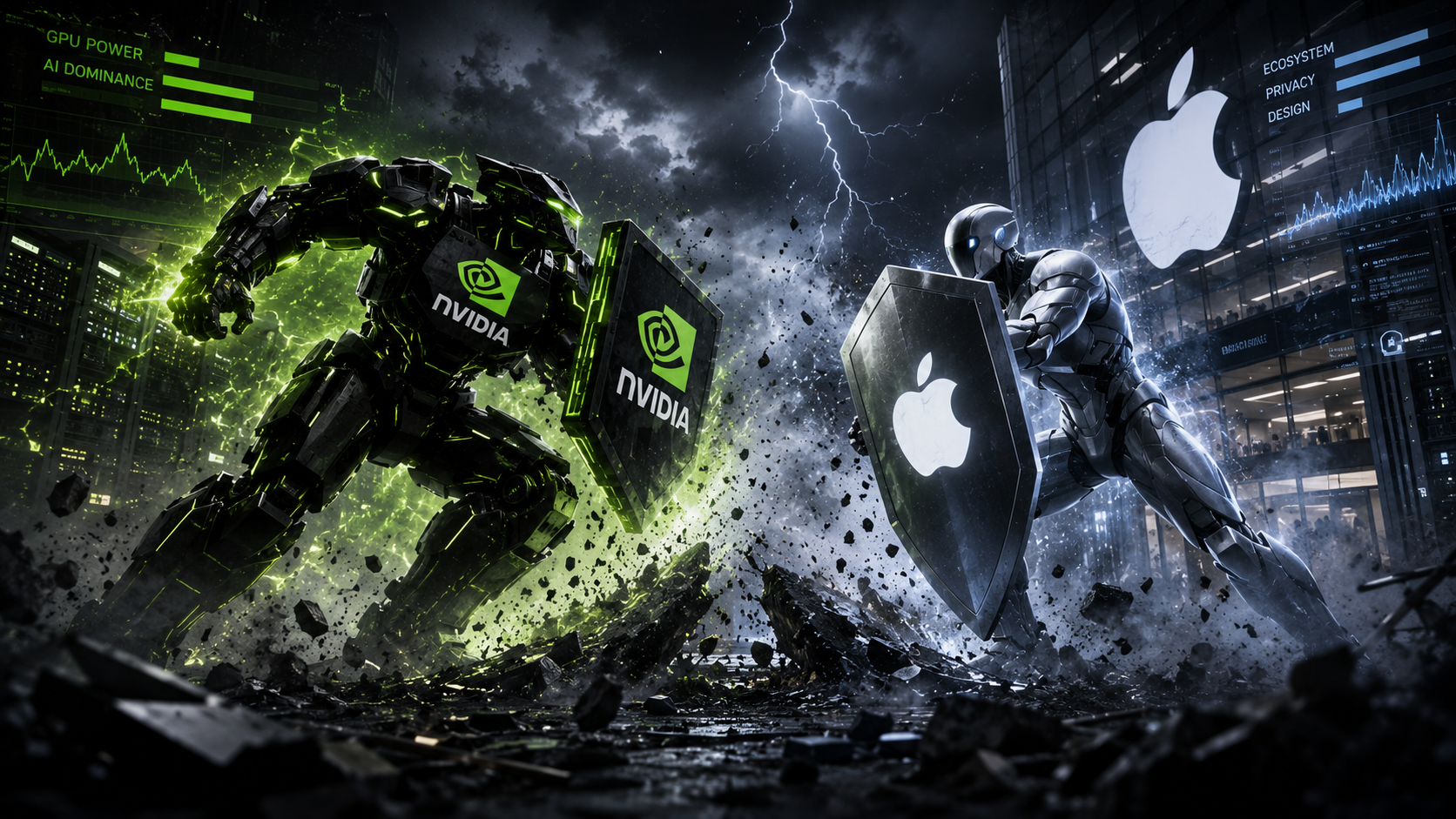
Apple reclaimed the title of the world’s most valuable public company Monday, overtaking Nvidia as its stock pushed toward a record high close. Apple’s market capitalization reached approximately $4.94 trillion, edging past Nvidia’s $4.83 trillion. The shift caps a remarkable turnaround for a company that spent much of the past two years being criticized for lagging behind its peers on artificial intelligence investment.

Apple shares have climbed more than 22% year to date, outperforming every other member of the so-called Magnificent Seven. The reason is almost the inverse of what drove the group’s dominance over the past two years. Investors are increasingly rewarding Apple precisely because it has not spent aggressively on AI infrastructure, treating capital discipline as a genuine strength rather than a competitive weakness.

The Capex Divide Reshaping Big Tech

Data tracked through Yahoo Finance’s AlphaSpace shows Apple’s capital expenditures have actually declined over the past three quarters, a striking contrast to nearly every other major technology company racing to build AI infrastructure. That restraint stands in sharp relief against Alphabet, which raised its capital spending outlook last week to fund its AI infrastructure buildout, and Tesla, which increased spending to support its robotaxi and robotics ambitions. Shares of both companies fell following their respective earnings reports. Alphabet is up only about 3% year to date, and Tesla has tumbled roughly 30% over the same period.

The market’s message has become increasingly clear this earnings season. Companies spending aggressively on AI capacity are being asked hard questions about return on that investment, while companies demonstrating they can capture AI-driven demand without ballooning capital expenditures are being rewarded with premium valuations.

A Pivotal Week Ahead

Apple reports earnings Thursday after the closing bell, and the report carries added significance beyond the usual quarterly scrutiny. Investors will be watching closely for signs the company can scale its Apple Intelligence features across its device lineup without a meaningful increase in capital expenditures or pressure on operating margins. If Apple can demonstrate that its AI strategy works within its existing capital-light framework, it would validate the market’s current thesis in dramatic fashion.

The timing carries additional weight. Thursday will mark Tim Cook’s final earnings call as CEO before he steps down September 1 to become executive chairman, with John Ternus, a longtime hardware engineering veteran at Apple, taking over as chief executive. Microsoft, Amazon, and Meta all report later this week as well, and all three are expected to announce further increases in AI-related spending, setting up a direct contrast with Apple’s approach in real time.

What This Means for the Broader Market

For investors tracking the AI infrastructure ecosystem, the leadership change at the top of the market matters beyond Apple and Nvidia individually. It reinforces a theme that has run through this entire earnings season: the market is no longer rewarding AI spending simply because it is AI spending. It is scrutinizing whether that capital is translating into visible product outcomes and sustainable margins.

That distinction has real implications down the market cap spectrum. Smaller companies supplying components, software, and infrastructure into the AI buildout are increasingly being evaluated on the same terms, whether their growth is funded responsibly or whether it depends on the kind of unchecked capital expenditure that has weighed on stocks like Alphabet and Tesla this earnings season. Apple’s ascent back to the top is, in part, the market rewarding exactly the kind of capital discipline that investors are now demanding across the board.

Nvidia’s Market Dominance Faces Growing Challenges in 2026

The world’s most valuable company is entering 2026 on uncertain footing. Nvidia shares have declined roughly 8% since hitting a record on October 29, losing $460 billion in market value over recent months while underperforming the broader S&P 500. The pullback comes as investors question the sustainability of AI spending and whether the chip giant can maintain its stranglehold on the accelerator market.

The decline is striking given Nvidia’s remarkable three-year run, which saw the stock surge more than 1,200% since late 2022 and pushed its market capitalization above $5 trillion at its peak. The company remains the single biggest contributor to the current bull market, accounting for approximately 16% of the S&P 500’s advance since October 2022—more than double Apple’s contribution. Any sustained weakness in Nvidia would reverberate across most equity portfolios.

Competition is intensifying from multiple directions. Advanced Micro Devices has secured major data center contracts with OpenAI and Oracle, with its data center revenue projected to jump about 60% to nearly $26 billion in 2026. More significantly, Nvidia’s largest customers are developing their own chips to circumvent the expense of buying Nvidia’s accelerators, which can exceed $30,000 each. Alphabet, Amazon, Meta, and Microsoft—collectively representing over 40% of Nvidia’s revenue—are all building internal alternatives.

Google has been working on tensor processing units for over a decade and recently optimized its latest Gemini AI chatbot to run on these proprietary chips. The company announced a chip deal with Anthropic valued in the tens of billions of dollars, and reports suggest Meta is negotiating to rent Google Cloud chips for use in 2027 data centers. This shift toward custom silicon is lifting companies like Broadcom, whose application-specific integrated circuit business has helped vault its market capitalization to $1.6 trillion, surpassing Tesla.

Nvidia’s December licensing deal with startup chipmaker Groq appears to acknowledge the growing demand for specialized, lower-cost alternatives. The company plans to incorporate elements of Groq’s low-latency semiconductor technology into future designs, suggesting even the market leader recognizes it must adapt to changing customer preferences.

Despite these headwinds, Wall Street remains largely bullish. Of the 82 analysts covering Nvidia, 76 maintain buy ratings with only one recommending a sale. The average price target implies a 37% gain over the next year, which would push the company’s valuation above $6 trillion. CEO Jensen Huang declared at CES that demand for Nvidia GPUs is “skyrocketing” as AI models increase by an order of magnitude annually, with the company’s next-generation Rubin chips nearing release.

Investors are closely monitoring Nvidia’s profit margins as competition heats up. The company’s gross margin dipped in fiscal 2026 due to higher costs from ramping up its Blackwell chip series, falling to a projected 71.2% from the mid-70s percentage range in previous years. Management expects margins to recover to around 75% in fiscal 2027, but any shortfall would likely trigger concern on Wall Street.

Interestingly, Nvidia trades at a relatively modest valuation of 25 times forward earnings despite expectations for 57% profit growth on a 53% revenue increase in its next fiscal year. This multiple is lower than most Magnificent Seven stocks except Meta, and cheaper than over a quarter of S&P 500 companies. Some analysts view this as opportunity, arguing the stock is priced as if the AI cycle has already ended.

The AI infrastructure buildout remains massive, with Amazon, Microsoft, Alphabet, and Meta projected to spend over $400 billion on capital expenditures in 2026, much of it directed toward data center equipment. Even as Big Tech develops internal chips, the computing power requirements are so enormous that companies continue purchasing Nvidia’s products. Bloomberg Intelligence analysts expect Nvidia’s market share to remain intact for the foreseeable future, though maintaining 90% dominance will clearly be more challenging than before.

Nvidia Faces Setback as China Reportedly Bans AI Chips

Nvidia, the world’s leading producer of artificial intelligence chips, is facing fresh uncertainty in one of its most important markets after reports that China has instructed domestic technology firms to stop using its products. According to sources familiar with the matter, Beijing’s Cyberspace Administration has urged major players, including TikTok parent company ByteDance and e-commerce giant Alibaba, to halt purchases of Nvidia’s RTX Pro 6000D chips. The processors were designed specifically for China after earlier restrictions limited the sale of more advanced models.

The development marks another escalation in the ongoing technology rivalry between the United States and China. Washington has already imposed limits on the export of advanced semiconductors to China, citing national security concerns. Last month, the Trump administration struck a deal with Nvidia that allowed its H20 server chips to be sold in the country under strict conditions, with a portion of sales revenues redirected to the U.S. government. However, Beijing’s reported response suggests a determination to reduce reliance on American hardware while accelerating investment in domestic alternatives.

Nvidia has long described its business in China as unpredictable, with company leaders acknowledging the volatility of operating amid geopolitical tensions. This latest setback follows news earlier in the week that Chinese regulators have launched an antitrust investigation into Nvidia’s $6.9 billion acquisition of Mellanox, an Israeli data center networking firm. The probe highlights Beijing’s willingness to scrutinize foreign acquisitions and could add further pressure to Nvidia’s strategic plans in the region.

Despite the challenges in China, Nvidia continues to expand globally at an aggressive pace. During a high-profile U.S. state visit to the U.K., the company announced £11 billion ($15 billion) in investment toward British artificial intelligence infrastructure. The move signals Nvidia’s intention to diversify its growth beyond Asia while deepening ties with Europe’s rapidly expanding AI sector. Other major American technology companies, including Microsoft, Google, and Salesforce, have announced similar multibillion-dollar AI commitments in the U.K., reflecting broader industry momentum.

China, however, remains a key focus for the global AI market. The country’s enormous tech ecosystem, vast consumer base, and strong government backing for artificial intelligence research make it one of the most competitive environments in the world. For Nvidia, exclusion from this market could slow growth and open the door for local competitors to capture share. At the same time, U.S. policy continues to shape the availability of high-performance chips abroad, adding layers of complexity for global semiconductor leaders.

The reported ban underscores the shifting dynamics of the U.S.-China tech rivalry and how quickly geopolitical tensions can reshape business strategies. While Nvidia remains dominant in AI chip innovation, its position in China has transformed from a driver of growth to a source of risk. The coming months will determine whether the company can adapt to the changing environment and preserve its competitive edge in the face of growing political and economic headwinds.

Nvidia Braces for $8 Billion Hit as China Ban and Tariffs Weigh on Earnings

Nvidia is preparing to release its second quarter earnings report, marking the final results of Big Tech’s earnings season. The announcement carries high stakes as the chipmaker navigates new challenges tied to U.S. policy shifts and strained relations with China.

The company previously warned investors that it expects an $8 billion hit to its bottom line for the quarter, primarily due to restrictions on chip sales to China. In April, former President Donald Trump imposed a ban on shipments of Nvidia’s advanced chips into China, citing national security concerns. While the ban was lifted in July, a new requirement mandates that Nvidia pay the U.S. government a 15% fee on sales to the Chinese market. This move has significantly impacted Nvidia’s projected revenue.

Adding further pressure, Trump announced plans to impose a 100% tariff on semiconductor shipments entering the United States unless companies commit to expanding domestic manufacturing. Nvidia, however, is expected to be exempt from this tariff given its existing U.S. operations and ongoing investments.

Despite these hurdles, Nvidia’s stock has continued to perform strongly throughout the year. Shares were up 35% year to date and more than 40% over the past 12 months leading into Wednesday’s report. In July, the company became the first in history to reach a $4 trillion market capitalization, a milestone that underscores its dominance in the artificial intelligence sector.

For the second quarter, Wall Street analysts expect Nvidia to post adjusted earnings per share of $1.01 on revenue of $46.2 billion, according to Bloomberg estimates. This compares with $0.68 in EPS and $30 billion in revenue during the same quarter last year, representing year-over-year growth of nearly 50%. While this growth rate is lower than the triple-digit surges Nvidia reported last year during the height of the AI boom, analysts believe the slowdown could be temporary.

Evercore ISI analyst Mark Lipacis suggested that a leveling out around 50% growth may attract new momentum investors and lead to further valuation expansion. Meanwhile, Nvidia’s data center business, the backbone of its AI strategy, is projected to generate $41.2 billion in sales this quarter, up sharply from $26.2 billion a year ago. Gaming, its second largest division, is expected to contribute $3.8 billion.

Investors will be listening closely to management’s commentary on shipments of Nvidia’s GB200 super chip, the rollout of its Blackwell Ultra processors, and the company’s position in China. Some analysts caution that third quarter guidance could come in below expectations if Nvidia excludes direct revenue from China sales.

At the same time, Nvidia faces political headwinds abroad. The Chinese government has warned local companies to avoid using Nvidia’s products, citing alleged security risks, a claim the company denies. Nvidia has signaled its willingness to cooperate with regulators and is reportedly preparing a new chip design tailored for the Chinese market, though it will need U.S. government approval before any shipments can begin.

As Nvidia heads into its earnings release, the company sits at the center of the global debate over technology, trade, and national security. The results will not only reflect Nvidia’s financial strength but also provide clues about how it intends to balance growth with the mounting pressures of geopolitics.

Nvidia Shatters Records: AI Giant Becomes World’s Most Valuable Company

In a stunning display of market dominance, Nvidia has officially entered uncharted territory by achieving a market capitalization of $3.92 trillion, surpassing Apple’s previous record and establishing itself as the most valuable company in corporate history.

The semiconductor giant’s shares surged as much as 2.4% to $160.98 during Thursday morning trading, propelling the company beyond Apple’s historic closing value of $3.915 trillion set on December 26, 2024. This milestone represents far more than a simple changing of the guard—it signals a fundamental shift in how markets value artificial intelligence infrastructure.

Nvidia’s ascent to unprecedented valuation levels reflects Wall Street’s unwavering confidence in the artificial intelligence revolution. The company’s specialized chips have become the essential building blocks for training the world’s most sophisticated AI models, creating what industry experts describe as “insatiable demand” for Nvidia’s high-end processors.

The magnitude of Nvidia’s valuation becomes even more striking when placed in global context. The company is now worth more than the combined value of all publicly listed companies in Canada and Mexico. It also exceeds the total market capitalization of the entire United Kingdom stock market, underscoring the extraordinary concentration of value in AI-related assets.

The transformation of Nvidia from a specialized gaming hardware company to Wall Street’s AI bellwether represents one of the most remarkable corporate evolution stories in modern business history. Co-founded in 1993 by CEO Jensen Huang, the Santa Clara-based company has seen its market value increase nearly eight-fold over the past four years, rising from $500 billion in 2021 to approaching $4 trillion today.

This meteoric rise has been fueled by an unprecedented corporate arms race, with technology giants Microsoft, Amazon, Meta Platforms, Alphabet, and Tesla competing to build expansive AI data centers. Each of these companies relies heavily on Nvidia’s cutting-edge processors to power their artificial intelligence ambitions, creating a virtuous cycle of demand for the chipmaker’s products.

Despite its record-breaking market capitalization, Nvidia’s valuation metrics suggest the rally may have room to run. The stock currently trades at approximately 32 times analysts’ expected earnings for the next 12 months—well below its five-year average of 41 times forward earnings. This relatively modest price-to-earnings ratio reflects the company’s rapidly expanding profit margins and consistently upward-revised earnings estimates.

The company’s remarkable recovery trajectory becomes evident when examining its recent performance. Nvidia’s stock has rebounded more than 68% from its April 4 closing low, when global markets were rattled by President Trump’s tariff announcements. The subsequent recovery has been driven by expectations that the White House will negotiate trade agreements to mitigate the impact of proposed tariffs on technology companies.

Nvidia’s dominance hasn’t gone unchallenged. Earlier this year, Chinese startup DeepSeek triggered a global equity selloff by demonstrating that high-performance AI models could be developed using less expensive hardware. This development sparked concerns that companies might reduce their spending on premium processors, temporarily dampening enthusiasm for Nvidia’s growth prospects.

However, the company’s ability to maintain its technological edge has kept it at the forefront of AI hardware innovation. Nvidia’s newest chip designs continue to demonstrate superior performance in training large-scale artificial intelligence models, reinforcing its position as the preferred supplier for major technology companies.

Nvidia now carries a weight of nearly 7.4% in the benchmark S&P 500, making it a significant driver of broader market performance. The company’s inclusion in the Dow Jones Industrial Average last November, replacing Intel, symbolized the semiconductor industry’s strategic pivot toward AI-focused development.

As Nvidia approaches the $4 trillion threshold, its unprecedented valuation serves as a barometer for investor confidence in artificial intelligence’s transformative potential across industries.

Nvidia Eyes Robotics as Its Next Trillion-Dollar Frontier

Key Points:
– Nvidia identifies robotics as its next major growth driver, second only to artificial intelligence, with self-driving cars and humanoid robots as early focus areas.
– Robotics and automotive revenue is currently small—just 1% of total sales—but growing rapidly, with 72% annual growth reported last quarter.
– Nvidia is evolving into a full AI infrastructure provider, offering chips, software, and cloud services to power future autonomous systems and robotics at scale.

Nvidia, the global leader in AI computing and graphics processing, is turning its attention to robotics as its next major growth engine—second only to artificial intelligence itself. During its annual shareholders meeting, CEO Jensen Huang outlined how robotics could transform from a niche revenue stream into a multitrillion-dollar opportunity for the company.

While Nvidia is best known today for the chips that power generative AI tools like ChatGPT, its ambitions are quickly expanding beyond data centers. Robotics, according to Huang, is poised to become one of the largest markets for Nvidia’s technology—integrating AI with physical systems across industries from transportation to manufacturing.

Currently, Nvidia’s automotive and robotics business makes up a small fraction of the company’s total revenue. In the most recent quarterly report, that segment generated $567 million, accounting for about 1% of total revenue. However, it showed strong momentum, up 72% year-over-year. Huang emphasized that this is only the beginning of what he sees as a long-term play.

One of the most immediate commercial applications of robotics, according to Nvidia, is autonomous vehicles. The company’s Drive platform—already adopted by major carmakers like Mercedes-Benz—includes powerful onboard chips and AI models capable of handling the complex task of self-driving navigation. But Nvidia’s robotics vision extends far beyond the road.

At the meeting, Huang also spotlighted the company’s newly released Cosmos AI models for humanoid robots. These models represent a leap toward enabling general-purpose robots that can interact with and adapt to dynamic environments. From warehouse automation to robotic factories and healthcare assistants, Nvidia sees its chips playing a central role in bringing these systems to life.

To support these ambitions, Nvidia continues to evolve its identity from a chip manufacturer to a full-fledged AI infrastructure provider. In addition to its industry-dominating GPUs, the company now offers networking hardware, enterprise software, and its own cloud services—all designed to create a seamless pipeline from model training to deployment in the real world.

Huang’s comments reflect Nvidia’s long-term strategy to build an end-to-end ecosystem for intelligent computing. With demand for AI capabilities showing no sign of slowing and emerging use cases like robotics gaining traction, the company appears well-positioned to lead in both digital and physical AI applications.

The financial markets appear to agree. Nvidia’s stock surged to a record high following the shareholder meeting, pushing its market capitalization to $3.75 trillion—surpassing Microsoft to become the most valuable public company in the world.

Although robotics currently represents a small sliver of Nvidia’s earnings, the strategic importance of this segment is growing. As more industries invest in automation and intelligent systems, Nvidia is betting that the same technology powering chatbots and data centers will eventually control fleets of robots, smart factories, and autonomous machines across the globe.

With the groundwork now in place, Nvidia is not just building chips—it’s building the future of intelligent automation.

Nvidia Surpasses Apple as World’s Most Valuable Company Amid AI Demand Surge

Key Points:
– Nvidia’s stock reached a market value of $3.53 trillion, overtaking Apple’s $3.52 trillion temporarily.
– AI-driven demand has significantly boosted Nvidia’s stock, leading to an 18% increase in October alone.
– The company remains a leader in AI chip production, benefiting from strong market optimism for artificial intelligence applications.

In a notable shift, Nvidia briefly overtook Apple to become the world’s most valuable company on Friday, fueled by unprecedented demand for its artificial intelligence (AI) chips. Nvidia’s stock value surged to $3.53 trillion during trading, edging just above Apple’s $3.52 trillion valuation before settling back slightly, LSEG data shows.

The rally in Nvidia’s stock underscores the growing dominance of tech firms in financial markets, especially companies that drive the AI sector. For several months, Nvidia, Apple, and Microsoft have held the top spots in market capitalization, reflecting their massive influence on Wall Street.

Following a record year driven by its specialized processors, Nvidia has become indispensable for companies investing in AI computing power. The firm’s AI processors, essential for complex computing tasks, have cemented Nvidia’s status as a key player in the competitive race to shape the future of artificial intelligence. The company’s market trajectory gained momentum in recent weeks after OpenAI, developer of the popular ChatGPT, announced a significant funding round of $6.6 billion. This news fueled optimism for Nvidia as its AI-related products are essential to the operations of companies like Microsoft, Alphabet, and Meta, who are vying for AI dominance.

The semiconductor market experienced a broader lift this week after chipmaker Western Digital reported better-than-expected quarterly earnings. This optimism added to Nvidia’s upswing, especially as companies look to integrate AI into their workflows.

Nvidia, a company known initially for its graphic processing units (GPUs) for gaming, has effectively transformed its focus to capitalize on the AI wave. The company’s shares climbed roughly 18% this October, following a record-breaking year-to-date performance. The firm has set a high bar with projections of nearly 82% year-over-year revenue growth, significantly outpacing the 5.5% projected growth for Apple, which faces headwinds in China, where iPhone sales dropped by 0.3% last quarter.

The AI boom has also made Nvidia a top choice for options traders, with its stock among the most actively traded. Nvidia’s price surge, nearly 190% year-to-date, demonstrates the confidence in AI’s potential for reshaping industries. However, some analysts, like Rick Meckler of Cherry Lane Investments, caution that while Nvidia’s financials are strong, long-term growth in the AI space may need to prove itself beyond current enthusiasm.

Meanwhile, Apple continues to face mixed projections. Analysts forecast the tech giant’s quarterly revenue to reach $94.5 billion, which, although solid, reflects slower growth than Nvidia’s. Apple’s challenges, including stiffer competition in international markets from brands like Huawei, underscore the shifting landscape. Nonetheless, both Nvidia and Apple, along with Microsoft, account for about 20% of the S&P 500 index, underscoring the tech sector’s influence on broader U.S. markets.

As AI investments surge and technology companies cement their place at the forefront of the market, Nvidia’s recent ascent highlights the rapidly changing dynamics of tech valuation. Investors are keeping a close watch on whether Nvidia can sustain its growth trajectory, particularly as new earnings data, interest rate changes, and evolving AI applications continue to impact the financial landscape.

Nvidia’s Stock Rollercoaster: AI Chip Leader Faces Market Volatility Amid Economic Uncertainty

Key Points:
– Nvidia’s stock experiences a sharp 7% decline, reversing the previous day’s 13% rally, as part of a broader tech sell-off.
– The volatility in Nvidia’s stock reflects both the excitement around AI investments and concerns about economic cooling.
– Despite short-term fluctuations, analysts remain optimistic about Nvidia’s long-term prospects in the AI chip market.

In a dramatic turn of events, Nvidia, the titan of AI chip manufacturing, saw its stock price plummet by 7% on Thursday, August 1, 2024, erasing the gains from its impressive 13% rally just a day earlier. This sudden reversal highlights the volatile nature of the tech sector, particularly in the rapidly evolving field of artificial intelligence.

The downturn wasn’t isolated to Nvidia; it was part of a broader sell-off in the tech sector, with chip stocks leading the decline. The catalyst for this market movement appeared to be weak economic data released during the trading session, which sent the 10-year Treasury yield lower and spooked investors across various sectors.

Nvidia’s stock performance is closely watched by market observers as a bellwether for the AI industry. The company has been riding high on the AI wave, with its stock up approximately 130% year-to-date, even after the recent pullback. This growth has been fueled by the increasing demand for AI chips from major tech companies, often referred to as hyperscalers.

Paul Meeks, co-chief investment officer at Harvest Portfolio Management, commented on the situation, stating, “These hyperscalers… their capital expenditures are high and potentially even rising into 2025. So this bodes incredibly well for Nvidia.” This optimism is supported by recent announcements from tech giants like Microsoft and Meta Platforms, which have indicated plans for significant increases in infrastructure investments.

However, the market’s reaction on Thursday suggests that investors are grappling with concerns about the sustainability of this growth trajectory. The fear that the current momentum might not last or that revenue projections for the next 12 months might be overly optimistic seems to be causing some jitters among shareholders.

Despite these short-term fluctuations, many analysts remain bullish on Nvidia’s prospects. Angelo Zino, a senior equity analyst at CFRA, suggested that fears about Nvidia’s revenue trajectory are starting to ease. Morgan Stanley analysts, led by Joseph Moore, recently placed Nvidia on their ‘Top Pick’ list, maintaining an Overweight rating and a $144 price target on the stock.

The chip sector as a whole has benefited from the AI frenzy, but Nvidia is widely seen as the primary beneficiary. Paul Meeks noted, “Over time, the pie will get bigger. I still think that Nvidia will have most of the slices, and AMD… they’ll be a good second supplier. But NVIDIA will have a hold on this market for as far as the eye can see.”

This optimism is tempered by the recognition of potential challenges. Morgan Stanley’s analysts identified five main drivers of Nvidia’s recent stock decline: concerns about spending plans, competition, export controls, supply chain fears, and valuation worries. However, they maintain that “Through those concerns, the earnings environment is likely to remain strong, for Nvidia and for the whole AI complex.”

As the market digests these conflicting signals, all eyes will be on Nvidia’s upcoming quarterly report, scheduled for August 28. This report will likely provide crucial insights into the company’s financial health and its ability to maintain its dominant position in the AI chip market.

In conclusion, while Nvidia’s stock may be experiencing short-term volatility, the underlying fundamentals of the AI industry appear strong. As the world continues to embrace artificial intelligence across various sectors, companies like Nvidia are poised to play a pivotal role in shaping the technological landscape of the future. Investors and industry watchers alike will be keenly observing how this AI chip leader navigates the challenges and opportunities that lie ahead in this dynamic and rapidly evolving market.

Nvidia Dethrones Microsoft as Most Valuable Company Amid AI Boom

In a monumental shift in the tech landscape, Nvidia (NVDA) has overtaken Microsoft (MSFT) to become the world’s most valuable publicly traded company. This remarkable feat, fueled by Nvidia’s dominance in the artificial intelligence (AI) chip market, has sent shockwaves through the industry and underscores the transformative power of generative AI technology.

On Tuesday, June 18, 2024, Nvidia’s stock price surged nearly 4%, propelling its market capitalization to an astounding $3.35 trillion, surpassing Microsoft’s market cap of $3.32 trillion. This milestone solidifies Nvidia’s position as the tech industry’s undisputed leader in AI chips and integrated software, a pivotal role that has driven its meteoric rise in recent years.

Nvidia’s Explosive Growth and the AI Revolution

Nvidia’s stock has skyrocketed over the past year, gaining a staggering 215%, and a remarkable 3,400% over the last five years. This unprecedented growth can be directly attributed to the generative AI explosion that began with the debut of OpenAI’s ChatGPT platform in late 2022.

As the go-to supplier for AI chips and software, Nvidia’s products have become indispensable for tech giants like Amazon, Google, Meta, Microsoft, and Tesla, powering everything from cloud-based AI offerings to their own AI models and services. This strategic advantage has propelled Nvidia to the forefront of the AI revolution, outpacing rivals AMD and Intel, who are now racing to catch up.

Nvidia’s Dominance in the AI Chip Market

Nvidia’s Data Center segment, which encompasses its AI chip business, saw a staggering 427% year-over-year revenue increase in the first quarter of 2024, accounting for a remarkable 86% of the company’s total revenue. This meteoric growth highlights the insatiable demand for Nvidia’s AI chips and software, cementing its position as the cornerstone of the AI revolution.

With the recent announcement of its upcoming Blackwell Ultra and Rubin AI chip platforms, Nvidia is doubling down on its AI supremacy, aiming to maintain its lead over competitors like AMD and Intel, who are aggressively developing their own AI chips.

Challenges and Competition Ahead

Despite its current dominance, Nvidia faces mounting competition from its own customers, as tech giants like Amazon, Google, and Microsoft seek to reduce their reliance on Nvidia’s chips and cut costs. These companies are investing billions in developing their own AI chips, aiming to gain greater control over their AI capabilities and reduce their dependence on Nvidia.

Additionally, rivals like AMD and Intel are making significant strides in the AI chip market, with AMD’s MI325X and MI350 chips slated for release in 2024 and 2025, and Intel’s Gaudi 2 and Gaudi 3 accelerators promising to undercut Nvidia on price.

Riding the AI Wave

Nvidia’s ascent to become the world’s most valuable company is a testament to its visionary leadership and its ability to capitalize on the AI revolution. As the demand for AI chips and software continues to soar, Nvidia’s position at the forefront of this transformative technology has propelled its growth to unprecedented heights.

However, with intense competition on the horizon, Nvidia faces the challenge of maintaining its innovative edge and fending off rivals eager to chip away at its dominance. As the AI arms race intensifies, Nvidia’s ability to navigate this rapidly evolving landscape will be critical to sustaining its newfound status as the world’s most valuable company.

Nvidia’s Mega Stock Split Signals Opportunity for Emerging Growth Plays

The opening trading bell on Monday ushered in a new era for semiconductor giant Nvidia (NVDA). The company’s white-hot stock began trading on a split-adjusted basis after undergoing a massive 10-for-1 stock split. This slashed Nvidia’s share price from over $1,200 to around $120, while multiplying the total shares outstanding tenfold.

For Nvidia, the split was a pragmatic move to make its stock more accessible to a wider range of investors after seeing its valuation soar past $3 trillion amid skyrocketing demand for its artificial intelligence (AI) chips. But the split also serves as an opportune reminder of the massive growth runway ahead for emerging players across the tech, AI, and semiconductor spaces.

As the appetite for advanced AI capabilities grows, companies able to provide the critical hardware, software, and cloud infrastructure are in the stratosphere in terms of market opportunity. Nvidia’s leadership position and shrewd strategic moves like this split should prompt investors to closely watch the rising cohort of potential AI/tech upstarts.

Why Stock Splits Matter
While stock splits have no impact on a company’s market capitalization or fundamentals, they do foster greater liquidity and affordability in trading the stock. This can open the floodgates for more participation from retail investors and ownership by funds previously restricted from buying such pricey shares.

There is also a psychological element. Stock splits are often viewed as a bullish signal of a company having exceeded its prior growth expectations. The increased affordability and accessibility of shares can also fuel incremental investor demand alone. Research shows stocks that split their shares tend to outperform the broader market in the year after announcing their split.

Nvidia’s split checks all of these boxes. Its relentless 90%+ rally in 2024 has been fueled by insatiable demand for its AI hardware from juggernauts like Microsoft, Google, Amazon, and a rapidly expanding set of sectors. Even after the split, analysts have an average price target north of $300 per share, implying over 140% upside potential from current levels. More affordable shares set the stage for further momentum.

Following the Leader
As the disruptive force of AI grows, more companies are racing to build their own chips, cloud services, and software tools to tap into this generational shift. Many of these upstarts could be prime candidates to pursue stock splits of their own as their solutions gain traction and valuations expand.

Keep an eye on AI semiconductor developers like Cerebras, SambaNova, and Groq that are designing specialized chips for AI workloads. There are also startups building their own AI cloud platforms and services like Anthropic, Cohere, and Adept that could become attractive public investment vehicles down the road.

Software players creating AI tools and applications tailored for specific industries like healthcare (Hugging Face), cybersecurity (Abnormal Security), or autonomous driving (Wayve) may also emerge as compelling split candidates as their categories take shape.

A rising tide of private capital being deployed into AI companies is fueling the rapid growth and maturation of many startups, pushing them closer to the public markets. Like Nvidia, those able to reach scale and capture significant market share should have ample justification to make their shares more affordable to incoming investors through splits.

Within the larger chip landscape, graphics processors tailored for AI and gaming workloads could become an M&A focus for incumbents like AMD, Intel, or Qualcomm looking to challenge Nvidia. Rising M&A premiums and valuations may incentivize others to split their shares as more investors jockey for exposure.

Bottom Line
Nvidia’s eye-popping stock split demonstrates the immense opportunity created by disruptive innovations like AI and generative technology. While still in its nascency, this revolution is rapidly ushering in a new wave of emerging tech leaders able to capitalize on this sea change.

Smart investors should monitor the publicly traded AI/chip space closely, keeping an eye out for the next stock split candidate as the next Nvidia may be just around the corner. As adoption further accelerates, these prospective splits could signal prime entry points for getting ahead of massive growth runways in these future-shaping fields.

Register Now for Noble Capital Markets’ Virtual Consumer, Communication, Media & Technology Emerging Growth Equity Conference.

Nvidia’s AI-Driven Stock Split Could Unlock New Investor Appeal and Dow Jones Potential

As the semiconductor industry’s unrivaled leader in artificial intelligence, Nvidia (NASDAQ: NVDA) has become a Wall Street sensation in recent years. The company’s latest strategic move – a 10-for-1 stock split – could further amplify its appeal to both individual investors and the prestigious Dow Jones Industrial Average.

The announcement of Nvidia’s stock split, effective June 7th, comes on the heels of the company’s blockbuster Q1 2024 earnings report. With revenue and forecasts exceeding analyst expectations, Nvidia’s shares have more than doubled so far this year, solidifying the chipmaker’s status as a bona fide tech titan.

Lowering the Barrier to Entry for Retail Investors
Nvidia’s decision to split its stock could open the doors wider for individual, or “retail,” investors to participate in the company’s AI-driven growth story. By reducing the per-share price from around $1,040 to approximately $104, the split makes Nvidia’s stock more accessible to investors with smaller trading accounts.

Analysts believe the lower price point could spark greater interest from retail investors, who typically trade in smaller lots compared to institutional investors. Currently, Nvidia is the most heavily weighted stock in the average retail trading portfolio, accounting for 9.3% of holdings – a figure that has more than doubled from a year ago.

While many retail investors can already buy fractional shares, the lower price could still make Nvidia more appealing to those without access to such features. The reduced share price could make Nvidia’s stock “less of an obstacle” for these investors, according to one expert.

Paving the Way for Dow Jones Inclusion
In addition to attracting more retail interest, Nvidia’s stock split could also improve the company’s prospects for inclusion in the prestigious Dow Jones Industrial Average. As a price-weighted index, the Dow favors lower-priced stocks, and Nvidia’s current share price of around $1,040 would make it the second-largest component, behind only UnitedHealth Group.

However, after the split, Nvidia’s share price would fall to approximately $104, making it the 21st-largest stock in the Dow, just behind Merck and ahead of Walt Disney. This more manageable price point could pave the way for Nvidia’s eventual inclusion in the blue-chip index.

Analysts believe Nvidia “checks all the boxes” for Dow Jones inclusion, citing the company’s strong reputation, history of sustained growth, investor appeal, and sector representation.

A Potential Boost for Shareholder Returns
Historically, companies that announce stock splits have tended to outperform the market. According to an analysis from Bank of America Global Research, stocks announcing splits have seen their shares rise an average of 25.4% over the following 12 months, compared to an 11.9% increase for the S&P 500.

However, it’s important to note that a stock split alone is unlikely to overcome broader market forces that can sway a company’s share price. As evidenced by the selloffs experienced by Amazon and Alphabet in 2022, even after their own stock splits, external factors such as rising interest rates can still weigh heavily on stock performance.

Nonetheless, Nvidia’s stock split announcement comes at a time when the company’s AI dominance has made it a must-have investment for both institutional and individual investors. By making its shares more accessible and potentially paving the way for Dow Jones inclusion, this move could further cement Nvidia’s position as a leading player in the rapidly evolving semiconductor and AI landscapes.