The inflation data the Federal Reserve cares about most just delivered an unwelcome surprise. The Personal Consumption Expenditures price index — the gauge the FOMC uses to measure progress toward its 2% target — rose to its highest level in three years in May, according to data released Thursday. The reading keeps the prospect of a 2026 interest rate hike firmly in play and complicates the path forward for a central bank already navigating one of the most difficult macro environments in years.
Headline PCE climbed to 3.5% year over year, up from the prior month and the highest since 2023. Core PCE, which strips out volatile food and energy costs and is the measure policymakers watch most closely, also accelerated. The data confirms what last month’s Consumer Price Index reading had already suggested: inflation is not cooling on the timeline markets had hoped for, and the energy-driven spike from the US-Iran conflict has bled into the broader price picture.
Why This Keeps a Hike in Play
The report lands just over a week after new Federal Reserve Chair Kevin Warsh presided over his first FOMC meeting, where the committee held rates steady but dropped its long-standing easing bias and signaled through its updated projections that nine of 18 officials now expect at least one rate hike before year-end. Thursday’s PCE reading strengthens that hawkish case considerably. Markets are now pricing in elevated odds of a rate increase in the second half of 2026 — a dramatic reversal from the rate cuts that were consensus just a few months ago.
For the Fed, the data presents a genuine dilemma. Inflation is accelerating while consumer sentiment recently hit an all-time low and growth signals have been mixed. That combination raises the specter of stagflation — the most difficult environment for any central bank to manage, and one with outsized consequences for smaller, rate-sensitive companies.
Where the Pressure Lands
The companies most exposed to this environment are consumer-facing businesses and those carrying significant variable-rate debt. When inflation erodes real household purchasing power, discretionary spending on dining, travel, apparel, and other non-essentials is typically the first to contract — pressuring the smaller consumer-facing companies that lack the pricing power and balance sheet depth of their large cap peers.
Energy sits on the other side of the equation. As the primary driver of May’s inflation spike, elevated energy prices that squeeze consumers can simultaneously support revenues for oil, gas, and energy infrastructure producers. That divergence is part of what makes the current inflation picture so difficult for the Fed to address with a single policy lever — the same force hurting one part of the economy is helping another.
What Comes Next
The PCE reading sets up a tense second half of the year. If energy prices continue easing as the Iran ceasefire holds and oil retreats below $75, the inflation picture could improve meaningfully in the coming months, giving the Fed room to hold rather than hike. If price pressures prove stickier and spread further into core categories, the case for a hike strengthens with each data release.
For small and microcap investors, the message is to watch the inflation trajectory as closely as the Fed itself. The cost of capital for smaller companies — which carry disproportionately more floating-rate debt than large caps — hinges directly on whether this PCE reading marks a peak or the start of a more troubling trend. Thursday’s number tilted the odds toward caution. The next several data points will determine whether that caution becomes conviction.
Intel (Nasdaq: INTC) stock soared more than 11% Thursday after President Trump posted on Truth Social that Apple has agreed to work with the chipmaker to build its processors. The announcement followed an earlier Wall Street Journal report that the two companies had reached a preliminary agreement under which Intel would manufacture chips for the iPhone maker. Intel declined to comment on the report.
The move caps an extraordinary run for a company that was written off by much of Wall Street barely a year ago. Intel stock has now climbed more than 250% since the start of 2026 and roughly 500% over the past twelve months, making it one of the most dramatic corporate turnarounds in the technology sector.
Why the Apple Report Matters
The significance of a potential Apple partnership is as much symbolic as it is financial. Apple previously relied on Intel chips for its laptops and desktops before abandoning the company in favor of designing its own custom silicon — a high-profile departure that came to symbolize Intel’s competitive decline over the past decade. A renewed manufacturing relationship, even a modest one, would represent a meaningful reversal of that narrative.
Industry analysts have tempered expectations on the initial scope. Early commentary suggests any first agreement would likely involve lower-volume, less critical components rather than Apple’s flagship processors. Intel will need to prove its manufacturing reliability before earning more substantial business. But as analysts noted, the first step is always the hardest — and Intel appears to be taking it.
A Foundry Strategy Finally Paying Off
The Apple report does not exist in isolation. It is the latest in a series of developments validating Intel’s multi-year effort to build out its foundry business — the arm of the company that manufactures chips for third-party customers rather than just for Intel itself. Recent reports indicate Intel will build three million Tensor Processing Units for Google, and that Nvidia is exploring using Intel to fabricate some of its own processors. Earlier this week, Intel announced that its latest 18A-P processor node has entered initial production, a key step toward full-volume manufacturing.
The turnaround effort began under former CEO Pat Gelsinger and has continued under current CEO Lip-Bu Tan, who has focused on aggressive cost-cutting while driving the foundry arm to secure external manufacturing deals. That strategy is now benefiting from favorable industry dynamics. TSMC, the world’s largest chip manufacturer, has been unable to provide enough capacity for all of its customers, forcing fabless chip companies — those without their own manufacturing capabilities — to seek alternative production partners. Intel has emerged as one of the few viable options.
The AI Tailwind Beneath It All
Underpinning the entire Intel story is the AI build-out and a structural shift in chip demand. While graphics processing units remain central to AI data centers, central processing units have become increasingly important as AI firms lean into agentic applications — digital assistants capable of performing tasks on a user’s behalf. As AI agents begin running more operations across networks, they increasingly rely on CPUs to complete requests, a segment where Intel holds genuine strength.
For investors tracking the broader semiconductor ecosystem, Intel’s resurgence carries a wider signal. The capacity constraints pushing major customers toward Intel are the same constraints reshaping the entire chip supply chain. Smaller semiconductor companies, specialty foundry service providers, and advanced packaging firms operating in adjacent parts of that supply chain are positioned within the same demand environment driving Intel’s recovery. When the largest chip customers cannot get enough capacity from the dominant manufacturer, the effects ripple across the entire sector — and the smaller companies serving that demand are worth watching closely.
Intel was left for dead a year ago. A 500% move later, the turnaround is no longer a thesis. It is happening.
In one of the more unexpected M&A announcements of the year, Bed Bath & Beyond (NYSE: BBBY) has entered into a definitive agreement to acquire Fathom Holdings (Nasdaq: FTHM), a national technology-driven real estate services platform, in an all-stock transaction. The deal implies an equity value of approximately $53.38 million for Fathom and reflects an exchange ratio of 0.2236 shares of Bed Bath & Beyond common stock for each Fathom share, subject to adjustments at closing. The transaction is expected to close in the second half of 2026, pending Fathom shareholder approval and customary regulatory clearances.
At first glance, a home goods retailer acquiring a real estate brokerage appears to make little sense. The logic becomes considerably clearer once you understand what Bed Bath & Beyond is actually trying to build.
The “Everything Home” Strategy
Bed Bath & Beyond — which operates today as a digital-first brand following its well-documented restructuring and relaunch under the Beyond corporate umbrella — is pursuing a strategy it calls “Everything Home.” The concept is built around three interconnected pillars: Homeownership and Transactions, Omnichannel Commerce, and Home Services. The goal is to own the entire lifecycle of a home, from the moment a consumer buys it, to financing it, to furnishing it, to maintaining it over time.
The Fathom acquisition slots directly into the Homeownership and Transactions pillar. Fathom is not simply a brokerage. It is an integrated platform combining residential real estate brokerage, mortgage origination through Encompass Lending, title services through Verus Title, insurance, and a proprietary cloud-based software platform called intelliAgent. By acquiring Fathom, Bed Bath & Beyond gains an established foothold across the financial and transactional side of homeownership that it could not easily build organically.
The Cross-Selling Thesis
The strategic appeal is the connection point between buying a home and furnishing one. Bed Bath & Beyond’s core business is selling products for the home. Fathom’s business is helping people buy and finance those homes. The combination creates a theoretical funnel: reach a consumer at the moment they purchase a home through Fathom’s brokerage and lending operations, then convert that same consumer into a furnishing and home goods customer through Bed Bath & Beyond’s omnichannel commerce platform.
Fathom, for its part, gains access to Bed Bath & Beyond’s nationally recognized brand, millions of existing customers, and significantly greater capital resources to invest in its technology platform and agent network. For a company with an equity value of roughly $53 million, access to a large consumer brand’s customer base and balance sheet represents a meaningful expansion of reach that would be difficult to achieve independently in the current real estate environment.
Alongside the announcement, Fathom named board member Adam Rothstein as Interim Chief Executive Officer and appointed Daniel Weinmann as Chief Financial Officer, both effective immediately.
The Small Cap Read
For investors tracking the small and microcap space, this deal is worth examining for what it represents rather than just its size. A $53 million all-stock acquisition is small by absolute standards, but it reflects a broader theme: companies are increasingly pursuing platform strategies that combine previously unrelated business lines around a single customer relationship. Real estate technology, in particular, has faced significant headwinds from elevated mortgage rates and suppressed transaction volumes, making smaller players like Fathom attractive targets for acquirers with complementary customer bases and the capital to support a longer-term vision.
Whether the homeownership-to-furnishing funnel ultimately delivers the cross-selling synergies both companies envision will take time to prove. But the strategic logic — owning the customer across the entire arc of homeownership rather than at a single transaction point — reflects exactly the kind of platform thinking that is driving M&A activity across the consumer economy in 2026.
Robinhood announced Tuesday it will cut approximately 10% of its full-time workforce — roughly 290 jobs — as the commission-free trading platform moves to flatten its organizational structure and operate more efficiently. The stock slipped approximately 1.5% in early trading following the news. The reduction is the latest example of a broad corporate trend that has accelerated through 2026: companies across sectors are aggressively scrutinizing headcount and management layers, even when their underlying businesses are performing well.
The Robinhood cuts are notable precisely because the company is not in distress. Its prediction markets business, anchored by the Rothera exchange, accounted for approximately 10% of total revenue in the first quarter of 2026, and the platform has continued to expand its product offering across crypto, retirement accounts, and event-based trading. This is not a retrenchment driven by weakness. It is a deliberate move to reduce organizational layers and improve operating leverage.
The Pattern Across the Market
Robinhood is not operating in isolation. The “efficiency” wave has become one of the defining corporate themes of 2026. Earlier this year, Intuit announced it would cut roughly 17% of its workforce despite beating earnings estimates. Cisco laid off approximately 4,000 employees as part of an AI-focused restructuring. The common thread connecting these decisions is a recognition that artificial intelligence and automation are changing the calculus around how many people a company actually needs to operate at scale.
Executives across industries are increasingly arguing that flatter organizations with fewer management layers move faster, make decisions more efficiently, and deploy capital more effectively. In many cases, AI tools are explicitly cited as the enabler — automating functions that previously required dedicated headcount and allowing companies to maintain or grow output with smaller teams.
What It Means for Smaller Companies
For investors in the small and microcap space, the efficiency wave carries a dual implication worth thinking through carefully.
On one hand, the trend validates a structural shift that benefits smaller, leaner companies. A startup or small cap company that was always going to operate with a lean team is now competing in an environment where its larger rivals are voluntarily shrinking toward that same operating model. The structural cost advantage that large companies historically held through scale is being partially eroded as AI levels the operational playing field.
On the other hand, the broad-based nature of these workforce reductions is a signal worth monitoring for what it says about the labor market and consumer spending. When profitable companies across multiple sectors simultaneously decide they need fewer workers, it has downstream implications for the consumer-facing small caps whose revenue depends on employed consumers with discretionary income. The May jobs report was strong, but corporate efficiency decisions made today show up in employment data months later.
The efficiency wave is reshaping how companies of every size think about headcount, technology, and operating leverage. For smaller companies, it is simultaneously a competitive opportunity and a macro signal that deserves attention. Robinhood is healthy, growing, and cutting jobs anyway. That combination is the story of corporate America in 2026.
Net Sales Increased 10.5% to $64.0 Million vs. 1Q25
Raises Full Year Fiscal 2026 Guidance
NEW YORK–(BUSINESS WIRE)– Vince Holding Corp. (Nasdaq: VNCE) (“VNCE” or the “Company”), a global retail platform, today reported its financial results for the first quarter ended May 2, 2026.
Brendan Hoffman, Chief Executive Officer of VNCE said, “We delivered strong first quarter results that demonstrate the powerful momentum we’ve built is not only sustained but accelerating. Net sales grew 10.5%, with direct-to-consumer up 15.6% and wholesale increasing 5.9% demonstrating strength across our entire business. Our strategic investments in customer experience are paying off, fueling double-digit growth in both new and reactivated customers and supporting healthy full-price selling.”
Mr. Hoffman continued, “We’re executing with discipline and precision across our business. The strength we’ve established has carried into the second quarter, reinforcing my confidence in our trajectory. With our strategic foundation firmly in place and a talented team driving product and execution, we are raising our full year guidance and remain focused on driving sustained profitable growth and creating long-term shareholder value.”
In this press release, the Company is presenting its financial results in conformity with U.S. generally accepted accounting principles (“GAAP”) as well as on an “adjusted” basis. Adjusted results presented in this press release are non-GAAP financial measures. See “Non-GAAP Financial Measures” below for more information about the Company’s use of non-GAAP financial measures.
For the first quarter ended May 2, 2026:
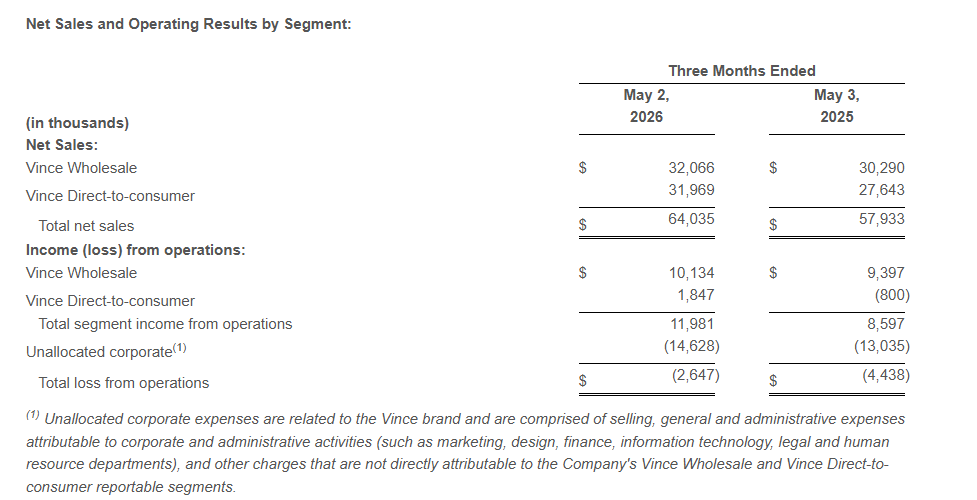
Total Company net sales increased 10.5% to $64.0 million compared to $57.9 million in the first quarter of fiscal 2025. The year-over-year increase was driven by a 15.6% increase in the direct-to-consumer segment and a 5.9% increase in the wholesale segment.
Gross profit was $32.4 million, or 50.6% of net sales, compared to gross profit of $29.2 million, or 50.3% of net sales, in the first quarter of fiscal 2025. The increase in gross margin rate was primarily driven by approximately 130 basis points due to the favorable impact from higher pricing and 100 basis points due to the favorable impact of lower discounting, largely offset by the unfavorable impact of higher tariffs.
Selling, general, and administrative expenses were $35.0 million, or 54.7% of sales, compared to $33.6 million, or 58.0% of sales, in the first quarter of fiscal 2025. The increase in SG&A dollars was primarily driven by higher benefit costs as well as marketing and advertising costs.
Loss from operations was $2.6 million compared to loss from operations of $4.4 million in the same period last year.
Income tax benefit was $0.4 million compared to an income tax expense of $0 in the same period last year. The benefit is due to the impact of applying the Company’s estimated annual effective tax rate to the year-to-date ordinary pre-tax loss.
Net loss was $2.1 million or $(0.16) per share compared to net loss of $4.8 million or $(0.37) per share in the same period last year.
Adjusted EBITDA* was $(1.1) million compared to $(3.0) million in the same period last year.
The Company ended the quarter with 54 company-operated Vince stores, a net decrease of 4 stores since the first quarter of fiscal 2025.
First Quarter Review
Net sales increased 10.5% to $64.0 million as compared to the first quarter of fiscal 2025.
Wholesale segment sales increased 5.9% to $32.1 million compared to the first quarter of fiscal 2025.
Direct-to-consumer segment sales increased 15.6% to $32.0 million compared to the first quarter of fiscal 2025.
Income from operations excluding unallocated corporate expenses was $12.0 million compared to income from operations of $8.6 million in the same period last year.
Balance Sheet
At the end of the first quarter of fiscal 2026, total borrowings under the Company’s debt agreements totaled $29.1 million and the Company had $31.2 million of excess availability under its revolving credit facility.
Net inventory at the end of the first quarter of fiscal 2026 was $70.8 million compared to $62.3 million at the end of the first quarter of fiscal 2025. The year-over-year increase in inventory includes approximately $4.5 million of higher inventory carrying value due to tariffs.
During the quarter ended May 2, 2026, the Company did not make any offerings or sales of shares of common stock under the Virtu At-the-Market Offering. At May 2, 2026, $0.9 million was available under the Virtu At-the-Market Offering.
Outlook
For the second quarter of fiscal 2026 the Company expects the following:
Net sales to increase approximately 10% to 12% compared to the prior year period.
Adjusted operating income as a percentage of net sales to be approximately 6.5% to 7.0%.
Adjusted EBITDA as a percentage of net sales to be approximately 8.0% to 8.5%.
For fiscal 2026 the Company expects the following:
Net sales to increase approximately 7% to 8% compared to the prior year.
Adjusted operating income as a percentage of net sales to be approximately 4% to 4.5%.
Adjusted EBITDA as a percentage of net sales to be approximately 5.5% to 6.0%.
Following the Supreme Court’s decision striking down certain tariffs imposed under the International Emergency Economic Powers Act, (“IEEPA”), the Company’s outlook assumes a 10 percent rate for applicable inventory receipts under Section 122 of the Trade Act of 1974. The Company’s outlook does not consider potential tariff refunds resulting from the Supreme Court’s decision on the IEEPA tariffs.
*Non-GAAP Financial Measures
In addition to reporting financial results in accordance with GAAP, the Company has provided, with respect to the financial results relating to the three months ended May 2, 2026 and May 3, 2025, adjusted EBITDA, which is a non-GAAP measure. Adjusted EBITDA is calculated as earnings before interest, taxes, depreciation and amortization, share-based compensation, and capitalized cloud computing amortization.
The Company believes that the presentation of these non-GAAP measures facilitates an understanding of the Company’s continuing operations without the impact associated with the aforementioned items. While these types of events can and do recur periodically, they are excluded from the indicated financial information due to their impact on the comparability of earnings across periods. Non-GAAP financial measures should not be considered in isolation from, or as a substitute for, financial information prepared in accordance with GAAP. A reconciliation of GAAP to non-GAAP results has been provided in Exhibit 3 to this press release.
Conference Call
A conference call to discuss the first quarter results will be held today, June 16, 2026, at 8:30 a.m. ET, hosted by Vince Holding Corp. Chief Executive Officer, Brendan Hoffman, and Chief Financial Officer, Yuji Okumura. During the conference call, the Company may make comments concerning business and financial developments, trends and other business or financial matters. The Company’s comments, as well as other matters discussed during the conference call, may contain or constitute information that has not been previously disclosed.
Those who wish to participate in the call may do so by dialing (833) 461-5787, conference ID 639507707. Any interested party will also have the opportunity to access the call via the Internet at http://investors.vince.com/. To listen to the live call, please go to the website at least 15 minutes early to register and download any necessary audio software. For those who cannot listen to the live broadcast, a recording will be available for 12 months after the date of the event. Recordings may be accessed at http://investors.vince.com.
ABOUT VINCE HOLDING CORP.
Vince Holding Corp. is a global retail platform that operates the Vince brand women’s and men’s ready-to-wear business. Vince, established in 2002, is a leading global luxury apparel and accessories brand best known for creating elevated yet understated pieces for everyday effortless style. Vince Holding Corp. operates 41 full-price retail stores, 12 outlet stores, and its e-commerce site, as well as through premium wholesale channels globally. Please visit www.vince.com for more information.
Forward-Looking Statements: This document, and any statements incorporated by reference herein contain forward-looking statements under the Private Securities Litigation Reform Act of 1995. Forward-looking statements include the statements under “Outlook” above as well as statements regarding, among other things, our current expectations about possible or assumed future results of operations of the Company and are indicated by words or phrases such as “may,” “will,” “should,” “believe,” “expect,” “seek,” “anticipate,” “intend,” “estimate,” “plan,” “target,” “project,” “forecast,” “envision” and other similar phrases. Although we believe the assumptions and expectations reflected in these forward-looking statements are reasonable, these assumptions and expectations may not prove to be correct and we may not achieve the results or benefits anticipated. These forward-looking statements are not guarantees of actual results, and our actual results may differ materially from those suggested in the forward-looking statements. These forward-looking statements involve a number of risks and uncertainties, some of which are beyond our control, including, without limitation: changes to and unpredictability in the trade policies and tariffs imposed by the U.S. and the governments of other nations; general economic conditions; our ability to maintain adequate cash flow from operations or availability under our revolving credit facility to meet our liquidity needs; restrictions on our operations under our credit facilities; our ability to improve our profitability; our ability to maintain our larger wholesale partners; our ability to accurately forecast customer demand for our products; our ability to maintain the license agreement relating to the Vince brand with ABG Vince; ABG Vince’s expansion of the Vince brand into other categories and territories; ABG Vince’s approval rights and other actions; our ability to realize the benefits of our strategic initiatives; our ability to make lease payments when due; our ability to open retail stores under favorable lease terms and operate and maintain new and existing retail stores successfully; our operating experience and brand recognition in international markets; our ability to remediate the identified material weakness in our internal control over financial reporting; our ability to comply with domestic and international laws, regulations and orders; increased scrutiny regarding our approach to sustainability matters and environmental, social and governance practices; competition in the apparel and fashion industry; our ability to attract and retain key personnel; seasonal and quarterly variations in our revenue and income; the protection and enforcement of intellectual property rights relating to the Vince brand; the extent of our foreign sourcing; our reliance on independent manufacturers; our ability to ensure the proper operation of the distribution facilities by third-party logistics providers; fluctuations in the price, availability and quality of raw materials; the ethical business and compliance practices of our independent manufacturers; our ability to mitigate system or data security issues, such as cyber or malware attacks, as well as other major system failures; our ability to adopt, optimize and improve our information technology systems, processes and functions; our ability to comply with privacy-related obligations; our status as a “controlled company”; our status as a “smaller reporting company”; and other factors as set forth from time to time in our Securities and Exchange Commission filings, including those described under “Item 1A—Risk Factors” in our Annual Report on Form 10-K and Quarterly Reports on Form 10-Q. We intend these forward-looking statements to speak only as of the time of this release and do not undertake to update or revise them as more information becomes available, except as required by law.
NEW YORK, June 11, 2026 (GLOBE NEWSWIRE) — Xcel Brands (NASDAQ: XELB), an industry-leading media and consumer products company specializing in building influencer led brands through social commerce and livestream shopping, is pleased to announce a new licensing partnership for Trust. Respect. Love by Cesar Millan with licensing partner EcoStrong for product categories that include cleaning products, odor management, shampoo and conditioners.
The partnership will introduce a collection of innovative pet care, pet shampoo, and home cleaning products inspired by Cesar Millan’s philosophy that trust, respect, and love are the foundation of every meaningful relationship between pets and their owners. The collection includes environmentally safe cleaning, grooming, and odor control solutions designed to support healthier homes and happier pets.
“We are excited to partner with EcoStrong as our licensing partner for the Trust. Respect. Love by Cesar Millan. Cesar Millan is one of the most recognized and trusted names in the pet space, and this partnership allows us to expand his philosophy into thoughtfully designed pet care products that align with today’s consumer demand for effective and environmentally safe solutions. EcoStrong’s expertise and innovation in pet safe products make them an ideal partner for this category launch,” said Robert D’Loren, Chairman and Chief Executive Officer of Xcel Brands.
“Cesar Millan has spent his career helping people build stronger relationships with their pets, and his mission aligns perfectly with EcoStrong’s commitment to creating safer, healthier environments for pets and their families,” said Bryan Sims, Chief Executive Officer and President of EcoStrong.
The Trust. Respect. Love by Cesar Millan collection will combine practical everyday functionality with products designed to help pet owners maintain clean and comfortable living environments while also supporting the health and wellness of their pets through premium grooming essentials, including pet shampoos and other pet care products.
“For me, trust, respect, and love are not just words — they are the foundation of every relationship with a dog,” said Cesar Millan. He further stated, “I’m excited to work with EcoStrong Pet Products and Xcel Brands to create products that support healthier homes and happier pets.”
About Cesar Millan Cesar Millan is a world-renowned dog behaviorist with over 25 years of experience transforming relationships between humans and their dogs. As the original host of the hit TV series, the Dog Whisperer, to his most recent Better Human, Better Dog, to his best-selling books and iconic workshops, Cesar has become a trusted guide for millions of dog lovers worldwide. With social media following over 21 million people and a legacy that spans two decades on television around the world, Cesar’s influence extends far and wide. Trusted by celebrities, world leaders, and first-time pet owners alike, Cesar is committed to helping you achieve lasting harmony with your dog. Cesar moves forward in his journey with purpose, and you can follow this journey at www.cesarmillan.com.
About Xcel Brands Xcel Brands, Inc. (NASDAQ: XELB) is a media and consumer products company engaged in the design, licensing, marketing, live streaming, and social commerce sales of branded apparel, footwear, accessories, fine jewelry, home goods, pet products and other consumer products, and the acquisition of dynamic consumer lifestyle brands. Xcel was founded in 2011 with a vision to reimagine shopping, entertainment, and social media as social commerce. Xcel is an industry leader in developing influencer led brands and owns the Halston and C. Wonder brands, as well as the co-branded influencer led brands Tower Hill by Christie Brinkley, Trust. Respect. Love by Cesar Millan, GemmaMade by Gemma Stafford and Off/Duty by Coco Rocha brand and holds noncontrolling interests or long-term license agreement in Mesa Mia by Jenny Martinez. Xcel also owns and manages the Longaberger by Shannon Doherty brand through its controlling interest in Longaberger Licensing, LLC. Xcel is pioneering a modern consumer products sales strategy which includes the promotion and sale of products under its brands through interactive television, digital live-stream shopping, social commerce, brick-and-mortar retailers, and e-commerce channels to be everywhere its customers’ shop. The company’s previously owned and current brands have generated more than $5 billion in retail sales via livestreaming in interactive television and digital channels alone and has over 20,000 hours of content production time in live-stream and social commerce. The brand portfolio reaches more than 46 million social media followers with broadcast reaching 200 million households. Headquartered in New York City, Xcel Brands is led by an executive team with significant live streaming, production, merchandising, design, marketing, retailing, and licensing experience, and a proven track record of success in elevating branded consumer products companies. For more information, visit www.xcelbrands.com.
EcoStrong is one of the fastest-growing consumer brands in the pet care category, known for developing high-performance household and pet care solutions powered by the latest advancements in natural, plant-based, and bio-enzymatic technologies. Its portfolio includes innovative cleaning products, odor eliminators, stain removers, laundry care products, and pet grooming solutions that deliver professional-grade results while maintaining a strong commitment to safety and sustainability. By combining scientific innovation with environmentally responsible product development, EcoStrong helps consumers care for their homes, their pets, and the planet without sacrificing effectiveness.
The 2026 FIFA World Cup officially begins today, June 11, and runs through July 19 across 16 cities in the United States, Canada, and Mexico. It is the largest tournament in the competition’s history — 48 teams, 104 matches, a projected global audience of more than 5 billion viewers, and commercial revenues estimated between $11 billion and $13 billion, up roughly 50% from the 2022 edition in Qatar. The United States is hosting 78 of the 104 matches across 11 cities including New York, Los Angeles, Miami, Dallas, Atlanta, Boston, Houston, and Seattle. The last time the US hosted was 1994 — a generation ago, before smartphones, before streaming, and before legal sports betting existed in virtually any American state.
The scale of what has changed in those 32 years is precisely what makes 2026 different from every prior World Cup as an investment event.
For investors, the question is not whether the World Cup generates economic activity. It clearly does. The question is where that activity concentrates — and which publicly traded companies are positioned to capture a meaningful share of it across a six-week window that begins today.
The Sports Betting Opportunity Is Real and Measurable
The single clearest financial beneficiary of a US-hosted World Cup in 2026 is the domestic sports betting industry — and the timing could not be more favorable. Legal sports betting is now available in 38 US states, compared to just three states when the tournament was last held on American soil. Global betting volumes during the tournament are projected to exceed $50 billion, averaging approximately $500 million per match, up sharply from $35 billion recorded during the 2022 World Cup. In-play wagering and parlay products tied to individual match events are expected to drive the majority of that volume growth.
For smaller publicly traded gaming and sports betting companies, a six-week window of record betting activity on 104 matches is a direct near-term revenue catalyst. Rush Street Interactive, one of the smaller publicly traded sportsbook operators, runs BetRivers across multiple US states and stands to benefit directly from elevated match-day wagering volumes. Regional casino operators with integrated sportsbook offerings in host cities are similarly positioned.
Prediction markets represent a newer layer of exposure. Robinhood’s recently launched Rothera exchange already accounted for approximately 10% of the company’s revenue in Q1 2026, making it one of the more direct plays on the prediction market boom that major sporting events historically accelerate.
The Hospitality Picture Is More Complicated
The economic impact projections for hotel and tourism spending are significant on paper — FIFA and the World Trade Organization project $6.4 billion in tourist spending in the US alone, with the accommodation and food sector identified as the primary beneficiary. However, the American Hotel and Lodging Association reported as recently as May that 80% of US host city hotels say bookings are tracking below those projections, citing visa processing barriers and geopolitical headwinds from the ongoing Iran conflict dampening international travel demand.
That gap between projection and reality is a meaningful qualifier for smaller regional hospitality operators in host cities who may have priced in demand that has not fully materialized. The domestic fan spending story remains more reliable than the international tourism story for this particular tournament, and investors tracking consumer-facing companies in host cities should weigh both sides of that equation carefully.
The Longer Arc
Beyond the six-week tournament window, the structural story is more compelling. Multiple research firms have characterized 2026 as soccer’s cultural inflection point in the United States — the moment the sport transitions from niche followership to mainstream commercial relevance in the largest sports economy in the world. Broadcast rights, digital engagement, merchandise, and youth participation spending all have multi-year trajectories that a successful US-hosted World Cup accelerates in ways that outlast the final whistle on July 19.
For companies in sports media, digital fan engagement, sports data and analytics, and gaming technology, that longer arc may ultimately matter more than the tournament itself. The 32-year wait is over. The commercial machine behind it has never been larger.
SSS. Improving Same Store Sales remains a key focus of management. In the first quarter of 2026, all brands saw sequential SSS growth, with STK reporting positive SSS and Benihana flat SSS. Even the Grill concepts have experienced a significant improvement in SSS over the past three quarters. ONE Group’s focus on providing value, the vibe experience, execution, and targeted marketing is paying dividends in a tough operating environment.
Equity Research is available at no cost to Registered users of Channelchek. Not a Member? Click ‘Join’ to join the Channelchek Community. There is no cost to register, and we never collect credit card information.
This Company Sponsored Research is provided by Noble Capital Markets, Inc., a FINRA and S.E.C. registered broker-dealer (B/D).
*Analyst certification and important disclosures included in the full report. NOTE: investment decisions should not be based upon the content of this research summary. Proper due diligence is required before making any investment decision.
NEW YORK, June 04, 2026 (GLOBE NEWSWIRE) — Xcel Brands (NASDAQ: XELB), a leading media and consumer products company specializing in building influencer-led brands through social commerce and livestream shopping, today announced the launch of OFF/DUTY by Coco Rocha, a new elevated fashion and accessories brand created in partnership with internationally renowned supermodel, entrepreneur, and fashion icon Coco Rocha. The collection will debut on QVC.
After more than two decades at the center of the fashion industry, Coco Rocha is bringing her unique perspective on style to consumers through a collection inspired by the pieces she has relied on throughout her career. From airports and backstage at fashion weeks to business meetings, school pickups, and international travel, OFF/DUTY by Coco Rocha is built around the belief that the most important pieces in a woman’s wardrobe are the ones she reaches for again and again. The collection combines effortless sophistication, versatility, and comfort with the confidence and polish that have become synonymous with Coco’s personal style.
Think of the oversized sweater thrown on between castings, the perfectly worn denim that transitions seamlessly from airport to dinner, the statement coat that instantly elevates a look, the chic tote that carries everything needed for a day navigating the streets of Paris, and the effortless layers, textures, and wardrobe staples that make getting dressed feel easy.
Known globally as the “Queen of Pose,” Coco Rocha has spent her career redefining the role of the modern supermodel. Having worked alongside the world’s leading fashion houses, celebrated designers, and renowned photographers while pioneering social media and personal branding within the industry, OFF/DUTY represents a natural evolution of her career, translating decades of industry expertise into a collection inspired by how women actually live and dress.
“Coco Rocha is one of the most recognizable and influential figures in fashion today. With OFF/DUTY by Coco Rocha, we are bringing Coco’s extraordinary fashion credibility, modern point of view, and global influence to QVC customers in an accessible and exciting way. The brand perfectly captures the intersection of luxury-inspired style and everyday versatility that today’s consumer is seeking,” said Robert D’Loren, Chairman and Chief Executive Officer of Xcel Brands.
“Fashion has always been about confidence and self-expression for me,” said Coco Rocha. “With OFF/DUTY by Coco Rocha, I wanted to create a collection that empowers women to feel elevated, stylish, and comfortable in every part of their lives, whether they’re traveling, working, relaxing, or stepping out. This brand reflects the pieces I genuinely love to wear when I’m off the runway and off duty.”
After spending more than twenty years wearing the creations of the world’s most celebrated designers, Coco Rocha is now sharing her own vision of modern dressing, one built not for the runway, but for the realities of everyday life.
About Xcel Brands
Xcel Brands, Inc. (NASDAQ: XELB) is a media and consumer products company engaged in the design, licensing, marketing, live streaming, and social commerce sales of branded apparel, footwear, accessories, fine jewelry, home goods, pet products and other consumer products, and the acquisition of dynamic consumer lifestyle brands. Xcel was founded in 2011 with a vision to reimagine shopping, entertainment, and social media as social commerce. Xcel is an industry leader in developing influencer led brands and owns the Halston and C. Wonder brands, as well as the co-branded influencer led brands Tower Hill by Christie Brinkley, Trust. Respect. Love by Cesar Millan, GemmaMade by Gemma Stafford and Off/Duty by Coco Rocha brand and holds noncontrolling interests or long-term license agreement in Mesa Mia by Jenny Martinez. Xcel also owns and manages the Longaberger by Shannon Doherty brand through its controlling interest in Longaberger Licensing, LLC. Xcel is pioneering a modern consumer products sales strategy which includes the promotion and sale of products under its brands through interactive television, digital live-stream shopping, social commerce, brick-and-mortar retailers, and e-commerce channels to be everywhere its customers’ shop. The company’s previously owned and current brands have generated more than $5 billion in retail sales via livestreaming in interactive television and digital channels alone and has over 20,000 hours of content production time in live-stream and social commerce. The brand portfolio reaches more than 46 million social media followers with broadcast reaching 200 million households. Headquartered in New York City, Xcel Brands is led by an executive team with significant live streaming, production, merchandising, design, marketing, retailing, and licensing experience, and a proven track record of success in elevating branded consumer products companies. For more information, visit www.xcelbrands.com.
The US labor market delivered its strongest headline surprise of 2026 on Friday morning. The Bureau of Labor Statistics reported the economy added 172,000 jobs in May, nearly doubling the 88,000 that economists surveyed by Bloomberg had anticipated. The unemployment rate held steady at 4.3%. The report landed alongside upward revisions to prior months: April’s original 115,000 payroll figure was revised to 179,000, and March was adjusted to 214,000, marking the first monthly gain above 200,000 since early 2024.
On the surface, the numbers paint a picture of a labor market that has defied repeated predictions of deterioration. Beneath the surface, the report is more complicated.
May’s gains were notably broad-based rather than concentrated in the healthcare sector, which has been the primary engine of US job growth for the better part of two years. Leisure and hospitality led all sectors with 70,000 new positions, followed by local government at 55,000 and healthcare at approximately 35,000. Food services and drinking places contributed 48,000 of the leisure and hospitality total.
That sectoral breakdown matters for context. A Bank of America Institute analysis released this week found that while May payroll growth accelerated, much of the underlying strength appears to be concentrated in lower-income job categories. Average hourly earnings for food services workers, one of the month’s largest contributing sectors, stand at $21.86 according to government data. Across the full economy, average hourly earnings grew 3.4% year over year in May, a pace that continues to track below the current rate of consumer price inflation.
The Federal Reserve’s Beige Book, released Wednesday, reinforced this picture at the ground level. Eleven of the Fed’s 12 districts described a low-hire, low-fire environment, with workers increasingly reluctant to change jobs amid broader economic uncertainty. The report noted that hiring across most districts remained selective and primarily focused on critical roles or attrition replacement rather than expansion.
For investors tracking monetary policy, Friday’s report arrives at a sensitive moment. Federal Reserve Chair Kevin Warsh presides over his first FOMC meeting June 16-17, and a labor market printing nearly double expectations gives the committee additional justification to hold rates steady. Markets had already priced in more than an 80% probability of a June hold heading into this week. A 172,000 payroll print is unlikely to change that calculus and may further push rate cut expectations into 2027.
The jobs report delivers a split verdict for the sub-$2 billion market cap space. The 70,000 jobs added in leisure and hospitality represent real incremental consumer activity that flows directly through to small cap restaurant operators, regional hospitality companies, and travel-adjacent businesses that have been managing through an uneven demand environment. More workers employed in discretionary spending sectors is a near-term tailwind for these names.
The counterweight is the Fed. A stronger-than-expected labor market that keeps the central bank on hold extends the timeline for the rate relief that smaller, variable-rate borrowers have been waiting on. Until wage growth catches up with inflation and gives the Fed room to ease, the rate environment for small cap balance sheets remains a structural headwind regardless of how many jobs the economy adds each month.
NEW YORK–(BUSINESS WIRE)– Vince Holding Corp., (Nasdaq: VNCE) (“VNCE” or the “Company”), a global retail platform, today announced that it plans to report its first quarter 2026 financial results pre-market on Tuesday, June 16, 2026. The Company also plans to hold a conference call to discuss its financial results on the same day at 8:30 a.m. ET. During the conference call, the Company may answer questions concerning business and financial developments, trends and other business or financial matters. The Company’s responses to these questions, as well as other matters discussed during the conference call, may contain or constitute information that has not been previously disclosed.
Those who wish to participate in the call may do so by dialing (833) 461-5787, conference ID 639507707. Any interested party will also have the opportunity to access the call via the Internet at http://investors.vince.com/. To listen to the live call, please go to the website at least 15 minutes early to register and download any necessary audio software. For those who cannot listen to the live broadcast, a recording will be available for 12 months after the date of the event. Recordings may be accessed at http://investors.vince.com/.
ABOUT VINCE HOLDING CORP. Vince Holding Corp. is a global retail platform that operates the Vince brand women’s and men’s ready to wear business. Vince, established in 2002, is a leading global luxury apparel and accessories brand best known for creating elevated yet understated pieces for every day effortless style. Vince Holding Corp. operates 42 full-price retail stores, 12 outlet stores, and its e-commerce site, vince.com, as well as through premium wholesale channels globally. Please visit www.vince.com for more information.
Michael Kupinski, Director of Research, Equity Research Analyst, Digital, Media & Technology , Noble Capital Markets, Inc.
Jacob Mutchler, Research Associate, Noble Capital Markets, Inc.
Refer to the full report for the price target, fundamental analysis, and rating.
Factory-Built housing meets public markets. BOXABL plans to become a publicly traded company through its proposed business combination with FG Merger II Corp. The transaction is expected to provide additional capital to support manufacturing optimization, production scaling, and broader market expansion initiatives.
Industrializing housing at scale. BOXABL is applying centralized manufacturing processes to residential construction to improve efficiency, lower costs, and accelerate deployment timelines. By standardizing production and reducing transportation complexity, BOXABL aims to deliver lower-cost housing solutions at scale. The company’s modular housing strategy is designed to address growing affordability challenges across entry-level and workforce housing markets.
Equity Research is available at no cost to Registered users of Channelchek. Not a Member? Click ‘Join’ to join the Channelchek Community. There is no cost to register, and we never collect credit card information.
This Research is provided by Noble Capital Markets, Inc., a FINRA and S.E.C. registered broker-dealer (B/D).
*Analyst certification and important disclosures included in the full report. NOTE: investment decisions should not be based upon the content of this research summary. Proper due diligence is required before making any investment decision.
Small caps are back in front. The Russell 2000 climbed 1.70% Tuesday, outpacing the Nasdaq’s 1.16% gain, the S&P 500’s 0.73% advance, and the Dow’s modest 0.17% move, as markets returned from the Memorial Day holiday weekend and immediately pushed toward record territory. The outperformance did not happen in a vacuum. It happened despite fresh escalations in both the Iran conflict and the war in Ukraine, two headlines that would have rattled markets badly just a few months ago.
The fact that investors are actively choosing to ignore those risks and rotate into the smallest, most domestically exposed names in the market says something worth paying attention to.
Going into Memorial Day, the narrative around small caps had been running dark. The Russell 2000 spent three consecutive weeks underperforming large cap indices as Treasury yields hit 19-year highs, traders priced in a near 50% probability of Fed rate hikes by year-end, and consumer sentiment fell to an all-time record low. Small caps carry disproportionately more variable-rate debt and have less balance sheet flexibility to absorb a prolonged higher-rate environment, which meant they bore the brunt of that anxiety more than any other segment of the market.
Tuesday’s session is the first indication that the selling pressure may have been overdone.
To understand why today matters, the short-term volatility needs to be placed inside the larger story building all year. The Russell 2000 entered 2026 trading at a 31% discount to the S&P 500 on a forward price-to-earnings basis, a valuation gap that had reached its widest level in over 25 years. In January, the index staged a historic 15-session winning streak against the S&P 500, the longest period of small cap dominance since May 1996, as institutional capital began rotating out of overextended large cap technology and into domestic-focused companies.
That rotation stalled in March and April as the Iran conflict sent oil surging, Treasury yields spiked, and rate cut expectations evaporated. But the fundamental case never went away. Russell 2000 companies generate approximately 80% of their revenue domestically, making them direct beneficiaries of the onshoring trend and fiscal provisions in the One Big Beautiful Bill Act. Consensus earnings growth estimates for the Russell 2000 sit at 44.9% year over year for Q1, the highest forward bar since mid-2025. The fundamentals have not deteriorated. The sentiment did.
Whether today represents the start of a sustained rotation or a post-holiday bounce will be answered in the sessions ahead. If the 30-year yield retreats from its 5.12% recent peak and rate hike probabilities fade, the conditions for a durable small cap rally fall into place. If yields hold and Fed Chair Kevin Warsh signals a hawkish June, today’s move fades just as quickly.
The underlying case remains intact. The Russell 2000 does not need perfection to move higher. It needs the rate picture to stop getting worse. Today, at least, that is exactly what the market decided to believe.