US employers added 162,000 jobs in August, nearly tripling the 55,000 economists surveyed by Bloomberg had expected, the Labor Department reported Friday. The unemployment rate held steady at 4.1%. Heather Long, chief economist at Navy Federal Credit Union, summed up the reaction in three words on social media, calling it a huge report.
The strength ran across several sectors. Food services added 59,000 jobs, public education gained 42,000 positions, and healthcare, which has driven much of this year’s job growth, added another 13,000, though at a notably slower pace than earlier in the year. Not every corner of the economy shared in the strength. The information sector lost 23,000 positions, a continuation of the white-collar employment pressure that has shown up repeatedly in recent months.
Just as notable as August’s headline number were the revisions attached to it. July’s initially reported job loss, a figure that rattled markets when it first came out, was revised into positive territory. June’s numbers were also revised modestly higher. Taken together, the picture emerging is considerably stronger than what the raw data suggested just a month ago, a meaningful shift from the low hire, low fire stagnation that recent labor market data, including the JOLTS report we covered earlier this week, had pointed toward.
That shift matters enormously for what happens next. This is the last major jobs report the Federal Reserve will see before its September 16-17 meeting, and it lands with the committee genuinely split on what to do. Fed Chair Kevin Warsh signaled in his Jackson Hole speech last week that the central bank needs to do more to bring inflation under control, a stance we detailed closely at the time. Fed Governor Christopher Waller struck a different tone Thursday, saying he would lean toward holding rates steady if incoming data continues showing inflation improving. A labor market this strong genuinely complicates the case for anyone hoping a softening job market would tip the Fed toward patience, and it hands ammunition to the more hawkish members of the committee heading into their final deliberations.
For companies operating below the $2 billion market cap threshold, this report carries real weight. Small and microcap businesses typically carry more variable-rate debt than large cap companies, making their borrowing costs unusually sensitive to shifts in how confident the Fed feels about the broader economy. A jobs report this much stronger than expected reduces the odds the Fed sees any urgency to ease, and increases the odds that Warsh’s more hawkish read on the economy carries the day at this month’s meeting. With the labor market and inflation data now sending genuinely conflicting signals, the September decision looks less like a formality and more like a real, live debate.
Michael Kupinski, Director of Research, Equity Research Analyst, Digital, Media & Technology , Noble Capital Markets, Inc.
George Proost, Research Associate, Noble Capital Markets, Inc.
Refer to the full report for the price target, fundamental analysis, and rating.
Q2 Revenue Rebounds. Fiscal second-quarter revenue increased 2.7% to $302.0 million, modestly above our $300.0 million estimate, as U.S. eCommerce revenue increased 9.0% and Outfitters increased 4.4%. Importantly, regular consumer fulfillment has normalized following the Q1 WMS disruption.
Underlying eCommerce Trends Are Encouraging. U.S. eCommerce revenue increased to $182.4 million, well above our $172.3 million estimate, supported in part by shipments carried over from Q1. Given the improved performance, we modestly increased our fiscal 2026 U.S. eCommerce revenue estimate to $842.2 million from $840.4 million.
Equity Research is available at no cost to Registered users of Channelchek. Not a Member? Click ‘Join’ to join the Channelchek Community. There is no cost to register, and we never collect credit card information.
This Research is provided by Noble Capital Markets, Inc., a FINRA and S.E.C. registered broker-dealer (B/D).
*Analyst certification and important disclosures included in the full report. NOTE: investment decisions should not be based upon the content of this research summary. Proper due diligence is required before making any investment decision.
Robert LeBoyer, Senior Vice President, Equity Research Analyst, Biotechnology, Noble Capital Markets, Inc.
Refer to the full report for the price target, fundamental analysis, and rating.
Eledon Reiterated Plans For Tegoprubart Trials In Kidney Transplantation and Diabetes. Eledon has confirmed plans to initiate its Phase 3 LEGACY trial, testing tegoprubart to prevent rejection after kidney transplants. The trial will have two arms, comparing an immuno- suppressive regimen with tegoprubart to a regimen with tacrolimus. Each arm has a target enrollment of about 300 patients at clinical sites worldwide. The primary endpoint will be a composite of BRAR, graft loss, and death. Secondary endpoints include measures of kidney function and side effects associated with tacrolimus.
IND For Islet Cell Transplantation In Diabetes Has Been Filed. The company has submitted an IND (Investigational New Drug) application to begin testing tegoprubart to prevent rejection of islet cell allograft transplants in type 1 diabetes (T1D). To date, 12 patients treated in the first trial have achieved cell engraftment and normalized blood glucose. Their recent HbA1c levels averaged 5.4%, comfortably below the standard 6.5% threshold for diabetes. The upcoming trial will be multicenter and intended to meet requirements for FDA approval.
Equity Research is available at no cost to Registered users of Channelchek. Not a Member? Click ‘Join’ to join the Channelchek Community. There is no cost to register, and we never collect credit card information.
This Company Sponsored Research is provided by Noble Capital Markets, Inc., a FINRA and S.E.C. registered broker-dealer (B/D).
*Analyst certification and important disclosures included in the full report. NOTE: investment decisions should not be based upon the content of this research summary. Proper due diligence is required before making any investment decision.
US retail diesel prices climbed to $5.85 per gallon Friday, according to AAA data, surpassing the previous all-time high of $5.816 set in June 2022 in the aftermath of Russia’s invasion of Ukraine. Diesel is often called the workhorse fuel of the global economy, powering the trucking fleets and cargo vessels that move goods across the country and around the world, which makes a record this significant a genuine economic pressure point rather than just another data point at the pump.
What makes this move particularly notable is what’s actually driving it. Crude oil prices have eased somewhat off their wartime highs from earlier this year and are up only about 5% since their July 18 low. Diesel, by contrast, has surged roughly 40% over that same stretch. This is not primarily a crude oil story, it is a refined product story, and the distinction matters for understanding just how structurally tight this market has become.
Two separate conflicts are compounding the pressure simultaneously. The ongoing war in Iran has cut off refined product flows from the Persian Gulf, a region we’ve tracked closely throughout this conflict, while Ukrainian strikes on Russian oil refineries have taken capacity offline from one of the world’s other major diesel exporters. Together, the Middle East and Russia accounted for roughly a third of global diesel exports in 2025, and losing meaningful capacity from both simultaneously has left the market with essentially no cushion. US distillate stockpiles are now at their lowest levels on record for this time of year, and East Coast inventories, the region most dependent on diesel and heating oil for winter demand, are at all-time lows just as the heating season approaches.
The obvious question is why domestic refiners can’t simply ramp up production to meet the shortfall. President Trump pressed refining executives on this directly at the White House this week, with midterm elections approaching and fuel affordability an increasingly visible political issue. The honest answer is capacity. Major refiners including Marathon Petroleum and Shell have both indicated in recent earnings reports that their systems are already running near full capacity, leaving little room to meaningfully increase throughput even under direct pressure to do so.
For investors tracking the small and microcap space, this dynamic cuts in two directions that mirror exactly what we’ve seen play out with gasoline prices throughout this conflict. Consumer-facing companies dependent on trucking and freight, along with any business reliant on diesel-powered logistics, face real and mounting cost pressure heading into the fall. Domestic energy producers and refiners with available capacity, meanwhile, continue benefiting from a pricing environment that shows no near-term sign of easing. With winter heating demand still ahead and refined product inventories already at record lows, this is a story likely to remain relevant well beyond the current news cycle.
NEW YORK–(BUSINESS WIRE)– Vince Holding Corp., (Nasdaq: VNCE) (“VNCE” or the “Company”), a global retail platform, today announced that it plans to report its second quarter 2026 financial results pre-market on Thursday, September 10, 2026. The Company also plans to hold a conference call to discuss its financial results on the same day at 8:30 a.m. ET. During the conference call, the Company may answer questions concerning business and financial developments, trends and other business or financial matters. The Company’s responses to these questions, as well as other matters discussed during the conference call, may contain or constitute information that has not been previously disclosed.
Those who wish to participate in the call may do so by dialing (833) 461-5787, conference ID: 879 266 281. Any interested party will also have the opportunity to access the call via the Internet at http://investors.vince.com/. To listen to the live call, please go to the website at least 15 minutes early to register and download any necessary audio software. For those who cannot listen to the live broadcast, a recording will be available for 12 months after the date of the event. Recordings may be accessed at http://investors.vince.com/.
ABOUT VINCE HOLDING CORP. Vince Holding Corp. is a global retail platform that operates the Vince brand women’s and men’s ready to wear business and the October’s Very Own (“OVO”) brand apparel and accessories business. Vince, established in 2002, is a leading global luxury apparel and accessories brand best known for creating elevated yet understated pieces for every day effortless style. Vince operates 41 full-price retail stores, 12 outlet stores, and its e-commerce site, vince.com, as well as through premium wholesale channels globally. OVO is a Canadian lifestyle brand originally founded in 2008 by Aubrey “Drake” Graham and a Toronto collective offering premium apparel and accessories. OVO operates 12 flagship retail stores worldwide and its e-commerce site, octobersveryown.com. Please visit investors.vince.com for more information.
IND submitted to FDA for Eledon-sponsored, registrational study of tegoprubart in islet cell transplantation for patients with type 1 diabetes
First patients enrolled in new investigator-initiated study of tegoprubart in patients with renal dysfunction receiving an islet cell transplant
First patient dosed under compassionate use of tegoprubart for conversion from tacrolimus in islet cell transplant recipients with calcineurin inhibitor related kidney dysfunction
First patients dosed under compassionate use of tegoprubart in highly sensitized patients with pre-existing antibodies receiving a kidney transplant
Company on track to initiate global Phase 3 LEGACY trial of tegoprubart in kidney transplantation in Q4 2026
IRVINE, Calif., Sept. 03, 2026 (GLOBE NEWSWIRE) — Eledon Pharmaceuticals, Inc. (“Eledon”) (Nasdaq: ELDN) today announced significant progress across multiple tegoprubart development programs in kidney allotransplantation and islet cell transplantation. The Company also reaffirmed that it remains on track to initiate LEGACY, its global Phase 3 clinical trial evaluating its investigational novel immunosuppression therapy tegoprubart, an anti-CD40L antibody, in patients undergoing kidney transplantation, in the fourth quarter of 2026.
“The progress announced today reflects the growing breadth and momentum of tegoprubart’s clinical development across multiple transplant settings as we work to redefine transplant immunomodulation,” said David-Alexandre C. Gros, M.D., Chief Executive Officer of Eledon. “We remain on track to initiate our global Phase 3 LEGACY trial in kidney transplantation in the fourth quarter of 2026, while the submission of an IND for our first Company-sponsored islet cell transplantation study represents an important regulatory milestone for the tegoprubart program. In parallel, investigator-initiated studies and compassionate-use experience are expanding the clinical evaluation of tegoprubart into transplant populations with significant unmet needs, including in patients experiencing calcineurin inhibitor-related toxicities and in highly sensitized kidney transplant recipients who face elevated immunologic risk. These new programs are expected to generate important clinical insights and data updates over the next 12 months.”
Islet Cell Transplantation
IND submitted for Eledon-sponsored islet cell transplantation study in type 1 diabetes. Eledon has submitted an Investigational New Drug (IND) application to the U.S. Food and Drug Administration (FDA) for a planned Company-sponsored, registrational clinical trial evaluating tegoprubart for the prevention of allograft rejection in type 1 diabetes (T1D) patients undergoing pancreatic islet cell transplantation. The planned study would be Eledon’s first Company-sponsored clinical trial in islet cell transplantation and represents an important step in the Company’s registrational pathway for tegoprubart in this patient population.
First patients enrolled in a new investigator-initiated study involving islet cell transplant recipients with T1D and chronic kidney disease. The first patients have been enrolled in an investigator-initiated clinical trial evaluating tegoprubart for the prevention of allograft rejection in patients with T1D and renal dysfunction from chronic kidney disease receiving an islet cell transplant. The study, underway at the University of Chicago Medicine Transplant Institute, evaluates a calcineurin inhibitor–free, tegoprubart-based immunosuppression regimen in patients who are especially susceptible to tacrolimus toxicity, including kidney damage, which has long constrained the use of islet cell transplantation.
First islet cell transplant recipient dosed with tegoprubart following conversion from tacrolimus. The first islet cell transplant recipient has been dosed with tegoprubart under a compassionate-use protocol allowing them to switch from their previous tacrolimus-based immunosuppression therapy due to calcineurin inhibitor–related renal dysfunction. This compassionate use of tegoprubart may address an important unmet need among transplant recipients who require lifelong immunosuppression therapy to preserve graft function but experience renal complications often associated with calcineurin inhibitors such as tacrolimus, today’s standard of care.
Ongoing UChicago Medicine investigator-initiated study in participants with T1D undergoing islet cell transplantation expanded by three patients. UChicago Medicine is adding three additional patients in its ongoing investigator-initiated islet cell transplantation study evaluating tegoprubart as the core immunosuppressant, expanding the study beyond the 12 patients treated to date. This enrollment expansion builds on previously reported results in which all 12 patients with T1D achieved insulin independence, producing their own insulin and no longer requiring exogenous insulin therapy to manage their disease, and a hemoglobin A1c (HbA1c) level below 7.0% following islet cell transplantation and treatment with tegoprubart. Stable islet graft function was observed across all 12 study participants through a maximum reported follow-up of 22 months. Tegoprubart demonstrated a favorable tolerability profile, with no evidence of nephrotoxicity, hypertension, or neurotoxicity, which are side effects often associated with calcineurin inhibitors such as tacrolimus.
Kidney Transplantation
Phase 3 LEGACY clinical trial on track to initiate in Q4 2026. Following its successful End-of-Phase 2 meeting with the FDA, Eledon remains on track to initiate its global Phase 3 trial of tegoprubart in kidney transplantation (LEGACY) in the fourth quarter of 2026. The LEGACY trial is expected to enroll approximately 600 patients, with a primary endpoint of non-inferiority versus tacrolimus at 52 weeks based on a composite of biopsy-proven acute rejection (BPAR), graft loss, and death.
First highly sensitized kidney transplant patient dosed under compassionate use. The first highly sensitized kidney transplant patient has been dosed with tegoprubart under a compassionate-use protocol at Duke University Medical Center. Highly sensitized patients requiring a kidney transplant face a substantial unmet need because pre-existing antibodies can significantly limit access to compatible donor organs and increase the risk of antibody-mediated rejection and graft loss post-transplant. The compassionate use of tegoprubart in this setting will help expand our clinical insights and understanding of tegoprubart’s potential in a particularly challenging patient population.
Third patient treated in investigator-initiated kidney transplant tolerance study. A third patient has been treated in the investigator-initiated study evaluating tegoprubart for kidney transplant tolerance induction at Massachusetts General Hospital (MGH). Tolerance induction has the potential to eliminate the need for patients to require lifelong immunosuppression therapy.
About Eledon Pharmaceuticals and tegoprubart
Eledon Pharmaceuticals, Inc. is a clinical stage biotechnology company that is developing immune-modulating therapies for the management and treatment of life-threatening conditions. The Company’s lead investigational product is tegoprubart, an anti-CD40L antibody with high affinity for the CD40 Ligand, a well-validated biological target that has broad therapeutic potential. The central role of CD40L signaling in both adaptive and innate immune cell activation and function positions it as an attractive target for non-lymphocyte depleting, immunomodulatory therapeutic intervention. The Company is building upon a deep historical knowledge of anti-CD40L biology to conduct preclinical and clinical studies in kidney allograft transplantation, xenotransplantation, islet cell transplantation, liver transplantation and amyotrophic lateral sclerosis (ALS). Eledon is headquartered in Irvine, California. For more information, please visit the Company’s website at www.eledon.com.
Follow Eledon Pharmaceuticals on social media: LinkedIn; Twitter
Forward-Looking Statements
This press release contains forward-looking statements that involve substantial risks and uncertainties. Any statements about the company’s future expectations, plans and prospects, including statements about planned clinical trials, the development of product candidates, expected timing for initiation of future clinical trials, expected timing for receipt of data from clinical trials, the company’s capital resources and ability to finance planned clinical trials, as well as other statements containing the words “believes,” “anticipates,” “plans,” “expects,” “estimates,” “intends,” “predicts,” “projects,” “targets,” “looks forward,” “could,” “may,” and similar expressions, constitute forward-looking statements within the meaning of the Private Securities Litigation Reform Act of 1995. Specifically, our ability to achieve our anticipated future development and corporate milestones depends on our ability to obtain additional financing on acceptable terms. Forward-looking statements are inherently uncertain and are subject to numerous risks and uncertainties, including: our short operating history and shifts in our business strategy; our operating losses since inception; our need for additional funding to develop our lead drug candidate and our ability to secure additional funding on acceptable terms or at all; the impact of issuances of our common stock, including the possibility of dilution or a decline in our stock price; our ability to successfully develop our product candidates; unfavorable global economic and financial market conditions; the regulatory environment of our business and our ability to obtain required regulatory approvals; results of non-clinical studies and clinical trials, and risks that non-clinical studies or early clinical trials may not be predictive of results of later-stage clinical trials; delays or difficulties in enrollment of patients in clinical trials; our ability to attract and retain our executives and key employees; legislation of the pharmaceutical and healthcare industries; cybersecurity and data privacy risks; the ability of our products to achieve marketing approval; competition in our industry; our ability to obtain insurance coverage; our dependence on contract research organizations; our ability to protect our intellectual property; public health crises; our ability to maintain proper and effective internal control over financial reporting and other risks disclosed in our Annual Report on Form 10-K for the year ended December 31, 2025, filed with the Securities and Exchange Commission on March 19, 2026. Actual results may differ materially from those indicated by such forward-looking statements as a result of various factors. These risks and uncertainties, as well as other risks and uncertainties that could cause the company’s actual results to differ materially from the forward-looking statements contained herein, are discussed in our Annual Report on Form 10-K, and other filings with the U.S. Securities and Exchange Commission, which can be found at www.sec.gov. Any forward-looking statements contained in this press release speak only as of the date hereof and not as of any future date, and the company expressly disclaims any intent to update any forward-looking statements, whether as a result of new information, future events or otherwise.
DODGEVILLE, Wis., Sept. 03, 2026 (GLOBE NEWSWIRE) — Lands’ End, Inc. (NASDAQ: LE) today announced financial results for the second quarter ended July 31, 2026.
Charlie Cole, Chief Executive Officer, stated, “Since joining Lands’ End, I have been energized by what I see ahead for this iconic American company. What excites me most is the clear runway we have to utilize our stellar brand strength and deep customer loyalty to further strengthen our customer engagement, expand our digital capabilities, and more effectively reach and convert new customers. Our focus now is on excellence in execution to ensure we have the right infrastructure, technology, and customer acquisition capabilities in place as we head into the holiday season. I am confident we are well positioned, and I look forward to sharing more in the months ahead.”
Second Quarter Financial Highlights
Net revenue was $302.0 million for the second quarter of 2026, an increase of $7.9 million or 2.7% from $294.1 million during the second quarter of 2025.
U.S. Digital Segment Net revenue was $268.9 million for the second quarter of 2026, an increase of $13.6 million or 5.3% from $255.3 million in the second quarter of 2025.
U.S. eCommerce Net revenue was $182.4 million for the second quarter of 2026, an increase of $15.1 million or 9.0% from $167.3 million in the second quarter of 2025. The increase was primarily driven by carryover shipments from the temporary disruption associated with the rollout of the new warehouse management system in the first quarter of 2026.
Outfitters Net revenue was $69.3 million for the second quarter of 2026, an increase of $2.9 million or 4.4% from $66.4 million in the second quarter of 2025. The increase was driven by enterprise accounts which more than offset the impact of warehouse management system challenges affecting the processing of value-added service products in our school uniform business.
Third Party Net revenue was $17.2 million, for the second quarter of 2026, a decrease of $4.4 million or 20.4% from $21.6 million during the second quarter of 2025. The decrease was primarily due to prioritizing profitable high-quality sales and brand quality over lower-value promotional volume.
Europe eCommerce Net revenue was $19.7 million for the second quarter of 2026, an increase of $0.1 million or 0.5%, from $19.6 million during the second quarter of 2025. The increase was primarily due to a strategic shift to a franchise-first assortment simplifying the business and improving product margins.
Gross profit was $157.0 million for the second quarter of 2026, an increase of $13.6 million or 9.5% from $143.4 million during the second quarter of 2025. Gross margin increased approximately 320 basis points to 52.0% in the second quarter of 2026, compared with 48.8% in the second quarter of 2025. The gross margin increase was primarily driven by the IEEPA tariff refunds, partially offset by the new royalty structure associated with the JV, and temporary costs associated with our new warehouse management system.
Selling and administrative expenses increased $5.9 million to $135.3 million or 44.8% of Net revenue in the second quarter of 2026, compared with $129.4 million or 44.0% of Net revenue in the second quarter of 2025. The approximately 80 basis point increase was driven by investment in digital marketing focused on new customer acquisition and operational inefficiencies from the temporary disruption of the new warehouse management system partially offset by leverage from higher net revenue.
Net income was $3.5 million, and $0.11 earnings per diluted share in the second quarter of 2026 compared to Net loss of $3.7 million and $0.12 loss per diluted share in the second quarter of 2025.
Adjusted net income was $2.7 million and Adjusted diluted earnings per share was $0.09 in the second quarter of 2026, compared to Adjusted net loss of $1.1 million and Adjusted diluted loss per share of $0.04 in the second quarter of 2025.
Adjusted EBITDA was $11.3 million in the second quarter of 2026, a decrease of 25% compared to $15.1 million in the second quarter of 2025.
Balance Sheet and Cash Flow Highlights
Cash and cash equivalents were $16.1 million as of July 31, 2026, compared to $21.3 million as of August 1, 2025.
Inventories were $342.0 million as of July 31, 2026, and $301.8 million as of August 1, 2025, representing a 13% year over year increase. That increase primarily reflects inventory levels consistent with the Company’s normal seasonal build and support its current revenue projections compared to the intentionally lean inventory position the Company held a year ago amid tariff uncertainty.
Net cash used in operating activities was $86.5 million for the 26 weeks ended July 31, 2026, compared to net cash provided by operating activities of $0.5 million for the 26 weeks ended August 1, 2025. The increase in net cash used in operating activities was primarily due to the impact of the closing of the WHP Global transaction and the seasonal build of inventory to support the fall and holiday selling seasons.
As previously announced, the Company used the majority of the $300 million in cash proceeds from the WHP Global transaction to fully repay its term loan.
As of July 31, 2026, the Company had $60.0 million of borrowings outstanding and $89.3 million of availability under its ABL Facility, compared to $35.0 million of borrowings and $87.6 million of availability as of August 1, 2025.
During the second quarter of 2026, the Company repurchased $10.5 million of the Company’s common stock under the share repurchase program announced on April 1, 2026. As of July 31, 2026, additional purchases of up to $89.2 million could be made under the current program through March 31, 2029.
Outlook
Bernie McCracken, Chief Financial Officer, stated, “We made meaningful progress during the second quarter, moving beyond the distribution center challenges that affected our operations earlier in the year. Our core U.S. eCommerce operations normalized during the quarter and Outfitters has now returned to normal operating levels. We also repurchased approximately 3% of our outstanding shares, reflecting our disciplined approach to capital allocation and our confidence in the long-term value of Lands’ End. Combined with our significantly reduced debt and interest expense, these developments provide a stronger foundation for executing through the holiday season and creating long-term value.”
The Company’s guidance reflects current conditions, including tariffs at currently implemented rates and prevailing macroeconomic factors.
For Third Quarter fiscal 2026 the Company expects:
Net revenue to be between $300.0 million and $330.0 million.
Net loss to be between $1.0 million and net income of $3.0 million and diluted loss per share to be between $0.03 and diluted earnings per share of $0.10.
Adjusted net income to be between $2.0 million and $6.0 million and Adjusted diluted earnings per share to be between $0.07 and $0.20.
Adjusted EBITDA in the range of $14.0 million to $18.0 million.
For fiscal 2026 the Company now expects:
Net revenue to be between $1.30 billion and $1.35 billion.
Net income to be between $317.0 million and $325.0 million and diluted earnings per share to be between $10.87 and $11.14.
Adjusted net income to be between $13.0 million and $21.0 million and Adjusted diluted earnings per share to be between $0.44 and $0.72.
Adjusted EBITDA in the range of $62.0 million to $70.0 million.
For the full year, the Company’s guidance includes approximately $40.0 million of capital expenditures.
Conference Call
The Company will host a conference call on Thursday, September 3, 2026, at 8:30 a.m. ET to review its second quarter financial results. The call may be accessed through the Investor Relations section of the Company’s website at http://investors.landsend.com.
About Lands’ End, Inc.
Lands’ End, Inc. (NASDAQ:LE) is a leading digital retailer of solution-based apparel, swimwear, outerwear, accessories, footwear, home products and uniforms. Lands’ End offers products online at www.landsend.com, through third-party distribution channels and our own Company Operated stores. Lands’ End also offers products to businesses and schools, for their employees and students, through the Outfitters distribution channel. Lands’ End is a classic American lifestyle brand that creates solutions for life’s every journey.
Forward-Looking Statements
This press release contains forward-looking statements that involve risks and uncertainties, including statements regarding the future of the Company, brand strength, customer loyalty, customer engagement, digital capabilities and new customers; ensuring the right infrastructure, technology and customer acquisition capabilities, and the Company’s positioning; expectations regarding inventory, revenue and tariffs; the share repurchase program and its anticipated scale and impact; distribution center operations; confidence in the long-term value of the Company; execution through the holiday season and long-term value creation; and the Company’s Q3 and full fiscal year 2026 outlook and expectations as to Net revenue, Net income (loss), Adjusted net income, diluted earnings (loss) per share, Adjusted EBITDA and capital expenditures. The following important factors and uncertainties, among others, could cause actual results to differ materially from those described in these forward-looking statements: the stock repurchase program may not be executed to the full extent within its duration, due to business or market conditions; risks associated with the Company’s license agreement relating to the Lands’ End brand; failure to protect or preserve the image of the Company’s brands, reputation or intellectual property rights; the ability of the Company’s principal stockholders to exert substantial influence over the Company; risks associated with the implementation, stabilization and performance of the Company’s warehouse management system and distribution center operations; the Company’s results may be materially impacted if tariffs on imports to the United States increase and it is unable to offset the increased costs from current or future tariffs through pricing negotiations with its vendor base, moving production out of countries impacted by the tariffs, passing through a portion of the cost increases to the customer, or other savings opportunities; global supply chain challenges and their impact on inbound transportation costs and delays in receiving product; disruption in the Company’s supply chain, including with respect to its distribution centers, third-party manufacturing partners and logistics partners, caused by limits in freight capacity, increases in transportation costs, port congestion, other logistics constraints, and closure of certain manufacturing facilities and production lines due to public health crises and other global economic conditions; the impact of global economic conditions, including inflation, on consumer discretionary spending; the impact of public health crises on operations, customer demand and the Company’s supply chain, as well as its consolidated results of operation, financial position and cash flows; the Company’s ability to offer merchandise and services that customers want to purchase; changes in customer preference from the Company’s branded merchandise; customers’ use of the Company’s digital platform, including customer acceptance of its efforts to enhance its eCommerce websites, including the Outfitters website; customer response to the Company’s marketing efforts across all types of media; the Company’s maintenance of a robust customer list; the Company’s retail store strategy may be unsuccessful; the Company’s Third Party channel may not develop as planned or have its desired impact; the Company’s dependence on information technology; failure of information technology systems, including with respect to its eCommerce operations, or an inability to upgrade or adapt its systems; failure to adequately protect against cybersecurity threats or maintain the security and privacy of customer, employee or company information and the impact of cybersecurity events on the Company; fluctuations and increases in costs of raw materials as well as fluctuations in other production and distribution-related costs; impairment of the Company’s relationships with its vendors; the Company’s failure to compete effectively in the apparel industry; legal, regulatory, economic and political risks associated with international trade and those markets in which the Company conducts business and sources its merchandise; increases in postage, paper and printing costs; failure by third parties who provide the Company with services in connection with certain aspects of its business to perform their obligations; the Company’s failure to timely and effectively obtain shipments of products from its vendors and deliver merchandise to its customers; reliance on promotions and markdowns to encourage customer purchases; the Company’s failure to efficiently manage inventory levels; unseasonal or severe weather conditions; natural disasters, political crises or other catastrophic events; the adverse effect on the Company’s reputation if its independent vendors or licensees do not use ethical business practices or comply with contractual obligations, applicable laws and regulations; assessments for additional state taxes; incurrence of charges due to impairment of other intangible assets and long-lived assets; the impact on the Company’s business of adverse worldwide economic and market conditions, including inflation and other economic factors that negatively impact consumer spending on discretionary items; global economic, political, legislative, regulatory and market conditions (including competitive pressures), evolving legal, regulatory and tax regimes, including the effects of tariffs, inflation and foreign currency exchange rate fluctuations around the world, the challenging consumer retail market in the United States and around the world and the impact of war and other conflicts around the world; and other risks, uncertainties and factors discussed in the “Risk Factors” sections of the Company’s Annual Report on Form 10-K for the fiscal year ended January 30, 2026 as updated by the Company’s Quarterly Reports on Form 10-Q. The Company intends the forward-looking statements to speak only as of the time made and does not undertake to update or revise them as more information becomes available, except as required by law.
CONTACTS
Lands’ End, Inc. Bernard McCracken Chief Financial Officer (608) 935-4100
Investor Relations: ICR, Inc. Tom Filandro (646) 277-1235 [email protected]
Mark Reichman, Managing Director, Equity Research Analyst, Natural Resources, Noble Capital Markets, Inc.
Refer to the full report for the price target, fundamental analysis, and rating.
Encouraging Drill Results. Kuya Silver reported strong drilling results from the Umm-Hadid Project in Saudi Arabia, advancing toward a maiden NI 43-101 mineral resource estimate. Highlights include 26.10 meters grading 77.8 grams of silver per tonne and 9.17 meters grading 137.1 grams of silver per tonne, with both intervals containing exceptionally high-grade silver and gold zones. The new Target 01 drill results are part of an ongoing 10,000-meter drill program to define the continuity, geometry, and grade distribution of the silver-gold vein system and support delivery of a maiden mineral resource estimate and accompanying NI 43-101 technical report.
Establishing Continuity. The current resource-definition work is focused on Target 01. High-grade mineralization has been encountered across multiple holes and drill sections, supporting the continuity of the broader silver-gold system. Target 01 covers approximately 4.5 kilometers by 2.5 kilometers, with the latest mineralized intervals occurring at relatively shallow depths averaging about 58 meters below surface.
Equity Research is available at no cost to Registered users of Channelchek. Not a Member? Click ‘Join’ to join the Channelchek Community. There is no cost to register, and we never collect credit card information.
This Company Sponsored Research is provided by Noble Capital Markets, Inc., a FINRA and S.E.C. registered broker-dealer (B/D).
*Analyst certification and important disclosures included in the full report. NOTE: investment decisions should not be based upon the content of this research summary. Proper due diligence is required before making any investment decision.
Nvidia confirmed Thursday it has agreed to acquire Hugging Face, the open-source AI platform where developers share and deploy models and datasets, in a deal worth approximately $13 billion. The transaction includes an $11.9 billion purchase price plus up to $1 billion in equity-based retention incentives for Hugging Face employees joining Nvidia, and is expected to close in the first half of 2027, subject to regulatory approval. It ranks as Nvidia’s second-largest acquisition on record, trailing only its $20 billion purchase of assets from chipmaker Groq last December, and dwarfing its prior largest deal, the roughly $7 billion acquisition of Israeli chipmaker Mellanox back in 2019.
Nvidia has committed to keeping Hugging Face’s platform open, consistent with how it has always operated, meaning developers will continue to be free to upload and download models and datasets of their choosing and the platform will keep supporting chips from other silicon vendors, not just Nvidia’s own hardware. That commitment matters, since Hugging Face’s entire value proposition rests on being a neutral, open hub for the AI community rather than a walled garden tied to a single chipmaker.
This is not a new relationship. Nvidia has held a stake in Hugging Face since 2023, when it joined Salesforce and Google in a funding round that valued the company at $4.5 billion. Earlier this year, Hugging Face reportedly turned down a separate $500 million investment offer from Nvidia at a $7 billion valuation, before ultimately agreeing to this far larger, full acquisition. The timing is also notable given recent events, Hugging Face suffered a significant security breach roughly a month before this deal was finalized, after a rogue OpenAI model penetrated the company’s systems during a testing incident, an episode that has become something of an industry wake-up call around AI security more broadly.
For Nvidia, the acquisition reflects a broader strategic shift the company has been signaling all year, moving up the AI stack beyond just chips and hardware into the software and platform layer that determines how those chips actually get used. Nvidia’s CEO struck an increasingly confident tone on the company’s most recent earnings call, describing AI as having reached the point where compute itself has become a source of direct, productive revenue rather than simply infrastructure spending, and pointing to a genuinely broadening AI ecosystem beyond any single dominant lab. Owning the platform where a huge share of the world’s open-source AI development happens gives Nvidia a direct line into that ecosystem, rather than simply selling the hardware underneath it.
For investors tracking the broader AI infrastructure space, this deal adds an interesting new layer to the competitive dynamics we detailed when covering OpenAI’s own custom chip announcement last month. Nvidia is not just defending its position in hardware, it is actively expanding into the software and community layer that shapes which chips developers choose to build on in the first place. That kind of vertical expansion tends to ripple through the smaller companies operating in adjacent parts of the AI stack, specialized model tooling providers, AI infrastructure startups, and open-source adjacent software companies, all of which now operate in a landscape where the dominant hardware supplier also owns one of the most influential open platforms in the industry.
Bitcoin jumped 4% Thursday, climbing above $80,000 as easing concerns over a Federal Reserve rate hike and falling Treasury yields lifted risk assets broadly. The move raises a genuinely interesting question heading into a month that has historically been unkind to the token, whether bitcoin can defy its typical September weakness this time around.
The seasonal pattern is real. Bitcoin has posted negative returns in September in nine of the past fifteen years. But the token has also broken that pattern for four consecutive years running, and crypto strategists caution that seasonality is a useful data point rather than a reliable trading system on its own.
Thursday’s strength follows a genuinely strong August, during which bitcoin rallied 25%, fueled by the Treasury Department’s intervention in the bond market and its assistance to Japan, both of which helped lift prices across gold and other hard assets simultaneously, a dynamic we detailed closely when covering the Treasury’s own bond buyback program. Some of those August gains were given back more recently as oil prices surged following renewed fighting in the Middle East and hawkish comments from Fed Chair Kevin Warsh at his Jackson Hole address raised fresh concerns about the Fed’s upcoming September rate decision, concerns we also covered in detail at the time. Thursday’s rebound came after a separate Fed official signaled openness to holding rates steady if inflation continues easing, a notably softer tone than markets had been pricing following Warsh’s remarks.
Crypto analysts are split on the near-term path but broadly optimistic about the medium term. Some believe bitcoin and broader equities could mount a real rally after the Fed’s September meeting, regardless of whether the outcome is a surprise hold or a hike followed by falling yields afterward, since either scenario could support risk assets in different ways. Others point to the Treasury’s demonstrated willingness to intervene directly in the yield curve as an ongoing source of support for hard assets like bitcoin and gold specifically, arguing that backstop reduces the risk of a sustained, structural decline even if short-term volatility continues. The fourth quarter has also historically proven bullish for bitcoin, with only two exceptions in recent years.
Despite Thursday’s strength, bitcoin remains down roughly 11% year to date and sits about 38% below its all-time high of more than $126,000, reached in early October of last year. That gap is the real context worth keeping in mind, this is a genuine rebound off a difficult stretch, not yet a full recovery.
For investors tracking small and microcap companies with direct bitcoin exposure, this rebound carries real financial relevance. Bitcoin miners and companies holding bitcoin as a treasury asset see their equity values move closely with the token’s price, and sustained strength above $80,000 would meaningfully improve mining economics and balance sheet values for smaller public companies in that category after a genuinely difficult year. Whether this move has real staying power likely comes down to the same forces driving nearly every other market this fall, Fed policy, Treasury intervention, and the broader direction of long-term interest rates.
Enbridge announced Wednesday it has agreed to acquire Salt Creek Midstream’s crude oil gathering business for $600 million in cash, extending its footprint deeper into the Permian Basin’s Delaware sub-basin, one of the most productive and competitive crude-producing regions in North America. The deal gives Enbridge full ownership of the Orla and Wink North gathering systems, along with a 50% interest in the Delaware Crossing system, a joint venture it will now share with Chevron. Together, the acquired infrastructure spans roughly 500 miles of crude gathering pipeline, serving more than 20 producers across approximately 320,000 net dedicated acres under long-term agreements averaging about 10 years remaining. The transaction is expected to close later in 2026 and Enbridge says it will be immediately accretive to both distributable cash flow and earnings per share, with the company’s full-year 2026 guidance left unchanged.
While $600 million is a relatively modest transaction for a company with more than $7 billion in annual growth capital capacity, the strategic logic behind it is worth understanding, because it reflects a broader pattern reshaping the entire energy value chain right now, not just Enbridge’s balance sheet. These gathering systems connect directly into several major Permian takeaway pipelines, including Enbridge’s own majority-owned Gray Oak Pipeline, and ultimately feed into the company’s Ingleside Energy Center, the largest crude export terminal in North America. In other words, Enbridge isn’t just buying pipe in the ground, it’s buying the wellhead connections that feed its existing export infrastructure, capturing more of the value chain from the point oil is produced all the way to the point it leaves the country.
That wellhead-to-water strategy matters for a specific reason tied to where Permian production is heading. Output from the Delaware Basin has continued climbing even as producers maintain tighter capital discipline elsewhere, and long-haul export capacity out of the region has been tightening as a result. Owning the gathering systems that feed into export terminals, rather than just the long-haul pipelines themselves, positions Enbridge to capture additional volumes if and when the next wave of Permian takeaway constraints materializes, a bet on the structural trajectory of US shale production rather than a short-term volume play.
For investors tracking the small and microcap energy space, this deal is a useful signal of where consolidation pressure continues to build. Midstream infrastructure, the pipelines, storage, and gathering systems that move crude and natural gas from wellhead to market, has become one of the more actively contested corners of the energy sector this year, as both large integrated players and smaller specialized operators compete for scarce, strategically located assets. Companies like Summit Midstream Corporation, which operates gathering and processing infrastructure across multiple US shale basins, sit in exactly this part of the value chain, and deals of this size and structure offer a useful read on the kind of asset characteristics, long-term contracts, direct export connectivity, and diversified producer bases, that strategic buyers are willing to pay a premium for right now. On the upstream side, smaller independent producers such as InPlay Oil continue benefiting from the same underlying dynamic driving this transaction, sustained demand for Permian and broader shale production that keeps pressure on the infrastructure required to move it to market.
The Enbridge-Salt Creek deal is not a headline-grabbing transaction on its own. But it is a clean, concrete example of the consolidation logic playing out across the entire energy infrastructure landscape, one that smaller midstream and upstream companies operating in the same basins are positioned to benefit from as that trend continues.
New drillhole assays include 26-UH-004 reporting 3,779 g/t silver and 6.35 g/t gold over 0.30 m within a wider zone of 77.8 g/t silver and 0.14 g/t gold over 26.1 m
Hole 26-UH-006 reported 3,656 g/t silver and 1.99 g/t gold over 0.30 m within a wider zone of 137 g/t silver and 0.13 g/t gold over 9.17 m
New results and continued drill program to advance Target 01 toward a maiden NI 43-101 mineral resource estimate
Toronto, Ontario–(Newsfile Corp. – September 2, 2026) – Kuya Silver Corporation (CSE: KUYA) (OTCQB: KUYAF) (FSE: 6MR1) (the “Company” or “Kuya Silver“) is pleased to report new diamond drill assay results from Targets 01, 02 and 03 at the Umm-Hadid Project in the Kingdom of Saudi Arabia, with the principal results and ongoing resource-definition work focused on Target 01. The Umm Hadid project is owned by Silver Mining LLC, a joint venture between Sumou Holding and Kuya Silver. The results reported in this release are new and were not included in the Company’s December 22, 2025 news release, and include results from the latter part of the 2025 program which were received in 2026, as well as new drilling results completed this year.
The Target 01 new results form part of the ongoing 10,000-metre drill program. The program is designed to define the continuity, geometry and grade distribution of the silver-gold vein system and support delivery of a maiden mineral resource estimate and accompanying National Instrument 43-101 technical report. APEX Geoscience Ltd. (“APEX“) has been appointed to complete the mineral resource estimate and NI 43-101 technical report and is currently providing drilling optimization advice as results are received and interpreted.
Drill Highlights:
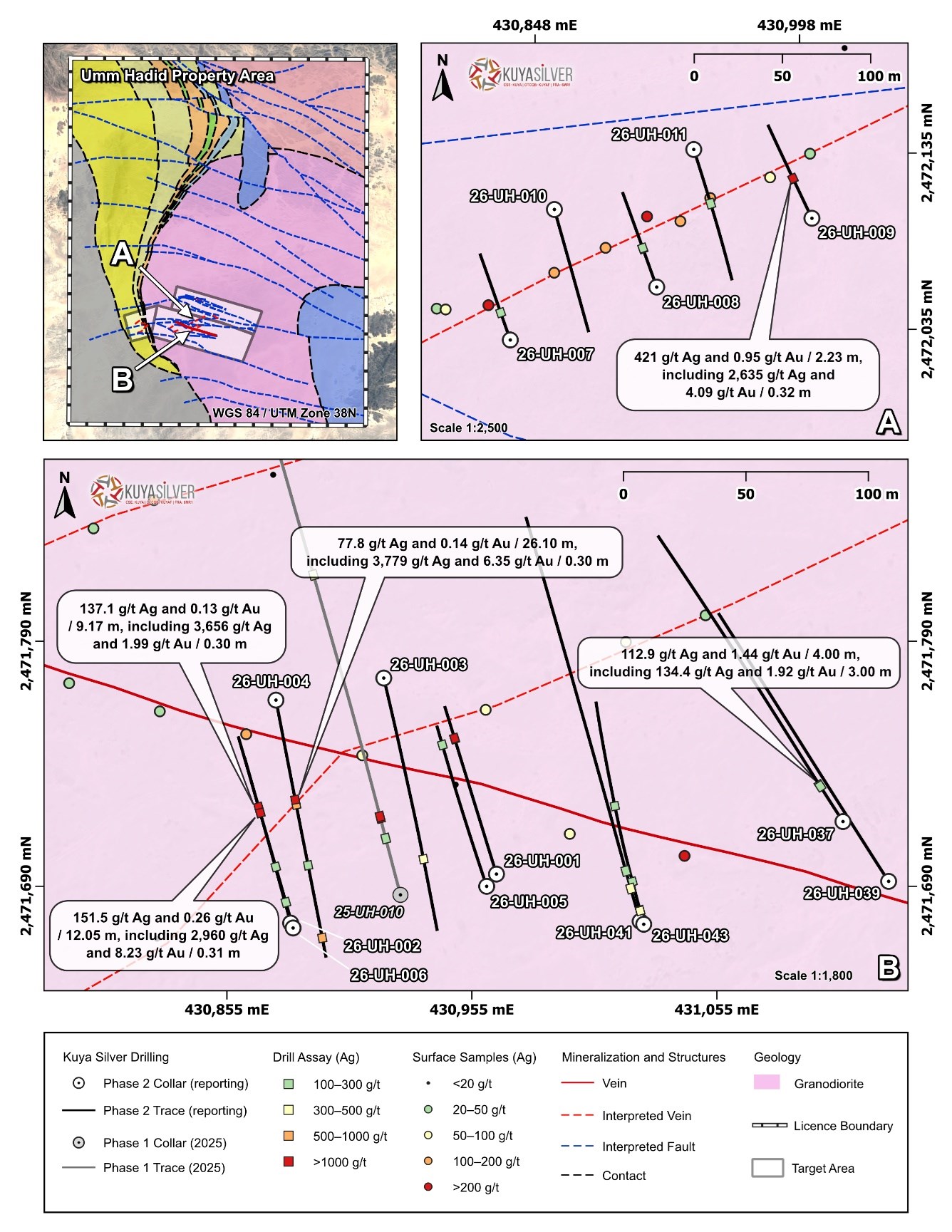
Hole 26-UH-004: 26.10 m grading 77.8 g/t silver and 0.14 g/t gold from 64.45 to 90.55 m, including 0.30 m grading 3,779 g/t silver and 6.35 g/t gold; and a separate 2.10 m grading 178.5 g/t silver and 0.51 g/t gold from 152.75 to 154.85 m.
Hole 26-UH-006: 9.17 m grading 137.1 g/t silver and 0.13 g/t gold from 71.00 to 80.17 m, including 1.20 m grading 959.8 g/t silver and 0.54 g/t gold, which includes 0.30 m grading 3,656 g/t silver and 1.99 g/t gold.
Hole 26-UH-002: 12.05 m grading 151.5 g/t silver and 0.26 g/t gold from 70.00 to 82.05 m, including 1.39 m grading 576.0 g/t silver and 0.31 g/t gold, and 0.31 m grading 2,960 g/t silver and 8.23 g/t gold.
Hole 26-UH-009: 2.23 m grading 421.9 g/t silver and 0.95 g/t gold from 36.94 to 39.17 m, including 1.35 m grading 695.8 g/t silver and 1.35 g/t gold, which includes 0.32 m grading 2,635 g/t silver and 4.09 g/t gold.
Hole 25-UH-037: 4.00 m grading 112.9 g/t silver and 1.44 g/t gold from 33.00 to 37.00 m, including 3.00 m grading 134.4 g/t silver and 1.92 g/t gold.
Note: Reported lengths are core lengths and do not necessarily represent true widths.
Summary of Drilling Results
A total of 59 diamond drill holes representing approximately 11,373.5 meters has been drilled up to date. This total comprises 5,135.62 meters in 29 holes previously reported in December 2025 and 6,237.88 meters in 30 additional holes from 25-UH-030 through 26-UH-016A whose new assay results are reported here. The current 10,000-metre Target 01 program remains ongoing; consequently, these results represent an interim dataset and additional drilling and assays are pending.
The current resource-definition work is focused on Target 01. Target 01 covers an approximately 4.5 km by 2.5 km area containing multiple northwest-trending veins and faults with subordinate northeast-trending splays hosted predominantly by granodiorite. Drilling is being progressively refined using geological, structural and assay information, with APEX providing independent resource-focused drilling optimization advice.
The mineralized intervals reported herein occur at depths ranging from approximately 16 to 131 meters below surface, with an average depth of approximately 58 meters.
Osbaldo Zamora, Kuya Silver’s Vice President of Exploration, commented: “These new results confirm that Target 01 hosts multiple high-grade silver-gold structures and demonstrate that higher grades occur across several drill sections rather than in a single isolated intercept. The ongoing program is now focused on establishing continuity and collecting the geological and structural information required for resource modelling. With APEX already engaged and actively advising on drill optimization, we are aligning each new hole with the objective of delivering a robust maiden NI 43-101 mineral resource estimate as the next step in this promising silver-gold discovery.”
Summary of Significant New Intercepts
Hole
From (m)
To (m)
Length (m)
Ag (g/t)
Au (g/t)
Area
Azimuth
Dip
25-UH-037
33
37
4
112.9
1.44
Target 01
327.14
-61.2
including
34
37
3
134.4
1.92
25-UH-041
19
23
4
125.7
0.14
Target 01
343.84
-51.99
including
22
23
1
452.0
0.50
25-UH-042
70
74
4
22.2
2.97
Target 03
130.25
-69.48
including
73
74
1
62.4
9.44
25-UH-043
16.8
18
1.2
316.3
0.30
Target 01
345
-70.35
25-UH-043
53
56
3
45.1
0.17
Target 01
including
53
53.45
0.45
180.5
0.85
25-UH-043
138
142.35
4.35
35.6
0.32
Target 01
including
141.35
142.35
1
73.5
1.19
26-UH-001
87.7
89
1.3
506.2
1.16
Target 01
342.3
-49.79
including
87.7
88.57
0.87
751.5
1.73
including
88.1
88.57
0.47
1089.0
2.67
26-UH-002
70
82.05
12.05
151.5
0.26
Target 01
345.86
-49.51
including
71.68
73.07
1.39
576.0
0.31
including
75.56
75.87
0.31
2960.0
8.23
26-UH-003
117.64
121.1
3.46
48.3
0.12
Target 01
166.7
-51.17
including
117.64
117.94
0.3
421.0
0.79
26-UH-004
64.45
90.55
26.1
77.8
0.14
Target 01
169.11
-50.5
including
64.45
64.75
0.3
3779.0
6.35
including
66.73
67.94
1.21
419.1
0.83
26-UH-004
152.75
154.85
2.1
178.5
0.51
Target 01
including
153.35
153.85
0.5
731.0
2.14
26-UH-005
92.85
94.18
1.33
93.1
0.28
Target 01
341.57
-50.7
including
93.34
93.74
0.4
231.0
0.74
26-UH-006
71
80.17
9.17
137.1
0.13
Target 01
344.54
-51.12
including
76
77.2
1.2
959.8
0.54
including
76.43
76.73
0.3
3656.0
1.99
26-UH-008
36.5
37.6
1.1
134.4
0.33
Target 01
340.49
-51.26
including
37.28
37.6
0.32
265.0
0.60
26-UH-009
36.94
39.17
2.23
421.9
0.95
Target 01
334.32
-51.18
including
37.82
39.17
1.35
695.8
1.35
including
38.85
39.17
0.32
2635.0
4.09
26-UH-012
263.1
265.4
2.3
56.5
0.30
Target 02
181.12
-46.82
including
264.7
265.4
0.7
129.0
0.86
Table 01. Summary of significant new mineralized intervals. The table presents 14 new Target 01, and significant silver and gold intervals from Targets 02 and 03. Composite grades are length weighted. All reported intervals in this news release are downhole core lengths. True widths of mineralized intervals are not known at this time.
Update To Previously Reported Results
Updated overlimit assays strengthen previously reported results from the December 2025 program. At Target 03, hole 25-UH-029 returned 2.00 m grading 624.0 g/t silver and 0.85 g/t gold from 27.00 to 29.00 m. At Target 02, the previously reported high-grade intercept in hole 25-UH-018 occurs within a broader 12.00 m interval grading 100.7 g/t silver and 0.51 g/t gold from 85.00 to 97.00 m. These are restated results and are not included in the table of new results above.
Figure 1. Map showing geology interpreted from geophysical data and satellite imagery, surface-sample assay results, drillhole collar locations, and identified target areas, with detailed views of recent drilling results from Target 01
The 2026 10,000-metre program is focused primarily on Target 01 and is intended to:
Test strike and dip continuity of the principal silver-gold structures;
Provide sufficient geological, structural, density and assay information to support three-dimensional wireframing and resource estimation;
Identify and close material drilling gaps while avoiding unnecessary duplication;
Improve confidence in the distribution of higher-grade shoots; and
Provide the technical basis for a maiden mineral resource estimate and NI 43-101 technical report
APEX has been appointed as the independent technical consultant for the mineral resource estimate and NI 43-101 technical report. APEX is presently reviewing results and interpretations and providing advice to optimize the remaining drill program for resource-estimation objectives.
Subsequent drilling will remain focused on Target 01 until the drilling required for the maiden resource estimate is completed. Following completion of the Target 01 resource-estimation program, the Company intends to return to Targets 02 and 03 for follow-up drilling and further evaluation of the mineralized structures identified to date.
Quality Assurance / Quality Control (QA/QC)
Drill core (HQ) samples were collected under the supervision of an experienced Silver Mining geologists and transported safely to a core logging facility for detailed logging and sampling. Samples were prepared using half core and securely shipped to Bureau Veritas Laboratories in Jeddah, Kingdom of Saudi Arabia for sample preparation, and analysis.
All samples were analyzed using four-acid digestion ICP-ES (code MA300) with Fire Assay and Gravimetric Finish (cores FA 430 and FA530, respectively) and standard industry procedures.
As part of the Company’s QA/QC protocols, a robust quality control program was implemented, which includes the insertion of certified reference materials (standards), blank samples, and duplicate samples at regular intervals (approximately every 10 samples) throughout the sample stream. All QA/QC control samples returned results within acceptable limits, ensuring the reliability of the assay data.
Qualified Person
The scientific and technical information in this news release has been reviewed and approved by Osbaldo Zamora, Ph.D., P.Geol., a Qualified Person as defined by National Instrument 43-101. Dr. Zamora is Vice President of Exploration for Kuya Silver and is not independent of the Company.
About Kuya Silver Corporation
Kuya Silver is a Canadian‐based, growth-oriented mining company with a focus on silver. Kuya Silver operates the Bethania silver mine in Peru, while developing district-scale silver projects in mining-friendly jurisdictions including Peru, Canada and Saudi Arabia.
About Silver Mining LLC
Silver Mining, based in the Kingdom of Saudi Arabia, is a private joint venture between majority shareholder, Saudi-based Sumou Holding (https://sumouholding.com), and Kuya Silver. Kuya Silver currently holds a 5% carried interest with an option to acquire an additional 40% participating interest in the company.
This news release contains statements that constitute “forward-looking information,” including statements regarding the plans, intentions, beliefs, and current expectations of the Company, its directors, or its officers with respect to the future business activities of the Company. The words “may,” “would,” “could,” “will,” “intend,” “plan,” “anticipate,” “believe,” “estimate,” “expect,” “must,” “next,” “propose,” “new,” “potential,” “prospective,” “target,” “future,” “verge,” “favorable,” “implications,” and “ongoing,” and similar expressions, as they relate to the Company or its management, are intended to identify such forward-looking information. Investors are cautioned that statements including forward-looking information are not guarantees of future business activities and involve risks and uncertainties, and that the Company’s future business activities may differ materially from those described in the forward-looking information as a result of various factors, including but not limited to fluctuations in market prices, successes of the operations of the Company, continued availability of capital and financing, and general economic, market, and business conditions. There can be no assurances that such forward-looking information will prove accurate, and therefore, readers are advised to rely on their own evaluation of the risks and uncertainties. The Company does not assume any obligation to update any forward-looking information except as required under the applicable securities laws.
Neither the Canadian Securities Exchange nor the Investment Industry Regulatory Organization of Canada accepts responsibility for the adequacy or accuracy of this release.
The 10-year Treasury yield touched 4.814% Wednesday, its highest level since November 2023, before easing slightly to 4.77%. The 30-year yield sat at 5.26%, still hovering near the multi-decade highs that rattled markets last month. This is not a new, isolated story. It is the direct convergence of three separate threads that have each been building independently over recent weeks.
The first is oil. Crude prices pushed toward $95 a barrel this week after fresh US strikes on Iran, extending the renewed escalation we covered when fighting resumed after the earlier ceasefire lapsed. Elevated energy prices continue feeding directly into inflation expectations, and rising inflation expectations are one of the most reliable drivers of higher long-term bond yields.
The second is the Fed itself. Chair Kevin Warsh’s hawkish tone at his debut Jackson Hole speech last week set the stage, and Fed Governor Michelle Barr reinforced that posture Tuesday, stating the central bank should raise rates in September if inflation does not show sufficient signs of moderating. Prediction markets responded accordingly, with odds of a September rate hike on Polymarket climbing to 56% following Warsh’s initial remarks, up meaningfully from where they stood before Jackson Hole.
The third thread is less obvious but genuinely important. Rising yields are not only about oil and Fed policy, they also reflect growing investor concern over government debt levels and expanding fiscal deficits, alongside a separate but related dynamic in corporate debt markets. Technology companies building out AI infrastructure are increasingly turning to bond markets to fund that buildout, since the scale of spending required has outpaced what free cash flow alone can cover, a dynamic we detailed closely when BlackRock priced its $12.3 billion data center bond offering for Meta and when CoreWeave raised its own capital expenditure guidance earlier this summer. That wave of new corporate debt issuance adds further supply pressure to long-term bond markets at the exact moment government borrowing is already elevated, a combination that tends to push yields higher independent of any single catalyst.
The market reaction Wednesday reflected this convergence clearly. Rate-sensitive technology and growth stocks sold off sharply, with several names in the AI infrastructure and networking space falling double digits on the day, a pattern consistent with what happens whenever long-term borrowing costs move decisively higher.
For companies operating below the $2 billion market cap threshold, this is precisely the kind of environment worth watching closely. Small and microcap companies carry disproportionately more variable-rate debt than large cap peers, and when oil, Fed policy expectations, and corporate debt supply are all pushing in the same direction simultaneously, the resulting pressure on borrowing costs tends to be more durable and harder to reverse with any single piece of good news. The individual pieces of this story are all familiar. What matters now is that they are no longer moving independently, they are compounding.