Aethlon Medical (NASDAQ: AEMD) and privately held North Immunology have entered into a definitive all-stock merger that will effectively take North public and create a Nasdaq-listed biotechnology company focused on immune and inflammatory diseases.
The combined company will operate as North Immunology, Inc. and is expected to trade under the new Nasdaq ticker NRTX. Existing North shareholders and investors participating in a concurrent financing are expected to own approximately 95.25% of the combined company, while pre-merger Aethlon shareholders are expected to own approximately 4.75%. The transaction values the combined company at approximately $346.5 million on a pro forma equity basis, including the financing.
Alongside the merger, North has secured an oversubscribed $180 million private placement backed by healthcare-focused institutional investors including Bain Capital Life Sciences, Janus Henderson Investors, Deep Track Capital, Longitude Capital, Soleus Capital, Farallon-managed funds and others. The financing is expected to fund operations into the second half of 2028 and support clinical development of North’s lead drug candidate, NOR-101. The transaction is expected to close in the first quarter of 2027, subject to shareholder, Nasdaq and other customary approvals.
A Reverse Merger Centered on North Immunology
Although the companies describe the transaction as a merger, the ownership and management structure make it functionally a reverse merger. North’s existing management team will lead the combined company, and its existing board – supplemented by new independent directors – is expected to become the board of the public entity. Aethlon’s Nasdaq listing and corporate structure provide North with a route to the public markets while the newly financed company concentrates its resources on North’s immunology pipeline.
That makes the transaction quite different from a conventional strategic acquisition in which the buyer absorbs the target’s assets and management. Here, North becomes the operating company that survives economically, while Aethlon shareholders retain a relatively small ownership stake.
Aethlon CEO James Frakes said the structure gives existing shareholders an opportunity to participate in North’s pipeline while preserving potential value from Aethlon’s legacy assets. Those legacy assets include the Hemopurifier, Aethlon’s clinical-stage blood-filtration device designed to remove cancer-promoting exosomes and certain life-threatening viruses from circulation. Aethlon shareholders immediately prior to closing are expected to receive contingent value rights, or CVRs, entitling them to potential proceeds if the Hemopurifier business is subsequently sold, licensed or otherwise monetized.
NOR-101 Becomes the Center of the Investment Story
The combined company will be built primarily around NOR-101, North Immunology’s half-life-extended bispecific antibody targeting both IL-13 and IL-18.
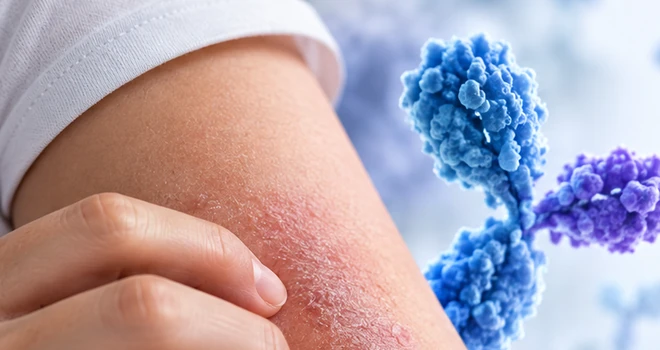
North is developing the drug initially for atopic dermatitis, the most common form of eczema. The chronic inflammatory skin disease can cause itching, lesions and recurring flare-ups, and moderate-to-severe cases increasingly are treated with biologic therapies or other systemic drugs.
The rationale behind NOR-101 is to attack two different components of the inflammatory response simultaneously. IL-13 is an established target associated with type 2 inflammation, while IL-18 is associated with additional inflammatory pathways. North believes blocking both could potentially address a broader spectrum of disease biology than therapies focused on type 2 inflammation alone.
The company has reported an approximately 42-day half-life in a non-human primate pharmacokinetic study, an attribute that could eventually support less frequent dosing if it translates into humans. NOR-101 remains preclinical, however, meaning the thesis still has to be demonstrated in patients.
North expects to begin a Phase 1a study in the first quarter of 2027, with interim pharmacokinetic and safety data expected by midyear. The company then plans to begin Phase 1b and Phase 2b studies in atopic dermatitis during 2027, with topline results from both studies anticipated in 2028.
Atopic Dermatitis Has Become a Highly Competitive Market
North is entering a field that offers substantial commercial opportunity but also an increasingly high clinical bar. Biologic therapies have transformed treatment of moderate-to-severe atopic dermatitis. Sanofi and Regeneron’s Dupixent, which inhibits IL-4 and IL-13 signaling, established the category, while Eli Lilly’s Ebglyss directly targets IL-13. AbbVie’s JAK inhibitor Rinvoq provides another systemic treatment option.
The strategic value pharmaceutical companies are assigning to differentiated eczema therapies was underscored this summer when AbbVie agreed to acquire Apogee Therapeutics for $10.9 billion. Apogee’s lead asset is a long-acting anti-IL-13 antibody that produced encouraging Phase 2 results and is designed in part to reduce injection frequency relative to existing biologics.
IL-18 is also attracting attention. Earlier this year, Evommune reported positive Phase 2a results for an experimental IL-18-targeting therapy in moderate-to-severe atopic dermatitis, sending its shares sharply higher following the data. Those developments provide scientific and commercial context for North’s decision to combine IL-13 and IL-18 inhibition in a single molecule, but they also demonstrate how competitive the field has become.
Differentiation Will Be Critical
Simply producing another effective eczema therapy may no longer be enough. Recent industry developments show that drugmakers are increasingly demanding meaningful improvements in efficacy, durability, convenience or safety before committing substantial additional capital to new atopic dermatitis programs.
Sanofi, for example, recently abandoned plans to seek approval for the atopic dermatitis drug amlitelimab after concluding that its clinical profile would not represent a sufficiently meaningful improvement over available therapies. Johnson & Johnson also discontinued development of an experimental eczema therapy earlier this year after an interim analysis failed to clear the company’s efficacy threshold.
That creates both the opportunity and the challenge for NOR-101. North is attempting to distinguish the candidate through dual-pathway inhibition and potentially extended dosing intervals, but investors will ultimately need human clinical data showing that those characteristics translate into meaningful improvements for patients. The first important test begins next year.
$180 Million Gives North a Longer Development Runway
The concurrent financing is an important component of the transaction. Clinical-stage biotechnology companies frequently use reverse mergers to access public markets, but the resulting companies can still face immediate capital needs. North is entering the public market with approximately $180 million of expected gross financing proceeds, including the conversion of roughly $34 million in convertible notes and related amounts.
Management expects that capital to fund operations into the second half of 2028, which would carry the company through several planned clinical milestones for NOR-101. The investor syndicate is also notable because it includes several established life sciences investors rather than relying principally on smaller retail-oriented financing sources. For investors evaluating the transaction, that does not eliminate clinical risk, but it provides North with a substantially stronger balance sheet as it enters human testing.
Aethlon Shareholders Retain Exposure to the Legacy Business
For existing Aethlon shareholders, the transaction effectively separates two investment propositions. Their 4.75% expected ownership of the combined company provides exposure to North Immunology and NOR-101, while the CVR preserves potential future value from Aethlon’s existing Hemopurifier program if those assets can be monetized.
Aethlon has been developing the Hemopurifier as an extracorporeal therapeutic device capable of depleting circulating cancer-promoting exosomes and certain viruses. The FDA has granted the technology Breakthrough Device designation in both oncology and life-threatening viral disease settings, and Aethlon has been conducting an early-stage study in solid-tumor patients receiving checkpoint inhibitors. Whether those assets ultimately generate meaningful CVR proceeds will depend on a future sale, licensing agreement or other transaction, making that component inherently uncertain.
Related Immunology Company in Noble Capital Markets Coverage
Eledon Pharmaceuticals (NASDAQ: ELDN) offers a related immunology example within Noble Capital Markets research coverage. Eledon is developing tegoprubart, an anti-CD40L antibody intended to modulate immune responses in organ and islet transplantation. Like NOR-101, its therapeutic approach targets a defined immune signaling pathway, although the diseases, mechanisms and stages of development are quite different. Eledon is covered by Noble Capital Markets.
North Immunology Prepares for the Public Markets
For Aethlon, the agreement represents a fundamental change in corporate direction. For North Immunology, it provides a Nasdaq listing, substantial new capital and a path to move its lead program into human trials without pursuing a traditional IPO.
The resulting company will bear North’s name, use its management team and focus primarily on its pipeline, making the transaction best understood as a reverse merger built around a newly financed immunology company.
The scientific thesis is straightforward: IL-13 inhibition is already validated in atopic dermatitis, while emerging research suggests additional inflammatory pathways such as IL-18 may contribute to disease in patients who remain inadequately treated. Whether simultaneously targeting both pathways can produce a differentiated therapy remains unproven.
With roughly $180 million in financing and the first NOR-101 clinical study expected to begin in early 2027, investors should not have to wait long for the combined company to begin generating the human data that will ultimately determine whether that strategy can compete in one of immunology’s most active therapeutic markets.