The Odds May Again be Stacked on the Side of a Prolonged Oil Price Rally
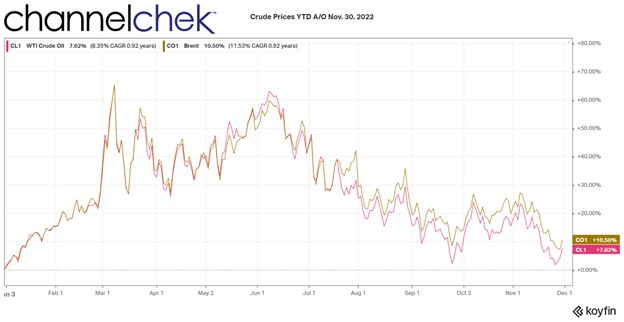
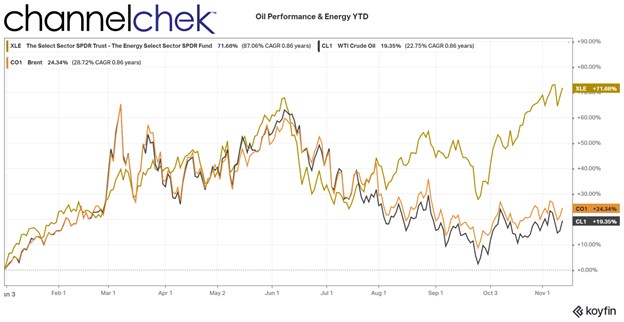
Oil markets and the related energy industry have been cheered this year as the one clear winner, yet within the past few days, crude has brushed up against its low recorded at the start of 2022. The commodity has since bounced, and there are at least four reasons to believe that it will continue to rally.
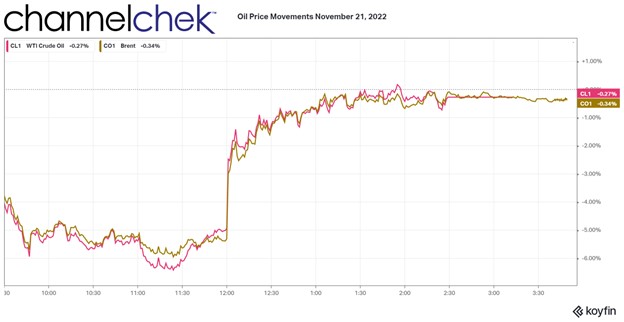
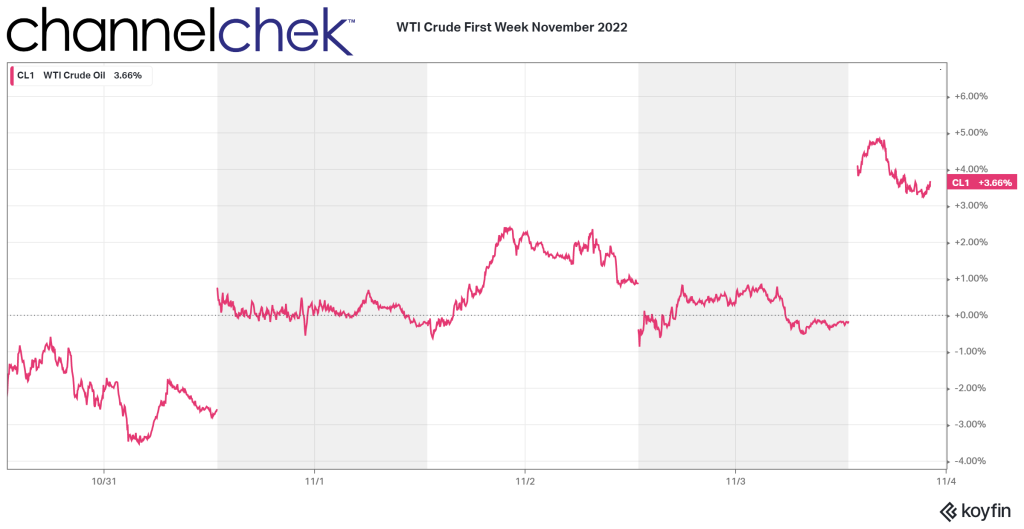
On Wednesday, November 30, news that China will take steps to ease lockdown restrictions, a drop in U.S. oil supplies, a weaker U.S. dollar, and a signal of OPEC+’s intentions helped push crude prices up by more than 3.5%.
China
Major Chinese manufacturing cities are lifting Covid lockdowns, including the financial hub Shanghai and Zhengzhou (the location of the world’s largest iPhone factory). Renewed expectations that China’s economy may strengthen after being held back by restrictions on movement to contain Covid-19 helped lift prices. After lockdown protests last weekend, Chinese authorities reported fewer cases of the virus on Tuesday. Guangzhou, a city in the south of the country, relaxed some rules on Wednesday. Increased economic activity in China could come at a pace that dramatically increases the demand for oil and related products.
US Supply
U.S. petroleum stockpiles declined by 7.9 million barrels last week, according to reports from the American Petroleum Institute. Official figures from the U.S. Energy Information Administration (EIA) shown below indicate a declining trend that is unsustainable and will soon need to be turned around.
Source: EIA
The decline in the days supply is effectively borrowing against future stockpiles as there will need to be a time when this reverses, and more output-increasing stockpiles will add to demand on production.
U.S. Dollar
A weakening dollar has also helped enhance demand globally for crude by making contracts priced in the U.S. currency more affordable for overseas buyers. The dollar index, a measure of strength against a basket of six other major trading currencies, slipped 0.3% on Wednesday. It’s down about 5% in the past month.
While the effect of this FX change may not be felt by U.S. buyers, the added demand by requiring less local currency to translate into dollars effectively creates demand by virtue of its lower cost.
Source: Koyfin
OPEC+
The Saudis had been considering increasing their output to help soften price pressures and increase availability. This would occur when the cartel meets this weekend to decide output levels. It is reported that the meeting will not be in-person. When OPEC+ agrees to meet virtually, it tends to indicate they are not discussing any major changes to output targets.
Expectations of an increase in output had been built into the price; the new expectations are putting upward pressure on crude.
Take Away
A number of factors have caused crude to trade off since late Spring. A number of forces are now stacked up that could push crude levels back upward. These include fewer lockdowns in China, a declining U.S. supply, the added global demand that will be attracted by a weakening dollar, and the new realization that members of OPEC+ are not likely to increase output limits. Additionally, there has been a looming concern as to how much supply will be taken offline with price limits that are to be placed on purchases of Russian oil early next week.
World Cup 2022: How Sponsorship has Become Less About Selling Drinks and More About Geopolitics
The Fifa men’s World Cup 2022 in Qatar is arguably the most political in history.
Even during the seemingly innocuous performance of South Korean pop star Jung Kook at the tournament’s opening ceremony, geopolitics were center stage. For Kook, 25, is not just a good-looking young man with a global fan base and a multi-million dollar fortune. In addition, he has a lucrative endorsement deal with the South Korean car maker Hyundai-Kia, which also happens to be a major Fifa sponsor.
This kind of relationship is neither an accident nor a simple business arrangement. For years, the South Korean government has been pursuing a strategy aimed at building and projecting “soft power”, developing its engagement with target audiences around the world. This has happened not just through football, music and cars, but also through Oscar winning films like Parasite and the massively popular TV series Squid Games.
And it’s not just South Korea taking advantage of the audiences that Fifa can provide. For while sellers of soft drinks and burgers are still part of the sponsorship roster, Fifa’s key partners are increasingly big corporations from countries keen to benefit from the global reach of football.
State-owned Qatar Airways for example, is busy selling plane tickets as Fifa’s official airline partner, but also plays a pivotal role in attempts by the Qatari government to establish Hamad International Airport as a major hub of global travel.
The award winning airline is an effective instrument of soft power, transmitting signals to global audiences about what Qatar is and what it aspires to be. In turn, the airline, and the very act of hosting the 2022 World Cup, are both illustrations of a nation intent on telling the world a particular story about itself – that it is a legitimate, trustworthy and important member of the international community.
The same applies to China, even though sporting and industrial progress have stalled somewhat since the pandemic. Its roster of four key World Cup sponsors featuring electronics (Hisense), mobile phones (Vivo), dairy products (Mengiu) and everything from property to media (Wanda) remains significant for a country hopeful of one day staging the tournament itself and a government keen to spread China’s influence around the world.
Rebels With a Cause
Alongside the World Cup’s main sponsors, a tradition has emerged of business competitors during tournament engaging in “ambush” marketing. This involves brands using the mega-event as a marketing tool without the considerable expense of an official link (Fifa is reportedly charging around US$100 million (£82 million) for a four-year sponsorship deal).
One notably successful ambush was perpetrated by Bavaria Beer’s provocative campaigns at the 2006 World Cup in Germany and again in 2010 in South Africa. These stunts involved equipping spectators with branded clothing, which was smuggled into stadiums. This gained huge global attention which was no doubt frustrating for the tournaments’ “official” beer, Budweiser.
Brightly colored ambush in 2010. EPA/STR
Yet even ambush marketing now appears to have become geopoliticised. For instance, during this World Cup, the authorities in nearby Dubai have been trying to draw attention away from Qatar with a tourism campaign featuring international football stars. The rival emirate will also be staging its own football tournament at the same time as the World Cup, featuring the likes of Liverpool, AC Milan and Arsenal.
And while in 2010, Bavaria Beer used women wearing orange dresses in its ambush, the UK-based brewer and pub chain BrewDog is trying to get in on this year’s action with its strident anti-World Cup marketing campaign.
Through a series of provocative billboards (in the UK), BrewDog is using references to autocracy, human rights abuses and corruption, all targeted at beer drinkers perturbed about Qatar’s staging of football’s biggest global event. While the bottom-line remains the same for BrewDog – to make a profit by selling beer – it is nevertheless contributing to the transformation of advertising and sponsorship from simple marketing to geopolitical posturing.
In a similar way, apparel brand Hummel has decided to hide its name and logos and the Danish football association’s badge from its kit. This is in protest against the treatment of migrant workers in Qatar and in support of LGBTQ+ communities.
In the company’s mission statement, Hummel emphasises its commitment to “Danishness” – and indeed, Denmark has been highly vocal in its condemnation of Qatar. Whenever the national team takes to the field, it will be in shirts that directly challenge the World Cup hosts.
So Qatar’s expensive ambitions in staging this tournament have come up against criticism and protest from countries and corporations alike. In 2022 it seems that football sponsorship is no longer just for kicks, or even customers. Everywhere you look, there are geopolitical points to be scored.
This article was republished with permission from The Conversation, a news site dedicated to sharing ideas from academic experts. It represents the research-based findings and thoughts of Simon Chadwick, Professor of Sport and Geopolitical Economy, SKEMA Business School.
Why the Fed Needs to Gain Trust, Gain Momentum, and Gain More Yards
Monetary policy and its implementation is as much sport as science. Economics is actually a social science, so it relies on human behavior to mimic past behaviors as its prediction guide. But as in sports, victory is difficult if there is distrust in the coach that’s calling the shots (in this case Powell), or if there are people on your side that have reason to work against you, (an example would be Yellen). Consistency in blocking and tackling (doing the right thing) and not giving up, over time, wins games. Knowing what to expect from the opposing team (consumers) wins a healthy economy.
One repeated trait in monetary policy is that there is a lag between implementation (easing or tightening) and a change in economic conditions. It isn’t a short lag, and the impact varies. Since it could take more than a year for a policy change to begin to impact the economy, the Fed usually moves at a slow and measured pace in order to not overdo it.
The slow pace allows policymakers to observe the impact of their moves and change tactics (positions on the playing field) mid-game.
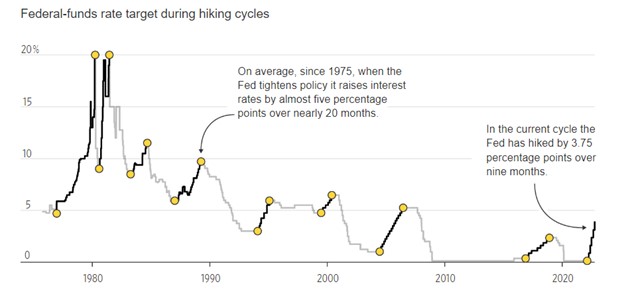
Federal-Funds Rate During Tightening Cycles
Note: From December 2008, midpoint of target range. December 2015 hike excluded from 2016-18 cycle
Source: Federal Reserve
Over the past nine months, we have been in a tightening cycle. During this period, the Fed has raised rates by 3.75%. On average (since 1975), when the Fed has tightened rates, they are notched up by 5.00% over 20 months.
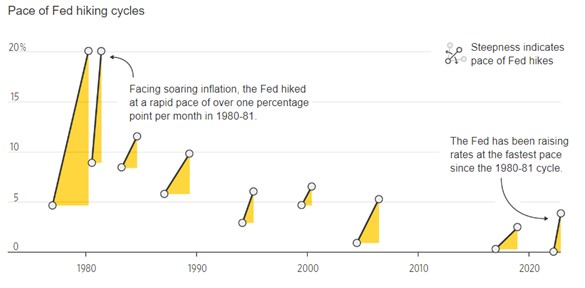
The Fed’s current pace is faster than average. This is because inflation took them by surprise, and rose rapidly. Putting up a strong defense against inflation that has been rampant is necessary to not be shut out and allow the Fed to gain control over the outcome.
Because one has to be able to reflect back more than 40 years to have experienced the Fed raising rates this fast. Many have lost confidence in its ability, and are in their own way working against a winning outcome.
Pace of Fed Hiking Cycles
Note: From December 2008, the midpoint of target range
Source: Federal Reserve
The stock and bond markets move in group anticipation of expected policy moves by the Fed. This has been more pronounced in recent years as the Fed has basically shared its expectations after each meeting, setting up for the next. Higher rates make bonds and bank deposits more attractive. Higher rates also weaken the economy and corporate profits, and that induces investors to move away from stocks and even real estate.
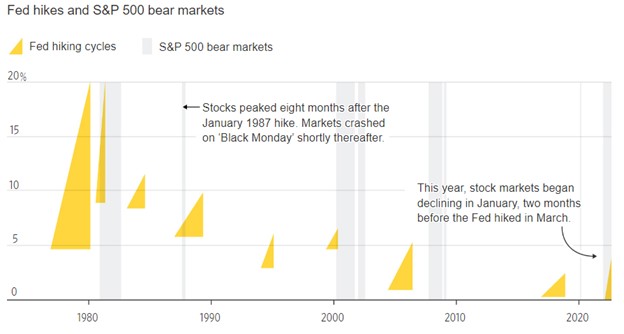
Bonds now offer the highest yields since 2007. The stock market may have anticipated what was to come as it peaked in early January of this year, more than two months before the Fed began hiking in March.
Fed Hikes and S&P 500 Bear Markets
Sources: Federal Reserve; Dow Jones Market Data
Employment
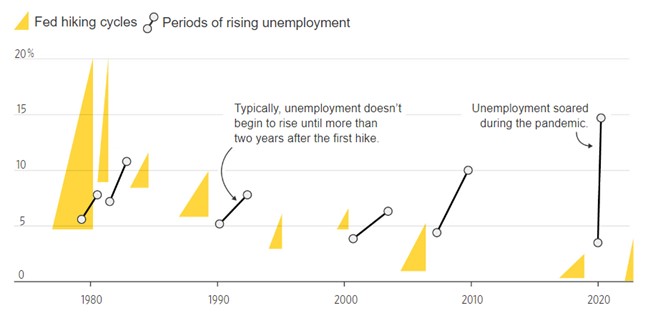
The Fed is concerned with a wage-price spiral feeding on itself. It likely won’t be satisfied that its tightening has been sufficient until it can be confident that it has avoided a wage-price storm on the economy.
Ideally, this would happen without unemployment rising. Soft landings took place in 1983-84 and 1994-95. But when inflation starts out too high, as it is now, unemployment usually rises notably, and a recession occurs.
Historically, this doesn’t happen until several years after the first increase. This time it is hoped it will be different, since the Fed is playing more aggressively.
Periods of Fed Hiking and Rising Unemployment
Note: The unemployment rate rose to 3.7% in October, up from the pandemic low of 3.5% a month earlier. Sources: Federal Reserve; Labor Department
Inflation
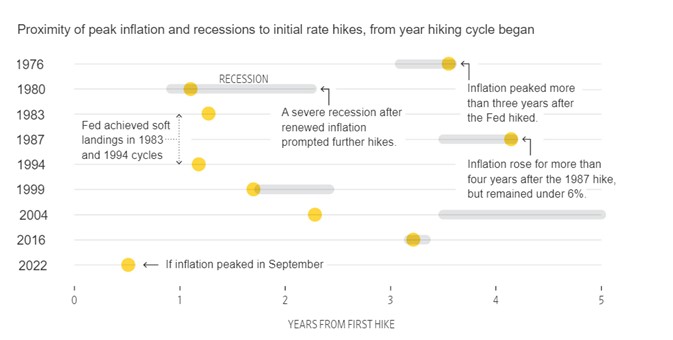
Historically, inflation has only fallen to acceptable levels after unemployment has increased, and long after the first rate increase – the exact timing has varied. If the fall in core inflation (which excludes the volatile food and energy components) between September and October continues, and September proves to be the peak, the time between the first Fed increase and the high point of inflation will be one of the shortest of any Fed hiking cycle.
Often, the break in inflation has been accompanied by a recession. The economy receded in each of the first two quarters and then grew in the third. The changes in the inflation component in Gross Domestic Product may have borrowed from one quarter and have been additive to the next. The fourth quarter reading should help level the growth averages out to see if we were indeed in a shallow recession.
Proximity of Peak Inflation and Recessions to Initial Rate Hikes, from Year Hiking Cycle Began
Note: Inflation refers to core CPI.
Sources: Federal Reserve; Labor Department
Take Away
As in many team sports, once one side gets momentum, they are difficult to stop . The Fed needs to gain the trust of the individual players in the economy in order to be successful. Saying one thing, then doing another, would undermine this trust. So far, despite the Fed originally being wrong about inflation, the Fed has done what it has said it would do. Stock and bond markets, which are a considerable part of the economy, have been slow to understand the Fed’s resolve.
It has been implementing the balance sheet run-off plan and raising rates toward a level it believes would equate to a future 2% inflation rate. Like so many other things in the social sciences, widely held expectations of the future become self-fulfilling.
Europe May Be Saved from the December Planned Oil Embargo in a Nick of Time
On December 5, the European Union plans to cap oil prices at levels where EU nations would then be permitted to buy oil from Russia. This would significantly reduce the petroleum supply of the region going into winter. The day before this goes into effect, (December 4), OPEC+ will meet to set output levels. Saudi Arabia and other OPEC producers are expected to discuss an output increase, according to emissaries from the group. The 11th hour move could keep much needed petroleum flowing into the region at a time that weather-related demand would naturally grow, holiday driving would be expected to increase, and war-related strategies would have reduced oil coming out of Russia. While western news has verified their sources as actual delegates of OPEC+, the Saudi’s are now saying that their plans are always secret.
About the New Expectations
A production increase of up to 500,000 barrels a day is now expected to be the discussion at OPEC+’s December 4 meeting, delegates said. Any output increase would mark a partial reversal of a controversial decision last month to cut production by 2 million barrels a day. This was agreed upon at the most recent meeting of the Organization of the Petroleum Exporting Countries and their Russia-led allies, a group known collectively as OPEC+.
The White House had said the production cut undermined global efforts to negatively impact Russia’s war in Ukraine. Saudi-U.S. relations have hit a low point over oil-production disagreements this year; if the December 4 OPEC+ meeting leads to increased oil, this may warm the cooled Saudi-U.S. relations.
About the EU December 5th Plan
The European Union has agreed to stop all oil imports from Russia on December 5. The plan is to cap the prices at which EU nations would buy oil from Russia, that price is expected to be near $60 per barrel. Russia has reacted by increasing exports to Asia, but the price cap is expected to reduce its exports and lower total supply by up to one million barrels per day.
About the OPEC+ December 4th Expectations
A production increase of up to 500,000 barrels a day is now under discussion for OPEC+’s December 4 meeting, emissaries said.
Any increase in OPEC+ output will partially undo the decision made at OPEC+’s its last monthly meeting. In October the cartel voted to cut production by 2 million barrels per day. The decision by the Organization of the Petroleum Exporting Countries and their Russia-led allies, (OPEC+) was a disappointment to the White House and NATO nations that saw reduced production as strengthening Russia’s ability to fund its war with higher priced exports.
Under normal production discussions by OPEC+ production increases, with oil prices falling more than 10% since the first week of November, one might not expect an increase. Brent crude traded at about $87 a barrel on Monday, while WTI, the U.S. benchmark, fell below $80 a barrel for the first time since September. Production increases could cause prices to fall further.
Emissaries say, a production increase would be to respond to expectations that oil consumption will rise in the winter. Oil demand is expected to increase by 1.69 million barrels a day to 101.3 million barrels a day in the first quarter next year, compared with the average level in 2022.
OPEC and its allies say they have been carefully studying the G-7 plans to impose a price cap on Russian oil, conceding privately that they see any such move by crude consumers to control the market as a threat. Russia has said it wouldn’t sell oil to any country participating in the price cap, potentially resulting in another effective production cut from Moscow—one of the world’s top three oil producers.
Raising oil production ahead of the December 5 EU embargo would give the Saudis another argument that they are acting in their own interests, and not is support of Russia’s.
Talk of the production increase emerged after the Biden administration told a federal court judge that Saudi Crown Prince Mohammed bin Salman should have sovereign immunity from a U.S. federal lawsuit related to the killing of Saudi journalist Jamal Khashoggi. The immunity decision is seen by some as a concession to Prince Mohammed, and heighten his standing as the kingdom’s de facto ruler. The move comes after the Biden administration tried for months to isolate him.
Another factor that helps account for the timing of OPEC+’s discussion to raise output is the two large OPEC members, Iraq and the United Arab Emirates that want to pump more oil. Both countries are pushing the oil-producing nations to allow them a higher daily-production ceiling, which would lead to more oil produced globally.
Saudi officials late Monday denied reports the kingdom is reversing course and helping the West with added production.
The Old Congress May Rush to Push Through a Debt Ceiling Agreement
Will there be a government shutdown as Congress grapples with debt ceiling issues?
Only Congress can spend money, so it is the job of Congress to set the upper limit if the nation may decide to go into debt. It is tricky most years, as the process often threatens the government shutdown of non-essential workers. Emergency spending measures often are used before an agreement is passed, before doing any further damage. The most damaging would be to the global faith in the U.S. Government to make do on its debts. Most U.S. Treasury securities are refinanced by reissuing new debt issues. If new debt issues can not be increased to cover today’s higher interest rates, or other increased levels of budgeted spending, the nation faces severe economic trouble.
Treasury Secretary Janet Yellen warned this weekend that lawmakers’ failure to raise the statutory limit on U.S. debt posed a “huge threat” to America’s credit rating and the functioning of U.S. financial markets.
Yellen said that cooperation is still possible between the two major political parties on other financial priorities, but lifting the debt ceiling is a non-negotiable item on the list.
Both parties always jockey for position to get funding for their projects as the country and government workers reel from the negotiation process each year. Currently, U.S. public debt stands at $31.2 trillion. Without an increase, it’s expected that there will be a default crisis by the third quarter of 2023.
Republicans tend to pay more lip service to making spending cuts. In 2010, a Republican lead Congress tried to hold the line on raising the budget risking a possible default on U.S. Government backed securities. The uncertainty over whether the U.S. could fund maturing U.S. Treasuries prompted a first-ever ratings cut on Treasury debt by Standard and Poor’s.
Yellen was asked whether Democrats, who will be in a weakened state after the new Congressional leaders take office in January, should pass legislation in the post-election session, while they still hold a majority. “I think it’s irresponsible not to raise the debt ceiling. It’s always been raised,” Yellen said. “It would be a huge threat to the country not to do it, and completely irresponsible to threaten the credit rating of America and the functioning of the single most important financial market.”
One of the higher priorities that Republicans would want to chop from the budget is the $87 billion in new funds the President wants for the IRS.
Yellen reminded that some Republicans backed last year’s infrastructure act and this year’s investments in semiconductors and research, she suggested the administration would look for measures that could draw further bipartisan support.
Take Away
Each year the U.S. Congress grapples with spending and financing the spending. The financed part, involves Congress providing enough money for the budgeted items. As interest rates rise, they become one more expense to be budgeted for and generally financed.
Janet Yellen, speaking at a G20 meeting in Indonesia warned of the need to lift the debt ceiling, as not doing so would have devastating economic impacts.
Factors Still Point to Higher Oil Prices and Sizeable Bets on Crude
There are many factors impacting why traditional energy prices and producers may have a hurricane-force tailwind heading into the holidays and next year.
A boost in demand for oil is expected as China just announced that it is lowering its quarantine requirements for visitors from outside the country. But Chinese Covid policies aren’t the only impetus pushing up oil demand – around the globe, there are supply challenges that are playing out. Oil hasn’t risen above $100 a barrel since early Summer, some traders are speculating it will rise above $200 in the coming months. Here’s why.
China
In addition to the announcement that the CPR was cutting the required quarantine period for the country (to five days from seven, with three days of home isolation), the required PCR test hurdle is being lowered as well. And airlines no longer run the risk of being suspended if the travelers they bring in that test positive is five or more.
Europe
The European Union has agreed to stop all oil imports from Russia on Dec. 5. The plan is to cap the prices at which EU nations would buy oil from Russia, that price is expected to be near $60 per barrel. Russia has reacted by increasing exports to Asia, but the price cap is expected to reduce its exports and lower total supply by up to one million barrels per day.
United States
Back in May, the U.S. took the drastic step of increasing available supply by selling oil from the U.S. Strategic Petroleum Reserve at a rate of nearly one million barrels per day starting in May. The increased supply has kept oil prices down. But the sales are unsustainable and expected to be reduced. Congress has allowed another sale of 26 million barrels that are expected to carry through to October 2023. This is a much slower pace of oil releases from the reserves. Plus, the reserves will need to be replenished.
After the Congressionally approved release, the reserve will be down to 348 million barrels, this is half the quantity compared to January of this year —the lowest since 1983. Congress has said that the reserve must stay above 252.4 million barrels, and the incoming Congress is expected to be more conservative when it comes to using these strategic assets to control prices.
Production growth overall in the U.S. has stalled after having increased through most of the year. Government data show that U.S. production dropped to 11.9 million barrels per day last week, this is tied for the lowest level in several months. Supplies of products such as diesel and heating oil in the U.S. are at multiyear lows. So there is not abundant supply should a weather-related or some other fuel-demanding crisis surface.
Oil is now trading between $92 and $93 a barrel. It had reached a high above $130 in March, shortly after the war began, and hasn’t seen the $100 a barrel level since late June.
Trading this week showed significant flows into an options contract that speculates that $200 per barrel may be in store. The most actively traded Brent crude options contract on Thursday was an option to buy Brent at $200 in March 2023. This was the most active oil contract of the day.
How significant is this bullish activity surrounding oil prices? The ratio of bullish to bearish bets in the options market is wider than at any time in recorded history, according to Bloomberg. Oil options traders are positioned more aggressively than ever before.
Take Away
Oil demand could rise soon in China as travel restrictions are lessened. Elsewhere in the world, oil demand is expected to increase as supplies remain the same or decrease. Demand remained elevated globally despite slower economies.
With supply likely to drop and demand ramping up, $200 by the third week in March is one price expectation for a record number of trades transacted at recently. More than doubling in a few months sounds unthinkable, but the massive trades were transacted by experienced institutional traders.
A Return to Gridlock in Washington Could be Healthy for Stocks
Political gridlock has historically been associated with higher stock market prices. So, while staunch supporters of either political party did not become overjoyed by the Election Day outcome, those invested in stocks may wind up better off. With President Biden (D) in the Executive branch, and at least the House of Representatives in the legislative branch holding a Republican majority, a split government is assured. This is true no matter the final outcome of the Senate races. A split government, with its accompanying gridlock, has been accompanied by positive long-term stock market performance.
A Smoother Road
The battles in Washington may take on a more heated tone with a split government, for investors, the gridlock scenario eliminates a lot of uncertainty. In the inflationary period we are in, a government with less ability to institute spending plans, and a reduced ability to change tax rates in an effort to pay for spending, is far less of a concern to market participants – less change will be enacted.
For businesses, there is more visibility to plan, budget, and implement plans to build their business. A split government should lead toward fewer dramatic changes or government intervention that bolsters one technology or product over another. With a lower risk of playing field changing legislation, tax change, or regulations, businesses are more likely to spend and invest as the risk of change is lower.
Historically, stocks have tended to do better under a divided government when a Democrat is in the White House. The average one-year S&P 500 returns have been 13% in a Republican-held Congress under a Democratic president and 14% when the Congress is split. This compares with 10% when Democrats controlled the White House and Congress.
Under the current situation, less spending on Build Back Better initiatives and a lower likelihood of passage of more plans like The Inflation Reduction Act help reduce spending and stimulus, which may allow the Federal Reserve to end its tightening cycle sooner.
The increase in Republicans could bring more attention to several stock market areas, such as biotech and pharmaceuticals. Their increased presence lowers prospects for price controls on prescription drugs. Big tech stocks could benefit from less of a threat to regulate the industry.
Some Choppiness Ahead
In 2011 the credit rating agency Standard & Poor’s downgraded the U.S. credit rating over the long gridlock battle that delayed increasing the Federal Debt ceiling. A possible downgrade, or “credit watch” category, could lead to an increase in rates, not just in U.S. government debt but all loans tied to these benchmark rates.
The enhanced power of Republicans could also slow infrastructure outlays, particularly the momentum in spending that has lifted so many alternative fuel stocks. Incentive plans and grants funded through borrowing and taxation have grown dramatically with both the executive and legislative branches under single-party control, those sectors that were expecting the pace to continue may find growth prospects slowing. Marijuana legalization on the Federal level may also be less of a priority now among lawmakers.
Stocks Post Mid-Terms Track Record
The S&P 500 has recorded a gain in each 12-month period after the mid-terms since World War Two. The markets have been clobbered with declining values since 2022 began; perhaps this is the turning point where the unfairly beaten-down sectors and companies begin to make up for lost ground.
Take Away
The election outcome wasn’t overly satisfying for either party but may lead to stronger stock market performance. Also, just getting past the mid-term elections without regard for the outcome has a stellar record of gains. If history is any indicator, a repeat of what the markets have experienced in the past, along with a slight shifting of those more positioned to take advantage of changes, should put investors in a positive mood as we approach year-end and enter 2023.
The Consequences of this Year’s Voting Should Create Opportunity for Investors
Once inconceivable in most voting districts throughout the U.S., ballots across the country this year will ask voters to decide on gambling measures, drug laws, and extra taxes based on defined demographics. While this is of interest to investors as it shows how trends are forming or continuing and can point to more potential for growth. Of the 130 ballot measures being decided upon on Tuesday, many will alter spending patterns and bolster industries.
What’s Being Decided Upon
Each year a number of states, including Maryland and Arkansas, are asking voters to decide upon legalizing recreational marijuana. Fully five states could move toward ending the use of involuntary prison labor. Nebraska and Nevada are asking voters if they should increase the minimum wage statewide. Gambling, firearms, and immigration are also the subject of state-level referendums.
A proposition in California would legalize online sports betting in that large potential market. Gaming companies, including DraftKings (DKNG) and FanDuel (DUEL) have poured nearly $160 million into the measure. It is not expected to pass, if it does, the news may cause a rally in these and other online gambling companies. Over $375 million has been spent by supporters and those against this measure.
Also being decided by California’s voters is a proposition that would raise taxes on personal incomes of $2 million or more. The revenue would be set aside to fund the state’s electric-vehicle production and help prevent wildfires. This is a very contentious measure that pit many from the same political party against each other.
In general environmental groups and companies perceived to benefit from a quicker evolving EV infrastructure support the “yes” campaign. Governor Newsom, and the California Teachers Association, a powerful state union, have joined business groups to oppose the measure, saying it would benefit a select number of large corporations as they transition to electric vehicles.
Recreational weed in Maryland? The pollsters seem to think it stands a good chance of passing. There are four other states (Arkansas, Missouri, North Dakota and South Dakota) where recreational cannabis is also on the ballot, those outcomes won’t be known until after the votes are counted.
To date, 19 states and the District of Columbia have legalized the adult recreational use of marijuana. Colorado could become the second state behind Oregon to legalize the personal use of psilocybin, the active ingredient in psychedelic mushrooms and other plant-based hallucinogens.
Massachusetts voters get to decide if they raise their income taxes by 4% if they have personal incomes of $1 million or more. This would leave the total rate for that bracket to 9%. Should this pass and bring in additional funds, they are earmarked for education and transportation.
Voters in five states will weigh whether to explicitly outlaw involuntary servitude as part of the punishment for a crime. Alabama, Louisiana, Oregon, Tennessee, and Vermont will all consider these questions on the topic; there is a growing movement to change the 13th Amendment so it no longer allows slavery as a form of criminal punishment. This could potentially benefit the industry in these states.
On immigration, Ohio voters are considering whether to ban all local governments from allowing noncitizens to vote. San Francisco and New York have passed laws allowing noncitizens to vote for local offices and ballot measures. These face legal challenges.
Elsewhere, ballot measures will ask voters whether to extend certain benefits to immigrants in the country illegally, including the ability to obtain a driver’s license in Massachusetts and pay in-state college tuition in Arizona.
Take Away
They say elections have consequences. As various states elect to adopt or deny changes in the running of their state, investors may be able to position themselves to benefit from trends, changes, and additional funds being made available.
How the U.S. and its Allies Plan to Put the Squeeze on Russian Oil Profits
Volatility in oil prices this week has been extreme, even by the standards already set this decade. The price of WTI rose nearly 5% just today. The month ahead promises to create even more volatility as Saudi Arabia just cut prices to Asia; meanwhile, the US and its allies have agreed to put a cap on Russian oil. Details on many of these influences have not yet been worked out or announced. What is known is that the price cap and other sanctions against Russia begin in one month. The commodity trading days leading to the planned December 5 start date and the weeks that follow ought to create a great deal of speculation and price movement. Here is what we do know the allies have agreed upon.
The Cap Map
Sales of Russian oil to the participating countries will be subject to a price cap. The cap pertains to the initial purchase of a load of seaborne Russian oil. The agreement settled by the US and its allies doesn’t subject any subsequent sale of crude as falling under the same cap. The cost of transporting Russian oil is not included in the calculation of the cap. However, these rules only apply once the load of oil makes land. Out at sea, the rules are different.
Trades of Russian oil that occur once the load is at sea are expected to still fall under the cap. However, if the Russia-originated oil has been refined into products such as diesel or gasoline, then it is not subject to the cap.
Restrictions and Jurisdictions
Under the expected price-cap plan, the Group of Seven and Australia are planning to restrict firms in their countries from providing insurance and other key maritime services for any Russian oil shipment unless the oil is sold below a set price. Because much of the world’s maritime services are based in G-7 countries and the European Union, the Western partners are aiming to effectively dictate the price at which Russia can sell some of its oil on global markets.
The Precise Price
The US and its allies have yet to set the price for the scheme, but they expect to define the level or range well before the December 5 implementation date. The slow pace of finalizing the plan have left some oil-market participants concerned that shipments of Russian oil at sea on December 5 could face the cap restrictions. The US Treasury Department, earlier this week, has clarified how this would be determined. The agreement rules that Russian oil shipped before December 5 would be exempt from the cap if it is unloaded at its destination by January 19.
It’s expected the price cap would not bring a crushing blow to banks, insurers, shippers, and traders that help make Russian oil available on global markets. The goal is to cut into the profits Russia earns from its oil sales, the hope by participants is to keep global markets supplied with Russian oil and keep energy prices steady.
The precise price is unknown, however a price range in the mid-60s has been discussed as the possible cap range, as it represents levels in line with where Russian oil had traded before the big run-up.
What Else?
Officials speaking for Russia have threatened to cut their oil production in retaliation for any price cap. It remains seen whether this game of each party partaking in ugly medicine for the survival of both will play out in unexpected ways.
The plan for the price cap for Russian crude will go into effect on December 5, while two separate price limits for refined Russian petroleum products will kick in on February 5.
Expect volatility in oil prices, leading up to and after the caps go into effect. At the same time, expect the unexpected as it relates to energy.
The Mid-Term Elections are Just One of the SEC’s Concerns
The mid-term elections have the potential to alter the course of the markets. It’s easy to recognize how the possible outcomes can cause changes to the overall economy, including industry sectors, fuel prices, and perhaps even national debt levels. But, one area that is less obvious could also impact investors in a big way, regulation. As election day is now days away, many regulatory changes that have been in the works are quickly coming to a head, with the expectations there may be a change in priorities, power, and philosophy. The push to get things through in the coming days may still be undermined by the U.S. system. Here’s why.
The U.S. Government at Work
Federal regulators are in scramble-mode working to finalize proposed rules before what appears will be a change in the balance of power in the legislative branch. The possibility that there may be a Republican-controlled Congress or the expected idea that the democrats will lose control over one of the branches of Congress would soften their ability to institute their aggressive agendas. As the agencies refine their proposals, they also have to be mindful that it isn’t just the new Congress that will be evaluating new regulations. The Supreme Court has recently taken a heightened interest in agencies overstepping their charter, that interest is likely to continue.
It’s easy to see how Congress whose job it is to decide where money is spent, can dampen the agenda of the Department of Education (DOE), Internal Revenue Service (IRS), Food and Drug Administration (FDA), or Gary Gensler’s plans at the Securities and Exchange Commission (SEC). But, the Supreme Court is also more than a casual observer and has shown how willing it is to make sure everyone stays in their defined lanes.
Recent SEC Initiatives
The SEC has a three-part mission that includes protecting investors, maintaining fair, orderly, and efficient markets, and facilitating capital formation. Under Gary Gensler, it has been working overtime to impact the changing marketplaces. The initiatives are considered by some to be beyond the scope of the SEC’s lawful mission.
Gensler, who was appointed by President Biden, has been extremely active. The former Chairman of the U.S. Commodities Futures Trading Commission (CFTC) and MIT economics professor is proposing or finalizing dozens of regulations. Some are minor alterations to existing rules, but many are complete redesigns of how they are handled now. This redesign may make it past an unenthusiastic Congress, as they have more pressing priorities, but they may experience an aggressive halt from the country’s Judicial branch.
Recent Supreme Court Actions
In June of 2022, the Supreme Court decided W. Virginia v. EPA. The decision struck down an EPA regulation fighting climate change. The decision was made based on the grounds that the rule violated the “major questions doctrine.” The Court had never used that term before, but it seemed evident that the court might use the term and intent of the phrase should it be called on to review other federal agencies and commissions.
The Court has the authority and now recent precedent to unwind regulation that goes beyond the original intent of Congress when an agency was created or any subsequent legal grants of authority. The 6-3 ruling against the EPA explained the Clean Air Act, designed for new power plant emissions, did not extend to existing plants requiring them to shift to wind or solar. It’s a nod by the Court to keep bureaucracies from growing beyond the express original legal reason for being.
The ruling also is relevant in that it looked at Congress’s unwillingness to legislate and legitimize the way that the agency chose to regulate. One Justice in a concurring opinion wrote the decision was in part based on whether the agency was “intruding” in a traditional area of state law.
How it Could Impact Investors
Under the major questions doctrine, several SEC efforts may become far more difficult.
One high-profile SEC goal involves environmental initiatives. Climate change activists have supported the SEC’s proposal to require companies to increase their disclosure of anticipated climate risks. But it would be difficult for the SEC to weigh its mission against this initiative and easily demonstrate that anyone has a great impact on the other (orderly markets, investor protection, capital formation). If environmental initiatives are to be carried out, they will need to be enacted by the representatives elected to legislate on behalf of citizens.
It is easy to see how priorities focusing more on fiscal restraint rather than environmental awareness could alter the investors playing field with a power change in the Capital building.
The so-called greening of Wall Street is just one example of how the elections will impact the coming year’s winners and losers in the stock market. Consider the SEC’s proposed rules for swaps, which are financial instruments that some investors use to speculate on securities. The SEC’s suggested rule would require public disclosure within a day of these transactions to the public. The proposed rule can be considered an unprecedented intervention in this multi-trillion-dollar market. The argument is strengthened by the reality that Congress could have authorized disclosure in the 2010 Dodd-Frank Act, but did not. The Supreme Court would be expected to rule on behalf of the laws as written.
Another SEC initiative also at risk is the proposed rule on “beneficial” ownership. Such a definition is important for a host of reporting obligations. The SEC is considering expanding what counts as ownership. But questions of ownership have long been a matter of state concern. Gorsuch may have something to say about the SEC’s effort to expand the definition.
Another example is Kim Kardashian, who was ordered by the SEC to pay a fine for having touted a cryptocurrency on her Instagram account and the compensation she failed to disclose. The SEC has been in a battle with other financial overseers of the U.S. financial system to regulate and control digital currencies, which may or may not meet the definitions of a security or other language that legally created the commission.
Take Away
Regulatory agencies, including the SEC, are likely to have to contend with increased barriers with both the only branch of government that makes both laws and spends money and the branch that deciphers and enforces laws. Rather than argue if this is what should be, or if it slows down progress when wearing one’s investor hat,” investors may only want to consider what industries and what companies within those industries will be the winners and losers – then how does that fit into your overall portfolio strategy.
If you haven’t registered to receive equity research and thoughtful articles and videos from Channelchek, this is a good time to sign-up in preparation for the year-end and 2023. Click here for free registration.
Housing Is Getting Less Affordable. Governments Are Making It Worse
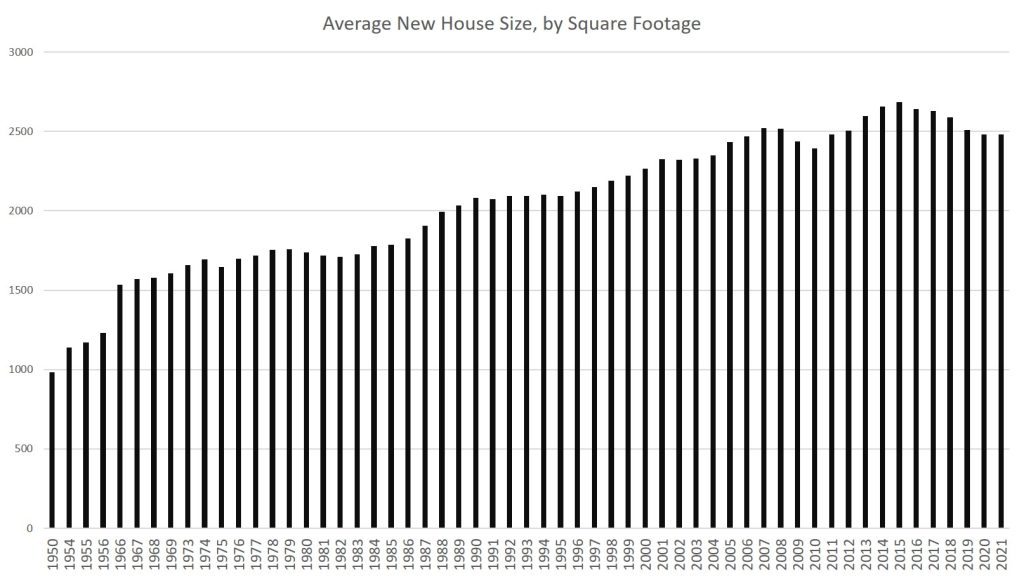
The average square footage in new single-family houses has been declining since 2015. House sizes tend to fall just during recessionary periods. It happened from 2008 to 2009, from 2001 to 2002, and from 1990 to 1991.
But even with strong economic-growth numbers well into 2019, it looks like demand for houses of historically large size may have finally peaked even before the 2020 recession and our current economic malaise. (Square footage in new multifamily construction has also increased.)
According to Census Bureau data, the average size of new houses in 2021 was 2,480 square feet. That’s down 7 percent from the 2015 peak of 2,687.
2015’s average, by the way, was an all-time high and represented decades of near-relentless growth in house sizes in the United States since the Second World War. Indeed, in the 48 years from 1973 to 2015, the average size of new houses increased by 62 percent from 1,660 to 2,687 square feet. At the same time, the quality of housing also increased substantially in everything from insulation, to roofing materials, to windows, and to the size and availability of garages.
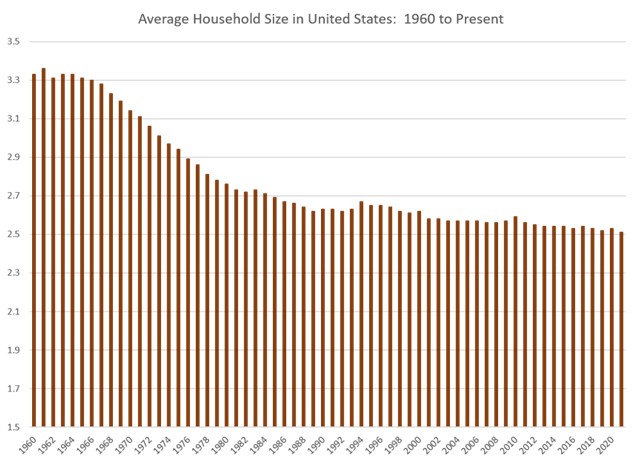
Meanwhile, the size of American households during this period decreased 16 percent from 3.01 to 2.51 people.
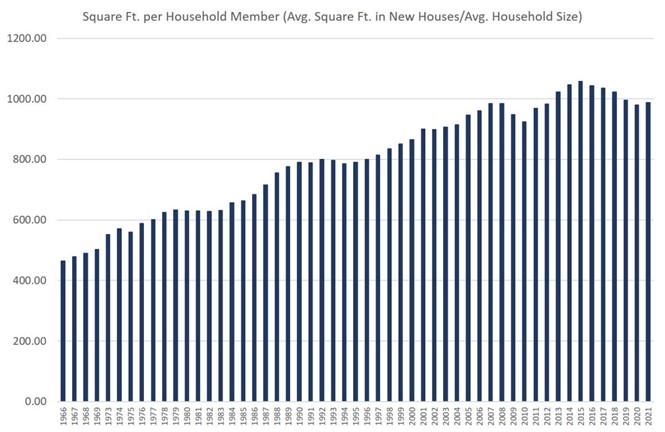
Yet, even with that 7 percent decline in house size since 2015, the average new home in America as of 2021 was still well over 50 percent larger than they were in the 1960s. Home size isn’t exactly falling off a cliff. US homes, on a square-foot-per-person basis, remain quite large by historical standards. Since 1973, square footage per person in new houses has nearly doubled, rising from 503 square feet per person in 1973 to 988 square feet person in 2021. By this measure, new house size actually increased from 2020 to 2021.
This continued drive upward in new home size can be attributed in part to the persistence of easy money over the past decade. Even as homes continued to stay big—and thus stay comparatively expensive—it was not difficult to find buyers for them. Continually falling mortgage rates to historical lows below even 3 percent in many cases meant buyers could simply borrow more money to buy big houses.
But we may have finally hit the wall on home size. In recent months we’re finally starting to see evidence of falling home sales and falling home prices. It’s only now, with mortgage rates surging, inflation soaring, and real wages falling—and thus home price affordability falling—that there are now good reasons for builders to think “wow, maybe we need to build some smaller, less costly homes.” There are many reasons to think that they won’t, and that for-purchase homes will simply become less affordable. But it’s not the fault of the builders.
This wouldn’t be a problem in a mostly-free market in which builders could easily adjust their products to meet the market where it’s at. In a flexible and generally free market, builders would flock to build homes at a price level at which a large segment of the population could afford to buy those houses. But that’s not the sort of economy we live in. Rather, real estate and housing development are highly regulated industries at both the federal level and at the local level. Thanks to this, it is becoming more and more difficult for builders to build smaller houses at a time when millions of potential first-time home buyers would gladly snatch them up.
How Government Policy Led to a Codification of Larger, More Expensive Houses
In recent decades, local governments have continued to ratchet up mandates as to how many units can be built per acre, and what size those new houses can be. As The Washington Post reported in 2019, various government regulations and fees, such as “impact fees,” which are the same regardless of the size of the unit, “incentivize developers to build big.” The Post continues, “if zoning allows no more than two units per acre, the incentive will be to build the biggest, most expensive units possible.”
Moreover, community groups opposed to anything that sounds like “density” or “upzoning” will use the power of local governments to crush developer attempts to build more affordable housing. However, as The Post notes, at least one developer has found “where his firm has been able to encourage cities to allow smaller buildings the demand has been strong. For those building small, demand doesn’t seem to be an issue.”
Similarly, in an article last month at The New York Times, Emily Badger notes the central role of government regulations in keeping houses big and ultimately increasingly unaffordable. She writes how in recent decades,
“Land grew more expensive. But communities didn’t respond by allowing housing on smaller pieces of it. They broadly did the opposite, ratcheting up rules that ensured builders couldn’t construct smaller, more affordable homes. They required pricier materials and minimum home sizes. They wanted architectural flourishes, not flat facades. …”
It is true that in many places empty land has increased in price, but in areas where the regulatory burden is relatively low—such as Houston—builders have nonetheless responded with more building of housing such as townhouses.
In many places, however, regulations continue to push up the prices of homes.
Badger notes that in Portland, Oregon, for example, “Permits add $40,000-$50,000. Removing a fir tree 36 inches in diameter costs another $16,000 in fees.” A lack of small “starter homes” is not due to an unwillingness on the part of builders. Governments have simply made smaller home unprofitable.
“You’ve basically regulated me out of anything remotely on the affordable side,” said Justin Wood, the owner of Fish Construction NW.
In Savannah, Ga., Jerry Konter began building three-bed, two-bath, 1,350-square-foot homes in 1977 for $36,500. But he moved upmarket as costs and design mandates pushed him there.
“It’s not that I don’t want to build entry-level homes,” said Mr. Konter, the chairman of the National Association of Home Builders. “It’s that I can’t produce one that I can make a profit on and sell to that potential purchaser.”
Those familiar with how local governments zone land and set building standards will not be surprised by this. Local governments, pressured by local homeowners, will intervene to keep lot sizes large, and to pass ordinances that keep out housing that might be seen by voters as “too dense” or “too cheap-looking.”
Yet, as much as existing homeowners and city planners would love to see nothing but upper middle-class housing with three-car garages along every street, the fact is that not everyone can afford this sort of housing. But that doesn’t mean people in the middle can only afford a shack in a shanty town either — so long as governments will allow more basic housing to be built.
But there are few signs of many local governments relenting on their exclusionary housing policies, and the result has been an ossified housing policy designed to reinforce existing housing, while denying new types of housing that is perhaps more suitable to smaller households and a more stagnant economic environment.
Eventually, though, something has to give. Either governments persist indefinitely with restrictions on “undesirable” housing — which means housing costs skyrocket — or local governments finally start to allow builders to build housing more appropriate to the needs of the middle class.
If current trends continue, we may finally see real pressure to get local governments to allow more building of more affordable single-family homes, or duplexes, or townhouses. If interest rates continue to march upward, this need will become only more urgent. Moreover, as homebuilding materials continue to become more expensive thanks to 40-year highs in inflation—thanks to the Federal Reserve—there will be even more need to find ways to cut regulatory costs in other areas.
For now, the results have been spotty. But where developers are allowed to actually build for a middle-class clientele, it looks like there’s plenty of demand.
About the Author
Ryan McMaken (@ryanmcmaken) is a senior editor at the Mises Institute. Ryan has a bachelor’s degree in economics and a master’s degree in public policy and international relations from the University of Colorado. He is the author of Breaking Away: The Case for Secession, Radical Decentralization, and Smaller Polities (forthcoming) and Commie Cowboys: The Bourgeoisie and the Nation-State in the Western Genre. He was a housing economist for the State of Colorado.
Investments of Washington’s Powerful Pieced Together
Top federal employees in the U.S. are required to disclose their trading activities. The disclosure must be made within 30 days of executing a transaction. And annually by May 15 of the following year. Over 2500 government officials report transactions each year, often trading in companies that lobby their department for the company’s financial benefit. Where are these disclosures? The government doesn’t maintain a public database of mandatory disclosures. Fortunately, the pieces can be made available and, although a huge undertaking, can be pieced together. The Wall Street Journal did this when they performed their Capital Assets Investigation by analyzing 12,000 federal officials’ financial disclosures. Some may not find the outcome comforting.
How the Investigation Was Conducted
The lack of a central database made this investigation a huge undertaking. The Journal pulled information on about 850,000 financial assets and more than 315,000 transactions of nearly 12,000 officials at 50 federal agencies filed during the five-year period between 2016 and 2021.
The financial publisher compared this data to lobbying reports filed by companies to identify officials who invested in firms seeking treatment that would benefit the companies represented by those agencies (including immediate family members). Journal analysts went as far as cross-referencing reported stock trades with announcements of contracts and regulatory, enforcement, and legal actions.
What Were the Findings
The investigation was immense and tedious, however, it didn’t take much digging to discover transactions and situations that would make the average taxpayer to raise an eyebrow. As a sample, the Food and Drug Administration (FDA) let an official own dozens of food and drug stocks on its no-buy list – a top official at the Environmental Protection Agency (EPA) reported purchases of oil and gas stocks – a Defense Department (DoD) official bought stock in a defense company several times before the company won new business from the Pentagon.
Drilling a little deeper, the Wall Street Journal uncovered and pieced together thousands of questionable investment situations from a multitude of decision-makers all on the taxpayer payroll.
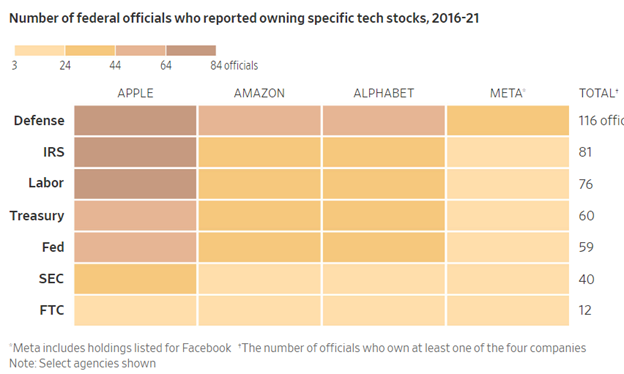
• While the U.S. government was escalating oversight and review of big tech companies, more than 1,800 federal official’s disclosed owning or trading at least one of four big tech stocks: Meta Platforms (META), Alphabet (GOOG), Apple (AAPL), and Amazon (AMZN).
• Over 60 officials at five agencies, including the Federal Trade Commission (FTC) and the Justice Department, reported trading stock in companies shortly before their departments announced enforcement actions, such as charges and settlements, against those companies.
• High-ranking public servants in the Office of the Secretary at the Department of Defense reported together owning between $1.2 million and $3.4 million of stock in aerospace and defense companies during each of the five years investigated. Some owned stock in Chinese companies during the period the U.S. was deciding if it should blacklist these companies.
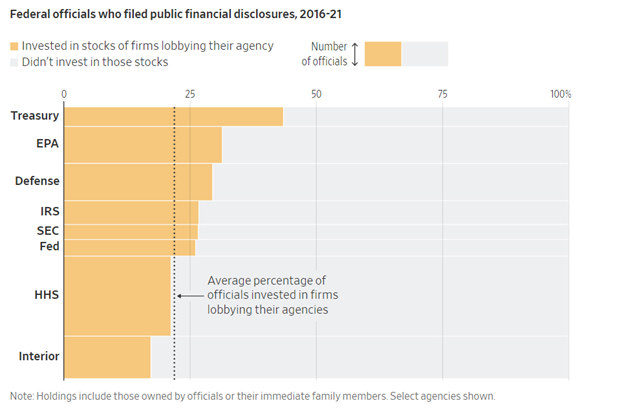
• Over 200 senior EPA officials, nearly one in three, disclosed taking positions in companies that were lobbying the agency. Exposure to these companies by EPA employees and their family members totaled between $400,000 and up to $2 million in shares of oil and gas companies each year between the years investigated.
When financial conflicts clearly were at odds with rules of the various agencies, the rules were often waived for the situation. In most instances, according to the Journal, ethics officials certified that the employees had complied with the rules, which contain several exemptions that provide for situations where officials can hold stock that conflicts with their agency’s function.
The officials, many of which are household names and faces, can influence and financially impact company’s while at the same time making decisions that come to play in the day-to-day lives of citizens. These include public health and food safety, diplomatic relations, weapons systems, medical care, and regulating trade, to name a few. Even in those cases where a rule has not been explicitly violated, or has been waived, the actions violate the spirit behind rules intended to elevate or maintain public trust in government.
Official’s Transactions
There is a running joke that Speaker of the House Nancy Pelosi, or more accurately, her husband Paul Pelosi’s investment picks and timing are so good that he must use a crystal ball. Lawmakers like Pelosi have gotten much more public attention. And activities at the Federal Reserve have recently caused resignations over accusations. But most agencies fly under the radar. The investigation by the Journal is expected to result in a number of WSJ special reports. Each time exposing another area that they want to bring to the public eye.
Congress had long been criticized for not prohibiting lawmakers from working on matters in which they have a financial interest. The rules were tightened in 2012 by the Stop Trading on Congressional Knowledge (STOCK) Act, passed following a series of Journal articles on congressional trading abuses.
Investigative journalism or watchdog reporting is part of what helps reshape rules that lead to forced integrity and increased trust. American’s should feel confident that approvals, decisions, and all undertakings by those hired to serve the citizenry, put the interest of those funding their paychecks first.
Soaring Inflation Prompts Biggest Social Security Cost-Of-Living Boost Since 1981 – 6 Questions Answered
Social Security is set to boost the benefits it provides retirees by 8.7%, the biggest cost-of-living adjustment since 1981. It comes as sky-high inflation continues to eat into incomes and savings.
The changes are set to take effect in January 2023 and were announced following the release of the September 2022 consumer price index report, which showed inflation climbing more than expected during the month, by 0.4%.
The automatic adjustment will surely come as a relief to tens of millions of retirees and those who receive supplemental security income who may be struggling to afford basic necessities as inflation has accelerated throughout 2022. But an annual adjustment wasn’t always the case – and other government benefits and programs deal with inflation differently.
John Diamond, who directs the Center for Public Finance at Rice’s Baker Institute, explains the history of the Social Security cost-of-living, or COLA, increase, what other benefits are adjusted for inflation and why the government makes these changes.
1. How fast is the cost of living rising?
The latest data, for September, shows average consumer prices are up 8.2% from a year earlier. The monthly gain of 0.4% was double what economists surveyed by Reuters had expected.
More troubling, so-called core inflation – which excludes volatile food and energy prices – gained even more in September, ticking up by 0.6%. Core inflation is a measure that’s closely watched by the Federal Reserve, as it helps show how pervasive and persistent inflation has become in the economy.
2. How are Social Security benefits adjusted for inflation?
Automatic adjustments to Social Security benefits began in 1975 after President Richard Nixon signed the 1972 Social Security amendments into law.
Before 1975, Congress had to act each year to increase benefits to offset the effects of inflation. But this was an inefficient system, as politics would often be injected into a simple economic decision. Under this system, an increase in benefits could be too small or too large, or could fail to happen at all if one party blocked the change entirely.
Not to mention that with the baby boomers – those born from 1946 to 1964 – entering the labor force it was already clear that Social Security would face long-term funding issues in the future, and so putting the program on autopilot reduced the political risk faced by politicians.
Since then, benefits have climbed automatically by the average increase in consumer prices during the third quarter of a given year from the same period 12 months earlier. This is based on a version of the consumer price index meant to estimate price changes for working people and has been rising slightly faster than the overall pace of inflation.
While helpful, these inflation adjustments are backward-looking and imperfect. For example, 2022 Social Security benefits increased by 5.9% from the previous year, even though inflation throughout this year has been significantly higher – which means the higher benefits weren’t covering the higher cost of living. Thus, the 2023 increase in benefits primarily offsets what was lost over the previous year.
A white hand holds a card reading social security
Millions of retirees and other will soon see a big jump in their Social Security benefits. AP Photo/Jenny Kane
3. Are the benefits taxable?
A growing portion of Social Security benefits are taxed in the same way as ordinary income, except at different threshold with various caps and percentages. Only 8% of benefits were subject to taxation in 1984, but that’s climbed to almost 50% in recent years. That percentage will likely continue to increase as the taxable thresholds are not adjusted for inflation.
For example, if an individual filer’s income, including benefits, is below US$25,000, none of that is taxed. But up to 50% of a person’s benefits may be taxed at incomes of $25,000 to $34,000. After that, up to 85% of their benefits may be taxed.
Such a big increase in Social Security benefits likely means some people who paid no tax will now have to pay some, while others will see larger increases in their tax liability.
4. Why does the government adjust benefits for inflation?
Rapid gains of inflation, like the kind the U.S. and many other countries are currently experiencing, can have significant impacts on the finances of households and businesses.
For example, it might mean seniors cutting back on heating or food. Government policies generally try to account for this to reduce the negative impacts that rising prices can have on those with limited or fixed resources.
In addition, reducing the impacts of price changes creates a more efficient and fair allocation of resources and reduces the arbitrary outcomes that would otherwise occur.
5. What other government programs typically get a COLA?
Other government programs and benefits also increase to account for inflation.
The U.S. Department of Agriculture estimates the cost of its Thrifty Food Plan each June and adjusts Supplemental Nutrition Assistance Program or SNAP benefits – formerly known as food stamps – in October of each year. Beginning in October 2022, food stamp benefits rose by 12.5%, which helps make up for the largest increases in food prices since the 1970s.
In addition, the federal poverty level is adjusted for changes in the consumer price index annually by the Department of Health and Human Services, an adjustment that affects a number of government-provided benefits, such as housing benefits, health insurance and others, including SNAP benefits.
6. Does the tax system also adjust for inflation?
While some aspects of the tax code adjust for inflation, others do not.
For example, income tax bracket thresholds, the size of the standard deduction, alternative minimum tax parameters and estate tax provisions all increase annually for inflation. That means come tax filing season next year, U.S. tax filers will likely see big changes in all these items.
But examples of provisions that are not adjusted for inflation include the maximum value of the child tax credit and the $10,000 cap on the deduction of state and local taxes. In addition, the threshold that determines who is liable for the net investment income tax – the additional 3.8% tax on investment and passive income for taxpayers above a certain income level – doesn’t adjust, which means each year more individuals are subject to it.
This article was republished with permission from The Conversation, a news site dedicated to sharing ideas from academic experts. It represents the research-based findings and thoughts of John W. Diamond, Director of the Center for Public Finance at the Baker Institute, Rice University.