Plusses and Minuses of Abundant Jobs

Image Credit: pxhere.com

The Employment Report Can be Viewed as Good for Economic Resilience

Does the Fed need to slow its tightening plans? Thankfully no, and darn it, no. On Friday, a report showed the U.S. economy created 263,000 jobs in September; this confirms a strong labor market, albeit one that has begun to slow somewhat. While this is a deceleration in jobs growth from the 315,000 jobs added in August, the report confirms broad-based strength in the labor market, at the average of what economists had been forecasting.

Why this is Positive for Stocks

The Fed has two main mandates, keep inflation in check (price stability), and make sure people have jobs (maximum employment). Friday’s report offers the clearest sign yet that the labor market is still showing considerable strength, although off its peak, as tighter monetary policy and higher labor costs begin to weigh on demand for workers. Although a slight cooling is evident, there is nothing in the report to suggest the Fed will alter its aggressive path of tightening monetary policy.

The cooling of the labor market is desirable when working to tame inflation. But it is likely employment is still promoting price pressures for labor.  The number should confirm that the Fed is inclined to hike rates by a fourth consecutive 0.75% in November.   

Of particular concern, as it relates to inflation, for the Fed is the continued strength in wages and decline for the month in labor-force participation, which remains well below its pre-pandemic level. The lack of workers allows inflationary bargaining power to those in the workforce or seeking work.

 Growth in average hourly earnings, which had slowed in August, remained steady in September, with wages climbing another 0.3%. And the labor-force participation rate erased a bit and was down 0.1 percentage point to 62.3% as fewer U.S. citizens looked for work than the month before. That contributed to the drop in the unemployment rate, which fell from 3.7% in August to 3.5%.

On the Downside

The resolve of this Fed can be stated this way, as long as the labor market remains healthy, they will remain hyper-focused on reining in inflation without concern for people’s 401ks or other distractions. They can afford to kill a few jobs, and bond or stock investors are not on the Fed’s list of primary concerns.

News to Use From Jobs Report?

Jobs were added in a number of industries, with big gains in the healthcare, leisure, and hospitality sectors. These are industries where positions had been lost during the pandemic. The construction industry, which many economists expected would shrink, added 19,000 jobs in September, in line with the average monthly growth so far this year in construction.

On the bad side, the retail sector lost more than 1,000 jobs in September. It remains broadly strong after three months of gains, 1000 across the population is not yet a concern.

The numbers reflect ongoing catch-up in hiring. Employers are still working to fill jobs lost during steps taken related to Covid-19 fears; the increased demand in many areas makes it difficult to find enough workers. The scenario could keep the labor market strong over the coming months, even if the Fed is successful in slowing the broader economy.

Other data not headlined in the labor market report shows signs the labor market remains strong. The number of workers who were employed part-time for economic reasons, meaning they would have preferred full-time work but had seen their hours cut or were unable to find full-time work, declined by 306,000 in September after rising for two straight months. More work, if wanted, is a strong factor that gives the Fed breathing room.

Another very telling group that showed employment expansion is not as robust as the numbers suggest, is the increased hiring of temporary help. Companies tend to release temporary workers; first, this type of work continued to rise. The sector added another 27,000 jobs in September.

Take Away

Employment remained strong through September. While this may indicate the Fed can continue to raise rates at will for stock market participants, it also means businesses have the potential for more output. So, while the headline news may scream rates ‘will go up!’ and ‘markets should beware!’, the better message is businesses continue to hire. This is especially true for leisure and less accurate for retail companies; the economy can be expected to keep plodding along if everyone who wants a job has a job.

Paul Hoffman

Managing Editor, Channelchek

Sources

https://www.bls.gov/news.release/empsit.nr0.htm

Stock Market Launch Never Happened in September

Image Credit: NASA Kennedy (Flickr)

Looking Back at September and Forward to the Fourth Quarter

September is behind us, and so are the first three quarters of 2022. Yet still, other than the U.S. dollar, there hasn’t been a moonshot in any major market or sector. September 2022 is best characterized by saying a few markets tried to get off the ground, but not unlike the Artemis rocket that was scheduled to go to the moon on September 3rd, the launches were scrubbed and are now on-hold. Maybe they’ll fly in October.

Below we look at the month behind us in stocks, bonds, gold, and crypto. We do this with confidence that they won’t all be grounded forever – and look to find clues as to how the final quarter of the year may treat investors.

Major Market Indicators Tracked Closely

Source: Koyfin

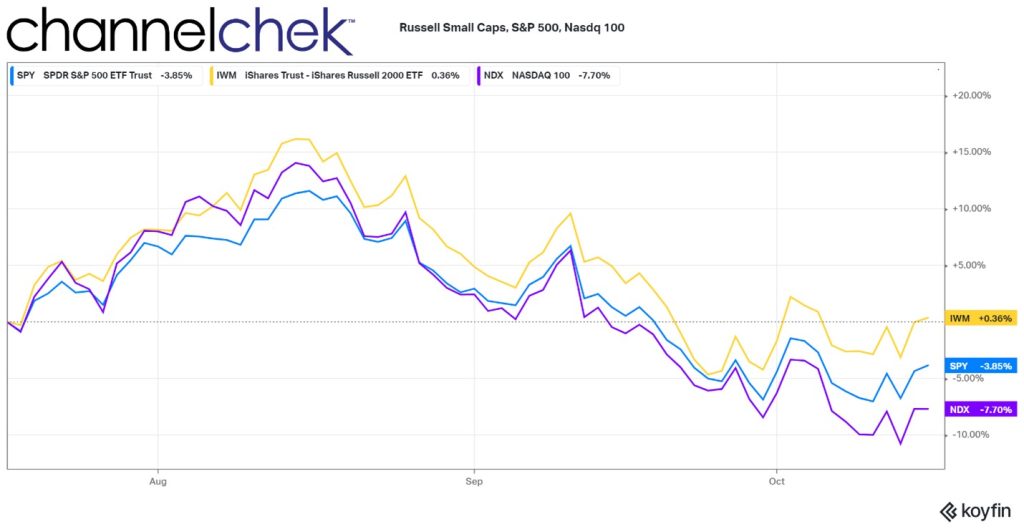
Out of the four closely followed benchmarks, Nasdaq 100, S&P 500, Russell 2000, and Dow 30, there was no runaway index either massively outperforming or underperforming. During the second week in September, the indexes teased that they were ready for take-off after they strung together several consecutive days where they were each up 1%-3%.

Reasons for the bounce that week include that a few of the indexes were approaching a technical floor, through which they’d be considered in a bear market. Stocks rarely break through support levels on their first try. In fact, they often bounce by a large degree.

Adding to the stock market’s climb to as much as up 4% on the month were strong economic numbers, which gave some participants comfort that the economy is still producing jobs and will withstand the Fed’s withdrawing accommodation. Others saw the sign of strong numbers as a sign that the Fed would drive up rates, drag the economy into a recession, and then ease policy by bringing rates back down. This forward-looking reasoning had them bullish.

Eventually, as the month moved along and Jay Powell, the chairman of the Federal Reserve, continued reiterating the central bank’s resolve, stock market investors stopped fighting the Fed – from  September 12th, until month-end, the indexes dropped between 12%-14%

Sectors Within S&P Index

Source: Koyfin

The two standout sectors within the S&P 500 include Health Care which was least negative at down 1.90%, and Biotech, down 4.42%. While this performance doesn’t seem like something to get overly excited about, the dynamics which have taken these two only half as down as the broader index are worth looking into. Both health care and biotech had once been in the stratosphere during the early and mid-pandemic era. As the potential for further benefit waned, these segments fell from their stratospheric highs. Currently, there is potential as large pharmaceutical companies are flush with cash from the pandemic, sit with patents approaching expiration, and biotech, with fresh patents and current R&D on the next generation of medicine, running low on funds. These conditions are ripe for partnerships and acquisitions to accelerate between the two. This may include some individual biotech companies surprising investors with some very good news in the coming months.

On the weak side is technology, which also is still coming down from the pandemic-induced high. The index is down 11.09%. Utilities are also underperforming the broader indexes as higher fuel costs for electric companies and higher interest rates erode the attractiveness of dividends paid on these stocks.

Gold and Bitcoin Performance

Source: Koyfin

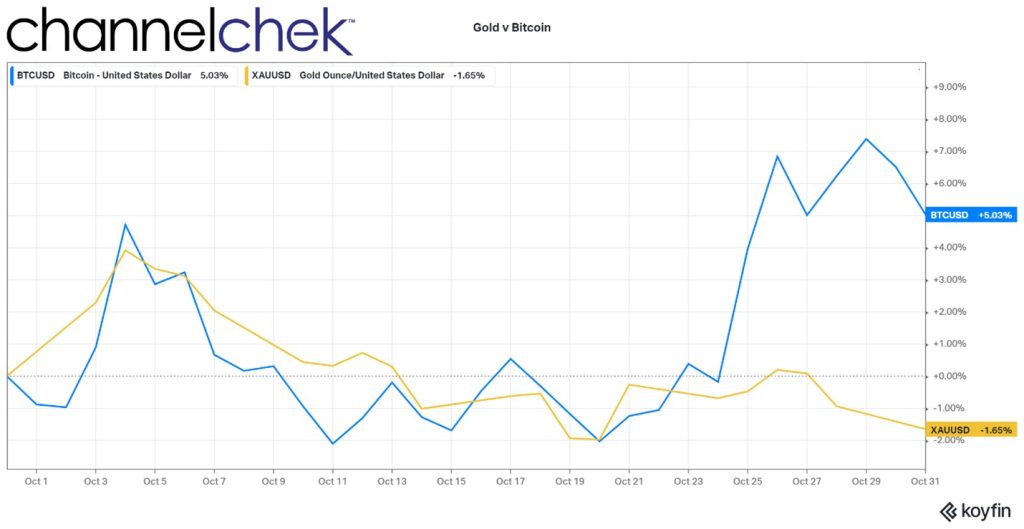
Two non-equity assets, each claiming to be a safe haven during any market, political, or economic upheaval, outperformed the broader stock markets during September. Gold maintained its steady as she goes pace with very little volatility, while bitcoin had dramatic days on the up and downside, with each less than 3% lower than where they began the month.

Fixed Income Performance

Source: Koyfin

Interest rates were the topic on everyone’s mind throughout the month. Government bonds are valued 3.48% less than they were at the start of September, with uncharacteristic volatility late in the month as markets first began to fear the worst and then reversed with the BOE announcement that it would resume a less restrictive and possibly easier monetary policy.

High-yield bonds more closely track equities (and even bitcoin) than the interest rate markets. These bonds of less creditworthy issuers spent almost half the month in the positive before underperforming treasuries, which were in the red for all of the month. Tips or inflation-indexed treasuries shed 6.89% for its investors. The securities are sold off a spread to a similar maturity treasury, so they will generally move in the same direction. The Fed holds on its balance sheet a large (as a percentage outstanding) of these securities, this has disrupted the bonds’ use as either a hedge against inflation or a gauge to see where the markets think inflation is heading.

A number of Fed governors spoke during the last week of September. They are united in their message that they are only just beginning to move monetary policy to a place where the economy is in a healthy situation where inflation isn’t eroding the dollar’s purchasing power. None have begun to hint that the policy statement from the November 2nd meeting will look any different than the last.

Paul Hoffman

Managing Editor, Channelchek

Sources

https://www.washingtonpost.com/technology/2022/09/03/artemis-launch/

www.koyfin

New Data Indicates Inflationary Recession

Image Credit: Tom Fisk (Pexels)

Inflation Still Surprisingly Strong and Economy Weak

Two important numbers were released on the last day of September. One was based on old news but significant in its finality; it’s the final revision to GDP for the second quarter. The next is viewed as the Fed’s preferred inflation gauge, the PCE deflator. The final GDP number will make it more difficult for public officials or pundits to suggest we can avoid a recession in 2022, and the second did not give any hope that the Fed will have any reason to change course on tightening.

A Recession By Any Other Name

Gross domestic product (GDP) is the indicator that reflects the amount of output produced quarterly in a country. In the U.S., the Bureau of Economic Analysis (BEA) releases two estimates of quarterly GDP, known as the advance and preliminary estimates, in the two months before the release of the final number. So until the final number prints, the number GDP measure is subject to revision.

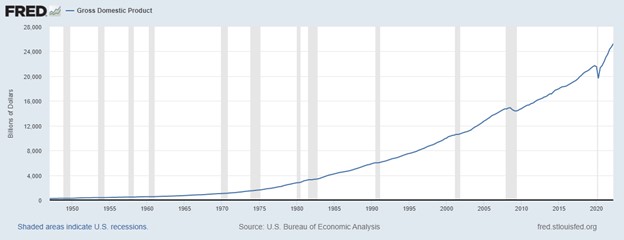
On September 30, 2022, the Final GDP report for the second quarter was released by the BEA. The report shows that GDP decreased at an annual rate of 0.6 percent in the second quarter of 2022 (table 1). This decline in economic output follows a decline of 1.6% in the first quarter of 2022.

Do two-quarters of a receding economy, based on GDP, indicate the U.S. is in the recessionary part of the business cycle? Most textbooks would agree with that definition. However, there is a Business Cycle Dating Committee within the National Bureau of Economic Research (NBER) that determines and labels where the nation is within the economic cycles; they have not made any declaration.

So far, in 2022, the economy has not experienced any economic growth. If the six months of contraction is eventually deemed an official recession, it will thus far have been a shallow one, characterized by strong employment.

Price Increases Higher than Expected

Inflation is still on many investor’s radar. The Fed is targeting reducing inflation to its 2% target. The inflation measure they use for this target is the PCE Deflator. That measure was released this morning, and it validates the aggressive actions being taken by the Federal Reserve. And suggests the Fed has a lot more work to do.

The personal consumption expenditures price index (PCE), which the Fed targets at 2%, rose 6.2% in August from a year earlier, the Commerce Department reported. Underlying inflation, as measured by a core reading that excludes food and energy prices, rose 4.9% from 4.7% previously.

These numbers are well in excess of the Fed’s target and seemingly trending upward. Expectations are the Fed will provide up to another 150 bp increase (1.50%) over the coming months. This would cause the Fed Funds rate to trade near 5%. There is nothing in today’s release that would likely cause expectations to change.

Stagflation?

High inflation and negative growth have many repeating the word “stagflation”. Stagflation has one more element missing, which is high unemployment. The current economic conditions in the U.S. include high demand for workers, this shortage actually helps feed into the inflation the Fed is trying to tame.

Take Away

The economy contracted slightly in the second quarter of 2022. The decline in production was smaller than measured during the first quarter. Federal Reserve policymakers saw one more reason to keep applying the economic brake pedal by taking money out of the economy, increasing upward rate pressures. The Fed caused rates to rise from 40-year lows faster than any time since the 1980s.

Stock market participants are factored into the Fed’s policy only to the extent that market moves may impact inflation or employment. The markets (stocks, bonds, real estate, gold) are negative on the year. There are some who suggest the Fed will use this as a signal to alter policy, if the Fed bowed to any of the markets listed here, the sign of weakness might actually cause a market collapse in stocks and bonds.

Paul Hoffman

Managing Editor, Channelchek

Sources

https://www.bea.gov/news/2022/gross-domestic-product-third-estimate-gdp-industry-and-corporate-profits-revised-2nd

https://www.bea.gov/news/2022/personal-income-and-outlays-august-2022-and-annual-update

https://finance.yahoo.com/news/fed-seen-keeping-big-rate-131814754.html

https://www.stlouisfed.org/on-the-economy/2014/may/do-revisions-to-gdp-follow-patterns

https://www.learningmarkets.com/who-decides-when-we-are-in-a-recession

https://www.bls.gov/news.release/empsit.nr0.htm

Will the Fed Yield on Raising Yields?

Image Credit: QuoteInspector.com (Flickr)

Foundational Changes in Stocks and Bonds

It’s a small world, and as we’ve seen, if something happens with one trading partner, it impacts them all.

Rapid moves and turnarounds in the U.S. Treasury market, considered the bedrock of all other markets, have increased the volatility in equity markets, commodities trading, and, more directly to, currency exchange rates across the globe. The uncertainty has caused investment capital to gravitate to U.S. markets; however, prolonged gyrations, especially in “risk-free” U.S. Treasuries, could put many investors on the sidelines and weaken asset prices globally.

The U.S./U.K. Example

At the end of 2021, the ten-year U.S. Treasury note was yielding 1.5%. Earlier this week a ten-year U.S. Treasury (backed by the same entity that backs the U.S. Currency) rose to yield 4%. That’s a 270% rise in the yield – for bondholders, prices of bonds decline as yields rise. So while the stock market frets over what a Federal Reserve increase in rates may do for equities, bond market investors can usually pull out a calculator and get a fairly precise answer as to how bonds will reprice. If the reaction is radically different, an important foundation is lost. The reaction has been unpredictable.

While the ten-year did hit 4% this week, after lingering around 3.50% the prior week, the yield abruptly dropped after news from across the Atlantic that England’s central bank, the Bank of England (BOE), was taking steps to halt rate increases, effectively implementing quantitative easing. The BOE buying bonds puts pound sterling into their economy and adds to inflation pressures. The immediate reaction was for rates to come down, there, in the U.S., and in other economies that have been tightening. This provided a feeling of relief from equity markets, as it was a sign that the central banks may one by one abandon their plans to fight inflation, choosing instead to fuel it.

The BOE’s move to buy bonds “on whatever scale is necessary” to stabilize its bond market, a move that followed large tax cuts last week by the U.K. government, despite double-digit inflation, many believe indicates a possible problem with a major financial institution or pension fund.

The world’s markets don’t trade in a vacuum. The sudden reversal in the U.K. to stop interest rate hikes and perhaps lower rates brought a positive tone to stocks and bonds in U.S. markets, each having historically challenging years. The conversation in the U.S. is that the Fed may have to pause its own aggressive direction. This would be either because increased rates would further strengthen the dollar, or because the U.S. may have its own underlying time bomb(s), institutions that would fail or bubbles that could burst.

The rallies in the U.S. stock and bond markets gained momentum after the BOE move as the Chicago Mercantile Exchange (CME) data showed reduced expectations of a terminal or neutral Fed Funds rate of 5%, with expectations now for the policy rate to top out around 4.25-4.5%.

Take Away

While the Fed taking its foot off the brake pedal would be a remarkable turnaround after Chairman Powell’s efforts to be clear about his intent to tighten, the reasons for the CME data shift are twofold. First, the Fed won’t be able to keep aggressively raising rates ad simultaneously reducing bond holdings (shrink its balance sheet), because the strong U.S. dollar is disrupting global markets. Secondly, as mentioned before, checking the health of major institutions, housing, and pension funds in the U.S. may be prudent before administering more economic medicine.

Uncertainty has the effect of investors pulling assets out of markets and businesses acting with more caution. Hopefully, clarity, one way or the other, soon presents itself so volatility is reduced and investors can better understand the playing field. 

Paul Hoffman Managing Editor, Channelchek

Sources

https://www.barrons.com/market-data/stocks/cme

https://www.wsj.com/articles/investors-fear-bond-market-turmoil-is-entering-a-new-phase-11664443801?mod=hp_lead_pos3

Understanding Money as the Lubricant for Wealth

Image Credit: John Guccione (Pexels)

Why Does Money Exist?

Imagine a world without money. With no way to buy stuff, you might need to produce everything you wear, eat or use unless you could figure out how to swap some of the things you made for other items.

Just making a chicken sandwich would require spending months raising hens and growing your own lettuce and tomatoes. You’d need to collect your own seawater to make salt.

You wouldn’t just have to bake the bread for your sandwich. You’d need to grow the wheat, mill it into flour and figure out how to make the dough rise without store-bought yeast or baking powder.

And you might have to build your own oven, perhaps fueled by wood you chopped yourself after felling some trees. If that oven broke, you’d probably need to fix it or build another one yourself.

Even if you share the burden of getting all this done with members of your family, it would be impossible for a single family to internally produce all the goods and provide all the services everyone is used to enjoying.

To maintain anything like today’s standard of living, your family would need to include a farmer, a doctor and a teacher. And that’s just a start.

This article was republished  with permission from The Conversation, a news site dedicated to sharing ideas from academic experts. It represents the research-based findings and thoughts of M. Saif Mehkari, Associate Professor of Economics, University of Richmond.

Specializing and Bartering

Economists like me believe that using money makes it a lot easier for everyone to specialize, focusing their work on a specific activity.

A farmer is better at farming than you are, and a baker is probably better at baking. When they earn money, they can pay others for the things they don’t produce or do.

As economists have known since David Ricardo’s work in the 19th century, there are gains for everyone from exchanging goods and services – even when you end up paying someone who is less skilled than you. By making these exchanges easy to do, money makes it possible to consume more.

People have traded goods and services with one kind of money or another, whether it was trinkets, shells, coins and paper cash, for tens of thousands of years.

People have always obtained things without money too, usually through barter. It involves swapping something, such as a cookie or a massage, for something else – like a pencil or a haircut.

Bartering sounds convenient. It can be fun if you enjoy haggling. But it’s hard to pull off.

Let’s say you’re a carpenter who makes chairs and you want an apple. You would probably find it impossible to buy one because a chair would be so much more valuable than that single piece of fruit. And just imagine what a hassle it would be to haul several of the chairs you’ve made to the shopping mall in the hopes of cutting great deals through barter with the vendors you’d find there.

Paper money is far easier to carry. You might be able sell a chair for, say, $50. You could take that $50 bill to a supermarket, buy two pounds of apples for $5 and keep the $45 in change to spend on other stuff later. Another advantage money has over bartering is that you can use it more easily to store your wealth and spend it later. Stashing six $50 bills takes up less room than storing six unsold chairs.

Nowadays, of course, many people pay for things without cash or coins. Instead, they use credit cards or make online purchases. Others simply wave a smartwatch at a designated device. Others use bitcoins and other cryptocurrencies. But all of these are just different forms of money that don’t require paper.

No matter what form it takes, money ultimately helps make the trading of goods and services go more smoothly for everyone involved.

Paper Hands and the IRS

Image Credit: Phillip Ingham (Flickr)

Selling at a Loss Near Year-End Could be Financially Worthwhile

Calling someone “paper hands” is common in online trading communities such as r/wallstreetbets. It borders on a bullying tactic to encourage others on the platform to remain in stocks that have weakened. The main reason is that many in the community own and have taken a “diamond hands” position. Investors should consider that the tax code may reward those investors that are looking out for themselves first and the chat board community second. 

The first three-quarters of overall market performance in 2022 can only be described as ugly. Each portfolio is likely to have its share of losses. Many investors can make a little lemonade out of the abundance of lemons that may be in their portfolios. But first, they need to take steps to harvest these lemons.

Tax Loss Harvesting

While there are many reasons that taking a loss is uncomfortable, the reason one invests in the first place is for financial gain. Playing the cards you’re handed at all times is considered prudent investing. Taking and using them to help reduce one’s tax bill can make financial sense. The tax consequence decision to sell below-cost investments and use the losses to offset gains from other investments or ordinary income is referred to as tax loss harvesting.

An example of how tax loss harvesting could help an investor financially is this. An investor will sell one or more of their negative on-the-year investments and recognize a loss. The investor then uses these capital losses to offset capital gains and/or W2 or 1099 income. If losses exceed gains by $3,000 or the losses taken up to $3,000, can be used to offset ordinary income in the current year. Amounts above $3,000 can be carried forward and used in future tax years.

There is one more step, investing in something else. The investor can either maintain their sector allocation or invest in something completely different. Buying back the same issuer name is an IRS no-no. The investors’ exposure to the overall market remains intact, but there is a $3,000 reduction in earned income or capital gains.

Wash Sale Rule

There is a link below this article to the IRS website; before executing a tax strategy, it is recommended you visit the site, and if not clear, consult your tax advisor.

One way investors have gotten themselves in trouble with the IRS is by selling a security at a loss and then reacquiring the same or substantially similar investment. If you sell a security and claim a tax loss on that sale, the Internal Revenue Service’s guidelines, commonly referred to as the “wash sale,” rule will require you don’t reinvest in the same issuer.  

The wash sale rule outlines that investors cannot buy a “substantially identical” security 30 days before or after the sale of the funds chosen when conducting tax loss harvesting. This doesn’t mean the investor has to buy an investment in a completely different industry. For example, if an investor sold a silver mining company stock to harvest a tax loss — but still wants mining exposure — they could potentially buy a new or different stock within the industry.

Take Away

Taking an investment loss means a hard dollar recognition of the loss and recognition that you judged wrong. But, investing is always about maximizing financial gain. Investors that are correct 25% of the time often beat those that are correct 60% of the time. So needing to be correct could actually hurt performance. Understanding the other financial moves investors can make to maximize their overall finances can incrementally benefit their personal balance sheet.

While belonging to a consortium of investors that are stronger when sticking together is comforting, one must recognize that when it comes to investing, most will do what is best for themselves first. There is no guilt in protecting or maximizing your own finances legally.

Channelchek is a niche community of small and microcap investors. We believe in leveling the playing field by providing the exact same research and analysis to individuals at no cost that the most revered hedge funds in the country download from expensive services they subscribe to. Sign-up to receive this equity research each morning.

Paul Hoffman

Managing Editor, Channelchek

Sources

https://www.irs.gov/taxtopics/tc409

https://www.nasdaq.com/articles/the-advisors-guide-to-tax-loss-harvesting

Do Low Mortgage Rate Homeowners Feel Handcuffed?

Image Credit: Julie Weatherbee (Flickr)

Homeowners With Low Rates May Keep Inventories Low and Prices Stable

For many, the largest single asset they own is their home. While many investors are concerned about what rising interest rates may mean for investments in the stock market, homeowners are keenly aware that rates can directly impact home prices as most borrow to buy. The amount they can borrow is directly related to their cash flow, so the purchase price they can afford rises and falls with mortgage rates. This impacts demand and offer prices. But what does it do for the supply side of the pricing mechanism?

Rate Increases and Homes on the Market

Mortgage rates over the past year have risen from the low 3% range to the low 6% range for traditional 30-year loans. Typically the period in the rate cycle when mortgages begin to rise corresponds to a Fed tightening cycle, as it has in 2022. While rates were lower, buyers were able to afford “more house” and allowed sellers to push up asking prices – or in some cases, buyers would have had a bidding war driving up a home’s price.

As rates increase and it then costs borrowers more each month for the same price, buyers lessen. Home prices initially don’t decline as quickly as sellers would like as home sellers are stickier on the way down than they are on the way up. As with any investment, until you book your profit/loss, it’s just paper gains/losses. And homeowners don’t like to think of themselves as having “lost” thousands because their house once would have fetched more. So home buyers sit and wait, which in the past has caused inventories to increase. Eventually, there is capitulation among homeowners, and many houses hit the market with lower prices attached to them.

This has not happened yet during this rate cycle, and there is an underlying reason that may prevent it from happening. Existing homes are not entering the market as expected.

Homes for Sale are Scarce

The Wall Street Journal published an investigative piece on the real estate market and how Homeowners with low mortgage rates are stubbornly refusing to sell their homes because it would mean they’d have to borrow at much higher rates for wherever they may move. 

The Journal reported that housing inventories had risen somewhat from record lows earlier in 2022. But this is primarily because they aren’t selling as quickly. The number of newly listed homes from mid-August to mid-September fell 19% from the same weeks last year. This suggests that those that may have sold to move for any reason are staying put.

The explanation for this unexpected phenomenon is that most that have purchased or refinanced their homes in the past few years have historically low mortgage rates. Imagine having 2.75% locked in for 30 years and knowing that if you purchase the home in the next town with the extra bedroom, your rate will be 6.25%. Potential sellers are opting to make do.

Homes will always enter the market regardless of dynamics. People die, change jobs, get divorced, the kids move out, etc. But, if those who have the option not to move decide to stay in larger percentages than in the past, it could keep the inventory of homes for sale below normal levels. The low supply could keep home prices elevated.

Another option someone who would like to move has is to rent. Rents have been quite high; this would serve to reduce the upward pressure on tenants. It would also keep homes from entering the market, allowing them to retain values better than might be expected with higher mortgage rates.

The scarcity of homes on the market is one of the primary reasons home prices have retained their high levels, despite seven straight months of declining sales in a period when interest rates have roughly doubled since December.

Handcuffed by Low Rates

There is a term used on Wall Street for employees that feel they can’t leave their company because they have vesting interests worth too much. For example, my friend Katherine was granted stock options from her company, the ability to exercise the options vested over a few years. At any point, if she left to take another position, or as she told me she wanted to do, raise children, she would have been leaving a huge sum of future stock or cash behind. Homeowners with mortgages near 3% when rates are near 6% have found their situation similarly handcuffs them and drives greed-based behavior.

Today Millions of Americans are locked in historically low borrowing rates. As of July 31, nearly nine of every ten first-lien mortgages had an interest rate below 5%, and more than two-thirds had a rate below 4%, according to mortgage-data firm Black Knight Inc. About 83% of those mortgages are 30-year fixed rates.

Can it Last?

Homeowners looking for more space are now more likely to add on than they had been before. For those looking to scale down, they may find that it isn’t worth it. In an analysis of four major metro areas—Atlanta, Chicago, Los Angeles, and Washington—Redfin found that homeowners with mortgage rates below 3.5% were less likely to list their homes for sale during August compared with homeowners with higher rates.

It is difficult to predict any market, and there is very little history to look back on when rates have been increased this quickly. Sam Khater, the chief economist for Freddie Mac, told the Wall Street Journal an analysis he did in 2016 of past periods of rising rates showed a decline in sales in which a buyers’ prior mortgage rate was more than 2% below their new mortgage rates. But there was no change if the difference between the rates was less than two percentage points. We are likely to retain more than a 2% margin for some time based on how low homeowners’ mortgages now are. Perhaps until many of the loans are paid off.

Paul Hoffman

Managing Editor, Channelchek

Sources

https://www.wsj.com/articles/after-years-of-low-mortgage-rates-home-sellers-are-scarce-11663810759?mod=hp_lead_pos3

https://www.blackknightinc.com/data-reports/?

September’s FOMC Meeting and Powell’s Unflinching Resolve

Image Credit: Federal Reserve (Flickr)

The FOMC Votes to Raise Rates for Fourth Time

The Federal Open Market Committee (FOMC) voted to raise overnight interest rates from a target of 2.25%-2.50% to the new level of 3.00% – 3.25% at the conclusion of its September 2022 meeting. The monetary policy shift in bank lending rates was as expected by economists, although many have urged the Fed to be more dovish, others suggest the central bank is behind and should move more quickly. The early reaction from the U.S. Treasury 10-year note ( a benchmark for 30-year mortgage rates) is downward slightly, while the S&P sold off 26 points and the Russell 2000 remained unfazed. Equities later sold off as the Chairman held a press conference.

The statement accompanying the policy shift also included a discussion on U.S. economic growth continuing to remain positive. The FOMC statement said recent indicators point to modest growth in spending and production. Job gains were also seen as strong in recent months, and the unemployment rate remains low.

However, the statement points out that inflation remains elevated. The Fed believes this reflects supply and demand imbalances related to the pandemic, higher food and energy prices, and broader price pressures.

Russia’s war against Ukraine is causing tremendous human and economic hardship, according to the Fed. The statement indicated the inflation risks related to the is an area they are paying attention to.

Source: FOMC Statement (September 21, 2022)

The Federal Reserve made clear it was continually assessing the appropriate actions related to monetary policy and the implications of incoming information on the economic outlook. The Committee says it is prepared to adjust the stance of monetary policy as appropriate if risks emerge that could impede reaching the Committee’s goals. This is to include a wide range of information, including readings on public health, labor market conditions, inflation pressures and inflation expectations, and financial and international developments, according to the statement.

Source: Federal Reserve Board and Federal Open Market Committee release economic projections from the September 20-21 FOMC meeting

Each member of the Federal Open Market Provides forward-looking assumptions on expected growth, employment, inflation, and individual projections of future interest rate policy. The table above indicates the range of expectations.

Take-Away

Higher interest rates can weigh on stocks as companies that rely on borrowing may find their cost of capital has increased. The risk of inflation also weighs on the markets. Additionally, investors find that alternative investments that pay a known yield may, at some point, be preferred to equities. For these reasons, higher interest rates are of concern to the stock market investor. However, an unhealthy, highly inflationary economy also comes at a cost to the economy, businesses, and households.

The next FOMC meeting is also a two-day meeting that takes place July 26-27. If the pace of employment and overall economic activity is little changed, the Federal Reserve is expected to again raise interest rates.

Paul Hoffman

Managing Editor, Channelchek

Sources

https://www.federalreserve.gov/newsevents/pressreleases.htm

Don’t Fear the Rate Hike

Image Credit: Samer Daboul (Pexels)

Historically, Tightening Cycles Have Not Caused Long-Lasting Market Damage

The Fed does not plan on having a tight monetary policy, just a less easy one.

On March 16, 2022, the FOMC Committee announced their intention to target a fed funds rate that would be 0.25% higher than it had been. It was the first increase since December 2018, and the hike more than doubled this key interest rate. Fed Chair Powell made it clear it would not be the Committee’s last.

Less than two months later, on May 4, the Fed adjusted the overnight target by an additional 0.50%. This was the largest increase since the year 2000.   But they were just getting started. They suspected they had fallen behind in their mandate of keeping inflation down. Stable prices generally mean balancing supply and demand, and since the Fed couldn’t do much to raise the consumable supply, they acted to dampen demand. They made money more expensive. In mid-June, the Fed hiked by 0.75%, in late July it pushed them up by 0.75% again, and that was the last time the FOMC met.

The next meeting will be held September 20-21st. The perceived guidance is that they will raise rates again by a similar amount as they did in June and July.

Tightening Cycles

The current tightening cycle is a concern for those that fear that it may lower asset prices and lower business activity. The concerns are warranted as tightening cycles are designed to do exactly that, tame prices and slow economic growth. It’s tough medicine but is supposed to provide for better economic health long term.

Over the past 30 years, the Fed has convened four recognized tightening cycles – periods when it increased the federal funds rate multiple times.

Source: Federal Reserve

Over three decades, the median number of rate hikes per period is eight, and the median time frame is 18 months (from first to last). How has the economy and markets fared through this recent history? Only two of the periods, the one ending in 2000 and then in 2006, were associated with a recession. In all four cases, the market retreated at first.

If one uses GDP as a measuring stick for an economy that is either growing or receding, then the U.S. was in a recessionary economy for a calendar quarter before the initial 0.25% hike. So the tightening may not put us into a recession, but it does have the potential to retard growth further for a  deeper recession.

Market Performance

Markets have traded lower in the months following the start of a tightening cycle, but in each of the periods defined above, they have ended higher one year later. It would seem that the market fear of what slower growth would do for companies and stock prices were front-loaded; those fears then gave way to buying as expectations became better defined.

Source: Koyfin

For the tightening cycle that began in 1994, a year after the Fed first took aim at the economy, the S&P 500 Index had already bounced off its low and climbed rapidly to end the 12 months with a positive 2.41% return. At it’s worst, the index had given up 6.50%.

Source: Koyfin

Four months after the tightening cycle began in 1999, the market began marching higher and crossed the breakeven point three times. The first time in August, just 45 days into the cycle, and the last one in May of 2000. For the 12-month period an investor in the index would have gained 5.97%.

Source: Koyfin

In 2004 the tightening cycle again began on June 30. Stock movement over the 12 months that followed are very similar as 1999. For investors that held for five months, (assuming their holdings approximated this benchmark) they were treated with returns of 4.43% 12 months later.    

Source: Koyfin

The most recent tightening cycle was seven years ago and began in December. Those invested in securities in 2015 that followed the overall stock market quickly broke even, and for those that held, they were up 10.81% a year later.

On average over the four periods the S&P 500 returned better than 6% after the Fed began a prolonged tightening cycle. The median drawdown is observed to be 9% in the first 49 days following the Fed’s first rate hike. For those that were invested in stocks that were more closely correlated to other indices, their experience was different.

Other Indices (Small Cap, Value, Growth)

Source: Bloomberg

The best average, although it did have a negative return in one of the periods, is the performance of the small cap Russell 2000 index. Investors in small cap stocks would have earned almost twice as much (11.30%) as those invested in the S&P 500 Large cap, almost three times as much earnings as those invested in the Russell 1000 Value stocks, and far more consistent and more than three times the Russell 1000 Growth index.

Take Away

This is not the first time the Federal Reserve has raised rates and implemented a tighter monetary policy. In the past it has not meant doom for the economy. In fact, the policy shift is intended to preserve a healthy economy before it begins causing larger problems for those that depend on jobs and stable prices along with a orderly banking system.

The most recent tightening cycle began six months ago. If history is an indicator, it may last another year, during that time stocks will rebound to a level higher than they were in March when the cycle began. While there are no guarantees that history will accurately point to the future, it helps to know what happened the last four times. Investors may also look to increase their allocation into small cap stocks as they have by far outpaced other indices.

Paul Hoffman

Managing Editor, Channelchek

Sources

https://www.federalreserve.gov/datadownload/Choose.aspx?rel=PRATES

https://www.forbes.com/advisor/investing/fed-funds-rate-history/

https://www.putnam.com/advisor/content/perspectives/

How Much More Will Your Paycheck be When Tax Brackets Adjust for Inflation?

Image Credit: Chris Potter (Flickr)

Increased Take Home Pay in 2023 Thanks to the IRS (and Inflation)

If two negatives make a positive, what do you get when you cross inflation with the IRS?

In addition to receiving much higher COLA increases on Social Security payments, and earning an interest rate in excess of 9% on US Savings Bonds, those making an income in 2023 are likely to see more take-home pay. This should happen whether or not they get a raise. An IRS calculation devised to prevent bracket creep is to thank for this. While high inflation is destructive, at least there are a few things that are put in place that will automatically adjust and help ease the pain.

The adjustment to tax brackets typically has had a minimal impact on workers paychecks. But the tax formulas that are law and the persistent inflation through 2022 point to significant impact on workers 2023 tax bill. Next year when income tax thresholds and the standard deductions are raised, if all else is unchanged, there will be more money in the income earners’ pockets, and less going to the government.

How Much More?

According to an accounting professor at Northern Illinois University named Jim Young, a single taxpayer with $100,000 in adjusted gross income in 2023 could experience a tax savings of about $500, or $42 each month.

Contribution maximums are also expected to be raised where tax-advantaged savings for retirement could also help reduce tax burdens in the coming years. Estate and gift tax thresholds would also automatically be increased by as much as $2 million more for a couple.

The IRS makes the adjustments based on formulas and inflation data spelled out in the tax code. This is different than the headline CPI-U which is most often reported.  

The inflation measure used for the tax and contribution adjustments is the Chained Consumer Price Index (C-CPI-U), which takes into account the substitutions customers make when costs rise. The average of the chained CPI from September 2021 through August 2022 is used to calculate the 2023 adjustments, which the IRS will announce next month. These ultimately affect tax returns for the 2023 tax year filed in early 2024.

Price increases eroding purchasing power are running at the most rampant pace in forty years. Based on the current average of the C-CPI-U, here are estimates on what to expect, according to the American Enterprise Institute:

Tax levels and other tax bracket thresholds and breakpoints will increase by around 7% over 2022. The 2022 increase over 2021 was around 3%, which was the largest percentage increase in four years. For the tax year 2023, income earners will see the breakpoints moved by the most in 35 years.

The top federal income tax threshold in 2023 is expected to rise by nearly $50,000 next year for married couples, and that 37% rate will apply to income above $693,750. For individuals, the top tax bracket will start at $578,125.

The standard deduction for married couples is expected to be $27,700 for 2023, up from $25,900 this year, and $13,850 for individuals, up from $12,950. This is the amount that those who do not itemize deductions can reduce their W-2 federal income by before being subject to income tax.

The federal estate tax exclusion amount, what a person can protect from estate taxes, is $12.06 million this year. That’s expected to rise to $12.92 million by 2023, meaning a married couple can shield nearly $26 million from estate taxes.

The annual tax-free gift limit is expected to rise from $16,000 this year to $17,000 by 2023.

The maximum contribution amount for an individual retirement account is expected to jump to $6,500 for 2023, up from $6,000, where it has been since 2019. The maximum contribution allowed for a flexible health account is expected to increase to $3,050 in 2023, up from $2,850 this year.

The maximum contribution amount for a 401(k) or similar workplace retirement plan is governed by yet another formula that uses September inflation data. It is estimated that the contribution limit will increase to $22,500 in 2023 from $20,500 this year and the catch-contribution amount for those age 50 or more will rise from $6,500 to at least $7,500.

The child tax credit under current law is $2,000 per child is not adjusted for inflation. But the additional child tax credit, which is refundable and available even to taxpayers that have no tax liability, is adjusted for inflation. It is expected to increase from $1,500 to $1,600 in 2023.

For those that look forward to capping out payments to Social Security, there is bad news. This has also increased. According to the 2022 Social Security Trustees Report, the wage base tax rate is projected to increase 5.5% from $147,000 to $155,100 in 2023.

Costs are rising, but so are deductions. It’s improbable that the reduced taxes will offset skyrocketing inflation, but at least there is one financial category that is helped by the increases.

Paul Hoffman

Managing Editor, Channelchek

Sources

https://www.irs.gov/newsroom/irs-provides-tax-inflation-adjustments-for-tax-year-2022

https://www.wsj.com/articles/one-upside-to-high-inflation-lower-tax-bills-11663174727?mod=livecoverage_web

https://www.spamchronicles.com/high-inflation-brings-changes-to-your-tax-bill/

The Markets Still Don’t Understand How the Current Tightening Cycle is Different

Source: Federal Reserve (Flickr)

The Hows and Whys of a Tightening Federal Reserve

The Federal Reserve (the Fed) will be holding a two-day Federal Open Market Committee (FOMC) meeting next week that ends on September 21. After the FOMC meeting, it is the current practice for the Fed to announce what the target Fed Funds range will be. That is, make the public aware of what overnight bank loan rate the Federal Reserve will work to maintain through open market operations.

Open market operations is the Federal Reserve buying and selling securities on the open market. The purchases are restricted to debt or debt-backed securities so that interest rates are impacted. It’s through controlling interest rates that the Fed works to maintain a sound banking system, keep inflation under control, and help maximize employment. Purchasing securities through its account puts money into the economy, which lowers rates and helps stimulate economic activity. Selling securities takes cash out of circulation. This tightens money’s availability and can also be accomplished by letting the financial instrument mature and then not replacing them with an equal purchase.

Quantitative Easing

If the Federal Reserve hadn’t put money into the economy, they’d have nothing to sell or allow to mature (roll-off). With this in mind, the natural position of the Federal Reserve Bank is stimulative.

Currently, the Fed owns about a third of the U.S.Treasury and mortgage-backed-securities (MBS) that have been issued and are still outstanding. Much of these holdings are a result of its emergency asset-buying to prop up the U.S. economy during the Covid-19 efforts.

Two years of quantitative easing (QE) doubled the central bank’s holdings to $9 trillion. This amount approximates 40% of all the goods and services produced in the U.S. in a year (GDP). By putting so much money in the economy, the cost of the money went down (interest rates), and the excess money, without much of an increase in how many stocks, bonds, or houses there are, made it easier for people to bid prices up for investible assets. For non-investments, the combination of easy money while lockdowns slowed production became a recipe for inflation.

Inflation

Inflation is now a concern for the average household. The Fed, which is supposed to keep inflation slow and steady, needs to act, so they are changing the current mix. It is making these changes by taking out a key inflation ingredient, easy money. This same easy money has been a contributor to the ever-increasing market prices for stocks, bonds, and real estate.

The overnight lending rate the Fed is likely to alter next week is the policy that will create headlines. These headlines may cause kneejerk market reactions that are often short-lived. It is the extra trillions being methodically removed from the economy that will have a longer-term impact on markets. These don’t have much impact on overnight rates, their maturities average much longer, so they impact longer rates, and of course spendable and investible cash in circulation.

Quantitative Tightening

The central bank has only just started to shrink its holdings by letting no more than $30 billion of Treasuries and $17.5 billion of MBS, roll off (cash removed from circulation). They did this in July and again in August. The Fed then has plans to double the amount rolling off this month (most Treasuries mature on the 15th  and month-end).

This pace is more aggressive than last time the Fed experimented with shrinking its balance sheet.

Will this lower the value of stocks, crash the economy, and make our homes worth the same as 2019? A lot depends on market expectations, which the Fed also helps control. If the markets, which knows the money that was quickly put in over two years, is now coming back out at a measured pace, and trusts the Fed to not hit the brake pedal too hard, the means exist to succeed without being overly disruptive. If instead the forward-looking stock market believes it sees disaster, an outcome that feels like a disaster increases in likelihood. For bonds, if the Fed does it correctly, rates will rise, which makes bonds cheaper. You’d rather not hold a bond that has gotten cheaper for the same reason that you don’t want to hold a stock that has gotten cheaper. However, buying a cheaper bond means you earn a higher interest rate. This is attractive to conservative investors but also serves as an improved alternative for those deciding to invest in stocks or bonds.

Houses are regional, don’t trade on an exchange and unlike securities, are each unique. They are often purchased with a long-term mortgage. Higher interest rates increase payment costs on the same amount of principal. In order to keep those payments affordable, home purchasers may demand a lower price, thereby causing real estate values to decline.

Take Away

The Fed has told us to expect tightening. They were honest when they promised to ease more than two years ago; there is no reason not to plan for higher rates and tighter money. The overnight rate increases get most of the attention. Further, out on the yield curve, the way quantitative tightening plays out depends on trust in the Fed and a lot of currently unknowns.

Paul Hoffman

Managing Editor, Channelchek

Source

https://www.federalreserve.gov/

The Fed Gets Inflation Tips from Cathie Wood

Image Credit: Meghan Marron (Pexels)

Ark Invest’s Cathie Wood Finds the Federal Reserve Quixotic

On Wall Street, staying with the herd guarantees average gains or losses. Wandering far from the herd adds two more possibilities. You may still have average performance, you may exceed the averages, or you may get slaughtered. ARK Invest’s Cathie Wood likes to explore her own field in which to graze, far from the herd. This preference shows in her funds performance. At times her returns have far exceeded competing hedge funds, and at other times they fall well below the pack.

In October of 2021, before Fed Chairman Powell changed his thinking that inflation may not be transitory, the renowned hedge fund manager, and market guru, Cathie Wood began sounding alarm bells about her fear of deflationary pressures. At the same time, she warned of job losses due to displacement as technology would reduce costs and the need for the current skill sets in the labor force.

For months renowned investor Cathie Wood has said that the Federal Reserve should stop raising interest rates, that the economy is seeing deflation rather than inflation, and that it is in a recession.

Even as others in the”transitory” camp have come more in line with the official position of the Fed on inflation, she has remained steadfast to her idea that new technology will solve supply issues. Supply is an important inflation input, and that innovation may oversupply to a point where the economy may struggle with falling prices.

This week she tweeted a few reasons for her forecast and shared her thoughts on Jerome Powell’s address at the Jackson Hole Economic Symposium.

Her view is that the Fed has overshot the target. Wood, who was already working on Wall Street during the high inflation 1970’s, tweeted her reasons for this belief. High on her list is the price of gold (expressed in dollars) which she says is one of the best inflation gauges. Gold, she tweeted,  “peaked more than two years ago.”

She also reminded followers of the price movements of other commodities, all down. These include lumber’s price decrease of 60%, iron ore 60%, oil 35%, and copper 30%. Much closer to final consumer prices, she highlighted that retailers are flush with inventories that don’t match the selling season. They’re discounting to clear shelves which could result in a deflation print in one of the more popular inflation gauges.

The Fed chairman who last fought inflation with unblinking resolve is Paul Volcker. Ms. Wood reminded her Twitter followers that the inflation he was battling had been “brewing and building for 15 years.”  In comparison, she said inflation under Jay Powell’s watch is only 15 months old and Covid-related.  She thinks the current Fed Chair has gone too far, and “I wouldn’t be surprised to see a significant policy pivot over the next three to six months,” Wood said.

A Quixotic Fed?

Powell and his colleagues are looking at the wrong data, Wood tweeted. “The Fed is basing monetary policy decisions on backward indicators: employment and core inflation,” she tweeted.  “Inflation is turning into deflation,” she said in another tweet.

Wood said, comparing the two Fed chairpersons, Powell invoked Volcker’s name four times in the Jackson Hole speech.  Her tweets explained inflation was much higher in Volker’s era.  “Until Volker took over [of the Fed] In 1979, 15 years after the start of the Vietnam War and the Great Society, did the Fed launch a decisive attack on inflation,” Wood detailed.

“Conversely, in the face of two-year supply-related inflationary shocks, Powell is using Volker’s sledgehammer and, I believe, is making a mistake.”

Take Away

Without different opinions and different investment holding periods, there would be no market. We’d all speculate on the same things, and they’d continue upward until the last dollar was invested.

Ark Invest’s flagship Arc Innovation ETF (arkk) has fallen 55% this year, more than double the fall-off of the indexes. When discussing current performance Wood has defended her strategy by reminding others that she has an investment horizon of five years. As of Sept. 7, Arc Innovation’s five-year annualized return was 5.81%.

Cathie Wood has continued an almost year-long campaign warning of deflation and saying the Federal Reserve should stop raising interest rates, and that the economy is in a recession. If she is right and has selected the investments that benefit from being correct, then those invested in her funds will be glad they placed some of their investment funds away from the herd.

Paul Hoffman

Managing Editor, Channelchek

Sources

https://twitter.com/CathieDWood/status/1567648675635073025

www.koyfin.com

What Powell is Doing About this Vexing Inflation Contributor

Image Credit: IMF (Flickr)

Fed Chairman Powell Shows His Steady Hand and Firm Conviction at Monetary Conference

In what is his last scheduled public appearance before the post-FOMC statement expected on Sept. 21, Fed Chairman Powell did not say anything that would change expectations of another 75bp Fed Funds rate hike. He instead emphasized the Fed’s commitment to reduce inflation and believes it can be done and at the same time avoid “very high social costs.” 

“It is very much our view, and my view, that we need to act now forthrightly, strongly, as we have been doing, and we need to keep at it until the job is done,”  Powell said Thursday (Sept. 8) at the 40th annual Monetary Conference held virtually by the Cato Institute.

The discussion was held after it was known that the Eurozone Central Bank had just raised rates by 75bp. Powell’s talk and the interest rate hike overseas didn’t upset U.S. markets as U.S. Jobless claims had been reported earlier and showed a very strong labor market which helped demonstrate that the Fed’s actions to return inflation to a more acceptable level are not severely hurting business.

The Federal Reserve Chairman continued to reiterate what he has been saying, that the U.S. central bank is focused on bringing down high inflation to prevent it from becoming entrenched as it did in the 1970s. The core theme, most recently heard at the Jackson Hole Economic Symposium, is that he is resolved to return inflation to the Fed’s 2% target.

Mr. Powell said it is critical to prevent households and businesses from ongoing expectations that inflation will rise. He said this is a key lesson taken from the persistent inflation of the 1970s. “The public had really come to think of higher inflation as the norm and to expect it to continue, and that’s what made it so hard to get inflation down in that case,” Powell said. The takeaway for policymakers, he added, is that “the longer inflation remains well above target, the greater the risk the public does begin to see higher inflation as the norm, and that has the capacity to really raise the costs of getting inflation down.”

Speaking the day before at the Economic Outlook and Monetary Policy at The Clearing House and Bank Policy Institute Annual Conference, Fed Vice Chairwoman Lael Brainard, didn’t express a preference on the size of the next increase but underscored the need for rates to rise and stay at levels that would slow economic activity. “We are in this for as long as it takes to get inflation down,” she said.

Fed officials have raised rates this year at the most rapid pace since the early 1980s. The federal funds rate, the percentage banks charge each other for overnight borrowing, rose from near zero in March to a range between 2.25% and 2.5% in July, which is where it sits today.

Take Away

The Fed’s two mandates are to keep inflation at bay and to make sure there are adequate jobs in the U.S. The lessons of the past indicate that expectations of inflation are inflationary themselves. The Fed Chairman and Fed Vice Chairwoman would undermine their goals if they did not talk tough on inflation. With the economy not having sunk into a deep recession, and joblessness at acceptable levels, their actions are likely to match their tough talk.

The stock market typically behaves well when confident that the Fed is fighting inflation and has a steady grasp of what too far is. Overly tight money would dampen business growth.

Paul Hoffman

Managing Editor, Channelchek

Sources

https://www.federalreserve.gov/newsevents/calendar.htm

https://www.cato.org/events/40th-annual-monetary-conference

https://www.nytimes.com/live/2022/09/08/business/ecb-meeting-inflation-interest-rates

https://www.reuters.com/markets/us/us-weekly-jobless-claims-fall-three-month-low-2022-09-08/