The Week Ahead – FOMC Policy Decision & Briefing Amidst Key Earnings Reports

The Fed May Try to Talk Rates Up While Increasing Overnight Levels by a Lower Amount

There will be plenty for the market to digest this week. While all ears will be on what Fed Chairman Powell says following Wednesday’s FOMC policy announcement, investors will get to also digest a barage of earnings reports. The quarterly reports, from various sectors, may set the tone for their industries. These include reporting on Monday by Advanced Micro (AMD), Amgen (AMGN), Caterpillar (CAT), Exxon Mobil (XOM), McDonald’s (MCD), Pfizer (PFE), and United Parcel (UPS). On Tuesday Meta Platforms (META) will be one of the most talked about, then on Wednesday the market gets a barrage from tech and pharmaceutical companies as Alphabet (GOOGL), Amazon.com (AMZN), Apple (AAPL), Bristol-Myers (BMY), Eli Lilly (LLY), Honeywell (HON), Merck (MRK), and Qualcomm (QCOM) are all scheduled to report operating performance.

Monday 1/30

  • With no consequential economic releases, market direction may take its tone from earnings reports from a wide swath of industries (see tickers above).

Tuesday 1/31

  • The first of 2023’s eight scheduled two-day FOMC meetings begins.
  • 8:30 AM ET, Employment Cost Index is expected to have risen 1.1% for the fourth quarter. For the last five quarters, large gains of 1 percent and more have been keeping wage inflation a concern.
  • 8:30 AM ET, After jumping 7 points in December, the consumer confidence index is expected to firm only 0.7 of a point to 109.0 in January. The pattern in consumer attitudes and spending is often the largest influence on stock and bond markets. For stocks, strong economic growth translates to healthy corporate profits and possibly higher stock prices as a result.

Wednesday 2/1

  • 7:00 AM ET, the Mortgage Bankers’ Association (MBA) compiles various mortgage loan indexes. The purchase applications index measures applications at mortgage lenders. This is a leading indicator for single-family home sales and housing construction. The composite index is expected to come in at 27.9%, while the Purchase applications are expected to show a reading of 24.7%. The data provides a gauge of not only the demand for housing, but economic momentum.
  • 9:45 AM ET, Construction Spending, for December is expected to slip 0.1 percent after moving 0.2 percent higher in November. Spending has been flat in recent months as gains in non-residential construction have been offset by declines on the residential side.
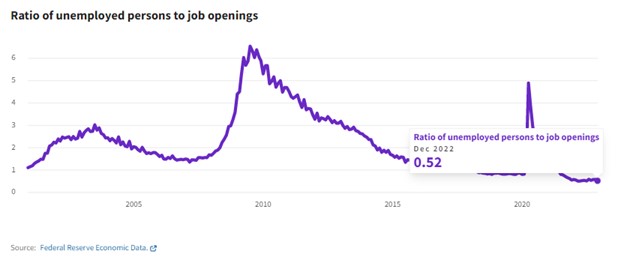
  • 10:00 AM ET, Job Openings and Labor Turnover Survey (JOLTS), which have been steady to lower, are expected to fall to 10.2 million in December versus 10.458 million in November.
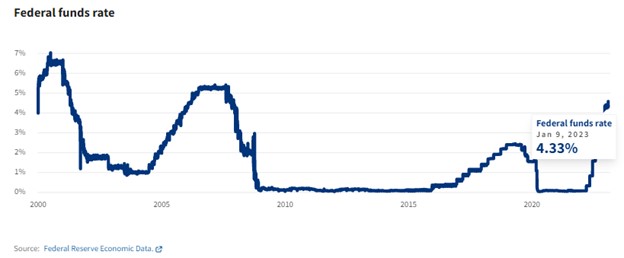
  • 2:00 PM ET, FOMC meeting concludes with statement of policy shift. The Fed is expected to reduce its rate hike magnitude to 25 basis points. A 0.25% increase would raise the overnight Fed Funds rate range up to 4.50% –  4.75%.
  • 2:30 PM ET, Fed Chair Powell’s press briefing. The purpose of the briefing is to provide additional context to the FOMC’s policy decisions and to allow for questions-and-answers with the press. There has been concern that the market has been pushing rates down out in terms beyond two years to maturity. This could be a undermining the Fed’s stated objective by tightening. If this is true, the briefing may be filled with language that tries to convince the bond markets, that the Fed is determined to slow the economy by pushing rates up.

Thursday 2/2

  • 7:30 AM ET, the Challenger Job Cut report counts and categorizes announcements of corporate layoffs based on mass layoff data from state departments of labor. The job-cut report doesn’t distinguish between layoffs scheduled for the short-term or the long term, or whether job cuts are handled through attrition or actual dismissals. Also, the job-cut report does not include jobs eliminated in small batches over a longer time period. Unlike most economic data, this series is not adjusted for seasonal variation.  
  • 8:30 AM ET, Nonfarm Productivity is expected to rise to a 2.4 percent annualized rate in the fourth quarter versus growth of 0.8 percent in the third quarter. Unit labor costs, which rose 2.4 percent in the third quarter, are expected to rise to a 1.5 percent rate in the fourth quarter.
  • 10:00 AM ET, Factory Orders are expected to rise 2.2 percent in December following  November’s steep 1.8 percent drop. The expected increase comes in the wake of a surge in aircraft orders.

Friday 2/3

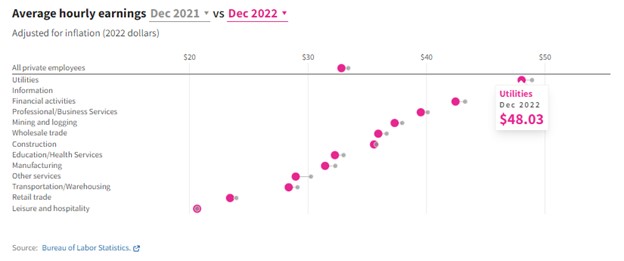
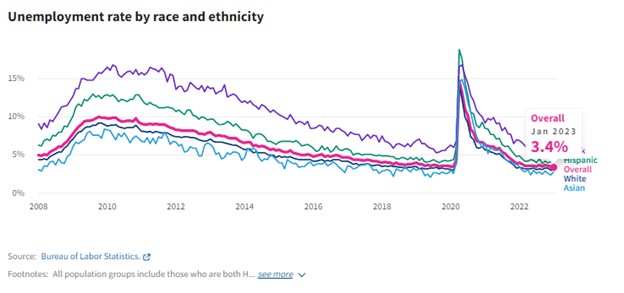
• 8:30 AM ET, Nonfarm Payroll is expected to have grown 185,000 in January versus 223,000 in December which was the eighth straight month and tenth of the last eleven that payroll growth exceeded the average economists expectation.  Average hourly earnings in January are expected to rise 0.3 percent on the month for a year-over-year rate of 4.4 percent.

What Else

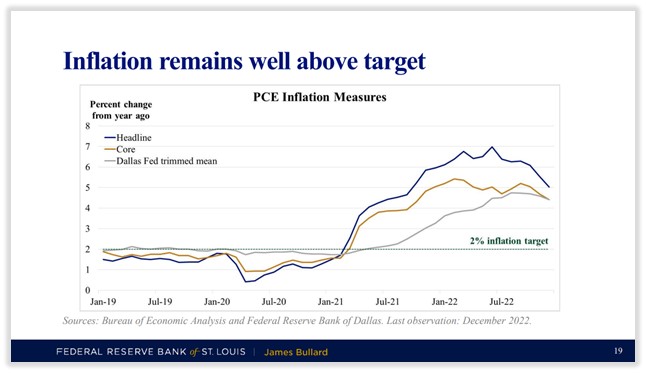
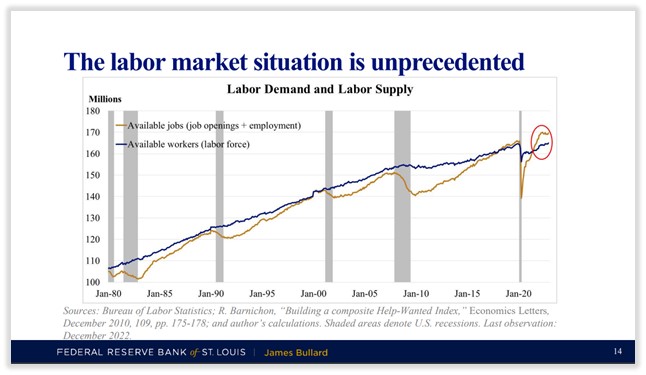
The tone of the chatter that is expected to come from Fed officials is one of continued hawkishness. The Fed’s preferred inflation measure (PCE) was at 4.4% for all of 2022, and has been trending downward. This is more than double the stated target of 2%. The question they are now facing is, whether they should soon pause tightening and observe the impact of previous moves. Or if the solid employment numbers and strong bank reserve positions leave room for continuing the war on inflation through aggressive overnight rate hikes. Powell’s press conference after the 2 pm announcement on Wednesday should reveal quite a bit.

Paul Hoffman

Managing Editor, Channelchek
PCE Inflation Versus CPI Inflation, What’s the Difference?

Image Credit: Brenda Gottsabend (Flickr)

The Increasing Popularity of the PCE Inflation Gauge

US inflation, by a number of official measures, reached its highest level in 40 years last year. For a large percentage of investors and shoppers, this is their first experience of prices quickly rising. For decades, on many tech products, prices declined over time (while adding functionality). There are a number of different measures of inflation reported regularly – they impact us in different ways. Knowing the difference, whether you’re investing, planning a purchase, or expecting a cost of living (COLA) increase, is helpful. Below we go through the different measures so you understand the impact of say “headline CPI” versus “core PCE.”

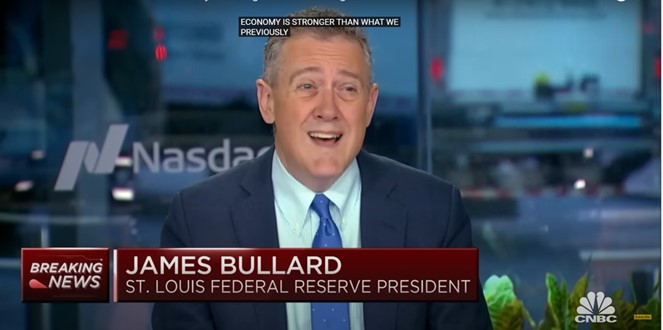
According to James Bullard, the president and CEO of the Federal Reserve Bank of St. Louis,  “measuring inflation is one of the most difficult issues studied by economists.”

By definition, inflation is the percentage change in overall prices in the economy over a specified period, commonly quoted as a year-over-year change. It’s much more than an increase in the prices of a few products. Given the inherent difficulties in following every price in the country, economists have created price indexes to approximate the overall price level.

PCE Inflation

Before the year 2000, the Federal Open Market Committee (FOMC) primarily focused on the Consumer Price Index (CPI) as its inflation gauge. We’ll explain CPI next, but for the Fed, when it now says it has a 2% inflation target, PCE is the data used.

Though the two indexes have a lot of overlap, there are reasons why the PCE is considered a better tool by policymakers.

The PCE price index, which rose 5.5% in November 2022 from a year earlier, is derived from a broader index of prices than the CPI’s more narrow set of goods and services. The argument as to why policymakers gave an edge in the late 1990s to make the change in 2000 is that a more comprehensive index (such as PCE) of prices provides a better way to gauge underlying inflationary pressures. Since the PCE includes more goods and services, the index’s weights for particular items will differ dramatically from those in the CPI. For example, housing has a weight of about 16% in the PCE price index versus 33% in the CPI. The varied items more accurately reflect actual costs to consumers since they may substitute one for another as prices of items change at different rates. This ability to substitute is a primary reason why PCE tends to print lower than headline CPI.

CPI Remains Important

The most widely cited measure of inflation is the headline Consumer Price Index (CPI), which is calculated by the Bureau of Labor Statistics (BLS). This index was created in 1919 as officials devised a way to measure rising consumer prices just after World War I.

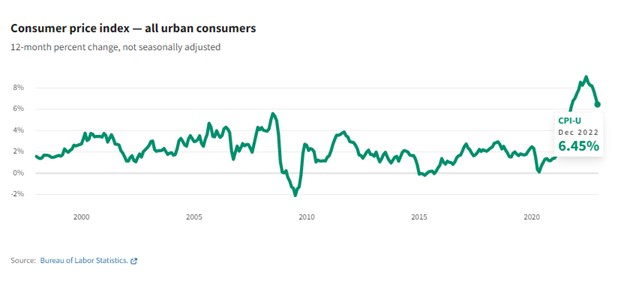
The CPI, which rose 6.5% for all of 2022, measures the price changes for a basket of goods and services purchased by the typical urban consumer. The items in this basket are weighted by their relative importance in consumer expenditures. For example, housing—rent and other spending on shelter—accounts for 33% of the index, while medical care accounts for nearly 9%.

This index, like others, takes into account changing consumption. New items come in and old items leave. The example I like to use is that prohibition began in January 1920, just after CPI came into use. Alcohol was not part of the index back then, whereas it is today (5.78% increase in 2022), product adoption changes.

The CPI weights had been adjusted every two years using two years of consumer spending data. Starting in 2023, the BLS will update weights annually using one year of data.

Headline PCE Inflation versus Headline CPI Inflation

The increasing popularity of the PCE is because the index’s weights are updated monthly, versus annually for CPI (prior to 2023 updates were every two years). Thus, the PCE can quickly reflect the impact of new technology or an abrupt change in consumer spending patterns. For example, the onset of the coronavirus pandemic quickly shifted consumption from services like restaurants to services like communication technology. Since the headline PCE uses more timely, actual outlays, it provides the FOMC a more accurate consumer experience in terms of inflation.  

The stated target by the FOMC is 2%, a level that policymakers judge to be consistent with achieving price stability and maximum employment. On average, inflation was hovering below this target before the pandemic’s economic ramifications (from 1995 through 2019 PCE average equaled 1.8%).  

Other Inflation Measures

While the FOMC targets headline PCE inflation, policymakers also watch other measures to gauge inflationary pressures. The headline PCE measure can be quite volatile due to the effects of extreme price movements for certain products. To get a sense of where underlying inflation really is, economists often look at some summary measure of inflation that doesn’t include these volatile prices.

A so-called “core” index—whether it be PCE or CPI—excludes food and energy components. That has some simplicity around it, but it’s not satisfactory. There are better ways to analyze underlying inflation than to throw out certain goods and services, especially those that hit low- to moderate-income consumers the hardest when prices rise. And even if you exclude food and energy prices, the remaining part of the index is still affected by their volatility; restaurant prices would be a classic example.

More recently, other statistical ideas have been developed. One method looks at price change distribution for the entire range of goods and services.3

One commonly used measure of this type is the Dallas Fed trimmed-mean PCE inflation rate, which removes the upper tail (the largest price changes) and the lower tail (the smallest price changes) and then takes a weighted average of the price changes for the remaining components. This measure has been popular as a tool for examining trends and overall inflation as opposed to special factors that might be driving inflation. Of course, these types of measures4 tend to be more persistent and move more slowly than headline inflation measures.

Take Away

While market concerns over inflation for many years were low and most may have been more concerned about deflation, the current tight supply of goods and labor, coupled with the easiness of money, has ushered in a period where markets are likely to feel the impact of each inflation post.

Understanding the most watched inflation gauges will help sort out whether a trend or single post is likely to cause a change in course on interest rates. Or is it more likely a blip that will on average work its way out? The Fed is currently targeting a PCE inflation rate of 2%. The current pace is more than double this, but trending down after the Fed tightened in 2022 at a record pace. The Fed and the markets are now awaiting the impact of those cuts as there is a lag in applying the economic brakes (to lessen inflation) and when the economy has its biggest reaction to the Fed’s heavy pressure on the brake pedal.

Paul Hoffman

Managing Editor, Channelchek
Sources

https://www.federalreserve.gov/newsevents/speech/powell20200827a.htm

https://files.stlouisfed.org/files/htdocs/publications/review/11/07/bullard.pdf

https://www.usinflationcalculator.com/

https://ycharts.com/indicators/us_consumer_price_index_alcoholic_beverages_unadjusted

https://www.stlouisfed.org/publications/regional-economist/2022/sep/making-sense-inflation-measures#authorbox

The Week Ahead – PCE Inflation, Big Tech Earnings, No Fed Speeches

With a Light Week Ahead for Economic Reports, Investors Eye Big-Tech Earnings

In contrast to recent weeks, which began quietly as investors waited on late-week releases (i.e.: inflation, Beige Book, Fed announcements, etc.) before getting involved, this week is relatively quiet for economic reports. With less to be concerned about undermining any new positions, early week activity, without a holiday, may help increase volume. The scarcity of economic numbers could also cause more attention to be paid to earnings reports. This coming week we’ll receive a slew of big tech companies reporting. Disappointment may cause tech, which is showing signs of life early in 2023, to fall behind again. Whereas surprises on the upside could help unwind some of last year’s dismal big tech performance. Small Cap stocks, for their part, are keeping pace with the Nasdaq 100 mega stocks.

Earnings of both small-caps and mega-caps this week may produce a clear front-running segment based on capitalization.  

There’s a Fed meeting next week. While the consensus seems to be for a 25 bp hike, Fed governors have been clear in recent addresses that the tightening cycle is not over. The PCE number late this week is considered the Fed’s favorite inflation gauge. There are no scheduled addresses by Fed regional presidents leading up to the two-day meeting that concludes on February 1.  

Monday 1/23

  • 8:30 AM ET The index of leading economic indicators, which has been in steep decline (dropped a full 1.0 percent in November), is expected to have fallen a further 0.7 percent in December. The index of leading economic indicators is a composite of 10 forward-looking components, including building permits, new factory orders, stock market performance, and unemployment claims. As such, estimates pre-report tend to be very close to the actual number. The report attempts to predict general economic conditions six months out.

Tuesday 1/24

  • 9:45 AM ET, The Purchasing Managers Index (PMI) has been drifting down further into contraction – no relief is expected for January. Manufacturing is seen at 46.5 with services at 45.5.

Wednesday 1/25

  • 7:00 AM ET, the Mortgage Bankers’ Association (MBA) compiles various mortgage loan indexes. The purchase applications index measures applications at mortgage lenders. This is a leading indicator for single-family home sales and housing construction. The composite index is expected to come in at 27.9%, while the Purchase applications are expected to show a reading of 24.7%. The data provides a gauge of not only the demand for housing but economic momentum.

Thursday 1/26

  • 8:30 AM ET, Forecasters see Durable Goods Orders rebounding 2.8 percent in December, which would more than reverse November’s steep 2.1 percent decline. Yet the gain is seen concentrated in aircraft as both ex-transportation and core capital goods orders are seen falling 0.2 percent.
  • 8:30 AM ET, Gross Domestic Product, or GDP for the fourth quarter is expected to have slowed to a 2.7% annualized growth versus third-quarter growth of 3.2%. Positive growth would indicate that the economy is not in a recession.
  • 8:30 AM ET, Jobless Claims are a weekly report. For the January 21 week, it is expected to come in at 202,000 versus a very low 190,000 in the prior week. The Fed focuses on jobs; the very strong numbers (low) suggest the Fed has room to tighten without being overly disruptive to job creation. Also, a tight labor market can be viewed as inflationary.
  • 10:00 AM ET, New Home Sales in December are expected to revert to the downward trend at a 614,000 annualized rate versus November’s 640,000. Higher home sales reverberate throughout the economy in terms of spending and growth.

Friday 1/27

• 8:30 AM ET, Personal Income is expected to have increased a monthly 0.2 percent higher in December, with consumption expenditures expected to have decreased 0.1 percent. These would compare with respective November gains of 0.4 and 0.1 percent.

The PCE inflation readings for December, which are part of the PI numbers, are expected to show no change overall and up 0.3 percent for the core (versus respective gains of 0.1 and 0.2 percent) for annual rates of 5.0 and 4.4 percent (versus November’s 5.5 and 4.7 percent).

What Else

The Federal Reserve is very likely through most of its overnight Fed Funds tightening cycle.  Japan, which had gone through decades of having a deflation problem, is now experiencing the highest inflation in 41 years. The Bank of Japan has not adopted the aggressively hawkish monetary policy that the US has. The US central bank, chaired by Jerome Powell, must be looking on and holding his stated opinion that he’d rather do too much tightening than too little.

Paul Hoffman

Managing Editor, Channelchek
Sources

https://www.reuters.com/markets/us/wall-st-week-ahead-tech-stock-rebound-faces-doubters-with-earnings-season-ahead-2023-01-20/

https://us.econoday.com/byweek.asp?cust=us

The Beige Book Has Some Gray Areas

January Fed Summary

Attention is Now Being Paid to the Beige Book

The so-called Beige Book is receiving much more attention from market participants than it has in years as they seek insight into the near- and long-term economic direction. The report is published eight times yearly and released about two weeks before the FOMC scheduled meetings. It contains anecdotal trends and moods from each of the 12 Federal Reserve districts. The information is collected and summarized and is relied on as part of the discussion topics at the Fed policy meetings.

The report released on January 18th was collected on or before January 9th. While each Federal Reserve district may have different economic experiences, for example, manufacturing regions may have a very different perspective than agricultural areas or districts where service jobs are more prevalent.

30,000 Foot View

The first Beige Book of 2023 shows the US economy is holding steady. However, there are only small amounts of growth experienced in some regions, while others expect small pockets of expansion. This overall summary would be difficult to use as an argument for the Fed to alter course from its stated intention of additional tightening, including Fed Funds rate hikes. The next meeting will be held on January 31st and February 1st.

“On balance, contacts across districts said they expected future price growth to moderate further in the year ahead,” the survey said.

The report doesn’t contain many surprises and confirms current expectations that residential real estate activity is sluggish, the labor market is strong, and that inflation is running at a slower pace of growth.

There is very little in January’s Beige Book that would alter analysts’ expectations of what the next monetary policy adjustment might be. Those that are expecting a 0.50% increase are not likely to shift their thinking from the summaries, and those expecting a 0.25% hike are similarly not inclined to shift their thinking. Most analysts fall into one of these two categories.

A Sign the Markets Wanted

In a recent interview, Cleveland Fed President Loretta Mester said the slowdown in inflation shows the Fed’s work raising rates is having the desired effect; she also suggested that further increases are still needed. “We’re beginning to see the kind of actions that we need to see,” Mester stated; these are “good signs that things are moving in the right direction. That’s important input into how we’re thinking about where policy needs to go.” This is heartening for those hoping for fewer rate hikes as Mester is considered one of the US central bank’s more hawkish members.

Take Away

The markets got a mixed bag with no clear change of direction from the summary of Federal reserve districts, otherwise known as the Beige Book. This could mean there will be few surprises at the close of the FOMC meeting on February 1st.

At least one Fed hawk is softening her rhetoric going into the meeting. If the trend continues, the prospect of fewer rate hikes should be viewed as positive for stocks and positive for bonds.

Paul Hoffman

Managing Editor, Channelchek

Sources

https://www.federalreserve.gov/monetarypolicy/beigebook202301.htm

https://www.federalreserve.gov/monetarypolicy/publications/beige-book-default.htm

https://www.usnews.com/news/economy/articles/2023-01-18/feds-beige-book-finds-economy-holding-steady-with-little-growth-expected-in-the-coming-months

Understanding the Debt Ceiling Enough to Survive this Week

Image Credit: Jeremy (Flickr)

Why America Has a Debt Ceiling: Five Questions Answered

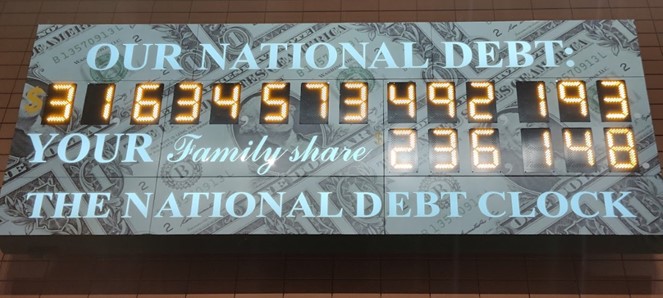
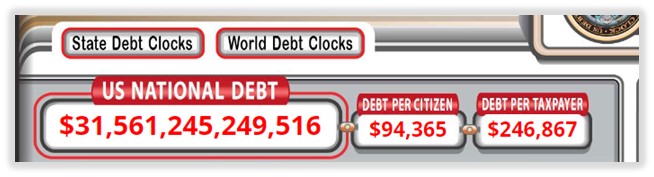
The Treasury Department on Jan. 13, 2023, said it expects the U.S. to hit the current debt limit of $31.38 trillion on Jan. 19. After that, the government would take “extraordinary measures” – which could extend the deadline until May or June – to avoid default. A default, even a risk of default would drive bond prices (interest rates) much higher than they currently are.

Is the debt ceiling still a good idea?

Economist Steve Pressman is a professor at The New School in Manhattan, below he explains the debt ceiling is and why we have it – and then shares his opinion on its usefulness.

What is the Debt Ceiling?

Like the rest of us, governments must borrow when they spend more money than they receive. They do so by issuing bonds, which are IOUs that promise to repay the money in the future and make regular interest payments. Government debt is the total sum of all this borrowed money.

The debt ceiling, which Congress established a century ago, is the maximum amount the government can borrow. It’s a limit on the national debt.

What’s the National Debt?

On Jan. 10, 2023, U.S. government debt was $30.92 trillion, about 22% more than the value of all goods and services that will be produced in the U.S. economy this year.

Around one-quarter of this money the government actually owes itself. The Social Security Administration has accumulated a surplus and invests the extra money, currently $2.8 trillion, in government bonds. And the Federal Reserve holds $5.5 trillion in U.S. Treasurys.

The rest is public debt. As of October 2022, foreign countries, companies and individuals owned $7.2 trillion of U.S. government debt. Japan and China are the largest holders, with around $1 trillion each. The rest is owed to U.S. citizens and businesses, as well as state and local governments.

Why is There a Borrowing Limit

Before 1917, Congress would authorize the government to borrow a fixed sum of money for a specified term. When loans were repaid, the government could not borrow again without asking Congress for approval.

The Second Liberty Bond Act of 1917, which created the debt ceiling, changed this. It allowed a continual rollover of debt without congressional approval.

Congress enacted this measure to let then-President Woodrow Wilson spend the money he deemed necessary to fight World War I without waiting for often-absent lawmakers to act. Congress, however, did not want to write the president a blank check, so it limited borrowing to $11.5 billion and required legislation for any increase.

The debt ceiling has been increased dozens of times since then and suspended on several occasions. The last change occurred in December 2021, when it was raised to $31.38 trillion.

What Happens When the US Hits the Ceiling?

Currently, the U.S. Treasury has under $400 billion cash on hand, and the U.S. government expects to borrow around $100 billion each month this year.

When the U.S. nears its debt limit, the Treasury secretary – currently Janet Yellen – can use “extraordinary measures” to conserve cash, which she indicated would begin on Jan. 19. One such measure is temporarily not funding retirement programs for government employees. The expectation will be that once the ceiling is raised, the government would make up the difference. But this will buy only a small amount of time.

If the debt ceiling isn’t raised before the Treasury Department exhausts its options, decisions will have to be made about who gets paid with daily tax revenues. Further borrowing will not be possible. Government employees or contractors may not be paid in full. Loans to small businesses or college students may stop.

When the government can’t pay all its bills, it is technically in default. Policymakers, economists and Wall Street are concerned about a calamitous financial and economic crisis. Many fear that a government default would have dire economic consequences – soaring interest rates, financial markets in panic and maybe an economic depression.

Under normal circumstances, once markets start panicking, Congress and the president usually act. This is what happened in 2013 when Republicans sought to use the debt ceiling to defund the Affordable Care Act.

But we no longer live in normal political times. The major political parties are more polarized than ever, and the concessions McCarthy gave Republicans may make it impossible to get a deal on the debt ceiling.

Is There a Better Way?

One possible solution is a legal loophole allowing the U.S. Treasury to mint platinum coins of any denomination. If the U.S. Treasury were to mint a $1 trillion coin and deposit it into its bank account at the Federal Reserve, the money could be used to pay for government programs or repay government bondholders. This could even be justified by appealing to Section 4 of the 14th Amendment to the U.S. Constitution: “The validity of the public debt of the United States … shall not be questioned.”

Few countries even have a debt ceiling. Other governments operate effectively without it. America could too. A debt ceiling is dysfunctional and periodically puts the U.S. economy in jeopardy because of political grandstanding.

The best solution would be to scrap the debt ceiling altogether. Congress already approved the spending and the tax laws that require more debt. Why should it also have to approve the additional borrowing?

It should be remembered that the original debt ceiling was put in place because Congress couldn’t meet quickly and approve needed spending to fight a war. In 1917 cross-country travel was by rail, requiring days to get to Washington. This made some sense then. Today, when Congress can vote online from home, this is no longer the case.

The Week Ahead – Earnings Season, Beige Book, Jobs Report

Can the S&P Hold Above 4,000? Will Fed Presidents Change Market Expectations?

The S&P 500 closed on the cusp of 4,000 last week; while this is still nearly 800 points from an all-time-high if it should break through and hold, it could have positive psychological value for equity markets.

Two reports this week that have the potential to drive direction are both released on Wednesday. They are the December numbers on retail sales and the Fed’s Beige Book. Earnings season is also in full swing beginning this week. The reporting results of companies such as Netflix on Thursday may have an impact and set the stage for specific sectors and markets.

The Beige Book will provide a sense of economic conditions across the 12 Federal Reserve Districts, measuring the period between late November and early January. The tone of the last three releases points toward the US economy sitting on the brink of recession. There will be information on how interest rates are impacting housing markets and the strength of the labor market in different districts. The evidence in the report could mean the difference between a 0.25% increase or a 0.50% increase after the FOMC meeting held on January 31 through February 1.

Monday 1/16

  • US Markets and Government Offices closed (MLK Jr. Day).

Tuesday 1/17

  • 8:30 AM ET, The Empire State Manufacturing Index disappointed in December with a reading of minus 11.2. The estimate for January is less negative minus 7.5. It tallies, each first of the month, the same pool of roughly 200 manufacturing executives (usually the CEO or the president) responses to a questionnaire on an assortment of indicators from the previous month.
  • 3:00 PM ET, John Williams, the President of the Federal Reserve Bank of New York will be speaking. The New York Fed President is a particularly influential voting member of the FOMC. There is the possibility of insight into how that member may have changed their leaning on policy, which could impact markets.

Wednesday 1/18

  • 8:30 AM ET, PPI- Final Demand Numbers will be released for December; they are expected to have fallen 0.1 percent on the month for a year-over-year increase of 6.8%. This would compare with a 7.4% year-over-year level in November.
  • 8:30 AM ET, Retail Sales are expected to fall 0.9% in December on top of November’s weaker-than-expected 0.6% decline. Ex-vehicle sales slipped 0.2% in November, with this measure expected to fall 0.5% in December. When excluding both vehicles and gasoline, sales are expected to read 0.1% higher.
  • 9:00 AM ET, the President of the Atlanta Fed, Raphael Bostic, will be speaking. Any time a voting member of the FOMC is speaking publicly, there is the potential for insight into how that member may have adjusted their leaning on policy. Atlanta Fed events are often broadcast live on this YouTube channel.
  • 9:15 AM ET, Industrial Production has been contracting, and further the contraction is expected to continue with a consensus loss estimate of 0.1% for December. Manufacturing output is expected to fall 0.2%.
  • 9:30 AM ET, the Chief Executive Officer of the St. Louis Fed, James Bullard, will be speaking.
  • 10:00 AM ET, Business inventories in November are expected to rise 0.4% following a 0.3% build in October.
  • 2:00 PM ET, Beige Book Release.

Thursday 1/19

  • 8:30 AM ET, December’s annualized rates are expected at 1.358 million for starts and 1.380 million for permits which would compare with 1.427 and 1.342 million in November.
  • 8:30 AM ET, Jobless claims for the January 14 week are expected to rise slightly to 215,000 versus 205,000 and 206,000 in the two prior weeks.
  • 8:30 AM ET, The Philadelphia Fed manufacturing index is expected to come in at minus 10.0 in January. This report has been contracting for six of the last seven reports.
  • 9:00 AM ET, Federal Reserve Bank of Boston Fed President Susan Collins is scheduled to speak.
  • The debt ceiling may be reached as per US Treasury Secretary Janet Yellen.

Friday 1/20

• 10:00 AM ET, Existing home sales in December are expected to have declined further to a 3.955 million annualized rate versus November’s lower-than-expected 4.090 million.

1:00 PM ET, Better World Acquisition (BWAC) will be interviewed in a C-Suite style interview. A video will be made available here on Channelchek.

What Else

The Federal Reserve members can impact longer-term interest rates by impacting expectations they set through their speeches. Some say their voices have been drowned out by analysts and media reporting. For this reason, Fed rhetoric may become elevated as we approach the next FOMC meeting that begins late month.

Earnings season begins to ramp up just as a major index at psychologically important levels. This could be what sets the tone for the stock market and various sectors for the first quarter.

Paul Hoffman

Managing Editor, Channelchek

Sources

https://us.econoday.com/byweek.asp?cust=us

https://home.treasury.gov/system/files/136/Debt-Limit-Letter-to-Congress-McCarthy-20230113.pdf

Cooling Inflation May Not Translate to a More Accommodating Fed

Image Credit: Brookings Institute (Flickr)

Unbalanced Hype in the Markets Surrounding the “Unknowable” Could be Costly

“It’s not knowable” if there will be a recession in 2023, said Fed Chair Jerome Powell recently. A month earlier, after the last change in monetary policy, he said it is easier to go too far and bring the economy back than to do too little and then have to then tame stronger inflationary pressures. The most recent CPI number shows a trend that policymakers want to see, but it likely is not a number the Fed will pivot off of. After all, for the Consumer Price Index (CPI) to rise by 6.5% YoY means that cost increases experienced by consumers are running more than three times higher than the Fed’s stated target. Of course, the rate increases have not had time to work their way into the system; they haven’t even fully worked their way into the interest rate markets.

An Alternative Way to Look at Tightening

Relatively speaking, a hypothetical decline in your investment account by 2% last month may be an improvement in performance if it had been down 3% the month before. But if your need to meet your goals is a positive 8%, then you still have a lot of work to do in order to consider yourself successful. The same for the Fed policymakers. US dollar buying power is losing ground, just not as quickly as it was. And since the inflation rate is also subject to what savers and investors call ‘the miracle of compounding’ and the jobs market is strong, the Fed has motivation and room to keep pulling money from the system and raising interest rates – the sooner, the better based on Powell’s statements.

And it may be that they are willingly driving the economy into reverse to stop service costs from rising as quickly, and bring inflationary wage increases lower. Workers, after all, have not reacted to the possibility of a recession. They still feel at ease leaving their employers at a very high pace, and the layoff rate is still near a record low. To demonstrate, the economy added 223,000 in payroll employment in December (well above the 200,000 forecast — and the unemployment rate came down to 3.5%, below the 3.7% forecast. This may not seem high compared to the gains just after the pandemic opening, but it is quite steamy.

Take Away

The financial news has been full of ‘pivot’ headlines for months. When it comes to the “unknowable,” it is important to remind oneself, as an investor, that very few things are a done deal until they happen. The big picture is the bond market has not priced itself in a way that fully reflects the Fed tightening of short-term rates. This represents difficulty for the Fed, and the Fed is looking for slower economic growth.

Throughout 2022, the big question while consumers faced increasing prices was whether the Federal Reserve would push the economy into decline. Their intent, after years of excessive stimulus, is to slow economic growth to bring inflation down. The Fed hiked interest rates seven times during 2022, its aggressive tactics caused some to worry about job losses and a recession. With an inflation rate that Powell thinks is more than three times too high, investors must consider that the Fed has different goals than investors but the same as consumers. We are all consumers, we’re not all investors.

As a final note, what the year brings is unknowable. There are always stocks going up, going down, and tracking sideways. A 2% inflation rate is easier to beat in terms of performance as an equity market investor than a 4% or 6% level. What the Fed will do, they likely don’t know for sure themselves; our job, that of investors, is to not get caught up in hype. And the markets and the media are breeding grounds for hype.

Paul Hoffman

Managing Editor, Channelchek

Powell Just Insisted, “We are not, and will not be, a climate policymaker”

Source: Riksbank Sweden (Bloomberg)

Fed Chair Jerome Powell made three strong points during the panel on “Central Bank Independence and the Mandate—Evolving Views,” which just took place in Stockholm. These points include the role of elected representatives and unelected agency officials, the transparency of a central bank’s intents and actions while remaining independent of political agendas, and not becoming sidetracked from the established mandates.

Continued Independence and Transparency

Powell reminded the international audience, which included central bankers, that the purpose of monetary policy independence is the benefits allowed the policymakers. This independence can insulate policy decisions from short-term political considerations. “Price stability is the bedrock of a healthy economy and provides the public with immeasurable benefits over time. But restoring price stability when inflation is high can require measures that are not popular in the short term as we raise interest rates to slow the economy,” said Powell. The head of the US central bank then explained the absence of politics over central bank decisions provides for less conflicted decision-making in light of short-lived political considerations.

While speaking from a US point of view, Powell said that in a “well-functioning democracy, important public policy decisions should be made, in almost all cases, by the elected branches of government.”  He explained that agencies trusted to act independently, such as the Federal Reserve, should have a narrow and explicitly defined mission that protects the agency from fleeting political considerations.

Within this kind of independence in a representative democracy, including transparency that allows for oversight, the Fed and other agencies find legitimacy. Powell said about of the current makeup of the Fed, “We are tightly focused on achieving our statutory mandate and on providing useful and appropriate transparency.”

Focus on Mandates

Climate change is not part of the US central bank’s statutory goals and authority. On the subject of climate, Powell added, “we resist the temptation to broaden our scope to address other important social issues of the day. Taking on new goals, however worthy, without a clear statutory mandate would undermine the case for our independence.”

In the area of bank regulation, Powell told the audience that independence helps ensure that the public can be confident that the overseer’s supervisory decisions are not influenced by political considerations. In response to his own hypothetical question about whether it is wise to incorporate into bank supervision the perceived risks associated with climate change, consistent with existing mandates, Powell sounded strongly opposed. “Addressing climate change seems likely to require policies that would have significant distributional and other effects on companies, industries, regions, and nations. Decisions about policies to directly address climate change should be made by the elected branches of government and thus reflect the public’s will as expressed through elections.”

He did, however, share his view that any climate-related financial risks that pose material risks to the banking system are the Fed’s responsibility and under their supervision. “But without explicit congressional legislation, it would be inappropriate for us to use our monetary policy or supervisory tools to promote a greener economy or to achieve other climate-based goals. We are not, and will not be, a “climate policymaker.”

Take Away

On January 10th, the head of the US central bank participated in an international symposium to mark the end of Stefan Ingves’ time as governor of Sweden’s central bank. Senior central bank officials and prominent academics participate in four panels that address central bank independence from various angles – climate, payments, mandates, and global policy coordination. Fed Chair Powell stood determined and resolute that the Fed’s mandate is narrow, well-defined, and should not be clouded with short-term political goals.

There has been pressure on the Fed to adopt additional mandates that include social reforms and climate concerns. His talk before a world audience may be the first time Jerome Powell has publicly addressed this pressure. The US House of Representatives has just shifted its balance to a more conservative power base; this may have had an empowering impact on Powell’s open remarks.

Paul Hoffman

Managing Editor, Channelchek
Sources

https://www.federalreserve.gov/newsevents/speech/powell20230110a.htm

https://www.riksbank.se/globalassets/media/konferenser/2022/riksbank-organises-international-symposium-on-central-bank-independence.pdf

https://www.reuters.com/markets/us/powell-fed-needs-independence-fight-inflation-should-avoid-climate-policy-2023-01-10/

The Pros, Cons, and Many Definitions of ‘Gig’ Work

Image Credit: Stock Catalog

What’s a ‘Gig’ Job? How it’s Legally Defined Affects Workers’ Rights and Protections

The “gig” economy has captured the attention of technology futurists, journalists, academics and policymakers.

“Future of work” discussions tend toward two extremes: breathless excitement at the brave new world that provides greater flexibility, mobility and entrepreneurial energy, or dire accounts of its immiserating impacts on the workers who labor beneath the gig economy’s yoke.

This article was republished with permission from The Conversation, a news site dedicated to sharing ideas from academic experts. It represents the research-based findings and thoughts of David Weil, Visiting Senior Faculty Fellow, Ash Center for Democracy Harvard Kennedy School / Professor, Heller School for Social Policy and Management, Brandeis University.

These widely diverging views may be partly due to the many definitions of what constitutes “gig work” and the resulting difficulties in measuring its prevalence. As an academic who has studied workplace laws for decades and ran the federal agency that enforces workplace protections during the Obama administration, I know the way we define, measure and treat gig workers under the law has significant consequences for workers. That’s particularly true for those lacking leverage in the labor market.

While there are benefits for workers for this emerging model of employment, there are pitfalls as well. Confusion over the meaning and size of the gig workforce – at times the intentional work of companies with a vested economic interest – can obscure the problems gig status can have on workers’ earnings, workplace conditions and opportunities.

Defining Gig Work

Many trace the phrase “gig economy” to a 2009 essay in which editor and author Tina Brown proclaimed: “No one I know has a job anymore. They’ve got Gigs.”

Although Brown focused on professional and semiprofessional workers chasing short-term work, the term soon applied to a variety of jobs in low-paid occupations and industries. Several years later, the rapid ascent of Uber, Lyft and DoorDash led the term gig to be associated with platform and digital business models. More recently, the pandemic linked gig work to a broader set of jobs associated with high turnover, limited career prospects, volatile wages and exposure to COVID-19 uncertainties.

The imprecision of gig, therefore, connotes different things: Some uses focus on the temporary or “contingent” nature of the work, such as jobs that may be terminated at any time, usually at the discretion of the employer. Other definitions focus on the unpredictability of work in terms of earnings, scheduling, hours provided in a workweek or location. Still other depictions focus on the business structure through which work is engaged – a staffing agency, digital platform, contractor or other intermediary. Further complicating the definition of gig is whether the focus is on a worker’s primary source of income or on side work meant to supplement income.

Measuring Gig Work

These differing definitions of gig work have led to widely varying estimates of its prevalence.

A conservative estimate from the Bureau of Labor Statistics household-based survey of “alternative work arrangements” suggests that gig workers “in non-standard categories” account for about 10% of employment. Alternatively, other researchers estimate the prevalence as three times as common, or 32.5%, using a Federal Reserve survey that broadly defines gig work to include any work that is temporary and variable in nature as either a primary or secondary source of earnings. And when freelancing platform Upworks and consulting firm McKinsey & Co. use a broader concept of “independent work,” they report rates as high as 36% of employed respondents.

No consensus definition or measurement approach has emerged, despite many attempts, including a 2020 panel report by the National Academies of Sciences, Engineering, and Medicine. Various estimates do suggest several common themes, however: Gig work is sizable, present in both traditional and digital workplaces, and draws upon workers across the age, education, demographic and skill spectrum.

Why it Matters

As the above indicates, gig workers can range from high-paid professionals working on a project-to-project basis to low-wage workers whose earnings are highly variable, who work in nonprofessional or semiprofessional occupations and who accept – by choice or necessity – volatile hours and a short-term time commitment from the organization paying for that work.

Regardless of their professional status, many workers operating in gig arrangements are classified as independent contractors rather than employees. As independent contractors, workers lose rights to a minimum wage, overtime and a safe and healthy work environment as well as protections against discrimination and harassment. Independent contractors also lose access to unemployment insurance, workers’ compensation and paid sick leave now required in many states.

Federal and state laws differ in the factors they draw on to make that call. A key concept underlying that determination is how “economically dependent” the worker is on the employer or contracting party. Greater economic independence – for example, the ability to determine price of service, how and where tasks are done and opportunities for expanding or contracting that work based on the individual’s own skills, abilities and enterprise – suggest a role as an independent contractor.

In contrast, if the hiring party basically calls the shots – for example, controlling what the individual does, how they do their work and when they do it, what they are permitted to do and not do, and what performance is deemed acceptable – this suggests employee status. That’s because workplace laws are generally geared toward employees and seek to protect workers who have unequal bargaining leverage in the labor market, a concept based on long-standing Supreme Court precedent.

Making Work More Precarious

Over the past few decades, a growing number of low-wage workers find themselves in gig work situations – everything from platform drivers and delivery personnel to construction laborers, distribution workers, short-haul truck drivers and home health aides. Taken together, the grouping could easily exceed 20 million workers.

Many companies have incentives to classify these workers as independent contractors in order to reduce costs and risks, not because of a truly transformed nature of work where those so classified are real entrepreneurs or self-standing businesses.

Since gig work tends to be volatile and contingent, losing employment protections amplifies the precariousness of work. A business using misclassified workers can gain cost advantages over competitors who treat their workers as employees as required by the law. This competitive dynamic can spread misclassification to new companies, industries and occupations – a problem we addressed directly, for example, in construction cases when I led the Wage and Hour Division and more recently in several health care cases.

The future of work is not governed by immutable technological forces but involves volitional private and public choices. Navigating to that future requires weighing the benefits gig work can provide some workers with greater economic independence against the continuing need to protect and bestow rights for the many workers who will continue to play on a very uneven playing field in the labor market.

The Week Ahead – Inflation Data in Focus

Although CPI is the Focus, Chairman Powell’s Discussion in Sweden Could Have a Long-Lasting Impact

As this full five-day trading week kicks off, stock’s YTD performance and the week-to-date performance are equal. This will change with the opening bell on Monday. It is a quiet week for highly scrutinized numbers or events. However, two scheduled events have the potential to change investor sentiment. The first comes on Tuesday when the US central bank chairman (Fed Chair Powell)  speaks in Stockholm about central bank independence. This debate regarding politic’s role in central bank decisions is getting more intense. Channelchek recently published an article on the subject which can be found here.

The second is CPI which is the next look we get at inflation. If inflation is higher than expectations, the stock and bond markets could sell off; if lower, they may celebrate with a rally.

Otherwise, the week kicks off with the Investment Movement Index, which will get little attention, but is worth watching. The IMX is a behavior-based index assembled by TD Ameritrade designed to measure what investors are actually doing. More on the IMX below.

Monday 01/09

  • 12:30 PM, The Investor Movement Index or IMX measures what investors are actually doing and how they are actually positioned in the markets. It accomplishes this by using data on the holdings/positions, trading activity, and other data from an anonymous sample of six million funded accounts. It reflects consumer retail portfolios. At its most basic level, the IMX can provide insight into whether investors are growing more bullish or bearish on equities.
  • 12:30 PM, the President of the Atlanta Fed, Raphael Bostic, will be speaking. Any time a voting member of the FOMC is speaking publicly, there is the potential for insight into how that member may have adjusted their leaning on policy. Atlanta Fed events are often broadcast live on this YouTube channel.

Tuesday 01/10

  • 6:00 AM, NFIB Small Business Optimism Index has been below the historical average of 98 for 11 months in a row. December’s consensus is 91.3 versus 91.9 and 91.3 in the past two reports. The index is a composite of 10 seasonally adjusted components based on the following questions: plans to increase employment, plans to make capital outlays, plans to increase inventories, expect the economy to improve, expect real sales higher, current inventory, current job openings, expected credit conditions, now a good time to expand, and earnings trend.
  • 9:00 AM, Fed Chair Powell speaks at the Sveriges Riksbank International Symposium on Central Bank Independence in Stockholm, Sweden. It is not expected that micro discussions on current interest rate policy will surface in his conversation.

Wednesday 01/10

  • 7:00 AM, Mortgage Bankers Association (MBA) will release numbers on mortgage applications. There has been a steady decline in applications over the past seven months.

Thursday 01/11

  • 7:30 AM ET, Philadelphia Fed President Patrick Harker will be speaking. Any time a voting member of the FOMC is speaking publicly, there is the possibility of insight into how that member may have changed their leaning on policy.
  • 8:30 AM, the CPI number will be such a distracting focus this week that trading may actually be subdued earlier in the week in anticipation of this inflation report. The consensus is for no monthly change in consumer prices. This would equate to a year-over-year rate of 6.6%.

Friday 01/12

  • 10:00 AM, Consumer Sentiment is expected to inch up to 60.0 in the first reading for January versus 59.7 in December.
  • 10:20 AM Philadelphia Fed President Patrick Harker will be speaking. Any time a voting member of the FOMC is speaking publicly, there is the possibility of insight into how that member may have changed their leaning on policy.

What Else

Guess what, the stock market is closed again on Monday the 16th.  Below is a copy of the holidays along with Fed meetings and other important dates throughout the year. It was provided by the NYSE. Perhaps bookmark a link to this beginning of the year look forward so as to have on hand a snapshot of all of these market impactful dates.

Paul Hoffman

Managing Editor, Channelchek

Sources

https://www.nyse.com/publicdocs/ICE_NYSE_2023_Yearly_Trading_Calendar.pdf?elqTrackId=16ec5f60c2d140d4babc3081b3d4cdd2&elq=00000000000000000000000000000000&elqaid=4274&elqat=2&elqCampaignId=&elqcst=272&elqcsid=1819

https://us.econoday.com/byweek.asp?cust=us

Innovation Works Best as a Freewheeling Process Not Grand Design

Image credit: Marcus Herzberg (Pexels)

For Now, Innovation and Entrepreneurship Still Hold a High Place in the USA

Commentators worry that the United States might lose its dominance in innovation to Asian countries like China and Singapore. Many policymakers are intimidated by the R&D budgets of Asian countries and by their superior performance on international academic assessments. However, these concerns are misguided because the United States still dominates innovation.

The United States ranks second on the Global Innovation Index and scores the highest in the world on fifteen of eighty-one innovation indicators. The US innovation ecosystem continues to lead in the commercialization of research, and its universities are on the cutting edge of academic research. Other countries are expanding research budgets, but the United States’ genius is its ability to commercialize relevant innovations.

Innovations are only useful when they disrupt industries by transforming society and altering consumer preferences. Because innovations respond to market changes, anything can become an innovation, and the process is highly spontaneous. Unfortunately, too many countries are laboring under the assumption that government plans inevitably lead to innovation. Finding the next game changer is tremendously difficult due to the dynamism of consumer preferences.

US entrepreneurs appreciate that innovation is a freewheeling process rather than an object of grand design. That is why Silicon Valley, with its reverence for risk and failure, has been known for innovation. In her 2014 book, The Upside of Down: Why Failing Well is the Key to Success, Megan McArdle argues that the United States’ tolerance toward failure is a crucial pillar of prosperity because it promotes self-actualization, risk, and the continuous quest for innovation.

The United States’ rivals have eloquent five-year plans and extravagant budgets, but US innovation is undergirded by private institutions with a strong appetite for risk and iconoclastic thinking. Private venture-capital associations and research institutions searching for future pioneers are the primary players in US innovation. Government innovation plans are inherently conservative because they hinge on the success of targeted industries.

But, in the private sector, entrepreneurs are deliberately scouting for disruptors to undercut traditional industries by launching breakthrough products. The conformity of government bureaucracies is an enemy of the unorthodox thinking that spurs innovation. China is known for having a competent and meritocratic civil service, yet scholars contend that it lacks an innovative environment.

A key problem is that China focuses on competing with western rivals instead of developing new industries; innovation is perceived as a competition between China and its rivals rather than an activity pursued for its own sake. Consequently, US companies remain market leaders and are more adept at converting market information into innovative products than their Chinese counterparts. Unlike China, US entrepreneurship is not a function of geopolitics.

Meanwhile, some commentators suggest that the US education system is better at deploying talent due to its encouragement of unorthodox thinking. In contrast, Singapore and China have been criticized for emphasizing rote learning at the expense of critical thinking. For example, Singapore’s public sector is a model of excellence; however, despite government support, Singapore is yet to become an innovation hotbed.

Bryan Cheung, in an assessment of industrial policy in Singapore, comments on the failure of Singapore to translate research into innovation: “Even though Singapore ranks highly on global innovation indices, closer scrutiny reveals that it scores poorly on the sub-component of innovation efficiency.” A recent edition of the Global Innovation Index, using a global comparison, declared that “Singapore produces less innovation outputs relative to its level of innovation investments.”

Cheung explains that Singapore is heavily reliant on foreign talent to boost innovation: “Even the six ‘unicorns’ that Singapore has produced (Grab, SEA, Trax, Lazada, Patsnap, Razer) were all founded or co-founded by foreign entrepreneurs. In the Start-Up Genome (2021), Singapore also performed relatively poorly in ‘quality and access’ to tech talent, research impact of publications, and local market reach, which is unsurprising since innovation activity is concentrated in foreign hands.”

Asian countries are growing more competitive, but it will take decades before they develop the United States’ appetite for risk, market-driven innovations, and the uncanny ability to monetize anything. The United States’ spectacular economic performance and business acumen are based on its unique culture. Those who bet against the United States by downplaying its culture are bound to lose. The United States’ rivals are still catching up.

About the Author

Lipton Matthews is a researcher, business analyst, and contributor to Merion WestThe FederalistAmerican Thinker, Intellectual Takeout, mises.org, and Imaginative Conservative. Visit his YouTube channel, here. He may be contacted at [email protected] or on Twitter (@matthewslipton)

Inflation, Interest Rates, and Economic Growth – Where are We Headed?

Global Economy 2023 – Central Banks Face an Epic Battle Against Inflation Amid Political Obstacles

Where is the global economy heading in 2023?

After all the challenges of last year, it’s a question asked with concern. Just as the economy was dealing with the aftermath of the COVID-19 pandemic, Russia’s invasion of Ukraine added a little more impetus to global inflation.

Significant rises in the cost of vital items such as food and energy created a cost-of-living issue that needs to be addressed by households and businesses. Central banks reacted with a barrage of interest-rate hikes, while a wave of industrial action saw workers in many countries fighting for pay and conditions to keep pace with this more expensive economic era.

Now, as we begin 2023, these conditions are set to continue, and the IMF thinks that a third of the world will experience a recession in the coming months. This article discusses the weakening independence of central banks and the uncertainty and possible high costs the political influence brings.

This article takes a deep dive into the new interference the Federal Reserve and other central bankers are faced with. It was authored by Steve Schifferes, Honorary Research Fellow, City Political Economy Research Centre, City, University of London. Schifferes believes there are two key ways politics may interfere with central bank plans in 2023.

Some of the world’s biggest economies – and their central banks – face a tricky task this year taming inflation via higher interest rates without triggering a recession.

And whether they like it or not, the U.S. Federal Reserve, the Bank of England and other central banks are now being thrust into the center of a political debate that could threaten their independence as well as their ability to act decisively to curb rising prices.

I’ve been following and covering politics and finance for four decades as a reporter and now as an economics research fellow. I believe there are two key ways politics may interfere with central bank plans in 2023.

An Inflationary Challenge

High inflation is perhaps the biggest challenge facing the world economy over the coming year.

Inflation has rapidly accelerated and is now at or near its highest rate in decades in most developed economies like the U.S. and in Europe, causing living standards to stagnate or decline in many countries. This has particularly hurt the poorest people, who suffer a higher rate of inflation than the general population because they spend more of their income on food and energy.

The sharp rise in inflation caught central banks by surprise after two decades of low and stable inflation. They reacted by aggressively raising interest rates in the second half of 2022, with the Fed leading the way. The U.S. central bank lifted rates 4.25 percentage points over a six-month period, and the Bank of England, the European Central Bank, and others followed in its footsteps.

Their strategies seem to be working. Inflation in the U.S. has slowed, while in the U.K. and the eurozone, recent data suggest inflation may have peaked – although it’s still very high, at around 10% – and might start trending down.

But interest rate hikes – which are expected to continue in 2023, albeit at a slower pace – could further cloud the outlook for economic growth, which already looks grim for developed economies.

The Organization for Economic Cooperation and Development predicts that in 2023 both the U.S. and the eurozone will grow by only 0.5%, well below their historic averages, while Europe’s largest economy, Germany, will actually shrink by 0.3%. In the U.K., the Bank of England projects that the economy will continue to shrink until the middle of 2024.

Fiscal Spending and Inflation

That brings us to the first political problem that could upset central bank plans: government spending.

The politics is playing out in different ways. In the U.S., spending has increased substantially, most notably with the $1.2 trillion infrastructure bill signed into law in late 2021 and the $1.7 trillion budget bill passed in December.

This kind of expansionary fiscal policy, which may be in place for years, could undermine attempts by central banks like the Fed to fight inflation. As the central banks seek to reduce inflation by curbing demand, increased government spending has the opposite effect. This could force the Fed and other banks to raise rates even higher than they otherwise would have.

In Europe and the U.K., governments have been forced to spend billions to subsidize the energy bills of consumers and businesses, while the economic slowdown has reduced their tax revenue, leading to soaring government deficits

Nevertheless, in the U.K. the Conservative government has prioritized the fight against inflation, announcing cutbacks to consumer subsidies for energy, plus higher taxes and further cuts in public spending if it wins the next general election, which is expected to take place in 2024. While these actions are deflationary, they are politically unpopular.

The Bank of England is now split on whether or how fast to continue to raise rates.

Central Bank Independence Under Threat

The other political problem is more existential for central banks and makes their task all the more delicate.

For the past 20 years, their independence from government interference and the setting of public inflation targets at around 2% have helped them gain credibility in fighting inflation, which stayed at historic lows for much of the 21st century.

Now both their credibility and independence may be under threat.

Central bankers, especially in Europe, are acutely aware of public concerns about how higher interest rates might stifle growth, in part because their economies have been more severely affected than the U.S. by the Ukraine war. Meanwhile, consumers are being hit by higher mortgage payments, which may tank the housing market.

At the same time, central bank efforts to persuade workers not to ask for higher wages to compensate for inflation, which would help reduce the need for more interest rate hikes, have spectacularly backfired, especially in Britain, where a wave of strikes by public-sector workers shows no sign of abating.

Long-standing political tensions over the role of the European Central Bank have been exacerbated by the election of right-wing governments in several eurozone countries.

Traditionally, under the influence of Germany’s Bundesbank, the European Central Bank has worried about inflation more than other central banks. Under competing political pressures, it has moved more slowly than some other central banks to unwind its policy of low – and even negative – interest rates.

In the States, where Fed Chief Jerome Powell has rejected any attempt to mitigate his focus on inflation, political pressures may grow from both left and right, particularly if Donald Trump becomes the Republican presidential nominee. This ultimately may lead Congress or a new administration to try to change the central bank’s approach, its leadership, and even its mandate.

Uncharted Waters

None of this might be a problem if central bank projections of a sharp fall in inflation by the end of 2023 come to pass. But these projections are based on the belief that energy prices will continue to remain below their peak or even fall further in the coming year.

Just as in 2022, when central banks failed to grasp the inflationary threat early enough, other risks beyond their control, as well as political developments, may derail their hopes. These include an escalation of the war in Ukraine, which could raise energy prices further, more supply chain disruptions from China, and domestic pushes for higher wages.

With the cost-of-living crisis now at the top of the public’s agenda in many developed countries, the setting of interest rates has ceased to be just a technical matter and has instead become highly political. Both governments and central banks are entering uncharted waters in their attempt to curb inflation without stifling growth. If their projections prove overly optimistic, the political as well as the economic costs could be high.

All this means that the outlook for inflation is highly uncertain. And fears of 1970s-style stagflation – high inflation and stagnant economic growth – could become a reality.

Newly Released FOMC Minutes Cause Concern

Image Credit: Donkey Hotey (Flickr)

New Year, Same Old Fed – A Synopsis of the Last FOMC Meeting

Interest rate moves orchestrated by the Federal Reserve or, more specifically, monetary policy as formed at each Federal Open Market Committee (FOMC) meeting have recently taken a front seat in driving markets. This includes the stock market, real estate prices, and more directly, bond values. In what direction is the FOMC likely to push rates in 2023, and at what pace? Some hints have been uncovered in the just-released December meeting minutes. The minutes describe the views expressed by policymakers and explain the reasons for the Committee’s decisions. While voting member thinking can change from one meeting to the next, it is seldom dramatic. This new set of minutes offered only subtle clues as to whether change is in store.

Fed Minutes Present a Case for Continued Rate Hikes

The minutes from the December 2022 Federal Open Market Committee (FOMC) meeting showed that the Fed remains committed to bringing inflation back to its defined 2% target. But the pace of rate hikes should taper in 2023. There was no discussion at all as to whether rates may be cut during 2023.

On the progression of the economy, the Committee members noted that GDP was increasing at a modest pace in the fourth quarter after expanding strongly in the third quarter. Labor markets had eased but remained tight enough to be trouble from an inflation point of view. Both Consumer Price Inflation (CPI) and Personal Consumption Expenditures (PCE) readings moved lower, but continued well above the target inflation range.

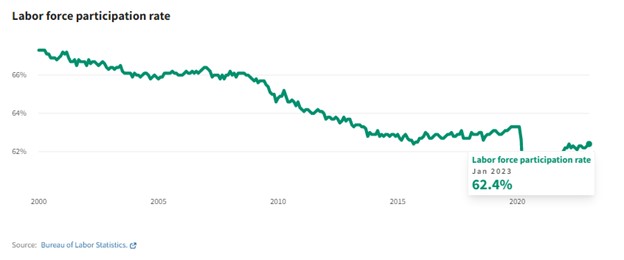
Jobs increased at a slower pace in October and November. Both the labor force participation rate and the employment-to-population ratio declined a little over the period of time between meetings. The private-sector job openings rate, as measured by the Job Openings and Labor Turnover Survey, moved back down in October but remained higher than would seem consistent with dramatically lower inflation. 

Wage growth continued higher than a pace expected to be consistent with the the two percent monetary policy target.  Average hourly earnings rose 5.1% over the 12 months ending in November. Compensation per hour (CPH) in the business sector rose 4.0 percent over the four quarters ending in the third quarter, but the reported increase likely understated the true pace of increase in CPH, as the lower second-quarter employment data from the Quarterly Census of Employment and Wages had not yet been incorporated in the CPH measure.

Foreign economic activity grew in the third quarter, but some recent data point to weakening growth, weighed down by the economic fallout of Russia’s war with Ukraine and a COVID-19-related slowdown in China. High inflation continued to contribute to a decline in real disposable incomes, which, together with disruptions to energy supplies, depressed economic activity, especially overseas. In China, authorities began to ease social restrictions even as COVID cases surged, raising the prospect of significant disruptions to economic activity in the near term but also a faster reopening. Weaker global demand and high interest rates also weighed on activity in emerging market economies. Despite tentative signs of easing in foreign headline inflation, core inflationary pressures remained elevated in many countries. In response to high inflation, many central banks further tightened monetary policy.

Implications

The December 2022 minutes confirmed that reining in inflation remains the principal concern of the Fed. No members spoke of a scenario where they may lower rates this year, there is concern that the cost of money is getting easier despite the Fed’s tightening efforts. The expected path of the federal funds rate implied by financial market quotes ended, showing the market anticipates lower rates. This is likely reflective of the larger-than-expected moderation in inflation. Medium-to-longer-term nominal Treasury yields declined substantially over the intermeeting period. This was driven primarily by lower-than-expected inflation data releases, which appeared to prompt a substantial reduction in investors’ concerns about the possibility that inflation would remain high for a long period.

What Do the Minutes Say About Stocks?

Broad stock price indexes increased. This likely reflected reduced concerns about the inflation outlook and the associated implications for the future path of policy. On balance, the one-month option-implied volatility on the S&P 500 (VIX) decreased and was around the middle of its range since mid-2020. This makes sense because of reduced investor concerns about the inflation outlook, spreads of interest rates on corporate debt, mortgage-backed securities, and municipal bonds to comparable-duration Treasury yields, which all narrowed since the last meeting.

Inflation Worries Deflated

With inflation still well above the Committee’s longer-run goal of two percent, participants agreed that inflation was unacceptably high. Participants agreed that the inflation data received for October and November showed welcome reductions in the monthly pace of price increases, but they stressed that it would take substantially more evidence of progress to be confident that inflation was on a sustained downward path.

Participants noted that core goods prices declined in the October and November CPI data, consistent with easing supply bottlenecks. Some participants also noted that, by some measures, firms’ markups were still elevated and that a continued subdued expansion in aggregate demand would likely be needed to reduce the remaining upward pressure on inflation. Regarding housing services inflation, many participants observed that measures of rent based on new leases indicated a deceleration, which would be reflected in the measures of shelter inflation with some lag. Participants noted that, in the latest inflation data, the pace of increase for prices of core services excluding shelter—which represents the largest component of core PCE price inflation—was high. They also remarked that this component of inflation has tended to be closely linked to nominal wage growth and, therefore would likely remain persistently elevated if the labor market remained very tight. Consequently, while there were few signs of adverse wage-price dynamics at present, they assessed that bringing down this component of inflation to mandate-consistent levels would require some softening in the growth of labor demand to bring the labor market back into better balance.

Rates Moving Forward

In discussing the policy outlook, participants continued to anticipate that ongoing increases in the target range for the federal funds rate is appropriate to achieve the Committee’s objectives. In determining the pace of future increases in the target range, participants judged that it would be appropriate to take into account the cumulative tightening of monetary policy, the lags with which monetary policy affects economic activity and inflation, and economic and financial developments.

With inflation staying above the Committee’s two percent goal and the labor market remaining very tight, all participants had raised their assessment of the appropriate path of the federal funds rate relative to their assessment at the time of the September meeting. No participants anticipated that it would be appropriate to begin reducing the federal funds rate target in 2023. Participants generally observed that a restrictive policy stance would need to be maintained until the incoming data provided confidence that inflation was on a sustained downward path to two percent. Which would likely take some time.

In view of the persistent and unacceptably high level of inflation, several participants commented that historical experience cautioned against prematurely loosening monetary policy.

In light of the heightened uncertainty regarding the outlooks for both inflation and real economic activity, most participants emphasized the need to retain flexibility and optionality when moving policy to a more restrictive stance. Participants generally noted that the Committee’s future decisions regarding policy would continue to be informed by the incoming data and their implications for the outlook for economic activity and inflation and that the Committee would continue to make decisions meeting by meeting.

Take Away

It’s a new year, it’s the same Fed, inflation is still quite elevated, policymakers are surprised at how quickly some inflation measures did drop, but the drop wasn’t enough for them to reverse course.

The FOMC reserves the right to be data-dependent and change its pace or direction when the data changes. Until then, they still have more rate hikes they expect to unleash early this year.

Scheduled FOMC Meetings in 2023

January/February 31-1

March 21-22

May 2-3

June 13-14

July 25-26

September 19-20

October/November 31-1

December 12-13

The Policy announcements have been at PM on the second meeting date after they have adjourned.

Paul Hoffman

Managing Editor, Channelchek
Sources

https://www.federalreserve.gov/monetarypolicy/fomcminutes20221214.htm

https://www.federalreserve.gov/faqs/minutes-federal-open-market-committee-fomc.htm