The Fed Chair’s Comments May be the Most Critical Market Event of the Week
It’s a quiet week for economic data. If the market takes a direction this week, it may have to take its lead from something other than statistics that indicate economic strength or weakness. This could be a Fed governor speaking, or a central bank outside of the US altering its hawkish stance.
Monday 2/6
With no consequential economic releases, market direction may take its tone from earnings reports from a wide swath of industries.
Tuesday 2/7
11:00 AM ET, New York Federal Reserve inflation expectations.
3:00 PM ET, Consumer Credit, or more definitively, the installment credit outstanding by consumers is expected to have increased by $25 billion in December versus November’s $27.9 billion increase. There is such a long delay reporting this number that it seldom has a market impact.
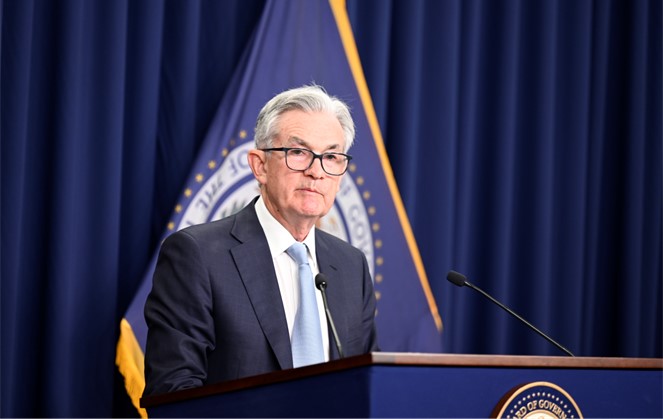
Fed Chair Jerome Powell will be speaking at the Economic Club of Washington.
Wednesday 2/8
10:00 AM ET, Wholesale Inventories revision for December is in line with the first estimate of 1%. Wholesale sales and inventory data can provide investors a chance to look below the surface of the consumer economy. Activity at the wholesale level can then be a precursor of consumer trends.
Thursday 2/9
8:30 AM ET, Jobless Claims, including Initial Claims and Continuing Claims, have been a big focus of the market as unemployment is running at a historically low pace. The consensus is for growth in Jobless levels to 190,000 versus 183,000 the prior week. Overall low claims would seem to be good news for the economy. The problem now is that it is except that it is worrisome for a Fed that views current inflationary pressures, including wage pressures unacceptably high.
Friday 2/10
• 10:00 AM ET, The University of Michigan’s Consumer Survey Center questions households each month on their assessment of current conditions and expectations of future conditions. Consumer sentiment is not expected to show much improvement, at a consensus 65.0 in the first reading for February versus 64.9 in January.
What Else
The FOMC meeting that ended on February 1 was the last before Chair Powell delivers the semiannual monetary policy testimony in late February or early March (not yet set). Any remarks by Fed officials in the February 6 week should be viewed in that context. Powell and associates will not want to confuse any upcoming message given at the semiannual Monetary Policy Report to Congress. Whatever is said is likely to foreshadow what will be in the report when he speaks before the Senate Banking Committee and the House Financial Services Committee.
Jerome Powell and FOMC Will “continue to monitor the implications of incoming information”
The Federal Open Market Committee (FOMC) voted to raise overnight interest rates from the previous target of 4.25% – 4.50% to the new target of 4.50% – 4.75%. This was announced at the conclusion of the Committee’s first scheduled meeting of 2023. The monetary policy shift in bank lending rates was as expected by economists and the markets as the overwhelming consensus was for a 25 bp move. It has been less than 12 months since the Fed began this tightening cycle, overnight rates since the beginning of last year have increased from near 0.00% to the current target of up to 4.75%.
One recent market focus has been that inflation has been, by most measures, trending lower each month. While lower increases may suggest that inflation is successfully being wrung out of the system, Powell and the other FOMC members have a 2% target for inflation which guides their policy. The current level is more than two times as high. The art of being the nation’s top bankers and economists trying to provide a soft landing for the still strong economy, is difficult. The result of the actions taken by the Fed can only be seen in the rearview mirror, months after the action.
Synopsis of Fed Decisions
The Board of Governors of the Federal Reserve System voted unanimously to approve a 1/4 percentage point increase in the primary credit rate to 4.75 percent, effective February 2, 2023. In a related decision, the Board of Governors of the Federal Reserve System voted unanimously to raise the interest rate paid on reserve balances to 4.65 percent, effective February 2, 2023.
Text from Federal Reserve’s Statement February 1, 2023
Recent indicators point to modest growth in spending and production. Job gains have been robust in recent months, and the unemployment rate has remained low. Inflation has eased somewhat but remains elevated.
Russia’s war against Ukraine is causing tremendous human and economic hardship and is contributing to elevated global uncertainty. The Committee is highly attentive to inflation risks.
The Committee seeks to achieve maximum employment and inflation at the rate of 2 percent over the longer run. In support of these goals, the Committee decided to raise the target range for the federal funds rate to 4-1/2 to 4-3/4 percent. The Committee anticipates that ongoing increases in the target range will be appropriate in order to attain a stance of monetary policy that is sufficiently restrictive to return inflation to 2 percent over time. In determining the extent of future increases in the target range, the Committee will take into account the cumulative tightening of monetary policy, the lags with which monetary policy affects economic activity and inflation, and economic and financial developments. In addition, the Committee will continue reducing its holdings of Treasury securities and agency debt and agency mortgage-backed securities, as described in its previously announced plans. The Committee is strongly committed to returning inflation to its 2 percent objective.
In assessing the appropriate stance of monetary policy, the Committee will continue to monitor the implications of incoming information for the economic outlook. The Committee would be prepared to adjust the stance of monetary policy as appropriate if risks emerge that could impede the attainment of the Committee’s goals. The Committee’s assessments will take into account a wide range of information, including readings on labor market conditions, inflation pressures and inflation expectations, and financial and international developments.
Take-Away
Higher interest rates can weigh on stocks as companies that rely on borrowing may find their cost of capital has increased. The risk of inflation also weighs on the markets. Additionally, investors find that alternative investments that pay a known yield may, at some point, be preferred to equities. For these reasons, higher interest rates are of concern to the stock market investor. However, an unhealthy, highly inflationary economy also comes at a cost to the economy, businesses, and households.
The statement suggests the Fed continues to remain data dependent, but expects further increases will follow. The statement did not provide strong guidance as to what to expect following future meetings.
Chairman Powell’s 2:30 PM ET press conference can be viewed here.
January’s Stock Market Performance Bodes Well for the Rest of 2023
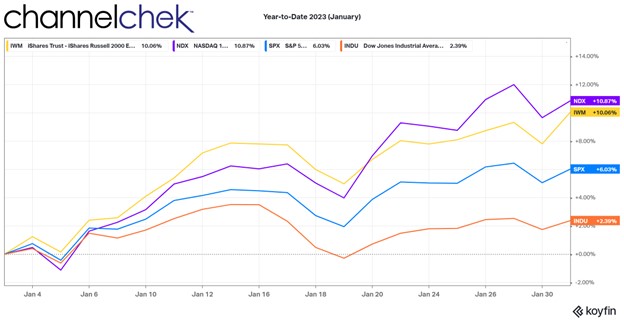
The stock market has put in a solid January in terms of overall performance. Following month after negative month last year, this is a welcome relief for those with money in the market which is beginning to look welcoming to those that have been on the sidelines. While the Fed is still looming with perhaps another 50-75 basis points in rate hikes left to implement over the coming months, the market has been resilient and has already made up for some of last year’s lost ground.
For the month (with an hour left before market close on January 31), the Nasdaq 100 is up over 10.8% for the month. Over 10% would be a good year historically, of course averaging in last year, it is still solidly underperforming market averages. The small-cap Russell 2000 index is also above 10%. Small-caps have underperformed larger cap stocks over several years and are seen to have more attractive valuations now than large caps as well as other fundamental strengths. These include a higher domestic US customer base in the face of a strong dollar, fewer borrowings that would be more costly with the increased rate environment, and an overall expectation that the major indexes will revert to their mean performance spreads which the small-cap indexes have been lagging. The S&P 500, the most quoted stock index is up over 6% in January, and the Dow 30 Industrials are up almost 2.4%.
Rate Increases
The stock and bond markets hope for a solid sign that the FOMCs rate increases will cease. The reduced fear of an ongoing tightening cycle will calm the nervousness that comes from knowing that higher rates hurt the consumer, increases unemployment, reduces spending and therefore hurts earnings which are most closely tied to stock valuations.
January Historically
January rallies, on their own, statistically have been a good omen for the 11 months ahead. When the S&P 500 posts a gain for the first month of the year, it goes on to rise another 8.6%, on average for the rest of the year according to statistics dating back to 1929. In more than 75% of these January rally years, the markets further gained during the year.
Other statistics indicate a bright year to come for the market as well. Using the S&P 500, it rallied for the final five trading days of last year and the first two of 2023, it gained for first five trading days of the new year, and rallied through January. When all three of these have occurred in the past, after a bear market (20%+ decline), the index’s average gain for the rest of the year is 13.9%. In fact it posted positive returns in almost all of the 17 post-bear market years that were ushered in with similar gains.
Follow Through
Beyond history, there is a reason for the follow-through years. January rallies are signs of confidence, they indicate that self-directed investors and professional money managers are buying stocks at the lower prices. It suggests they have a strong enough belief that conditions that caused the bear market have or will soon reverse.
And this is quite possibly where the markets are at today. The lower valuations seem attractive, this is especially true of the overly beaten down Nasdaq 100 stocks and the small-caps that had been trailing in returns since before the pandemic.
Federal Reserve Chair Powell is looking to make money more expensive in order to slow an economy that is still exhibiting inflationary pressures. He is not, however, looking to crush the stock market. Fed governors seem to be concerned that the bond market prices haven’t declined to match their tightening efforts, but a healthy stock market helps the Fed by giving it latitude to act. Powell will take the podium post FOMC meetings eight times this year.
Each time his intention will be to usher in a long term healthy economy, with reasonable growth, low inflation, and jobs levels that are in line with consumer confidence.
US Debt Default Could Trigger Dollar’s Collapse – and Severely Erode America’s Political and Economic Might
Republicans, who regained control of the House of Representatives in November 2022, are threatening to not allow an increase in the debt limit unless spending cuts are agreed to. In so doing, there is a risk of the U.S. government could move into default.
Brinkmanship over the debt ceiling has become a regular ritual – it happened under the Clinton administration in 1995, then again with Barack Obama as president in 2011, and more recently in 2021.
This article was republished with permission from The Conversation, a news site dedicated to sharing ideas from academic experts. It represents the research-based findings and thoughts of, Michael Humphries, Deputy Chair of Business Administration, Touro University
As an economist, I know that defaulting on the national debt would have real-life consequences. Even the threat of pushing the U.S. into default has an economic impact. In August 2021, the mere prospect of a potential default led to an unprecedented downgrade of the the nation’s credit rating, hurting America’s financial prestige as well as countless individuals, including retirees.
And that was caused by the mere specter of default. An actual default would be far more damaging.
Dollar’s Collapse
Possibly the most serious consequence would be the collapse of the U.S. dollar and its replacement as global trade’s “unit of account.” That essentially means that it is widely used in global finance and trade.
Day to day, most Americans are likely unaware of the economic and political power that goes with being the world’s unit of account. Currently, more than half of world trade – from oil and gold to cars and smartphones – is in U.S. dollars, with the euro accounting for around 30% and all other currencies making up the balance.
As a result of this dominance, the U.S. is the only country on the planet that can pay its foreign debt in its own currency. This gives both the U.S. government and American companies tremendous leeway in international trade and finance.
No matter how much debt the U.S. government owes foreign investors, it can simply print the money needed to pay them back – although for economic reasons, it may not be wise to do so. Other countries must buy either the dollar or the euro to pay their foreign debt. And the only way for them to do so is to either to export more than they import or borrow more dollars or euros on the international market.
The U.S. is free from such constraints and can run up large trade deficits – that is, import more than it exports – for decades without the same consequences.
For American companies, the dominance of the dollar means they’re not as subject to the exchange rate risk as are their foreign competitors. Exchange rate risk refers to how changes in the relative value of currencies may affect a company’s profitability.
Since international trade is generally denominated in dollars, U.S. businesses can buy and sell in their own currency, something their foreign competitors cannot do as easily. As simple as this sounds, it gives American companies a tremendous competitive advantage.
If Republicans push the U.S. into default, the dollar would likely lose its position as the international unit of account, forcing the government and companies to pay their international bills in another currency.
Loss of Political Power Too
Since most foreign trade is denominated in the dollar, trade must go through an American bank at some point. This is one important way dollar dominance gives the U.S. tremendous political power, especially to punish economic rivals and unfriendly governments.
For example, when former President Donald Trump imposed economic sanctions on Iran, he denied the country access to American banks and to the dollar. He also imposed secondary sanctions, which means that non-American companies trading with Iran were also sanctioned. Given a choice of access to the dollar or trading with Iran, most of the world economies chose access to the dollar and complied with the sanctions. As a result, Iran entered a deep recession, and its currency plummeted about 30%.
President Joe Biden did something similar against Russia in response to its invasion of Ukraine. Limiting Russia’s access to the dollar has helped push the country into a recession that’s bordering on a depression.
No other country today could unilaterally impose this level of economic pain on another country. And all an American president currently needs is a pen.
Rivals Rewarded
Another consequence of the dollar’s collapse would be enhancing the position of the U.S.‘s top rival for global influence: China.
While the euro would likely replace the dollar as the world’s primary unit of account, the Chinese yuan would move into second place.
If the yuan were to become a significant international unit of account, this would enhance China’s international position both economically and politically. As it is, China has been working with the other BRIC countries – Brazil, Russia and India – to accept the yuan as a unit of account. With the other three already resentful of U.S. economic and political dominance, a U.S. default would support that effort.
They may not be alone: Recently, Saudi Arabia suggested it was open to trading some of its oil in currencies other than the dollar – something that would change long-standing policy.
Severe Consequences
Beyond the impact on the dollar and the economic and political clout of the U.S., a default would be profoundly felt in many other ways and by countless people.
In the U.S., tens of millions of Americans and thousands of companies that depend on government support could suffer, and the economy would most likely sink into recession – or worse, given the U.S. is already expected to soon suffer a downturn. In addition, retirees could see the worth of their pensions dwindle.
The truth is, we really don’t know what will happen or how bad it will get. The scale of the damage caused by a U.S. default is hard to calculate in advance because it has never happened before.
But there’s one thing we can be certain of. If there is a default, the U.S. and Americans will suffer tremendously.
According to popular thinking, the government’s definition of money is of a flexible nature. Sometimes it could be M1, and at other times it could be M2 or some other M money supply. M1 includes currency and demand deposits. M2 includes all of M1, plus savings deposits, time deposits, and money market funds. By popular thinking what determines whether M1, M2, or some other M is considered money is whether it has high correlation with key economic data such as the gross domestic product (GDP).
However, since the early 1980s, correlations between various definitions of money and the GDP have broken down. The reason for this breakdown, many economists believe, is that financial deregulation has made the demand for money unstable. Consequently, the usefulness of money as a predictor of economic activity has significantly diminished.
Some economists believe that the relationship between money supply and the GDP could be strengthened by assigning weights to money supply components. The Divisia indicator, named after the French economist François Divisia, adjusts for differences in the degree to which various components of the monetary aggregate serve as money. This, in turn, supposedly offers a more accurate picture of what is happening to money supply.
The primary Divisia monetary indicator for the US is M4. It is a broad aggregate that includes negotiable money market securities, such as commercial paper, negotiable CDs, and T-bills. By assigning suitable weights, which are estimated by means of quantitative methods, it is held that one is likely to improve the correlation between the weighted monetary gauge and economic indicators.
Consequently, one could employ this monetary measure to ascertain the future course of key economic indicators. However, does it make sense?
Defining Money
No definition of money can be established by means of a correlation. A definition is supposed to present the essence of the subject being identified.
To establish the definition of money, we must determine how a money-using economy came about. Money emerged because barter could not support the market economy. A butcher who wanted to exchange his meat for fruit would have difficulty finding a fruit farmer who wanted his meat, while the fruit farmer who wanted to exchange his fruit for shoes might not have been able to find a shoemaker who wanted his fruit.
The distinguishing characteristic of money is that it is the general medium of exchange. It has evolved from the most marketable commodity. According to Murray Rothbard:
Just as in nature there is a great variety of skills and resources, so there is a variety in the marketability of goods. Some goods are more widely demanded than others, some are more divisible into smaller units without loss of value, some more durable over long periods of time, some more transportable over large distances. All of these advantages make for greater marketability. Eventually, one or two commodities are used as general media—in almost all exchanges—and these are called money.
With money, the butcher can exchange his meat for money and then exchange money for fruits. Likewise, the fruit farmer could exchange his fruit for money. With the obtained money, the fruit farmer can now exchange it for shoes. The reason why all these transactions become possible is because money is the most marketable commodity (i.e., the most accepted commodity).
According to Rothbard:
Money is not an abstract unit of account, divorceable from a concrete good; it is not a useless token only good for exchanging; it is not a “claim on society”; it is not a guarantee of a fixed price level. It is simply a commodity.
It follows then that all other goods and services are traded for money. This fundamental characteristic of money is contrasted with other goods. For instance, food supplies the necessary energy to human beings. Capital goods permit the expansion of the infrastructure that, in turn, permits the production of a larger quantity of goods and services. Contrary to the mainstream thinking, the essence of money has nothing to do with financial deregulation as this essence will remain intact in the most deregulated of markets.
Some commentators maintain that money’s main function is to fulfill the role of a means of savings. Others argue that its main role is to be a unit of account and a store of value. While all these roles are important, they are not fundamental. The basic role of money is to be a medium of exchange, with other functions such as unit of account, a store of value, and a means of savings arising from that role.
Through an ongoing selection process over thousands of years, individuals have settled on gold as money. In today’s monetary system, the money supply is no longer gold, but metal coins and paper notes issued by the government and the central bank. Consequently, coins and notes constitute money, known as cash, that is employed in transactions.
Distinction between Claim and Credit Transactions
At any point in time, an individual can keep money in a wallet or somewhere at home or deposit the money with a bank. In depositing money, an individual never relinquishes ownership over the money having an absolute claim over it.
This contrasts with a credit transaction, in which the lender of money relinquishes a claim over one’s money for the duration of the loan. As a result, in a credit transaction, money is transferred from a lender to a borrower. Credit transactions do not alter the amount of money. If Bob lends $1,000 to Joe, the money is transferred from Bob’s demand deposit or from Bob’s wallet to Joe’s possession.
Why Are Various Popular Definitions of Money Misleading?
Consider the money M2 definition, which includes money market securities, mutual funds, and other time deposits. However, investing in a mutual fund is, in fact, an investment in various money market instruments. The quantity of money is not altered because of this investment; only the ownership of money has temporarily changed. Hence, including mutual funds as part of money results in double counting.
The Divisia monetary gauge is of little help in establishing what money is. Because this indicator was designed to strengthen the correlation between monetary aggregates such as M4 and other Ms with an economic activity indicator, the Divisia gauge can better be seen as an exercise in curve fitting.
The Divisia of various Ms, such as the Divisia M4, does not address the double counting of money. The M4 is a broad aggregate and includes a mixture of claim and credit transactions (i.e., a double counting of money). This generates a misleading picture of what money is.
Applying various weights to the components of money cannot make the definition of money valid if it is created from erroneous components. Furthermore, even if the components were valid, one does not improve the money definition by assigning weights to components.
The introduction of electronic money has supposedly introduced another confusion regarding the definition of money. It is believed that electronic money is likely to make the cash redundant. We hold that electronic money is not new money, but rather a new way of employing existing monetary transactions. Regardless of these new ways of employing money, definitions and the role of money do not change.
Conclusion
The attempt to strengthen the correlation between various monetary aggregates and economic activity by using variable weighting of money supply components defeats the definition of money. The essence of money cannot be established by means of a statistical correlation, but rather by understanding what money is about.
About the Author
Frank Shostak is an Associated Scholar of the Mises Institute. His consulting firm, Applied Austrian School Economics, provides in-depth assessments and reports of financial markets and global economies. He received his bachelor’s degree from Hebrew University, his master’s degree from Witwatersrand University, and his PhD from Rands Afrikaanse University.
Image: President Biden reads newspaper before a phone call with Kevin McCarthy, Aug. 23, 2021 (The White House)
Could the Debt Ceiling Challenges be Ironed Out Before the Eleventh Hour?
The market-moving potential of key meetings in Washington on Wednesday, February 1st, includes more than the FOMC decision on monetary policy. Up the road from the Federal Reserve building, also scheduled for the first of the month, will be another important meeting for the markets. House of Representatives Speaker Kevin McCarthy will be headed to the Oval Office for a discussion to resolve other risks to the US economy, risks that could quickly spin out of control. High on the list is the national debt limit. Without a plan, the inability for the government to borrow above the current debt ceiling, could impact trust in the credit rating of US debt. This would move bond prices lower as rates would naturally rise at even the smallest prospect of a US default.
Why It’s Critical to Markets
A debt limit increase would allow the government to finance existing obligations. These obligations have, as in the past, expanded beyond the borrowing cap imposed on the US Treasury. An inability to roll existing maturing debt or afford additional interest rate costs would cause a default. The reverberations of this can not be understated as US Treasuries, like US currency, is the backbone of the worlds financial system.
An actual default could precipitate a mega financial crisis, threatening jobs, asset values, and trust.
The US reached its technical borrowing limit of $31.4 trillion in January. US Treasury Secretary Yellen enacted planned accounting moves that will allow the federal government to pay its bills until sometime in June by postponing some obligations. Before then, a solution must be devised by lawmakers that would then be signed by the President in order for the government to take on new debt and fund its responsibilities.
The Meeting Agenda
President Biden and House of Representatives Speaker Kevin McCarthy will meet at the White House to find common negotiating ground to avert a default. They currently seem far apart on a potential solution as the President’s party wishes to raise the debt ceiling quickly and resume business as usual in DC, while many in the House Speaker’s party are looking for concessions and spending cuts before they agree to raise the borrowing limit.
Republican lawmakers don’t currently support a measure that would let the country pay its debts unless there is agreement on various spending cuts going forward. The White House, which must sign or veto anything passed in Congress, has said raising the debt limit is critical and non-negotiable, citing the risk to the US economy from a default.
Both Biden and McCarthy will want to come away from this meeting with something their constituents and the onlooking financial markets can be comfortable with, and at the same time provides assurance to the world that is also looking on.
Congress has always passed an increase in the debt limit. Since 1960, Congress has acted 78 separate times to permanently raise, temporarily extend, or change the definition of the debt limit. Congressional leaders in both parties have believed in the end that it is best. However, the negotiations tend to go to the eleventh hour with escalating showmanship on all sides.
The eleventh hour comes sometime in June. Skeptics of any success of this face-to-face talk have a long history on which to hang their skepticism. However, McCarthy being new to his role and Biden having an aggressive spending agenda may help to shape a quicker outcome than in the past.
On Sunday, January 9th, McCarthy said that Republicans would not allow a US default that cuts into Social Security and Medicare, this would be “off the table” in any debt ceiling negotiations.
“The President will ask Speaker McCarthy if he intends to meet his Constitutional obligation to prevent a national default, as every other House and Senate leader in US history has done,” a White House spokesperson said.
The statements following, both by the White House and the Speakers camp, may cause a sigh of relief or elevate the level of panic.
Politics Involved
House Speaker McCarthy, in order to be elected speaker, agreed to rules that made it easier for his party to oust him over policy disagreements. He said he’d focus on discretionary spending, which has increased dramatically in the past two years with infrastructure and semiconductor legislation and a green-energy bill supported by Democrats.
“I think everything, when you look at discretionary, is sitting there,” McCarthy said. “We shouldn’t just print more money, we should balance our budget. So I want to look at every single department. Where can we become more efficient, more effective and more accountable?”
Biden, who is contemplating seeking re-election in 2024, has been sharply critical of McCarthy’s Republican caucus. He characterized them as “fiscally demented” earlier this month, threatened to veto their legislation and accused them of trying to balloon the deficit, favoring billionaires, raising middle-class taxes and threatening benefit programs.
Take Away
In the past, debt ceiling news typically made the top headline when the negotiations are truly in the eleventh hour. The meeting on Wednesday between two politicians that have a lot to gain from a successful outcome may avert a late Spring crisis and provide calm in what is already a cloudy economic environment. An agreement would be positive for the markets – lack of agreement will likely be taken as business as usual.
The Fed May Try to Talk Rates Up While Increasing Overnight Levels by a Lower Amount
There will be plenty for the market to digest this week. While all ears will be on what Fed Chairman Powell says following Wednesday’s FOMC policy announcement, investors will get to also digest a barage of earnings reports. The quarterly reports, from various sectors, may set the tone for their industries. These include reporting on Monday by Advanced Micro (AMD), Amgen (AMGN), Caterpillar (CAT), Exxon Mobil (XOM), McDonald’s (MCD), Pfizer (PFE), and United Parcel (UPS). On Tuesday Meta Platforms (META) will be one of the most talked about, then on Wednesday the market gets a barrage from tech and pharmaceutical companies as Alphabet (GOOGL), Amazon.com (AMZN), Apple (AAPL), Bristol-Myers (BMY), Eli Lilly (LLY), Honeywell (HON), Merck (MRK), and Qualcomm (QCOM) are all scheduled to report operating performance.
Monday 1/30
With no consequential economic releases, market direction may take its tone from earnings reports from a wide swath of industries (see tickers above).
Tuesday 1/31
The first of 2023’s eight scheduled two-day FOMC meetings begins.
8:30 AM ET, Employment Cost Index is expected to have risen 1.1% for the fourth quarter. For the last five quarters, large gains of 1 percent and more have been keeping wage inflation a concern.
8:30 AM ET, After jumping 7 points in December, the consumer confidence index is expected to firm only 0.7 of a point to 109.0 in January. The pattern in consumer attitudes and spending is often the largest influence on stock and bond markets. For stocks, strong economic growth translates to healthy corporate profits and possibly higher stock prices as a result.
Wednesday 2/1
7:00 AM ET, the Mortgage Bankers’ Association (MBA) compiles various mortgage loan indexes. The purchase applications index measures applications at mortgage lenders. This is a leading indicator for single-family home sales and housing construction. The composite index is expected to come in at 27.9%, while the Purchase applications are expected to show a reading of 24.7%. The data provides a gauge of not only the demand for housing, but economic momentum.
9:45 AM ET, Construction Spending, for December is expected to slip 0.1 percent after moving 0.2 percent higher in November. Spending has been flat in recent months as gains in non-residential construction have been offset by declines on the residential side.
10:00 AM ET, Job Openings and Labor Turnover Survey (JOLTS), which have been steady to lower, are expected to fall to 10.2 million in December versus 10.458 million in November.
2:00 PM ET, FOMC meeting concludes with statement of policy shift. The Fed is expected to reduce its rate hike magnitude to 25 basis points. A 0.25% increase would raise the overnight Fed Funds rate range up to 4.50% – 4.75%.
2:30 PM ET, Fed Chair Powell’s press briefing. The purpose of the briefing is to provide additional context to the FOMC’s policy decisions and to allow for questions-and-answers with the press. There has been concern that the market has been pushing rates down out in terms beyond two years to maturity. This could be a undermining the Fed’s stated objective by tightening. If this is true, the briefing may be filled with language that tries to convince the bond markets, that the Fed is determined to slow the economy by pushing rates up.
Thursday 2/2
7:30 AM ET, the Challenger Job Cut report counts and categorizes announcements of corporate layoffs based on mass layoff data from state departments of labor. The job-cut report doesn’t distinguish between layoffs scheduled for the short-term or the long term, or whether job cuts are handled through attrition or actual dismissals. Also, the job-cut report does not include jobs eliminated in small batches over a longer time period. Unlike most economic data, this series is not adjusted for seasonal variation.
8:30 AM ET, Nonfarm Productivity is expected to rise to a 2.4 percent annualized rate in the fourth quarter versus growth of 0.8 percent in the third quarter. Unit labor costs, which rose 2.4 percent in the third quarter, are expected to rise to a 1.5 percent rate in the fourth quarter.
10:00 AM ET, Factory Orders are expected to rise 2.2 percent in December following November’s steep 1.8 percent drop. The expected increase comes in the wake of a surge in aircraft orders.
Friday 2/3
• 8:30 AM ET, Nonfarm Payroll is expected to have grown 185,000 in January versus 223,000 in December which was the eighth straight month and tenth of the last eleven that payroll growth exceeded the average economists expectation. Average hourly earnings in January are expected to rise 0.3 percent on the month for a year-over-year rate of 4.4 percent.
What Else
The tone of the chatter that is expected to come from Fed officials is one of continued hawkishness. The Fed’s preferred inflation measure (PCE) was at 4.4% for all of 2022, and has been trending downward. This is more than double the stated target of 2%. The question they are now facing is, whether they should soon pause tightening and observe the impact of previous moves. Or if the solid employment numbers and strong bank reserve positions leave room for continuing the war on inflation through aggressive overnight rate hikes. Powell’s press conference after the 2 pm announcement on Wednesday should reveal quite a bit.
The Increasing Popularity of the PCE Inflation Gauge
US inflation, by a number of official measures, reached its highest level in 40 years last year. For a large percentage of investors and shoppers, this is their first experience of prices quickly rising. For decades, on many tech products, prices declined over time (while adding functionality). There are a number of different measures of inflation reported regularly – they impact us in different ways. Knowing the difference, whether you’re investing, planning a purchase, or expecting a cost of living (COLA) increase, is helpful. Below we go through the different measures so you understand the impact of say “headline CPI” versus “core PCE.”
According to James Bullard, the president and CEO of the Federal Reserve Bank of St. Louis, “measuring inflation is one of the most difficult issues studied by economists.”
By definition, inflation is the percentage change in overall prices in the economy over a specified period, commonly quoted as a year-over-year change. It’s much more than an increase in the prices of a few products. Given the inherent difficulties in following every price in the country, economists have created price indexes to approximate the overall price level.
PCE Inflation
Before the year 2000, the Federal Open Market Committee (FOMC) primarily focused on the Consumer Price Index (CPI) as its inflation gauge. We’ll explain CPI next, but for the Fed, when it now says it has a 2% inflation target, PCE is the data used.
Though the two indexes have a lot of overlap, there are reasons why the PCE is considered a better tool by policymakers.
The PCE price index, which rose 5.5% in November 2022 from a year earlier, is derived from a broader index of prices than the CPI’s more narrow set of goods and services. The argument as to why policymakers gave an edge in the late 1990s to make the change in 2000 is that a more comprehensive index (such as PCE) of prices provides a better way to gauge underlying inflationary pressures. Since the PCE includes more goods and services, the index’s weights for particular items will differ dramatically from those in the CPI. For example, housing has a weight of about 16% in the PCE price index versus 33% in the CPI. The varied items more accurately reflect actual costs to consumers since they may substitute one for another as prices of items change at different rates. This ability to substitute is a primary reason why PCE tends to print lower than headline CPI.
CPI Remains Important
The most widely cited measure of inflation is the headline Consumer Price Index (CPI), which is calculated by the Bureau of Labor Statistics (BLS). This index was created in 1919 as officials devised a way to measure rising consumer prices just after World War I.
The CPI, which rose 6.5% for all of 2022, measures the price changes for a basket of goods and services purchased by the typical urban consumer. The items in this basket are weighted by their relative importance in consumer expenditures. For example, housing—rent and other spending on shelter—accounts for 33% of the index, while medical care accounts for nearly 9%.
This index, like others, takes into account changing consumption. New items come in and old items leave. The example I like to use is that prohibition began in January 1920, just after CPI came into use. Alcohol was not part of the index back then, whereas it is today (5.78% increase in 2022), product adoption changes.
The CPI weights had been adjusted every two years using two years of consumer spending data. Starting in 2023, the BLS will update weights annually using one year of data.
Headline PCE Inflation versus Headline CPI Inflation
The increasing popularity of the PCE is because the index’s weights are updated monthly, versus annually for CPI (prior to 2023 updates were every two years). Thus, the PCE can quickly reflect the impact of new technology or an abrupt change in consumer spending patterns. For example, the onset of the coronavirus pandemic quickly shifted consumption from services like restaurants to services like communication technology. Since the headline PCE uses more timely, actual outlays, it provides the FOMC a more accurate consumer experience in terms of inflation.
The stated target by the FOMC is 2%, a level that policymakers judge to be consistent with achieving price stability and maximum employment. On average, inflation was hovering below this target before the pandemic’s economic ramifications (from 1995 through 2019 PCE average equaled 1.8%).
Other Inflation Measures
While the FOMC targets headline PCE inflation, policymakers also watch other measures to gauge inflationary pressures. The headline PCE measure can be quite volatile due to the effects of extreme price movements for certain products. To get a sense of where underlying inflation really is, economists often look at some summary measure of inflation that doesn’t include these volatile prices.
A so-called “core” index—whether it be PCE or CPI—excludes food and energy components. That has some simplicity around it, but it’s not satisfactory. There are better ways to analyze underlying inflation than to throw out certain goods and services, especially those that hit low- to moderate-income consumers the hardest when prices rise. And even if you exclude food and energy prices, the remaining part of the index is still affected by their volatility; restaurant prices would be a classic example.
More recently, other statistical ideas have been developed. One method looks at price change distribution for the entire range of goods and services.3
One commonly used measure of this type is the Dallas Fed trimmed-mean PCE inflation rate, which removes the upper tail (the largest price changes) and the lower tail (the smallest price changes) and then takes a weighted average of the price changes for the remaining components. This measure has been popular as a tool for examining trends and overall inflation as opposed to special factors that might be driving inflation. Of course, these types of measures4 tend to be more persistent and move more slowly than headline inflation measures.
Take Away
While market concerns over inflation for many years were low and most may have been more concerned about deflation, the current tight supply of goods and labor, coupled with the easiness of money, has ushered in a period where markets are likely to feel the impact of each inflation post.
Understanding the most watched inflation gauges will help sort out whether a trend or single post is likely to cause a change in course on interest rates. Or is it more likely a blip that will on average work its way out? The Fed is currently targeting a PCE inflation rate of 2%. The current pace is more than double this, but trending down after the Fed tightened in 2022 at a record pace. The Fed and the markets are now awaiting the impact of those cuts as there is a lag in applying the economic brakes (to lessen inflation) and when the economy has its biggest reaction to the Fed’s heavy pressure on the brake pedal.
With a Light Week Ahead for Economic Reports, Investors Eye Big-Tech Earnings
In contrast to recent weeks, which began quietly as investors waited on late-week releases (i.e.: inflation, Beige Book, Fed announcements, etc.) before getting involved, this week is relatively quiet for economic reports. With less to be concerned about undermining any new positions, early week activity, without a holiday, may help increase volume. The scarcity of economic numbers could also cause more attention to be paid to earnings reports. This coming week we’ll receive a slew of big tech companies reporting. Disappointment may cause tech, which is showing signs of life early in 2023, to fall behind again. Whereas surprises on the upside could help unwind some of last year’s dismal big tech performance. Small Cap stocks, for their part, are keeping pace with the Nasdaq 100 mega stocks.
Earnings of both small-caps and mega-caps this week may produce a clear front-running segment based on capitalization.
There’s a Fed meeting next week. While the consensus seems to be for a 25 bp hike, Fed governors have been clear in recent addresses that the tightening cycle is not over. The PCE number late this week is considered the Fed’s favorite inflation gauge. There are no scheduled addresses by Fed regional presidents leading up to the two-day meeting that concludes on February 1.
Monday 1/23
8:30 AM ET The index of leading economic indicators, which has been in steep decline (dropped a full 1.0 percent in November), is expected to have fallen a further 0.7 percent in December. The index of leading economic indicators is a composite of 10 forward-looking components, including building permits, new factory orders, stock market performance, and unemployment claims. As such, estimates pre-report tend to be very close to the actual number. The report attempts to predict general economic conditions six months out.
Tuesday 1/24
9:45 AM ET, The Purchasing Managers Index (PMI) has been drifting down further into contraction – no relief is expected for January. Manufacturing is seen at 46.5 with services at 45.5.
Wednesday 1/25
7:00 AM ET, the Mortgage Bankers’ Association (MBA) compiles various mortgage loan indexes. The purchase applications index measures applications at mortgage lenders. This is a leading indicator for single-family home sales and housing construction. The composite index is expected to come in at 27.9%, while the Purchase applications are expected to show a reading of 24.7%. The data provides a gauge of not only the demand for housing but economic momentum.
Thursday 1/26
8:30 AM ET, Forecasters see Durable Goods Orders rebounding 2.8 percent in December, which would more than reverse November’s steep 2.1 percent decline. Yet the gain is seen concentrated in aircraft as both ex-transportation and core capital goods orders are seen falling 0.2 percent.
8:30 AM ET, Gross Domestic Product, or GDP for the fourth quarter is expected to have slowed to a 2.7% annualized growth versus third-quarter growth of 3.2%. Positive growth would indicate that the economy is not in a recession.
8:30 AM ET, Jobless Claims are a weekly report. For the January 21 week, it is expected to come in at 202,000 versus a very low 190,000 in the prior week. The Fed focuses on jobs; the very strong numbers (low) suggest the Fed has room to tighten without being overly disruptive to job creation. Also, a tight labor market can be viewed as inflationary.
10:00 AM ET, New Home Sales in December are expected to revert to the downward trend at a 614,000 annualized rate versus November’s 640,000. Higher home sales reverberate throughout the economy in terms of spending and growth.
Friday 1/27
• 8:30 AM ET, Personal Income is expected to have increased a monthly 0.2 percent higher in December, with consumption expenditures expected to have decreased 0.1 percent. These would compare with respective November gains of 0.4 and 0.1 percent.
The PCE inflation readings for December, which are part of the PI numbers, are expected to show no change overall and up 0.3 percent for the core (versus respective gains of 0.1 and 0.2 percent) for annual rates of 5.0 and 4.4 percent (versus November’s 5.5 and 4.7 percent).
What Else
The Federal Reserve is very likely through most of its overnight Fed Funds tightening cycle. Japan, which had gone through decades of having a deflation problem, is now experiencing the highest inflation in 41 years. The Bank of Japan has not adopted the aggressively hawkish monetary policy that the US has. The US central bank, chaired by Jerome Powell, must be looking on and holding his stated opinion that he’d rather do too much tightening than too little.
The so-called Beige Book is receiving much more attention from market participants than it has in years as they seek insight into the near- and long-term economic direction. The report is published eight times yearly and released about two weeks before the FOMC scheduled meetings. It contains anecdotal trends and moods from each of the 12 Federal Reserve districts. The information is collected and summarized and is relied on as part of the discussion topics at the Fed policy meetings.
The report released on January 18th was collected on or before January 9th. While each Federal Reserve district may have different economic experiences, for example, manufacturing regions may have a very different perspective than agricultural areas or districts where service jobs are more prevalent.
30,000 Foot View
The first Beige Book of 2023 shows the US economy is holding steady. However, there are only small amounts of growth experienced in some regions, while others expect small pockets of expansion. This overall summary would be difficult to use as an argument for the Fed to alter course from its stated intention of additional tightening, including Fed Funds rate hikes. The next meeting will be held on January 31st and February 1st.
“On balance, contacts across districts said they expected future price growth to moderate further in the year ahead,” the survey said.
The report doesn’t contain many surprises and confirms current expectations that residential real estate activity is sluggish, the labor market is strong, and that inflation is running at a slower pace of growth.
There is very little in January’s Beige Book that would alter analysts’ expectations of what the next monetary policy adjustment might be. Those that are expecting a 0.50% increase are not likely to shift their thinking from the summaries, and those expecting a 0.25% hike are similarly not inclined to shift their thinking. Most analysts fall into one of these two categories.
A Sign the Markets Wanted
In a recent interview, Cleveland Fed President Loretta Mester said the slowdown in inflation shows the Fed’s work raising rates is having the desired effect; she also suggested that further increases are still needed. “We’re beginning to see the kind of actions that we need to see,” Mester stated; these are “good signs that things are moving in the right direction. That’s important input into how we’re thinking about where policy needs to go.” This is heartening for those hoping for fewer rate hikes as Mester is considered one of the US central bank’s more hawkish members.
Take Away
The markets got a mixed bag with no clear change of direction from the summary of Federal reserve districts, otherwise known as the Beige Book. This could mean there will be few surprises at the close of the FOMC meeting on February 1st.
At least one Fed hawk is softening her rhetoric going into the meeting. If the trend continues, the prospect of fewer rate hikes should be viewed as positive for stocks and positive for bonds.
Why America Has a Debt Ceiling: Five Questions Answered
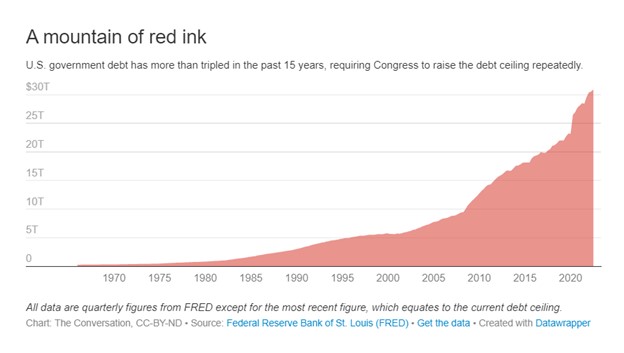
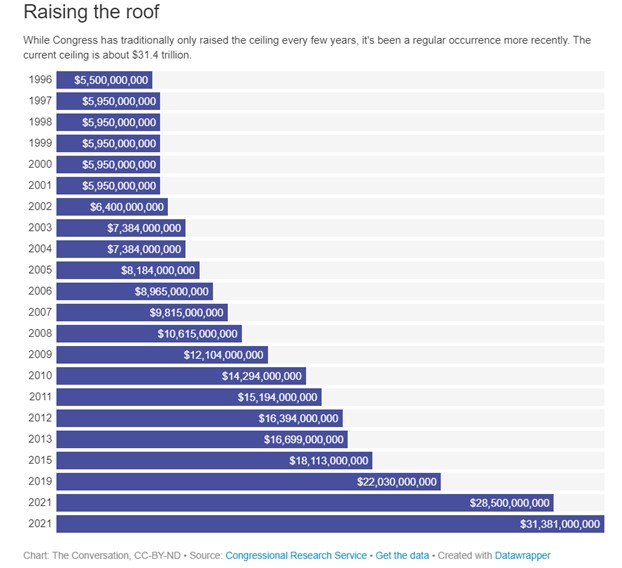
The Treasury Department on Jan. 13, 2023, said it expects the U.S. to hit the current debt limit of $31.38 trillion on Jan. 19. After that, the government would take “extraordinary measures” – which could extend the deadline until May or June – to avoid default. A default, even a risk of default would drive bond prices (interest rates) much higher than they currently are.
Is the debt ceiling still a good idea?
Economist Steve Pressman is a professor at The New School in Manhattan, below he explains the debt ceiling is and why we have it – and then shares his opinion on its usefulness.
What is the Debt Ceiling?
Like the rest of us, governments must borrow when they spend more money than they receive. They do so by issuing bonds, which are IOUs that promise to repay the money in the future and make regular interest payments. Government debt is the total sum of all this borrowed money.
The debt ceiling, which Congress established a century ago, is the maximum amount the government can borrow. It’s a limit on the national debt.
What’s the National Debt?
On Jan. 10, 2023, U.S. government debt was $30.92 trillion, about 22% more than the value of all goods and services that will be produced in the U.S. economy this year.
Around one-quarter of this money the government actually owes itself. The Social Security Administration has accumulated a surplus and invests the extra money, currently $2.8 trillion, in government bonds. And the Federal Reserve holds $5.5 trillion in U.S. Treasurys.
The rest is public debt. As of October 2022, foreign countries, companies and individuals owned $7.2 trillion of U.S. government debt. Japan and China are the largest holders, with around $1 trillion each. The rest is owed to U.S. citizens and businesses, as well as state and local governments.
Before 1917, Congress would authorize the government to borrow a fixed sum of money for a specified term. When loans were repaid, the government could not borrow again without asking Congress for approval.
The Second Liberty Bond Act of 1917, which created the debt ceiling, changed this. It allowed a continual rollover of debt without congressional approval.
Congress enacted this measure to let then-President Woodrow Wilson spend the money he deemed necessary to fight World War I without waiting for often-absent lawmakers to act. Congress, however, did not want to write the president a blank check, so it limited borrowing to $11.5 billion and required legislation for any increase.
The debt ceiling has been increased dozens of times since then and suspended on several occasions. The last change occurred in December 2021, when it was raised to $31.38 trillion.
Currently, the U.S. Treasury has under $400 billion cash on hand, and the U.S. government expects to borrow around $100 billion each month this year.
When the U.S. nears its debt limit, the Treasury secretary – currently Janet Yellen – can use “extraordinary measures” to conserve cash, which she indicated would begin on Jan. 19. One such measure is temporarily not funding retirement programs for government employees. The expectation will be that once the ceiling is raised, the government would make up the difference. But this will buy only a small amount of time.
If the debt ceiling isn’t raised before the Treasury Department exhausts its options, decisions will have to be made about who gets paid with daily tax revenues. Further borrowing will not be possible. Government employees or contractors may not be paid in full. Loans to small businesses or college students may stop.
When the government can’t pay all its bills, it is technically in default. Policymakers, economists and Wall Street are concerned about a calamitous financial and economic crisis. Many fear that a government default would have dire economic consequences – soaring interest rates, financial markets in panic and maybe an economic depression.
Under normal circumstances, once markets start panicking, Congress and the president usually act. This is what happened in 2013 when Republicans sought to use the debt ceiling to defund the Affordable Care Act.
But we no longer live in normal political times. The major political parties are more polarized than ever, and the concessions McCarthy gave Republicans may make it impossible to get a deal on the debt ceiling.
Is There a Better Way?
One possible solution is a legal loophole allowing the U.S. Treasury to mint platinum coins of any denomination. If the U.S. Treasury were to mint a $1 trillion coin and deposit it into its bank account at the Federal Reserve, the money could be used to pay for government programs or repay government bondholders. This could even be justified by appealing to Section 4 of the 14th Amendment to the U.S. Constitution: “The validity of the public debt of the United States … shall not be questioned.”
Few countries even have a debt ceiling. Other governments operate effectively without it. America could too. A debt ceiling is dysfunctional and periodically puts the U.S. economy in jeopardy because of political grandstanding.
The best solution would be to scrap the debt ceiling altogether. Congress already approved the spending and the tax laws that require more debt. Why should it also have to approve the additional borrowing?
It should be remembered that the original debt ceiling was put in place because Congress couldn’t meet quickly and approve needed spending to fight a war. In 1917 cross-country travel was by rail, requiring days to get to Washington. This made some sense then. Today, when Congress can vote online from home, this is no longer the case.
Can the S&P Hold Above 4,000? Will Fed Presidents Change Market Expectations?
The S&P 500 closed on the cusp of 4,000 last week; while this is still nearly 800 points from an all-time-high if it should break through and hold, it could have positive psychological value for equity markets.
Two reports this week that have the potential to drive direction are both released on Wednesday. They are the December numbers on retail sales and the Fed’s Beige Book. Earnings season is also in full swing beginning this week. The reporting results of companies such as Netflix on Thursday may have an impact and set the stage for specific sectors and markets.
The Beige Book will provide a sense of economic conditions across the 12 Federal Reserve Districts, measuring the period between late November and early January. The tone of the last three releases points toward the US economy sitting on the brink of recession. There will be information on how interest rates are impacting housing markets and the strength of the labor market in different districts. The evidence in the report could mean the difference between a 0.25% increase or a 0.50% increase after the FOMC meeting held on January 31 through February 1.
Monday 1/16
US Markets and Government Offices closed (MLK Jr. Day).
Tuesday 1/17
8:30 AM ET, The Empire State Manufacturing Index disappointed in December with a reading of minus 11.2. The estimate for January is less negative minus 7.5. It tallies, each first of the month, the same pool of roughly 200 manufacturing executives (usually the CEO or the president) responses to a questionnaire on an assortment of indicators from the previous month.
3:00 PM ET, John Williams, the President of the Federal Reserve Bank of New York will be speaking. The New York Fed President is a particularly influential voting member of the FOMC. There is the possibility of insight into how that member may have changed their leaning on policy, which could impact markets.
Wednesday 1/18
8:30 AM ET, PPI- Final Demand Numbers will be released for December; they are expected to have fallen 0.1 percent on the month for a year-over-year increase of 6.8%. This would compare with a 7.4% year-over-year level in November.
8:30 AM ET, Retail Sales are expected to fall 0.9% in December on top of November’s weaker-than-expected 0.6% decline. Ex-vehicle sales slipped 0.2% in November, with this measure expected to fall 0.5% in December. When excluding both vehicles and gasoline, sales are expected to read 0.1% higher.
9:00 AM ET, the President of the Atlanta Fed, Raphael Bostic, will be speaking. Any time a voting member of the FOMC is speaking publicly, there is the potential for insight into how that member may have adjusted their leaning on policy. Atlanta Fed events are often broadcast live on this YouTube channel.
9:15 AM ET, Industrial Production has been contracting, and further the contraction is expected to continue with a consensus loss estimate of 0.1% for December. Manufacturing output is expected to fall 0.2%.
9:30 AM ET, the Chief Executive Officer of the St. Louis Fed, James Bullard, will be speaking.
10:00 AM ET, Business inventories in November are expected to rise 0.4% following a 0.3% build in October.
2:00 PM ET, Beige Book Release.
Thursday 1/19
8:30 AM ET, December’s annualized rates are expected at 1.358 million for starts and 1.380 million for permits which would compare with 1.427 and 1.342 million in November.
8:30 AM ET, Jobless claims for the January 14 week are expected to rise slightly to 215,000 versus 205,000 and 206,000 in the two prior weeks.
8:30 AM ET, The Philadelphia Fed manufacturing index is expected to come in at minus 10.0 in January. This report has been contracting for six of the last seven reports.
9:00 AM ET, Federal Reserve Bank of Boston Fed President Susan Collins is scheduled to speak.
The debt ceiling may be reached as per US Treasury Secretary Janet Yellen.
Friday 1/20
• 10:00 AM ET, Existing home sales in December are expected to have declined further to a 3.955 million annualized rate versus November’s lower-than-expected 4.090 million.
1:00 PM ET, Better World Acquisition (BWAC) will be interviewed in a C-Suite style interview. A video will be made available here on Channelchek.
What Else
The Federal Reserve members can impact longer-term interest rates by impacting expectations they set through their speeches. Some say their voices have been drowned out by analysts and media reporting. For this reason, Fed rhetoric may become elevated as we approach the next FOMC meeting that begins late month.
Earnings season begins to ramp up just as a major index at psychologically important levels. This could be what sets the tone for the stock market and various sectors for the first quarter.
Unbalanced Hype in the Markets Surrounding the “Unknowable” Could be Costly
“It’s not knowable” if there will be a recession in 2023, said Fed Chair Jerome Powell recently. A month earlier, after the last change in monetary policy, he said it is easier to go too far and bring the economy back than to do too little and then have to then tame stronger inflationary pressures. The most recent CPI number shows a trend that policymakers want to see, but it likely is not a number the Fed will pivot off of. After all, for the Consumer Price Index (CPI) to rise by 6.5% YoY means that cost increases experienced by consumers are running more than three times higher than the Fed’s stated target. Of course, the rate increases have not had time to work their way into the system; they haven’t even fully worked their way into the interest rate markets.
An Alternative Way to Look at Tightening
Relatively speaking, a hypothetical decline in your investment account by 2% last month may be an improvement in performance if it had been down 3% the month before. But if your need to meet your goals is a positive 8%, then you still have a lot of work to do in order to consider yourself successful. The same for the Fed policymakers. US dollar buying power is losing ground, just not as quickly as it was. And since the inflation rate is also subject to what savers and investors call ‘the miracle of compounding’ and the jobs market is strong, the Fed has motivation and room to keep pulling money from the system and raising interest rates – the sooner, the better based on Powell’s statements.
And it may be that they are willingly driving the economy into reverse to stop service costs from rising as quickly, and bring inflationary wage increases lower. Workers, after all, have not reacted to the possibility of a recession. They still feel at ease leaving their employers at a very high pace, and the layoff rate is still near a record low. To demonstrate, the economy added 223,000 in payroll employment in December (well above the 200,000 forecast — and the unemployment rate came down to 3.5%, below the 3.7% forecast. This may not seem high compared to the gains just after the pandemic opening, but it is quite steamy.
Take Away
The financial news has been full of ‘pivot’ headlines for months. When it comes to the “unknowable,” it is important to remind oneself, as an investor, that very few things are a done deal until they happen. The big picture is the bond market has not priced itself in a way that fully reflects the Fed tightening of short-term rates. This represents difficulty for the Fed, and the Fed is looking for slower economic growth.
Throughout 2022, the big question while consumers faced increasing prices was whether the Federal Reserve would push the economy into decline. Their intent, after years of excessive stimulus, is to slow economic growth to bring inflation down. The Fed hiked interest rates seven times during 2022, its aggressive tactics caused some to worry about job losses and a recession. With an inflation rate that Powell thinks is more than three times too high, investors must consider that the Fed has different goals than investors but the same as consumers. We are all consumers, we’re not all investors.
As a final note, what the year brings is unknowable. There are always stocks going up, going down, and tracking sideways. A 2% inflation rate is easier to beat in terms of performance as an equity market investor than a 4% or 6% level. What the Fed will do, they likely don’t know for sure themselves; our job, that of investors, is to not get caught up in hype. And the markets and the media are breeding grounds for hype.