Amazon founder Jeff Bezos announced he is moving from Seattle to Miami in an emotional Instagram post on Thursday. The billionaire said that while the move is exciting, leaving Seattle is bittersweet.
“Seattle, you will always have a place in my heart,” Bezos wrote.
Bezos established Amazon in Seattle back in 1994, starting out in his garage in the suburb of Bellevue. Over the decades, Amazon transformed Seattle into a major tech hub and is the city’s largest private employer. Bezos stepped down as Amazon CEO last year to become executive chairman, with Andy Jassy succeeding him in the top role.
The billionaire recently purchased two luxury homes in Miami for $79 million and $68 million. He said the move brings him closer to his parents, his partner Lauren Sanchez, and operations for his space company Blue Origin which are increasingly shifting to Cape Canaveral.
Miami has been attracting more of the ultra-wealthy and their companies, luring them with a combination of lifestyle, business opportunities, and low taxes. Finance moguls like Ken Griffin, Dan Loeb and Josh Harris have also bought multi-million dollar Miami Beach mansions during the pandemic.
Griffin notably moved the headquarters of his hedge fund Citadel from Chicago to Miami last year. He is also planning to build a new $1 billion headquarters for Citadel in the city. Inter Miami CF, the Florida soccer club owned by David Beckham, recently signed superstar Lionel Messi who purchased his own lavish home in the area.
While being closer to family and friends is likely a factor, the tax benefits of moving to Florida also can’t be ignored. Jeff Bezos currently resides in Washington State which passed a 7% tax on capital gains that could cost wealthy individuals like Bezos millions when they sell stock.
Meanwhile, Florida is one of nine U.S. states without personal income or capital gains taxes. This tax haven status has drawn more billionaires to make Florida their primary residence. By moving from Seattle to Miami, Bezos could avoid Washington’s new capital gains tax and save huge amounts of money when he eventually sells his Amazon shares.
Why Florida is a Hotspot for Investors
In addition to its tax advantages, Florida offers an appealing climate and business-friendly environment that makes it attractive for investors and investment funds. The state has no personal income tax and no estate tax, allowing investors and funds to grow their capital faster.
Miami has also established itself as a hub for venture capital, with VC funding to Florida startups increasing year over year. Several high-profile investors have already established offices in Miami, and the city is actively trying to recruit more VC funds and angels.
With no state capital gains tax and rising startup activity, Florida provides an optimal environment for investors looking to maximize returns. The influx of investment funds and business incentives continue to make the state more appealing for entrepreneurs as well.
Jeff Bezos is the world’s third richest man according to Bloomberg’s Billionaire Index, with a current net worth of around $139 billion. Nearly all of his wealth comes from the 16% stake he still holds in Amazon stock.
By leaving Washington for Florida, Bezos joins other tech billionaires and investors like PayPal co-founder Peter Thiel and hedge fund manager Paul Tudor Jones who have relocated to the Sunshine State. Miami Mayor Francis Suarez has specifically been trying to court more tech entrepreneurs, investors and venture capital to Miami.
While Bezos did not mention taxes as a reason for his move, the massive savings he will enjoy underscores why Florida has become increasingly popular with the mega-rich. Fellow billionaire Elon Musk also moved himself to Texas in 2020 which does not collect personal income tax.
With no state income tax and a low cost of living relative to coastal cities like New York and San Francisco, Florida provides financial incentives for the wealthy to establish residency. For Jeff Bezos, the hundreds of millions he could save in taxes make relocating to Miami well worth leaving Seattle, the place that birthed his legendary company Amazon.
Joe Gomes, Managing Director, Equity Research Analyst, Generalist , Noble Capital Markets, Inc.
Joshua Zoepfel, Research Associate, Noble Capital Markets, Inc.
Refer to the full report for the price target, fundamental analysis, and rating.
Moving Forward, but Cyclicality Still Here. CVG is making progress on the business transformation to a less cyclical, higher margin, faster growing business, as evidenced by the 17% y-o-y growth in the Electrical Systems business. But the cyclicality of the Vehicle Solutions business remains, and will be a headwind in 2024.
Continuing to Add New Business. CVG recorded approximately $15 million of new business wins in the quarter, increasing the YTD number to $140 million, almost to the 2023 goal of $150 million of new business wins. The majority of new business wins continue to be within the Electrical Systems segment.
Equity Research is available at no cost to Registered users of Channelchek. Not a Member? Click ‘Join’ to join the Channelchek Community. There is no cost to register, and we never collect credit card information.
This Company Sponsored Research is provided by Noble Capital Markets, Inc., a FINRA and S.E.C. registered broker-dealer (B/D).
*Analyst certification and important disclosures included in the full report. NOTE: investment decisions should not be based upon the content of this research summary. Proper due diligence is required before making any investment decision.
ACCO Brands Corporation is one of the world’s largest designers, marketers and manufacturers of branded academic, consumer and business products. Our widely recognized brands include AT-A-GLANCE®, Esselte®, Five Star®, GBC®, Kensington®, Leitz®, Mead®, PowerA®, Quartet®, Rapid®, Rexel®, Swingline®, Tilibra®, and many others. Our products are sold in more than 100 countries around the world. More information about ACCO Brands, the Home of Great Brands Built by Great People, can be found at www.accobrands.com.
Joe Gomes, Managing Director, Equity Research Analyst, Generalist , Noble Capital Markets, Inc.
Joshua Zoepfel, Research Associate, Noble Capital Markets, Inc.
Refer to the full report for the price target, fundamental analysis, and rating.
Continued Margin Expansion. Gross profit margin increased 400 basis points to 32.3%, primarily due to the cumulative effect of global price increases and cost reduction actions. Year-to-date, ACCO has delivered 380 basis points of gross margin improvement and is now back to 2019 gross margin rate.
But Environment Is Challenged. Macroeconomic weakness, with prolonged softer global demand for technology accessories, and a stronger U.S. dollar, led to lower than expected sales in the quarter. In addition, major retailers in North America continue to focus on holding lower inventory levels, impacting ACCO revenue. The challenged environment is expected to continue at least through the fourth quarter.
Equity Research is available at no cost to Registered users of Channelchek. Not a Member? Click ‘Join’ to join the Channelchek Community. There is no cost to register, and we never collect credit card information.
This Company Sponsored Research is provided by Noble Capital Markets, Inc., a FINRA and S.E.C. registered broker-dealer (B/D).
*Analyst certification and important disclosures included in the full report. NOTE: investment decisions should not be based upon the content of this research summary. Proper due diligence is required before making any investment decision.
Reported net sales of $448 million, with gross margin expanding 400 basis points
Operating income of $32 million; adjusted operating income grew 8% to $46 million
EPS of $0.15; adjusted EPS of $0.24, at the high end of the Company’s outlook
Net operating cash flow improved $80 million year to date; maintains full year 2023 free cash flow outlook of at least $110 million
LAKE ZURICH, Ill.–(BUSINESS WIRE)– ACCO Brands Corporation (NYSE: ACCO) today reported financial results for the third quarter and nine months ended September 30, 2023.
“We are pleased with our overall performance and delivered significant gross margin improvement in the third quarter. Gross margins expanded 400 basis points year over year. This improvement reflects the continued recovery of margin from our pricing actions that lagged the pace of inflation last year, as well as cost savings from our restructuring and footprint rationalization efforts. However, macroeconomic weakness, with prolonged softer global demand for technology accessories, and a stronger U.S. dollar led to lower than expected sales in the quarter. Our updated full year sales outlook now reflects a continuing softer demand environment. We remain confident our margin recovery and cost mitigation efforts will drive operating income growth and improved cash flow,” said Tom Tedford, President and Chief Executive Officer of ACCO Brands.
Mr. Tedford concluded, “With our strong cash flow we have reduced debt, and lowered our leverage ratio, positioning us well for the future. We are evaluating ways to further optimize our cost structure and simplify our operations to better leverage our global scale. In addition, we are focused on accelerating our new product development and innovation, as this is a critical component for delivering organic revenue growth over the long term. I am confident that these initiatives, along with our geographically diverse portfolio of leading brands and talented employees, will enable us to further strengthen the company going forward. We are committed to expanding our margin profile and using our strong cash flow to support our quarterly dividend and reduce debt.”
Third Quarter Results
Net sales declined 7.7 percent to $448.0 million from $485.6 million in 2022. Comparable sales fell 9.9 percent, as favorable foreign exchange increased sales by $10.5 million, or 2.2 percent. Both reported and comparable sales declines reflect softer demand due to a weaker macroeconomic environment which has also led to lower global technology spending, and the stabilization of return to office trends.
Operating income was $32.2 million versus an operating loss of $63.0 million in 2022. In 2022, the operating loss was due to a non-cash goodwill impairment charge of $98.7 million related to the North America segment. In 2023, we recognized restructuring charges in EMEA of $3.0 million related to our continued footprint rationalization program. Adjusted operating income increased 7.5 percent to $46.0 million, from $42.8 million in the prior year. This increase reflects recovery of gross margin from the effect of cumulative global price increases and cost reduction actions. This was partially offset by negative fixed cost leverage, and higher SG&A expense primarily due to an increase in incentive compensation compared to the prior year.
The Company reported net income of $14.9 million, or $0.15 per share, compared with a prior year net loss of $68.7 million, or ($0.73) per share. The increase in reported net income was primarily due to the non-repeat of a goodwill impairment charge, partially offset by higher restructuring and income tax expense in the current year. Adjusted net income was $23.1 million, or $0.24 per share, compared with $24.1 million, or $0.25 per share in 2022. Reported and adjusted net income reflects higher interest and non-operating pension expenses.
Business Segment Results
ACCO Brands North America – Third quarter segment net sales of $218.9 million decreased 14.9 percent versus the prior year. Adverse foreign exchange reduced sales by 0.3 percent. Comparable sales of $219.6 million were down 14.6 percent. Both decreases reflect softer demand due to a weaker macroeconomic environment, which has caused lower volumes for technology accessories and certain office products, as well as tight inventory management by retail customers. This more than offset the effect of cumulative pricing actions.
Third quarter operating income in North America was $19.9 million versus an operating loss of $78.4 million a year earlier. The operating loss in 2022 was due to a $98.7 million non-cash goodwill impairment charge. Adjusted operating income was $25.5 million compared to $25.8 million a year ago. The benefit of pricing and cost savings actions was more than offset by the impact of lower sales, negative fixed cost leverage and higher incentive compensation.
ACCO Brands EMEA – Third quarter segment net sales of $126.6 million decreased 2.8 percent versus the prior year. Favorable foreign exchange increased sales by 5.4 percent. Comparable sales of $119.6 million decreased 8.2 percent versus the prior-year period. Both reported and comparable sales declines reflect reduced demand for technology accessories and lower overall demand in the region. This more than offset the effect of cumulative pricing actions.
Third quarter operating income in EMEA was $6.9 million compared to $4.9 million a year earlier, and adjusted operating income was $13.6 million compared to $7.4 million a year ago. In 2023, operating income includes a restructuring charge of $3.0 million related to our footprint rationalization program. The increases in both reported operating income and adjusted operating income reflect recovery of gross margins from price increases and cost savings actions, more than offsetting negative fixed cost leverage and higher incentive compensation.
ACCO Brands International – Thirdquarter segment sales of $102.5 million increased 4.5 percent versus the prior year. Favorable foreign exchange increased sales by 4.3 percent. Comparable sales of $98.3 million increased 0.2 percent versus the year-ago period. Both sales increases reflect stronger pricing and volume growth in Latin America, more than offsetting the impact of weaker economic conditions in Australia and Asia.
Third quarter operating income in the International segment was $16.4 million versus $17.3 million a year earlier. Adjusted operating income was $17.9 million compared to $19.2 million a year ago. The decline in both reflects increased spending to support go-to-market strategies and a favorable reduction of our bad debt reserve during the prior year, which more than offset pricing and cost savings actions.
Nine Month Results
Net sales decreased 7.2 percent to $1,344.2 million from $1,448.2 million in 2022. Adverse foreign exchange reduced sales by $0.9 million, or 0.1 percent. Comparable sales decreased 7.1 percent. Both reported and comparable sales declines reflect lower sales of technology accessories and softer demand in North America and EMEA due to the challenging macroeconomic environment, as well as tight inventory management by our customers. These more than offset the benefit of price increases across all segments, and volume growth in the International segment.
Operating income of $97.5 million compares to an operating loss of $0.8 million in 2022. The operating loss in 2022 was primarily due to a non-cash goodwill impairment charge of $98.7 million, partially offset by the change in value of the contingent consideration. In 2023, we recorded $6.3 million of restructuring charges, largely related to our footprint rationalization program. Adjusted operating income of $136.5 million increased from $123.5 million last year. Both reported and adjusted operating income increases reflect the benefit of global price increases and cost reduction initiatives, partially offset by negative fixed cost leverage and higher SG&A expense primarily due to increased incentive compensation.
Net income was $37.6 million, or $0.39 per share, compared with a net loss of $32.0 million, or ($0.33) per share, in 2022. The increase in reported net income was primarily due to the non-repeat of a goodwill impairment charge, partially offset by higher restructuring and income tax expense in the current year. Adjusted net income was $68.1 million, compared with $70.5 million in 2022, and adjusted earnings per share were $0.70 compared with $0.73 in 2022. Reported and adjusted net income reflect higher interest and non-operating pension expenses.
Capital Allocation and Dividend
Year to date, the Company significantly improved its operating cash flow to $70.7 million versus a cash outflow of $9.6 million in the prior year, driven primarily by improved working capital management. Adjusted free cash flow improved by $75.2 million and was an inflow of $63.2 million versus an outflow of $12.0 million a year earlier. Adjusted free cash flow in 2022 excludes the contingent earnout payment. At the end of the third quarter of 2023, our consolidated leverage ratio was 3.8x.
On October 27, 2023, ACCO Brands announced that its board of directors declared a regular quarterly cash dividend of $0.075 per share. The dividend will be paid on December 6, 2023, to stockholders of record at the close of business on November 15, 2023.
Updated Full Year 2023 Outlook
Reported sales for 2023 are now expected to be down 6 percent to 7 percent. The full year adjusted EPS outlook is now expected to be in the range of $1.03 to $1.07. Low double-digit growth in adjusted operating income is expected to be mostly offset by higher interest and non-cash, non-operating pension expenses. The update reflects the expectation of continued soft demand due to economic uncertainty and a stronger U.S. dollar. The Company is maintaining its 2023 free cash flow outlook to at least $110 million and now expects to end the year with a consolidated leverage ratio of approximately 3.5x.
Webcast
At 8:30 a.m. ET on November 3, 2023, ACCO Brands Corporation will host a conference call to discuss the Company’s third quarter 2023 results. The call will be broadcast live via webcast. The webcast can be accessed through the Investor Relations section of www.accobrands.com. The webcast will be in listen-only mode and will be available for replay following the event.
About ACCO Brands Corporation
ACCO Brands, the Home of Great Brands Built by Great People, designs, manufactures and markets consumer and end-user products that help people work, learn, play and thrive. Our widely recognized brands include AT-A-GLANCE®, Five Star®, Kensington®, Leitz®, Mead®, PowerA®, Swingline®, Tilibra® and many others. More information about ACCO Brands Corporation (NYSE: ACCO) can be found at www.accobrands.com.
Non-GAAP Financial Measures
In addition to financial results reported in accordance with generally accepted accounting principles (GAAP), we have provided certain non-GAAP financial information in this earnings release to aid investors in understanding the Company’s performance. Each non-GAAP financial measure is defined and reconciled to its most directly comparable GAAP financial measure in the “About Non-GAAP Financial Measures” section of this earnings release.
Forward-Looking Statements
Statements contained herein, other than statements of historical fact, particularly those anticipating future financial performance, business prospects, growth, strategies, business operations and similar matters, results of operations, liquidity and financial condition, are “forward-looking statements” within the meaning of the Private Securities Litigation Reform Act of 1995. These statements are based on the beliefs and assumptions of management based on information available to us at the time such statements are made. These statements, which are generally identifiable by the use of the words “will,” “believe,” “expect,” “intend,” “anticipate,” “estimate,” “forecast,” “project,” “plan,” and similar expressions, are subject to certain risks and uncertainties, are made as of the date hereof, and we undertake no duty or obligation to update them. Because actual results may differ materially from those suggested or implied by such forward-looking statements, you should not place undue reliance on them when deciding whether to buy, sell or hold the Company’s securities.
Our outlook is based on certain assumptions, which we believe to be reasonable under the circumstances. These include, without limitation, assumptions regarding the impact of inflation and global geopolitical and economic uncertainties, fluctuations in foreign currency exchange rates and acquisitions; and the other factors described below.
Among the factors that could cause our actual results to differ materially from our forward-looking statements are: our ability to successfully execute our restructuring plans and realize the benefits of our productivity initiatives; our ability to obtain additional price increases and realize longer-term cost reductions; the ongoing impact of the COVID-19 pandemic; a relatively limited number of large customers account for a significant percentage of our sales; issues that influence customer and consumer discretionary spending during periods of economic uncertainty or weakness; risks associated with foreign currency exchange rate fluctuations; challenges related to the highly competitive business environment in which we operate; our ability to develop and market innovative products that meet consumer demands and to expand into new and adjacent product categories that are experiencing higher growth rates; our ability to successfully expand our business in emerging markets and the exposure to greater financial, operational, regulatory, compliance and other risks in such markets; the continued decline in the use of certain of our products; risks associated with seasonality; the sufficiency of investment returns on pension assets, risks related to actuarial assumptions, changes in government regulations and changes in the unfunded liabilities of a multi-employer pension plan; any impairment of our intangible assets; our ability to secure, protect and maintain our intellectual property rights, and our ability to license rights from major gaming console makers and video game publishers to support our gaming accessories business; continued disruptions in the global supply chain; risks associated with inflation and other changes in the cost or availability of raw materials, transportation, labor, and other necessary supplies and services and the cost of finished goods; risks associated with outsourcing production of certain of our products, information technology systems and other administrative functions; the failure, inadequacy or interruption of our information technology systems or its supporting infrastructure; risks associated with a cybersecurity incident or information security breach, including that related to a disclosure of personally identifiable information; our ability to grow profitably through acquisitions; our ability to successfully integrate acquisitions and achieve the financial and other results anticipated at the time of acquisition, including planned synergies; risks associated with our indebtedness, including limitations imposed by restrictive covenants, our debt service obligations, and our ability to comply with financial ratios and tests; a change in or discontinuance of our stock repurchase program or the payment of dividends; product liability claims, recalls or regulatory actions; the impact of litigation or other legal proceedings; our failure to comply with applicable laws, rules and regulations and self-regulatory requirements, the costs of compliance and the impact of changes in such laws; our ability to attract and retain qualified personnel; the volatility of our stock price; risks associated with circumstances outside our control, including those caused by public health crises, such as the occurrence of contagious diseases, severe weather events, war, terrorism and other geopolitical incidents; and other risks and uncertainties described in “Part I, Item 1A. Risk Factors” in our Annual Report on Form 10-K for the year ended December 31, 2022, and in other reports we file with the Securities and Exchange Commission.
ACCO Brands Corporation and Subsidiaries
Condensed Consolidated Balance Sheets
September 30, 2023
December 31, 2022
(in millions)
(unaudited)
Assets
Current assets:
Cash and cash equivalents
$
73.7
$
62.2
Accounts receivable, net
351.7
384.1
Inventories
368.5
395.2
Other current assets
41.1
40.8
Total current assets
835.0
882.3
Total property, plant and equipment
585.7
589.2
Less: accumulated depreciation
(417.5
)
(404.1
)
Property, plant and equipment, net
168.2
185.1
Right of use asset, leases
86.4
88.8
Deferred income taxes
92.5
99.7
Goodwill
664.8
671.5
Identifiable intangibles, net
814.4
847.0
Other non-current assets
22.4
20.3
Total assets
$
2,683.7
$
2,794.7
Liabilities and Stockholders’ Equity
Current liabilities:
Notes payable
$
2.9
$
10.3
Current portion of long-term debt
67.2
49.7
Accounts payable
173.0
239.5
Accrued compensation
47.1
38.3
Accrued customer program liabilities
97.0
103.3
Lease liabilities
19.2
21.2
Other current liabilities
112.5
126.7
Total current liabilities
518.9
589.0
Long-term debt, net
892.2
936.5
Long-term lease liabilities
73.9
75.2
Deferred income taxes
134.0
144.1
Pension and post-retirement benefit obligations
140.3
155.5
Other non-current liabilities
86.4
84.3
Total liabilities
1,845.7
1,984.6
Stockholders’ equity:
Common stock
1.0
1.0
Treasury stock
(45.1
)
(43.4
)
Paid-in capital
1,908.5
1,897.2
Accumulated other comprehensive loss
(537.5
)
(540.3
)
Accumulated deficit
(488.9
)
(504.4
)
Total stockholders’ equity
838.0
810.1
Total liabilities and stockholders’ equity
$
2,683.7
$
2,794.7
ACCO Brands Corporation and Subsidiaries
Consolidated Statements of Income (Loss) (Unaudited)
(In millions, except per share data)
Three Months Ended September 30,
Nine Months Ended September 30,
2023
2022
% Change
2023
2022
% Change
Net sales
$
448.0
$
485.6
(7.7
)%
$
1,344.2
$
1,448.2
(7.2
)%
Cost of products sold
303.2
348.2
(12.9
)%
915.9
1,041.2
(12.0
)%
Gross profit
144.8
137.4
5.4
%
428.3
407.0
5.2
%
Operating costs and expenses:
Selling, general and administrative expenses
98.8
93.9
5.2
%
291.8
284.3
2.6
%
Amortization of intangibles
10.8
9.9
9.1
%
32.7
31.5
3.8
%
Restructuring charges
3.0
0.1
NM
6.3
2.3
NM
Goodwill impairment
—
98.7
NM
—
98.7
NM
Change in fair value of contingent consideration
—
(2.2
)
NM
—
(9.0
)
NM
Total operating costs and expenses
112.6
200.4
(43.8
)%
330.8
407.8
(18.9
)%
Operating income (loss)
32.2
(63.0
)
NM
97.5
(0.8
)
NM
Non-operating expense (income):
Interest expense
15.6
12.1
28.9
%
45.0
32.6
38.0
%
Interest income
(1.6
)
(2.6
)
(38.5
)%
(6.2
)
(6.2
)
NM
Non-operating pension expense (income)
0.2
(0.5
)
NM
0.5
(3.2
)
NM
Other income, net
(3.6
)
(7.4
)
(51.4
)%
(2.1
)
(10.2
)
(79.4
)%
Income (loss) before income tax
21.6
(64.6
)
NM
60.3
(13.8
)
NM
Income tax expense
6.7
4.1
63.4
%
22.7
18.2
24.7
%
Net income (loss)
$
14.9
$
(68.7
)
NM
$
37.6
$
(32.0
)
NM
Per share:
Basic income (loss) per share
$
0.16
$
(0.73
)
NM
$
0.40
$
(0.33
)
NM
Diluted income (loss) per share
$
0.15
$
(0.73
)
NM
$
0.39
$
(0.33
)
NM
Weighted average number of shares outstanding:
Basic
95.4
94.5
95.2
95.6
Diluted
96.7
94.5
96.8
95.6
Cash dividends declared per common share
$
0.075
$
0.075
$
0.225
$
0.225
Statistics (as a % of Net sales, except Income tax rate)
Three Months Ended September 30,
Nine Months Ended September 30,
2023
2022
2023
2022
Gross profit (Net sales, less Cost of products sold)
32.3
%
28.3
%
31.9
%
28.1
%
Selling, general and administrative expenses
22.1
%
19.3
%
21.7
%
19.6
%
Operating income (loss)
7.2
%
(13.0
)%
7.3
%
(0.1
)%
Income (loss) before income tax
4.8
%
(13.3
)%
4.5
%
(1.0
)%
Net income (loss)
3.3
%
(14.1
)%
2.8
%
(2.2
)%
Income tax rate
31.0
%
(6.3
)%
37.6
%
(131.9
)%
ACCO Brands Corporation and Subsidiaries
Condensed Consolidated Statements of Cash Flows (Unaudited)
Nine Months Ended September 30,
(in millions)
2023
2022
Operating activities
Net income (loss)
$
37.6
$
(32.0
)
Payments of contingent consideration
—
(9.2
)
Loss on disposal of assets
(0.3
)
(0.1
)
Change in fair value of contingent liability
—
(9.0
)
Depreciation
25.2
28.6
Amortization of debt issuance costs
2.3
2.0
Amortization of intangibles
32.7
31.5
Stock-based compensation
10.4
7.8
Non-cash charge for goodwill impairment
—
98.7
Changes in operating assets and liabilities:
Accounts receivable
30.9
48.8
Inventories
35.5
(20.9
)
Other assets
(5.4
)
(20.1
)
Accounts payable
(72.8
)
(80.8
)
Accrued expenses and other liabilities
(17.8
)
(47.2
)
Accrued income taxes
(7.6
)
(7.7
)
Net cash provided (used) by operating activities
70.7
(9.6
)
Investing activities
Additions to property, plant and equipment
(9.7
)
(11.8
)
Proceeds from the disposition of assets
2.2
0.2
Net cash used by investing activities
(7.5
)
(11.6
)
Financing activities
Proceeds from long-term borrowings
121.9
218.0
Repayments of long-term debt
(145.4
)
(95.2
)
Repayments of notes payable, net
(7.3
)
(7.6
)
Dividends paid
(21.4
)
(21.5
)
Payments of contingent consideration
—
(17.8
)
Repurchases of common stock
—
(19.4
)
Payments related to tax withholding for stock-based compensation
(1.7
)
(2.5
)
Proceeds from the exercise of stock options
—
4.3
Net cash (used) provided by financing activities
(53.9
)
58.3
Effect of foreign exchange rate changes on cash and cash equivalents
2.2
(0.3
)
Net increase in cash and cash equivalents
11.5
36.8
Cash and cash equivalents
Beginning of the period
62.2
41.2
End of the period
$
73.7
$
78.0
About Non-GAAP Financial Measures
We explain below how we calculate each of our non-GAAP financial measures. This is followed by a reconciliation of our current period and historical non-GAAP financial measures to the most directly comparable GAAP financial measures.
We use our non-GAAP financial measures both to explain our results to stockholders and the investment community and in the internal evaluation and management of our business. We believe our non-GAAP financial measures provide management and investors with a more complete understanding of our underlying operational results and trends, facilitate meaningful period-to-period comparisons and enhance an overall understanding of our past and future financial performance.
Our non-GAAP financial measures exclude certain items that may have a material impact upon our reported financial results such as restructuring charges, transaction and integration expenses associated with material acquisitions, the impact of foreign currency exchange rate fluctuations and acquisitions, unusual tax items, goodwill impairment charges, and other non-recurring items that we consider to be outside of our core operations. These measures should not be considered in isolation or as a substitute for, or superior to, the directly comparable GAAP financial measures and should be read in connection with the Company’s financial statements presented in accordance with GAAP.
Our non-GAAP financial measures include the following:
Comparable Sales: Represents net sales excluding the impact of material acquisitions, if any, with current-period foreign operation sales translated at prior-year currency rates. We believe comparable sales are useful to investors and management because they reflect underlying sales and sales trends without the effect of material acquisitions and fluctuations in foreign exchange rates and facilitate meaningful period-to-period comparisons. We sometimes refer to comparable sales as comparable net sales.
Adjusted Selling, General and Administrative (SG&A) Expenses: Represents selling, general and administrative expenses excluding transaction and integration expenses related to material acquisitions. We believe adjusted SG&A expenses are useful to investors and management because they reflect underlying SG&A expenses without the effect of expenses related to acquiring and integrating acquisitions that we consider to be outside our core operations and facilitate meaningful period-to-period comparisons.
Adjusted Operating Income (Loss)/Adjusted Income (Loss) Before Taxes/Adjusted Net Income (Loss)/Adjusted Net Income (Loss) Per Diluted Share:Represents operating income (loss), income (loss) before taxes, net income (loss), and net income per diluted share excluding restructuring and goodwill impairment charges, the amortization of intangibles, the amortization of the step-up in value of inventory, the change in fair value of contingent consideration, transaction and integration expenses associated with material acquisitions, non-recurring items in interest expense or other income/expense such as expenses associated with debt refinancing, a bond redemption, or a pension curtailment, and other non-recurring items as well as all unusual and discrete income tax adjustments, including income tax related to the foregoing. We believe these adjusted non-GAAP financial measures are useful to investors and management because they reflect our underlying operating performance before items that we consider to be outside our core operations and facilitate meaningful period-to-period comparisons. Senior management’s incentive compensation is derived, in part, using adjusted operating income and adjusted net income per diluted share, which is derived from adjusted net income. We sometimes refer to adjusted net income per diluted share as adjusted earnings per share or adjusted EPS.
Adjusted Income Tax Expense/Rate:Represents income tax expense/rate excluding the tax effect of the items that have been excluded from adjusted income before taxes, unusual income tax items such as the impact of tax audits and changes in laws, significant reserves for cash repatriation, excess tax benefits/losses, and other discrete tax items. We believe our adjusted income tax expense/rate is useful to investors because it reflects our baseline income tax expense/rate before benefits/losses and other discrete items that we consider to be outside our core operations and facilitates meaningful period-to-period comparisons.
Adjusted EBITDA:Represents net income excluding the effects of depreciation, stock-based compensation expense, amortization of intangibles, the change in fair value of contingent consideration, interest expense, net, other (income) expense, net, and income tax expense, the amortization of the step-up in value of inventory, transaction and integration expenses associated with material acquisitions, restructuring and goodwill impairment charges, non-recurring items in interest expense or other income/expense such as expenses associated with debt refinancing, a bond redemption, or a pension curtailment and other non-recurring items. We believe adjusted EBITDA is useful to investors because it reflects our underlying cash profitability and adjusts for certain non-cash charges, and items that we consider to be outside our core operations and facilitates meaningful period-to-period comparisons. In addition, this calculation of adjusted EBITDA is used in our loan agreement to calculate our leverage ratio covenant.
Free Cash Flow/Adjusted Free Cash Flow:Free cash flow represents cash flow from operating activities less cash used for additions to property, plant and equipment. Adjusted free cash flow represents free cash flow, less cash payments made for contingent earnouts, plus cash proceeds from the disposition of assets. We believe free cash flow and adjusted free cash flow are useful to investors because they measure our available cash flow for paying dividends, funding strategic material acquisitions, reducing debt, and repurchasing shares.
Consolidated Leverage Ratio:Represents balance sheet debt, plus debt origination costs and less any cash and cash equivalents divided by adjusted EBITDA. We believe that consolidated leverage ratio is useful to investors since the company has the ability to, and may decide to use, a portion of its cash and cash equivalents to retire debt.
We also provide forward-looking non-GAAP comparable sales, adjusted earnings per share, free cash flow, adjusted free cash flow, adjusted EBITDA, and adjusted tax rate, and historical and forward-looking consolidated leverage ratio. We do not provide a reconciliation of these forward-looking and historical non-GAAP measures to GAAP because the GAAP financial measure is not currently available and management cannot reliably predict all the necessary components of such non-GAAP measures without unreasonable effort or expense due to the inherent difficulty of forecasting and quantifying certain amounts that are necessary for such a reconciliation, including adjustments that could be made for restructuring, integration and acquisition-related expenses, the variability of our tax rate and the impact of foreign currency fluctuation and material acquisitions, and other charges reflected in our historical results. The probable significance of each of these items is high and, based on historical experience, could be material.
ACCO Brands Corporation and Subsidiaries
Reconciliation of GAAP to Adjusted Non-GAAP Information (Unaudited)
(In millions, except per share data)
The following tables set forth a reconciliation of certain Consolidated Statements of Income (Loss) information reported in accordance with GAAP to Adjusted Non-GAAP Information for the three months ended September 30, 2023 and 2022.
Three Months Ended September 30, 2023
Operating Income
% of Sales
Income before Tax
% of Sales
Income Tax Expense (A)
Tax Rate
Net Income
% of Sales
Reported GAAP
$
32.2
7.2
%
$
21.6
4.8
%
$
6.7
31.0
%
$
14.9
3.3
%
Reported GAAP diluted income per share (EPS)
$
0.15
Restructuring charges
3.0
3.0
0.7
2.3
Amortization of intangibles
10.8
10.8
2.8
8.0
Gain on sale of property
—
(1.5
)
(0.5
)
(1.0
)
Operating tax gains
(D)
—
(1.3
)
(0.4
)
(0.9
)
Other discrete tax items
—
—
0.2
(0.2
)
Adjusted Non-GAAP
$
46.0
10.3
%
$
32.6
7.3
%
$
9.5
29.1
%
$
23.1
5.2
%
Adjusted net income per diluted share (Adjusted EPS)
$
0.24
Three Months Ended September 30, 2022
SG&A
% of Sales
Operating(Loss) Income
% of Sales
(Loss) Income before Tax
% of Sales
Income Tax Expense (A)
Tax Rate
Net (Loss) Income
% of Sales
Reported GAAP
$
$
93.9
19.3
%
$
(63.0
)
(13.0
)%
$
(64.6
)
(13.3
)%
$
4.1
(6.3
)%
$
(68.7
)
(14.1
)%
Reported GAAP diluted loss per share (EPS)
$
(0.73
)
Release of charge for Russia business
0.7
(0.7
)
(0.7
)
(0.1
)
(0.6
)
Restructuring charges
—
0.1
0.1
0.1
—
Goodwill impairment charge
—
98.7
98.7
—
98.7
Amortization of intangibles
—
9.9
9.9
2.6
7.3
Change in fair value of contingent consideration
(C)
—
(2.2
)
(2.2
)
(0.6
)
(1.6
)
Operating tax gains
(D)
—
—
(7.3
)
(2.5
)
(4.8
)
Other discrete tax items
—
—
—
6.2
(6.2
)
Adjusted Non-GAAP
$
94.6
19.5
%
$
42.8
8.8
%
$
33.9
7.0
%
$
9.8
29.0
%
$
24.1
5.0
%
Adjusted net income per diluted share (Adjusted EPS)
$
0.25
See “Notes to Reconciliations of GAAP to Adjusted Non-GAAP Information and Net Income (Loss) to Adjusted EBITDA (Unaudited)” for further information regarding adjusted items.
ACCO Brands Corporation and Subsidiaries
Reconciliation of GAAP to Adjusted Non-GAAP Information (Unaudited)
(In millions, except per share data)
The following tables set forth a reconciliation of certain Consolidated Statements of Income (Loss) information reported in accordance with GAAP to Adjusted Non-GAAP Information for the nine months ended September 30, 2023 and 2022.
Nine Months Ended September 30, 2023
Operating Income
% of Sales
Income before Tax
% of Sales
Income Tax Expense (A)
Tax Rate
Net Income
% of Sales
Reported GAAP
$
97.5
7.3
%
$
60.3
4.5
%
$
22.7
37.6
%
$
37.6
2.8
%
Reported GAAP diluted income per share (EPS)
$
0.39
Restructuring charges
6.3
6.3
1.6
4.7
Amortization of intangibles
32.7
32.7
8.6
24.1
Other asset write-off
(B)
—
1.1
0.3
0.8
Gain on sale of property
—
(1.5
)
(0.5
)
(1.0
)
Operating tax gains
(D)
—
(1.3
)
(0.4
)
(0.9
)
Other discrete tax items
—
—
(2.8
)
2.8
Adjusted Non-GAAP
$
136.5
10.2
%
$
97.6
7.3
%
$
29.5
30.2
%
$
68.1
5.1
%
Adjusted net income per diluted share (Adjusted EPS)
$
0.70
Nine Months Ended September 30, 2022
SG&A
% of Sales
Operating (Loss) Income
% of Sales
(Loss) Income before Tax
% of Sales
Income Tax Expense (A)
Tax Rate
Net (Loss) Income
% of Sales
Reported GAAP
$
284.3
19.6
%
$
(0.8
)
(0.1
)%
$
(13.8
)
(1.0
)%
$
18.2
(131.9
)%
$
(32.0
)
(2.2
)%
Reported GAAP diluted loss per share (EPS)
$
(0.33
)
Charge for Russia business
(0.8
)
0.8
0.8
0.2
0.6
Restructuring charges
—
2.3
2.3
0.6
1.7
Goodwill impairment charge
—
98.7
98.7
—
98.7
Amortization of intangibles
—
31.5
31.5
8.3
23.2
Change in fair value of contingent consideration
(C)
—
(9.0
)
(9.0
)
(2.3
)
(6.7
)
Operating tax gains
(D)
—
—
(11.2
)
(3.8
)
(7.4
)
Other discrete tax items
—
—
—
7.6
(7.6
)
Adjusted Non-GAAP
$
283.5
19.6
%
$
123.5
8.5
%
$
99.3
6.9
%
$
28.8
29.0
%
$
70.5
4.9
%
Adjusted net income per diluted share (Adjusted EPS)
$
0.73
See “Notes to Reconciliations of GAAP to Adjusted Non-GAAP Information and Net Income (Loss) to Adjusted EBITDA (Unaudited)” for further information regarding adjusted items.
ACCO Brands Corporation and Subsidiaries
Reconciliation of Net Income (Loss) to Adjusted EBITDA (Unaudited)
(In millions)
The following table sets forth a reconciliation of net income (loss) reported in accordance with GAAP to Adjusted EBITDA.
Three months ended September 30,
Nine months ended September 30,
2023
2022
% Change
2023
2022
% Change
Net income (loss)
$
14.9
$
(68.7
)
NM
$
37.6
$
(32.0
)
NM
Stock-based compensation
1.5
0.6
NM
10.4
7.8
33.3
%
Depreciation
7.9
9.0
(12.2
)%
25.2
28.6
(11.9
)%
(Release) charge for Russia business
—
(0.7
)
NM
—
0.8
NM
Amortization of intangibles
10.8
9.9
9.1
%
32.7
31.5
3.8
%
Restructuring charges
3.0
0.1
NM
6.3
2.3
NM
Goodwill impairment charge
—
98.7
NM
—
98.7
NM
Change in fair value of contingent consideration
(C)
—
(2.2
)
NM
—
(9.0
)
NM
Interest expense, net
14.0
9.5
47.4
%
38.8
26.4
47.0
%
Other income, net
(3.6
)
(7.4
)
(51.4
)%
(2.1
)
(10.2
)
(79.4
)%
Income tax expense
6.7
4.1
63.4
%
22.7
18.2
24.7
%
Adjusted EBITDA (non-GAAP)
$
55.2
$
52.9
4.3
%
$
171.6
$
163.1
5.2
%
Adjusted EBITDA as a % of Net Sales
12.3
%
10.9
%
12.8
%
11.3
%
See “Notes to Reconciliations of GAAP to Adjusted Non-GAAP Information and Net Income (Loss) to Adjusted EBITDA (Unaudited)” for further information regarding adjusted items.
Reconciliation of Net Cash (Used) Provided by Operating Activities to Adjusted Free Cash Flow (Unaudited)
(In millions)
The following table sets forth a reconciliation of net cash (used) provided by operating activities reported in accordance with GAAP to Adjusted Free Cash Flow.
Three months ended September 30, 2023
Three months ended September 30, 2022
For the nine months ended September 30, 2023
For the nine months ended September 30, 2022
Net cash provided (used) by operating activities
$
110.0
$
88.3
$
70.7
$
(9.6
)
Net (used) provided by:
Additions to property, plant and equipment
(3.6
)
(4.8
)
(9.7
)
(11.8
)
Proceeds from the disposition of assets
2.2
—
2.2
0.2
Payments of contingent consideration
—
—
—
9.2
Adjusted Free Cash Flow (non-GAAP)
$
108.6
$
83.5
$
63.2
$
(12.0
)
Notes to Reconciliations of GAAP to Adjusted Non-GAAP Information and Net Income (Loss) to Adjusted EBITDA (Unaudited)
A. The income tax impact of the non-GAAP adjustments and other discrete tax items.
B. Represents the write off of assets related to a capital project.
C. Represents income from the change in fair value of the contingent consideration for the PowerA acquisition.
D. Represents gains related to the release of reserves for certain operating taxes.
ACCO Brands Corporation and Subsidiaries
Supplemental Business Segment Information and Reconciliation (Unaudited)
(In millions)
2023
2022
Changes
Adjusted
Adjusted
Reported
Adjusted
Operating
Reported
Adjusted
Operating
Adjusted
Adjusted
Operating
Operating
Income
Operating
Operating
Income
Operating
Operating
Reported
Income
Adjusted
Income
(Loss)
Reported
Income
Adjusted
Income
(Loss)
Net Sales
Net Sales
Income
Income
Margin
Net Sales
(Loss)
Items
(Loss)
Margin
Net Sales
(Loss)
Items
(Loss)
Margin
$
%
(Loss) $
(Loss) %
Points
Q1:
ACCO Brands North America
$
176.7
$
5.2
$
5.7
$
10.9
6.2
%
$
208.5
$
13.9
$
5.9
$
19.8
9.5
%
$
(31.8
)
(15.3
)%
$
(8.9
)
(44.9
)%
(330
)
ACCO Brands EMEA
135.8
7.8
5.8
13.6
10.0
%
156.1
5.6
3.5
9.1
5.8
%
(20.3
)
(13.0
)%
4.5
49.5
%
420
ACCO Brands International
90.1
9.0
2.7
11.7
13.0
%
77.0
4.2
2.0
6.2
8.1
%
13.1
17.0
%
5.5
88.7
%
490
Corporate
—
(11.9
)
—
(11.9
)
—
(16.9
)
4.4
(12.5
)
—
0.6
Total
$
402.6
$
10.1
$
14.2
$
24.3
6.0
%
$
441.6
$
6.8
$
15.8
$
22.6
5.1
%
$
(39.0
)
(8.8
)%
$
1.7
7.5
%
90
Q2:
ACCO Brands North America
$
292.6
$
55.1
$
5.6
$
60.7
20.7
%
$
306.6
$
50.7
$
6.5
$
57.2
18.7
%
$
(14.0
)
(4.6
)%
$
3.5
6.1
%
200
ACCO Brands EMEA
125.7
5.7
3.8
9.5
7.6
%
137.9
(1.5
)
3.6
2.1
1.5
%
(12.2
)
(8.8
)%
7.4
NM
610
ACCO Brands International
75.3
6.7
1.6
8.3
11.0
%
76.5
6.3
2.3
8.6
11.2
%
(1.2
)
(1.6
)%
(0.3
)
(3.5
)%
(20
)
Corporate
—
(12.3
)
—
(12.3
)
—
(0.1
)
(9.7
)
(9.8
)
—
(2.5
)
Total
$
493.6
$
55.2
$
11.0
$
66.2
13.4
%
$
521.0
$
55.4
$
2.7
$
58.1
11.2
%
$
(27.4
)
(5.3
)%
$
8.1
13.9
%
220
Q3:
ACCO Brands North America
$
218.9
$
19.9
$
5.6
$
25.5
11.6
%
$
257.2
$
(78.4
)
$
104.2
$
25.8
10.0
%
$
(38.3
)
(14.9
)%
$
(0.3
)
(1.2
)%
160
ACCO Brands EMEA
126.6
6.9
6.7
13.6
10.7
%
130.3
4.9
2.5
7.4
5.7
%
(3.7
)
(2.8
)%
6.2
83.8
%
500
ACCO Brands International
102.5
16.4
1.5
17.9
17.5
%
98.1
17.3
1.9
19.2
19.6
%
4.4
4.5
%
(1.3
)
(6.8
)%
(210
)
Corporate
—
(11.0
)
—
(11.0
)
—
(6.8
)
(2.8
)
(9.6
)
—
(1.4
)
Total
$
448.0
$
32.2
$
13.8
$
46.0
10.3
%
$
485.6
$
(63.0
)
$
105.8
$
42.8
8.8
%
$
(37.6
)
(7.7
)%
$
3.2
7.5
%
150
Q4:
ACCO Brands North America
$
225.7
$
8.9
$
9.8
$
18.7
8.3
%
ACCO Brands EMEA
156.0
12.7
5.7
18.4
11.8
%
ACCO Brands International
117.7
22.7
1.6
24.3
20.6
%
Corporate
—
(8.7
)
(0.4
)
(9.1
)
Total
$
499.4
$
35.6
$
16.7
$
52.3
10.5
%
YTD:
ACCO Brands North America
$
688.2
$
80.2
$
16.9
$
97.1
14.1
%
$
998.0
$
(4.9
)
$
126.4
$
121.5
12.2
%
ACCO Brands EMEA
388.1
20.4
16.3
36.7
9.5
%
580.3
21.7
15.3
37.0
6.4
%
ACCO Brands International
267.9
32.1
5.8
37.9
14.1
%
369.3
50.5
7.8
58.3
15.8
%
Corporate
—
(35.2
)
—
(35.2
)
—
(32.5
)
(8.5
)
(41.0
)
Total
$
1,344.2
$
97.5
$
39.0
$
136.5
10.2
%
$
1,947.6
$
34.8
$
141.0
$
175.8
9.0
%
See “Notes to Reconciliations of GAAP to Adjusted Non-GAAP Information and Net Income (Loss) to Adjusted EBITDA (Unaudited)” for further information regarding adjusted items.
ACCO Brands Corporation and Subsidiaries
Supplemental Net Sales Change Analysis (Unaudited)
% Change – Net Sales
$ Change – Net Sales (in millions)
GAAP
Non-GAAP
GAAP
Non-GAAP
Comparable
Comparable
Net Sales
Currency
Net Sales
Net Sales
Currency
Net Sales
Comparable
Change
Translation
Change (A)
Change
Translation
Change (A)
Net Sales
Q1 2023:
ACCO Brands North America
(15.3)%
(0.7)%
(14.6)%
$(31.8)
$(1.5)
$(30.3)
$178.2
ACCO Brands EMEA
(13.0)%
(5.7)%
(7.3)%
(20.3)
(9.0)
(11.3)
144.8
ACCO Brands International
17.0 %
(0.2)%
17.2 %
13.1
(0.2)
13.3
90.3
Total
(8.8)%
(2.4)%
(6.4)%
$(39.0)
$(10.6)
$(28.4)
$413.2
Q2 2023:
ACCO Brands North America
(4.6)%
(0.5)%
(4.1)%
$(14.0)
$(1.6)
$(12.4)
$294.2
ACCO Brands EMEA
(8.8)%
0.3 %
(9.1)%
(12.2)
0.4
(12.6)
125.3
ACCO Brands International
(1.6)%
0.7 %
(2.3)%
(1.2)
0.5
(1.7)
74.8
Total
(5.3)%
(0.2)%
(5.1)%
$(27.4)
$(0.8)
$(26.6)
$494.4
Q3 2023:
ACCO Brands North America
(14.9)%
(0.3)%
(14.6)%
$(38.3)
$(0.7)
$(37.6)
$219.6
ACCO Brands EMEA
(2.8)%
5.4 %
(8.2)%
(3.7)
7.0
(10.7)
119.6
ACCO Brands International
4.5 %
4.3 %
0.2 %
4.4
4.2
0.2
98.3
Total
(7.7)%
2.2 %
(9.9)%
$(37.6)
$10.5
$(48.1)
$437.5
2023 YTD:
ACCO Brands North America
(10.9)%
(0.5)%
(10.4)%
$(84.1)
$(3.8)
$(80.3)
$692.0
ACCO Brands EMEA
(8.5)%
(0.4)%
(8.1)%
(36.2)
(1.6)
(34.6)
389.7
ACCO Brands International
6.5 %
1.8 %
4.7 %
16.3
4.5
11.8
263.4
Total
(7.2)%
(0.1)%
(7.1)%
$(104.0)
$(0.9)
$(103.1)
$1,345.1
(A) Comparable sales represents net sales excluding material acquisitions, if any, and with current-period foreign operation sales translated at the prior-year currency rates.
Christopher McGinnis Investor Relations (847) 796-4320
ACCO Brands Corporation is one of the world’s largest designers, marketers and manufacturers of branded academic, consumer and business products. Our widely recognized brands include AT-A-GLANCE®, Esselte®, Five Star®, GBC®, Kensington®, Leitz®, Mead®, PowerA®, Quartet®, Rapid®, Rexel®, Swingline®, Tilibra®, and many others. Our products are sold in more than 100 countries around the world. More information about ACCO Brands, the Home of Great Brands Built by Great People, can be found at www.accobrands.com.
Joe Gomes, Managing Director, Equity Research Analyst, Generalist , Noble Capital Markets, Inc.
Joshua Zoepfel, Research Associate, Noble Capital Markets, Inc.
Refer to the full report for the price target, fundamental analysis, and rating.
A Mixed Bag. ACCO’s 3Q23 results were a mixed bag. Global macroeconomic weakness, softer technology accessories product demand, and a stronger U.S. dollar negatively impacted 3Q23 top line. But gross margin improved by 400 basis points, reflecting the continued recovery of margin from pricing actions, as well as cost savings from the Company’s restructuring and footprint rationalization efforts.
3Q23 Results. Net sales for the quarter declined 7.7% to $448.0 million from $485.6 million last year. We had estimated sales of $475 million. Comparable sales fell 9.9%. Net income was $14.9 million, or $0.15 per share, compared to a net loss of $68.7 million, or $0.73, last year. Last year was impacted by a goodwill impairment charge, partially offset by higher restructuring and income tax expense in the current year. Adjusted net income was $23.1 million, or $0.24, compared to $24.1 million, or $0.25, last year.
Equity Research is available at no cost to Registered users of Channelchek. Not a Member? Click ‘Join’ to join the Channelchek Community. There is no cost to register, and we never collect credit card information.
This Company Sponsored Research is provided by Noble Capital Markets, Inc., a FINRA and S.E.C. registered broker-dealer (B/D).
*Analyst certification and important disclosures included in the full report. NOTE: investment decisions should not be based upon the content of this research summary. Proper due diligence is required before making any investment decision.
For more than 45 years, 1-800-Flowers.com has offered truly original floral arrangements, plants and unique gifts to celebrate birthdays, anniversaries, everyday occasions, and seasonal holidays, and to deliver comfort during times of grief. Backed by a caring team obsessed with service, 1-800-Flowers.com provides customers thoughtful ways to express themselves and connect with the most important people in their lives. 1-800-Flowers.com is part of the 1-800-FLOWERS.COM, Inc. family of brands. Shares in 1-800-FLOWERS.COM, Inc. are traded on the NASDAQ Global Select Market, ticker symbol: FLWS.
Michael Kupinski, Director of Research, Equity Research Analyst, Digital, Media & Technology , Noble Capital Markets, Inc.
Jacob Mutchler, Research Associate, Noble Capital Markets, Inc.
Refer to the full report for the price target, fundamental analysis, and rating.
Fiscal Q1 results better than expected. Total company revenues of $269.1 million, which declined 11.4% from a year earlier, beat our estimate of $249.9 million, driven by better results in each of its operating segments. The revenue decrease represented a significant moderation from the 17.9% decline in its fiscal Q4. The seasonal adj. EBITDA loss of $22.0 million was better than our loss estimate of $27.8 million.
Improving margin outlook still favorable. Gross margins in the latest quarter improved 450 basis points from 33.4% to 37.9% due to lower ocean freight costs, moderating commodity prices, and lower inventory write-offs. While ocean freight prices have returned to near pre-Covid levels, there is still significant margin expansion opportunities as commodity prices moderate. We anticipate that full fiscal year 2024 gross margins should improve from 37.5% in 2023 to 39.3% in 2024.
Equity Research is available at no cost to Registered users of Channelchek. Not a Member? Click ‘Join’ to join the Channelchek Community. There is no cost to register, and we never collect credit card information.
This Company Sponsored Research is provided by Noble Capital Markets, Inc., a FINRA and S.E.C. registered broker-dealer (B/D).
*Analyst certification and important disclosures included in the full report. NOTE: investment decisions should not be based upon the content of this research summary. Proper due diligence is required before making any investment decision.
Joe Gomes, Managing Director, Equity Research Analyst, Generalist , Noble Capital Markets, Inc.
Joshua Zoepfel, Research Associate, Noble Capital Markets, Inc.
Refer to the full report for the price target, fundamental analysis, and rating.
3Q23 Results. Revenue of $246.7 million was down 1.9% y-o-y, and slightly below our $255 million estimate, mostly due to a COVID related backlog in Asia-Pacific last year that was not repeated this year. Adjusted EBITDA came in at $16.6 million, up 16.1% y-o-y, and in-line with our $17 million estimate. GAAP and adjusted net income was $7.3 million, or $0.22/sh, compared to GAAP $3.6 million, or $0.11/sh, and adjusted $5.1 million, or $0.15/sh, last year. We had forecast net income of $7.2 million, or $0.21/sh.
Segments. Vehicle Solutions revenue was $145.4 million compared to $154 million last year, while operating income was $10.9 million versus $9.6 million. Electrical Systems revenue was $53.9 million versus $46.1 million and operating income grew to $5.9 million from $5.2 million. Aftermarket revenue was $34.4 million, down from $37.1 million and operating income was $4.5 million compared to $5.0 million. Industrial Automation revenue was $13.0 million compared to $14.1 million and segment operating income was $0.7 million compared to an operating loss of $1.0 million last year.
Equity Research is available at no cost to Registered users of Channelchek. Not a Member? Click ‘Join’ to join the Channelchek Community. There is no cost to register, and we never collect credit card information.
This Company Sponsored Research is provided by Noble Capital Markets, Inc., a FINRA and S.E.C. registered broker-dealer (B/D).
*Analyst certification and important disclosures included in the full report. NOTE: investment decisions should not be based upon the content of this research summary. Proper due diligence is required before making any investment decision.
The acclaimed culinary chef and Masters of Meat join forces to support military, veteran, and first responder personnel.
Plantation, Fla., Oct. 31, 2023 (GLOBE NEWSWIRE) — Smokey Bones today announces that world-class culinary personality and philanthropist, Chef Robert Irvine, will join the Masters of Meat to introduce a limited-time menu, Robert’s Ribfeast, starting on October 31, 2023. Fans are asked to bring their appetites to try this delicious new menu, which will benefit the Robert Irvine Foundation, dedicated to transforming the lives of service members, veterans, first responders and their families. Smokey Bones has committed to donate 10 percent of sales from “Robert’s Ribfeast” promotion, up to $100,000.
As a Smokey Bones fan and loyalist, particularly of its award-winning ribs, Chef Irvine is working with the brand to share good food with guests while supporting and showing appreciation for the country’s military and veterans. Robert’s Ribfeast includes:
Robert’s Ribfeast for One ($19.99): A half-rack of Smokey Bones’ signature house-smoked St. Louis ribs, two sides, a piece of garlic bread, and choice of appetizer or dessert.
Ribfeast for Two ($29.99): A full rack of St. Louis ribs, four sides, two pieces of garlic bread, and choice of appetizer or dessert.
“We are honored to partner with Chef Irvine, who shares our appreciation for not only our ribs but also for our active-duty military and veterans,” said Cole Robillard, Chief Marketing Officer at Smokey Bones. “Chef Irvine is a frequent guest at Smokey Bones and a natural fit for our brand as he has made a significant impact on both the restaurant industry and military community. We are excited to not only offer guests a terrific deal on his favorite meal, but to bring our communities together to support this important cause.”
Chef Irvine is an acclaimed chef, entrepreneur, and longtime philanthropic supporter of America’s military. He’s also the host of Food Network’s hit show “Restaurant: Impossible,” where he gives struggling restaurateurs a second chance to turn their lives and businesses around.
“We are thankful for the generosity of Smokey Bones in their efforts to support the Robert Irvine Foundation,” said Chef Irvine. “These funds will go towards our Food, Wellness, Community, and Financial-Support programs which impact thousands of service members, veterans and their families. We look forward to kicking off this partnership with the Masters of Meat in supporting America’s heroes.”
Robert’s Ribfeast will be available at all Smokey Bones locations until January 1, 2024, while supplies last.
FAT Brands (NASDAQ: FAT) is a leading global franchising company that strategically acquires, markets, and develops fast casual, quick-service, casual dining, and polished casual dining concepts around the world. The Company currently owns 18 restaurant brands: Round Table Pizza, Fatburger, Marble Slab Creamery, Johnny Rockets, Fazoli’s, Twin Peaks, Great American Cookies, Hot Dog on a Stick, Buffalo’s Cafe & Express, Hurricane Grill & Wings, Pretzelmaker, Elevation Burger, Smokey Bones, Native Grill & Wings, Yalla Mediterranean and Ponderosa and Bonanza Steakhouses, and franchises and owns over 2,300 units worldwide. For more information on FAT Brands, please visit www.fatbrands.com.
About Smokey Bones
The ‘Masters of Meat,’ Smokey Bones is a full-service restaurant delivering great barbecue, award-winning ribs, crave-worthy cocktails and memorable moments in 61 locations across 16 states. Smokey Bones serves lunch, dinner, and late night every day. Smokey Bones also has a full bar featuring a variety of bourbons and whiskeys; a selection of domestic, import and local craft beers; and signature, handcrafted cocktails. Smokey Bones offers a 10 percent discount to active duty and veterans with ID.
About the Robert Irvine Foundation
The Robert Irvine Foundation was established by chef, entrepreneur and TV personality Robert Irvine. The Robert Irvine Foundation supports and strengthens the physical and mental well-being of our service members, veterans, first responders, and their families. They provide these heroes with life-changing opportunities that unlock the potential in their personal and professional lives through food, wellness, community, and financial support. For more information, please visit: www.robertirvinefoundation.org.
Xcel Brands, Inc. 1333 Broadway 10th Floor New York, NY 10018 United States https:/Sector(s): Consumer Cyclical Industry: Apparel Manufacturing Full Time Employees: 84 Key Executives Name Title Pay Exercised Year Born Mr. Robert W. D’Loren Chairman, Pres & CEO 1.27M N/A 1958 Mr. James F. Haran CFO, Principal Financial & Accou
Michael Kupinski, Director of Research, Equity Research Analyst, Digital, Media & Technology , Noble Capital Markets, Inc.
Patrick McCann, CFA, Research Analyst, Noble Capital Markets, Inc.
Refer to the full report for the price target, fundamental analysis, and rating.
Initiating coverage with Outperform rating and $3.50 price target. Xcel Brands is a fashion apparel company, boasting several well-known and iconic brands, such as Isaac Mizrahi and Halston. In our view, the company is on the cusp of a new, profitable growth era, after its recent business model transformation to an asset-light, brand licensor.
Business model transformation. The new licensing business model is expected to significantly lower the company’s costs, eliminating warehousing and inventory costs as well as capital expenditure needs. We believe this repositioning of the business is a key catalyst for the company to swing towards positive cash flow generation later this year.
Equity Research is available at no cost to Registered users of Channelchek. Not a Member? Click ‘Join’ to join the Channelchek Community. There is no cost to register, and we never collect credit card information.
This Company Sponsored Research is provided by Noble Capital Markets, Inc., a FINRA and S.E.C. registered broker-dealer (B/D).
*Analyst certification and important disclosures included in the full report. NOTE: investment decisions should not be based upon the content of this research summary. Proper due diligence is required before making any investment decision.
FAT Brands (NASDAQ: FAT) is a leading global franchising company that strategically acquires, markets, and develops fast casual, quick-service, casual dining, and polished casual dining concepts around the world. The Company currently owns 17 restaurant brands: Round Table Pizza, Fatburger, Marble Slab Creamery, Johnny Rockets, Fazoli’s, Twin Peaks, Great American Cookies, Hot Dog on a Stick, Buffalo’s Cafe & Express, Hurricane Grill & Wings, Pretzelmaker, Elevation Burger, Native Grill & Wings, Yalla Mediterranean and Ponderosa and Bonanza Steakhouses, and franchises and owns over 2,300 units worldwide. For more information on FAT Brands, please visit www.fatbrands.com.
Joe Gomes, Managing Director, Equity Research Analyst, Generalist , Noble Capital Markets, Inc.
Joshua Zoepfel, Research Associate, Noble Capital Markets, Inc.
Refer to the full report for the price target, fundamental analysis, and rating.
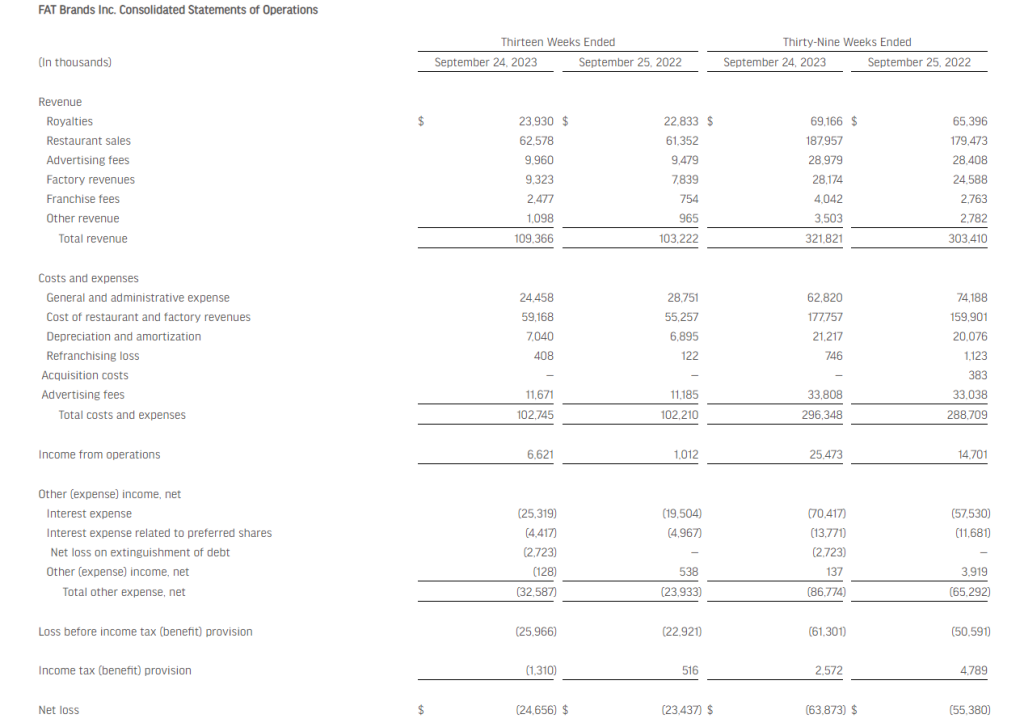
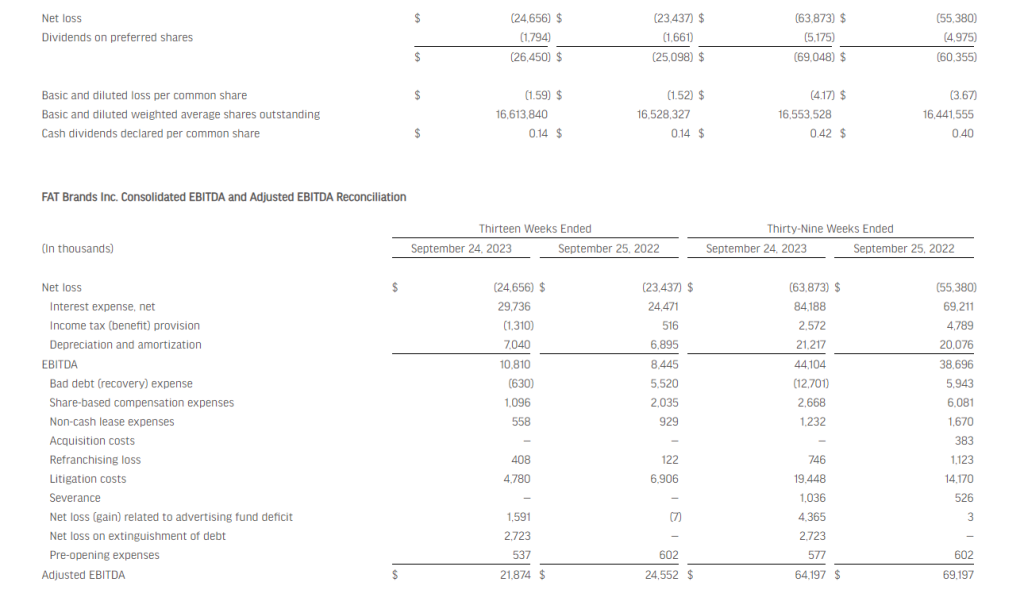
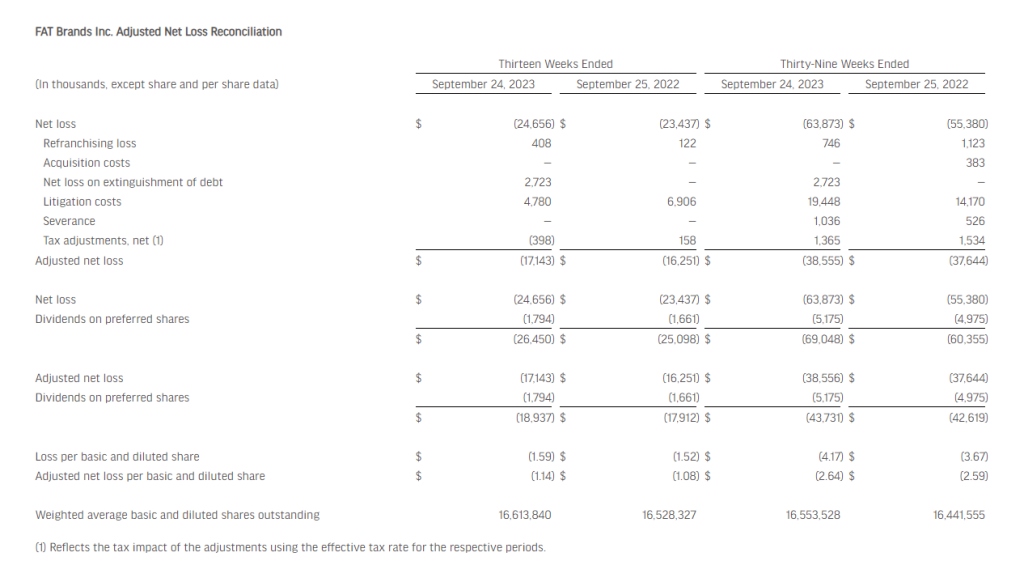
3Q23 Results. FAT Brands reported 3Q23 revenue of $109.4 million, up 6% y-o-y from $103.2 million in the year ago quarter. System-wide sales growth was 0.8%. FAT reported adjusted EBITDA of $21.9 million in the quarter, compared to $24.6 million in 3Q22 (which included $7.2 million of tax credits). Net loss for the quarter was $26.5 million, or $1.59/sh, compared to a net loss of $25.1 million, or $1.52/sh last year. Adjusted net loss for the quarter was $18.9 million, or $1.14/sh, compared to a net loss of $17.9 million, or a loss of $1.08/sh, last year. We had projected revenue of $107 million and a net loss of $28.4 million, or a loss of $1.71/sh.
Ongoing Development. YTD, FAT has opened 96 restaurants, including 30 in 3Q. The Company expects to see 150 openings 2023. YTD, over 200 new franchise agreements have been signed, bringing the total pipeline to over 1,100 signed agreements. This pipeline will add some $60 million to adjusted EBITDA.
Equity Research is available at no cost to Registered users of Channelchek. Not a Member? Click ‘Join’ to join the Channelchek Community. There is no cost to register, and we never collect credit card information.
This Company Sponsored Research is provided by Noble Capital Markets, Inc., a FINRA and S.E.C. registered broker-dealer (B/D).
*Analyst certification and important disclosures included in the full report. NOTE: investment decisions should not be based upon the content of this research summary. Proper due diligence is required before making any investment decision.
LOS ANGELES, Oct. 26, 2023 (GLOBE NEWSWIRE) — FAT (Fresh. Authentic. Tasty.) Brands Inc. (NASDAQ: FAT) (“FAT Brands” or the “Company”) today reported financial results for the fiscal third quarter ended September 24, 2023.
Andy Wiederhorn, Chairman of FAT Brands, commented, “With the acquisition of Smokey Bones early in the fourth quarter, we have grown the FAT Brands portfolio to 18 iconic restaurant brands with annualized system wide sales of $2.4 billion. Year to date through the third quarter, we have opened 96 restaurants, including 30 that opened in the third quarter, and are on track to open 150 new restaurants in 2023. We are seeing strong franchisee interest in development opportunities, having signed over 200 development agreements in 2023, bringing our total pipeline to over 1,100 units. This represents the potential for over 50% EBITDA growth over the next several years.”
Rob Rosen, Co-Chief Executive Officer of FAT Brands, commented, “While franchise interest remains high across all of our brands, we continue to be focused on the expansion of Twin Peaks. This year, we plan to open 15 to 17 new lodges, of which 11 have been opened so far. We expect to end the year with over 110 lodges, a 35% increase since acquiring the brand in 2021. Our growth pipeline includes over 125 lodges and Smokey Bones’ healthy real estate portfolio provides us with the opportunity to convert over 40 locations into Twin Peaks lodges, with the potential to significantly accelerate the growth of the brand.”
Ken Kuick, Co-Chief Executive Officer of FAT Brands, commented, “We believe there are significant opportunities on the horizon for FAT Brands. Our seasoned leadership team and strong brand management platform allow us to efficiently integrate new brands while maintaining a healthy and evolving pipeline for organic growth. These strengths position us for continued growth in the future, which will help deleverage our balance sheet.”
Fiscal ThirdQuarter 2023Highlights
• Total revenue improved 6.0% to $109.4 million compared to $103.2 million in the fiscal third quarter of 2022
◦ System-wide sales growth of 0.8% in the fiscal third quarter of 2023 compared to the prior year fiscal quarter ◦ Year-to-date system-wide same-store sales growth of 1.3% in the fiscal third quarter of 2023 compared to the prior year ◦ 30 new store openings during the fiscal third quarter of 2023
• Net loss of $24.7 million, or $1.59 per diluted share, compared to $23.4 million, or $1.52 per diluted share, in the fiscal third quarter of 2022 • Adjusted EBITDA(1) of $21.9 million compared to $24.6 million in the fiscal third quarter of 2022 • Adjusted net loss(1) of $17.1 million, or $1.14 per diluted share, compared to adjusted net loss of $16.3 million, or $1.08 per diluted share, in the fiscal third quarter of 2022
(1) EBITDA, Adjusted EBITDA and adjusted net loss are non-GAAP measures defined below, under “Non-GAAP Measures”. Reconciliation of GAAP net loss to EBITDA, adjusted EBITDA and adjusted net loss are included in the accompanying financial tables.
Summary of Fiscal ThirdQuarter 2023Financial Results
Total revenue increased $6.2 million, or 6.0%, in the third quarter of 2023 to $109.4 million compared to $103.2 million in the same period of 2022, driven by a 4.8% increase in royalties, a 2.0% increase in company-owned restaurant revenues, a 228.5% increase in franchise fees and an 18.9% increase in revenues from our manufacturing facility.
Costs and expenses consist of general and administrative expense, cost of restaurant and factory revenues, depreciation and amortization, refranchising net loss and advertising fees. Costs and expenses remained largely unchanged in the third quarter, increasing 0.5% in the third quarter of 2023 compared to the same period in the prior year.
General and administrative expense decreased $4.3 million, or 14.9%, in the third quarter of 2023 compared to the same period in the prior year, primarily due to the recognition of $1.0 million related to Employee Retention Credits during the third quarter of 2023 and lower professional fees related to certain litigation matters.
Cost of restaurant and factory revenues increased $3.9 million, or 7.1%, in the third quarter of 2023 compared to the same period in the prior year, primarily due to Employee Retention Credits recognized during the third quarter of 2022 and higher company-owned restaurant and dough factory revenues.
Depreciation and amortization increased $0.1 million, or 2.1% in the third quarter of 2023 compared to the same period in the prior year, primarily due to depreciation of new property and equipment at company-owned restaurant locations.
Advertising expenses in the third quarter of 2023 increased $0.5 million compared to the prior year period. These expenses vary in relation to advertising revenues.
Total other expense, net, for the third quarter of 2023 and 2022 was $32.6 million and $23.9 million, respectively, which is inclusive of interest expense of $29.7 million and $24.5 million, respectively. Total other expense, net for the third quarter of 2023 also included a $2.7 million net loss on extinguishment of debt.
Adjusted net loss(1) of $17.1 million, or $1.14 per diluted share, compared to adjusted net loss of $16.3 million, or $1.08 per diluted share, in the fiscal third quarter of 2022.
Key Financial Definitions
New store openings – The number of new store openings reflects the number of stores opened during a particular reporting period. The total number of new stores per reporting period and the timing of stores openings has, and will continue to have, an impact on our results.
Same-store sales growth – Same-store sales growth reflects the change in year-over-year sales for the comparable store base, which we define as the number of stores open and in the FAT Brands system for at least one full fiscal year. For stores that were temporarily closed, sales in the current and prior period are adjusted accordingly. Given our focused marketing efforts and public excitement surrounding each opening, new stores often experience an initial start-up period with considerably higher than average sales volumes, which subsequently decrease to stabilized levels after three to six months. Additionally, when we acquire a brand, it may take several months to integrate fully each location of said brand into the FAT Brands platform. Thus, we do not include stores in the comparable base until they have been open and in the FAT Brands system for at least one full fiscal year.
System-wide sales growth – System wide sales growth reflects the percentage change in sales in any given fiscal period compared to the prior fiscal period for all stores in that brand only when the brand is owned by FAT Brands. Because of acquisitions, new store openings and store closures, the stores open throughout both fiscal periods being compared may be different from period to period.
Conference Call and Webcast
FAT Brands will host a conference call and webcast to discuss its fiscal third quarter 2023 financial results today at 4:30 PM ET. Hosting the conference call and webcast will be Andy Wiederhorn, Chairman of the Board, and Ken Kuick, Co-Chief Executive Officer and Chief Financial Officer.
The conference call can be accessed live over the phone by dialing 1-844-826-3035 from the U.S. or 1-412-317-5195 internationally. A replay will be available after the call until Thursday, November 16, 2023, and can be accessed by dialing 1-844-512-2921 from the U.S. or 1-412-317-6671 internationally. The passcode is 10183290. The webcast will be available at www.fatbrands.com under the “Investors” section and will be archived on the site shortly after the call has concluded.
About FAT (Fresh. Authentic. Tasty.) Brands
FAT Brands (NASDAQ: FAT) is a leading global franchising company that strategically acquires, markets, and develops fast casual, quick-service, casual dining, and polished casual dining concepts around the world. The Company currently owns 18 restaurant brands: Round Table Pizza, Fatburger, Marble Slab Creamery, Johnny Rockets, Fazoli’s, Twin Peaks, Smokey Bones, Great American Cookies, Hot Dog on a Stick, Buffalo’s Cafe & Express, Hurricane Grill & Wings, Pretzelmaker, Elevation Burger, Native Grill & Wings, Yalla Mediterranean and Ponderosa and Bonanza Steakhouses and franchises and owns approximately 2,300 units worldwide. For more information, please visit www.fatbrands.com.
Forward-Looking Statements
This press release contains forward-looking statements within the meaning of the Private Securities Litigation Reform Act of 1995, including statements relating to the future financial and operating results of the Company, estimates of future EBITDA, the timing and performance of new store openings, future reductions in cost of capital and leverage ratio, our ability to conduct future accretive acquisitions and our pipeline of new store locations. Forward-looking statements generally use words such as “expect,” “foresee,” “anticipate,” “believe,” “project,” “should,” “estimate,” “will,” “plans,” “forecast,” and similar expressions, and reflect our expectations concerning the future. Forward-looking statements are subject to significant business, economic and competitive risks, uncertainties and contingencies, many of which are difficult to predict and beyond our control, which could cause our actual results to differ materially from the results expressed or implied in such forward-looking statements. We refer you to the documents that we file from time to time with the Securities and Exchange Commission, such as our reports on Form 10-K, Form 10-Q and Form 8-K, for a discussion of these and other risks and uncertainties that could cause our actual results to differ materially from our current expectations and from the forward-looking statements contained in this press release. We undertake no obligation to update any forward-looking statements to reflect events or circumstances occurring after the date of this press release.
Non-GAAP Measures (Unaudited)
This press release includes the non-GAAP financial measures of EBITDA, adjusted EBITDA and adjusted net loss.
EBITDA is defined as earnings before interest, taxes, and depreciation and amortization. We use the term EBITDA, as opposed to income from operations, as it is widely used by analysts, investors, and other interested parties to evaluate companies in our industry. We believe that EBITDA is an appropriate measure of operating performance because it eliminates the impact of expenses that do not relate to business performance. EBITDA is not a measure of our financial performance or liquidity that is determined in accordance with generally accepted accounting principles (“GAAP”), and should not be considered as an alternative to net loss as a measure of financial performance or cash flows from operations as measures of liquidity, or any other performance measure derived in accordance with GAAP.
Adjusted EBITDA is defined as EBITDA (as defined above), excluding expenses related to acquisitions, refranchising loss, impairment charges, and certain non-recurring or non-cash items that the Company does not believe directly reflect its core operations and may not be indicative of the Company’s recurring business operations.
Adjusted net loss is a supplemental measure of financial performance that is not required by or presented in accordance with GAAP. Adjusted net loss is defined as net loss plus the impact of adjustments and the tax effects of such adjustments. Adjusted net loss is presented because we believe it helps convey supplemental information to investors regarding our performance, excluding the impact of special items that affect the comparability of results in past quarters to expected results in future quarters. Adjusted net loss as presented may not be comparable to other similarly titled measures of other companies, and our presentation of adjusted net loss should not be construed as an inference that our future results will be unaffected by excluded or unusual items. Our management uses this non-GAAP financial measure to analyze changes in our underlying business from quarter to quarter based on comparable financial results.
Reconciliations of net loss presented in accordance with GAAP to EBITDA, adjusted EBITDA and adjusted net loss are set forth in the tables below.
With more than 60 units, RCI Hospitality Holdings, Inc., through its subsidiaries, is the country’s leading company in adult nightclubs and sports bars/restaurants. Clubs in New York City, Chicago, Dallas-Fort Worth, Houston, Miami, Minneapolis, Denver, St. Louis, Charlotte, Pittsburgh, Raleigh, Louisville, and other markets operate under brand names such as Rick’s Cabaret, XTC, Club Onyx, Vivid Cabaret, Jaguars Club, Tootsie’s Cabaret, Scarlett’s Cabaret, Diamond Cabaret, and PT’s Showclub. Sports bars/restaurants operate under the brand name Bombshells Restaurant & Bar.
Joe Gomes, Managing Director, Equity Research Analyst, Generalist , Noble Capital Markets, Inc.
Joshua Zoepfel, Research Associate, Noble Capital Markets, Inc.
Refer to the full report for the price target, fundamental analysis, and rating.
A Modification. RCI announced the Company modified $15.7 million in debt due October 2024 through extending maturities of the notes to free up more cash to buy back shares. The notes will continue to be unsecured at 12% interest, with $9.1 million due October 1, 2026, interest-only payable monthly, and $6.6 million due November 1, 2027, with monthly payments of interest and principal based on a 10-year amortization.
Buying Up Shares. With the modification in place for the debt, the Company has over $15 million to buy back shares. Using the Company’s closing price on October 26 of $52.70, RCI can purchase up to 297,912 shares. If the Company were to do so, this lowers the Company’s outstanding shares to roughly 9.1 million.
Equity Research is available at no cost to Registered users of Channelchek. Not a Member? Click ‘Join’ to join the Channelchek Community. There is no cost to register, and we never collect credit card information.
This Company Sponsored Research is provided by Noble Capital Markets, Inc., a FINRA and S.E.C. registered broker-dealer (B/D).
*Analyst certification and important disclosures included in the full report. NOTE: investment decisions should not be based upon the content of this research summary. Proper due diligence is required before making any investment decision.
BOCA RATON, Fla.–(BUSINESS WIRE)–Oct. 25, 2023– The ODP Corporation (NASDAQ:ODP) (“ODP,” or the “Company”), a leading provider of business services, products and digital workplace technology solutions to businesses and consumers, will announce third quarter 2023 financial results before the market open on Wednesday, November 8th, 2023. The ODP Corporation will webcast a call with financial analysts and investors that day at 9:00 am Eastern Time which will be accessible to the media and the general public.
To listen to the conference call via webcast, please visit The ODP Corporation’s Investor Relations website at investor.theodpcorp.com. A replay of the webcast will be available approximately two hours following the event. A copy of the earnings press release, supplemental financial disclosures and presentation will also be available on the website.
About The ODP Corporation
The ODP Corporation (NASDAQ:ODP) is a leading provider of products and services through an integrated business-to-business (B2B) distribution platform and omnichannel presence, which includes world-class supply chain and distribution operations, dedicated sales professionals, a B2B digital procurement solution, online presence and a network of Office Depot and OfficeMax retail stores. Through its operating companies Office Depot, LLC; ODP Business Solutions, LLC; Veyer, LLC; and Varis, Inc., The ODP Corporation empowers every business, professional, and consumer to achieve more every day. For more information, visit theodpcorp.com.
ODP and ODP Business Solutions are trademarks of ODP Business Solutions, LLC. Office Depot is a trademark of The Office Club, LLC. OfficeMax is a trademark of OMX, Inc. Veyer is a trademark of Veyer, LLC. Varis is a trademark of Varis Inc. Grand&Toy is a trademark of Grand & Toy, LLC in Canada. Any other product or company names mentioned herein are the trademarks of their respective owners.