Mark Reichman, Managing Director, Equity Research Analyst, Natural Resources, Noble Capital Markets, Inc.
Refer to the full report for the price target, fundamental analysis, and rating.
Supporting Project Advancement. Aurania Resources has appointed current independent director Mr. Thomas Ullrich as Special Advisor, effective immediately, to support the advancement of the company’s strategic projects. Working closely with President and Chief Executive Officer Dr. Keith Barron, Mr. Ullrich will provide strategic guidance on operational and mineral exploration activities, evaluate strategic opportunities, assist with project management, strengthen industry relationships, and help prioritize key initiatives across the company’s portfolio while continuing to serve on the Board of Directors.
Leveraging Experience and Expertise. Mr. Ullrich offers more than 35 years of experience in mineral exploration and geoscience, with expertise encompassing technical exploration, project evaluation, and capital markets. He currently serves as Chief Executive Officer and a director of Aston Bay Holdings Ltd. and previously held senior technical roles with Antofagasta Minerals and Almaden Minerals, where he managed the drill program that led to the discovery of the Ixtaca silver-gold deposit in Mexico. We think Mr. Ullrich’s expanded role will enhance Aurania’s ability to advance its exploration and development initiatives to create long-term shareholder value.
Equity Research is available at no cost to Registered users of Channelchek. Not a Member? Click ‘Join’ to join the Channelchek Community. There is no cost to register, and we never collect credit card information.
This Company Sponsored Research is provided by Noble Capital Markets, Inc., a FINRA and S.E.C. registered broker-dealer (B/D).
*Analyst certification and important disclosures included in the full report. NOTE: investment decisions should not be based upon the content of this research summary. Proper due diligence is required before making any investment decision.
Mark Reichman, Managing Director, Equity Research Analyst, Natural Resources, Noble Capital Markets, Inc.
Refer to the full report for the price target, fundamental analysis, and rating.
Strong Operating Momentum. Kuya Silver reported another record quarter at its Bethania mine, with mined mineralized material increasing 66% sequentially to 5,097 tonnes. The company also achieved record quarterly silver production of 23,912 ounces or 30,559 silver-equivalent ounces, along with record monthly production in June as underground development, mine sequencing, and production rates continued to improve. Management expects recoveries and grades to continue strengthening as the operation advances toward steady-state production.
Quarterly Financial Highlights. Revenue for the quarter totaled approximately $1.25 million, generated primarily from silver sales, which accounted for 87% of total revenue. Metal sold included 17,450 ounces of silver or 20,006 ounces of silver equivalent. The company realized an average silver selling price of $72 per ounce during the quarter, benefiting from a favorable silver price environment. While quarterly silver sales volumes were lower than the prior year due to the timing of sales, higher realized silver prices supported revenue growth as production continued to ramp toward higher sustainable mining rates. We expect the company to release full second quarter financial and operational results in mid-August.
Equity Research is available at no cost to Registered users of Channelchek. Not a Member? Click ‘Join’ to join the Channelchek Community. There is no cost to register, and we never collect credit card information.
This Company Sponsored Research is provided by Noble Capital Markets, Inc., a FINRA and S.E.C. registered broker-dealer (B/D).
*Analyst certification and important disclosures included in the full report. NOTE: investment decisions should not be based upon the content of this research summary. Proper due diligence is required before making any investment decision.
Mark Reichman, Managing Director, Equity Research Analyst, Natural Resources, Noble Capital Markets, Inc.
Refer to the full report for the price target, fundamental analysis, and rating.
Golden Gate FAST-41 Designation. Resolution Minerals’ Golden Gate Project in Idaho has been granted FAST-41 Transparency Coverage by the U.S. Federal Permitting Council, making it the Company’s second project to receive the designation after Antimony Ridge. The designation highlights the strategic importance of the Horse Heaven Project as a domestic source of tungsten, antimony, and gold and is expected to accelerate permitting through enhanced federal coordination and oversight.
Golden Gate Plan of Operations. The Golden Gate Project is part of Resolution’s 15,000-acre Horse Heaven Project, which also includes the Antimony Ridge target, the Johnson Creek Tungsten Mill, and historical tungsten stockpiles. The Company has submitted a Plan of Operations that includes construction of new access roads, up to 340 drill holes and 2,000 feet of trenching, while continuing a fully funded 45-hole drilling program to advance resource definition.
Equity Research is available at no cost to Registered users of Channelchek. Not a Member? Click ‘Join’ to join the Channelchek Community. There is no cost to register, and we never collect credit card information.
This Research is provided by Noble Capital Markets, Inc., a FINRA and S.E.C. registered broker-dealer (B/D).
*Analyst certification and important disclosures included in the full report. NOTE: investment decisions should not be based upon the content of this research summary. Proper due diligence is required before making any investment decision.
Mark Reichman, Managing Director, Equity Research Analyst, Natural Resources, Noble Capital Markets, Inc.
Refer to the full report for the price target, fundamental analysis, and rating.
Building Momentum. Power Metallic is advancing the Nisk Project from exploration toward development, with a maiden NI 43-101 mineral resource estimate expected by the end of July 2026, followed by a Preliminary Economic Assessment which we anticipate could be completed in December 2026. The addition of mining executive Mr. Christopher Beal as Vice President of Operations further strengthens the company’s technical and operational capabilities as it progresses toward engineering studies and future development.
Drilling Continues to Deliver. Recent drilling reinforced the exceptional quality of the Lion Zone, highlighted by an intercept of 36.42 meters grading 2.83% copper equivalent, including 6.0 meters grading 12.38% copper equivalent. Combined with consistently high-grade drill results, strong metallurgical recoveries, and multiple target areas, the Nisk Project has the potential to become a significant polymetallic mining district.
Equity Research is available at no cost to Registered users of Channelchek. Not a Member? Click ‘Join’ to join the Channelchek Community. There is no cost to register, and we never collect credit card information.
This Research is provided by Noble Capital Markets, Inc., a FINRA and S.E.C. registered broker-dealer (B/D).
*Analyst certification and important disclosures included in the full report. NOTE: investment decisions should not be based upon the content of this research summary. Proper due diligence is required before making any investment decision.
Mark Reichman, Managing Director, Equity Research Analyst, Natural Resources, Noble Capital Markets, Inc.
Refer to the full report for the price target, fundamental analysis, and rating.
Angel Island Lithium Carbonate to High-Purity Lithium Metal. Century Lithium announced that lithium carbonate produced from its wholly owned Angel Island Lithium Project in Nevada was successfully converted into high-purity lithium metal by Alpha-En Corporation using its proprietary extraction and electrodeposition technology and subsequently incorporated into cylindrical battery cells manufactured by EaglePicher Technologies. The work was completed under the U.S. Army Small Business Innovation Research (SBIR) program, which supports the development of technologies critical to national defense.
Strong Battery Performance. Testing demonstrated that the lithium metal anodes met EaglePicher’s performance specifications and delivered higher operating voltages and improved power performance compared with control cells. These results highlight the suitability of Angel Island lithium for advanced, high-energy battery applications while validating the project’s potential to supply a domestic source of battery-grade lithium for defense-related technologies.
Equity Research is available at no cost to Registered users of Channelchek. Not a Member? Click ‘Join’ to join the Channelchek Community. There is no cost to register, and we never collect credit card information.
This Company Sponsored Research is provided by Noble Capital Markets, Inc., a FINRA and S.E.C. registered broker-dealer (B/D).
*Analyst certification and important disclosures included in the full report. NOTE: investment decisions should not be based upon the content of this research summary. Proper due diligence is required before making any investment decision.
Mark Reichman, Managing Director, Equity Research Analyst, Natural Resources, Noble Capital Markets, Inc.
Refer to the full report for the price target, fundamental analysis, and rating.
Private Placement Financing. First Phosphate completed the final tranche of its non-brokered private placement with the issuance of 960,500 flow-through shares and 178,325 hard dollar units. Across both tranches, the company raised total gross proceeds of C$17,698,290 with the issuance of 7,238,070 flow-through shares and 1,611,075 hard dollar units. The hard dollar units were priced at C$2.00 per unit and included one common share and one warrant exercisable at C$2.50 per share through December 31, 2026, subject to accelerated expiry. The flow-through shares were issued at C$2.00 per share.
Board Appointment. First Phosphate appointed Mr. Peter Kent to its board of directors, effective July 10, expanding the board to five members from four. Mr. Kent, who previously served as President, director, and advisor to the company, replaces Mr. John Passalacqua, CEO and director, on the Audit Committee. A former Canadian Minister of the Environment and Minister of State for the Americas, Mr. Kent brings extensive experience in environmental assessment, resource development policy, and regulatory affairs.
Equity Research is available at no cost to Registered users of Channelchek. Not a Member? Click ‘Join’ to join the Channelchek Community. There is no cost to register, and we never collect credit card information.
This Research is provided by Noble Capital Markets, Inc., a FINRA and S.E.C. registered broker-dealer (B/D).
*Analyst certification and important disclosures included in the full report. NOTE: investment decisions should not be based upon the content of this research summary. Proper due diligence is required before making any investment decision.
ULSA, OKLAHOMA, July 2, 2026 — Alliance Resource Partners, L.P. (NASDAQ: ARLP) (“ARLP”) today announced that it has completed its previously announced acquisition of certain general partner and limited partner interests in AllDale Minerals III, LP and AllDale Minerals IV, LP for approximately $206.2 million, subject to customary post-closing adjustments.
ARLP funded the acquisition using a combination of cash on hand, borrowings under its revolving credit facility, and a new $150.0 million term loan at its wholly owned subsidiary Alliance Minerals, LLC.
Following the acquisition, ARLP now controls approximately 115,680 net royalty acres within its Oil & Gas Royalties segment, including over 44,770 net royalty acres in the Permian Basin. ARLP expects to provide additional commentary regarding the acquisition during its next quarterly earnings conference call.
About Alliance Resource Partners, L.P. ARLP is a diversified natural resource company that is currently the second largest coal producer in the eastern United States, supplying reliable, affordable energy domestically and internationally to major utilities, metallurgical and industrial users. ARLP also generates operating and royalty income from mineral interests it owns in strategic coal and oil & gas producing regions in the United States. In addition, ARLP is positioning itself as a reliable energy partner for the future by pursuing opportunities that support the growth and development of energy-related technologies and infrastructure.
News, unit prices and additional information about ARLP, including filings with the Securities and Exchange Commission (“SEC”), are available at www.arlp.com. For more information, contact the investor relations department of ARLP at (918) 295-7673 or via email at [email protected].
Investor Relations Contact Cary P. Marshall Senior Vice President and Chief Financial Officer 918-295-7673 [email protected]
Mark Reichman, Managing Director, Equity Research Analyst, Natural Resources, Noble Capital Markets, Inc.
Refer to the full report for the price target, fundamental analysis, and rating.
2026 Drill Program. Resolution continues to de-risk its flagship Horse Heaven Antimony-Tungsten-Gold-Silver Project in Idaho. The company has completed 16 diamond drill holes totaling 4,470 meters at the Golden Gate South target, maintaining a rapid drilling rate while keeping geological logging and sample preparation current. With approximately one-third of the drilling campaign complete, Resolution is advancing Golden Gate toward its first mineral resource estimate, which is expected during the first quarter of 2027. Successful drilling could substantially de-risk the project and establish the foundation for future economic studies.
Defining Scale and Continuity. The program is designed to define the scale and continuity of gold mineralization along strike and at depth while also evaluating the extent of tungsten mineralization surrounding the historic Golden Gate Tungsten Mine and a large tungsten soil anomaly. The campaign builds on encouraging 2025 drilling results that intersected broad intervals of gold mineralization.
Equity Research is available at no cost to Registered users of Channelchek. Not a Member? Click ‘Join’ to join the Channelchek Community. There is no cost to register, and we never collect credit card information.
This Research is provided by Noble Capital Markets, Inc., a FINRA and S.E.C. registered broker-dealer (B/D).
*Analyst certification and important disclosures included in the full report. NOTE: investment decisions should not be based upon the content of this research summary. Proper due diligence is required before making any investment decision.
Toronto, Ontario–(Newsfile Corp. – June 30, 2026) – Aurania Resources Ltd. (TSXV: ARU) (OTCQB: AUIAF) (FSE: 20Q) (“Aurania” or the “Company”) announces that its Board of Directors granted 3,260,000 stock options to directors, officers, and employees (the “Optionees”) pursuant to the terms and subject to the conditions of the Company’s Incentive Stock Option Plan.
The 3,260,000 stock options were granted to directors, officers, and employees on June 30, 2026, and have an exercise price of C$0.185. These options are exercisable for five years from the date of grant and the options shall vest in thirds on the date of grant and each of the first and second anniversaries of the dates of grant, always subject to the Optionee’s maintenance of continuous status as an employee, director, or officer of the Company.
In addition to the options noted above, certain Directors of the Company agreed to receive their quarterly director fees for the second quarter of 2026 in the form of stock options in lieu of cash. On June 30th, 2026, an aggregate of 94,500 stock options was granted to directors in lieu of their director fees for the second financial quarter of 2026. All such stock options will be exercisable at a price of C$0.185 for a period of three years from the date of grant and vested immediately upon grant. In the event a director intends to exercise such stock options, such director shall be solely responsible for paying the entirety of the exercise price.
About Aurania Aurania is a mineral exploration company engaged in the identification, evaluation, acquisition, and exploration of mineral property interests, with a focus on precious metals and critical energy in Europe and abroad.
Neither the TSXV nor its Regulation Services Provider (as that term is defined in the policies of the TSXV) accepts responsibility for the adequacy or accuracy of this release.
VANCOUVER, BC, April 28, 2026 – Nicola Mining Inc.(NASDAQ: NICM) (TSXV: NIM) (FSE: HLIA) (the “Company” or “Nicola“) is pleased to announce commencement of the 2026 Exploration Diamond Drilling Program (the “2026 Program“) at its New Craigmont Copper Project (“New Craigmont”), near Merritt, BC.
Exploration Target
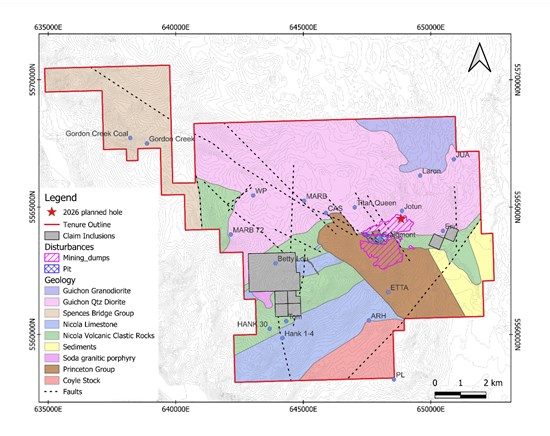
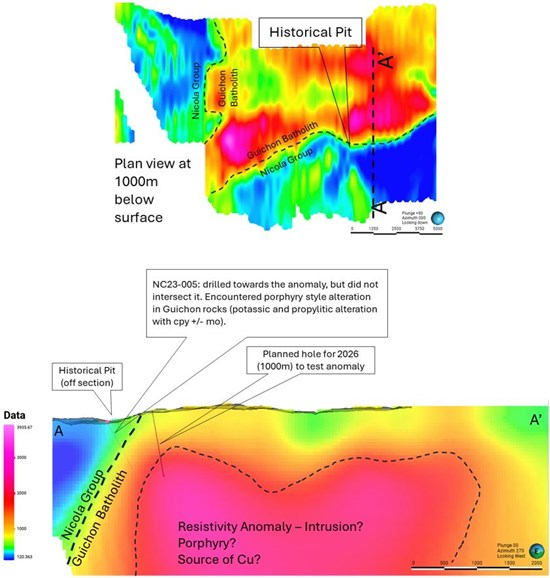
In 2022, Nicola Mining Inc. completed a property-wide Z-axis Tipper Electromagnetic (ZTEM) survey conducted by Geotech Ltd. Interpretation of the dataset identified a prominent resistivity anomaly located immediately north of the historical Craigmont open pit (Figure 1). Subsequent drilling completed in 2023 (holes NC23-005 and NC23-006), positioned to the south of this anomaly, intersected encouraging porphyry-style alteration assemblages, supporting the potential for a larger mineralized system at depth. Nicola has designated this geophysical feature as the “Jotun” target (pronounced Yoten).
The Company considers the Jotun target to be a compelling exploration opportunity that may represent the causative intrusive source responsible for the high-grade copper skarn historically mined at Craigmont. Nicola’s 2026 plans include drilling an exploration hole to directly test the ZTEM anomaly and evaluate its potential as a core of a porphyry-skarn system; however, it should be noted that New Craigmont has the potential of hosting multiple porphyries, as highlighted by the adjacent Highland Valley Copper.
Figure 1. Location Map of the Planned Drill Hole and Geological Setting
Diamond Drilling Plans
Exploration plans for the 2026 Program include diamond drilling at the Jotun target area, a previously untested zone within the New Craigmont Project. The Company will be working with Dorado Drilling Ltd. to execute the program.
The planned drill hole is designed to test the interpreted ZTEM resistivity anomaly at depth, with the target zone expected to be intersected at approximately 775 metres downhole, based on the current geological model and assuming a drill orientation of approximately 80 degrees dip and the planned azimuth. This hole is intended to evaluate the potential presence of a causative intrusive body associated with the historical Craigmont copper skarn system.
Drilling at the Jotun target will open a new exploration area at New Craigmont and is expected to provide valuable geological information to support ongoing target development, including improved understanding of alteration assemblages, structural controls, lithological contacts, and mineralization, which are critical components in advancing exploration of a potential porphyry copper system at New Craigmont.
Figure 2. Cross section (and plan view) of the Jotun target: untested ZTEM resistivity high.
The estimated budget for the 2026 Program is $1.5M, which includes a geophysical survey and a soil sampling campaign. Nicola anticipates drilling to conclude in early June before commencing another diamond drilling program at its Treasure Mountain silver project.
Soil sampling will be conducted in the northwestern portion of the property to support target generation in underexplored areas. In addition, the Company plans to complete a comprehensive Mobile Magnetotelluric (Mobile MT) survey to further refine deep geophysical targets across the property. Details of these programs will be shared as the field season advances.
The Company also expects to have its thermal vectoring dataset fully processed during the season, which will support further interpretation of hydrothermal alteration patterns and help guide decisions on whether to continue expanding this work with additional data collection in the following year.
The Company expects to provide additional updates on exploration activities and results as the field season progresses.
Qualified Person The scientific and technical disclosure included in this news release have been reviewed and approved by Will Whitty, P.Geo., who is the Qualified Person as defined by NI 43-101. Mr. Whitty is Vice President, Exploration for the Company.
About Nicola Mining Nicola Mining Inc. is a junior mining company listed on the TSX-V Exchange and Frankfurt Exchange that maintains a 100% owned mill and tailings facility, located near Merritt, British Columbia. It has signed Mining and Milling Profit Share Agreements with high-grade BC-based gold projects. Nicola’s fully permitted mill can process both gold and silver mill feed via gravity and flotation processes.
The Company owns 100% of the New Craigmont Project, a property that hosts historic high-grade copper mineralization and covers an area of over 10,800 hectares along the southern end of the Guichon Batholith and is adjacent to Highland Valley Copper, Canada’s largest copper mine. The Company also owns 100% of the Treasure Mountain Property, which includes 30 mineral claims and a mineral lease, spanning an area exceeding 2,200 hectares.
Neither the TSX Venture Exchange nor its Regulation Services Provider (as that term is defined in the policies of the TSX Venture Exchange) accepts responsibility for the adequacy or accuracy of this release.
Mark Reichman, Managing Director, Equity Research Analyst, Natural Resources, Noble Capital Markets, Inc.
Refer to the full report for the price target, fundamental analysis, and rating.
Private Placement Financing. Aurania Resources closed the second and final tranche of its non-brokered private placement, raising C$578,370.96 through the sale of 3,213,172 units at a price of C$0.18 per unit. Combined with the first tranche, the financing generated gross proceeds of C$1,256,634.72 through the issuance of 6,981,304 units at a price of C$0.18 per unit. Each unit is composed of one common share and one warrant exercisable at C$0.35 per share for a period of 24 months following the date of issuance.
Use of Funds. Net proceeds from the financing will be used for exploration at the Thor’s Valley epithermal gold project in Iceland, the Balangero nickel-cobalt tailings retreatment project in Italy, and for general working capital. Following the financing, we estimate the company has 139,236,609 shares outstanding.
Equity Research is available at no cost to Registered users of Channelchek. Not a Member? Click ‘Join’ to join the Channelchek Community. There is no cost to register, and we never collect credit card information.
This Company Sponsored Research is provided by Noble Capital Markets, Inc., a FINRA and S.E.C. registered broker-dealer (B/D).
*Analyst certification and important disclosures included in the full report. NOTE: investment decisions should not be based upon the content of this research summary. Proper due diligence is required before making any investment decision.
Mark Reichman, Managing Director, Equity Research Analyst, Natural Resources, Noble Capital Markets, Inc.
George Proost, Research Associate, Noble Capital Markets, Inc.
Refer to the full report for the price target, fundamental analysis, and rating.
Initiating coverage. We are initiating coverage of Tectonic Metals Inc. with an Outperform rating and price target of US$3.50 (C$4.85) per share. In our view, Tectonic’s Flat Gold Project, located in the prolific Kuskokwim Mineral Belt in Alaska, offers the potential to become a Tier 1 gold mine which are generally defined as those producing at least 500 thousand gold ounces per year, exhibit a mine life of 10+ years, with costs in the lower half of the global industry cost curve. Based on drilling results to date, we estimate a potential mineral endowment of at least 5.3 million gold ounces with significant growth prospects. Tectonic expects to publish an initial resource estimate in the first quarter of 2027.
Exploration and drilling program yields significant discoveries. Drilling at the Flat Gold Project continues to demonstrate scale, with mineralization at the Chicken Mountain target now defined over approximately 3.3 kilometers of strike length, widths of up to 700 meters, and depths exceeding 300 meters while remaining open in all directions. All 191 holes drilled at Chicken Mountain have intersected gold mineralization, with 117 of 191 holes ending in mineralization.
Equity Research is available at no cost to Registered users of Channelchek. Not a Member? Click ‘Join’ to join the Channelchek Community. There is no cost to register, and we never collect credit card information.
This Research is provided by Noble Capital Markets, Inc., a FINRA and S.E.C. registered broker-dealer (B/D).
*Analyst certification and important disclosures included in the full report. NOTE: investment decisions should not be based upon the content of this research summary. Proper due diligence is required before making any investment decision.
Mark Reichman, Managing Director, Equity Research Analyst, Natural Resources, Noble Capital Markets, Inc.
Refer to the full report for the price target, fundamental analysis, and rating.
Recent drilling results. Power Metallic Mines reported additional assay results from its Winter 2026 drilling program at the Lion Zone, with the results expected to support the company’s initial NI 43-101 Mineral Resource Estimate (MRE), which is scheduled for completion by the end of July. The MRE for both the Lion Zone and the Nisk deposit will provide the foundation for a Preliminary Economic Assessment (PEA) that is expected to begin immediately afterward.
Strong near-surface copper grades. The latest drilling focused on infill holes designed to improve confidence in resource modeling along the western side of the Lion Zone, particularly within a potential future open-pit area. Results continue to demonstrate strong near-surface mineralization, highlighted by Hole PML-26-115, which returned 13.3 meters grading 3.98% copper equivalent (CuEq) beginning just 25 meters below surface, including a higher-grade interval of 3.77 meters grading 9.36% CuEq. Hole PML-26-105 also delivered a strong intercept of 5.26 meters grading 8.45% CuEq at a depth of approximately 140 meters. Both will be included in the upcoming MRE.
Equity Research is available at no cost to Registered users of Channelchek. Not a Member? Click ‘Join’ to join the Channelchek Community. There is no cost to register, and we never collect credit card information.
This Research is provided by Noble Capital Markets, Inc., a FINRA and S.E.C. registered broker-dealer (B/D).
*Analyst certification and important disclosures included in the full report. NOTE: investment decisions should not be based upon the content of this research summary. Proper due diligence is required before making any investment decision.