Michael Kupinski, Director of Research, Equity Research Analyst, Digital, Media & Technology , Noble Capital Markets, Inc.
Jacob Mutchler, Research Analyst, Noble Capital Markets, Inc.
Refer to the full report for the price target, fundamental analysis, and rating.
Q4 Should Reinforce Improving Cash Flow Story. Although fourth quarter revenue should normalize following the seasonally strong Medicare enrollment period, we expect another quarter of healthy profitability and cash generation that reinforces management’s expectation for a significant cash flow acceleration entering fiscal 2027.
Senior Business Demonstrates Structural Earnings Strength. Even amid continued Medicare Advantage disruption, the Senior business has consistently produced EBITDA margins above 25% during enrollment periods. We expect another solid quarter as disciplined marketing spend and strong customer retention continue to support attractive economics.
Equity Research is available at no cost to Registered users of Channelchek. Not a Member? Click ‘Join’ to join the Channelchek Community. There is no cost to register, and we never collect credit card information.
This Company Sponsored Research is provided by Noble Capital Markets, Inc., a FINRA and S.E.C. registered broker-dealer (B/D).
*Analyst certification and important disclosures included in the full report. NOTE: investment decisions should not be based upon the content of this research summary. Proper due diligence is required before making any investment decision.
Joe Gomes, CFA, Managing Director, Equity Research Analyst, Generalist , Noble Capital Markets, Inc.
Refer to the full report for the price target, fundamental analysis, and rating.
Overview. Resources Connection’s 4Q26 results were mostly in line with management expectations. Overall industry conditions were consistent with 3Q26, suggesting the market is stabilizing. During the quarter, RGP continued to make focused investments to support future growth, which we are hopeful will occur in 2HFY27.
4Q26 Details. Revenue of $106.1 million was down 18.3% on a constant currency basis y-o-y but was within management’s $104-$109 guide. 4Q26 also had one less week of billable activity compared to 4Q25. Gross margin of 37.6% was down from 40.2% y-o-y but exceeded the top end of management’s guide. Adjusted EPS was a net loss of $0.07 compared to EPS of $0.16 in 4Q25.
Equity Research is available at no cost to Registered users of Channelchek. Not a Member? Click ‘Join’ to join the Channelchek Community. There is no cost to register, and we never collect credit card information.
This Company Sponsored Research is provided by Noble Capital Markets, Inc., a FINRA and S.E.C. registered broker-dealer (B/D).
*Analyst certification and important disclosures included in the full report. NOTE: investment decisions should not be based upon the content of this research summary. Proper due diligence is required before making any investment decision.
Mark Reichman, Managing Director, Equity Research Analyst, Natural Resources, Noble Capital Markets, Inc.
Refer to the full report for the price target, fundamental analysis, and rating.
Supporting Project Advancement. Aurania Resources has appointed current independent director Mr. Thomas Ullrich as Special Advisor, effective immediately, to support the advancement of the company’s strategic projects. Working closely with President and Chief Executive Officer Dr. Keith Barron, Mr. Ullrich will provide strategic guidance on operational and mineral exploration activities, evaluate strategic opportunities, assist with project management, strengthen industry relationships, and help prioritize key initiatives across the company’s portfolio while continuing to serve on the Board of Directors.
Leveraging Experience and Expertise. Mr. Ullrich offers more than 35 years of experience in mineral exploration and geoscience, with expertise encompassing technical exploration, project evaluation, and capital markets. He currently serves as Chief Executive Officer and a director of Aston Bay Holdings Ltd. and previously held senior technical roles with Antofagasta Minerals and Almaden Minerals, where he managed the drill program that led to the discovery of the Ixtaca silver-gold deposit in Mexico. We think Mr. Ullrich’s expanded role will enhance Aurania’s ability to advance its exploration and development initiatives to create long-term shareholder value.
Equity Research is available at no cost to Registered users of Channelchek. Not a Member? Click ‘Join’ to join the Channelchek Community. There is no cost to register, and we never collect credit card information.
This Company Sponsored Research is provided by Noble Capital Markets, Inc., a FINRA and S.E.C. registered broker-dealer (B/D).
*Analyst certification and important disclosures included in the full report. NOTE: investment decisions should not be based upon the content of this research summary. Proper due diligence is required before making any investment decision.
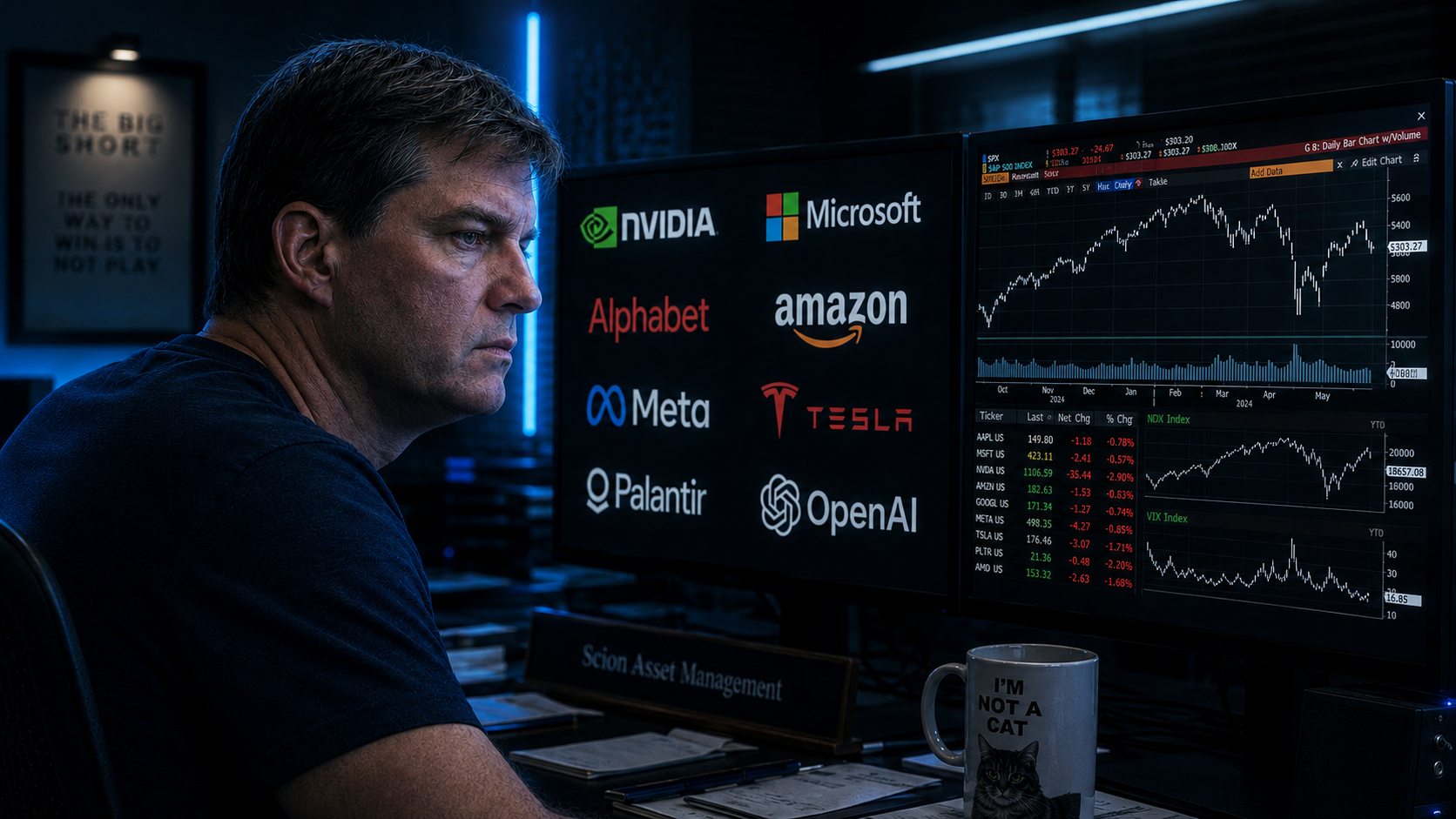
Michael Burry, the investor whose prediction of the 2008 housing crash inspired The Big Short, is once again warning that markets have detached from fundamentals. Throughout 2026, Burry has taken bearish positions against several high-profile AI-related technology names, arguing that investor enthusiasm has pushed valuations in that corner of the market well beyond what the underlying businesses justify.
In a recent post, Burry described the current environment as reminiscent of the final months of the 1999 to 2000 dot-com bubble, arguing that markets have become fixated on a single narrative to the exclusion of nearly everything else. He observed that stocks are no longer moving based on employment data or consumer sentiment, but simply because they have been rising, driven by what he called a two-letter thesis that everyone believes they understand.
A Pattern He Has Seen Before
Burry’s more interesting point, buried beneath the crash warning, is about where he believes the opportunity actually lies. He compared the current setup to the period immediately following the dot-com collapse, when he spent his time patiently acquiring established companies that the market had abandoned entirely in its rush toward speculative technology names. His argument is that the same dynamic is playing out today: capital has become so singularly focused on AI that companies with solid fundamentals outside that narrow theme are being overlooked and mispriced.
That framing is worth taking seriously independent of whether a crash actually materializes. Burry has also been candid about the limits of his own track record. He acknowledged mistakenly calling a Bitcoin crash in 2021 that never happened on the timeline he predicted, and he has been characterized by critics as a repeat false alarm. At the same time, he points to real calls that did play out, including the 2008 housing crash, the 2019 to 2020 period disrupted by COVID, the 2021 meme stock unwind, and the 2023 regional bank stress event.
He Is Not Alone in the Concern
Burry’s warning does not exist in isolation. Legendary investor Paul Tudor Jones told CNBC in May that current conditions feel similar to 1999, though he expects the rally could continue for another year or two before any significant correction. Jones specifically flagged concern about how far valuations could stretch if the market extends further from here, noting that a large enough move would push stock market value as a share of GDP to levels never seen before.
That relationship, known as the Buffett Indicator, remains at historically elevated levels today, reinforcing the view that US equities are expensive relative to the size of the underlying economy. As both Burry and market historians note, expensive markets can remain expensive for a long time before any correction arrives, which is precisely what makes timing a crash so difficult even for investors who share the underlying concern.
What It Means for Small Cap Investors
For investors in the sub-$2 billion market cap space, Burry’s core observation carries a genuinely relevant signal, independent of whether his crash timing proves correct. If capital concentration in a narrow group of AI-related names has pushed valuations to unsustainable levels, the companies most likely to be overlooked and mispriced in that environment are exactly the smaller, fundamentally sound businesses operating outside the AI narrative entirely.
That is consistent with a theme that has defined 2026. The Russell 2000 posted its best first half in 35 years while trading at a historically wide valuation discount to large caps, and market breadth has been expanding as capital gradually rotates beyond a handful of dominant technology names. Whether or not the broader market experiences the kind of correction Burry is warning about, his underlying thesis, that patient investors willing to look past the crowded trade can find genuine value in overlooked companies, is one small cap investors have effectively been living for the better part of this year.
Tesla reported second quarter results Wednesday that missed Wall Street’s profit expectations by a wide margin, and the stock fell 14% the following session as investors weighed the earnings shortfall against the company’s confirmed plan to spend $25 billion on capital expenditures for the full year.
Adjusted earnings per share came in at $0.33, well below the approximately $0.50 analysts had expected, a miss of roughly 34%. Operating margin collapsed to 1.4% from 4.1% a year earlier, and operating income fell 57% to just $398 million. Adjusted EBITDA landed at $3.2 billion versus the $4 billion expected. On the profitability side of the ledger, this was a clear and significant miss.
Revenue told a different story. Tesla reported $28.24 billion, up 26% year over year and above the $26.32 billion Bloomberg consensus estimate. Vehicle deliveries came in at 480,126 units, up 25% year over year and well ahead of the 406,000 consensus. For the first time in company history, Tesla crossed $100 billion in trailing twelve month revenue. The top line beat. The bottom line did not, and it was the bottom line that drove the stock’s decline.
Where the Profit Miss Came From
Part of the shortfall traces back to regulatory credit income. For the first time in many quarters, those credits, which had historically contributed $700 million to $900 million per quarter to Tesla’s bottom line, came in far below that level, removing a cushion that had quietly supported margins for years.
The larger driver is capital spending. Capital expenditures surged 142% year over year to $5.79 billion for the quarter, pushing free cash flow negative at $1.09 billion. Management confirmed on the earnings call that full-year capex will total approximately $25 billion, directed almost entirely at scaling Cybercab production, building out Optimus manufacturing lines, and expanding the company’s Cortex AI compute infrastructure in Texas. CFO Vaibhav Taneja told investors that operating expenditures will continue growing through 2026 and beyond, and that commodity price increases and interest rate changes will keep adding to costs.
The Bet Behind the Spending
Every dollar of that $25 billion is aimed at a future well beyond electric vehicles. Cybercab began production and public-road testing during the quarter at Gigafactory Texas. Robotaxi service is now live in seven US metro areas. First-generation Optimus assembly lines are being installed at the Fremont factory, on space freed up after Tesla decommissioned its Model S and X production lines, with initial production targeted for later this year. Tesla Semi and Megapack 3 remain on schedule to begin production in 2026 as well.
CEO Elon Musk described this as Tesla’s largest and most exciting period of investment, acknowledging that scaling would be non-linear and reiterating a long-term value creation focus over near-term margin optimization.
What It Means for Investors Tracking the Broader Market
Tesla’s quarter fits a pattern that has now repeated across multiple high-profile earnings reports this season. TSMC beat estimates and fell. Netflix missed guidance by roughly 1% and lost $100 billion in value. Tesla beat revenue significantly, missed profit estimates badly, and confirmed a massive year of spending ahead, and the stock dropped 14% because the market is scrutinizing margin quality and cash generation with a level of skepticism it did not apply a year ago.
For companies at every market capitalization, the message from this earnings season is consistent. Strong top-line growth alone is no longer sufficient to satisfy investors who are increasingly focused on whether that growth translates into cash flow and margin durability. Companies funding aggressive expansion through negative free cash flow, regardless of how compelling the long-term vision, are being held to a higher standard of proof than they were earlier in this market cycle.
TROY, Mich., July 23, 2026 (GLOBE NEWSWIRE) — Kelly, a global workforce strategy and solutions provider, will release its second-quarter earnings before the market opens on Thursday, August 6, 2026. In conjunction with its earnings release, Kelly will publish a financial presentation and host a live webcast of a conference call with financial analysts at 9 a.m. ET on August 6 to review the results from the quarter and answer questions.
The presentation and a link to the live webcast will be accessible through the Company’s public website on the Investor Relations page under Events & Presentations. The webcast will be recorded, and a replay will be available within one hour of completion of the event through the same link as the live webcast.
About Kelly
Kelly Services, Inc. (Nasdaq: KELYA, KELYB) helps companies recruit and manage skilled workers and helps job seekers find great work. Since inventing the staffing industry in 1946, we have become experts in the many industries and local and global markets we serve. With a network of suppliers and partners around the world, we connect approximately 375,000 people with work every year. Our suite of outsourcing and consulting services and solutions ensures companies have the people they need, when and where they are needed most. Headquartered in Troy, Michigan, we empower businesses and individuals to access limitless opportunities in industries such as science, engineering, technology, education, manufacturing, retail, finance, and energy. Revenue in 2025 was $4.3 billion. Learn more at kellyservices.com.
KLYA-FIN
Analyst & Media Contacts: Scott Thomas (248) 251-7264 [email protected]
SAN DIEGO, July 23, 2026 (GLOBE NEWSWIRE) — Kratos Defense & Security Solutions, Inc. (NASDAQ: KTOS), a Technology Company in the Defense, National Security and Global Markets, announced today that it will publish financial results for the second quarter 2026 after the close of market on Tuesday, August 4th. Management will discuss the Company’s operations and financial results in a conference call beginning at 2:00 p.m. Pacific (5:00 p.m. Eastern).
The call will be available at www.kratosdefense.com. Participants may register for the call using this On-line Form. Upon registration, all telephone participants will receive the dial-in number along with a unique PIN that can be used to access the call. For those who cannot access the live broadcast, a replay will be available on Kratos’ website.
About Kratos Defense & Security Solutions Kratos Defense & Security Solutions, Inc. (NASDAQ: KTOS) is a technology, products, system and software company addressing the defense, national security, and commercial markets. Kratos makes true internally funded research, development, capital and other investments, to rapidly develop, produce and field solutions that address our customers’ mission critical needs and requirements. At Kratos, affordability is a technology, and we seek to utilize proven, leading edge approaches and technology, not unproven bleeding edge approaches or technology, with Kratos’ approach designed to reduce cost, schedule and risk, enabling us to be first to market with cost effective solutions. We believe that Kratos is known as an innovative disruptive change agent in the industry, a company that is an expert in designing products and systems up front for successful rapid, large quantity, low cost future manufacturing which is a value add competitive differentiator for our large traditional prime system integrator partners and also to our government and commercial customers. Kratos intends to pursue program and contract opportunities as the prime or lead contractor when we believe that our probability of win (PWin) is high and any investment required by Kratos is within our capital resource comfort level. We intend to partner and team with a large, traditional system integrator when our assessment of PWin is greater or required investment is beyond Kratos’ comfort level. Kratos’ primary business areas include virtualized ground systems for satellites and space vehicles including software for command & control (C2) and telemetry, tracking and control (TT&C), jet powered unmanned aerial drone systems, hypersonic vehicles and rocket systems, propulsion systems for drones, missiles, loitering munitions, supersonic systems, space craft and launch systems, C5ISR and microwave electronic products for missile, radar, missile defense, space, satellite, counter UAS, directed energy, communication and other systems, and virtual & augmented reality training systems for the warfighter. For more information, visit www.KratosDefense.com
BATAVIA, N.Y.–(BUSINESS WIRE)– Graham Corporation (NYSE: GHM), a global leader in the design and manufacture of mission critical fluid, power, heat transfer, vacuum and advanced mixing technologies for the Defense, Space, Energy, and Process industries, announced that it will release its first quarter fiscal year 2027 financial results before financial markets open on Thursday, August 6, 2026.
The Company will host a conference call and webcast to review its financial and operating results, strategy, and outlook. A question-and-answer session will follow.
First Quarter Fiscal Year 2027 Financial Results Conference Call
Thursday, August 6, 2026 11:00 a.m. Eastern Time Phone: (877) 407-0784 or (201) 689-8560 (International) Internet webcast link and accompanying slide presentation: ir.grahamcorp.com
A telephonic replay will be available from 3:00 p.m. ET on the day of the teleconference through Thursday, August 13, 2026. To listen to the archived call, dial (844) 512-2921 and enter conference ID number 13761669 or access the webcast replay via the Company’s website at ir.grahamcorp.com, where a transcript will also be posted once available.
ABOUT GRAHAM CORPORATION Graham is a global leader in the design and manufacture of mission critical fluid, power, heat transfer, vacuum, and advanced mixing technologies for the Defense, Space, Energy, and Process industries. Graham Corporation and its family of global brands are built upon world-renowned engineering expertise, proprietary technologies, as well as its responsive and flexible service and the unsurpassed quality customers have come to expect from the Company’s products and systems. Graham Corporation routinely posts news and other important information on its website, grahamcorp.com, where additional information on Graham Corporation and its businesses can be found.
Toronto, Ontario–(Newsfile Corp. – July 23, 2026) – Aurania Resources Ltd. (TSXV: ARU) (OTCQB: AUIAF) (FSE: 20Q) (“Aurania” or the “Company”) is pleased to announce that its Board of Directors have appointed Mr. Thomas Ullrich as Special Advisor to the Company, effective immediately.
Mr. Ullrich, is currently an independent director of the Company and has over 35 years of experience in mineral exploration and geoscience
Working closely with Aurania’s President and CEO, Dr. Keith Barron, Mr. Ullrich will support the advancement of Aurania’s projects by providing strategic guidance on the operational and mineral exploration activities of the Company
The Board of Directors has granted Mr. Ullrich 350,000 stock options as compensation for his role as Special Advisor
“Tom Ullrich has been a highly valued member of our Board since July 2022 and brings extensive technical experience in the mining industry as well as capital markets, project evaluation and project advancement experience,” said Dr. Keith Barron, Chairman, President and CEO of the Company. “As we advance our exploration and development initiatives, we believe Tom’s increased involvement and support will strengthen our ability to unlock value across our project portfolio while supporting our long-term strategy.”
Mr. Ullrich has over 35 years of experience in mineral exploration and geoscience. He has been the CEO and director of Aston Bay since 2016. Prior to that, Mr. Ullrich was Chief Geologist North America for Antofagasta Minerals plc, investigating the region’s copper potential through extensive property evaluations and management of drill programs in the United States, Mexico and Canada. Prior to Antofagasta, he was Senior Geologist for Almaden Minerals, where he managed the drill program for the team’s discovery of the Ixtaca Ag-Au deposit in Mexico. Mr. Ullrich also established the Ar-Ar geochronology lab at the University of British Columbia and studied the Candelaria Cu-Au mine, Chile, while at Queen’s University. Mr. Ullrich is also on the Technical Advisory Board for American West Metals Limited.
“I am pleased to take on this expanded role and work more closely with the management team,” said Thomas Ullrich. “Aurania’s CEO, Keith Barron has assembled a unique and compelling collection of projects globally, including strategically important projects for critical minerals. I look forward to contributing to the advancement of these projects and supporting Aurania’s efforts to create long-term value for shareholders.”
In his capacity as Special Advisor to advise and oversee the Company’s operational and exploration activities, Mr. Ullrich may also assist in the evaluation of strategic opportunities, project management, strengthening industry relationships and prioritizing specific initiatives within Aurania’s portfolio of projects.
Thomas Ullrich will continue to serve as a director of the Company’s board of directors while undertaking these advisory responsibilities and will report to the board of directors.
In conjunction with the aforementioned appointment and pursuant to the Company’s Stock Option Plan, the Board of Directors granted Mr. Ullrich 350,000 stock options on July 22, 2026 at an exercise price of C$0.215. These options are exercisable for five years from the date of grant and the options shall vest in thirds on the date of grant and each of the first and second anniversaries of the dates of grant. In the event Mr. Ullrich intends to exercise such stock options, he shall be solely responsible for paying the entirety of the exercise price.
About Aurania Aurania is a mineral exploration company engaged in the identification, evaluation, acquisition, and exploration of mineral property interests, with a focus on precious metals and critical energy in Europe and abroad.
Neither the TSXV nor its Regulation Services Provider (as that term is defined in the policies of the TSXV) accepts responsibility for the adequacy or accuracy of this release.
Forward-Looking Statements This news release contains forward-looking information as such term is defined in applicable securities laws, which relate to future events or future performance and reflect management’s current expectations and assumptions. The forward-looking information includes Mr. Ullrich’s proposed role and responsibilities as Special Advisor to the Company, and that Mr. Ullrich’s increased involvement and support will strengthen the Company’s ability to unlock value across its project portfolio while supporting its long-term strategy, Aurania’s objectives, goals, future plans or other statements of intent, Aurania’s ongoing engagement in the identification, evaluation, acquisition and exploration of mineral property interests, and any potential exploration results or potential mineralization resulting therefrom and Aurania’s ongoing exploration efforts in France, Italy, Ecuador and abroad, Such forward-looking statements reflect management’s current beliefs and are based on assumptions made by and information currently available to Aurania, including the assumption that, there will be no material adverse change in metal prices and all necessary consents, licenses, permits and approvals will be obtained, including various local government licenses and the market. Investors are cautioned that these forward-looking statements are neither promises nor guarantees and are subject to risks and uncertainties that may cause future results to differ materially from those expected. Risk factors that could cause actual results to differ materially from the results expressed or implied by the forward-looking information include, among other things, the state of the capital markets generally and of the mining markets more particularly, any commodity prices supply chain disruptions, restrictions on labour and workplace attendance and local and international travel due to war, weather, pandemics or otherwise; a failure to obtain or delays in obtaining the required regulatory licenses, permits, approvals and consents; an inability to access financing as needed, including pursuant to the Loan; a general economic downturn, a volatile stock price, labour strikes, political unrest, changes in the mining regulatory regime governing Aurania; a failure to comply with environmental regulations; a weakening of market and industry reliance on precious metals, copper and critical minerals; and those risks set out in the Company’s public documents filed on SEDAR+. Aurania cautions the reader that the above list of risk factors is not exhaustive. Although the Company believes that the assumptions and factors used in preparing the forward-looking information in this news release are reasonable, undue reliance should not be placed on such information, which only applies as of the date of this news release, and no assurance can be given that such events will occur in the disclosed time frames or at all. The Company disclaims any intention or obligation to update or revise any forward-looking information, whether as a result of new information, future events or otherwise, other than as required by law.
Robert LeBoyer, Senior Vice President, Equity Research Analyst, Biotechnology, Noble Capital Markets, Inc.
Refer to the full report for the price target, fundamental analysis, and rating.
Advancing Products Through Partnerships. Cadrenal announced that it has modified its development strategy and product pipeline to focus on therapies for cardiac surgical care and orphan cardiac conditions. It now plans to advance the products through development partnerships, licensing, and commercialization agreements to minimize capital expenditures. This announcement formalizes the transition we have seen over the past several months.
Building A “Cardiac Acute Critical Care Franchise”. Cadrenal has refined its clinical focus to late-stage critical-care cardiovascular products for conditions with no effective treatments. It now plans to form partnerships for CAD-1005, frunexian, and tecarfarin, avoiding the large capital raises needed to fund further clinical trials.
Equity Research is available at no cost to Registered users of Channelchek. Not a Member? Click ‘Join’ to join the Channelchek Community. There is no cost to register, and we never collect credit card information.
This Company Sponsored Research is provided by Noble Capital Markets, Inc., a FINRA and S.E.C. registered broker-dealer (B/D).
*Analyst certification and important disclosures included in the full report. NOTE: investment decisions should not be based upon the content of this research summary. Proper due diligence is required before making any investment decision.
Mark Reichman, Managing Director, Equity Research Analyst, Natural Resources, Noble Capital Markets, Inc.
Refer to the full report for the price target, fundamental analysis, and rating.
Updating Estimates. We have increased our 2Q 2026 revenue, adj. EBITDA, and adj. EPS estimates to $54.9 million, $38.4 million, and $1.15, respectively, from $50.0 million, $35.2 million, and $1.00. Our estimates reflect higher time charter equivalent rates than previously estimated. Moreover, we have lowered our estimates for vessel operating expenses in the second quarter and increased our estimate for general and administrative expenses in the second and third quarters. For FY 2026, we forecast revenue, adj. EBITDA, and adj. EPS of $203.2 million, $131.3 million, and $3.50, respectively, compared to our previous estimates of $198.3 million, $130.2 million, and $3.45.
Constructive Outlook. Seanergy’s outlook remains constructive, supported by favorable Capesize market fundamentals, a disciplined capital allocation strategy, and a multi-year fleet modernization program that positions the company to benefit from what we think will be a structurally attractive market through 2029. Following a strong first quarter in which the company reported significantly higher earnings and cash flow, we expect the momentum to continue, with second quarter time charter equivalent (TCE) rates projected to be approximately $31,430 per day.
Equity Research is available at no cost to Registered users of Channelchek. Not a Member? Click ‘Join’ to join the Channelchek Community. There is no cost to register, and we never collect credit card information.
This Company Sponsored Research is provided by Noble Capital Markets, Inc., a FINRA and S.E.C. registered broker-dealer (B/D).
*Analyst certification and important disclosures included in the full report. NOTE: investment decisions should not be based upon the content of this research summary. Proper due diligence is required before making any investment decision.
Late July has a reputation in financial markets, and it is earning it again this year. Trading volume thins out, institutional desks empty as portfolio managers take vacation, and major indices tend to drift sideways in a pattern traders have long called the summer doldrums. This year that pattern is showing up clearly: after struggling for six weeks to break through previous highs, major indices have settled into a range-bound stretch defined more by low conviction than by any real change in direction.
For investors in the small and microcap space, understanding what actually happens beneath a quiet surface matters more than watching the headline indices tread water.
Why Summer Markets Behave Differently
Reduced trading volume is not a neutral condition. It changes the texture of price action in ways that create both risk and opportunity, particularly for smaller companies where institutional coverage is already thin during a normal month. With fewer active participants, spreads widen, single trades can move a stock more than they would in September, and speculative growth names with reduced analyst attention tend to see more dramatic swings than usual. A disciplined approach to liquidity, favoring names with real trading volume and avoiding thinly traded positions on news days, matters more in July than at almost any other point in the calendar year.
The flip side of that volatility is opportunity. Lower institutional participation means mispricings can persist longer before larger players notice and correct them. For patient investors willing to do the work that quieter markets discourage, summer often rewards genuine stock selection over broad index exposure.
The Rotation Happening Beneath the Surface
This summer’s quiet has masked a genuinely active rotation across sectors. Technology has become increasingly extended following a strong second quarter, while precious metals have pulled back sharply and now sit in what many consider oversold territory after a punishing five to six month correction. Healthcare, largely out of favor for most of the year, has begun showing signs of recovery. That kind of leadership shift, happening quietly under a flat index, is exactly the environment where small cap stock pickers can find value that broad market participants overlook entirely.
The Russell 2000 remains a central part of that story. Entering 2026, small caps traded at close to a 30% valuation discount to the S&P 500 on a forward earnings basis, among the widest gaps in three decades. Even after a strong rally earlier this year, a meaningful portion of that discount remains unresolved, and domestic revenue exposure continues to insulate small caps from the currency and tariff headwinds pressuring large multinational companies.
What to Watch Heading Into Fall
Two catalysts matter most for the second half of the year. Earnings season is arriving with mega cap companies facing an unusually high bar after years of outperformance, and any disappointment there tends to accelerate rotation into the broader market rather than dampen it entirely. Second, Federal Reserve policy remains the swing factor. If incoming data keeps the Fed hawkish for longer than expected, the rate relief that smaller, more leveraged companies have been counting on gets pushed further out. If core inflation continues cooling, the setup for small caps heading into the fall strengthens considerably.
Historically, seasonal patterns have pointed to improving market strength as the calendar moves from summer into fall, and July itself has typically been a modestly positive month for equities over multi-decade averages. None of that guarantees anything this particular year. But for investors willing to look past low volume and range-bound headlines, the summer doldrums are historically less about danger and more about patience being rewarded before the market’s attention returns in September.
The federal government’s push to embed artificial intelligence into the core of American scientific research just gained a major private sector partner. Microsoft announced Wednesday it is investing $60 million to advance the Department of Energy’s Genesis Mission, a program designed to unite 17 national laboratories, industry partners, and academic institutions around AI-enabled research and development. The stated goal is to harness AI for breakthroughs in energy dominance, discovery science, and national security.
The investment breaks down into two distinct components. Forty million dollars will fund Azure compute and AI credits distributed to the program over three years, giving national lab researchers direct access to Microsoft’s cloud infrastructure and AI models. The remaining $20 million will go toward what Microsoft calls solution engineering enablement services, covering the engineering, architecture, deployment, and adoption support needed to actually turn that cloud capacity into usable research outcomes rather than unused credits sitting on a balance sheet.
A New Management Layer for a Sprawling Initiative
Alongside the investment, Microsoft is launching a new program called SPARK, short for Scientific Partnership Advancing Research and Knowledge, which will function as a management office for the Genesis Mission. SPARK is designed to facilitate secure collaboration across the many institutions involved, addressing one of the most persistent challenges in large, multi-lab federal research initiatives: coordinating dozens of separate organizations with different systems, security requirements, and research priorities into a single functioning research enterprise.
Microsoft’s language around the announcement was notably direct about where it sees this heading. The company described entering an era where AI and quantum computing do not just support the scientific process but become essential to it, committing to provide hyperscale compute, advanced models, emerging quantum capabilities, and dedicated technical expertise running alongside the labs’ own world-leading systems.
Why This Matters Beyond Microsoft
For investors tracking the broader technology ecosystem, the Genesis Mission is a continuation of a theme that has defined 2026: the federal government treating AI and quantum computing infrastructure as a strategic national priority rather than a purely commercial pursuit. Earlier this year, the Trump administration committed $2 billion in direct equity investments across nine domestic quantum computing companies under the CHIPS and Science Act framework, a move that signaled Washington views these technologies with the same urgency it once reserved for semiconductor manufacturing and rare earth supply chains.
The Genesis Mission operates on a different mechanism, funding compute access and research infrastructure rather than taking direct equity stakes, but the underlying logic is the same. When 17 national laboratories gain hyperscale AI and quantum compute access, the research output that follows tends to generate downstream commercial opportunities. National lab research has historically been a significant source of spinout technology, licensing agreements, and early-stage partnerships that eventually flow into smaller, publicly traded companies operating in specialized AI, quantum computing, and scientific instrumentation niches.
The Small Cap Angle
For companies operating below the $2 billion market cap threshold in the AI infrastructure, quantum computing, and specialized scientific computing space, initiatives like the Genesis Mission represent a slower-moving but potentially significant catalyst. Government-funded research at this scale often creates procurement opportunities, licensing pathways, and collaborative research agreements that smaller, more nimble companies are frequently better positioned to capture than the largest technology platforms funding the core infrastructure.
As the Genesis Mission matures over its three-year funding window, the research coming out of these 17 laboratories is worth monitoring closely. History suggests that when the federal government makes this scale of commitment to a specific technology area, the commercial ecosystem around it tends to expand well beyond the initial corporate partners involved.