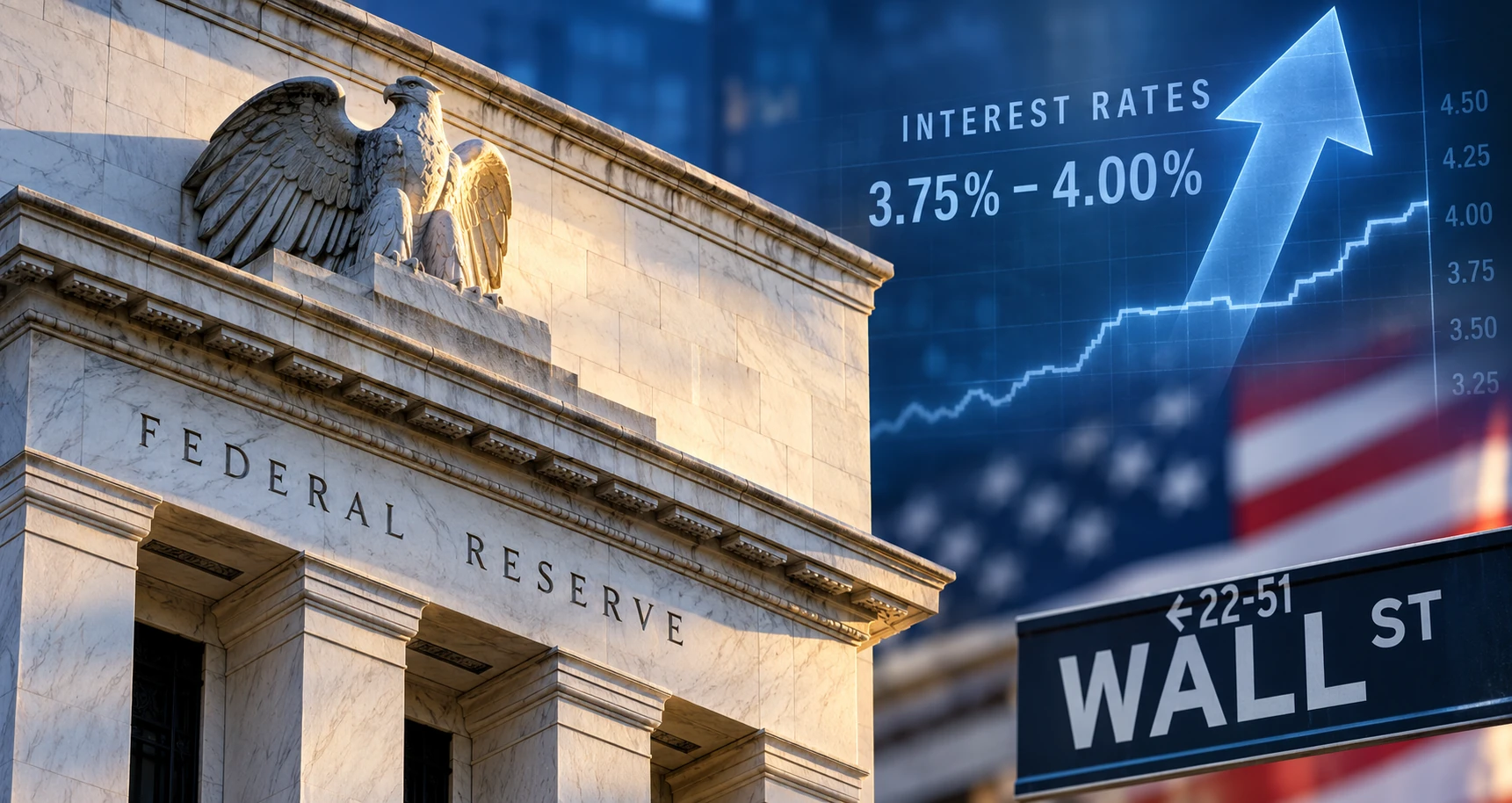
The Federal Reserve raised interest rates Wednesday for the first time in more than three years, reversing course as persistent inflation and renewed energy pressures pushed policymakers back toward tighter monetary policy.
The Federal Open Market Committee voted 12-0 to increase the federal funds target range by 25 basis points to 3.75% to 4.00%. In its statement, the Fed said economic activity continues to expand at a solid pace, domestic spending remains resilient, productivity growth is strong and capital investment is robust, while inflation remains elevated.
The move itself had been widely expected. The more important message for investors came from the Fed’s updated projections and Chair Kevin Warsh’s press conference: policymakers are not signaling that Wednesday’s increase will necessarily be a one-time adjustment.
A majority of Fed officials now expect at least one additional rate increase before the end of 2026, while the median projection points to rates around 4.1% at year-end. Twelve of 18 officials projected one more increase this year, while another four anticipated two additional hikes could be appropriate.
Warsh reinforced that message in unusually direct terms, telling reporters that “inflation is too high and has been for too long.”
For investors, that changes the conversation. After years in which markets focused largely on when interest rates would fall, the Federal Reserve is once again signaling that rates can move higher if inflation fails to return toward its 2% target.
Why the Fed Raised Rates Now
The Fed’s decision reflects an economy that has proven resilient even as inflation has remained stubbornly above target. In Wednesday’s statement, policymakers said economic activity is expanding at a solid pace, domestic spending remains resilient and capital investment is robust. Employment conditions also remain relatively stable, with job gains keeping pace with growth in the workforce and unemployment changing little.
That strength gives the Fed more room to concentrate on inflation. Price pressures have intensified in recent months, particularly through energy. Higher oil and gasoline prices tied to geopolitical disruptions have pushed headline inflation higher, while underlying inflation has also remained above the Fed’s comfort zone.
The Fed’s updated projections reflect that concern. Officials now expect overall inflation of roughly 3.7% in 2026 and core inflation of about 3.4%, both slightly higher than their June estimates. Policymakers still expect inflation to moderate next year, but the path back toward 2% has become slower and less certain. That combination — persistent inflation and an economy that has not weakened dramatically — made another rate increase easier to justify.
Energy Makes the Inflation Problem More Complicated
The current inflation backdrop is particularly difficult because a meaningful portion of the pressure originates outside the traditional reach of monetary policy. Higher interest rates cannot increase crude-oil production, repair energy infrastructure or eliminate geopolitical disruptions. The Fed can only influence demand by making borrowing and spending more expensive.
But energy inflation does not always remain isolated. Higher gasoline and diesel prices can raise transportation costs, more expensive jet fuel can affect airfare, and higher shipping and manufacturing costs can eventually filter into the prices of goods and services throughout the economy.
The Fed therefore faces a difficult balancing act. Policymakers may want to avoid overreacting to a temporary oil shock, but they also do not want elevated energy prices to become embedded in broader inflation expectations. That concern helps explain the language in Wednesday’s statement that the rate increase should support a “timelier return” to the Fed’s 2% inflation objective.
A Major Reversal in the Rate Cycle
Wednesday’s move is historically significant because it marks the Fed’s first increase since July 2023. The previous tightening cycle ultimately pushed the upper end of the federal funds target range to 5.50% in 2023 before the Fed eventually began cutting rates as inflation moderated. By 2026, the target range had fallen back to 3.50% to 3.75%.
Now the direction has reversed again. That matters because the Fed is not tightening from near-zero rates, as it did earlier in the decade. It is raising borrowing costs from a level that was already restrictive compared with much of the post-financial-crisis period. The implication is that households and businesses are entering this renewed tightening phase while already dealing with relatively expensive credit.
What Higher Rates Mean for Investors
A quarter-point increase in the federal funds rate does not translate directly into a quarter-point move across every market, but it raises the baseline cost of short-term money throughout the financial system. Credit-card rates, floating-rate business loans and other short-term borrowing costs tend to respond relatively quickly. Mortgage rates are more closely tied to longer-term Treasury yields, but higher Fed rates can still contribute to tighter financial conditions more broadly.
For equity investors, the bigger issue is valuation. Higher interest rates increase the discount rate investors use when valuing future corporate earnings. That tends to weigh most heavily on companies whose valuations depend heavily on profits expected far into the future.
At the same time, fixed income becomes more competitive. When investors can earn attractive yields on government securities, money-market funds and high-quality bonds, equities must offer a more compelling expected return to justify the additional risk. That does not mean stocks automatically decline when rates rise. Earnings growth, economic strength and company-specific fundamentals still matter. But the hurdle rate for owning risk assets becomes higher.
Small Caps Face Pressure — but Not Uniformly
Smaller public companies can be particularly sensitive to higher interest rates because they often rely more heavily on bank financing, floating-rate debt or repeated access to capital markets. That means refinancing risk becomes increasingly important.
A small-cap company with high debt and weak free cash flow may face significantly higher borrowing costs as older debt matures. By contrast, a company with strong cash generation, low leverage and limited near-term refinancing needs can gain a relative advantage over more indebted competitors.
Higher rates can therefore create greater dispersion within the small-cap market rather than producing the same outcome for every company. There are also sector-specific opportunities. Banks may benefit if a more favorable yield curve improves lending spreads without producing a major deterioration in credit quality. Industrials tied to domestic investment can continue to benefit if economic activity remains strong. Companies with cash-rich balance sheets may also become more competitive in acquisitions because leveraged buyers face higher financing costs.
For small-cap investors, the environment places a greater premium on balance-sheet strength, profitability, cash flow and financing discipline.
Treasury Yields Remain a Critical Variable
The Fed’s decision comes against the backdrop of another important development: long-term Treasury yields have recently moved back toward levels not seen since before the financial crisis. The 10-year Treasury yield has hovered near 5%, while longer-term yields remain elevated.
Those rates matter enormously because they influence mortgage rates, corporate bond yields and equity valuations more directly than the overnight federal funds rate in many parts of the economy. Interestingly, the bond market did not respond to Wednesday’s hike with a straightforward surge in yields. The 10-year Treasury yield slipped to roughly 4.95%, while the 2-year yield finished around 4.65% after initially moving around following the announcement.
That reaction highlights an important paradox. If investors believe the Fed is serious about bringing inflation under control, tighter policy today can sometimes reduce inflation expectations and help stabilize longer-term interest rates. In other words, a rate hike can increase short-term borrowing costs while potentially helping prevent an even larger increase in long-term yields.
Wall Street Initially Struggles to Interpret the Message
Markets were volatile as investors digested the Fed’s decision and Warsh’s comments. Equities initially moved around the flatline before diverging across the major indexes. The Dow came under pressure during the afternoon, while the S&P 500 and Nasdaq were more resilient as investors balanced the prospect of additional rate hikes against easing oil prices and relatively healthy economic growth.
That mixed reaction makes sense because Wednesday’s decision contains both negative and potentially constructive elements for investors. Higher rates raise financing costs and can pressure equity valuations. At the same time, the Fed’s willingness to respond aggressively to inflation can reinforce confidence that policymakers will not allow price pressures to become permanently entrenched.
That distinction is important. Markets generally dislike inflation uncertainty because it makes future corporate profits, interest rates and asset valuations harder to estimate. A credible inflation response may therefore carry short-term costs while improving longer-term visibility.
What the Fed Is Signaling Next
The updated projections suggest Wednesday’s increase may not be the end of the tightening cycle. A majority of Fed officials expect at least one more hike before year-end, while a smaller group sees the possibility of two additional increases. The median forecast then shows rates remaining largely unchanged through 2027.
Warsh, however, stopped short of committing to a predetermined path. That means upcoming inflation, employment and spending data will take on increased importance. If oil prices ease and inflation begins moving convincingly lower, the Fed could decide that limited additional tightening is sufficient. If energy costs remain elevated and inflation spreads more broadly through the economy, policymakers would have a stronger case for additional increases.
Economic growth will matter as well. As long as consumer spending, employment and business investment remain resilient, the Fed has more flexibility to focus on inflation. A meaningful weakening in those areas would make further tightening considerably more difficult.
Political Pressure Adds Another Layer
The decision also arrives during an unusual period for the central bank. President Donald Trump appointed Warsh as Fed chair earlier this year after repeatedly calling for lower interest rates. Since taking office, Warsh has emphasized that the Fed’s decisions will be driven by inflation, employment and its congressional mandate rather than political preferences.
Wednesday’s unanimous increase therefore puts the central bank on a different policy path from the lower-rate stance publicly advocated by the president. The Fed’s institutional independence matters to financial markets because confidence in monetary policy can influence inflation expectations and long-term Treasury yields.
If investors believe the central bank will tolerate excessive inflation because of political pressure, they may demand higher yields to compensate for future purchasing-power risk. If they believe the Fed will act when necessary, even when doing so is politically unpopular, that credibility can help anchor longer-term expectations.
A Different Market Environment
For much of the past year, the primary debate on Wall Street centered on when the Federal Reserve would cut interest rates and how quickly borrowing costs might decline. Wednesday’s move changes that narrative.
The Fed has now demonstrated that rates can move in either direction when economic conditions warrant it. More importantly, policymakers are signaling that further tightening remains possible if inflation does not improve. For investors, that means the outlook for inflation, energy prices and Treasury yields becomes even more important.
Companies with weak balance sheets or heavy refinancing needs could face additional pressure. Businesses with strong cash flow, low leverage and pricing power may be better positioned. Banks and other financial companies could benefit under certain yield-curve conditions, while savers and fixed-income investors may continue earning yields that were unavailable for much of the previous decade.
The rate increase itself was widely anticipated. The more important message from Washington is that the inflation fight is not over, and the Federal Reserve is prepared to keep monetary policy restrictive until it sees clearer evidence that price pressures are returning toward its 2% objective.
For investors, the question now shifts from whether the Fed would raise rates in September to how many additional increases may be required — and which companies are best positioned for a world in which the cost of money stays higher for longer.