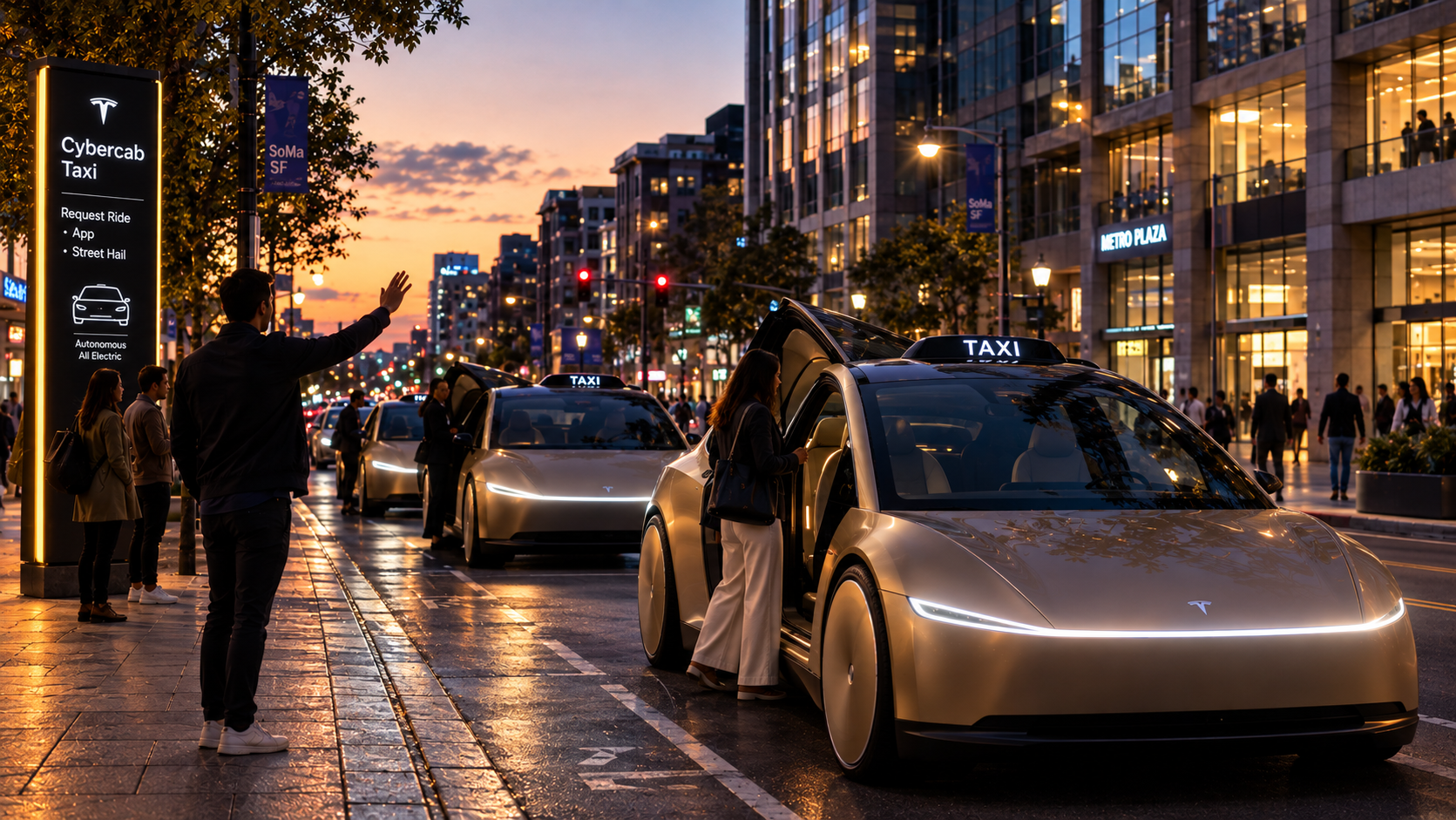
Tesla will unveil the production version of its Cybercab at a launch event in Austin on September 3, according to invitations that surfaced among Tesla watchers over the weekend and were subsequently confirmed by outlets covering the electric vehicle industry. The vehicle itself is notable for what it lacks: no steering wheel, no pedals, a two-seat design built entirely around autonomy rather than adapted from an existing model. It represents Tesla’s first vehicle engineered purely to run on the company’s Full Self-Driving software as part of the robotaxi fleet the company launched in Austin last year using modified Model Ys.
Tesla shares were little changed on the unofficial confirmation, but the muted stock reaction understates just how much is actually riding on this vehicle’s success. Tesla’s current valuation carries a meaningful premium built on the assumption that the company can convert its robotaxi ambitions into an autonomous ride-hailing network at scale, in addition to selling Full Self-Driving subscriptions to private owners at software-like profit margins rather than traditional auto manufacturing margins. The Cybercab is the physical product meant to prove that thesis works.
A Competitive Landscape Just Got Clearer
The timing is notable for a second reason. Last week, the Nevada Transportation Authority unanimously approved permits clearing Tesla, Alphabet’s Waymo, and Uber to operate commercial robotaxis in Clark County, home to Las Vegas, authorizing up to 8,000 driverless vehicles over the next twelve months. Tesla secured the largest allocation at roughly 5,000 vehicles, though the company’s Cybercab chief engineer told regulators Tesla expects to actually field closer to 2,500 within the year, noting the 5,000 figure has always represented a ceiling rather than a target. Waymo, widely viewed as the current leader in autonomous ride-hailing, was cleared for up to 1,000 vehicles, while Uber secured roughly 1,100 combined through partnerships with Hyundai-backed Motional and Amazon’s Zoox unit.
That approval gives investors a genuinely useful, apples-to-apples comparison point across three major public companies, Tesla, Alphabet, and Uber, all racing toward commercial autonomous ride-hailing in the same market simultaneously. Local taxi and livery operators have already pushed back, warning of oversaturation and congestion risk, and Tesla still faces the harder task of proving to regulators and the public that a Cybercab can operate safely with genuinely no one in the driver’s seat, not just in a permitted market but at the commercial scale its valuation assumes.
For investors tracking the broader market beyond Tesla itself, this launch and the accompanying Nevada approval illustrate something worth watching closely: autonomous vehicle technology is no longer a distant, speculative theme confined to a single company’s investor presentations. It is now a live, permitted, multi-company competitive race playing out in real regulatory jurisdictions, with real vehicle counts attached. That shift creates downstream implications for smaller companies supplying the sensors, lidar systems, mapping software, and specialized components that every one of these robotaxi fleets, regardless of which company ultimately wins market share, will need in growing volume as commercial deployment expands beyond pilot markets like Austin and Las Vegas into additional cities over the coming years.