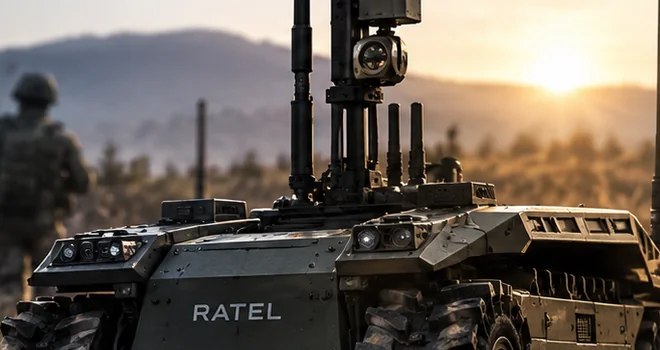
Swarmer, Inc. (NASDAQ: SWMR) announced Thursday that it has entered into a definitive agreement to acquire Ratel Robotics, a leading Ukrainian manufacturer of unmanned ground vehicles, in a transaction valued at up to $224 million if all earnout milestones are achieved.
The acquisition would mark Swarmer’s first major deal under Chairman Erik Prince and significantly expand the company beyond autonomous drone software by adding a portfolio of combat-proven ground vehicles already being used in Ukraine for logistics, casualty evacuation, reconnaissance, demining and drone-launch missions.
The consideration will consist of a mix of cash and stock, with closing subject to customary legal, regulatory and shareholder approvals. More than 300 Ratel employees are expected to join Swarmer following the transaction, bringing the combined company to nearly 500 employees. Ratel founder and CEO Taras Ostapchuk is expected to remain in his role and report to Swarmer President and U.S. CEO Alex Fink.
From Drone Software to a Broader Autonomous Platform
Swarmer has built its business around vendor-agnostic autonomy software designed to allow a single operator to control large numbers of unmanned systems in real time. Its technology focuses on swarm coordination, distributed decision-making and integration across multiple unmanned platforms rather than manufacturing individual drones itself.
The company says its systems have supported more than 100,000 real-world combat missions in Ukraine since first being deployed there in April 2024. That operating history has given Swarmer access to large amounts of battlefield telemetry, sensor data and operational feedback that can be used to improve autonomous performance and resilience.
Ratel adds the hardware side of that equation. Its unmanned ground vehicles are designed for missions that place soldiers at particularly high risk, including supply delivery, casualty evacuation, engineering operations, mine clearance and strike support. The company is also expanding into unmanned aerial systems, mobile workshops and solar-powered trailers.
For Swarmer, the strategic logic is to combine its autonomy software with a broader base of battlefield-tested platforms rather than remaining solely at the software layer.
Ratel Brings Scale and Existing Defense Contracts
Ratel is not an early-stage prototype developer. The company has already secured approximately $86 million in contracts this year and is in discussions with multiple NATO countries through the “Build With Ukraine” initiative.
According to Swarmer, Ratel products represented approximately 37% of the 11 billion Ukrainian hryvnia, or roughly $247 million, spent by Ukraine’s Ministry of Defense Procurement Agency on unmanned ground vehicle contracts between January 1 and April 18, 2026.
That installed base is particularly important in a defense market increasingly emphasizing systems that have already been tested in active combat environments. Ratel’s serial Ratel H and Ratel M vehicles carry NATO stock numbers and AQAP 2110 certification, giving the company a foundation for expansion beyond Ukraine.
Ground Robots Are Becoming a Bigger Part of Modern Warfare
The acquisition also reflects a broader shift in defense technology. Ukraine has become one of the world’s most active proving grounds for unmanned systems, with aerial drones receiving much of the attention early in the war. Ground robotics, however, are increasingly being used for missions where sending personnel creates unnecessary risk, including logistics, reconnaissance, casualty evacuation and perimeter support.
That trend fits directly with Swarmer’s view of Ratel’s vehicles as more than standalone ground robots. Management believes UGVs can serve as mobile launch platforms for drones, interceptors and other autonomous assets, creating integrated systems that operate across both ground and air domains.
Consolidation Comes to Ukraine’s Defense-Tech Industry
The transaction may also be significant as an early example of consolidation within Ukraine’s highly fragmented defense-technology sector. The country has developed hundreds of drone and robotics companies during the war, many of which have built products quickly around immediate battlefield requirements. That decentralized ecosystem helped accelerate innovation, but it has also produced a large number of relatively small manufacturers that can face difficulty scaling production, accessing Western capital and selling into larger NATO procurement programs.
Swarmer itself appears to be positioning the transaction as the beginning of a broader platform strategy. Prince has said the company intends to assemble battlefield-tested systems into a more integrated defense-technology offering, suggesting additional acquisitions could eventually follow.
Building an Integrated Autonomous Defense Company
For investors, the acquisition changes the profile of Swarmer in an important way. Until now, the company’s core value proposition has centered on the software layer — providing autonomy, coordination and decision-making capabilities that can work across different unmanned platforms. Ratel would add manufacturing, physical systems, existing government contracts and a sizable workforce operating directly inside Ukraine’s defense ecosystem.
That combination could allow Swarmer to pursue larger integrated programs while continuing to deploy its autonomy technology across third-party systems. Ratel extends that strategy onto the ground.
If the transaction closes and the two companies successfully integrate their technologies, Swarmer would emerge with a much broader portfolio spanning autonomous software, aerial systems and unmanned ground vehicles — all built around technologies that have already been exposed to real-world combat conditions.
For a defense industry increasingly focused on autonomy, interoperability and reducing the number of personnel placed in high-risk environments, that could make the Ratel acquisition more than simply an expansion of Swarmer’s product catalog. It could be an early step toward building a larger, multi-domain autonomous defense platform.
Investors following the broader defense technology sector can also explore Noble Capital Markets coverage of T3 Defense (NASDAQ: DFNS), a defense-focused holding company pursuing growth through acquisitions, and Kratos Defense & Security Solutions (NASDAQ: KTOS), whose portfolio includes unmanned systems and other national security technologies.