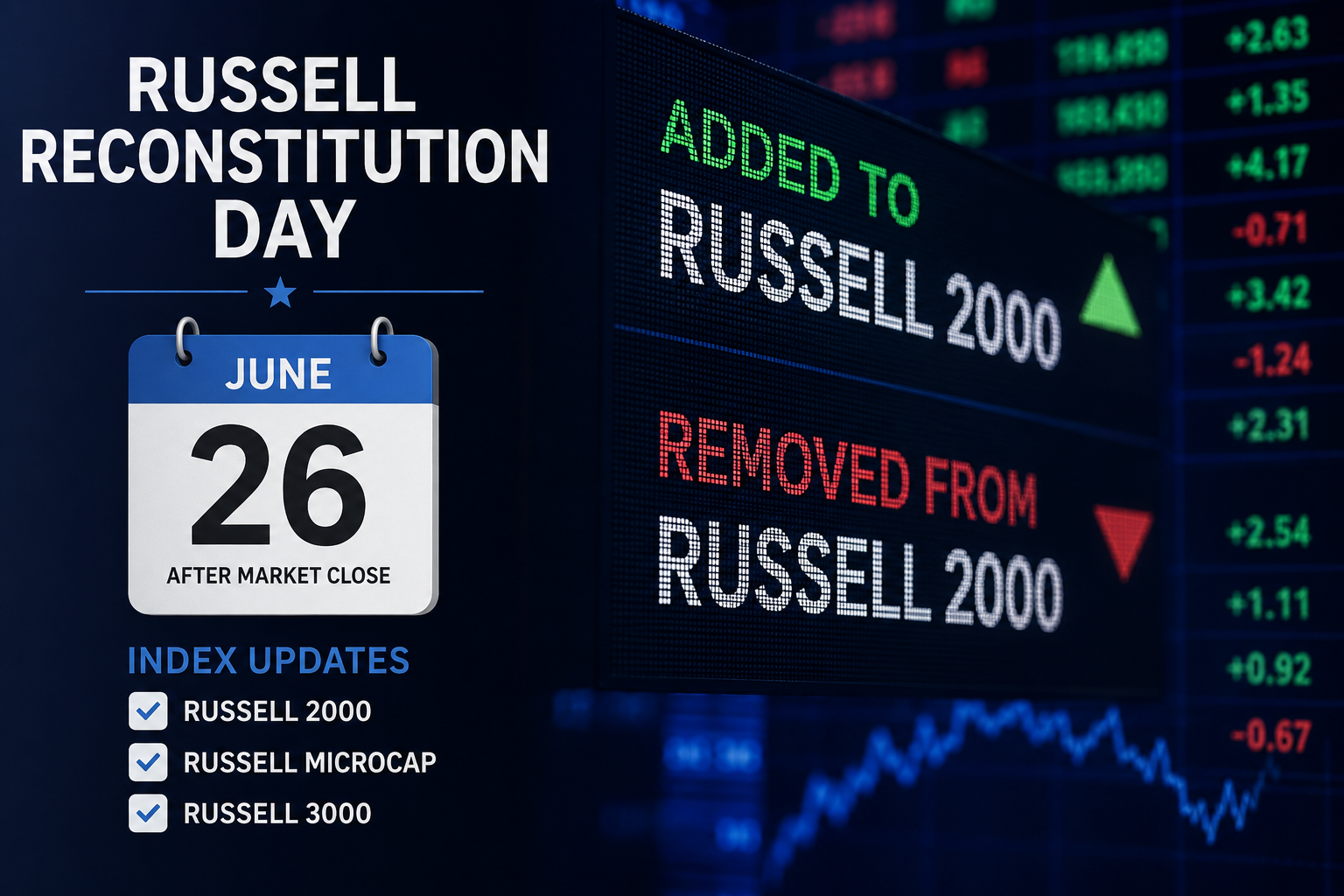
The annual Russell Index reconstitution becomes official after the market closes on Friday, June 26, setting the stage for one of the busiest trading sessions of the year for small-cap stocks.
While the event occurs every June, this year’s reconstitution arrives amid renewed investor interest in small caps and follows a strong first half for many emerging growth companies. As index funds and ETFs rebalance portfolios to reflect the new membership lists, millions of shares are expected to change hands during Friday’s closing auction.
For companies being added to the Russell 2000 and Russell Microcap indexes, inclusion can provide increased visibility, improved liquidity, and exposure to a broader institutional investor base.
Hundreds of Companies Set to Join Russell Indexes
FTSE Russell’s preliminary lists show hundreds of companies scheduled for addition across the Russell index family. The Russell 2000 is expected to add more than 200 companies, while numerous smaller firms will enter the Russell Microcap Index.
Several notable additions have already attracted investor attention, particularly among healthcare, technology, industrial, and defense-related companies. Healthcare remains the largest source of new additions, reflecting the continued recovery in small-cap biotech valuations. Technology and industrial companies also represent a significant portion of new constituents.
Why Friday Matters
The actual reconstitution occurs during the closing auction on Friday, often producing extraordinary trading volumes in affected stocks.
Passive funds tracking Russell indexes must adjust their holdings to match the updated index composition. This creates concentrated buying in newly added companies and selling in stocks being removed.
For some smaller companies, the volume traded during the closing auction can exceed multiple days’ worth of normal trading activity.
Historically, stocks scheduled for inclusion often experience elevated volume leading into reconstitution day as traders attempt to position ahead of index fund purchases. The largest impact, however, typically occurs during the final minutes of trading on the effective date.
Institutional Visibility Can Be a Catalyst
Although index inclusion does not change a company’s fundamentals, it can increase awareness among institutional investors that may have previously overlooked the stock.
For smaller companies, particularly those transitioning from micro-cap status, Russell inclusion often serves as a milestone. Increased liquidity can improve trading efficiency, broaden ownership, and potentially attract additional analyst coverage.
Investors should remember that index inclusion alone rarely drives long-term performance. Ultimately, earnings growth, execution, and capital allocation remain the primary determinants of shareholder returns.
Looking Beyond Reconstitution Day
Once Friday’s rebalance is complete, attention will shift from index mechanics back to fundamentals.
Nevertheless, Russell reconstitution remains one of the most important annual events for the small-cap market. For investors, it provides a snapshot of which companies have achieved sufficient scale and market value to earn inclusion in one of the most widely followed small-cap benchmarks.
As the closing bell approaches on Friday, traders and portfolio managers alike will be watching closely as billions of dollars are repositioned across the small-cap landscape.
Notable Companies Joining the Russell Indexes
This year’s reconstitution includes companies from a wide range of industries, underscoring the diversity of today’s small-cap market. Among the companies expected to be added to the Russell indexes are Conduent (NASDAQ: CNDT), Star Equity Holdings (NASDAQ: STRR), The Beachbody Company (NYSE: BODI), Vince Holding Corp. (NYSE: VNCE), Commercial Vehicle Group (NASDAQ: CVGI), FreightCar America (NASDAQ: RAIL), Ocugen (NASDAQ: OCGN), Twin Disc (NASDAQ: TWIN), and Unicycive Therapeutics (NASDAQ: UNCY).
The additions span sectors including business services, industrials, consumer discretionary, transportation, healthcare, and technology. Russell membership is determined through FTSE Russell’s annual reconstitution process, which ranks eligible U.S. companies by market capitalization and other index criteria. The final index changes become effective after the market closes on June 27.