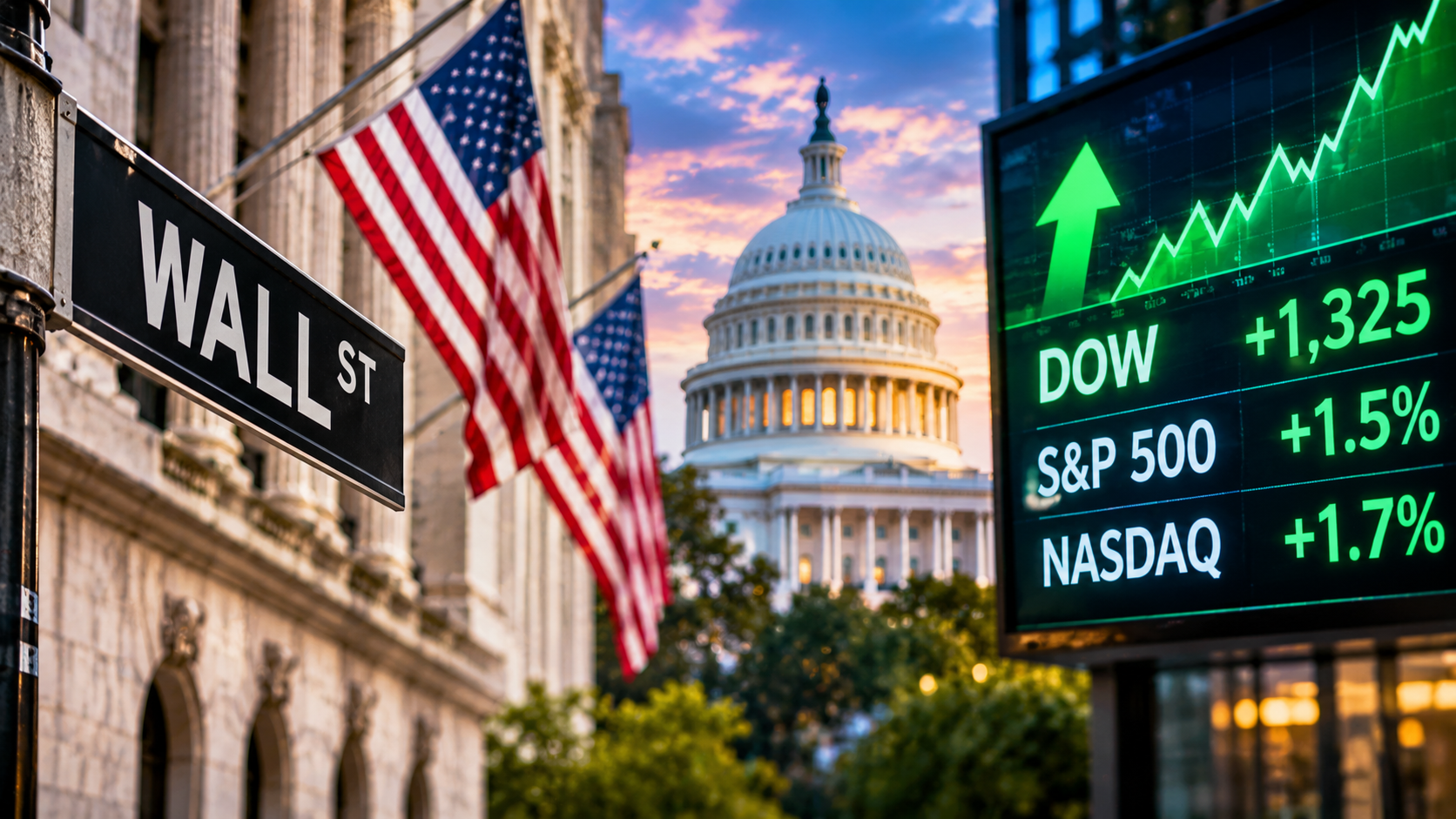
U.S. stocks surged Wednesday, November 4, with the Dow Jones Industrial Average climbing more than 1,000 points after Democrats won control of both chambers of Congress in the 2026 midterm elections. The rally reflected investors’ reassessment of the political landscape in Washington, with expectations that divided government could limit sweeping policy changes while creating new opportunities and risks across major sectors.
By late morning, the Dow had gained approximately 1,325 points, or 2.6%, while the S&P 500 advanced 1.5% and the Nasdaq Composite rose 1.7%. The gains followed a volatile period for technology stocks as investors weighed concerns about artificial intelligence spending, corporate earnings, and geopolitical uncertainty.
Tuesday’s election results marked a significant change in Washington, ending two years of unified Republican control of Congress and giving Democrats majorities in both the House of Representatives and Senate.
President Donald Trump will remain in office, creating a divided government in which major legislative proposals may face greater challenges securing congressional approval.
For Wall Street, the prospect of legislative gridlock can sometimes provide reassurance by reducing uncertainty surrounding major changes to tax policy, government spending, and business regulation. However, the implications will depend on how lawmakers approach negotiations over federal budgets, healthcare, energy policy, and other economic priorities.
Several sectors experienced notable moves following the election.
Renewable energy stocks rallied as investors considered whether Democratic control of Congress could influence federal energy policy and oversight. Solar and wind companies attracted renewed attention, while traditional oil producers faced pressure amid declining crude prices and changing expectations for energy legislation.
Healthcare companies also advanced, particularly hospitals and businesses exposed to federal healthcare programs. Investors assessed whether the new congressional balance could affect healthcare funding and previous changes to government assistance programs.
Technology stocks delivered a mixed performance.
Apple and Microsoft helped support the broader market, while several semiconductor companies faced selling pressure amid concerns that new political leadership could increase scrutiny of artificial intelligence infrastructure and data-center construction.
The election also raised questions about the future of federal support for rapidly expanding AI facilities, particularly as concerns grow about electricity consumption, environmental impacts, and the cost of new infrastructure.
For smaller technology companies supplying components, equipment, and services to data centers, potential changes in permitting and infrastructure policy could influence future investment decisions.
Treasury yields declined during Wednesday’s session, with the benchmark 10-year yield falling to approximately 4.92%. Lower yields can improve borrowing conditions and support stock valuations, particularly among companies that depend on external financing.
Small-cap businesses are often more sensitive to changes in interest rates because they generally have less access to capital markets than larger corporations and may rely more heavily on bank loans or floating-rate debt.
The election outcome could also affect federal spending priorities in defense, infrastructure, and healthcare, industries where government contracts and reimbursement policies play an important role in corporate revenue.
However, congressional control does not automatically translate into immediate changes in economic policy.
The president retains significant executive authority over trade, tariffs, and foreign policy, while major legislative changes typically require agreement between Congress and the White House.
Investors must also consider broader economic conditions beyond the election.
Wednesday’s market rally coincided with new employment data showing that U.S. private employers added 86,000 jobs in October, exceeding economists’ expectations and suggesting that hiring activity remains resilient despite concerns about a slowing labor market.
Corporate earnings, inflation trends, and Federal Reserve policy will continue to influence market performance in the months ahead.
Although historical data suggests stocks have frequently performed well following midterm elections, past results do not guarantee future returns.
For investors, Wednesday’s rally demonstrates how quickly markets can respond to political developments, but the longer-term outlook will depend on how the new congressional balance affects economic legislation, corporate investment, and business confidence.
As Washington prepares for a new political environment, attention will increasingly shift from election results to the policies that emerge and their implications for publicly traded companies heading into 2027.