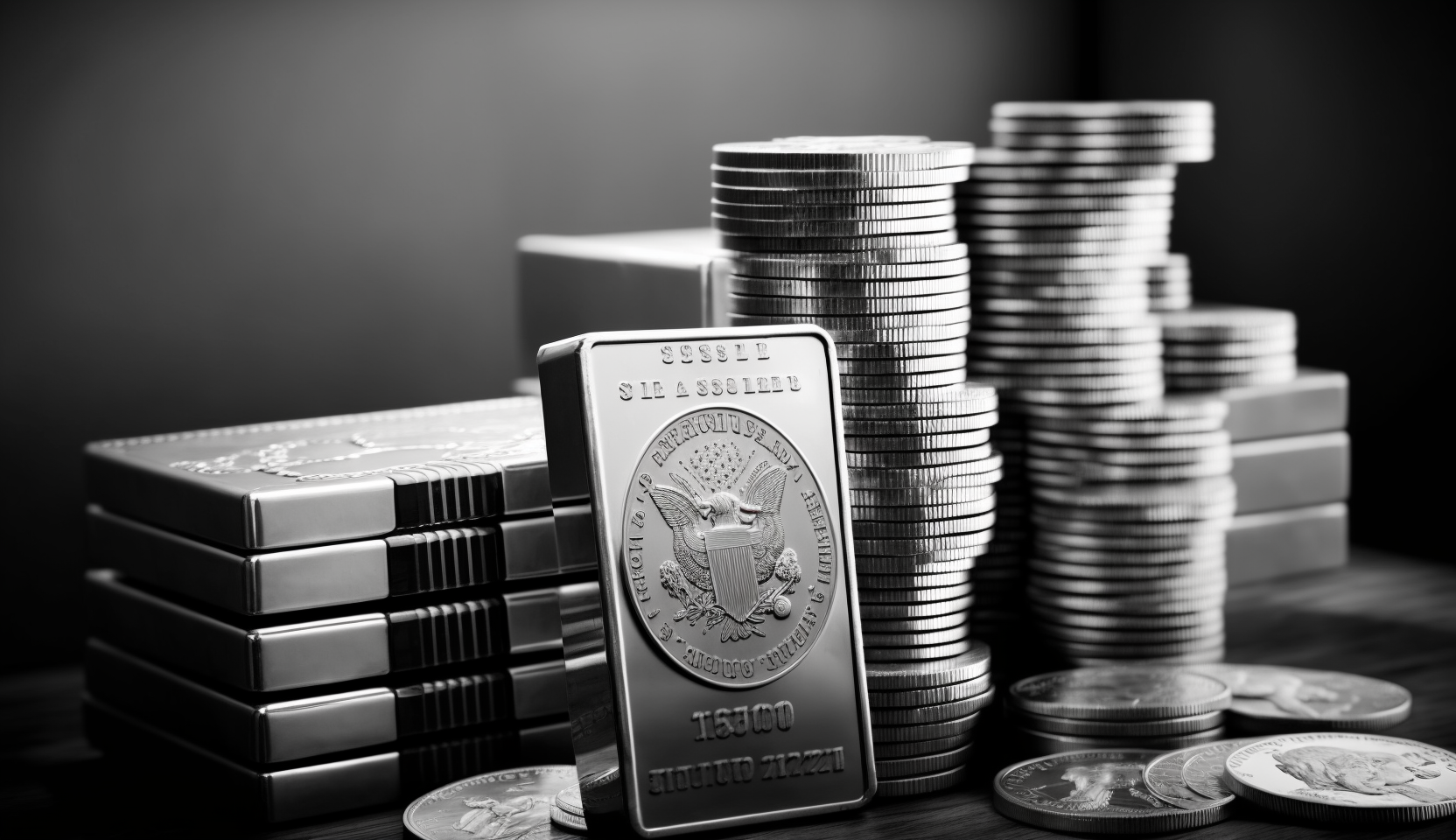
Gold and silver prices suffered a brutal reversal on Friday, marking one of the sharpest pullbacks in modern precious metals trading as a crowded bullish trade rapidly unwound. Gold futures plunged as much as 11%, briefly falling below $4,800 per ounce before stabilizing near $4,900, while silver collapsed more than 25% in its steepest one-day decline on record. The violent sell-off followed months of near-parabolic gains that had pushed both metals to historic highs and attracted increasingly speculative positioning.
The sudden reversal unfolded amid a broader risk-off move across global markets. Equities sold off sharply after President Trump nominated former Federal Reserve governor Kevin Warsh to succeed Jerome Powell as Fed chair, a decision markets interpreted as potentially restoring a more hawkish tilt to monetary policy. The US dollar strengthened in response, with the dollar index rising nearly 1%, adding pressure to metals that had benefited heavily from dollar weakness earlier this year.
Strategists largely agreed that the sell-off, while extreme, was not entirely unexpected. “The higher metals rise, the more likely 2026 will mark enduring price peaks — notably for silver — if history is a guide,” Bloomberg Intelligence senior commodity strategist Mike McGlone wrote, pointing to the speed and magnitude of the rally as warning signs. Gold and silver had become emblematic of the so-called “debasement trade,” fueled by expectations of aggressive rate cuts, fiscal expansion, and declining confidence in fiat currencies.
Ole Hansen, head of commodity strategy at Saxo Bank, warned earlier this week that the metals rally was entering a “dangerous phase.” According to Hansen, volatility itself became the catalyst for collapse. As price swings intensified, liquidity thinned, making the market vulnerable to forced selling. Once prices began to fall, leveraged positions were quickly unwound, accelerating losses and overwhelming buyers.
Gold’s rally had been particularly striking. Just days earlier, prices surged past $5,500 per ounce after the Federal Reserve held rates steady and Chair Jerome Powell offered limited resistance to a weakening dollar. Goldman Sachs had recently reiterated a bullish year-end target of $5,400, citing increased participation from private-sector investors and sustained demand for inflation hedges. That optimism evaporated quickly as sentiment flipped from fear of missing out to fear of being last out.
Silver’s decline was even more dramatic. After topping $120 per ounce earlier this week, the metal fell to around $87, still up roughly 28% year to date but far removed from its peak. Silver’s dual role as both a monetary and industrial metal tends to amplify volatility, and its explosive rise in 2025 left prices especially vulnerable to sharp corrections. JPMorgan analysts had cautioned earlier this month that silver had “significantly overshot” forecasted averages, even as they acknowledged the difficulty of calling a top in a momentum-driven market.
Despite the scale of the drop, some analysts argue the long-term bull case for precious metals may not be fully broken. Persistent fiscal deficits, geopolitical uncertainty, and structural shifts in global reserves could continue to support gold over time. Still, Friday’s crash served as a stark reminder that even the most compelling macro narratives can unravel quickly when trades become crowded — and that volatility cuts both ways.
TULSA, Okla.–(BUSINESS WIRE)– Alliance Resource Partners, L.P. (NASDAQ: ARLP) (“ARLP” or the “Partnership”) announced today that its subsidiary, Mettiki Coal (WV), LLC (“Mettiki”), issued Worker Adjustment and Retraining Notification (“WARN”) Act notices to all employees of Mettiki’s Mountain View Mine near Tucker County, West Virginia.
“Mettiki has a long operating history, having been part of ARLP and its predecessor entities for nearly 50 years,” said Joseph W. Craft, III, Chairman, President and Chief Executive Officer. “We recognize today’s announcement will affect families and communities that have supported this mine for generations, and that decision weighs heavily on us.”
Mr. Craft continued, “Unfortunately, a series of planned and unplanned outages at a key customer’s plant negatively impacted their demand and our shipments in 2025. We have recently been informed that the plant expects additional outages during 2026 and based upon current demand projections and contractual commitments for 2026, they are not in a position to commit to purchase any additional tons from Mettiki for the foreseeable future. Due to the location of the mine and the low-volatile quality of coal the mine produces, Mettiki’s livelihood depends on this customer purchasing a minimum of one million tons per year for it to be viable under its existing operating plan. With no clear alternative customer to absorb production, issuing WARN Act notices became an unavoidable step. We remain committed to open communication with our employees and community partners as we move forward.”
The Mettiki mine, an indirect wholly-owned subsidiary of ARLP, currently employs approximately two hundred employees. Mettiki’s full year coal sales and production volumes for 2025 was approximately 1.2 million tons, with 300 thousand tons shipped to the export metallurgical market and the balance to the key customer’s plant in question.
As of January 29, 2026, Mettiki expects to fulfill its existing contractual commitments, which are scheduled to conclude in March 2026, primarily from existing inventory. Production will immediately cease, giving Mettiki time to evaluate its options concerning the mine’s future and the exact timing for permanent closure. Mettiki employees not involved in the reduced production of coal will focus efforts on reclamation activities, as needed, throughout the Mountain View Mine.
The Partnership will reflect the anticipated impact of reduced sales volumes at Mettiki in its 2026 guidance, which is scheduled to be announced on February 2, 2026. For the year ended December 31, 2025, Segment Adjusted EBITDA less capital expenditures attributable to the operation was approximately $3.5 million. Additionally, the Partnership will evaluate any potential impairment related to this decision during the first quarter of 2026.
About Alliance Resource Partners, L.P.
ARLP is a diversified energy company that is currently the second largest coal producer in the eastern United States, supplying reliable, affordable energy domestically and internationally to major utilities, metallurgical and industrial users. ARLP also generates operating and royalty income from mineral interests it owns in strategic coal and oil & gas producing regions in the United States. In addition, ARLP is positioning itself as a reliable energy partner for the future by pursuing opportunities that support the growth and development of energy and related infrastructure.
News, unit prices and additional information about ARLP, including filings with the Securities and Exchange Commission (“SEC”), are available at www.arlp.com. For more information, contact the investor relations department of ARLP at (918) 295-7673 or via e-mail at investorrelations@arlp.com.
The statements and projections used throughout this release are based on current expectations. These statements and projections are forward-looking, and actual results may differ materially. These projections do not include the potential impact of any mergers, acquisitions or other business combinations that may occur after the date of this release. We have included more information below regarding business risks that could affect our results.
FORWARD-LOOKING STATEMENTS: With the exception of historical matters, any matters discussed in this press release are forward-looking statements that involve risks and uncertainties that could cause actual results to differ materially from projected results. Those forward-looking statements include expectations with respect to our future financial and operational performance, coal and oil & gas consumption and expected future prices, our ability to increase or maintain unitholder distributions in future quarters, business plans and potential growth with respect to our energy and infrastructure transition investments, optimizing cash flows, reducing operating and capital expenditures, infrastructure projects at our existing properties, growth in domestic electricity demand, preserving liquidity and maintaining financial flexibility, our future repurchases of units, and the impact of recently announced tax legislation. These risks to our ability to achieve these outcomes include, but are not limited to, the following: decline in the coal industry’s share of electricity generation, including as a result of environmental concerns related to coal mining and combustion, the cost and perceived benefits of other sources of electricity and fuels, such as oil & gas, nuclear energy, and renewable fuels and the planned retirement of coal-fired power plants in the U.S.; our ability to provide fuel for growth in domestic energy demand, should it materialize; changes in macroeconomic and market conditions and market volatility, and the impact of such changes and volatility on our financial position; changes in global economic and geo-political conditions or changes in industries in which our customers operate; changes in commodity prices, demand and availability which could affect our operating results and cash flows; the effects of a prolonged government shutdown; impacts of geopolitical events, including the conflicts in Ukraine and in the Middle East; the severity, magnitude and duration of any future pandemics and impacts of such pandemics and of businesses’ and governments’ responses to such pandemics on our operations and personnel, and on demand for coal, oil, and natural gas, the financial condition of our customers and suppliers and operators, available liquidity and capital sources and broader economic disruptions; actions of the major oil-producing countries with respect to oil production volumes and prices and the direct and indirect impacts over the near and long term on oil & gas exploration and production operations at the properties in which we hold mineral interests; changes in competition in domestic and international coal markets and our ability to respond to such changes; potential shut-ins of production by the operators of the properties in which we hold oil & gas mineral interests due to low commodity prices or the lack of downstream demand or storage capacity; risks associated with the expansion of and investments into the infrastructure of our operations and properties, including the timing of such investments coming online; our ability to identify and complete acquisitions and to successfully integrate such acquisitions into our business and achieve the anticipated benefits therefrom; our ability to identify and invest in new energy and infrastructure transition ventures; the success of our development plans for our wholly owned subsidiary, Matrix Design Group, LLC, and our investments in emerging and other infrastructure and technology companies; dependence on significant customer contracts, including renewing existing contracts upon expiration; adjustments made in price, volume, or terms to existing coal supply agreements; the effects of and changes in trade, monetary and fiscal policies and laws, and the results of central bank policy actions including interest rates, bank failures, and associated liquidity risks; the effects of and changes in taxes or tariffs and other trade measures adopted by the United States and foreign governments, including the imposition of or increase in tariffs on steel and/or other raw materials; legislation, regulations, and court decisions and interpretations thereof, both domestic and foreign, including those relating to the environment and the release of greenhouse gases, such as the Environmental Protection Agency’s emissions regulations for coal-fired power plants, and state legislation seeking to impose liability on a wide range of energy companies under greenhouse gas “superfund” laws, mining, miner health and safety, hydraulic fracturing, and health care; deregulation of the electric utility industry or the effects of any adverse change in the coal industry, electric utility industry, or general economic conditions; investors’ and other stakeholders’ attention to environmental, social, and governance matters; liquidity constraints, including those resulting from any future unavailability of financing; customer bankruptcies, cancellations or breaches to existing contracts, or other failures to perform; customer delays, failure to take coal under contracts or defaults in making payments; our productivity levels and margins earned on our coal sales; disruptions to oil & gas exploration and production operations at the properties in which we hold mineral interests; changes in equipment, raw material, service or labor costs or availability, including due to inflationary pressures; changes in our ability to recruit, hire and maintain labor; our ability to maintain satisfactory relations with our employees; increases in labor costs, adverse changes in work rules, or cash payments or projections associated with workers’ compensation claims; increases in transportation costs and risk of transportation delays or interruptions; operational interruptions due to geologic, permitting, labor, weather, supply chain shortage of equipment or mine supplies, or other factors; risks associated with major mine-related accidents, mine fires, mine floods or other interruptions; results of litigation, including claims not yet asserted; foreign currency fluctuations that could adversely affect the competitiveness of our coal abroad; difficulty maintaining our surety bonds for mine reclamation as well as workers’ compensation and black lung benefits; difficulty in making accurate assumptions and projections regarding post-mine reclamation as well as pension, black lung benefits, and other post-retirement benefit liabilities; uncertainties in estimating and replacing our coal mineral reserves and resources; uncertainties in estimating and replacing our oil & gas reserves; uncertainties in the amount of oil & gas production due to the level of drilling and completion activity by the operators of our oil & gas properties; uncertainties in the future of the electric vehicle industry and the market for EV charging stations; the impact of current and potential changes to federal or state tax rules and regulations, including a loss or reduction of benefits from certain tax deductions and credits; difficulty obtaining commercial property insurance, and risks associated with our participation in the commercial insurance property program; evolving cybersecurity risks, such as those involving unauthorized access, denial-of-service attacks, malicious software, data privacy breaches by employees, insiders or others with authorized access, cyber or phishing attacks, ransomware, malware, social engineering, physical breaches, or other actions; and difficulty in making accurate assumptions and projections regarding future revenues and costs associated with equity investments in companies we do not control.
Additional information concerning these, and other factors can be found in ARLP’s public periodic filings with the SEC, including ARLP’s Annual Report on Form 10-K for the year ended December 31, 2024, filed on February 27, 2025, and ARLP’s Quarterly Reports on Form 10-Q for the quarters ended March 31, 2025, June 30, 2025 and September 30, 2025, filed on May 9, 2025, August 7, 2025 and November 7, 2025, respectively. Except as required by applicable securities laws, ARLP does not intend to update its forward-looking statements.
Investor Relations Contact Cary P. Marshall Senior Vice President and Chief Financial Officer 918-295-7673 investorrelations@arlp.com
Toronto, Ontario–(Newsfile Corp. – January 29, 2026) – Aurania Resources Ltd. (TSXV: ARU) (OTCQB: AUIAF) (FSE: 20Q) (“Aurania” or the “Company”) announces that its Chairman, President and Chief Executive Officer, Dr. Keith Barron (the “Lender”) has agreed to provide a loan of up to C$750,000 to the Company to be advanced from time to time in principal amounts as agreed by the parties (the “Loan”).
Dr. Keith Barron commented, “This loan provides the Company with additional working capital to continue advancing its projects while preserving shareholder value. Importantly, this structure avoids immediate dilution and reflects my confidence in our strategy and our projects as we continue work on multiple fronts.”
The Loan is unsecured, bears interest at 2% per annum and matures twelve months and one day after demand for repayment is given by the Lender, which may be provided at any time following the date hereof. The proceeds of the Loan will be used to fund the Company’s preliminary economic assessment on the Balangero tailings retreatment project in Italy, including related laboratory/assay fees, and general working capital.
Dr. Keith Barron is a related party of the Company by virtue of the fact that he is the Chairman, the President and Chief Executive Officer, a promoter and a principal shareholder of the Company, and as a result, each advance and repayment under the Loan constitutes a “Related Party Transaction” for the purposes of Multilateral Instrument 61-101 – Protection of Minority Security Holders in Special Transactions (“MI 61-101”). The Company is relying upon an exemption from the formal valuation and minority shareholder approval requirements under MI 61-101 in respect of the Related Party Transactions, in reliance on Sections 5.5(a) and 5.7(1) of MI 61-101, respectively, as the fair market value of the Related Party Transaction, collectively, does not exceed 25% of the Company’s market capitalization, as determined in accordance with MI 61-101. The Company did not file a material change report related to the Loan more than 21 days before the expected closing of the Loan as required by MI 61-101, as the Company wished to organize the Loan on an expedited basis for sound business reasons.
The Loan was approved by the members of the board of directors of the Company who are independent for purposes of the related party transaction, being all directors other than Dr. Barron. No special committee was established in connection with the Loan, and no materially contrary view or abstention was expressed or made by any director of the Company in relation thereto.
About Aurania Aurania is a mineral exploration company engaged in the identification, evaluation, acquisition, and exploration of mineral property interests, with a focus on precious metals and critical energy in Europe and abroad.
Neither the TSX Venture Exchange nor its Regulation Services Provider (as that term is defined in the policies of the TSX Venture Exchange) accepts responsibility for the adequacy or accuracy of this release.
Forward-Looking Statements This news release contains forward-looking information as such term is defined in applicable securities laws, which relate to future events or future performance and reflect management’s current expectations and assumptions. The forward-looking information includes Aurania’s objectives, goals, future plans or other statements of intent, Aurania’s ongoing engagement in the identification, evaluation, acquisition and exploration of mineral property interests, and any potential exploration results or potential mineralization resulting therefrom, Aurania’s ongoing exploration efforts in France, Italy, Ecuador and abroad, potential additional advances pursuant to the Loan, eventual repayment of the Loan or any part thereof by Aurania, and the use by Aurania of funds received pursuant to the Loan Such forward-looking statements reflect management’s current beliefs and are based on assumptions made by and information currently available to Aurania, including the assumption that, there will be no material adverse change in metal prices and all necessary consents, licenses, permits and approvals will be obtained, including various local government licenses and the market. Investors are cautioned that these forward-looking statements are neither promises nor guarantees and are subject to risks and uncertainties that may cause future results to differ materially from those expected. Risk factors that could cause actual results to differ materially from the results expressed or implied by the forward-looking information include, among other things, the state of the capital markets generally and of the mining markets more particularly, any commodity prices supply chain disruptions, restrictions on labour and workplace attendance and local and international travel due to war, weather, pandemics or otherwise; a failure to obtain or delays in obtaining the required regulatory licenses, permits, approvals and consents; an inability to access financing as needed, including pursuant to the Loan; a general economic downturn, a volatile stock price, labour strikes, political unrest, changes in the mining regulatory regime governing Aurania; a failure to comply with environmental regulations; a weakening of market and industry reliance on precious metals, copper and critical minerals; and those risks set out in the Company’s public documents filed on SEDAR+. Aurania cautions the reader that the above list of risk factors is not exhaustive. Although the Company believes that the assumptions and factors used in preparing the forward-looking information in this news release are reasonable, undue reliance should not be placed on such information, which only applies as of the date of this news release, and no assurance can be given that such events will occur in the disclosed time frames or at all. The Company disclaims any intention or obligation to update or revise any forward-looking information, whether as a result of new information, future events or otherwise, other than as required by law.
ARLP is a diversified natural resource company that generates operating and royalty income from coal produced by its mining complexes and royalty income from mineral interests it owns in strategic oil & gas producing regions in the United States, primarily the Permian, Anadarko and Williston basins. ARLP currently produces coal from seven mining complexes its subsidiaries operate in Illinois, Indiana, Kentucky, Maryland and West Virginia. ARLP also operates a coal loading terminal on the Ohio River at Mount Vernon, Indiana. ARLP markets its coal production to major domestic and international utilities and industrial users and is currently the second largest coal producer in the eastern United States. In addition, ARLP is positioning itself as an energy provider for the future by leveraging its core technology and operating competencies to make strategic investments in the fast growing energy and infrastructure transition.
Mark Reichman, Managing Director, Equity Research Analyst, Natural Resources, Noble Capital Markets, Inc.
Hans Baldau, Associate Analyst, Noble Capital Markets, Inc.
Refer to the full report for the price target, fundamental analysis, and rating.
Fourth quarter and full year 2025 financial results. Alliance will report its fourth quarter and full year 2025 financial results before the market opens on Monday, February 2, 2026. Management will host an investor conference call and webcast the same day at 10:00 am ET. Along with the 2025 operational and financial results, we expect ARLP to release its 2026 corporate guidance and outlook.
Noble Estimates. We forecast fourth quarter 2025 revenue, EBITDA, and EPU of $560.1 million, $182.9 million, and $0.57, respectively. Our full year 2025 revenue, EBITDA, and EPU estimates are $2.2 billion, $690.5 million, and $2.33, respectively. Our fourth quarter EPU estimate reflects an expected unrealized and non-cash loss on the marked-to-market value of ARLP’s bitcoin holdings, which has no impact on our EBITDA estimate. We forecast 2026 revenue, EBITDA, and EPU of $2.3 billion, $700.5 million, and $2.65, respectively.
Equity Research is available at no cost to Registered users of Channelchek. Not a Member? Click ‘Join’ to join the Channelchek Community. There is no cost to register, and we never collect credit card information.
This Company Sponsored Research is provided by Noble Capital Markets, Inc., a FINRA and S.E.C. registered broker-dealer (B/D).
*Analyst certification and important disclosures included in the full report. NOTE: investment decisions should not be based upon the content of this research summary. Proper due diligence is required before making any investment decision.
TULSA, Okla.–(BUSINESS WIRE)–Alliance Resource Partners, L.P. (NASDAQ: ARLP) today announced that the Board of Directors of ARLP’s general partner approved a cash distribution to its unitholders for the quarter ended December 31, 2025 (the “2025 Quarter”).
ARLP unitholders of record as of the close of trading on February 6, 2026 will receive a cash distribution for the 2025 Quarter of $0.60 per unit (an annualized rate of $2.40 per unit), payable on February 13, 2026. The announced distribution is consistent with the cash distribution of $0.60 per unit for the quarter ended September 30, 2025.
As previously announced, ARLP will report financial results for the 2025 Quarter before the market opens on Monday, February 2, 2026 and Alliance management will discuss these results during a conference call beginning at 10:00 a.m. Eastern that same day.
To participate in the conference call, dial (877) 407-0784 and request to be connected to the Alliance Resource Partners, L.P. earnings conference call. International callers should dial (201) 689-8560 and request to be connected to the same call. Investors may also listen to the call via the “Investors” section of ARLP’s website at www.arlp.com.
An audio replay of the conference call will be available for approximately one week. To access the audio replay, dial U.S. Toll Free (844) 512-2921; International Toll (412) 317-6671 and request to be connected to replay using access code 13757920.
Concurrent with this announcement we are providing qualified notice to brokers and nominees that hold ARLP units on behalf of non-U.S. investors under Treasury Regulation Section 1.1446-4(b) and (d) and Treasury Regulation Section 1.1446(f)-4(c)(2)(iii). Brokers and nominees should treat one hundred percent (100%) of ARLP’s distributions to non-U.S. investors as being attributable to income that is effectively connected with a United States trade or business. In addition, brokers and nominees should treat one hundred percent (100%) of the distribution as being in excess of cumulative net income for purposes of determining the amount to withhold. Accordingly, ARLP’s distributions to non-U.S. investors are subject to federal income tax withholding at a rate equal to the highest applicable effective tax rate plus ten percent (10%). Nominees, and not ARLP, are treated as the withholding agents responsible for withholding on the distributions received by them on behalf of non-U.S. investors.
About Alliance Resource Partners, L.P.
ARLP is a diversified energy company that is currently the second largest coal producer in the eastern United States, supplying reliable, affordable energy domestically and internationally to major utilities, metallurgical and industrial users. ARLP also generates operating and royalty income from mineral interests it owns in strategic coal and oil & gas producing regions in the United States. In addition, ARLP is evolving and positioning itself as a reliable energy partner for the future by pursuing opportunities that support the growth and development of energy and related infrastructure.
News, unit prices and additional information about ARLP, including filings with the Securities and Exchange Commission (“SEC”), are available at www.arlp.com. For more information, contact the investor relations department of ARLP at (918) 295-7673 or via e-mail at investorrelations@arlp.com.
Contacts
Investor Relations Contact
Cary P. Marshall Senior Vice President and Chief Financial Officer 918-295-7673 investorrelations@arlp.com
Mark Reichman, Managing Director, Equity Research Analyst, Natural Resources, Noble Capital Markets, Inc.
Hans Baldau, Associate Analyst, Noble Capital Markets, Inc.
Refer to the full report for the price target, fundamental analysis, and rating.
Processing plant acquisition. Kuya Silver signed a Letter of Intent (LOI) to purchase 100% of SMRL Camila, the company that owns the Camila conventional flotation plant, for US$7.8 million, subject to closing conditions. The Camila plant is currently processing Kuya Silver’s mineralized material to produce silver and other metal concentrates on a toll-milling basis. The plant is located on a key transport corridor between the Bethania mine and Lima, Peru, where concentrate is shipped to port. Execution of a definitive agreement is subject to the completion of legal, financial, environmental, and technical due diligence.
Scalable processing capacity. The Camila plant currently operates at 150 metric tonnes per day with plans to increase production capacity to 300 to 350 tonnes per day, which Kuya Silver expects to undertake after closing the acquisition. The expansion is projected to require an additional capital investment in the range of US$0.7 million to US$1.0 million.
Equity Research is available at no cost to Registered users of Channelchek. Not a Member? Click ‘Join’ to join the Channelchek Community. There is no cost to register, and we never collect credit card information.
This Company Sponsored Research is provided by Noble Capital Markets, Inc., a FINRA and S.E.C. registered broker-dealer (B/D).
*Analyst certification and important disclosures included in the full report. NOTE: investment decisions should not be based upon the content of this research summary. Proper due diligence is required before making any investment decision.
The investment landscape entering 2026 has delivered an unmistakable verdict: when uncertainty strikes, capital flows to tangible assets. While cryptocurrencies continue to struggle with volatility and declining investor confidence, precious metals are shattering records in a historic surge that’s forcing investors to reconsider where true value resides.
In a stunning display of safe-haven demand, gold exploded past $5,100 per ounce in late January 2026, following a 65% gain throughout 2025. Silver achieved an even more extraordinary feat, soaring beyond $117 per ounce after rising over 200% in just 12 months. Platinum surged 121% while palladium rallied to breach $2,000 per ounce. This synchronized rally across all major precious metals represents the most significant wealth preservation movement in modern financial history.
Meanwhile, the cryptocurrency market tells a starkly different story. After finishing 2025 down 6% for Bitcoin and 11% for Ethereum, early 2026 has brought more pain. Bitcoin plunged below $90,000 in mid-January amid global risk-off sentiment, while Ethereum dropped below $3,000. Heavy liquidations continued to plague the market, with over $1 billion wiped out in a single January event as 182,000 traders saw their positions forcibly closed. Bitcoin ETFs recorded persistent outflows, with nearly $500 million exiting in late 2025 as investors lost confidence in digital assets.
The rotation from crypto to hard assets isn’t speculation—it’s quantifiable and accelerating. Gold funds attracted nearly $40 billion in 2025 alone, while gold mining funds soared 114% with $5.4 billion in net inflows during Q3—the largest quarterly move since 2009. Most tellingly, the Bitcoin-to-gold ratio collapsed by 50% throughout 2025 and continues to deteriorate. With gold now around $5,100 and Bitcoin at roughly $90,000, one bitcoin now buys less than 18 ounces of gold—down dramatically from highs where it purchased over 30 ounces.
Four converging forces explain this historic reallocation. The U.S. Dollar Index plummeted 10-11% in 2025, marking its worst performance in over five decades, driving investors urgently toward assets with intrinsic value. Goldman Sachs recently raised its December 2026 gold forecast to $5,400 per ounce. Federal Reserve rate cuts have made non-yielding assets like gold more attractive, while paradoxically failing to boost crypto as advocates predicted. Rising geopolitical tensions including tariff threats, military actions, and global debt fears have amplified safe-haven demand. Perhaps most critically, physical precious metals face real-world production limits—COMEX silver inventories plunged 26% in a single week in January 2026, triggering what analysts call a “run on the vaults” that pushed prices parabolic.
The market has spoken with unprecedented clarity: as gold breaches $5,100, silver soars past $117, and investment banks project gold could reach $6,000 by year-end, the evidence of a historic wealth rotation is irrefutable. When survival is at stake, investors don’t seek innovation—they seek preservation. And preservation, history repeatedly demonstrates, resides in physical assets that have maintained value for millennia, not digital tokens that have existed for barely a decade.
Rare earth stocks rallied sharply on Monday after the Trump administration announced a major equity investment in USA Rare Earth (NASDAQ: USAR), underscoring Washington’s escalating push to secure critical mineral supply chains and reduce reliance on China.
Shares of USA Rare Earth jumped as much as 12% following news that the company will receive $1.6 billion from the U.S. Department of Commerce in exchange for an equity stake. The deal also includes collaboration with the Department of Energy on a $1.3 billion loan package and an additional $277 million in federal funding. Industry peers such as MP Materials, Energy Fuels, and Trilogy Metals also saw early gains, reflecting renewed investor enthusiasm across the sector.
Under the agreement, USA Rare Earth will issue 16.1 million shares of common stock and approximately 17.6 million warrants to the Department of Commerce. The company simultaneously announced a $1.5 billion capital raise, significantly strengthening its balance sheet and accelerating development timelines.
The funding is expected to fast-track USA Rare Earth’s vertically integrated strategy, spanning mining, processing, and magnet manufacturing. Key assets include the company’s magnet plant in Stillwater, Oklahoma, and its Round Top rare earth deposit in West Texas, which is slated to begin commercial production in 2028. Once operational, these facilities could play a crucial role in supplying domestic demand for permanent magnets used in defense systems, electric vehicles, data centers, and advanced manufacturing.
This move fits squarely within a broader government strategy to onshore critical mineral production. China currently dominates global rare earth mining and processing, a strategic vulnerability the U.S. has been actively working to address. In 2025, the Pentagon became MP Materials’ largest shareholder after purchasing $400 million worth of stock. Similar government-backed deals were announced last year with Lithium Americas and Trilogy Metals.
Rare earth elements sit at the center of some of the fastest-growing and most strategically important industries, including artificial intelligence, defense technology, renewable energy, and advanced electronics. As AI data centers proliferate and defense spending increases, demand for these materials is expected to rise sharply over the coming decade.
Strategists argue that direct public-sector involvement materially changes the risk profile for rare earth miners. According to Sprott Asset Management, government participation enhances revenue visibility, mitigates project execution risk, and increases the likelihood that new capacity actually comes online. For investors, this reduces dependence on speculative capital markets and supports higher long-term valuations.
The geopolitical dimension is also intensifying. President Trump recently indicated that a future framework deal with NATO over Greenland could include access to rare earth mineral rights, signaling that resource security is becoming a core component of U.S. foreign and defense policy.
While rare earth stocks remain volatile and capital intensive, the growing alignment between government priorities and private miners provides a powerful tailwind. For small-cap investors, the sector is increasingly less about speculation and more about strategic relevance. As Washington continues to write checks—and take equity stakes—the message is clear: rare earths are now a national priority.
January 23, 2026 – MustGrow Biologics Corp. (TSXV: MGRO; OTC: MGROF; FRA: 0C0) (the “Company” or “MustGrow”), is pleased to announce: the closing of its previously announced non-brokered private placement of 4,000,000 units of the Company (each, a “Unit”) at a price of $0.50 per Unit for gross proceeds of $2,000,000 (the “LIFE Offering”).
Each Unit consists of (i) one common share of the Company (a “Share”) and (ii) one common share purchase warrant (a “Warrant”). Each whole Warrant will be exercisable for a period of 60 months from the date of closing and will entitle the holder thereof to purchase one additional Share (a “Warrant Share”) at an exercise price of $0.70 per Warrant Share.
The Company intends to use the net proceeds raised from the LIFE Offering for inventory production for its mustard-derived organic biofertility product TerraSanteTM, inventory for agricultural products to sell via its Canadian distribution platform NexusBioAg, and working capital and general corporate purposes.
The Units sold pursuant to the LIFE Offering were offered pursuant to the listed issuer financing exemption from the prospectus requirement available under Part 5A of National Instrument 45-106 – Prospectus Exemptions as modified by Coordinated Blanket Order 45-935 Exemptions from Certain Conditions of the Listed Issuer Financing Exemption.
Subject to the rules and policies of the TSX Venture Exchange (the “TSXV”), the securities issuable from the sale of Units to Canadian resident subscribers will not be subject to a hold period under applicable Canadian securities laws.
As consideration for services, certain eligible finders received (i) an aggregate cash fee equal to $105,000, being 6.0% of the gross proceeds of the LIFE Offering from investors introduced to the Company by such finders; and (ii) 210,000 non-transferable common share purchase warrants (the “Finder’s Warrants”) representing 6.0% of the aggregate number of Shares forming part of the Units issued to investors introduced to the Company by the finders. Each Finder’s Warrant will entitle its holder to purchase one Share (a “Finder Warrant Share”) at a price of $0.70 per Share for a 60-month period. The Finder Warrants and any Finder Warrant Shares issuable upon exercise thereof will be subject to a statutory hold period expiring four months and one day following the date of issue in accordance with applicable Canada securities laws.
The LIFE Offering remains subject to final approval of the TSXV.
Market Awareness Services and Investor Relations Agreements
The Company has entered into market awareness and investor awareness agreements (the “Awareness Agreements”) with partners to bring visibility and awareness to MustGrow over the next 12 months: Apaton Finance GmbH (“Apaton”), Ellernstr. 34, 30175 Hanover, Germany, www.apaton.com. The objective of this partnership is to further enhance the reach, visibility, and relevance of the Company’s corporate communications. As part of the cooperation, Apaton will produce editorial and video content in both German and English. This content will be distributed directly and indirectly via news portals, search engines, and AI-supported platforms, newsletter, thereby increasing the accessibility of the Company’s information for interested investors. The brand-building initiative, combining fact-based reporting with emotionally engaging video storytelling, has been agreed for a fixed term of 12 months, commencing in February 1, 2026, with a total budget of EUR 120,000.
About MustGrow
MustGrow Biologics Corp. is a fully-integrated provider of innovative biological and regenerative agriculture solutions designed to support sustainable farming. The Company’s proprietary and third-party product lines offer eco-friendly alternatives to restricted or banned synthetic chemicals and fertilizers. In North America, MustGrow offers a portfolio of third-party crop nutrition solutions, including micronutrients, nitrogen stabilizers, biostimulants, adjuvants and foliar products. These products are synergistically distributed alongside MustGrow’s wholly-owned proprietary products and technologies that are derived from mustard and developed into organic biocontrol and biofertility products to help replace banned or restricted synthetic chemicals and fertilizers. Outside of North America, MustGrow is focused on collaborating with agriculture companies, such as Bayer AG in Europe, the Middle East and Africa, to commercialize MustGrow’s wholly-owned proprietary products and technologies. The Company is dedicated to driving shareholder value through the commercialization and expansion of its intellectual property portfolio of approximately 110 patents that are currently issued and pending, and the sales and distribution of its proprietary and third-party product lines through NexusBioAg. MustGrow is a publicly traded company (TSXV-MGRO) and has approximately 62.9 million common shares issued and outstanding and 77.1 million shares fully diluted. For further details, please visit www.mustgrow.ca.
Contact Information
Corey Giasson Director & CEO Phone: +1-306-668-2652 info@mustgrow.ca
MustGrow Forward-Looking Statements
Certain statements included in this news release constitute “forward-looking statements” which involve known and unknown risks, uncertainties and other factors that may affect the results, performance or achievements of MustGrow.
Generally, forward-looking information can be identified by the use of forward-looking terminology such as “plans”, “expects”, “is expected”, “budget”, “estimates”, “intends”, “anticipates” or “does not anticipate”, or “believes”, or variations of such words and phrases or statements that certain actions, events or results “may”, “could”, “would”, “might”, “occur” or “be achieved”. Forward-looking statements in this news release, including statements about: the intended use of proceeds from the LIFE Offering and TSXV’s final approval of the LIFE Offering and the Agreements, the outcomes resulting from the Agreements and are subject to a number of risks and uncertainties that may cause the actual results of MustGrow to differ materially from those discussed in such forward-looking statements, and even if such actual results are realized or substantially realized, there can be no assurance that they will have the expected consequences to, or effects on, MustGrow. Important factors that could cause MustGrow’s actual results and financial condition to differ materially from those indicated in the forward-looking statements include: risks relating to the Company’s receipt of final approval from the TSXV and those risks described in more detail in MustGrow’s Annual Information Form for the year ended December 31, 2024 and other continuous disclosure documents filed by MustGrow with the applicable securities regulatory authorities which are available on SEDAR+ at www.sedarplus.ca. Readers are referred to such documents for more detailed information about MustGrow, which is subject to the qualifications, assumptions and notes set forth therein.
Mark Reichman, Managing Director, Equity Research Analyst, Natural Resources, Noble Capital Markets, Inc.
Hans Baldau, Associate Analyst, Noble Capital Markets, Inc.
Refer to the full report for the price target, fundamental analysis, and rating.
Fourth Quarter Performance. The company mined 1,999 tonnes of mineralized material and processed 1,570 tonnes. Average processed grades were 6.0 oz/t silver (186.6 g/t), 1.40% lead, and 1.10% zinc, or 8.5 oz/t silver equivalent (264 g/t). Recoveries averaged 73.3% for silver, 79.1% for lead, and 57.1% for zinc. Metal processed included 7,724 ounces of silver, 18 tonnes of lead, and 15 tonnes of zinc. Sales included 5,441 ounces of silver, 15 tonnes of lead, and 8 tonnes of zinc, representing 6,194 silver-equivalent ounces, with silver contributing 88%.
Private Placement Financing. Kuya closed a brokered private placement raising gross proceeds of C$25.5 million. The company intends to pursue either the acquisition of an operating plant near the mine or the construction of a plant at the Bethania site to vertically integrate silver concentrate production. As mine production expands toward the Phase 1 target of 350 tonnes per day, Kuya expects more consistent processing, improved silver recoveries, and the recovery of minor gold and copper currently lost in the toll-milling process.
Equity Research is available at no cost to Registered users of Channelchek. Not a Member? Click ‘Join’ to join the Channelchek Community. There is no cost to register, and we never collect credit card information.
This Company Sponsored Research is provided by Noble Capital Markets, Inc., a FINRA and S.E.C. registered broker-dealer (B/D).
*Analyst certification and important disclosures included in the full report. NOTE: investment decisions should not be based upon the content of this research summary. Proper due diligence is required before making any investment decision.
Silver prices surged past the $100-per-ounce mark on Friday, reaching a milestone few market participants believed possible just a year ago. The move caps an extraordinary rally driven by speculative enthusiasm, strong investment demand, and years of structural supply deficits, while raising growing concerns about overheating and the risk of a sharp correction.
Spot silver climbed more than 5% on the day to trade above $101 per troy ounce, extending a powerful advance that began in 2025. The metal has gained roughly 40% since the start of 2026, following a staggering 147% surge last year—its strongest annual performance in more than four decades. Silver’s rally has been amplified by gold’s parallel rise, with gold prices also hitting record highs as geopolitical uncertainty and inflation hedging continue to dominate investor psychology.
Market analysts say silver’s lower absolute price compared to gold has made it especially attractive to retail investors, fueling momentum-driven buying. Waves of demand for physical bars and coins, combined with strong inflows into physically backed exchange-traded funds, have tightened available supply and intensified price moves.
The gold-to-silver ratio, a closely watched metric, has dropped sharply. It now takes just 50 ounces of silver to buy one ounce of gold—the lowest level in 14 years. Historically, such extremes have often preceded periods of underperformance for silver, suggesting the metal’s outperformance relative to gold may be stretched.
Fundamentally, the picture is more mixed. While silver benefits from its dual role as both a precious and industrial metal—used extensively in electronics, solar panels, and manufacturing—some analysts argue prices have outrun underlying demand. Bank of America estimates a fundamentally justified silver price closer to $60 an ounce, pointing to signs that solar-related demand may have peaked and that elevated prices could begin to curb industrial consumption.
Supply constraints, however, remain a key pillar of support. The silver market has recorded five consecutive years of structural deficits, a trend expected to continue into 2026. Recycling accounts for nearly 20% of global supply, but limited high-grade refining capacity has slowed the return of scrap metal to the market, preventing inventories from rebuilding quickly.
Although stockpiles in London and U.S. futures markets have partially recovered from last year’s lows, they remain well below historical norms. This reduced buffer has left the market more vulnerable to sudden surges in demand.
Looking ahead, analysts expect volatility to remain elevated. With some easing in physical market tightness and the possibility of profit-taking after the explosive rally, a pullback appears increasingly likely. Still, silver’s dramatic move above $100 underscores a broader reality: in an environment of geopolitical risk, supply constraints, and speculative fervor, precious metals remain firmly in the spotlight—and silver is leading the charge.
President Donald Trump’s abrupt de-escalation of tariff threats against Europe came with a significant strategic tradeoff: a NATO-centered framework that would dramatically expand the United States’ military and economic footprint in Greenland. While the agreement stops short of addressing sovereignty, it lays the groundwork for US missile deployments, expanded NATO activity in the Arctic, and American access to critical mineral resources—moves aimed squarely at countering Russian and Chinese influence in the region.
The outlines of the deal emerged after Trump met NATO Secretary General Mark Rutte at the World Economic Forum in Davos. According to European officials briefed on the talks, the framework focuses on Arctic security cooperation, including stationing US missile systems in or around Greenland and granting the US preferential mining rights to prevent Chinese firms from gaining a foothold. In exchange, Trump agreed to suspend planned tariffs on European nations that had threatened to fracture transatlantic relations.
For NATO, the agreement reflects growing urgency around the Arctic. Melting ice is opening new sea lanes that could provide strategic access between the Pacific and Atlantic, raising alarms about potential military and commercial exploitation by rival powers. Rutte has emphasized that Greenland sits at the center of this shift, making it critical to alliance defense planning. Strengthening NATO’s presence there would help monitor emerging routes, protect undersea infrastructure, and deter hostile activity.
Crucially, the framework avoids any discussion of transferring sovereignty over Greenland, a semi-autonomous territory of Denmark. That omission marks a notable shift from Trump’s earlier rhetoric, which repeatedly suggested US acquisition of the island. Danish Prime Minister Mette Frederiksen has been firm that Greenland is not for sale, stressing that any arrangement must respect international law and Danish sovereignty. NATO officials have echoed that position, framing the deal as a security partnership rather than a territorial negotiation.
Still, Trump has portrayed the outcome as a decisive win. In interviews following the Davos meeting, he claimed the US would gain “total access” to Greenland for security purposes, with no clear time limits. While the details remain vague, officials say the framework could involve updating a 1951 defense agreement that already grants the US broad latitude to operate militarily in Greenland under NATO auspices.
Beyond missiles and bases, mining rights represent a key economic dimension. Greenland holds significant deposits of rare earths and other critical minerals essential to advanced manufacturing, clean energy, and defense systems. By securing access for US or allied companies, the deal would aim to keep Chinese interests—currently dominant in global rare-earth supply chains—out of the Arctic resource race.
The agreement, however, is far from finalized. Danish leaders have cautioned that NATO’s secretary general has no mandate to negotiate on Denmark’s behalf, and Greenland’s own government remains wary. Trump’s earlier threats and aggressive language have fueled anxiety among Greenlanders, with local leaders warning residents to remain vigilant even if the likelihood of conflict is low.
For investors and policymakers alike, the emerging framework underscores how geopolitics, critical minerals, and defense strategy are converging in the Arctic. Whether the deal evolves into a durable alliance agreement or stalls amid political backlash will shape not only NATO’s northern posture, but also the balance of power in one of the world’s fastest-changing strategic frontiers.
Gold prices continue to hover near record territory as bullish momentum in the precious metals market shows little sign of slowing. Spot gold recently traded above $4,870 per ounce, extending a powerful rally that has already delivered gains of roughly 11% year to date and follows a nearly 65% surge in 2025. The sustained strength has prompted analysts to raise year-end 2026 price targets to as high as $5,400 per ounce, reflecting growing confidence in gold’s long-term demand outlook.
Market analysts point to a notable shift in demand dynamics as a key driver behind the higher forecasts. While central bank buying fueled much of gold’s advance in 2023 and 2024, private-sector investors are now emerging as a dominant force. This influx of capital has intensified competition for limited physical supply, reinforcing upward price pressure and reducing the likelihood of meaningful pullbacks in the near term.
Analysts also note that many of these private buyers — including institutional investors, high-net-worth families, and asset managers — are positioning gold as a strategic allocation rather than a short-term trade. As a result, selling pressure remains muted, even as prices approach historic highs.
Why Gold Is Rallying
Several structural and cyclical factors continue to support gold’s ascent:
Central bank accumulation: Global central banks remain steady buyers of gold as they diversify reserves away from traditional fiat currencies and hedge against geopolitical risk.
Private-sector diversification: Investors are increasing exposure through ETFs and physical bullion as portfolio diversification becomes a priority amid market uncertainty.
Monetary policy tailwinds: Federal Reserve rate cuts and expectations of looser financial conditions have lowered real yields, making non-yielding assets like gold more attractive.
Currency debasement concerns: Persistent fiscal deficits and long-term inflation risks have renewed interest in gold as a store of value, particularly among wealthy investors.
Geopolitical uncertainty: From trade disputes to shifting global alliances, gold has consistently rallied during periods of heightened geopolitical tension, reinforcing its safe-haven appeal.
Although gold futures briefly dipped overnight following recent political developments, prices quickly rebounded toward record levels as buyers returned. Analysts say this pattern of shallow pullbacks followed by rapid recoveries reflects strong underlying demand and limited downside risk.
Gold has now gained roughly 11% year to date, building on its nearly 65% advance in 2025. The metal has responded positively to nearly every major geopolitical headline this year, underscoring its role as a hedge against both financial and political instability.
Looking ahead, analysts see risks to their updated forecasts as skewed to the upside, particularly if global policy uncertainty persists or investor diversification accelerates further. While volatility remains possible, gold’s structural support appears firmly in place.
For investors, gold’s performance highlights its evolving role beyond crisis protection. Increasingly, it is being treated as a core portfolio component — valued not only for downside protection, but also for its ability to preserve purchasing power and deliver long-term resilience in an uncertain global environment.