Mark Reichman, Managing Director, Equity Research Analyst, Natural Resources, Noble Capital Markets, Inc.
Refer to the full report for the price target, fundamental analysis, and rating.
Golden Gate 2026 drilling program. Resolution has completed its planned 2026 Golden Gate drilling program at the Horse Heaven Project in Idaho, completing 42 diamond core holes totaling 12,236 meters. The program, the largest exploration campaign undertaken at Horse Heaven, was designed to define the scale and extent of both gold and tungsten mineralization across Golden Gate North and the recently established Golden Gate South discovery. Core logging is complete, and final samples are being sent to the laboratory for analysis, leaving assay results from 39 of the 42 holes as the principal near-term catalyst.
Early results suggest a potentially large gold system. Results from the first three 2026 holes extended gold mineralization at least 2,000 meters south of Golden Gate North and established Golden Gate South as a new discovery. The strongest 2026 result reported to date was 305.7 meters grading 0.64 g/t gold from surface in Hole HH-GG26-003C, while the 2025 program returned higher-grade intervals including 189.2 meters at 1.30 g/t gold and 253 meters at 1.5 g/t gold. Along with a broad gold-in-soil anomaly between the two areas, the results provide increasing evidence that Golden Gate may represent a considerably larger mineralized system than initially recognized.
Equity Research is available at no cost to Registered users of Channelchek. Not a Member? Click ‘Join’ to join the Channelchek Community. There is no cost to register, and we never collect credit card information.
This Research is provided by Noble Capital Markets, Inc., a FINRA and S.E.C. registered broker-dealer (B/D).
*Analyst certification and important disclosures included in the full report. NOTE: investment decisions should not be based upon the content of this research summary. Proper due diligence is required before making any investment decision.
FORTY-TWO DIAMOND CORE DRILL HOLES COMPLETED AT GOLDEN GATE. MAJOR DRILL PROGRAM OVER 12,200M TARGETED EXTENSIONS OF GOLD ANDTUNGSTEN MINERALISATION
HIGHLIGHTS
Forty-Two drill holes completed at Horse Heaven’s Golden Gate Prospect: 42 diamond core holes have been drilled for 12,236m (40,144 ft) successfully completing the planned 2026 drill program at Golden Gate, part of the Horse Heaven Project. The average hole depth is approximately 290m.
Assay results pending on 39 holes: Assay results pending for gold and tungsten from 39 drillholes, with results to be reported over coming months as they are received.
Wide intercepts of gold mineralisation previously reported: Gold mineralisation has been previously reported from Golden Gate from the first three holes of the 2026 drill program and the 2025 program, including:
Best gold intercept this year to date: 305.7 metres @ 0.64 g/t gold (Au) from surface in HH-GG26-003C, including 17.25m @ 1.19g/t Au from 264.85m (ASX announcement 24 August 2026).
Best gold intercepts in last year’s drill program were: 189.2m @ 1.30 g/t Au from 34.1m, in HH-GG25-001C, including 70.8m @ 2.24 g/t Au from 128.8m and 253m @ 1.5 g/t Au in HH-GG25-003C (ASX announcements 2 December 2025 & 18 March 2026).
Major extension to gold mineralisation previously reported at Golden Gate South: Results from the first three holes released to date this year have extended gold mineralisation at least 2,000 metres south of Golden Gate North, confirming “discovery status” at Golden Gate South (see ASX announcement 24 August 2026).
Target tungsten mineralisation: The drilling program was also designed to identify the extent of tungsten mineralisation around previous mine workings at the historical Golden Gate Tungsten mine and explore a broad tungsten anomaly in soil samples at Golden Gate South. Known scheelite occurrences in early drillholes were identified visually using a shortwave ultraviolet light (see ASX announcement 1 July 2026 and 13 July 2026).
Core logging and sample dispatch: All the drilled core has been logged and the final drill hole samples will be dispatched for multi-element analysis within the coming week.
NASDAQ trading successful: RML has been well-received by the US market, as demonstrated by the stock achieving its highest-ever value traded on its first day trading on NASDAQ (9 September 2026). RML.NAS is trading as an ADR (200:1), which has boosted the Company’s visibility and exposure to U.S. investors, institutions and U.S. government organisations and personnel. This elevated presence in the U.S. is expected to benefit RML as it develops Horse Heaven into a potential supplier of American-made tungsten and antimony and aims to provide critical metal supply chain security to the U.S. Administration.
Resolution Minerals Ltd (ASX:RML; NASDAQ: RML) (“Resolution” or the “Company”) is pleased to report that a total of forty two (42) diamond core holes have been completed at the Golden Gate North and Golden Gate South Prospects, for a total of 12,236m (40,144 ft) to finish the planned 2026 drill program at the Horse Heaven antimony-tungsten-gold-silver project (“Horse Heaven”), Idaho, USA (Figure 1).
Core logging is complete, recording geology, alteration and mineralisation. All drill metres have been logged (and photographed) by Company geologists or full-time contractors, including inspection by UV light to identify scheelite, a tungsten ore-mineral.
Craig Lindsay, Resolution’s CEO of US Operations, stated: “Iam exceedingly pleased to announce the completion of all the planned drillholes at Golden Gate. We await gold and tungsten assay results from the drillhole samples with anticipation. The 2026 drill program marks the largest exploration program ever conducted at Horse Heaven. I thank the team and the drillers for this accomplishment. This work marks a major step forward in the development of the project.”
Golden Gate is located within Resolution’s Horse Heaven Antimony-Tungsten-Gold-Silver Project in Idaho, USA, and immediately adjacent to Perpetua Resources’ Stibnite Gold Project, a large, recently permitted Antimony-Gold project. Both Golden Gate and Antimony Ridge have been selected for FAST-41 Transparency Coverage from the US Permitting Council, accelerating the permitting timelines for an ongoing permitting program at both prospects and the entire Horse Heaven project.
Wide intercepts of gold mineralisation, previously reported, with higher grade zones:
Gold mineralisation has been identified in all three previously reported diamond core drill holes with assay results from this year’s drilling, extending gold mineralisation at least 2000 metres south from Golden Gate North to Golden Gate South. The best gold intercept in this year’s drilling to date shows gold mineralisation extending from surface downhole to the base of hole in drill hole HH-GG26-003C.
Drill hole HH-GG26-003C: 305.7 metres @ 0.64 g/t Au from surface; Including: 6.5m @ 1.33g/t Au from 62.0m downhole;
17.25m @ 1.19g/t Au from 264.85m downhole;
Major extension to gold mineralisation confirms discovery status at Golden Gate South
Significant pervasive gold mineralisation was identified in all three diamond core drill holes with reported assay results to date from this season’s drilling. Results extended gold mineralisation at least 2,000 metres south of Golden Gate North, confirming “discovery status” at Golden Gate South. Drilling assay results, soil sampling, geophysics and geological mapping has now confirmed the discovery and presence of gold mineralisation at Golden Gate South (ASX announcement 24 August 2026).
Successful Phase 1 drilling last year (2025) for gold mineralisation
This season’s drilling follows the successful Phase 1 drilling campaign in 2025, which totalled 3,780 metres (10,100 ft) across 14 drill holes. All Phase 1 drill holes intersected gold mineralisation from surface and delivered multiple broad gold intercepts, including:
253m @ 1.5 g/t Au (HH-GG25-003C);
189.2m @ 1.30 g/t Au (HH-GG25-001C);
265.2m @ 0.60 g/t Au (HH-GG25-002C); and
240.8m @ 0.64 g/t Au (HH-GG25-004C) (ASX announcements 2 December 2025 & 18 March 2026).
Table 1: Completed drill hole details for 2026 drill program for a total of 12,236m (40,144 ft)
Drill holes targeted tungsten and gold mineralisation at Golden Gate
Drill holes have targeted both gold and tungsten mineralisation, including a significant tungsten in soil anomaly identified at Golden Gate South and around previously mined scheelite at Golden Gate North.
Scheelite is known to occur at Golden Gate (ASXAnnouncement8September2025). In 2025 diamond core drilling scheelite is reported to occur with quartz and manganese in veins in heavily oxidised quartz-feldspar altered granite. In the Company’s 2026 drill program at Golden Gate, scheelite has again been identified. Known scheelite occurrences in the early drillholes were identified visually using a shortwave ultraviolet light (ASX announcement 1 July 2026 and 13 July 2026). The Company anticipates assay results from this core in coming weeks.
Objectives of the 2026 Drill Program
The objectives of RML’s large 2026 Golden Gate Drill Program, of over 12,000 metres (40,000 ft) of diamond core drilling, across 42 holes, was to target and define the scale and extent of tungsten and gold mineralisation at Golden Gate, starting at Golden Gate South. Golden Gate is located within RML’s Horse Heaven Antimony-Tungsten-Gold-Silver Project in Idaho, USA, immediately adjacent to the recently permitted Perpetua Resources’ Stibnite Gold Project.
Figure 1: Resolution’s Horse Heaven Antimony-Tungsten-Gold-Silver Project – Antimony Ridge (Sb) with Golden Gate(Au) and Golden Gate Tungsten (W).
Figure3:Resolution’sGoldenGateSouthandGoldenGateNorthwithintheHorseHeavenProject–Locationofdrillholesovercolouredgold-in-soil-sampleswiththelocationofCrosssectioninFigure2.Gold-in-soil-samplesemphasisesthecontinuityofgoldmineralisationbetweenGoldenGateSouthandGoldenGateNorthandbetweendrilledareas(from ASX announcement 24 August 2026 and 11 June 2025).
Figure4:Resolution’sGoldenGateSouth–Locationofdrillholesovercolouredgold-in-soil-samplesandinterpretedmineralisation and alteration with three reported drill hole gold assays as histograms (red) and location of Cross section in Figure 2. Gold-in-soil-samples emphasises the continuity of gold mineralisation between drilled areas(fromASX announcement 24 August 2026 and 11 June 2025).
Authorised for release by the Board of Resolution Minerals Ltd.
This announcement may contain forward-looking statements. These statements relate to the Company’s expectations, beliefs, intentions or strategies regarding the future. These statements can be identified by the use of words like “anticipate”, “believe”, “intend”, “estimate”, “expect”, “may”, “plan”, “project”, “will”, “should”, “seek” and similar words or expressions containing same. These forward-looking statements reflect the Company’s views and assumptions with respect to future events as of the date of this release and are subject to a variety of unpredictable risks, uncertainties, and other unknowns. Actual and future results and trends could differ materially from those set forth in such statements due to various factors, many of which are beyond our ability to control or predict. These include, but are not limited to, risks or uncertainties associated with the acquisition and divestment of projects, joint venture and other contractual risks, metal prices, exploration, development and operating risks, competition, production risks, sovereign risks, regulatory risks including environmental regulation and liability and potential title disputes, availability and terms of capital and general economic and business conditions.
Given these uncertainties, no one should place undue reliance on any forward-looking statements attributable to the Company,or any of its affiliates or persons acting on its behalf. Subject to any continuing obligations under applicable law, the Company disclaims any obligation or undertaking to disseminate any updates or revisions to any forward-looking statements in this announcement to reflect any change in expectations in relation to any forward-looking statements or any change in events, conditions or circumstances on which any such statement is based.
JORC cross references
The Company confirms it is not aware of any new information or data that materially affects the information cross referenced in this announcement and further to “Agreement to Acquire Major US Antimony Project and Placement” on 11 June 2025, “Drilling to Expand Footprint at Horse Heaven” on 8 September 2025, “Exceptional Rock Chip and Soil Results from Antimony Ridge” on 15 September 2025, “Exceptional Rock Chip and Soil Results Update” on 24 September 2025, “Significant Gold Discovery at Horse Heaven Project” on 28 October 2025, “Significant Gold Discoveries Continue at Golden Gate” on 3 November 2025, “Golden Gate Discovery Grows with Multiple Gold Intercepts” on 2 December 2025, “Further Ultra High Grade Antimony and Silver Results” on 14 January 2026, “New Gold Discovery at Golden Gate South” on 9 February 2026, “Gold & Significant Tungsten Mineralisation in Drilling” on 17 February 2026, “Major Drilling Program Planned to Test Golden Gate Scale” on 18 March 2026, “Exceptional Tungsten Grade Identified in Stockpile Material” on 26 March 2026, “Antimony Ridge Model Shows Extensive Vein Swarms” on 10 April 2026, “Antimony Trioxide Produced from Antimony Ridge“ on 14 April 2026, “Tungsten Concentrates Produced from Golden Gate“ on 28 April 2026, ”Tungsten and Gold Drilling Underway and High Gold Recoveries” on 15 May 2026, and “First 2026 Gold and Tungsten Drilling Proving Encouraging” on 21 May 2026, “Drill Program Progressing Well at Horse Heaven” on 1 July2026 and clarified on 13 July 2026, and “Major Gold Extension Confirmed at Golden Gate” on 24 August 2026 . The Company confirms that the form and context in which the Competent Person’s findings are presented have not been materially modified from the original announcements.
Competent Person’s Statement
The information in this report that relates to exploration results relating to metallurgy, is based on and fairly represents information reviewed and compiled by Mr Ross Brown BSc (Hons), M AusIMM, Principal Geologist/director of exploration consulting firm, Riviere Minerals Pty. Ltd, who is a Member of the Australasian Institute of Mining and Metallurgy. Mr Brown has sufficient experience, which is relevant to the exploration activities, style of mineralisation and types of deposits under consideration, and to the activity which has been undertaken, to qualify as a Competent Person as defined in the 2012 Edition of the “Australasian Code for Reporting of Exploration Results, Mineral Resources and Ore Reserves”. Riviere Minerals is consulting to Resolutions Minerals Limited and consents to the inclusion in this announcement of the matters based on their information in the form and context in which it appears.
Appendix A: JORC Code, 2012 Edition
Section 1 Sampling Techniques and Data
(Criteria in this section apply to all succeeding sections.)
Criteria
JORC Code explanation
Commentary
Sampling techniques
Nature and quality of sampling (eg cut channels, random chips, or specific specialised industry standard measurement tools appropriate to the minerals under investigation, such as down hole gamma sondes, or handheld XRF instruments, etc). These examples should not be taken as limiting the broad meaning of sampling.Include reference to measures taken to ensure sample representivity and the appropriate calibration of any measurement tools or systems used.Aspects of the determination of mineralisation that are Material to the Public Report.In cases where ‘industry standard’ work has been done this would be relatively simple (eg ‘reverse circulation drilling was used to obtain 1 m samples from which 3 kg was pulverised to produce a 30 g charge for fire assay’). In other cases more explanation may be required, such as where there is coarse gold that has inherent sampling problems. Unusual commodities or mineralisation types (eg submarine nodules) may warrant disclosure of detailed information.
This announcement provides an update of the completion of the Company’s 2026 drill program conducted at its Horse Heaven Project in Idaho, USA.This announcement reports the completion of all forty two drill holes, without any exploration results apart from hole location and drill depth data, with the ID reference from HH-GG26-001 to HH-GG26-042, inclusive (“Drilled Holes”).Variations on drill hole reference nomenclature may occur from time to time. The prefix “HH” (denoting Horse Heaven) may not be used. The suffix “C” (denoting Core) may also not be used, as is the case in this announcement. Reported exploration results (data) solely includes drill hole type, drill hole location (UTM metric) and drill hole parameters (dip, azimuth, altitude and end of hole data).No drill core sample assay results of the above-mentioned holes are included in this announcement.No reference to mineralised intersects are included in this announcement.
Drilling techniques
Drill type (eg core, reverse circulation, open-hole hammer, rotary air blast, auger, Bangka, sonic, etc) and details (eg core diameter, triple or standard tube, depth of diamond tails, face-sampling bit or other type, whether
The Drilled Holes are diamond core drill holes that were drilled by Evolve Exploration Ltd using two Multipower MP1500 modular core rigs providing HQ diamond drill core.
Criteria
JORC Code explanation
Commentary
core is oriented and if so, by what method, etc).
The drill core is oriented. The core orientation method is conducted using the ACTxCore Orientation System.
Drill sample recovery
Method of recording and assessing core and chip sample recoveries and results assessed.Measures taken to maximise sample recovery and ensure representative nature of the samples.Whether a relationship exists between sample recovery and grade and whether sample bias may have occurred due to preferential loss/gain of fine/coarse material.
Drill core recovery of the drilled holes have been consistently high (a function of the solid lithologies) approaching 100%. Lower core recovery rates are sometimes observed in fault zones, with the most significant losses usually occurring near the top of the drill hole, close to the collar, with core recoveries of approximately 50% recovery.
Logging
Whether core and chip samples have been geologically and geotechnically logged to a level of detail to support appropriate Mineral Resource estimation, mining studies and metallurgical studies.Whether logging is qualitative or quantitative in nature. Core (or costean, channel, etc) photography.The total length and percentage of the relevant intersections logged.
Drill core was logged for lithology, alteration, mineralisation, structure (geotechnical) using oriented core to a level which has enabled preliminary interpretations relating to style of mineralisation, host and thickness. At this stage no Mineral Resource Estimates, mining studies or metallurgical studies are appropriate.Drill core is also logged for RQD and Core recovery.Drill core is then digitally photographed wet while whole after logging.The logging, as described above is both quality and quantitative.100% of the relevant intersections were logged as per above.
Sub-sampling techniques and sample preparation
If core, whether cut or sawn and whether quarter, half or all core taken.If non-core, whether riffled, tube sampled, rotary split, etc and whether sampled wet or dry.
The HQ core was halved using a diamond core saw and sampled on geological intervals approximating 0.2m to 1.5m in length. The smallest intervals selected to specifically target mineralised veins
Criteria
JORC Code explanation
Commentary
For all sample types, the nature, quality and appropriateness of the sample preparation technique.Quality control procedures adopted for all sub-sampling stages to maximise representivity of samples.Measures taken to ensure that the sampling is representative of the in situ material collected, including for instance results for field duplicate/second-half sampling.Whether sample sizes are appropriate to the grain size of the material being sampled.
have used down to 0.2m intervals. The 1.5 metre interval is most commonly applied across the core. Drill core is being halved using an electric powered core saw by RML contract staff who maintain possession of the core at its Antimony Camp facility.Half-cut core samples will be bagged and tagged using bar-coded sample tags and were securely stored prior to shipment at the Antimony Camp facility.Half cut core samples were transported by RML contractors under lock and key to ALS prep’ lab’ facility in Twin Falls, ID. No third-party shippers were involved in the shipping process; chain of custody forms were exchanged at ALS Minerals in Twin Falls and a copy kept on file. The remaining boxed cut core are kept at a secure locked facility at Antimony Camp, ID.ALS Minerals Twin Falls prep’ lab’ logs in the samples using the sample tag bar codes provided. Samples were then crushed to 70% less than 2mm, rotary split off 250g, pulverise split to better than 85% passing 75 microns.All samples were then shipped to ALS Minerals analytical laboratory in Vancouver, British Columbia.
Quality of assay data and laboratory tests
The nature, quality and appropriateness of the assaying and laboratory procedures used and whether the technique is considered partial or total.For geophysical tools, spectrometers, handheld XRF instruments, etc, the parameters used in determining the analysisincluding instrument make and
No drill core assay results are referred to this announcement.
Criteria
JORC Code explanation
Commentary
model, reading times, calibrations factors applied and their derivation, etc.Nature of quality control procedures adopted (eg standards, blanks, duplicates, external laboratory checks) and whether acceptable levels of accuracy (i.e. lack of bias) and precision have been established.
Verification of sampling and assaying
The verification of significant intersections by either independent or alternative company personnel.The use of twinned holes.Documentation of primary data, data entry procedures, data verification, data storage (physical and electronic) protocols.Discuss any adjustment to assay data.
No drill core assay results are referred to this announcement.For clarity, although no drill core assay results are referred to this announcement, various of the Drilled Holes share drill platforms (referred to as Drill Sites). The holes may be fanned (same collar, different azimuth/dip), or scissored (same collar, same plane but opposing azimuth). No holes are twinned (same collar, same azimuth, different dip).
Location of data points
Accuracy and quality of surveys used to locate drill holes (collar and down-hole surveys), trenches, mine workings and other locations used in Mineral Resource estimation.Specification of the grid system used.Quality and adequacy of topographic control.
The locations of the Drilled Holes were achieved using handheld GPS programmed into the local coordinate system. The accuracy of the GPS is in line with best practice standards.
Data spacing and distribution
Data spacing for reporting of Exploration Results.Whether the data spacing and distribution is sufficient to establish the degree of geological and grade continuity appropriate for the Mineral Resource and Ore Reserve estimation procedure(s) and classifications applied.Whether sample compositing has been applied.
In terms of geological data spacing associated with the Drilled Holes every metre of these holes was logged, with details of lithology, alteration, mineralisation recorded to sub-decimetre detail.
Criteria
JORC Code explanation
Commentary
Orientation of data in relation to geological structure
Whether the orientation of sampling achieves unbiased sampling of possible structures and the extent to which this is known, considering the deposit type.If the relationship between the drilling orientation and the orientation of key mineralised structures is considered to have introduced a sampling bias, this should be assessed and reported if material.
The Drilled Holes have a drill direction that is approaching perpendicular to the regional trend (lithologically and structurally) and also approaching perpendicular to the known mineralisation. The purpose of the Drilled Holes was to test the possible extension of known gold and tungsten mineralisation at surface at depth along strike from past drill holes and past surface sample results and to test the occurrence of gold in un-oxidised rocks at depth..
Sample security
The measures taken to ensure sample security.
All drill core samples were delivered directly to RML’s geologists and contractors on site where they remain under direct supervision at a secure site.
Audits or reviews
The results of any audits or reviews of sampling techniques and data.
The competent person is unaware of the undertaking of audits or reviews for sampling technique and data, other than its own review.
Section 2 Reporting of Exploration Results
(Criteria listed in the preceding section also apply to this section.)
Criteria
JORC Code explanation
Commentary
Mineral tenement and land tenure status
Type, reference name/number, location and ownership including agreements or material issues with third parties such as joint ventures, partnerships, overriding royalties, native title interests, past sites, wilderness or national park and environmental settings.The security of the tenure held at the time of reporting along with any known impediments to obtaining a licence to operate in the area.
This announcement refers to exploration results regarding drill core at Golden Gate, a project within the one larger project, Horse Heaven project in Idaho USA, comprising seven hundred and twenty-nine (729) U.S. Federal lode mining claims covering 14,580 acres and includes seven hundred and nineteen (719) mining claims and ten lode mining claims referred as the Oberbillig Group.The competent person understands that the mining claims are all in good standing.
Exploration done by other parties
Acknowledgment and appraisal of exploration by other parties.
No exploration results reported in this announcement were performed by other parties.
Geology
Deposit type, geological setting and style of mineralisation.
The project area is dominated by Cretaceous-aged granitic rocks relating to intrusive phases associated with the Atlanta Lobe of the Idaho Batholith. These largely granodiorite rocks have intruded Neoproterozoic-aged metasediments, comprising quartzites (which are dominant) calc-silicates, marble and black shale. The area and broader region is affected by broad regional folding and N-S, NNE-SSW, and NE-SW faults.Gold, antimony, tungsten and silver mineralisation is associated with hydrothermally altered and fractured granodiorites.
Criteria
JORC Code explanation
Commentary
Drillhole Information
A summary of all information material to the understanding of the exploration results including a tabulation of the following information for all Material drillholes:easting and northing of the drillhole collarelevation or RL (Reduced Level – elevation above sea level in metres) of the drillhole collardip and azimuth of the holedown hole length and interception depthhole length.If the exclusion of this information is justified on the basis that the information is not Material and this exclusion does not detract from the understanding of the report, the Competent Person should clearly explain why this is the case.
The drillhole information for the Drilled Holes is included in a table (Table1) with drill collar location data, altitude, dip, azimuth, and end of hole.
Data aggregation methods
In reporting Exploration Results, weighting averaging techniques, maximum and/or minimum grade truncations (eg cutting of high grades) and cut-off grades are usually Material and should be stated.Where aggregate intercepts incorporate short lengths of high-grade results and longer lengths of low-grade results, the procedure used for such aggregation should be stated and some typical examples of such aggregations should be shown in detail.The assumptions used for any reporting of metal equivalent values should be clearly stated.
No drill core assay results are referred to this announcement, by this, no weighting averaging techniques, maximum and/or minimum grade truncations (eg cutting of high grades) and cut-off grades were used.
Relationship between mineralisation
These relationships are particularly important in the reporting of Exploration Results.
With reference to the Drilled Holes, these holes were drilled close to perpendicular
Criteria
JORC Code explanation
Commentary
widths and intercept lengths
If the geometry of the mineralisation with respect to the drillhole angle is known, its nature should be reported.If it is not known and only the down hole lengths are reported, there should be a clear statement to this effect (eg ‘down hole length, true width not known’).
across the prospect-scale orientation of the known mineralisation. No drill core assay results are referred to this announcement, by this, no relationships pertaining to the geometry of the mineralisation with respect to the drillhole dip and azimuth are included.
Diagrams
Appropriate maps and sections (with scales) and tabulations of intercepts should be included for any significant discovery being reported These should include, but not be limited to a plan view of drillhole collar locations and appropriate sectional views.
Two drill hole location plans are provided with geolocation information (coordinates, northing and scale bar) showing the locations of the Drilled Holes and/or the drill pads. Legends are included within each figure (where appropriate) and when additional explanation is required, this is given to the figure caption.
Balanced reporting
Where comprehensive reporting of all Exploration Results is not practicable, representative reporting of both low and high grades and/or widths should be practiced to avoid misleading reporting of Exploration Results.
This announcement is considered to be fair and balanced with respect to the exploration results, being a drilling update.
Other substantive exploration data
Other exploration data, if meaningful and material, should be reported including (but not limited to): geological observations; geophysical survey results; geochemical survey results; bulk samples – size and method of treatment; metallurgical test results; bulk density, groundwater, geotechnical and rock characteristics; potential deleterious or contaminating substances.
There is no other material data associated with the Drilled Holes not mentioned in this announcement.
Further work
The nature and scale of planned further work (eg tests for lateral extensions or depth extensions or large-scale step-out drilling).
The drill hole subject of this announcement, the Drilled Holes, are the summary of the 2026 large diamond core drill program of 42-holes for and
Criteria
JORC Code explanation
Commentary
Diagrams clearly highlighting the areas of possible extensions, including the main geological interpretations and future drilling areas, provided this information is not commercially sensitive.
12,236m (40,144 ft), which is now completed. Drill hole results will be released on an ongoing basis.
Mark Reichman, Managing Director, Equity Research Analyst, Natural Resources, Noble Capital Markets, Inc.
Refer to the full report for the price target, fundamental analysis, and rating.
Initial 2026 drilling results. Tectonic Metals reported the first assays from its 2026 program at Chicken Mountain, with results from 15 holes totaling 2,276 meters, demonstrating extensions of mineralization both at depth and along the southern margin. The strongest diamond hole, CMD26-036, returned 1.40 g/t gold (Au) over 30.00 meters, including 4.58 g/t Au over 4.50 meters, followed by a 118.16-meter interval grading 0.51 g/t Au that continued to the end of the hole. The result extends Central Corridor 2 to more than 300 meters of vertical depth and supports the interpretation of Chicken Mountain as a large, bulk-tonnage reduced intrusion-related gold system potentially amenable to heap-leach processing.
The mineralized footprint continues to grow. Approximately 1.2 kilometers south of Hole CMD26-036, step-out holes CMR26-141 and CMR26-142 extended the southernmost tested mineralization by approximately 200 meters, increasing its interpreted length to roughly 600 meters. Hole CMR26-142 returned 0.56 g/t Au over 38.10 meters, including 3.06 g/t Au over 4.57 meters, while Hole CMR26-141 intersected 0.31 g/t Au over 25.91 meters and ended in mineralization. The results confirm lateral continuity and expand the mineralized volume that could contribute to a maiden resource.
Equity Research is available at no cost to Registered users of Channelchek. Not a Member? Click ‘Join’ to join the Channelchek Community. There is no cost to register, and we never collect credit card information.
This Research is provided by Noble Capital Markets, Inc., a FINRA and S.E.C. registered broker-dealer (B/D).
*Analyst certification and important disclosures included in the full report. NOTE: investment decisions should not be based upon the content of this research summary. Proper due diligence is required before making any investment decision.
Drilling Also Returns 0.51 g/t Au Over 118.16 Metres of Continuous Mineralization to End of Hole; Step-Out Drilling Expands Southern Mineralized Footprint by 200 Metres to 600 Metres
Assays Pending from 97 Drill Holes Representing 18,000 Metres of 2026 Drilling; Maiden Mineral Resource Estimate Targeted for Q1 2027
VANCOUVER, B.C., September 10, 2026 – Tectonic Metals Inc. (“Tectonic” or the “Company”) (TSX-V: TECT; OTCQX: TETOF) today announced the first assay results from its 2026 drill program at Chicken Mountain, the most advanced intrusion target at the Company’s flagship 99,840-acre Flat Gold Project (“Flat”) in southwest Alaska, U.S. The results from 15 drill holes totalling 2,276 metres (“m”) have expanded gold mineralization both at depth and to the south, further substantiating Chicken Mountain as a bulk-tonnage Reduced Intrusion Related Gold System (“RIRGS”), with potential for heap-leach processing.
Chicken Mountain is one of six district-scale intrusion targets currently identified at Flat and is being advanced toward a maiden Mineral Resource Estimate (“MRE”) targeted for Q1 2027.
Key Drill Results & Geological Highlights1
The 2026 drill program at Flat has completed over 22,000 m year-to-date, with assay results from 15 holes totalling 2,276 m reported in this release. These results extend gold mineralization in two priority areas at Chicken Mountain: Central Corridor 2, one of six higher-grade corridors identified across 3.3 kilometres (“km”) of drilled strike; and the southern extension of the near-surface mineralized footprint.
Central Corridor 2 Depth Extension to Over 300 m:
Diamond hole CMD26-036 returned 1.40 grams per tonne gold (“g/t Au”) over 30.00 m from 183.00 m, including 4.58 g/t Au over 4.50 m, and a separate deeper interval of 0.51 g/t Au over 118.16 m from 270.00 m to the end of the hole at 388.16 m, including 0.93 g/t Au over 19.50 m and 1.42 g/t Au over 7.50 m.
This area, defined as Central Corridor 2, was first described in Tectonic’s January 22, 2026 news release2 with CMD25-011, which intersected 0.69 g/t Au over 124.97 m, including 1.46 g/t Au over 26.00 m, across a corridor measuring approximately 200 m strike × 150 m width × 100 m depth.
CMD26-036 now confirms the continuation of this zone down to over 300 m vertical depth. Central Corridor 2 remains open in all directions.
Southern Mineralized Footprint Expanded by 200 m to 600 m in Length: Located 1.2 km south of CMD26-036, RC holes CMR26-141 and CMR26-142 expanded the drilled southern margin of Chicken Mountain by 200 m to the southwest, increasing its interpreted length in the southernmost tested area to approximately 600 m:
CMR26-141: 0.31 g/t Au over 25.91 m from 144.78 m, including 0.81 g/t Au over 4.57 m; hole ended in mineralization at 172.21 m.
CMR26-142 – southwestern step-out: 0.56 g/t Au over 38.10 m from 80.77 m, including 3.06 g/t Au over 4.57 m.
Together, these step-out holes confirm gold mineralization 200 m southwest of previous drilling and materially expand the drilled footprint in the southern portion of Chicken Mountain.
Higher-grade Interval Within Broader Mineralization: RC hole CMR26-128 located in the southern mineralized footprint returned 0.71 g/t Au over 22.86 m from 59.44 m, including 6.79 g/t Au over 1.52 m; hole ended in mineralization at 111.25 m.
Higher-Grade Corridor Characterization:
Currently, there are six higher-grade corridors identified within the broader mineralized envelope across the 3.3 km of drilled strike (see Figure 1). They range from 200 to 300 m in strike and up to 200 m in width, remaining open at depth. These corridors warrant further drilling (see Figure 4) and may have the potential to support future starter-pit opportunities.
Central Corridor 2 and the other higher-grade gold corridors are commonly associated with intense oxidization and/or sericite alteration, with a mineralized quartz and quartz-carbonate vein density of 1–3 veins per metre. These veins and alteration commonly host fine- to medium-grained arsenopyrite, pyrite and stibnite.
Tectonic is integrating oriented-core structural measurements with alteration, vein-density and multi-element geochemical data to refine the controls on higher-grade mineralization.
100% Drill Success Rate Continues at Chicken Mountain:
All 206 holes drilled to date at Chicken Mountain have intersected gold mineralization, demonstrating the widespread distribution of gold across the system.
Of these holes, 127 (over 60%) ended in mineralization, providing numerous opportunities for follow-up drilling below current hole depths.
Chicken Mountain Growth Potential Still Remains Largely Untested:
Gold-in-soil anomaly, based on historical data, extends 4.0 km in length and up to 1.0 km in width.
Mapped monzonitic gold intrusive host rock complex measures approximately 4.5 km x 3.0 km, with a larger geophysical intrusive footprint of 6.5 km x 6.0 km.
More than 90% of the mapped intrusion complex remains untested by drilling.
The currently defined mineralized area (3.3 km strike x up to 700 m width x 300 m depth) remains open in all directions.
Near-Term Catalysts:
Substantial Assay Pipeline: Assays are pending for 97 additional drill holes currently in the laboratory queue, representing nearly 18,000 m of the 2026 drill program. The majority of these holes are targeting resource delineation and infill drilling in support of the maiden MRE.
Drilling Continues: Five drill rigs remain active at Flat and are expected to operate through the end of the field season in late October, supporting a steady flow of assay results through year-end.
Regional Surface Exploration: Results from the regional soil-sampling program are pending and will help refine and prioritize exploration targets beyond the current drilled footprint.
Heap Leach Column Testwork: Results are pending from column-leach tests evaluating multiple crush sizes, including material crushed to two inches.
Completion of the maiden MRE is targeted for Q1 2027.
Tony Reda, Co-Founder, President & CEO, commented:
“Drilling at Chicken Mountain continues to answer the questions that matter at this stage: does the mineralization continue at depth, does the footprint keep growing and can higher grades recur within the broader system? These first 2026 results provide encouraging evidence on all three fronts.
“Every one of the 206 holes reported to date at Chicken Mountain has intersected gold, and over 60% have ended in mineralization. We are combining disciplined resource-delineation drilling with structural interpretation, geochemistry, environmental baseline work and geotechnical studies to evaluate Chicken Mountain’s potential as a large-scale, open-pit, heap-leach gold opportunity while substantial exploration upside remains across Flat and its other intrusion targets.”
Figure 1: Simplified regional geology map of the Flat Gold Project and map of the Chicken Mountain intrusion drilling area, highlighting the six identified higher-grade corridors.
Chicken Mountain: In Pursuit of a Heap-Leachable Bulk-Tonnage Mining Opportunity
Chicken Mountain is interpreted as a RIRGS, hosted by a monzonitic intrusive complex. Gold mineralization occurs in sericite-altered and variably oxidized monzonite containing sheeted, millimetre- to centimetre-scale quartz to quartz-carbonate veinlets. Drilling has outlined a mineralized footprint extending 3.3 km along strike, up to 700 m wide and to 300 m vertical depth (see Figure 2). Mineralization remains open in all directions.
Tectonic is using oriented-core structural measurements, alteration and vein-density observations, and multi-element geochemistry to refine the geological model, define the controls on higher-grade mineralization and prioritize follow-up drilling. This integrated work is intended to improve confidence in the geometry and grade distribution of the broader mineralized envelope and its internal higher-grade corridors.
The 15 holes reported in this release represent 2,276 m of step-out and early-stage resource-delineation drilling at Chicken Mountain. Assays remain pending from 97 additional drill holes representing nearly 18,000 m of 2026 drilling. Results from regional soil sampling are also pending and will be used to refine targets beyond the current drilled footprint. Environmental baseline, geochemical and geotechnical programs are advancing in parallel as the Company works toward its maiden MRE targeted for Q1 2027.
Figure 2: Chicken Mountain plan view and long section showing the mineralized drill results, 3.3 km drilled strike extent and gold-in-soil anomalism.
Figure 3: Chicken Mountain drill plan highlighting three of the six interpreted higher-grade corridors.
Figure 4: Cross section L1-L1′, looking north, showing CMD26-036 and mineralization across a 500 m-wide section.
Note: All reported intercepts are reported as downhole lengths, as insufficient data exists to determine true widths. Select composites utilizing 0.10, 0.30 or 0.50 g/t Au cut-offs, with a maximum 3.2 m continuous (two sample) below the cut-off inclusion.
Table 3 – Drill Hole Details at Chicken Mountain
Hole ID
Type
Azimuth (o)
Dip (o)
Length (m)
UTM E
UTM N
Prospect
Purpose
CMD26-036
DDH
120
-55
388.16
552387
6917005
Chicken Mountain
MRE
CMR26-127
RC
120
-55
144.78
552580
6916262
Chicken Mountain
MRE
CMR26-128
RC
120
-75
111.25
552579
6916262
Chicken Mountain
MRE
CMR26-129
RC
120
-55
169.16
552528
6916179
Chicken Mountain
MRE
CMR26-130
RC
120
-75
147.83
552527
6916179
Chicken Mountain
MRE
CMR26-131
RC
120
-55
111.25
552635
6916223
Chicken Mountain
MRE
CMR26-132
RC
120
-75
111.25
552635
6916224
Chicken Mountain
MRE
CMR26-133
RC
120
-55
164.59
552590
6916145
Chicken Mountain
MRE
CMR26-134
RC
120
-75
94.49
552589
6916145
Chicken Mountain
MRE
CMR26-135
RC
120
-55
128.02
552657
6916107
Chicken Mountain
MRE
CMR26-136
RC
120
-75
121.92
552657
6916107
Chicken Mountain
MRE
CMR26-137
RC
120
-55
149.35
552705
6916193
Chicken Mountain
MRE
CMR26-138
RC
120
-75
118.87
552705
6916193
Chicken Mountain
MRE
CMR26-141
RC
120
-55
172.21
552719
6916070
Chicken Mountain
MRE
CMR26-142
RC
120
-75
143.26
552718
6916071
Chicken Mountain
MRE
Qualified Person
Tectonic Metals’ disclosure of technical or scientific information in this press release has been reviewed, verified and approved by Peter Kleespies, M.Sc., P.Geo., Chief Geological Officer, who is a Qualified Person in accordance with Canadian regulatory requirements set out in National Instrument 43-101.
Analytical work for the 2026 Flat project drilling program was performed by ALS Global (“ALS”), an internationally recognized and accredited laboratory independent of Tectonic. On-site, core and reverse circulation samples were sealed in security-tagged bags and shipped under strict chain-of-custody protocols to the Lynden Transport logistics operator in Anchorage, Alaska, for delivery to ALS facilities in Vancouver, British Columbia.
Upon arrival at the laboratory, samples were dried, crushed to 2 mm and riffle split into nominal 500-gram subsample aliquots (prep codes CRU-31, SPL-32a). One portion was analyzed for gold using PhotonAssay™ (ALS code Au-PA01). PhotonAssay™ uses high-energy X-rays to determine gold content from a large sample aliquot, typically 500 g of crushed material. The method is non-destructive and is particularly suited to gold systems where larger sample aliquots may improve representativity. If additional nominal 500-gram PhotonAssayTM analysis splits are conducted for a given sample, results from all splits are combined on a weight average basis. A second portion was pulverized such that 85% of the sample passed 75 µm, (PUL-31) and was analyzed by four-acid digestion with ICP-MS finish for 48 elements (ME-MS61), along with aqua regia digestion with ICP-MS finish for trace levels of mercury (Hg-MS42).
Quality assurance and quality control (QA/QC) protocols included the insertion of certified reference material every 20 samples, blank samples at rate of every 25 samples and field duplicate samples (split from the original 1.5 m for RC or 1.5 m for core intervals) every 25 samples. All QA/QC results returned values within acceptable limits.
About Tectonic Metals Inc.
Tectonic Metals Inc. is a mineral exploration company led by an experienced and well-respected technical and financial team with a track record of wealth creation for shareholders. The Company is focused on exploring and developing its flagship Flat Gold Project in southwestern Alaska, covering 99,840 acres of predominantly Native-owned land belonging to Doyon, Ltd., a leading Alaska Native Regional Corporation and one of Tectonic’s largest shareholders. The current focus is on advancing the Chicken Mountain target, one of six multi-kilometre-scale intrusion zones at the Flat Gold Project, where drilling has achieved a 100% success rate across 206 holes to date.
Founded by key members of the Kaminak Gold team behind the discovery and advancement of the Coffee Gold Project, which was acquired by Goldcorp for $520 million in 2016, Tectonic brings a proven track record in exploration, project advancement, capital markets and value creation. Collectively, the team has helped identify more than 30 million ounces of gold, advanced 18 projects through to feasibility, permitted 20 projects, completed over $3 billion in mergers and acquisitions and raised more than $2 billion in capital.
Tectonic’s mission is to be a shift in the game: working for our shareholders and the communities where we operate, putting people first, playing big and staying true to our word every step of the way.
On behalf of Tectonic Metals Inc., Tony Reda, President and Chief Executive Officer
For further information about Tectonic Metals Inc. or this news release, please visit our website at www.tectonicmetals.com or contact: Keren Yun, Vice President, Investor Relations, 1-888-685-8558 or [email protected].
Cautionary Note Regarding Forward-Looking Statements, Historical Information and Visual Observations
This news release contains “forward-looking statements” and “forward-looking information” (collectively, “forward-looking statements”) within the meaning of applicable Canadian securities laws. All statements herein that are not statements of historical fact may be deemed to be forward-looking statements. Forward-looking statements are often, but not always, identified by words such as “may,” “will,” “should,” “anticipate,” “believe,” “expect,” “intend,” “plan,” “estimate,” “potential,” “target,” or similar terminology, or that events or conditions “may” or “will” occur.
Forward-looking statements in this release include, but are not limited to, statements regarding: the potential for mineralization at Tectonic’s projects; the nature, scope, and timing of future exploration activities; the interpretation of geological observations; the possible size or scale of mineralized systems; the receipt of regulatory approvals, and the anticipated benefits of current and future exploration programs.
This release also refers to historical information, including results from past exploration activities and placer production figures. Such historical information has not been independently verified by Tectonic, may not be reliable, and should not be relied upon as current, NI 43-101 compliant data.
In addition, this release contains, detailed geological notes, and descriptive observations such as alteration styles, mineralogy and visible gold. These observations are preliminary in nature, may not be representative of the entire interval or system, and should not be relied upon as a guarantee of mineralized assay results or as the basis for any investment decision. Investors and readers are cautioned that visual estimates, core photographs, and geological descriptions are not substitutes for laboratory assay results and do not demonstrate the economic viability of any mineral deposit.
Forward-looking statements are not guarantees of future performance. They are based on a number of assumptions made as of the date such statements are provided, including, among others: assumptions regarding future gold and other metal prices; currency exchange and interest rates; favourable operating and political conditions; timely receipt of permits and regulatory approvals; availability of labour, equipment, and services; stability of financial and capital markets; availability of financing on acceptable terms; accuracy of exploration data and geological models; and the ability to successfully advance planned exploration programs. Many of these assumptions are beyond the control of Tectonic and may prove to be incorrect.
Forward-looking statements are subject to known and unknown risks, uncertainties, and other factors that may cause actual results, performance, or achievements to differ materially from those expressed or implied. These risks include, without limitation: risks inherent to mineral exploration and development; volatility of commodity prices; changes in laws, regulations, and policies; delays or inability to obtain required approvals and permits; availability of financing; general economic, political, and market conditions; labour disputes and shortages; equipment and supply risks; environmental and social risks; competition; inaccuracies in exploration results or geological interpretations; and other risks detailed from time to time in the Company’s continuous disclosure filings.
Although management believes the expectations expressed in such forward-looking statements are reasonable as of the date made, there can be no assurance they will prove to be correct. Readers are cautioned not to place undue reliance on forward-looking statements, historical information, or preliminary visual geological observations. Actual results and future events may differ materially from those anticipated. All forward-looking statements contained in this news release are expressly qualified by this cautionary statement. Tectonic disclaims any intention or obligation to update or revise forward-looking statements, whether as a result of new information, future events, or otherwise, except as required by applicable securities laws.
Neither the TSX Venture Exchange nor its Regulation Services Provider (as that term is defined in the policies of the TSX Venture Exchange) accepts responsibility for the adequacy or accuracy of this release.
1 All intervals are downhole lengths; true widths are unknown. Highlighted intervals above are selected results. Complete reported composites for all 15 holes are provided in Tables 1 and 2. 2 January 22, 2026 News Release: Tectonic Metals Drills 9.94 g/t Au Over 36.58 Metres Including 15.73 g/t Au Over 22.86 Metres with 104.23 g/t Au Over 3.05 Metres at Chicken Mountain, Flat Gold Project
Mark Reichman, Managing Director, Equity Research Analyst, Natural Resources, Noble Capital Markets, Inc.
Refer to the full report for the price target, fundamental analysis, and rating.
A major milestone. Century Lithium reached a major permitting milestone at its 100%-owned Angel Island Lithium Project in Nevada with the submission of its Mine Plan of Operations and Nevada Reclamation Permit Application. The Plan of Operations formally defines the proposed project for federal environmental review and moves Angel Island into the National Environmental Policy Act (NEPA) process.
Angel Island lithium project. Angel Island will be a large, long-life surface mine designed to produce battery-grade lithium carbonate on site. Development would be phased from approximately 8,300 tons per day during the first four years to as much as 16,500 tons per day from years five through 40, supported by direct lithium extraction, closed-loop water recycling, and significant power and water infrastructure.
Equity Research is available at no cost to Registered users of Channelchek. Not a Member? Click ‘Join’ to join the Channelchek Community. There is no cost to register, and we never collect credit card information.
This Company Sponsored Research is provided by Noble Capital Markets, Inc., a FINRA and S.E.C. registered broker-dealer (B/D).
*Analyst certification and important disclosures included in the full report. NOTE: investment decisions should not be based upon the content of this research summary. Proper due diligence is required before making any investment decision.
Mark Reichman, Managing Director, Equity Research Analyst, Natural Resources, Noble Capital Markets, Inc.
Refer to the full report for the price target, fundamental analysis, and rating.
Nasdaq listing enhances Resolution’s U.S. market presence. Resolution Minerals’ American Depositary Shares, or ADSs, commenced trading on the Nasdaq Capital Market on September 9, 2026, under the ticker RML. Each ADS represents 200 ordinary Resolution shares, while the ASX remains the company’s primary listing. Resolution did not conduct a U.S. capital raise in connection with the Nasdaq listing.
The listing supports Resolution’s broader U.S. strategy. We expect the Nasdaq listing to increase the company’s visibility among U.S. retail and institutional investors and strengthen its ability to raise capital in the United States. The timing is favorable given heightened U.S. interest in securing domestic supplies of critical minerals, particularly tungsten and antimony.
Equity Research is available at no cost to Registered users of Channelchek. Not a Member? Click ‘Join’ to join the Channelchek Community. There is no cost to register, and we never collect credit card information.
This Research is provided by Noble Capital Markets, Inc., a FINRA and S.E.C. registered broker-dealer (B/D).
*Analyst certification and important disclosures included in the full report. NOTE: investment decisions should not be based upon the content of this research summary. Proper due diligence is required before making any investment decision.
Secondary U.S. listing complements RML’s ASX listing and supports the Company’s U.S. market strategy as it advances the
Horse Heaven Project in Idaho, USA.
HIGHLIGHTS
Trading scheduled to commence on the Nasdaq Capital Market on Wednesday, 9 September 2026 (U.S. time) under ticker code RML.
There is no capital raising associated with the Nasdaq listing.
The Nasdaq listing will enable RML to tap into the world’s largest equity capital markets at a time of strong investment interest in U.S. critical minerals, and trade alongside its U.S.-listed critical metals peers such as neighbouring Perpetua Resources Corp (US$3 billion market cap) and MP Materials Corp (US$10 billion market cap).
The Nasdaq listing follows RML’s successful A$20 million institutionally-led placement in April this year, which was corner-stoned by Tribeca Investment Partners and L1 Capital Global Opportunities Master Fund.
Additionally, the Nasdaq listing is expected to increase RML’s visibility for White House and U.S. Department of War funding and development incentives, improve the Company’s U.S. capital raising ability, provide M&A currency for any potential
U.S. corporate opportunities, and facilitate U.S. broker research exposure.
The U.S. Government is aware of the strategic importance of RML’s Golden Gate and Antimony Ridge assets as a potential source of U.S. domestic tungsten and antimony, given that both projects have been awarded FAST-41 Permitting Status by the White House.
To the best of RML’s knowledge, no other company has been awarded two FAST-41 approvals, demonstrating recognition by the U.S. Government of the potential that RML has to help address the American national security and critical mineral supply chain requirements.
Elevated geopolitical tension, a U.S. Government push to onshore its critical minerals supply chain, as well as historically high tungsten and precious metal prices, have all contributed to increased interest in Resolution Minerals from U.S. investors looking for exposure to defence, critical and precious metals.
Resolution Minerals Ltd (ASX:RML; Nasdaq:RML) (Resolution or the Company) is pleased to report on its progress towards its Nasdaq listing.
NASDAQ TRADING TO COMMENCE ON TODAY
Resolution is pleased to announce that American Depositary Shares (ADS) representing its ordinary shares will commence trading on the Nasdaq Capital Market (Nasdaq) on Wednesday morning, 9 September 2026 (US time), under the ticker symbol “RML”. Each ADS represents 200 ordinary shares of the Company.
The listing on Nasdaq follows the declaration of effectiveness by the U.S. Securities and Exchange Commission (SEC) of the Company’s registration statement on Form 20-F and formal approval from Nasdaq upon meeting its listing requirements. The Nasdaq listing is a secondary listing and complements the Company’s existing primary listing of ordinary shares on the ASX.
The Company completed the Nasdaq listing without an associated capital raise in the United States. Therefore, initial trading of ADSs may be limited due to the time it takes for existing shareholders to deposit their RML ordinary shares into the ADR program and receive ADSs for trading on Nasdaq.
The Bank of New York Mellon has been appointed depositary, custodian, and registrar for the Company’s American Depositary Receipt program.
A dual-listing on the NASDAQ strengthens Resolution’s emerging status as a potential future American supplier of critical metals for the defense needs of the U.S. and its allies.
Some other critical mineral companies on the NASDAQ / NYSE include MP Materials Corp (MP.NYSE), Perpetua Resources Corp (PPTA.NAS), Almonty Industries Inc (ALM.NAS), USA Rare Earth Inc (USAR.NAS) and Energy Fuels Inc (UUUU.AME).
RML will maintain a primary listing on ASX on which its ordinary shares will continue to trade.
Ari Zaetz, RML’s Managing Director, commented:
Authorised for release by the board of Resolution Minerals Ltd.
Mark Reichman, Managing Director, Equity Research Analyst, Natural Resources, Noble Capital Markets, Inc.
Refer to the full report for the price target, fundamental analysis, and rating.
Maiden resource establishes Lion as a high-grade polymetallic deposit. Power Metallic’s inaugural maiden resource estimate (MRE) defined approximately 4.75 million tonnes at roughly 3.9% copper equivalent (CuEq), containing approximately 406 million pounds of CuEq, with more than 85% of the resource classified as Indicated. Importantly, mineralization begins at the surface, with approximately 59% of the current tonnage contained within the conceptual open pit resource, and the underground Indicated resource grading 4.71% CuEq.
Strong metallurgy and favorable infrastructure. Locked-cycle testing achieved copper recoveries above 98% while producing concentrates grading more than 25% copper, alongside strong recoveries for palladium, platinum, gold, and silver. The Lion Zone’s near-surface mineralization and proximity to all-season roads and major Hydro-Québec power infrastructure could support a relatively efficient development scenario, potentially beginning with an open pit before transitioning underground. Power Metallic is now preparing for a preliminary economic assessment (PEA), expected to be released in December 2026, that may include integration of the Nisk resource.
Equity Research is available at no cost to Registered users of Channelchek. Not a Member? Click ‘Join’ to join the Channelchek Community. There is no cost to register, and we never collect credit card information.
This Research is provided by Noble Capital Markets, Inc., a FINRA and S.E.C. registered broker-dealer (B/D).
*Analyst certification and important disclosures included in the full report. NOTE: investment decisions should not be based upon the content of this research summary. Proper due diligence is required before making any investment decision.
Mark Reichman, Managing Director, Equity Research Analyst, Natural Resources, Noble Capital Markets, Inc.
Refer to the full report for the price target, fundamental analysis, and rating.
Drilling has commenced at Thor’s Valley. Aurania has commenced a six-hole, approximately 770-meter diamond drilling program at the Thor’s Valley gold project in Iceland. The program is expected to take about one month. Five holes will twin historical holes to validate previously reported high-grade intercepts using modern drilling and standards, while a sixth will test a new target associated with surface rock chip boulders grading up to 102 grams per tonne (g/t) gold.
Thor’s Valley has a history of high-grade gold. Historical mining between 1911 and 1924 identified a productive vein approximately one meter wide and at least one kilometer long, with grades ranging from 11 g/t to 315 g/t gold. More recent exploration has reinforced the project’s high-grade characteristics, with 32 holes drilled in 2005 and 2006 returning results of up to 415.4 g/t gold, and another 11 holes completed in 2020 returning grades of up to 113 g/t gold.
Equity Research is available at no cost to Registered users of Channelchek. Not a Member? Click ‘Join’ to join the Channelchek Community. There is no cost to register, and we never collect credit card information.
This Company Sponsored Research is provided by Noble Capital Markets, Inc., a FINRA and S.E.C. registered broker-dealer (B/D).
*Analyst certification and important disclosures included in the full report. NOTE: investment decisions should not be based upon the content of this research summary. Proper due diligence is required before making any investment decision.
~406Mlb contained CuEq | ~3.9% CuEq | >85% Indicated | Starts at surface |~59% of tonnes within open-pit resource | >98% Cu recovery | 25%+ Cu concentrate | MRE cut-off April 19| 5 rigs active| Post cut-off deep drilling not included | Assays expected by end of September
TORONTO, Sept. 8, 2026 — Power Metallic Mines Inc. (the “Company” or “Power Metallic”) (TSXV: PNPN) (OTCBB: PNPNF) (Frankfurt: IVV1) is pleased to announce an updated Mineral Resource Estimate (“MRE”) for its Nisk Project (Power Metallic 80% / Critical Elements Lithium Corp. 20%) in the Eeyou Istchee James Bay territory of Québec, including the inaugural mineral resource for the Lion Zone and an updated mineral resource for the Nisk Main deposit. The MRE was prepared by SGS Canada Inc. (“SGS”) in accordance with National Instrument 43-101 – Standards of Disclosure for Mineral Projects (“NI 43-101”) and the CIM Definition Standards for Mineral Resources and Mineral Reserves (2014), has an effective date of June 19, 2026, and incorporates drilling completed to April 19, 2026.
Power Metallic has declared the inaugural Mineral Resource Estimate for the Lion Zone, a high-grade, copper-dominant polymetallic deposit discovered in 2023 at the Nisk property. Over 85% of the initial Lion resource is classified as Indicated, while mineralisation remains open for expansion.
Locked-cycle testing completed by SGS Canada of representative mineralization from Lion has returned copper recoveries above 98% across all composite samples tested, producing concentrates grading over 25% Cu, with high recoveries also reported for gold, palladium, platinum and silver.
The Company is currently assessing proposals from engineering firms to complete a Preliminary Economic Assessment (“PEA”) evaluating the development potential of Lion including the integration of the Nisk resource.
Ongoing resource expansion drilling with 5 active rigs is targeting extensions at depth and along strike with assays from the summer 2026 program expected starting in September 2026.
The updated MRE also restates the existing Nisk nickel-copper resource, which will be assessed alongside Lion as part of the broader PEA development strategy.
Mineral Resource Statement
2026 Lion Deposit Mineral Resource Estimate at a cut-off grade of 0.35% CuEq for the open pit MRE and 0.90% CuEq for the underground MRE, June 19, 2026.
Mining Method
Resource Class
Tonnes
Grade
Ni (%)
Cu (%)
Co (%)
Pt (g/t)
Pd (g/t)
Au (g/t)
Ag (g/t)
NiEq (%)
CuEq (%)
Open Pit
Indicated
2,782,000
0.08
1.47
0.004
0.84
2.35
0.42
11.65
2.07
3.45
Inferred
100,000
0.07
1.09
0.004
0.43
1.31
0.31
9.63
1.41
2.36
Underground
Indicated
1,363,000
0.13
2.10
0.007
0.87
3.15
0.62
13.35
2.83
4.71
Inferred
501,000
0.14
1.99
0.007
0.62
3.17
0.43
13.04
2.60
4.34
Mining Method
Resource Class
Tonnes
Contained Metal
Ni (Mlb)
Cu (Mlb)
Co (Mlb)
Pt (oz)
Pd (oz)
Au (oz)
Ag (oz)
NiEq (Mlb)
CuEq (Mlb)
Open Pit
Indicated
2,782,000
5.01
90.04
0.22
76,000
210,000
37,000
1,042,000
126.74
211.24
Inferred
100,000
0.16
2.41
0.01
1,000
4,000
1,000
31,000
3.12
5.19
Underground
Indicated
1,363,000
3.98
63.03
0.21
38,000
138,000
27,000
585,000
84.94
141.57
Inferred
501,000
1.51
22.02
0.08
10,000
51,000
7,000
210,000
28.77
47.95
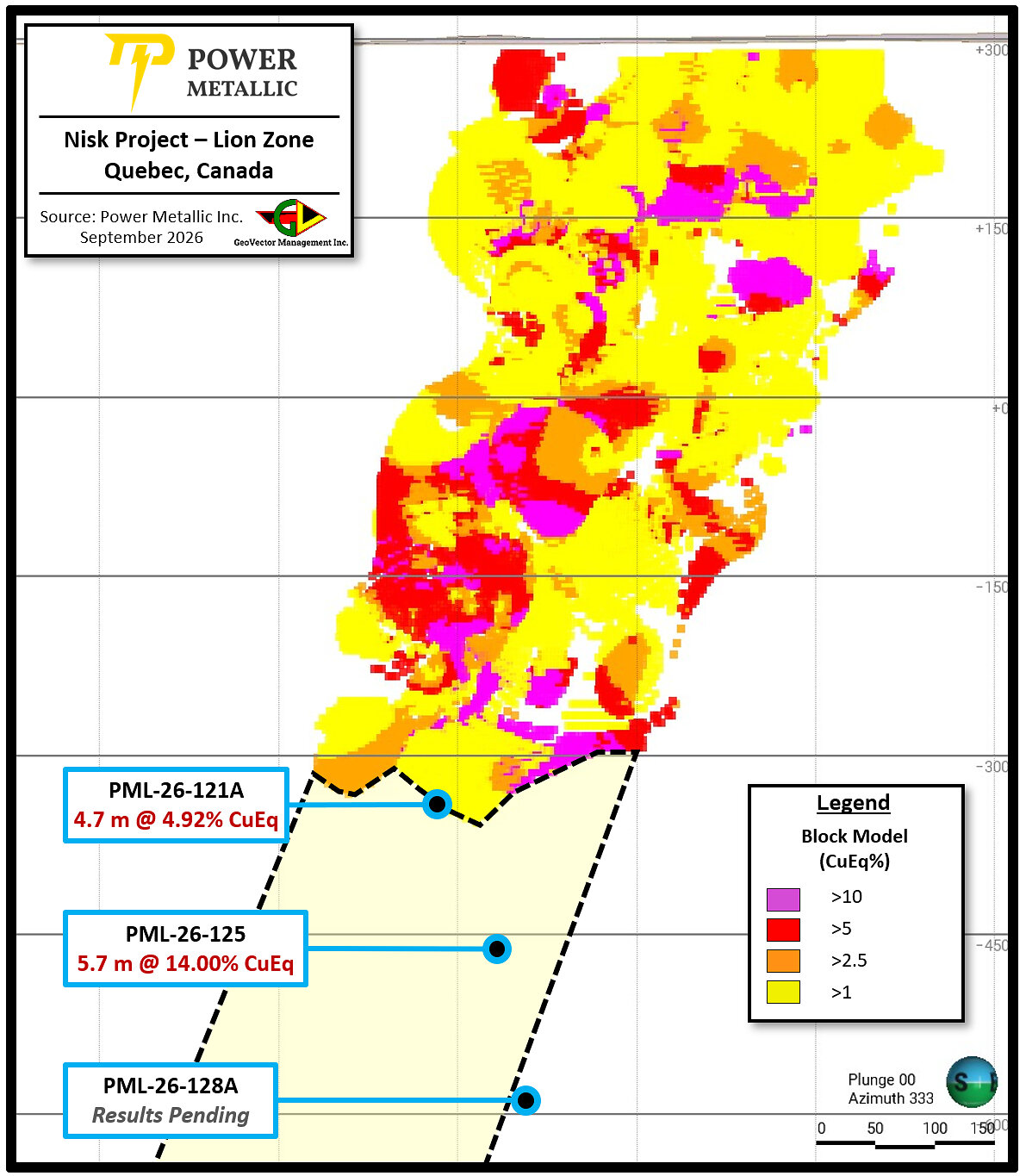
Figure 1 – Lion zone block model overlain 3D inversion of airborne magnetic high – holes marked by Vertical Depth (VD)
2026 Nisk Deposit Mineral Resource Estimate at a cut-off grade of 0.30% NiEq for the open pit MRE and 0.80% NiEq for the underground MRE, June 19, 2026.
Mining Method
Resource Class
Tonnes
Grade
Ni (%)
Cu (%)
Co (%)
Pt (g/t)
Pd (g/t)
Au (g/t)
Ag (g/t)
NiEq (%) *
CuEq (%) *
Open Pit
Indicated
607,000
0.60
0.35
0.039
0.08
0.49
0.03
2.19
1.01
1.68
Inferred
210,000
0.54
0.22
0.035
0.07
0.48
0.03
2.04
0.86
1.44
Underground
Indicated
2,096,000
0.96
0.53
0.061
0.21
0.91
0.04
2.00
1.65
2.75
Inferred
1,806,000
0.98
0.57
0.063
0.26
1.05
0.03
1.57
1.73
2.89
Mining Method
Resource Class
Tonnes
Contained Metal
Ni (Mlb)
Cu (Mlb)
Co (Mlb)
Pt (oz)
Pd (oz)
Au (oz)
Ag (oz)
NiEq (Mlb) *
CuEq (Mlb) *
Open Pit
Indicated
607,000
7.99
4.66
0.53
2,000
10,000
1,000
43,000
13.49
22.47
Inferred
210,000
2.50
1.03
0.16
500
3,000
200
14,000
3.99
6.66
Underground
Indicated
2,096,000
44.44
24.52
2.83
14,000
61,000
3,000
135,000
76.13
126.89
Inferred
1,806,000
39.17
22.53
2.50
15,000
61,000
2,000
91,000
69.06
115.09
* Exclusive of Au and Ag
Figure 2 – Nisk zone block model overlain 3D inversion of airborne magnetic high
(1)
The effective date of the Nisk Project MRE, including the Nisk and Lion deposits, is June 19, 2026.
(2)
Marc-Antoine Laporte, M.Sc., P.Geo. of SGS is responsible for the Nisk and Lion Mineral Resource Estimates and is an independent Qualified Person as defined by NI 43-101.
(3)
The classification of the current MRE into Indicated and Inferred mineral resources is consistent with current 2014 CIM Definition Standards – For Mineral Resources and Mineral Reserves.
(4)
All figures are rounded to reflect the relative accuracy of the estimateand numbers may not add due to rounding.
(5)
The mineral resource is presented undiluted and in situ, constrained by a 3D grade control resource model, and is considered to have reasonable prospects for eventual economic extraction. The mineral resource is exclusive of mined out material.
(6)
Mineral resources which are not mineral reserves do not have demonstrated economic viability. An Inferred Mineral Resource has a lower level of confidence than that applying to an Indicated Mineral Resource and must not be converted to a Mineral Reserve. It is reasonably expected that most Inferred Mineral Resources could be upgraded to Indicated Mineral Resources with continued exploration.

(7)
The Mineral Resource Estimates for Nisk and Lion are based on a validated surface diamond drill hole database, and 3D resource models constructed in Leapfrog Geo 2026.1.2. Grades for Ni, Cu, Co, Pt, Pd, Ag and Au are estimated for each mineral resource domain using 0.75 m (Nisk) and 1.0 m (Lion) capped composites assigned to that domain. To generate grade within the blocks, the inverse distance squared (ID2) interpolation method was used for all domains.
(8)
Based on the location, surface exposure, size, shape, general true thickness, and orientation, it is envisioned that parts of the Nisk and Lion deposits may be mined using open-pit mining methods. In-pit mineral resources are reported at a base case cut-off grade of 0.3% NiEq for Nisk and 0.35% CuEq for Lion. The in-pit resource grade blocks are quantified above the base case cut-off grade, above the constraining pit shell, below topography and overburden and within the constraining mineralized domains (the constraining volumes).
(9)
Based on the size, shape, general true thickness, and orientation, it is envisioned that parts of the Lion and Nisk deposits may be mined using underground mining methods. Underground mineral resources are reported at a base case cut-off grade of 0.8% NiEq for Nisk and 0.9% CuEq for Lion. The mineral resource grade blocks are quantified above the base case cut-off grade, below surface/pit surface and within the constraining resource models (considered mineable shapes). Based on the size, shape, general thickness, and orientation of the mineralized structures, it is envisioned that the deposits may be mined using a combination of underground mining methods including sub-level stoping (SLS) and/or cut and fill (CAF) mining.
(10)
The in-pit and underground base case cut-off grades consider metal prices of $8.00/lb Ni, $4.80/lb Cu, $15.00/lb Co, $1,400/oz Pt, $1,200/oz Pd, $3,600/oz Au and $38/oz for Ag. Base case cut-off grades consider an open-pit mining cost of $2.80/t, an underground mining cost of $70/t, a processing cost, including treatment and refining and transportation of $30/t mineralized material, and G&A cost of US$4.00/t open pit and $8.50/t underground mineralized material.
(11)
The in-pit and underground base case cut-off grades consider metal recoveries, of 70% for Ni, 44% for Cu, 79% for Co, 27% for Pt and 67% for Pd for Nisk (Au and Ag is not considered); 63% for Ni, 98.5% for Cu, 70% for Co, 90% for Pt, 92% for Pd, 84% for Au and 82 % for Ag for Lion.
(12)
The estimate of Mineral Resources may be materially affected by environmental, permitting, legal, title, taxation, socio-political, marketing, or other relevant issues.
Terry Lynch, CEO of Power Metallic, commented: ” This inaugural Lion resource confirms what the drilling has been telling us: Lion is a high-grade polymetallic deposit. Approximately 4.75 million tonnes grading close to 4% CuEq has been defined, containing approximately 406 million pounds of CuEq, with more than 85% of the resource already in the Indicated category. Importantly, high-grade mineralisation begins at surface, and the deposit remains open at depth. We believe the quality of Lion has been demonstrated. Now our focus is on demonstrating its scale.
The Federal and Québec governments have put a number of incentive programs in place for critical-minerals projects, and we believe the Company may qualify for several of them. Combining these potential incentives with the high-grade mineralisation from surface and our location next to existing road and major power infrastructure, Lion has the potential to be developed with a relatively modest initial footprint and capital requirement.
From here, the exploration question is how deep Lion goes and where the nickel went. Lion carries the copper and precious metals that come out of a magmatic sulphide system last; the nickel-rich sulphide that comes out first should be somewhere in the system, and we have not found it yet. The summer program has been aimed at the down-dip extension of the shoot, with some holes targeting hundreds of metres below the current resource. Assays on Lion Deep are expected by the end of September”
Joe Campbell, VP Exploration of Power Metallic, added: “Lion is a textbook fractionated copper- and precious-metal-rich shoot within a magmatic sulphide system. The advantage at Lion over similar deposits of this type is that it begins at surface and is modelled continuously to more than 600 metres vertical depth. The deposit remains open at depth and our priority since the April 19, 2026 cut-off date for drill holes in the MRE has been to test the shoot below 600 metres with deep step-out drilling, following up with borehole EM to delineate more mineralization.”
Lion Zone Geology and Depth Potential
The Lion Zone comprises multiple modelled lenses of copper–PGE–gold–silver–nickel–cobalt sulphide mineralization that together form a continuous, steeply plunging shoot extending from surface to approximately 675 metres down-dip (more than 600 metres vertical depth), the limit of drilling included in the MRE to April 19, 2026. The modelled shoot is approximately 400 metres along strike at its widest and 290 metres at its narrowest, and consists of multiple subparallel lenses, each approximately 2 to 15 metres thick, within a mineralized package up to 50 metres thick that dips at approximately 65° to the north-northwest. The high-grade core of the shoot is dominated by massive to brecciated chalcopyrite and cubanite with pyrrhotite, pentlandite and pyrite. The deepest reported hole intersecting the core of the Lion shoot to date (PML-25-002) intersected 1.95 metres at 7.95% CuEqRec* at approximately 610 metres vertical depth (see news release dated April 30, 2025). The Deposit remains open at depth with subsequent deeper drilling, as illustrated by drill targets PML26-121A, PML-26-125 and PML-26-128A in Figure 1, completed after the cut-off date for the MRE and below the modelled zone intersecting visible copper mineralization (assays pending).
*CuEqRec in the referenced Power Metallic news releases represents CuEq calculated based on the following metal prices (USD): 2,360.15 $/oz Au, 27.98 $/oz Ag, 1,215.00 $/oz Pd, 1000.00 $/oz Pt, 4.00 $/lb Cu, 10.00 $/lb Ni and 22.50 $/lb Co., and a recovery grade of 80% for all commodities, consistent with comparable peers.
Lion is interpreted as a magmatic sulphide system. As the sulphide liquid cools, nickel-rich monosulphide solid solution crystallizes first and the residual liquid becomes progressively enriched in copper, platinum, palladium, gold and silver. This fractionated, copper- and precious-metal-rich liquid is the most mobile phase and migrates furthest away, from the original source; the copper–PGE footwall vein deposits of the Sudbury district are the classic example. Lion’s metal endowment – dominated by copper, palladium, platinum, gold and silver with subordinate nickel and cobalt, and with the highest palladium grades hosted in massive copper sulphide – is consistent with that fractionated end-member. The Company’s working model is that the Lion shoot represents a gravity-driven sulphide accumulation whose down-plunge extent has not yet been tested.
Depth continuity of this order is well documented in analogous camps. In the Sudbury district, the Creighton mine has been developed to approximately 2.4 kilometres below surface; Glencore’s Onaping Depth project has reached ore at approximately 2,600 metres; Nickel Rim South was mined between approximately 1,100 and 1,720 metres; and the copper–PGE footwall veins of the Morrison deposit at Levack were developed between approximately 1,200 and 1,650 metres and remain open at depth. Readers are cautioned that the depth extent and grade of mineralization at these deposits are not necessarily indicative of the mineralization at Lion, which has been drilled to approximately 600 metres vertical depth (see “Cautionary Notes” below).
Power Metallic’s program to test the down-plunge extension of the Lion shoot includes borehole electromagnetic surveys from the deepest holes on the shoot, and deep step-out and wedge drilling from existing collars. Results will be incorporated into future resource updates.
Metallurgy
Metallurgical test work on Lion mineralization has been carried out by SGS at its Quebec City and Lakefield laboratories (see news releases dated January 19, 2026 and May 26, 2026). Two locked-cycle flotation tests have been completed: LCT1, on a blended composite of high-grade and low-grade material representative of run-of-mine feed, and LG2, on a low-grade composite of disseminated mineralization designed to test whether lower-grade material responds to conventional flotation. Both tests produced a single high-grade copper concentrate carrying the platinum, palladium, gold, silver and nickel, with results summarized in Table 4. The LG2 results support the inclusion of lower-grade disseminated material in the Mineral Resource. Mineralogical work indicates that copper occurs as coarse-grained chalcopyrite and cubanite and that most platinum-group minerals occur within or attached to those copper sulphides (see news release dated July 23, 2025). Hydrometallurgical testing of the copper concentrate to evaluate a direct-to-metal processing route is in progress. The metallurgical recoveries applied in the MRE are set out in Note 7 to Table 1.
These metallurgical results are analogous to similar deposits in the Sudbury camp noted above and typical of the high-grade Cuprous zone or Copper zone of these deposits.
Table 4: Lion Zone locked-cycle flotation test results (SGS Canada Inc.)
Element
LCT1 blended composite – feed grade
LCT1 – concentrate grade
LCT1 – recovery (%)
LG2 low-grade composite – feed grade
LG2 – concentrate grade
LG2 – recovery (%)
Recovery applied in MRE (%)
Cu
3.42 %
25.8 %
98.9
0.62 %
25.4 %
98.3
98.5 %
Ni
0.20 %
1.2 %
77.1
0.04 %
0.78 %
47.7
63 %
Co
n/r
n/r
n/r
n/r
n/r
n/r
70 %
Pd
5.37 g/t
41.4 g/t
93.9
0.97 g/t
38.9 g/t
89.1
92 %
Pt
2.90 g/t
23.4 g/t
96.8
0.22 g/t
7.9 g/t
84.1
90 %
Au
0.70 g/t
4.83 g/t
85.0
0.37 g/t
12.7 g/t
83.1
84 %
Ag
24.9 g/t
159 g/t
88.9
6.26 g/t
271 g/t
75.9
82 %
Sources: Company news releases dated January 19, 2026 (LCT1: blended composite of 103 high-grade samples from 15 drill holes and 99 low-grade samples from 10 drill holes, approximately 50/50 by modelled volume) and May 26, 2026 (LG2: low-grade disseminated composite). n/r = not reported. Recoveries are to a single copper concentrate. Test work is preliminary; recoveries used in the MRE are those selected by SGS and set out in Note 7 to Table 1.
Location and Infrastructure
The Nisk Project is in the Eeyou Istchee James Bay territory of Québec, approximately 280 kilometres north-northwest of Chibougamau and 425 kilometres northeast of Matagami. The property is accessed by the Route du Nord, an all-season road managed by the Société de développement de la Baie-James that connects Route 167 at Chibougamau to the paved Billy-Diamond Highway Hydro-Québec’s Albanel substation, on the 735 kV transmission system that carries power from the La Grande complex to southern Québec and accessed by the Route du Norde, is located adjacent to the property approximately 4 km from the Nisk Main deposit and 9.1 km from the Lion Zone. The Nemiscau airport (1,524 metre gravel runway, with scheduled service by Air Creebec) is approximately 30 kilometres west of the property along the Route du Nord, and the Nemiscau camp on the Route du Nord, operated by the Cree Construction and Development Company, provides lodging, food services and fuel. The Cree community of Nemaska, approximately 51 kilometres by road, has a hotel and restaurant, grocery, fuel, a health clinic and other services available to Project staff.
NISK / Lion Property
Regional transportation and energy infrastructure in Eeyou Istchee James Bay continues to be upgraded. The Société de développement de la Baie-James is carrying out a multi-year rehabilitation of the Billy-Diamond Highway, the 2026–2027 Québec budget allocated a further $19.4 million over two years to the maintenance of that highway, and in 2025 the Société du Plan Nord and Nemaska Lithium co-funded a $9.2 million upgrade of the Matagami rail transshipment yard, which serves mining projects in the region. Québec’s 2025–2031 Critical and Strategic Minerals Strategy, released in January 2026, includes a commitment to develop an infrastructure development plan for the Eeyou Istchee James Bay region, and the feasibility studies completed in 2024 under the La Grande Alliance between the Cree Nation Government and the Government of Québec examined a potential rail line from Matagami along the Billy-Diamond Highway and an upgrade of the Route du Nord. Under Québec’s 2025 energy legislation, industrial power allocations of 5 MW or more require ministerial authorization, and the Government of Québec has indicated that critical and strategic minerals projects are a priority for such allocations.
Critical Minerals and Government Incentives
Copper, platinum, palladium, nickel and cobalt are each included on the critical minerals lists of Québec, Canada, the United States and the European Union, and silver is also included on the United States list (Table 6).
Table 6: Nisk Project metals on government critical minerals lists
Metal
Québec (Critical and Strategic Minerals list)
Canada (2024 Canadian Critical Minerals List)
United States (Final 2025 List of Critical Minerals)
European Union (Critical Raw Materials Act, Regulation (EU) 2024/1252)
Copper
Yes (critical)
Yes
Yes
Yes (strategic)
Nickel
Yes (strategic)
Yes
Yes
Yes (battery grade; strategic)
Cobalt
Yes (strategic)
Yes
Yes
Yes (strategic)
Platinum
Yes (platinum group elements; strategic)
Yes (platinum group metals)
Yes
Yes (platinum group metals)
Palladium
Yes (platinum group elements; strategic)
Yes (platinum group metals)
Yes
Yes (platinum group metals)
Silver
No
No
Yes
No
Sources: Gouvernement du Québec, list of critical and strategic minerals (updated January 2026); Natural Resources Canada, Canadian Critical Minerals List (June 2024); U.S. Geological Survey, Final 2025 List of Critical Minerals (90 FR 50494, November 7, 2025); Regulation (EU) 2024/1252 of April 11, 2024, Annexes I and II.
Canada’s Clean Technology Manufacturing investment tax credit (“CTM ITC”) provides a refundable tax credit equal to 30% of the capital cost of eligible new machinery and equipment used in the extraction and processing of qualifying critical minerals, including copper, nickel and cobalt, for property that becomes available for use by the end of 2031. Amendments enacted in March 2026 extended eligibility to mine-site extraction and processing property where 50% or more of the expected value of the commercial output is attributable to qualifying materials, subject to certification by an independent engineer or geoscientist. Copper is expected to be the largest contributor to the Project’s anticipated output value, and nickel and cobalt are also qualifying materials; on that basis the Company believes the Project is well positioned to satisfy the eligibility test and is evaluating the application of the credit to a future development of the Project. The principal federal and Québec measures the Company is evaluating are summarized in Table 7.
Table 7: Principal federal and Québec critical-minerals tax credits and incentive programs under evaluation
Refundable credit equal to 30% of the capital cost of eligible new machinery and equipment used to extract and process qualifying critical minerals (copper, nickel and cobalt qualify; platinum, palladium, gold and silver do not)
50% or more of expected output value from qualifying materials for mine-site property, certified by an independent engineer or geoscientist; full 30% rate for property available for use by December 31, 2031, reducing to 20% in 2032, 10% in 2033 and 5% in 2034
Critical Mineral Exploration Tax Credit
Canada
30% tax credit to flow-through share investors on eligible exploration expenses targeting critical minerals, including copper, nickel, cobalt and platinum group metals
Flow-through share agreements entered into on or before March 31, 2027; qualified person certification
Tax credit relating to resources
Québec
Refundable credit of up to 45% of eligible exploration and mining development expenses attributable to critical and strategic minerals (22.5% for other mineral resources) for corporations that do not operate a mine; 20% and 10% for other corporations
Expenses incurred after March 25, 2025 and paid before January 1, 2030; $100 million of eligible expenses per five-year period
Mining Tax Act measures
Québec
Allowance for the development of critical and strategic minerals; refundable duties credit for losses of 16% of eligible expenses
Critical and strategic minerals development expenses incurred after March 25, 2021 (allowance capped at $31.25 million)
Tax holiday for large investment projects
Québec
Ten-year income tax and Health Services Fund contribution holiday, capped at a percentage of eligible investment
Investment of at least $100 million; mining projects mainly (50% or more) related to critical and strategic minerals; applications by December 31, 2029
Fonds pour les minéraux critiques et stratégiques
Québec
$2.5 billion fund administered by Investissement Québec for equity and other financing of critical and strategic minerals projects
Announced in the 2026–2027 Québec budget (March 2026)
Canada Critical Minerals Accelerator
Canada
$2 billion fund providing equity-like investments, loan guarantees and offtake support through Export Development Canada
Launched July 2026
First and Last Mile Fund
Canada
Up to $1.5 billion through 2029–2030 for on-site mine development, transportation and clean-energy infrastructure for critical minerals projects
Invitation-based; funding runs to March 31, 2030
Hydro-Québec industrial power allocation
Québec
Rate L industrial electricity supply from Hydro-Québec’s low-carbon hydroelectric grid
Ministerial authorization required for blocks of 5 MW or more; the Government of Québec has stated that critical and strategic minerals projects are a priority
Sources: Canada Revenue Agency and Department of Finance Canada (Budget 2024, Budget 2025 and Bill C-15, Royal Assent March 26, 2026); Natural Resources Canada; Finances Québec (Budget 2025–2026 and Budget 2026–2027); Revenu Québec; Gouvernement du Québec; Hydro-Québec. Program terms are summarized for convenience only and are subject to the applicable legislation and regulations.
Power Metallic is evaluating the relevance of each of these programs to the Project and believes the Project qualifies for several of them. Eligibility for any program is subject to the applicable legislation, regulations and administrative determinations, and no assurance can be given that the Project will qualify for or receive any tax credit or incentive.
Next Steps
The MRE forms the basis for a Preliminary Economic Assessment (PEA). The PEA will evaluate an initial open pit followed by underground mining at Lion with processing options including the potential incorporation of Nisk Main feed. Additional work is being carried out on improving Nisk metallurgical recovery while preserving an efficient pathway to Lion development. Drilling completed since the MRE data cut-off (five rigs are currently active across the Nisk land package), with results expected from September 2026 onward, will be incorporated into future resource updates and into the PEA to the extent practicable.
A two-year environmental baseline survey program commenced in January 2026, following completion of a desktop study in April 2025. The first field season is being conducted from May to October 2026, with a second planned for summer 2027. To support completion within the planned two-year timeframe, the program has been designed to cover a broader area than is currently expected to be required, including a conservatively defined area for hydrological surveys. Its scope will continue to be reviewed as survey results are received and the project design evolves. The currently defined program is scheduled for completion in 2027 and is progressing in parallel with the technical studies to support preparation of the Environmental and Social Impact Assessment.
A technical report prepared in accordance with NI 43-101 in support of the MRE will be filed under the Company’s profile on SEDAR+ at www.sedarplus.ca within 45 days of the date of this news release.
With the updated Technical Report, Power Metallic will be able to submit the last requirement in its Nasdaq application process. The Company is applying for an American Depositary Receipt (ADR) on Nasdaq. This would enable Power Metallic to trade on Nasdaq via a multiple of its shares to meet the Nasdaq $4 threshold. The Company would expect to advise on its Nasdaq application in October.
6ix Presentation
Power Metallic will be hosting a webinar on Tuesday September 8th, 2026, at 12 noon (Eastern). It will be recorded for those who cannot attend. The link below will provide details how to attend the live event.
Marc-Antoine Laporte, P.Geo., of SGS Canada Inc., is the independent Qualified Person responsible for the MRE, as defined by NI 43-101, and has reviewed and approved the scientific and technical disclosure relating to the MRE in this news release. Joseph Campbell, P.Geo., VP Exploration of Power Metallic, is a Qualified Person as defined by NI 43-101 and has reviewed and approved the other scientific and technical information in this news release.
Cautionary Notes
Mineral Resources that are not Mineral Reserves do not have demonstrated economic viability. The Company has not completed a PEA or any other economic study of the Nisk Project. The mining concepts described in this news release were used solely to establish reasonable prospects for eventual economic extraction for the purpose of reporting Mineral Resources; they do not constitute a mine plan or an economic analysis, and the mining sequence, production rate and mine life of any future operation have not been determined. This news release refers to other mineral deposits and mines, including in the Sudbury and Norilsk–Talnakh districts, solely to illustrate the depths to which magmatic sulphide mineralization has been mined elsewhere. The Company has no interest in those properties, and the mineralization on those properties is not necessarily indicative of the mineralization at the Nisk Project.

About Power Metallic Mines Inc.
Power Metallic is a Canadian exploration company focused on advancing the Nisk Project Area (Nisk–Lion–Tiger)—a high–grade Copper–PGE, Nickel, gold and silver system—toward Canada’s next polymetallic mine.
On 1 February 2021, Power Metallic (then Chilean Metals) secured an option to earn up to 80% of the Nisk project from Critical Elements Lithium Corp. (TSX–V: CRE). Following the June 2025 purchase of 313 adjoining claims (~167 km²) from Li–FT Power, the Company now controls ~330 km² and roughly 50 km of prospective basin margins.
Power Metallic is expanding mineralization at the Nisk and Lion discovery zones, evaluating the Tiger target, and exploring the enlarged land package through successive drill programs. Beyond the Nisk Project Area, Power Metallic indirectly has an interest in significant land packages in British Columbia and Chile, by its 50% share ownership position in Chilean Metals Inc., which were spun out from Power Metallic via a plan of arrangement on February 3, 2025.
It also owns 100% of Power Metallic Arabia which owns 100% interest in the Jabul Baudan exploration license in The Kingdom of Saudi Arabia’s Jabal Said Belt. The property encompasses over 200 square kilometres in an area recognized for its high prospectivity for copper gold and zinc mineralization. The region is known for its massive volcanic sulfide (VMS) deposits, including the world-class Jabal Sayid mine and the promising Umm and Damad deposit.
About SGS Canada Inc.
SGS is the world’s leading testing, inspection and certification company, with a network of over 2,500 laboratories and business facilities across 115 countries and a team of over 100,000 professionals. SGS Geological Services, based in Quebec City, Québec, provides ore body modelling and resource estimation, mine engineering, technical reports under NI 43-101, JORC and S-K 1300, and technical audits and due diligence, drawing on more than 45 years of geostatistical expertise and more than 1,600 consulting projects worldwide. SGS’s Metallurgical Centre of Excellence in Lakefield, Ontario has served the Canadian and global mining industry since 1941 and has completed more than 22,000 projects; together with SGS’s Quebec City laboratory, it carried out the Lion Zone metallurgical test work reported in this news release.
For further information, readers are encouraged to contact: Power Metallic Mines Inc. The Canadian Venture Building 82 Richmond St East, Suite 202 Toronto, ON
Neither the TSX Venture Exchange nor its Regulation Services Provider accepts responsibility for the adequacy or accuracy of this release.
This message contains certain statements that may be deemed “forward-looking statements” concerning the Company within the meaning of applicable securities laws. Forward-looking statements are statements that are not historical facts and are generally, but not always, identified by the words “expects,” “plans,” “anticipates,” “believes,” “intends,” “estimates,” “projects,” “potential,” “indicates,” “opportunity,” “possible” and similar expressions, or that events or conditions “will,” “would,” “may,” “could” or “should” occur. Although the Company believes the expectations expressed in such forward-looking statements are based on reasonable assumptions, such statements are not guarantees of future performance, are subject to risks and uncertainties, and actual results or realities may differ materially from those in the forward-looking statements. Such material risks and uncertainties include, but are not limited to, among others; the timing for producing a PEA and for various drilling plans, including the benefits of drilling to further depth; the ability for inferred mineral resources to be upgraded to indicated mineral resources; the availability and criteria of various government tax credits and incentives for critical minerals and the risks that such incentives change; the ability to raise sufficient capital to fund expanded exploration and development efforts going forward and to conduct drilling and exploration; to maintain its mineral tenures and concessions in good standing; to explore and develop its projects; changes in economic conditions or financial markets; the inherent hazards associates with mineral exploration and mining operations; future prices of copper, nickel and other metals; changes in general economic conditions; accuracy of mineral resource and reserve estimates; the potential for new discoveries; the ability of the Company to obtain the necessary permits and consents required to explore, drill and develop the projects and if accepted, to obtain such licenses and approvals in a timely fashion relative to the Company’s plans and business objectives for the applicable project; the general ability of the Company to monetize its mineral resources; and changes in environmental and other laws or regulations that could have an impact on the Company’s operations, compliance with environmental laws and regulations, dependence on key management personnel and general competition in the mining industry.
Toronto, Ontario–(Newsfile Corp. – September 8, 2026) – Aurania Resources Ltd. (TSXV: ARU) (OTCQB: AUIAF) (FSE: 20Q) (“Aurania” or the “Company”) is pleased to announce that drilling has commenced at the Thormodsdalur gold project (“Thor’s Valley” or the “Project”) in Iceland. Aurania has engaged a Finland-based drilling contractor – Arctic Drilling Company Oy Ltd – to carry out the program to diamond drill six holes for a total of approximately 770 metres at Thor’s Valley. The program is expected to run for approximately one month and drill core samples will be sent for assaying.
Highlights
Drill program underway at the Thor’s Valley epithermal gold project in Iceland
Six drill holes planned with five twin holes to re-test historical intercepts under modern drilling and QA/QC practice and one hole to test a new target where numerous high-grade rock-chip boulder samples up to 102 ppm gold (Au) have been mapped at surface
A previous operator drilled thirty-two holes totaling 2,431m at Thor’s Valley which returned results up to 415.40 g/t Au[1]
In 2020, Iceland Resources ehf drilled eleven drill holes totaling 1,780m with results of up to 113 g/t Au[1]
Dr. Keith Barron, Chairman, President and CEO of Aurania, commented, “The Thor’s Valley project is supported by a history of documented high-grade gold mineralization. Many of the structural targets remain largely untested by modern exploration methods. Amazingly, the drill location is only a 30-minute drive from downtown Reykjavik, the capital of Iceland. We are optimistic that our project could potentially replicate what was done in the 1920’s; namely, produce “direct-shipping” siliceous ore that could be taken to the port by truck and thence sent by freighter to Scandinavia or Canada to be used as smelter flux. This would obviate the need for tailings containments or a mill. The famous Hishikari Gold Mine in Japan has been supplying Sumitomo with copper smelter flux for years. Precious metals are retrieved in the copper refining process. Thor’s Valley is a low-sulphidation epithermal gold-silver system, and of the same type as Hishikari.”
Figure 1. Image of drill rig operating on site at the Thor’s Valley epithermal gold project in Iceland.
In April 2026, Aurania entered into a definitive option agreement with St-Georges Eco-Mining Corp (“St-Georges”) (CSE: SX), a Canadian incorporated mineral exploration company and its wholly owned subsidiary Iceland Resources ehf (“IR”), an Icelandic incorporated precious metals exploration company to work collaboratively to define and execute a phased exploration program aimed at advancing the Thor’s Valley gold project, towards initial modern resource definition. The Thor’s Valley project is held by IR and is located approximately 20 kilometres east of Reykjavík, the capital of Iceland.
Thor’s Valley is a historically known gold-bearing, low-sulphidation epithermal system that was initially discovered in 1903 when two Icelandic farm boys picked up pieces of white quartz from a stream, which proved to be gold-bearing. A number of ventures were organized from 1911 to 1924 using German or British capital. Two shafts were sunk and approximately 400 metres of lateral workings performed. As a result of this, the productive vein was estimated to be 1 metre wide and at least 1 kilometre long. Reported grades were 11 g/t to 315 g/t gold[1]. The ore was “direct shipping” and initially sent to Norway and later to Germany for treatment. There are no historic tailings on site. Perhaps significantly, the historical record indicates that the last operator, Arcturus, a German company, failed due to the Weimar hyperinflation rather than ore depletion.
Between 2005 and 2006, the private exploration company Melmi ehf drilled 32 holes totaling 2,431m, which returned results up to 415.40 g/t Au. Melmi ehf was acquired by Iceland Resources in 2020, which completed eleven additional drill holes totaling 1,780m with results of up to 113 g/t Au[1].
The scientific and technical information contained in this news release has been reviewed and approved by Aurania’s VP Exploration, Mr. Jean-Paul Pallier, MSc. Mr. Pallier is a designated EurGeol by the European Federation of Geologists and a Qualified Person as defined by National Instrument 43-101, Standards of Disclosure for Mineral Projects of the Canadian Securities Administrators.
About Aurania
Aurania is a mineral exploration company engaged in the identification, evaluation, acquisition, and exploration of mineral property interests, with a focus on precious metals and critical energy in Europe and abroad.
Neither the TSXV nor its Regulation Services Provider (as that term is defined in the policies of the TSXV) accepts responsibility for the adequacy or accuracy of this release.
Forward-Looking Statements
This news release contains forward-looking information as such term is defined in applicable securities laws, which relate to future events or future performance and reflect management’s current expectations and assumptions. The forward-looking information includes: statements regarding the Project, that the drill program at the Project will consist of drill six holes for a total of approximately 770 metres and that the drill program is expected to run for approximately one month and drill core samples will be sent for assaying, that the Company is optimistic that our project could potentially replicate what was done in the 1920’s; namely, produce “direct-shipping” siliceous ore, statements regarding the option agreement with St. Georges and IR and the goals, plans and objectives set out thereunder, , anticipated exploration programs, timing of activities, the potential to advance the Project, Aurania’s objectives, goals or future plans, statements, exploration results, potential mineralization, the tonnage and grade of mineralization which has the potential for economic extraction and processing, the merits and effectiveness of known process and recovery methods, the corporation’s portfolio, treasury, management team and enhanced capital markets profile, the estimation of mineral resources, exploration, timing of the commencement of operations, the commencement of any drill program and estimates of market conditions. Such forward-looking statements reflect management’s current beliefs and are based on assumptions made by and information currently available to Aurania, including the assumption that there will be no material adverse change in metal prices, all necessary consents, licenses, permits and approvals will be obtained, including various local government licenses and the market. Investors are cautioned that these forward-looking statements are neither promises nor guarantees and are subject to risks and uncertainties that may cause future results to differ materially from those expected. Risk factors that could cause actual results to differ materially from the results expressed or implied by the forward-looking information include, among other things: failure to achieve the anticipated results, incorrect assumptions made in the initial evaluation of the Project, failure to identify mineral resources; failure to convert estimated mineral resources to reserves; the inability to complete a feasibility study which recommends a production decision; the preliminary nature of metallurgical test results; the inability to recover and process mineralization using known mining methods; the presence of deleterious mineralization or the inability to process mineralization in an environmentally acceptable manner; commodity prices, supply chain disruptions, restrictions on labour and workplace attendance and local and international travel; a failure to obtain or delays in obtaining the required regulatory licenses, permits, approvals and consents; an inability to access financing as needed; a general economic downturn, a volatile stock price, labour strikes, political unrest, changes in the mining regulatory regime governing Aurania; a failure to comply with environmental regulations; a weakening of market and industry reliance on precious metals and base metals; and those risks set out in the Company’s public documents filed on SEDAR+. Aurania cautions the reader that the above list of risk factors is not exhaustive. Although the Company believes that the assumptions and factors used in preparing the forward-looking information in this news release are reasonable, undue reliance should not be placed on such information, which only applies as of the date of this news release, and no assurance can be given that such events will occur in the disclosed time frames or at all. The Company disclaims any intention or obligation to update or revise any forward-looking information, whether as a result of new information, future events or otherwise, other than as required by law.
US retail diesel prices climbed to $5.85 per gallon Friday, according to AAA data, surpassing the previous all-time high of $5.816 set in June 2022 in the aftermath of Russia’s invasion of Ukraine. Diesel is often called the workhorse fuel of the global economy, powering the trucking fleets and cargo vessels that move goods across the country and around the world, which makes a record this significant a genuine economic pressure point rather than just another data point at the pump.
What makes this move particularly notable is what’s actually driving it. Crude oil prices have eased somewhat off their wartime highs from earlier this year and are up only about 5% since their July 18 low. Diesel, by contrast, has surged roughly 40% over that same stretch. This is not primarily a crude oil story, it is a refined product story, and the distinction matters for understanding just how structurally tight this market has become.
Two separate conflicts are compounding the pressure simultaneously. The ongoing war in Iran has cut off refined product flows from the Persian Gulf, a region we’ve tracked closely throughout this conflict, while Ukrainian strikes on Russian oil refineries have taken capacity offline from one of the world’s other major diesel exporters. Together, the Middle East and Russia accounted for roughly a third of global diesel exports in 2025, and losing meaningful capacity from both simultaneously has left the market with essentially no cushion. US distillate stockpiles are now at their lowest levels on record for this time of year, and East Coast inventories, the region most dependent on diesel and heating oil for winter demand, are at all-time lows just as the heating season approaches.
The obvious question is why domestic refiners can’t simply ramp up production to meet the shortfall. President Trump pressed refining executives on this directly at the White House this week, with midterm elections approaching and fuel affordability an increasingly visible political issue. The honest answer is capacity. Major refiners including Marathon Petroleum and Shell have both indicated in recent earnings reports that their systems are already running near full capacity, leaving little room to meaningfully increase throughput even under direct pressure to do so.
For investors tracking the small and microcap space, this dynamic cuts in two directions that mirror exactly what we’ve seen play out with gasoline prices throughout this conflict. Consumer-facing companies dependent on trucking and freight, along with any business reliant on diesel-powered logistics, face real and mounting cost pressure heading into the fall. Domestic energy producers and refiners with available capacity, meanwhile, continue benefiting from a pricing environment that shows no near-term sign of easing. With winter heating demand still ahead and refined product inventories already at record lows, this is a story likely to remain relevant well beyond the current news cycle.
Mark Reichman, Managing Director, Equity Research Analyst, Natural Resources, Noble Capital Markets, Inc.
Refer to the full report for the price target, fundamental analysis, and rating.
Encouraging Drill Results. Kuya Silver reported strong drilling results from the Umm-Hadid Project in Saudi Arabia, advancing toward a maiden NI 43-101 mineral resource estimate. Highlights include 26.10 meters grading 77.8 grams of silver per tonne and 9.17 meters grading 137.1 grams of silver per tonne, with both intervals containing exceptionally high-grade silver and gold zones. The new Target 01 drill results are part of an ongoing 10,000-meter drill program to define the continuity, geometry, and grade distribution of the silver-gold vein system and support delivery of a maiden mineral resource estimate and accompanying NI 43-101 technical report.
Establishing Continuity. The current resource-definition work is focused on Target 01. High-grade mineralization has been encountered across multiple holes and drill sections, supporting the continuity of the broader silver-gold system. Target 01 covers approximately 4.5 kilometers by 2.5 kilometers, with the latest mineralized intervals occurring at relatively shallow depths averaging about 58 meters below surface.
Equity Research is available at no cost to Registered users of Channelchek. Not a Member? Click ‘Join’ to join the Channelchek Community. There is no cost to register, and we never collect credit card information.
This Company Sponsored Research is provided by Noble Capital Markets, Inc., a FINRA and S.E.C. registered broker-dealer (B/D).
*Analyst certification and important disclosures included in the full report. NOTE: investment decisions should not be based upon the content of this research summary. Proper due diligence is required before making any investment decision.