CALGARY, AB, April 30, 2026 /CNW/ – InPlay Oil Corp. (TSX: IPO) (OTCQX: IPOOF) (“InPlay” or the “Company”) is pleased to confirm that its Board of Directors has declared a monthly cash dividend of $0.09 per common share payable on May 29, 2026, to shareholders of record at the close of business on May 15, 2026. The monthly cash dividend is expected to be designated as an “eligible dividend” for Canadian federal and provincial income tax purposes.
About InPlay Oil Corp. InPlay is a junior oil and gas exploration and production company with operations in Alberta focused on light oil production. The company operates long-lived, low-decline properties with drilling development and enhanced oil recovery potential as well as undeveloped lands with exploration possibilities. The common shares of InPlay trade on the Toronto Stock Exchange under the symbol IPO and the OTCQX Exchange under the symbol IPOOF.
SOURCE InPlay Oil Corp.
For further information please contact: Doug Bartole, President and Chief Executive Officer, InPlay Oil Corp., Telephone: (587) 955-0632, www.inplayoil.com; Darren Dittmer, Chief Financial Officer, InPlay Oil Corp., Telephone: (587) 955-0634
HOUSTON, April 29, 2026 /PRNewswire/ — Summit Midstream Corporation (NYSE: SMC) (“Summit”, “SMC” or the “Company”) announced today that it will report operating and financial results for the first quarter of 2026 on Monday, May 11, 2026, after the close of trading on the New York Stock Exchange.
First Quarter 2026 Earnings Call
SMC will host a conference call at 10:00 a.m. Eastern on May 12, 2026, to discuss its quarterly operating and financial results. The call can be accessed via teleconference at: Q1 2026 Summit Midstream Corporation Earnings Conference Call (https://register-conf.media-server.com/register/BI874f39fdf8c54b499c4ac477755fbcad). Once registration is completed, participants will receive a dial-in number along with a personalized PIN to access the call. While not required, it is recommended that participants join 10 minutes prior to the event start. The conference call, live webcast and archive of the call can be accessed through the Investors section of SMC’s website at www.summitmidstream.com
Upcoming Investor Conferences
Members of SMC’s senior management team will attend the 2026 Energy Infrastructure CEO & Investor Conference which will take place on May 18–20, 2026, the 2026 RBC Capital Markets Global Energy, Power & Infrastructure Conference taking place on June 2–3, 2026, and the BofA Energy and Power Credit Conference on June 3–4, 2026. The presentation materials associated with this event will be accessible through the Investors section of SMC’s website at www.summitmidstream.com prior to the beginning of the conference.
About Summit Midstream Corporation
SMC is a value-driven corporation focused on developing, owning and operating midstream energy infrastructure assets that are strategically located in the core producing areas of unconventional resource basins, primarily shale formations, in the continental United States. SMC provides natural gas, crude oil and produced water gathering, processing and transportation services pursuant to primarily long-term, fee-based agreements with customers and counterparties in five unconventional resource basins: (i) the Williston Basin, which includes the Bakken and Three Forks shale formations in North Dakota; (ii) the Denver-Julesburg Basin, which includes the Niobrara and Codell shale formations in Colorado and Wyoming; (iii) the Fort Worth Basin, which includes the Barnett Shale formation in Texas; (iv) the Arkoma Basin, which includes the Woodford and Caney shale formations in Oklahoma; and (v) the Piceance Basin, which includes the Mesaverde formation as well as the Mancos and Niobrara shale formations in Colorado. SMC has an equity method investment in Double E Pipeline, LLC, which provides interstate natural gas transportation service from multiple receipt points in the Delaware Basin to various delivery points in and around the Waha Hub in Texas. SMC is headquartered in Houston, Texas.
Forward-Looking Statements
This press release includes certain statements concerning expectations for the future that are forward-looking within the meaning of the federal securities laws. Forward-looking statements include, without limitation, any statement that may project, indicate or imply future results, events, performance or achievements and may contain the words “expect,” “intend,” “plan,” “anticipate,” “estimate,” “believe,” “will be,” “will continue,” “will likely result,” and similar expressions, or future conditional verbs such as “may,” “will,” “should,” “would” and “could.” In addition, any statement concerning future financial performance (including future revenues, earnings or growth rates), payment of dividends on any series of stock, ongoing business strategies and possible actions taken by SMC or its subsidiaries are also forward-looking statements. Forward-looking statements also contain known and unknown risks and uncertainties (many of which are difficult to predict and beyond management’s control) that may cause SMC’s actual results in future periods to differ materially from anticipated or projected results. An extensive list of specific material risks and uncertainties affecting SMC is contained in its 2025 Annual Report on Form 10-K filed with the Securities and Exchange Commission (the “SEC”) on March 16, 2026, as amended and updated from time to time. Any forward-looking statements in this press release are made as of the date of this press release and SMC undertakes no obligation to update or revise any forward-looking statements to reflect new information or events.
Total revenue of $516.0 million, net income of $9.1 million, and Adjusted EBITDA of $155.0 million
2026 expected coal sales volumes over 95% committed and priced at the midpoint of 2026 guidance
Record oil & gas royalty revenues and volumes, up 14.6% and 16.1%, respectively, year-over-year
Completed $16.2 million in oil & gas mineral interest acquisitions during the 2026 Quarter
Total and net leverage ratios as of March 31, 2026, were 0.73 times and 0.69 times, respectively
Declares quarterly cash distribution of $0.60 per unit, or $2.40 per unit annualized
TULSA, Okla.–(BUSINESS WIRE)–Alliance Resource Partners, L.P. (NASDAQ: ARLP) (“ARLP” or the “Partnership”) today reported financial and operating results for the quarter ended March 31, 2026 (the “2026 Quarter”). This release includes comparisons of results to the quarter ended March 31, 2025 (the “2025 Quarter”) and to the quarter ended December 31, 2025 (the “Sequential Quarter”). All references in the text of this release to “net income” refer to “net income attributable to ARLP.” For a definition of Adjusted EBITDA and Segment Adjusted EBITDA Expense and related reconciliations to comparable GAAP financial measures, please see the end of this release.
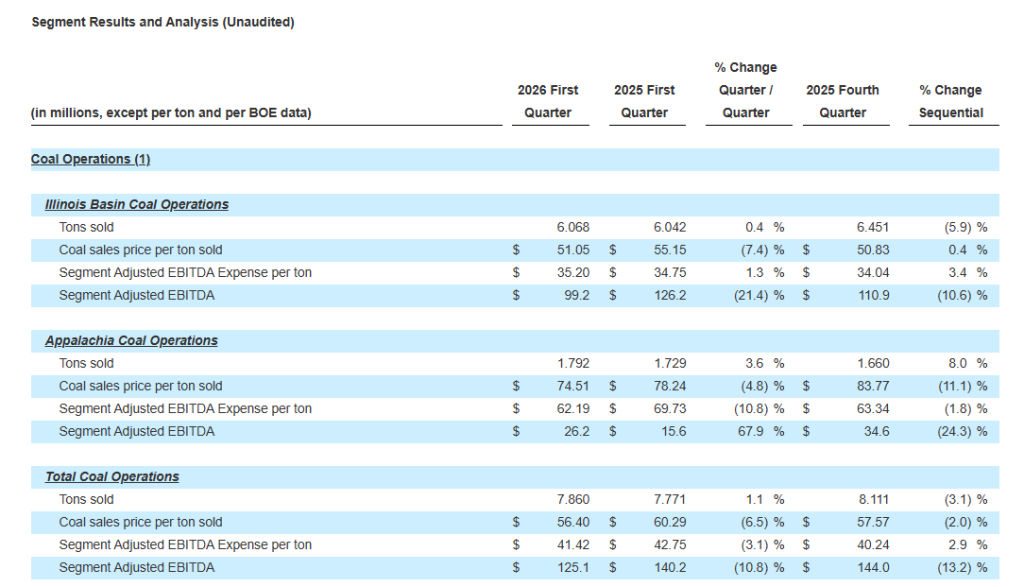
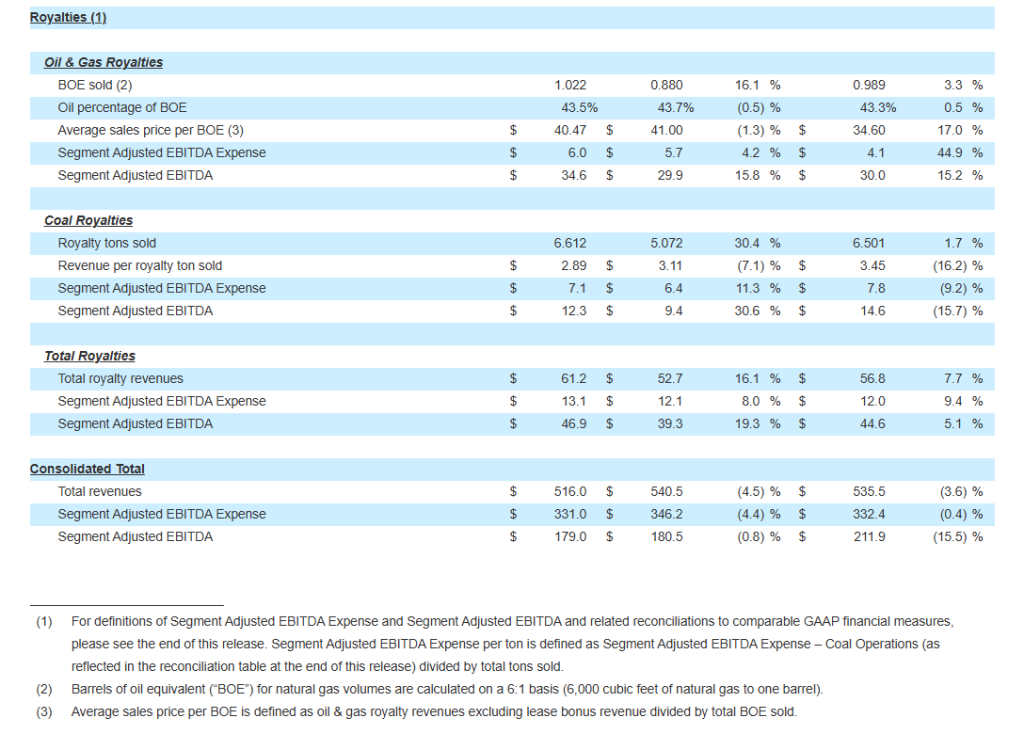
Total revenues decreased 4.5% to $516.0 million for the 2026 Quarter compared to $540.5 million for the 2025 Quarter primarily due to lower coal sales pricing, partially offset by record oil & gas royalty revenues and higher coal sales volumes. Net income for the 2026 Quarter was $9.1 million, or $0.07 per basic and diluted limited partner unit, compared to $74.0 million, or $0.57 per basic and diluted limited partner unit, for the 2025 Quarter. Net income was impacted by lower coal sales and higher depreciation, as well as an $11.6 million decrease in the fair value of our digital assets and a $37.8 million non-cash asset impairment charge in the 2026 Quarter due to ceasing longwall production and uncertainty regarding future operations at our Mettiki mine. Adjusted EBITDA decreased 3.1% to $155.0 million in the 2026 Quarter compared to $159.9 million in the 2025 Quarter.
Compared to the Sequential Quarter, total revenues decreased by 3.6% due to lower coal sales volumes and prices, partially offset by higher oil & gas royalty revenues. Net income decreased by 89.0% compared to the Sequential Quarter primarily due to lower production and lower coal sales volumes from our Hamilton mine as a result of a planned extended longwall move during the 2026 Quarter that led to higher per ton operating expenses. In addition, increased depreciation, non-cash asset impairment charges at Mettiki and lower investment income contributed to lower net income in the 2026 Quarter. Adjusted EBITDA for the 2026 Quarter decreased by 18.9% compared to the Sequential Quarter primarily due to higher costs at Hamilton and Mettiki.
CEO Commentary
“Most of our coal operations performed better than expected during the quarter, however meaningful weather-related shipment disruptions relating to Winter Storm Fern delayed sales volumes for the quarter,” said Joseph W. Craft III, Chairman, President and Chief Executive Officer. “In the Illinois Basin, increased productivity at River View and Gibson South helped offset some of the impact of the planned extended longwall move at Hamilton. In Appalachia, Tunnel Ridge had production gains of approximately 28% compared to both the 2025 Quarter and the Sequential Quarter, while results at Mettiki reflected lower production and a non-cash impairment associated with ceasing longwall production and uncertainty regarding future operations as previously discussed.”
Mr. Craft added, “We delivered another record quarter in our oil & gas royalties segment, driven by increased production volumes and higher oil prices. Increased drilling and completion activity across our core basins continues to validate the quality of our mineral portfolio, and for the second consecutive quarter, we expanded our portfolio, completing $16.2 million in acquisitions during the quarter. These results underscore the durability of our asset base and reinforce our disciplined approach to allocating capital to attractive, long-lived mineral interests. We believe our oil and gas royalties portfolio enhances our cash flow stability and long-term optionality across commodity cycles.”
Coal Operations
Coal sales volumes decreased by 5.9% in the Illinois Basin compared to the Sequential Quarter due primarily to decreased tons sold from our Hamilton mine as a result of a planned extended longwall move during the 2026 Quarter. In Appalachia, tons sold increased by 3.6% and 8.0% compared to the 2025 Quarter and Sequential Quarter, respectively, primarily as a result of fewer production days in the prior periods at our Tunnel Ridge mine due to longwall moves. Coal sales price per ton sold decreased by 7.4% in the Illinois Basin compared to the 2025 Quarter as a result of the expiration of higher priced legacy contracts. In Appalachia, coal sales price per ton sold decreased by 4.8% and 11.1% compared to the 2025 Quarter and Sequential Quarter, respectively, primarily due to an increased sales mix of lower priced Tunnel Ridge sales volumes in the 2026 Quarter and reduced domestic sales price per ton. ARLP ended the 2026 Quarter with total coal inventory of 1.2 million tons, representing a decrease of 0.2 million tons and an increase of 0.1 million tons compared to the end of the 2025 Quarter and Sequential Quarter, respectively.
Segment Adjusted EBITDA Expense per ton in the Illinois Basin increased 3.4% compared to the Sequential Quarter due primarily to the planned extended longwall move at our Hamilton mine during the 2026 Quarter. In Appalachia, Segment Adjusted EBITDA Expense per ton for the 2026 Quarter decreased by 10.8% compared to the 2025 Quarter as a result of increased production at our Tunnel Ridge operation primarily as a result of fewer production days due to the longwall moves in the 2025 Quarter.
Royalties
Segment Adjusted EBITDA for the Oil & Gas Royalties segment increased to $34.6 million in the 2026 Quarter compared to $29.9 million and $30.0 million in the 2025 Quarter and Sequential Quarter, respectively, due to record oil & gas royalty volumes, which increased 16.1% and 3.3%, respectively, as a result of increased drilling and completion activities on our interests and acquisitions of additional oil & gas mineral interests. Improved commodity pricing also contributed to the increase in Segment Adjusted EBITDA compared to the Sequential Quarter.
Segment Adjusted EBITDA for the Coal Royalties segment increased to $12.3 million in the 2026 Quarter compared to $9.4 million in the 2025 Quarter due to higher royalty tons sold, primarily from Tunnel Ridge, partially offset by lower average royalty rates per ton received from the Partnership’s mining subsidiaries. Compared to the Sequential Quarter, Segment Adjusted EBITDA for the Coal Royalties segment decreased 15.7%, primarily reflecting lower realized royalty rates per ton.
Balance Sheet and Liquidity
As of March 31, 2026, total debt and finance leases were outstanding in the amount of $507.7 million. The Partnership’s total and net leverage ratios were 0.73 times and 0.69 times debt to trailing twelve months Adjusted EBITDA, respectively, as of March 31, 2026. ARLP ended the 2026 Quarter with total liquidity of $431.2 million, which included $28.9 million of cash and cash equivalents and $402.3 million of borrowings available under its revolving credit and accounts receivable securitization facilities. In addition, ARLP held 618 bitcoins valued at $42.2 million as of March 31, 2026.
Distributions
ARLP announced today that the Board of Directors of ARLP’s general partner approved a cash distribution to unitholders for the 2026 Quarter of $0.60 per unit (an annualized rate of $2.40 per unit), payable on May 15, 2026, to all unitholders of record as of the close of trading on May 8, 2026.
Concurrent with this announcement we are providing qualified notice to brokers and nominees that hold ARLP units on behalf of non-U.S. investors under Treasury Regulation Section 1.1446-4(b) and (d) and Treasury Regulation Section 1.1446(f)-4(c)(2)(iii). Brokers and nominees should treat one hundred percent (100%) of ARLP’s distributions to non-U.S. investors as being attributable to income that is effectively connected with a United States trade or business. In addition, brokers and nominees should treat one hundred percent (100%) of the distribution as being in excess of cumulative net income for purposes of determining the amount to withhold. Accordingly, ARLP’s distributions to non-U.S. investors are subject to federal income tax withholding at a rate equal to the highest applicable effective tax rate plus ten percent (10%). Nominees, and not ARLP, are treated as the withholding agents responsible for withholding on the distributions received by them on behalf of non-U.S. investors.
Outlook
“Looking ahead, contracting activity with domestic utility customers for 2026 has remained active, though the pace has varied as some customers continue to evaluate summer burn requirements,” commented Mr. Craft. “During the quarter, the Iran conflict briefly reopened U.S. thermal coal export activity in early March, enabling us to enter into contracts for 1.8 million tons to be delivered in 2026 and 2027. In addition, we sold an additional 0.5 million tons to domestic customers, bringing our sales book to more than 95% committed and priced for 2026 assuming production comes in at the midpoint of our guidance range. Our remaining open position is concentrated in the second half of 2026, where additional commitments will depend on summer burn and customer requirements. More broadly, we continue to see a constructive demand backdrop as growing power demand, particularly from data centers, reinforces the importance of reliable baseload generation.”
Mr. Craft continued, “We expect first quarter shipment disruptions tied to Winter Storm Fern and subsequent high-water conditions to be recovered over the balance of the year. In addition, once the planned longwall moves at Hamilton and Tunnel Ridge are completed in the second quarter, we do not expect any further longwall moves in 2026, which should improve operating visibility for the back half of the year.”
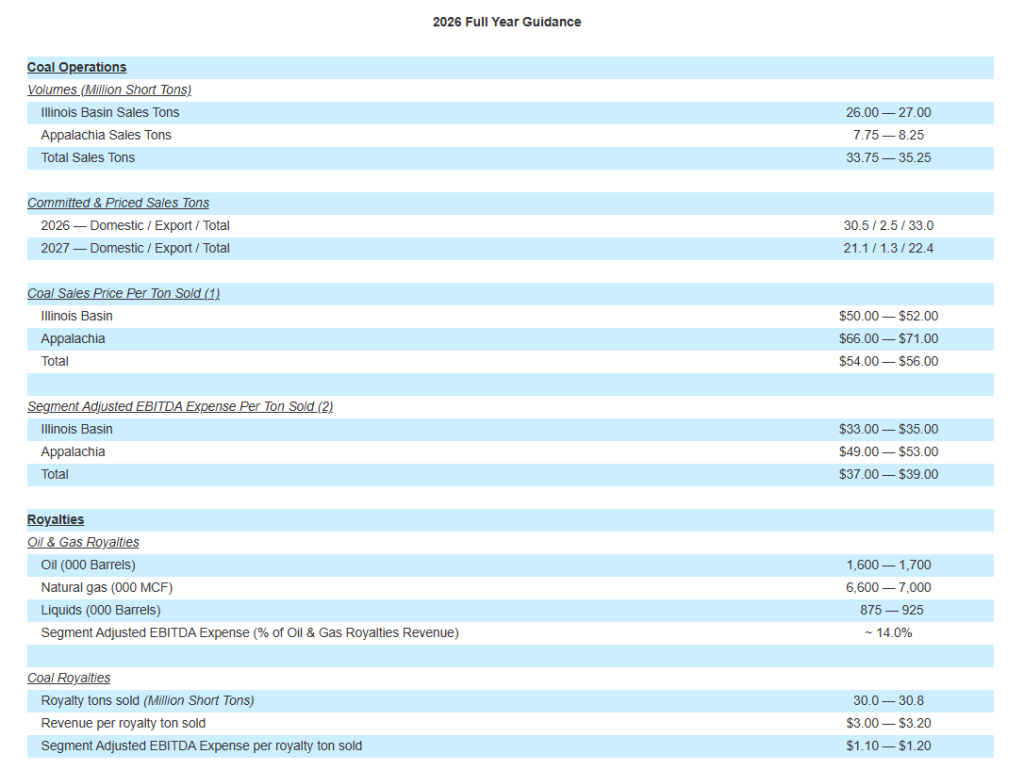
Mr. Craft concluded, “Based on year-to-date outperformance of our oil & gas royalties, we are increasing our volume guidance for the segment. Recent strength and volatility in crude oil prices have increased the near-term outlook and, because our current portfolio is unhedged, changes in market prices are reflected directly in our realized pricing. If current market conditions persist, we would expect realized BOE prices to be higher than last year, contributing to stronger segment results.”
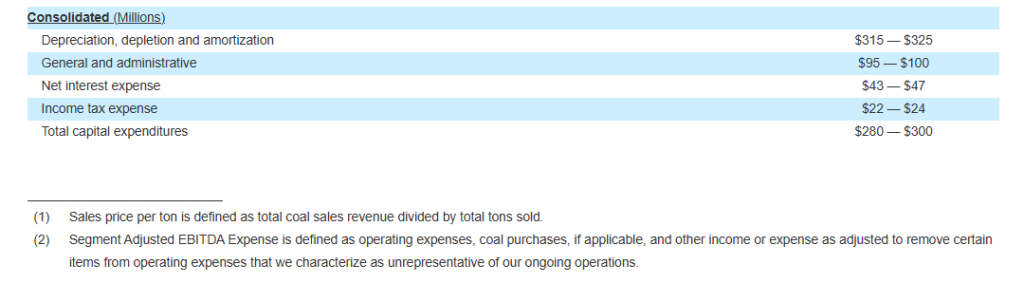
ARLP is updating the following guidance for the full year ending December 31, 2026:
Conference Call
A conference call regarding ARLP’s 2026 Quarter financial results and updated 2026 guidance is scheduled for today at 10:00 a.m. Eastern. To participate in the conference call, dial (877) 407-0784 and request to be connected to the Alliance Resource Partners, L.P. earnings conference call. International callers should dial (201) 689-8560 and request to be connected to the same call. Investors may also listen to the call via the “Investors” section of ARLP’s website at www.arlp.com.
An audio replay of the conference call will be available for approximately one week. To access the audio replay, dial U.S. Toll Free (844) 512-2921; International Toll (412) 317-6671 and request to be connected to replay using access code 13759702.
About Alliance Resource Partners, L.P.
ARLP is a diversified natural resource company that is currently the second largest coal producer in the eastern United States, supplying reliable, affordable energy domestically and internationally to major utilities, metallurgical and industrial users. ARLP also generates operating and royalty income from mineral interests it owns in strategic coal and oil & gas producing regions in the United States. In addition, ARLP is positioning itself as a reliable energy partner for the future by pursuing opportunities that support the growth and development of energy-related technologies and infrastructure.
News, unit prices and additional information about ARLP, including filings with the Securities and Exchange Commission (“SEC”), are available at www.arlp.com. For more information, contact the investor relations department of ARLP at (918) 295-7673 or via e-mail at [email protected].
The statements and projections used throughout this release are based on current expectations. These statements and projections are forward-looking, and actual results may differ materially. These projections do not include the potential impact of any mergers, acquisitions or other business combinations that may occur after the date of this release. We have included more information below regarding business risks that could affect our results.
Two of the offshore energy sector’s most recognized names are joining forces. Helix Energy Solutions Group (NYSE: HLX) and Hornbeck Offshore Services have announced a definitive all-stock merger agreement that will create one of the most comprehensive integrated deepwater services companies in the world — and the timing couldn’t be more calculated.
Under the terms of the deal, Hornbeck shareholders will own approximately 55% of the combined company while Helix shareholders retain roughly 45% on a fully diluted basis. The newly formed entity will operate under the Hornbeck Offshore Services name and trade on the New York Stock Exchange under the ticker symbol “HOS.” Todd Hornbeck, currently Chairman, President and CEO of Hornbeck, will lead the combined company, with William Transier serving as Chairman of a seven-member board comprised of three Helix directors and four from Hornbeck.
Why This Deal Makes Strategic Sense
This isn’t a merger of desperation — it’s a merger of expansion. Helix brings deep subsea expertise, well intervention capabilities, and a global robotics fleet with operations spanning the Gulf of America, Brazil, North Sea, West Africa and Asia Pacific. Hornbeck contributes a fleet of technologically advanced, high-specification offshore support vessels with a strong concentration in the Americas, including Brazil and Mexico, along with meaningful exposure to U.S. government and offshore wind contracts.
Together, the combined company covers the entire life cycle of deepwater field operations — from installation and production enhancement to decommissioning — across energy, defense and renewables. That kind of end-to-end service coverage significantly reduces the cyclicality risk that has historically plagued pure-play offshore services companies.
The Numbers Behind the Deal
The transaction is expected to generate $75 million or more in annual revenue and cost synergies within three years of closing. Those synergies will come from integrated service offerings, expanded customer reach and fleet optimization that reduces reliance on expensive third-party vessel charters.
The combined backlog currently stands at approximately $2 billion — split evenly between the two companies — with $1 billion tied to long-term contracts in Hornbeck’s military and specialty vessel segments. That backlog provides meaningful near-term revenue visibility as the integration unfolds.
Helix also reported Q1 2026 revenue of $287.95 million, beating analyst estimates by roughly $24 million, and reiterated full-year 2026 guidance of $1.2 billion to $1.4 billion in revenue with EBITDA projected between $230 million and $290 million. The company closed Q1 with $501 million in cash and just $10 million in funded debt — a balance sheet position that gives the combined entity significant flexibility for organic growth or further M&A post-close.
What to Watch
The merger requires Helix shareholder approval and customary regulatory sign-offs, with closing expected in the second half of 2026. Notably, Ares Management funds, representing a significant portion of Hornbeck’s ownership, have already delivered written consent approving the transaction — removing one of the more common deal-risk variables upfront.
For investors tracking the small and midcap offshore services space, this deal reshapes the competitive landscape. The combined HOS will be a scaled, diversified operator in a sector where scale increasingly determines who wins long-term contracts and who gets squeezed out.
The deepwater services consolidation wave continues — and this merger puts the new Hornbeck Offshore squarely at its center.
Oil markets were thrown into a volatile session Friday morning after Iran’s foreign minister declared the Strait of Hormuz fully open to commercial traffic for the duration of a fragile 10-day ceasefire between Israel and Lebanon — sending crude prices into a sharp, double-digit freefall.
Brent crude dropped 10%, falling below $90 per barrel, while West Texas Intermediate slid more than 10.5%, pulling below $82. Both benchmarks had opened the week above $100, meaning the week’s loss alone represents one of the most dramatic oil price collapses in recent memory.
The swift selloff reflects just how much of the oil market’s recent premium was baked in around fears of a sustained Strait of Hormuz closure. The strait is the world’s most critical chokepoint for global energy flows, with roughly 20% of all seaborne oil passing through its narrow passage daily. Even a partial disruption sends shockwaves through energy markets — and traders had been pricing in exactly that risk.
The announcement comes as a direct byproduct of the Israel-Lebanon ceasefire that took effect Thursday evening. With that front temporarily cooling, Tehran signaled it could ease its stranglehold on one of the most strategically sensitive waterways on the planet. On the surface, that’s a significant de-escalation.
But energy markets shouldn’t pop the champagne just yet.
Iranian state media clarified Friday that any vessel seeking passage must coordinate directly with the Revolutionary Guard Corps — a requirement that carries its own practical and geopolitical complications for commercial shipowners. It also remained unclear which specific route Iran expects vessels to use, a sticking point that emerged after Iran previously insisted ships pass close to the Iranian coast rather than through more neutral Omani waters.
Adding to the confusion, President Trump posted shortly after the Iranian announcement that while the strait is open, the U.S. naval blockade targeting Iran specifically will remain in full force until a broader deal is finalized. That dual reality — technically open waters but an active American naval presence — leaves shipowners navigating a legal and logistical gray area.
The bigger picture here is a potential U.S.-Iran deal that’s reportedly taking shape. According to reports Friday, Washington is considering a framework that would release roughly $20 billion in frozen Iranian assets in exchange for Iran surrendering its stockpile of enriched uranium. Trump told reporters a deal was looking favorable and that a second round of negotiations could begin as early as this weekend.
For energy investors and small-cap companies with exposure to oil services, exploration, or transportation, Friday’s move is a reminder of how quickly geopolitical sentiment can reprice an entire sector. The energy trade that dominated the first quarter — long crude on Middle East risk — just took a serious gut punch.
Watch the second round of talks carefully. If a deal materializes, energy markets could reprice even further. If talks collapse, expect crude to snap back hard.
West Texas Intermediate crossed $104 per barrel Monday morning as the U.S. formally blockaded the Strait of Hormuz, putting an official military stamp on a crisis that has already cut the waterway’s commercial traffic by more than 90% since late February. Oil has surged more than 55% since the U.S.-Israel air campaign against Iran began. The large-cap conversation around this move centers on inflation, rate policy, and Big Oil earnings. The small-cap opportunity underneath it is considerably more specific — and considerably less crowded.
Domestic energy producers don’t carry the insurance exposure, rerouting costs, or geopolitical risk that’s hammering international supply chains. When global energy flows are disrupted at the source — and the Strait of Hormuz handles roughly 25% of the world’s seaborne oil and 20% of global LNG exports — the demand vacuum gets filled by producers operating entirely outside the conflict zone. U.S. domestic natural gas producers, onshore oil operators, and domestic refiners are each collecting a demand premium that didn’t exist eight weeks ago.
The LNG dynamic is particularly important for small-cap energy investors. Qatar and the UAE supply a substantial share of LNG to Asian buyers. With Qatari LNG facilities struck by Iranian drones and Gulf shipping lanes effectively closed, Asian markets are competing aggressively for alternative supply — pulling from U.S. export terminals at a pace that is tightening the domestic natural gas market. That demand surge is landing at exactly the moment AI infrastructure is driving electricity consumption higher. Data centers require massive volumes of consistent baseload power, and natural gas remains the backbone of that grid in the United States. The theoretical “AI-Energy Nexus” that analysts have been discussing is no longer theoretical — it is being forced into reality by a geopolitical event that knocked out the world’s primary LNG export corridor.
Domestic refiners are in a comparably favorable position. With crude prices elevated and refining margins widening as global capacity strains, mid-size operators processing domestic crude are capturing spread that simply wasn’t available in a $70-per-barrel world. Large-cap refining names have already moved. Many small and microcap upstream producers with pure domestic production profiles have lagged the repricing — a pattern that historically corrects as the supply story matures and investors rotate down the market cap spectrum.
The broader implications extend beyond hydrocarbons. The Hormuz crisis is accelerating a policy conversation with real capital allocation consequences: the shift from “green energy” to “secure energy.” Nuclear, domestic grid hardening, and U.S.-based energy infrastructure are being reconsidered as national security imperatives rather than purely climate investments. That reframing is attracting new institutional attention to sectors that were previously viewed as transitional.
The primary risk is speed. A diplomatic breakthrough or a durable ceasefire could reverse oil toward the $80 range and compress margins that have only recently expanded. Energy executives are warning, however, that even if the Strait reopens, infrastructure damage and the global shipping backlog could take months to fully unwind — putting a floor under the repricing that has already occurred.
For investors focused on the small and microcap space, the Hormuz crisis is not just an oil price story. It is a structural demand signal for domestic producers operating in a global market that suddenly cannot source enough of what they have.
TULSA, Okla.–(BUSINESS WIRE)–Alliance Resource Partners, L.P. (NASDAQ: ARLP) will report its first quarter 2026 financial results before the market opens on Monday, April 27, 2026. Alliance management will discuss these results during a conference call beginning at 10:00 a.m. Eastern that same day.
To participate in the conference call, dial U.S. Toll Free (877) 407-0784 and request to be connected to the Alliance Resource Partners, L.P. earnings conference call. International callers should dial (201) 689-8560 and request to be connected to the same call. Investors may also listen to the call via the “Investors” section of ARLP’s website at www.arlp.com.
An audio replay of the conference call will be available for approximately one week. To access the audio replay, dial U.S. Toll Free (844) 512-2921; International Toll (412) 317-6671 and request to be connected to replay using access code 13759702.
About Alliance Resource Partners, L.P.
ARLP is a diversified energy company that is currently the second largest coal producer in the eastern United States, supplying reliable, affordable energy domestically and internationally to major utilities, metallurgical and industrial users. ARLP also generates operating and royalty income from mineral interests it owns in strategic coal and oil & gas producing regions in the United States. In addition, ARLP is positioning itself as a reliable energy partner for the future by pursuing opportunities that support the growth and development of energy and related infrastructure.
News, unit prices and additional information about ARLP, including filings with the Securities and Exchange Commission (“SEC”), are available at www.arlp.com. For more information, contact the investor relations department of ARLP at (918) 295-7673 or via e-mail at [email protected].
Contacts
Investor Relations Contact
Cary P. Marshall Senior Vice President and Chief Financial Officer (918) 295-7673 [email protected]
Bonds: Yields steady as investors weigh inflation risk
Volatility: Elevated ahead of Trump’s deadline
Wall Street traded cautiously Monday while oil prices swung sharply as geopolitical tensions escalated, with President Donald Trump intensifying threats against Iran ahead of a Tuesday 8 p.m. ET deadline to reopen the Strait of Hormuz.
The hesitation comes after a strong rebound last week, when the S&P 500 rose 3.4%, snapping a five-week losing streak. That momentum is now being tested by rising uncertainty around global energy flows and the potential for a significant escalation in the Middle East.
Ceasefire Talks Falter
Diplomatic efforts remain fluid but increasingly strained. Reports indicate the U.S., Iran, and regional mediators have discussed a 45-day ceasefire and broader proposals that could reopen the Strait. However, Iran has rejected a temporary ceasefire, calling instead for a permanent end to the war with guarantees against future attacks.
Trump acknowledged that Iran had made a “significant step” in negotiations but said it was “not good enough,” reinforcing that the U.S. is prepared to act if its demands are not met.
Trump Signals Readiness for Rapid Strikes
During a Monday press conference, Trump outlined the potential scale and speed of U.S. military action, stating that American forces could destroy Iran’s bridges and power infrastructure within hours.
“We have a plan… where every bridge in Iran will be decimated by 12 o’clock tomorrow night,” Trump said, adding that power plants would be “burning, exploding and never to be used again.”
He also dismissed concerns about potential violations of international law, saying he is “not at all” worried about accusations of war crimes, even as the United Nations warned that attacks on civilian infrastructure could violate international law.
Trump also criticized NATO allies and key Pacific partners—including Japan, South Korea, and Australia—for not supporting U.S. efforts to reopen the Strait of Hormuz.
Oil Becomes the Market’s Pressure Point
Markets are reacting primarily through energy. The Strait of Hormuz is one of the world’s most critical oil chokepoints, and any disruption to flows can quickly tighten global supply and push prices higher.
Oil continued trading above $110 per barrel, with intraday swings reflecting the push and pull between:
Hopes for a diplomatic resolution
Rising risk of U.S. strikes on Iranian infrastructure
Continued attacks on energy-related facilities
Recent strikes, including reported attacks on Iran’s South Pars petrochemical complex, highlight the growing risk that energy infrastructure could become a central target in the conflict.
Conflict Expands, Timeline Unclear
The situation on the ground continues to intensify. Israeli and U.S. forces carried out additional strikes on Iran Monday, while Iran responded with missile attacks targeting Israel and Gulf Arab states. Senior Iranian military officials were also reportedly killed in the latest round of fighting.
Israel’s defense leadership has signaled preparations for weeks of continued conflict, suggesting tensions—and market volatility—may persist beyond the immediate deadline.
Meanwhile, Trump’s timeline for ending the war remains uncertain. While he previously suggested a roughly six-week conflict, shifting objectives and ongoing escalation have made the endgame increasingly unclear.
Investor Takeaway
Markets have shifted into a headline-driven environment, where geopolitical developments—not economic data—are dictating direction.
Best case: A deal reopens the Strait, easing oil prices and supporting equities
Risk case: Missed deadline triggers U.S. strikes, sending oil higher and pressuring stocks
Base case: Continued volatility as negotiations and escalation unfold in parallel
For now, oil remains the key signal. As long as crude prices stay elevated and reactive to headlines, broader market sentiment is likely to remain cautious despite last week’s rebound.
Mark Reichman, Managing Director, Equity Research Analyst, Natural Resources, Noble Capital Markets, Inc.
Refer to the full report for the price target, fundamental analysis, and rating.
Updating 1Q 2026 estimates. We have lowered our 1Q and FY 2026 EPU estimates to $(0.02) and $2.20, respectively, from $0.61 and $2.60. We have marked-to-market ARLP’s holding of bitcoins, which amounted to 592 bitcoins as of year-end 2025. The price of bitcoin closed at $87,508.83 on December 31, 2025, compared to $68,233.31 on March 31. We anticipate that the value of digital assets in Q1 2026 could decrease by approximately $11.4 million if all bitcoins were held through the end of the first quarter. Because it would represent a non-cash unrealized loss, it has no impact on our adjusted EBITDA estimate. Moreover, our EPU estimate reflects a non-cash impairment charge of $43 million related to a decision to cease longwall production at the Mettiki Mining complex, although it has no impact on our adjusted EBITDA estimate.
FY 2026 estimates. We have also adjusted the cadence of coal sales throughout the year, with lower volumes in the first quarter, along with higher segment adjusted EBITDA expense per ton. While we have lowered our FY 2026 EPU estimates, our adjusted EBITDA estimate declined only modestly to $708.3 million from $708.4 million due, in part, because our estimates reflect greater tonnage in the second half of the year when adjusted EBITDA expense per ton is lower, and margins are stronger. Quarterly coal sales volume is expected to be lowest in the first quarter, increase modestly in the second, and peak in the back half as longwall move disruptions abate.
Equity Research is available at no cost to Registered users of Channelchek. Not a Member? Click ‘Join’ to join the Channelchek Community. There is no cost to register, and we never collect credit card information.
This Company Sponsored Research is provided by Noble Capital Markets, Inc., a FINRA and S.E.C. registered broker-dealer (B/D).
*Analyst certification and important disclosures included in the full report. NOTE: investment decisions should not be based upon the content of this research summary. Proper due diligence is required before making any investment decision.
CALGARY, AB, April 1, 2026 /CNW/ – InPlay Oil Corp. (TSX: IPO) (OTCQX: IPOOF) (“InPlay” or the “Company”) is pleased to confirm that its Board of Directors has declared a monthly cash dividend of $0.09 per common share payable on April 30, 2026, to shareholders of record at the close of business on April 15, 2026. The monthly cash dividend is expected to be designated as an “eligible dividend” for Canadian federal and provincial income tax purposes.
About InPlay Oil Corp. InPlay is a junior oil and gas exploration and production company with operations in Alberta focused on light oil production. The company operates long-lived, low-decline properties with drilling development and enhanced oil recovery potential as well as undeveloped lands with exploration possibilities. The common shares of InPlay trade on the Toronto Stock Exchange under the symbol IPO and the OTCQX Exchange under the symbol IPOOF.
SOURCE InPlay Oil Corp.
For further information please contact: Doug Bartole, President and Chief Executive Officer, InPlay Oil Corp., Telephone: (587) 955-0632, www.inplayoil.com; Darren Dittmer, Chief Financial Officer, InPlay Oil Corp., Telephone: (587) 955-0634
Oil markets opened the week in full crisis mode — and two developments over the weekend made clear that this conflict is far from finding a ceiling.
Brent crude traded near $108 per barrel Monday morning while WTI crossed $102, each up roughly 3% on the session and more than 70% above where they started the year. The war in Iran is now in its fifth week, and the supply picture just got significantly more complicated.
A Second Chokepoint Enters the Picture
The Strait of Hormuz has been effectively closed since early March, stripping roughly 20% of global oil and LNG supply from world markets in a single stroke. Saudi Arabia’s East-West Pipeline — the only meaningful rerouting option — is already running at its full capacity of 7 million barrels per day with zero room to expand.
Now a second chokepoint is under direct threat. Iran-backed Houthi militants in Yemen are positioning to disrupt the Bab el-Mandeb Strait — the narrow passage between Yemen and Djibouti that connects the Red Sea to the Gulf of Aden. Every westbound oil tanker that escapes Hormuz via Saudi Arabia’s pipeline must still transit this corridor to reach European and Atlantic markets. Insurance costs for Red Sea routes are climbing sharply and shipowners are already pulling back.
If the Bab el-Mandeb is closed, the market loses another estimated 7 million barrels per day — stacked on top of the 15 million already offline. That math would represent the most severe supply disruption in recorded energy history, eclipsing the 1973 oil shock in scale and speed.
Washington Raises the Stakes
The second driver of Monday’s move came from the White House. President Trump renewed explicit threats to destroy Iran’s oil infrastructure, power generation plants, and desalination facilities if a deal is not reached imminently. The U.S. now has approximately 50,000 troops deployed to the Gulf, including elite rapid-entry units. A Wall Street Journal report Sunday evening added that the administration is weighing a special operations mission to extract uranium from Iran’s underground nuclear compounds — a scenario that analysts broadly view as an immediate and severe escalation trigger.
Treasury Secretary Bessent offered a partial offset, hinting at potential U.S. or multinational naval escorts to restore navigation through the straits — which briefly pulled futures off their highs at Monday’s open. But the underlying tension held. Iran has continued to insist it is not in active negotiations, even as Trump has claimed “great progress” toward a deal.
JPMorgan’s commodities strategy team, led by Natasha Kaneva, wrote Sunday that markets are still underestimating the downside risks. The concern, they noted, is no longer whether this escalates further — it’s when.
The Broader Market Fallout
The energy crisis is metastasizing beyond the oil patch. European gas storage entered this conflict at historically low levels — roughly 30% capacity — after a harsh winter. Dutch TTF gas benchmarks have nearly doubled since hostilities began. Chemical and steel manufacturers across the UK and EU have imposed surcharges of up to 30% to offset surging input costs. The ECB has already postponed planned rate cuts and revised its inflation forecasts higher.
The International Energy Agency announced what would be the largest strategic petroleum reserve release in its history — 400 million barrels — as a near-term stabilizer. It addresses the pressure but not the cause. With two chokepoints now in play, no diplomatic resolution on the table, and 50,000 U.S. troops in the region, the structural bid under oil prices isn’t dissipating this week.
The energy industry’s own assessment is blunt: this may only be the beginning of the supply shock, not the peak of it.
The Iran war didn’t just push Brent crude past $100 a barrel — it drew a sharp line through the small-cap market, separating companies that are printing cash from those quietly bleeding out. One month in, that divide just got wider.
Brent crude surged 2.82% to $111.06 per barrel on Friday after two ultra-large container vessels owned by China Ocean Shipping Company — COSCO, the world’s fourth-largest shipping line by capacity — attempted to transit the Strait of Hormuz and were turned back. The incident carries significant weight: China is an ally of Iran, and Tehran had previously signaled that friendly nations’ ships could pass freely. The fact that even Chinese vessels are being blocked signals that Iran’s chokehold on the waterway remains firmly in place, despite diplomatic noise suggesting otherwise.
Iran controls access to a strait that handles roughly 20% of the world’s daily oil supply. Since the U.S.-Israeli strikes began on February 28, close to 500 million barrels of total liquids have been lost, with approximately 17.8 million barrels per day of oil and fuel flows disrupted, according to Rystad Energy. WTI, meanwhile, climbed to $97.01 on Friday — up from roughly $65 in February. The buffer that kept prices from going completely vertical is now gone. Rystad’s chief oil analyst described the global supply system as having shifted from “buffered to fragile,” with inventories drawn down to a point where there is little room left to absorb further shocks.
President Trump announced a 10-day pause on strikes targeting Iran’s energy infrastructure through April 6, and said talks were progressing — but markets barely reacted. The COSCO incident hit the same day, effectively negating any diplomatic optimism. Iran also reportedly allowed 10 oil tankers to pass through the strait this week as a goodwill gesture, but analysts were quick to caution that isolated shipments do not signal a reopening.
The Winners: Domestic Producers and LNG Players
The clearest beneficiaries are U.S.-based exploration and production companies with no Middle East operational exposure. They’re capturing elevated prices without the liability of stranded tankers, damaged facilities, or rerouting costs eating into the margins of globally integrated operators.
Small- and mid-cap names like Antero Resources (AR), Solaris Energy Infrastructure (SEI), and SM Energy (SM) have all been flagged by analysts as well-positioned to benefit from both higher prices and the scramble among European and Asian buyers to replace Persian Gulf supply. Antero in particular benefits from the LNG export surge — Asian LNG prices have skyrocketed more than 140% since the war began as Qatar halted exports, and U.S. natural gas producers with export exposure are capturing that spread directly. The SPDR S&P Oil & Gas Exploration & Production ETF (XOP) is up roughly 10% since the conflict started, significantly outpacing the broader market.
The Losers: Everyone Paying the Energy Tax
For small-cap companies outside the energy sector, $110 oil is a cost, not a catalyst. Airlines, regional manufacturers, consumer discretionary companies, and logistics-heavy businesses are absorbing higher input costs with limited pricing power and thin margins. Unlike large-caps with robust balance sheets, smaller companies can’t easily hedge energy exposure or wait out a prolonged commodity spike.
The macro backdrop makes it worse. The Russell 2000 entered correction territory this month and the timing is brutal. Approximately 32% of the debt held by Russell 2000 companies is floating-rate, meaning every basis point that rate-cut expectations get pushed back translates directly into higher interest expenses. With the Fed holding rates steady at its March 18 meeting and revising its inflation outlook higher, the one rate cut markets were pricing in for late 2026 is increasingly in doubt. Small-cap firms are facing approximately $368 billion in debt maturing in 2026 alone, much of it originally issued at near-zero rates — now needing to be refinanced at 6.5% to 8%.
Bank of America has noted that small caps with oil exposure but limited refinancing risk may be best positioned in the current environment. That framing is the right lens heading into Q1 earnings. The question isn’t whether oil stays at $110. It’s whether your small-cap holdings are collecting the windfall or paying the price for it — and with the Strait of Hormuz turning away even Chinese vessels, there’s no telling when this resolves.
The Trump administration has agreed to refund $1 billion in offshore wind lease fees to French energy giant TotalEnergies, effectively paying the company to abandon two major U.S. wind projects and redirect that capital into oil, gas, and liquefied natural gas development. The move marks one of the most aggressive — and costly — steps yet in the administration’s campaign to dismantle the offshore wind industry built up under the Biden era.
The Department of Interior announced Monday that TotalEnergies will surrender its leases for planned offshore wind projects off the coasts of North Carolina and New York. In exchange, the company will receive reimbursement up to the full amount it paid to acquire those leases. TotalEnergies has also pledged not to pursue any new offshore wind development in the United States. The refunded capital will be redirected toward the construction of a liquefied natural gas facility in Texas and the expansion of the company’s broader U.S. oil and gas portfolio.
For context, TotalEnergies paid roughly $133,000 for the North Carolina lease and approximately $795,000 for the New York and New Jersey lease — both purchased in 2022 during the height of the Biden administration’s offshore wind push. The Carolina Long Bay project had been designed to generate over one gigawatt of power, enough to supply roughly 300,000 homes. The New York project was even larger, with a planned capacity of three gigawatts capable of powering close to one million homes.
The deal raises immediate questions about the use of public funds. Environmental advocates were quick to characterize it as taxpayer money being spent to eliminate clean energy capacity rather than build it — particularly at a moment when the Iran conflict has sent oil prices surging and renewed global debate about energy security and diversification.
This transaction also comes after the administration’s earlier attempts to halt offshore wind construction were struck down by federal courts. Judges overturned executive orders that had targeted five major East Coast wind projects on national security grounds, allowing construction to continue. The TotalEnergies deal appears to signal a strategic pivot — using financial settlements to achieve what legal orders could not.
The broader energy policy picture is shifting rapidly. Ironically, on the same day this deal was announced, one of the offshore wind farms previously targeted by the administration — Coastal Virginia Offshore Wind — began delivering power to the Virginia grid. The developer, Dominion Energy, confirmed the milestone, underscoring the fact that the offshore wind industry, despite significant political headwinds, continues to advance.
For investors in the small and microcap energy space, the implications cut both ways. Companies with exposure to LNG infrastructure, domestic oil and gas development, and fossil fuel supply chains stand to benefit from the administration’s policy direction and capital reallocation. On the other side, smaller renewable energy developers and wind supply chain companies face an increasingly hostile regulatory and financial environment in the U.S., even as offshore wind capacity expands globally — with China leading the world in new installations.
The $1 billion question is whether this deal represents a one-time settlement or the beginning of a broader pattern of government-funded exits from the U.S. renewable energy sector.





 View original content: