Money Supply Drives Stock Market Performance


Money Supply is Like Caffeine for Stocks


The growth of money supply over the past year is beyond comparison to any other point in history. Change in money in circulation has a fairly predictable impact on many areas of the economy. When it grows above the pace of the economy it impacts prices. This includes asset prices such as stocks and real estate. The impact on financial assets that provide income such as bonds is most often negative. Investors should be well-versed on the impact increased money in the economy has on investments.

Money Supply

“Money Supply” refers to the amount of money in circulation. This could include everything from physical currency, the amount of unused revolving credit, and short-term deposits such as checking and longer-term deposits in CDs. Money supply in effect is a measure of the purchasing power of a population. The economic law of supply and demand, says, the higher the money supply (easy money), the more difficult it is for the currency to retain its value. When any currency loses its value, it takes more of it to buy goods, services, even investments. The number of dollars it takes to buy something is inflated.

The growth can be shown to be directly correlated to increases in stock market valuation. When there is a greater amount of money available, there is more money to be put in stocks. Anecdotally, we saw an impact on stock prices each time a new stimulus check was approved (forward-looking investors) and again after they hit people’s accounts. The reason is basic; more money in circulation, with a roughly unchanged supply of equity to be owned, results in pushing the value of the equity up.

In the past year, money supply as measured by the widely quoted M2 data (cash, checking deposits, and easily convertible “near money”) are striking. As a reference, the money supply surge in 2020 exceeded any in the one-and-a-half centuries for which there is data. Between March and November, the measure of M2, jumped 24%. The steep rise has flattened a bit, but growth remains rampant into 2021.

Inflation

As prices move up (inflation), investors demand a higher return on their investments to make up for the erosion in purchasing power of their money. They reduce their investments in interest-bearing securities such as bonds until the yield reaches their future inflation expectations, plus some additional level of protection. Bond investors are particularly cautious because higher interest rates reduce the value of their comparatively lower yielding portfolio. This disincentive to invest in bonds, or lend in other ways, motivates more people to move more money into stocks. The trend that occurs with investors moving out of bonds and chasing superior equity returns, can become self-fulfilling. The more stocks rise and bonds fall, the more investors allocate their portfolio to include more equities. They are chasing return and it may snowball for them.

Stock Prices

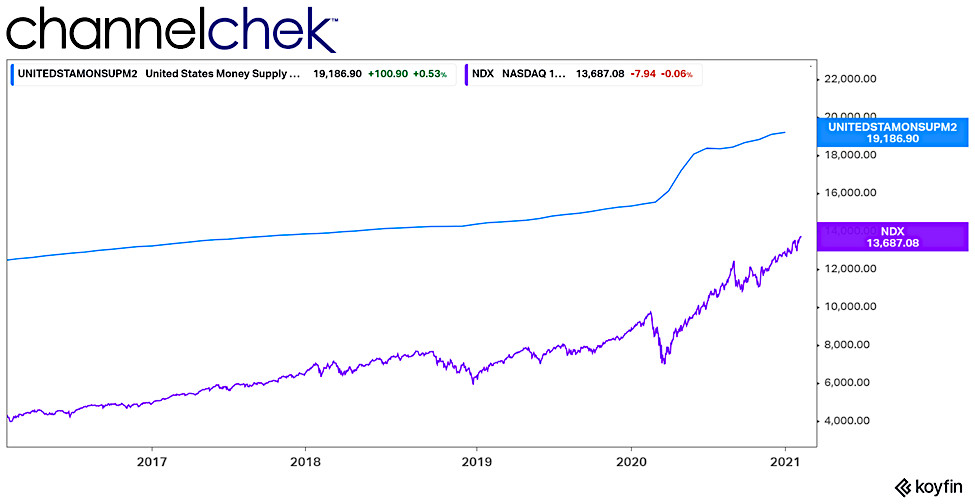
Visually, the trend in Money Supply growth is shown below to coincide with the trend in stock market returns. As more activity and money flows into a market, that market naturally has a positive upward trend. Because of this, market analysts keep an eye on big changes in money as an indicator of the way the stock market will behave in the near future.


Money Supply (M2) Trend compared to Stocks (Nasdaq 100) trend since 2016. M2 has a smooth line as money in circulation has few bumps or dips. The trajectory over most time periods is mostly equivalent.

Take-Away

The growth trend of the overall ability to spend throughout the economy has been growing at rates not seen since the 1970s. That decade was known for its struggle to tame price increases. The annual inflation rate (CPI-U) measured in December 2020 was 1.4%. During the year inflation reached a high of 2.5%, in January and a low of 0.1 in May. The Fed forecasts a 2% CPI-U growth rate for 2021. Their open market operations, which include buying bonds and bond ETFs are ongoing. This injects money, directly into the system, and into the hands of investors (sellers). There are many factors impacting stock prices, this is one of those factors that is positive for equities.

About the Author:

Laila Jiwani is a freelance writer specializing in topics related to social finance and international economic trends. Currently based in Dallas, Texas, she is an Erasmus Mundus Joint Master’s Graduate and has worked for economic development organizations in the U.S., Morocco, Kenya, Pakistan and Kyrgyzstan.


Suggested Reading:

What Stocks do you Buy When the Dollar Goes Down?

Financial Markets Lifted Household Wealth to Record Levels

Expect 500,000 Fewer Births in 2021


Sources:

U.S. Inflation – CPI

Higher Inflation is Coming and it Will Hit Bondholders


Release – CoreCivic (CXW) – Reports Fourth Quarter and Full Year 2020 Results


CoreCivic Reports Fourth Quarter and Full Year 2020 Results


BRENTWOOD, Tenn. – February 10, 2021 – CoreCivic, Inc. (NYSE: CXW) (the Company) announced today its financial results for the fourth quarter and full year 2020.

Financial Highlights – Full Year 2020

  • Total revenue of $1.91 billion
    • CoreCivic Safety revenue of $1.71 billion
    • CoreCivic Community revenue of $106.0 million
    • CoreCivic Properties revenue of $93.1 million
  • Net income attributable to common stockholders of $54.2 million
  • Diluted EPS per share of $0.45
  • Adjusted diluted EPS of $1.32
  • Normalized FFO per diluted share of $2.25
  • Adjusted EBITDA of $404.8 million
  • Non-cash impairment charges of $60.6 million

Damon T. Hininger, CoreCivic’s President and Chief Executive Officer, said, “While 2020 was an unprecedented and unpredictable year, we once again displayed the value of the mission-critical solutions we provide to our government partners and the durability of our cash flows. For the full year, we generated Normalized FFO per share of $2.25, only 4% below the mid-point of our guidance of $2.35 announced in February 2020, before the COVID-19 pandemic. In the fourth quarter we continued our capital allocation strategy of debt reduction by repaying more than $125 million in long-term debt, net of the change in cash, due to our strong operating cash flows and net proceeds provided by our recently announced sale of non-core government-leased real estate assets. We currently expect the sale of additional non-core assets, when combined with the sale completed in the fourth quarter of 2020, will result in aggregate net cash proceeds consistent with our original estimate of up to $150 million.

“Our achievements are only possible thanks to our dedicated professionals who continue to be on the front lines of the COVID-19 pandemic. Their dedication and diligence have been essential to meeting the needs of our government partners through a difficult period of time, and we continue to work tirelessly to protect our employees and the individuals in our care,” added Hininger.

CoreCivic is dedicated to helping those in its care be successful in their next step in life. Every day, CoreCivic’s chaplains, counselors and instructors help nearly 1,500 inmates learn the life and vocational skills they need to find and keep employment once released. Every year, its dedicated teachers help more than 1,500 inmates earn a GED, which research shows makes them 30% less likely to return to prison after they’re released. CoreCivic helps its government partners solve some of their toughest challenges by providing flexibility to manage constantly changing needs and populations and delivering on proven reentry programs that fight recidivism and change lives.

Financial Highlights – Fourth Quarter 2020

  • Total revenue of $473.5 million
    • CoreCivic Safety revenue of $424.3 million/li>
    • CoreCivic Community revenue of $25.3 million
    • CoreCivic Properties revenue of $23.8 million
  • Net loss attributable to common stockholders of $26.8 million
  • Diluted loss per share of $0.22
  • Adjusted diluted EPS of $0.40
  • Normalized FFO per diluted share of $0.63
  • Adjusted EBITDA of $108.7 million
  • Non-cash impairment charges of $47.6 million

Fourth Quarter 2020 Financial Results Compared With Fourth Quarter 2019

Net loss attributable to common stockholders in the fourth quarter of 2020 totaled $26.8 million, or $0.22 per diluted share, and was driven by $75.6 million, or $0.62 per share, of special items, compared with net income attributable to common stockholders generated in the fourth quarter of 2019 of $42.0 million, or $0.35 per diluted share. Adjusted for special items, net income in the fourth quarter of 2020 was $48.8 million, or $0.40 per diluted share (Adjusted Diluted EPS), compared with adjusted net income in the fourth quarter of 2019 of $42.8 million, or $0.36 per diluted share, a per share increase of 11.1%. Special items in the fourth quarter of 2020 included primarily $47.6 million in asset impairments, $7.1 million in expenses associated with debt repayments and refinancing transactions, $2.8 million in expenses associated with COVID-19, and $17.9 million in loss on sale of real estate assets. Special items in the fourth quarter of 2019 included $0.6 million in expenses associated with debt repayments and refinancing transactions and $0.2 million of expenses associated with mergers and acquisitions.

Funds From Operations (FFO) was $22.8 million, or $0.19 per diluted share, in the fourth quarter of 2020, compared to $69.0 million, or $0.58 per diluted share, in the fourth quarter of 2019. Normalized FFO, which excludes the special items described above, was $76.3 million, or $0.63 per diluted share, in the fourth quarter of 2020, compared with $69.8 million, or $0.59 per diluted share, in the fourth quarter of 2019, an increase in Normalized FFO per share of 6.8%.

EBITDA was $33.0 million in the fourth quarter of 2020, compared with $102.7 million in the fourth quarter of 2019. Adjusted EBITDA was $108.7 million in the fourth quarter of 2020, compared with $103.5 million in the fourth quarter of 2019, an increase of 5.0%. Adjusted EBITDA excludes the special items described above.

Adjusted financial results in the fourth quarter of 2020, compared with the fourth quarter of 2019, improved primarily because of incremental utilization under new contracts executed in 2019 and 2020 with (i) Immigration and Customs Enforcement (ICE) to activate our previously idle 910-bed Torrance County Detention Facility in New Mexico, (ii) ICE to utilize capacity at our 3,060-bed La Palma Correctional Center in Arizona, (iii) the U.S. Marshals Service (USMS) to utilize capacity at our 1,600-bed Cimarron Correctional Facility in Oklahoma, (iv) the states of Mississippi and Idaho to utilize available capacity at our 2,672-bed Tallahatchie County Correctional Facility in Mississippi and our 1,896-bed Saguaro Correctional Facility in Arizona. Financial results were also favorably impacted by lower general and administrative expenses in the fourth quarter of 2020 due to a reduction in incentive compensation.

The improved financial results were partially offset by lower utilization of our existing contracts with ICE and modest utilization declines across many of our state-level contracts due to the ongoing impact of COVID-19.

Balance Sheet and Liquidity as of December 31, 2020

As of December 31, 2020, cash on hand was $113.2 million, with an additional $566.2 million available under our revolving credit facility. Cash from operations and net proceeds from the sale of a portfolio of government-leased properties enabled us to repay $127.7 million of total debt during the fourth quarter of 2020, net of the change in cash and cash equivalents, increasing our financial flexibility. We have no material capital commitments, and no debt maturities until October 2022, when $250.0 million of 5.0% unsecured notes matures. We currently expect to repay these notes upon maturity with existing resources.

Recent Developments

On January 26, 2021, President Biden issued the Executive Order (EO) on Reforming Our Incarceration System to Eliminate the Use of Privately Operated Criminal Detention Facilities. The EO directs the Attorney General to not renew Department of Justice (DOJ) contracts with privately operated criminal detention facilities. Two agencies of the DOJ, the BOP and the USMS, utilize our services. The BOP houses inmates who have been convicted, and the USMS is generally responsible for detainees who are awaiting trial. The BOP has experienced a steady decline in inmate populations over the last seven years, a trend that has been accelerated by the COVID-19 pandemic. CoreCivic has one prison contract with the BOP, accounting for 2% of its total revenue for the year ended December 31, 2020, which was recently renewed through November 2022.

Commenting on the EO, Damon Hininger stated, “With nearly 70,000 fewer individuals in their system since its peak in 2013, the BOP’s need for prison capacity from the private sector has been reduced substantially. We are extremely proud of the critically important services we have provided to the BOP during their period of need extending for more than 20 years. Providing government agencies flexibility to manage fluctuations in their populations is one of the most important ways we provide value.” Hininger concluded, “We believe that our work is in alignment with the administration’s goals on equity. Our most recent ESG report shows we’re making real, measurable progress on our goals to expand proven reentry programs to fight recidivism and change lives – programs that help those in our care develop to their fullest potential and find success in their next step in life.”

Unlike the BOP, the USMS, does not own detention capacity and relies on the private sector, along with county jails, for their detainee population. We do not believe the USMS currently has sufficient detention capacity that satisfies their need without the private sector, and we are not currently aware of an alternative solution for the USMS. CoreCivic currently has eight detention facilities that have separate contracts where the USMS is the primary customer that all expire at various times over the next several years, with the exception of two contracts that have indefinite terms. For the year ended December 31, 2020, the USMS accounted for 21% of our total revenue.

Business Development Update

New Contract Award for the Development and Lease of Two Correctional Facilities for the State of Alabama. On February 1, 2021, we were awarded two new 30-year lease agreements with the Alabama Department of Corrections (ADOC) for the development of two correctional facilities, to be operated by the ADOC. Final lease costs for both properties will become available when project financing is completed. The two facilities will be the largest development projects in the Company’s history. We expect to finance 10%-15% of the project costs with existing resources, with the balance financed with non-recourse, project specific debt. Construction of both facilities, which will contain an aggregate of approximately 7,000 beds, is expected to commence later this year or the beginning of 2022. The two facilities are expected to be ready for occupancy once construction is completed in approximately three years. Both facilities will be leased, operated and staffed by the ADOC. CoreCivic will retain ownership and be responsible for facility maintenance throughout the term of the leases.

Commencement of New Management Contract with the Federal Bureau of Prisons for Reentry Services. On October 1, 2020, we were awarded a new contract by the Federal Bureau of Prisons for residential reentry and home confinement services at our 289-bed Turley Residential Center in Tulsa, Oklahoma and our 494-bed Oklahoma Reentry Opportunity Center in Oklahoma City, Oklahoma. As a result, we have recently reactivated the Turley Residential Center and began accepting residents at the facility and at the Oklahoma Reentry Opportunity Center under the new contract in February 2021. This contract supplements the existing contract with the state of Oklahoma at the Oklahoma Reentry Opportunity Center.

Sale of 42 Property Portfolio of Non-Core Government-Leased Properties. On December 23, 2020, we completed the sale of 42 non-core government-leased properties in a single transaction to a third party for an aggregate price of $106.5 million, generating net proceeds of $27.8 million after the repayment of non-recourse mortgage notes associated with some of the properties and other transaction-related costs. After considering tax protection payments required to be paid to the contributing partners of our wholly-owned subsidiary, Government Real Estate Solutions, LLC (GRES) in connection with the sale, we reported a net loss on this sale of $17.9 million. In connection with the sale, we also incurred a net debt defeasance charge of $7.1 million associated with the prepayment of the non-recourse mortgage notes. We intend to dissolve GRES in 2021, and currently expect to report a gain upon dissolution of the partnership reflected as an increase to stockholders’ equity of $15.0 million to $20.0 million, assuming we take no further actions that impact the partnership.

Assets Held for Sale. As of December 31, 2020, we had three additional non-core real estate assets held for sale with a net book value of $279.4 million. Although we can provide no assurance, based on interest expressed to-date, we are hopeful to consummate the sale of these assets during the first half of 2021. If we are successful in consummating the sale of these assets, combined with the sale completed in the fourth quarter of 2020, we expect the net proceeds from our sale of non-core assets will be consistent with our original estimate of up to $150 million.

Goodwill Impairment of Community Segment. In connection with our annual impairment test for the goodwill associated with the Community reporting unit, during the fourth quarter of 2020, we performed a quantitative goodwill impairment test and concluded to record an impairment charge of $42.6 million, representing the full value of goodwill allocated to this reporting unit. Our analysis considered numerous factors, with the impairment predominantly driven by our consideration of the broad-based declines in the market capitalization of publicly-traded companies in our industry, primarily during the second half of 2020, which is an indicator of fair value under ASU 2017-04, “Intangibles-Goodwill and Other (Topic 350): Simplifying the Test of Goodwill Impairment”. Our analysis also considered the reduction in cash flows from the COVID-19 pandemic and the anticipated change in tax structure effective January 1, 2021. We believe the cash flows in this segment will improve once effects of the pandemic subside, and remain committed to this segment, which focuses on helping those entrusted to our care obtain employment and successfully reintegrate into their communities. This segment serves a critical need to parolees, defendants, and offenders who are serving their full sentence, the last portion of their sentence, waiting to be sentenced, awaiting trial while supervised in a community environment, or as an alternative to incarceration.

Financial Guidance

At this time we are not providing 2021 financial guidance because of uncertainties associated with COVID-19, as well as uncertainties associated with the application of the administration’s various executive orders related to immigration and criminal justice. We do not expect to provide financial guidance until we have further clarity around these uncertainties. Our business is very durable, and continues to generate cash flow even during these unprecedented disruptions to the economy and criminal justice system. This resiliency is due to the essential nature of our facilities and services in our Safety and Community segments, further enhanced by the diversification and stability of our Properties segment, all supported by payments from highly rated federal, state, and local government agencies.

Supplemental Financial Information and Investor Presentations

We have made available on our website supplemental financial information and other data for the fourth quarter of 2020. Interested parties may access this information through our website at http://ir.corecivic.com/ under “Financial Information” of the Investors section. We do not undertake any obligation, and disclaim any duties to update any of the information disclosed in this report.

Management may meet with investors from time to time during the first quarter of 2021. Written materials used in the investor presentations will also be available on our website beginning on or about March 1, 2021. Interested parties may access this information through our website at http://ir.corecivic.com/ under “Events & Presentations” of the Investors section.

Conference Call, Webcast and Replay Information

We will host a webcast conference call at 10:00 a.m. Central Time (11:00 a.m. Eastern Time) on Thursday, February 11, 2021, to discuss our fourth quarter and full year 2020 financial results and business outlook. Interested parties may access this information through our website at http://ir.corecivic.com/ under “Events & Presentations” of the Investors page. The live broadcast can also be accessed by dialing 800-367-2403 in the U.S. and Canada, including the confirmation passcode 3061661. The conference call will be archived on our website following the completion of the call. In addition, there will be a telephonic replay available beginning at 1:00 p.m. central time (2:00 p.m. eastern time) on February 11, 2021, through 1:00 p.m. central time (2:00 p.m. eastern time) on February 19, 2021. To access the telephonic replay, dial 888-203-1112 in the U.S. and Canada. International callers may dial +1 719-457-0820 and enter passcode 3061661.

About CoreCivic

The Company is a diversified government solutions company with the scale and experience needed to solve tough government challenges in flexible, cost-effective ways. We provide a broad range of solutions to government partners that serve the public good through corrections and detention management, a network of residential reentry centers to help address America’s recidivism crisis, and government real estate solutions. We are the nation’s largest owner of partnership correctional, detention and residential reentry facilities, and believe we are the largest private owner of real estate used by U.S. government agencies. The Company has been a flexible and dependable partner for government for more than 35 years. Our employees are driven by a deep sense of service, high standards of professionalism and a responsibility to help government better the public good. Learn more at www.corecivic.com.

Forward-Looking Statements

This press release contains statements as to our beliefs and expectations of the outcome of future events that are “forward-looking” statements within the meaning of Section 21E of the Securities Exchange Act of 1934, as amended, and the Private Securities Litigation Reform Act of 1995. These forward-looking statements are subject to risks and uncertainties that could cause actual results to differ materially from the statements made. These include, but are not limited to, the risks and uncertainties associated with: (i) changes in government policy (including the DOJ not renewing contracts as a result of the EO), legislation and regulations that affect utilization of the private sector for corrections, detention, and residential reentry services, in general, or our business, in particular, including, but not limited to, the continued utilization of our correctional and detention facilities by the federal government, and the impact of any changes to immigration reform and sentencing laws (our company does not, under longstanding policy, lobby for or against policies or legislation that would determine the basis for, or duration of, an individual’s incarceration or detention); (ii) our ability to obtain and maintain correctional, detention, and residential reentry facility management contracts because of reasons including, but not limited to, sufficient governmental appropriations, contract compliance, negative publicity and effects of inmate disturbances; (iii) changes in the privatization of the corrections and detention industry, the acceptance of our services, the timing of the opening of new facilities and the commencement of new management contracts (including the extent and pace at which new contracts are utilized), as well as our ability to utilize available beds; (iv) general economic and market conditions, including, but not limited to, the impact governmental budgets can have on our contract renewals and renegotiations, per diem rates, and occupancy; (v) fluctuations in our operating results because of, among other things, changes in occupancy levels, competition, contract renegotiations or terminations, increases in costs of operations, fluctuations in interest rates and risks of operations; (vi) the duration of the federal government’s denial of entry at the United States southern border to asylum-seekers and anyone crossing the southern border without proper documentation or authority in an effort to contain the spread of COVID-19; (vii) government and staff responses to staff or residents testing positive for COVID-19 within public and private correctional, detention and reentry facilities, including the facilities we operate; (viii) the location and duration of shelter in place orders and other restrictions associated with COVID-19 that disrupt the criminal justice system, along with government policies on prosecutions and newly ordered legal restrictions that affect the number of people placed in correctional, detention, and reentry facilities; (ix) whether revoking our REIT election, effective January 1, 2021, and our revised capital allocation strategy can be implemented in a cost effective manner that provides the expected benefits, including facilitating our planned debt reduction initiative and planned return of capital to shareholders; (x) our ability to identify and consummate the sale of additional non-core assets at attractive prices; (xi) our ability to successfully identify and consummate future development and acquisition opportunities and our ability to successfully integrate the operations of our completed acquisitions and realize projected returns resulting therefrom; (xii) increases in costs to develop or expand real estate properties that exceed original estimates, or the inability to complete such projects on schedule as a result of various factors, many of which are beyond our control, such as the effects of, and delays caused by, COVID-19, weather, the availability of labor and materials, labor conditions, delays in obtaining legal approvals, unforeseen engineering, archeological or environmental problems, and cost inflation, resulting in increased construction costs; (xiii) our ability to identify and initiate service opportunities that were unavailable under our former REIT structure; (xiv) our ability to have met and maintained qualification for taxation as a REIT for the years we elected REIT status; and (xv) the availability of debt and equity financing on terms that are favorable to us, or at all. Other factors that could cause operating and financial results to differ are described in the filings we make from time to time with the Securities and Exchange Commission.

CoreCivic takes no responsibility for updating the information contained in this press release following the date hereof to reflect events or circumstances occurring after the date hereof or the occurrence of unanticipated events or for any changes or modifications made to this press release or the information contained herein by any third-parties, including, but not limited to, any wire or internet services.

Contact:

Investors: Cameron Hopewell
Managing Director, Investor Relations
(615) 263-3024

Financial Media: David Gutierrez
Dresner Corporate Services
(312) 780-7204

SOURCE: CoreCivic

Release – CoreCivic (CXW) – Announces 2020 Fourth Quarter Earnings Release and Conference Call Dates


CoreCivic Reports Fourth Quarter and Full Year 2020 Results


BRENTWOOD, Tenn. – February 10, 2021 – CoreCivic, Inc. (NYSE: CXW) (the Company) announced today its financial results for the fourth quarter and full year 2020.

Financial Highlights – Full Year 2020

  • Total revenue of $1.91 billion
    • CoreCivic Safety revenue of $1.71 billion
    • CoreCivic Community revenue of $106.0 million
    • CoreCivic Properties revenue of $93.1 million
  • Net income attributable to common stockholders of $54.2 million
  • Diluted EPS per share of $0.45
  • Adjusted diluted EPS of $1.32
  • Normalized FFO per diluted share of $2.25
  • Adjusted EBITDA of $404.8 million
  • Non-cash impairment charges of $60.6 million

Damon T. Hininger, CoreCivic’s President and Chief Executive Officer, said, “While 2020 was an unprecedented and unpredictable year, we once again displayed the value of the mission-critical solutions we provide to our government partners and the durability of our cash flows. For the full year, we generated Normalized FFO per share of $2.25, only 4% below the mid-point of our guidance of $2.35 announced in February 2020, before the COVID-19 pandemic. In the fourth quarter we continued our capital allocation strategy of debt reduction by repaying more than $125 million in long-term debt, net of the change in cash, due to our strong operating cash flows and net proceeds provided by our recently announced sale of non-core government-leased real estate assets. We currently expect the sale of additional non-core assets, when combined with the sale completed in the fourth quarter of 2020, will result in aggregate net cash proceeds consistent with our original estimate of up to $150 million.

“Our achievements are only possible thanks to our dedicated professionals who continue to be on the front lines of the COVID-19 pandemic. Their dedication and diligence have been essential to meeting the needs of our government partners through a difficult period of time, and we continue to work tirelessly to protect our employees and the individuals in our care,” added Hininger.

CoreCivic is dedicated to helping those in its care be successful in their next step in life. Every day, CoreCivic’s chaplains, counselors and instructors help nearly 1,500 inmates learn the life and vocational skills they need to find and keep employment once released. Every year, its dedicated teachers help more than 1,500 inmates earn a GED, which research shows makes them 30% less likely to return to prison after they’re released. CoreCivic helps its government partners solve some of their toughest challenges by providing flexibility to manage constantly changing needs and populations and delivering on proven reentry programs that fight recidivism and change lives.

Financial Highlights – Fourth Quarter 2020

  • Total revenue of $473.5 million
    • CoreCivic Safety revenue of $424.3 million/li>
    • CoreCivic Community revenue of $25.3 million
    • CoreCivic Properties revenue of $23.8 million
  • Net loss attributable to common stockholders of $26.8 million
  • Diluted loss per share of $0.22
  • Adjusted diluted EPS of $0.40
  • Normalized FFO per diluted share of $0.63
  • Adjusted EBITDA of $108.7 million
  • Non-cash impairment charges of $47.6 million

Fourth Quarter 2020 Financial Results Compared With Fourth Quarter 2019

Net loss attributable to common stockholders in the fourth quarter of 2020 totaled $26.8 million, or $0.22 per diluted share, and was driven by $75.6 million, or $0.62 per share, of special items, compared with net income attributable to common stockholders generated in the fourth quarter of 2019 of $42.0 million, or $0.35 per diluted share. Adjusted for special items, net income in the fourth quarter of 2020 was $48.8 million, or $0.40 per diluted share (Adjusted Diluted EPS), compared with adjusted net income in the fourth quarter of 2019 of $42.8 million, or $0.36 per diluted share, a per share increase of 11.1%. Special items in the fourth quarter of 2020 included primarily $47.6 million in asset impairments, $7.1 million in expenses associated with debt repayments and refinancing transactions, $2.8 million in expenses associated with COVID-19, and $17.9 million in loss on sale of real estate assets. Special items in the fourth quarter of 2019 included $0.6 million in expenses associated with debt repayments and refinancing transactions and $0.2 million of expenses associated with mergers and acquisitions.

Funds From Operations (FFO) was $22.8 million, or $0.19 per diluted share, in the fourth quarter of 2020, compared to $69.0 million, or $0.58 per diluted share, in the fourth quarter of 2019. Normalized FFO, which excludes the special items described above, was $76.3 million, or $0.63 per diluted share, in the fourth quarter of 2020, compared with $69.8 million, or $0.59 per diluted share, in the fourth quarter of 2019, an increase in Normalized FFO per share of 6.8%.

EBITDA was $33.0 million in the fourth quarter of 2020, compared with $102.7 million in the fourth quarter of 2019. Adjusted EBITDA was $108.7 million in the fourth quarter of 2020, compared with $103.5 million in the fourth quarter of 2019, an increase of 5.0%. Adjusted EBITDA excludes the special items described above.

Adjusted financial results in the fourth quarter of 2020, compared with the fourth quarter of 2019, improved primarily because of incremental utilization under new contracts executed in 2019 and 2020 with (i) Immigration and Customs Enforcement (ICE) to activate our previously idle 910-bed Torrance County Detention Facility in New Mexico, (ii) ICE to utilize capacity at our 3,060-bed La Palma Correctional Center in Arizona, (iii) the U.S. Marshals Service (USMS) to utilize capacity at our 1,600-bed Cimarron Correctional Facility in Oklahoma, (iv) the states of Mississippi and Idaho to utilize available capacity at our 2,672-bed Tallahatchie County Correctional Facility in Mississippi and our 1,896-bed Saguaro Correctional Facility in Arizona. Financial results were also favorably impacted by lower general and administrative expenses in the fourth quarter of 2020 due to a reduction in incentive compensation.

The improved financial results were partially offset by lower utilization of our existing contracts with ICE and modest utilization declines across many of our state-level contracts due to the ongoing impact of COVID-19.

Balance Sheet and Liquidity as of December 31, 2020

As of December 31, 2020, cash on hand was $113.2 million, with an additional $566.2 million available under our revolving credit facility. Cash from operations and net proceeds from the sale of a portfolio of government-leased properties enabled us to repay $127.7 million of total debt during the fourth quarter of 2020, net of the change in cash and cash equivalents, increasing our financial flexibility. We have no material capital commitments, and no debt maturities until October 2022, when $250.0 million of 5.0% unsecured notes matures. We currently expect to repay these notes upon maturity with existing resources.

Recent Developments

On January 26, 2021, President Biden issued the Executive Order (EO) on Reforming Our Incarceration System to Eliminate the Use of Privately Operated Criminal Detention Facilities. The EO directs the Attorney General to not renew Department of Justice (DOJ) contracts with privately operated criminal detention facilities. Two agencies of the DOJ, the BOP and the USMS, utilize our services. The BOP houses inmates who have been convicted, and the USMS is generally responsible for detainees who are awaiting trial. The BOP has experienced a steady decline in inmate populations over the last seven years, a trend that has been accelerated by the COVID-19 pandemic. CoreCivic has one prison contract with the BOP, accounting for 2% of its total revenue for the year ended December 31, 2020, which was recently renewed through November 2022.

Commenting on the EO, Damon Hininger stated, “With nearly 70,000 fewer individuals in their system since its peak in 2013, the BOP’s need for prison capacity from the private sector has been reduced substantially. We are extremely proud of the critically important services we have provided to the BOP during their period of need extending for more than 20 years. Providing government agencies flexibility to manage fluctuations in their populations is one of the most important ways we provide value.” Hininger concluded, “We believe that our work is in alignment with the administration’s goals on equity. Our most recent ESG report shows we’re making real, measurable progress on our goals to expand proven reentry programs to fight recidivism and change lives – programs that help those in our care develop to their fullest potential and find success in their next step in life.”

Unlike the BOP, the USMS, does not own detention capacity and relies on the private sector, along with county jails, for their detainee population. We do not believe the USMS currently has sufficient detention capacity that satisfies their need without the private sector, and we are not currently aware of an alternative solution for the USMS. CoreCivic currently has eight detention facilities that have separate contracts where the USMS is the primary customer that all expire at various times over the next several years, with the exception of two contracts that have indefinite terms. For the year ended December 31, 2020, the USMS accounted for 21% of our total revenue.

Business Development Update

New Contract Award for the Development and Lease of Two Correctional Facilities for the State of Alabama. On February 1, 2021, we were awarded two new 30-year lease agreements with the Alabama Department of Corrections (ADOC) for the development of two correctional facilities, to be operated by the ADOC. Final lease costs for both properties will become available when project financing is completed. The two facilities will be the largest development projects in the Company’s history. We expect to finance 10%-15% of the project costs with existing resources, with the balance financed with non-recourse, project specific debt. Construction of both facilities, which will contain an aggregate of approximately 7,000 beds, is expected to commence later this year or the beginning of 2022. The two facilities are expected to be ready for occupancy once construction is completed in approximately three years. Both facilities will be leased, operated and staffed by the ADOC. CoreCivic will retain ownership and be responsible for facility maintenance throughout the term of the leases.

Commencement of New Management Contract with the Federal Bureau of Prisons for Reentry Services. On October 1, 2020, we were awarded a new contract by the Federal Bureau of Prisons for residential reentry and home confinement services at our 289-bed Turley Residential Center in Tulsa, Oklahoma and our 494-bed Oklahoma Reentry Opportunity Center in Oklahoma City, Oklahoma. As a result, we have recently reactivated the Turley Residential Center and began accepting residents at the facility and at the Oklahoma Reentry Opportunity Center under the new contract in February 2021. This contract supplements the existing contract with the state of Oklahoma at the Oklahoma Reentry Opportunity Center.

Sale of 42 Property Portfolio of Non-Core Government-Leased Properties. On December 23, 2020, we completed the sale of 42 non-core government-leased properties in a single transaction to a third party for an aggregate price of $106.5 million, generating net proceeds of $27.8 million after the repayment of non-recourse mortgage notes associated with some of the properties and other transaction-related costs. After considering tax protection payments required to be paid to the contributing partners of our wholly-owned subsidiary, Government Real Estate Solutions, LLC (GRES) in connection with the sale, we reported a net loss on this sale of $17.9 million. In connection with the sale, we also incurred a net debt defeasance charge of $7.1 million associated with the prepayment of the non-recourse mortgage notes. We intend to dissolve GRES in 2021, and currently expect to report a gain upon dissolution of the partnership reflected as an increase to stockholders’ equity of $15.0 million to $20.0 million, assuming we take no further actions that impact the partnership.

Assets Held for Sale. As of December 31, 2020, we had three additional non-core real estate assets held for sale with a net book value of $279.4 million. Although we can provide no assurance, based on interest expressed to-date, we are hopeful to consummate the sale of these assets during the first half of 2021. If we are successful in consummating the sale of these assets, combined with the sale completed in the fourth quarter of 2020, we expect the net proceeds from our sale of non-core assets will be consistent with our original estimate of up to $150 million.

Goodwill Impairment of Community Segment. In connection with our annual impairment test for the goodwill associated with the Community reporting unit, during the fourth quarter of 2020, we performed a quantitative goodwill impairment test and concluded to record an impairment charge of $42.6 million, representing the full value of goodwill allocated to this reporting unit. Our analysis considered numerous factors, with the impairment predominantly driven by our consideration of the broad-based declines in the market capitalization of publicly-traded companies in our industry, primarily during the second half of 2020, which is an indicator of fair value under ASU 2017-04, “Intangibles-Goodwill and Other (Topic 350): Simplifying the Test of Goodwill Impairment”. Our analysis also considered the reduction in cash flows from the COVID-19 pandemic and the anticipated change in tax structure effective January 1, 2021. We believe the cash flows in this segment will improve once effects of the pandemic subside, and remain committed to this segment, which focuses on helping those entrusted to our care obtain employment and successfully reintegrate into their communities. This segment serves a critical need to parolees, defendants, and offenders who are serving their full sentence, the last portion of their sentence, waiting to be sentenced, awaiting trial while supervised in a community environment, or as an alternative to incarceration.

Financial Guidance

At this time we are not providing 2021 financial guidance because of uncertainties associated with COVID-19, as well as uncertainties associated with the application of the administration’s various executive orders related to immigration and criminal justice. We do not expect to provide financial guidance until we have further clarity around these uncertainties. Our business is very durable, and continues to generate cash flow even during these unprecedented disruptions to the economy and criminal justice system. This resiliency is due to the essential nature of our facilities and services in our Safety and Community segments, further enhanced by the diversification and stability of our Properties segment, all supported by payments from highly rated federal, state, and local government agencies.

Supplemental Financial Information and Investor Presentations

We have made available on our website supplemental financial information and other data for the fourth quarter of 2020. Interested parties may access this information through our website at http://ir.corecivic.com/ under “Financial Information” of the Investors section. We do not undertake any obligation, and disclaim any duties to update any of the information disclosed in this report.

Management may meet with investors from time to time during the first quarter of 2021. Written materials used in the investor presentations will also be available on our website beginning on or about March 1, 2021. Interested parties may access this information through our website at http://ir.corecivic.com/ under “Events & Presentations” of the Investors section.

Conference Call, Webcast and Replay Information

We will host a webcast conference call at 10:00 a.m. Central Time (11:00 a.m. Eastern Time) on Thursday, February 11, 2021, to discuss our fourth quarter and full year 2020 financial results and business outlook. Interested parties may access this information through our website at http://ir.corecivic.com/ under “Events & Presentations” of the Investors page. The live broadcast can also be accessed by dialing 800-367-2403 in the U.S. and Canada, including the confirmation passcode 3061661. The conference call will be archived on our website following the completion of the call. In addition, there will be a telephonic replay available beginning at 1:00 p.m. central time (2:00 p.m. eastern time) on February 11, 2021, through 1:00 p.m. central time (2:00 p.m. eastern time) on February 19, 2021. To access the telephonic replay, dial 888-203-1112 in the U.S. and Canada. International callers may dial +1 719-457-0820 and enter passcode 3061661.

About CoreCivic

The Company is a diversified government solutions company with the scale and experience needed to solve tough government challenges in flexible, cost-effective ways. We provide a broad range of solutions to government partners that serve the public good through corrections and detention management, a network of residential reentry centers to help address America’s recidivism crisis, and government real estate solutions. We are the nation’s largest owner of partnership correctional, detention and residential reentry facilities, and believe we are the largest private owner of real estate used by U.S. government agencies. The Company has been a flexible and dependable partner for government for more than 35 years. Our employees are driven by a deep sense of service, high standards of professionalism and a responsibility to help government better the public good. Learn more at www.corecivic.com.

Forward-Looking Statements

This press release contains statements as to our beliefs and expectations of the outcome of future events that are “forward-looking” statements within the meaning of Section 21E of the Securities Exchange Act of 1934, as amended, and the Private Securities Litigation Reform Act of 1995. These forward-looking statements are subject to risks and uncertainties that could cause actual results to differ materially from the statements made. These include, but are not limited to, the risks and uncertainties associated with: (i) changes in government policy (including the DOJ not renewing contracts as a result of the EO), legislation and regulations that affect utilization of the private sector for corrections, detention, and residential reentry services, in general, or our business, in particular, including, but not limited to, the continued utilization of our correctional and detention facilities by the federal government, and the impact of any changes to immigration reform and sentencing laws (our company does not, under longstanding policy, lobby for or against policies or legislation that would determine the basis for, or duration of, an individual’s incarceration or detention); (ii) our ability to obtain and maintain correctional, detention, and residential reentry facility management contracts because of reasons including, but not limited to, sufficient governmental appropriations, contract compliance, negative publicity and effects of inmate disturbances; (iii) changes in the privatization of the corrections and detention industry, the acceptance of our services, the timing of the opening of new facilities and the commencement of new management contracts (including the extent and pace at which new contracts are utilized), as well as our ability to utilize available beds; (iv) general economic and market conditions, including, but not limited to, the impact governmental budgets can have on our contract renewals and renegotiations, per diem rates, and occupancy; (v) fluctuations in our operating results because of, among other things, changes in occupancy levels, competition, contract renegotiations or terminations, increases in costs of operations, fluctuations in interest rates and risks of operations; (vi) the duration of the federal government’s denial of entry at the United States southern border to asylum-seekers and anyone crossing the southern border without proper documentation or authority in an effort to contain the spread of COVID-19; (vii) government and staff responses to staff or residents testing positive for COVID-19 within public and private correctional, detention and reentry facilities, including the facilities we operate; (viii) the location and duration of shelter in place orders and other restrictions associated with COVID-19 that disrupt the criminal justice system, along with government policies on prosecutions and newly ordered legal restrictions that affect the number of people placed in correctional, detention, and reentry facilities; (ix) whether revoking our REIT election, effective January 1, 2021, and our revised capital allocation strategy can be implemented in a cost effective manner that provides the expected benefits, including facilitating our planned debt reduction initiative and planned return of capital to shareholders; (x) our ability to identify and consummate the sale of additional non-core assets at attractive prices; (xi) our ability to successfully identify and consummate future development and acquisition opportunities and our ability to successfully integrate the operations of our completed acquisitions and realize projected returns resulting therefrom; (xii) increases in costs to develop or expand real estate properties that exceed original estimates, or the inability to complete such projects on schedule as a result of various factors, many of which are beyond our control, such as the effects of, and delays caused by, COVID-19, weather, the availability of labor and materials, labor conditions, delays in obtaining legal approvals, unforeseen engineering, archeological or environmental problems, and cost inflation, resulting in increased construction costs; (xiii) our ability to identify and initiate service opportunities that were unavailable under our former REIT structure; (xiv) our ability to have met and maintained qualification for taxation as a REIT for the years we elected REIT status; and (xv) the availability of debt and equity financing on terms that are favorable to us, or at all. Other factors that could cause operating and financial results to differ are described in the filings we make from time to time with the Securities and Exchange Commission.

CoreCivic takes no responsibility for updating the information contained in this press release following the date hereof to reflect events or circumstances occurring after the date hereof or the occurrence of unanticipated events or for any changes or modifications made to this press release or the information contained herein by any third-parties, including, but not limited to, any wire or internet services.

Contact:

Investors: Cameron Hopewell
Managing Director, Investor Relations
(615) 263-3024

Financial Media: David Gutierrez
Dresner Corporate Services
(312) 780-7204

SOURCE: CoreCivic

Release – Comstock Mining (LODE) – Comstock and MCU Ready Launch of Mercury Remediation Operations


Comstock and MCU Ready Launch of Mercury Remediation Operations; First Regional Remediation and Extraction Facility Expected to Begin Full Operations in March 2021


Virginia City, NV (February 10, 2021) – Comstock Mining Inc. (NYSE: LODE) (“Comstock” and the “Company”) and Mercury Clean Up LLC (“MCU”), announced today that construction is nearly complete in their Clean Mercury Remediation Technologies (“CMRT”) joint venture, representing the first mercury remediation and gold extraction facility in the province of Davao D’ Oro, Philippines, with initial operations launching next week.

Artisanal and Small-Scale Gold Mining (ASGM) Dilemma

Mercury?dependent ASGM uses a process known as amalgamation to dissolve gold from natural deposits. The amalgam is then typically isolated by hand and then heated to distill the mercury and isolate the gold. Problematically, mercury is hazardous to human health and the environment, where residual ASGM wastes contaminate water and soil and ultimately bioaccumulate into food chains. Mercury risks to children are particularly acute, with mercury emissions from ASGM disabling both physical and mental development. The process was regulated into near extinction by most countries, but upwards of 20 million people still use mercury to mine for gold in more than 70 countries, making mercury pollution from ASGM a U.N. prioritized global issue through the Minamata Convention.

Proprietary Remediation and Extraction Process

The MCU mercury remediation system is the first of several planned by MCU, Comstock and CMRT in the region. Each system is mobile and specifically designed for remote deployment, to remediate mercury from existing amalgamation wastes while extracting residual by-products, including gold, cleaned sand, soil and gravel for commercial use. The mercury wastes are disposed in a safe and compliant manner, thereby repairing and enhancing local ecosystems, while the extracted gold and cleaned by-products provide multiple high-margin revenue streams.

“Each facility is expected to produce positive cash flow within a few months of start-up, with fast returns on capital deployed, typically in less than a year, depending on processing rates and the various by-products extracted from environment,” said Corrado De Gasperis, Comstock’s Executive Chairman and Chief Executive Officer. “Our deployment plan involves several additional systems once the first remediation activities are up and running, so we are very much looking forward to achieving that objective and moving into positive cash flows and sustained growth.”

A photo accompanying this announcement is available at https://www.comstockmining.com/press-releases/comstock-and-mcu-ready-launch-of-mercury-remediation-operations

About Comstock Mining Inc.

Comstock Mining Inc. is a Nevada-based, precious and strategic metal-based exploration, economic resource development, mineral production and metal processing business with a strategic focus on high-value, cash-generating, environmentally friendly, and economically enhancing mining and processing technologies and businesses. The Company has extensive, contiguous property in the historic Comstock and Silver City mining districts (collectively, the “Comstock District”), is an emerging leader in sustainable, responsible mining and processing, and is currently commercializing environment-enhancing, metal-based technologies, products, and processes for precious and strategic metals recovery.

Forward-Looking Statements

This press release and any related calls or discussions may include forward-looking statements within the meaning of Section 27A of the Securities Act of 1933, as amended, and Section 21E of the Securities Exchange Act of 1934, as amended. All statements, other than statements of historical facts, are forward-looking statements. The words “believe,” “expect,” “anticipate,” “estimate,” “project,” “plan,” “should,” “intend,” “may,” “will,” “would,” “potential” and similar expressions identify forward-looking statements, but are not the exclusive means of doing so. Forward-looking statements include statements about matters such as: consummation of all pending transactions; project, asset or Company valuations; future industry market conditions; future explorations, acquisitions, investments and asset sales; future performance of and closings under various agreements; future changes in our exploration activities; future estimated mineral resources; future prices and sales of, and demand for, our products; future impacts of land entitlements and uses; future permitting activities and needs therefor; future production capacity and operations; future operating and overhead costs; future capital expenditures and their impact on us; future impacts of operational and management changes (including changes in the board of directors); future changes in business strategies, planning and tactics and impacts of recent or future changes; future employment and contributions of personnel, including consultants; future land sales, investments, acquisitions, joint ventures, strategic alliances, business combinations, operational, tax, financial and restructuring initiatives; the nature and timing of and accounting for restructuring charges and derivative liabilities and the impact thereof; contingencies; future environmental compliance and changes in the regulatory environment; future offerings of equity or debt securities; asset sales and associated costs; future working capital, costs, revenues, business opportunities, debt levels, cash flows, margins, earnings and growth.

These statements are based on assumptions and assessments made by our management in light of their experience and their perception of historical and current trends, current conditions, possible future developments and other factors they believe to be appropriate. Forward-looking statements are not guarantees, representations or warranties and are subject to risks and uncertainties, many of which are unforeseeable and beyond our control and could cause actual results, developments and business decisions to differ materially from those contemplated by such forward-looking statements. Some of those risks and uncertainties include the risk factors set forth in our filings with the SEC and the following: counterparty risks; capital markets’ valuation and pricing risks; adverse effects of climate changes or natural disasters; global economic and capital market uncertainties; the speculative nature of gold or mineral exploration, including risks of diminishing quantities or grades of qualified resources; operational or technical difficulties in connection with exploration or mining activities; contests over title to properties; potential dilution to our stockholders from our stock issuances and recapitalization and balance sheet restructuring activities; potential inability to comply with applicable government regulations or law; adoption of or changes in legislation or regulations adversely affecting businesses; permitting constraints or delays; decisions regarding business opportunities that may be presented to, or pursued by, us or others; the impact of, or the non-performance by parties under agreements relating to, acquisitions, joint ventures, strategic alliances, business combinations, asset sales, leases, options and investments to which we may be party; changes in the United States or other monetary or fiscal policies or regulations; interruptions in production capabilities due to capital constraints; equipment failures; fluctuation of prices for gold or certain other commodities (such as silver, zinc, cyanide, water, diesel fuel and electricity); changes in generally accepted accounting principles; adverse effects of terrorism and geopolitical events; potential inability to implement business strategies; potential inability to grow revenues; potential inability to attract and retain key personnel; interruptions in delivery of critical supplies, equipment and raw materials due to credit or other limitations imposed by vendors or others; assertion of claims, lawsuits and proceedings; potential inability to satisfy debt and lease obligations; potential inability to maintain an effective system of internal controls over financial reporting; potential inability or failure to timely file periodic reports with the SEC; potential inability to list our securities on any securities exchange or market; inability to maintain the listing of our securities; and work stoppages or other labor difficulties. Occurrence of such events or circumstances could have a material adverse effect on our business, financial condition, results of operations or cash flows or the market price of our securities. All subsequent written and oral forward-looking statements by or attributable to us or persons acting on our behalf are expressly qualified in their entirety by these factors. Except as may be required by securities or other law, we undertake no obligation to publicly update or revise any forward-looking statements, whether as a result of new information, future events, or otherwise.

Neither this press release nor any related calls or discussions constitutes an offer to sell, the solicitation of an offer to buy or a recommendation with respect to any securities of the Company, the fund or any other issuer.

Contact information for

Comstock Mining Inc.
117 American Flat Rd
PO Box 1118
Virginia City, NV 89440
http://www.comstockmining.com

Corrado De Gasperis
Executive Chairman & CEO
Tel (775) 847-4755
[email protected]

Zach Spencer
Director of External Relations
Tel (775) 847-5272 ext.151
[email protected]

Source: Comstock Mining

Neovasc (NVCN)(NVCN:CA) – Complied with Nasdaq Minimum Bid Price Requirement

Wednesday, February 10, 2021

Neovasc (NVCN)(NVCN:CA)
Complied with Nasdaq Minimum Bid Price Requirement

As of April 24, 2020, Noble Capital Markets research on Neovasc is published under ticker symbols (NVCN and NVCN:CA). The price target is in USD and based on ticker symbol NVCN. Research reports dated prior to April 24, 2020 may not follow these guidelines and could account for a variance in the price target.

Neovasc Inc is a specialty medical device company. The company develops, manufactures and markets products for the rapidly growing cardiovascular marketplace. Its products include the Tiara for the transcatheter treatment of mitral valve disease and the Neovasc Reducer for the treatment of refractory angina. Neovasc is developing the Tiara for the treatment of mitral valve disease. Neovasc operates its business in one segment.

Ahu Demir, Ph. D., Biotechnology Research Analyst, Noble Capital Markets, Inc.

Refer to the full report for the price target, fundamental analysis, and rating.

    Regained compliance with the minimum bid price. Neovasc regained compliance with Nasdaq with the minimum bid price requirement and will continue listing on Nasdaq. The shares gained 55% attributed to this news. The company is still required to maintain the minimum market value of US$35 million by June 8, 2021, to continue its listing.

    Reducer Germany reimbursement is renewed.  New examination and treatment methods (NUBs) Status 1 was renewed for 2021 under the German healthcare system. As Reducer is currently CE-marked in the European Union for the treatment of refractory angina, this highest priority designation is renewed every year and open doors to full reimbursement coverage for Reducer therapy …


This Company Sponsored Research is provided by Noble Capital Markets, Inc., a FINRA and S.E.C. registered broker-dealer (B/D).

*Analyst certification and important disclosures included in the full report. NOTE: investment decisions should not be based upon the content of this research summary.  Proper due diligence is required before making any investment decision. 

Golden Predator Mining (NTGSF)(GPY:CA) – Bankable Feasibility Study Expected Later This Quarter

Wednesday, February 10, 2021

Golden Predator Mining (NTGSF)(GPY:CA)
Bankable Feasibility Study Expected Later This Quarter

Golden Predator Mining Corp is a Canada based exploration stage company engaged in the business of acquiring and exploring mineral properties. It owns properties primarily in Yukon, Canada. Some of the company’s projects located in Yukon are the 3 Aces, Sprogge, Reef, Brewery Creek, Marg, Sonora Gulch, Grew Creek, Upper Hyland and others.

Mark Reichman, Senior Research Analyst of Natural Resources, Noble Capital Markets, Inc.

Refer to the full report for the price target, fundamental analysis, and rating.

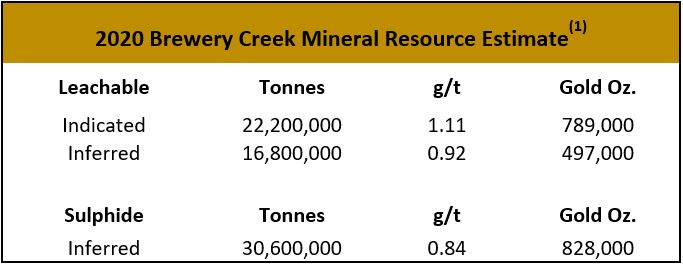
    Final drill results from 2020 work program. Results were released for the remaining 16 of 32 drill holes from the 2020 work program. Recall that 32 infill drill holes, representing 3,706 meters, were completed in a 400-meter gap area between the Golden and Lucky resource areas. The infill drill program built on the company’s 2019 program that established continuity of mineralization within the licensed Reserve Trend between the eastern edge of the Canadian-Fosters-Kokanee-Golden pits (Keg pit shell) east to the Lucky pit. Infill drilling within this 400-meter gap is intended to convert inferred resources to indicated resources and confirm continuity of mineralization between the two deposits to incorporate the Lucky resource into the Keg pit shell.

    Positive outcomes.  Assay results indicated significant thicknesses of gold mineralization in 14 of the 16 drill holes. Two of the drill holes were not completed to target depth. Composite mineralized intercept thicknesses ranged from 6.10 meters to 45.72 meters with an average composite mineralized thickness of 26.05 meters in the 11 drill holes that had full intersections across the mineralized …


This Company Sponsored Research is provided by Noble Capital Markets, Inc., a FINRA and S.E.C. registered broker-dealer (B/D).

*Analyst certification and important disclosures included in the full report. NOTE: investment decisions should not be based upon the content of this research summary.  Proper due diligence is required before making any investment decision. 

Comtech (CMTL) – Awarded $235.7 Million Contract from U.S. Army

Wednesday, February 10, 2021

Comtech (CMTL)
Awarded $235.7 Million Contract from U.S. Army

Comtech Telecommunications Corp. engages in the design, development, production, and marketing of products, systems, and services for advanced communications solutions in the United States and internationally. It operates in three segments: Telecommunications Transmission, Mobile Data Communications, and RF Microwave Amplifiers. The Telecommunications Transmission segment provides satellite earth station equipment and systems, over-the-horizon microwave systems, and forward error correction technology, which are used in various commercial and government applications, including backhaul of wireless and cellular traffic, broadcasting (including HDTV), IP-based communications traffic, long distance telephony, and secure defense applications. The Mobile Data Communications segment provides mobile satellite transceivers, and computers and satellite earth station network gateways and associated installation, training, and maintenance services; supplies and operates satellite packet data networks, including arranging and providing satellite capacity; and offers microsatellites and related components. The RF Microwave Amplifiers segment designs, develops, manufactures, and markets satellite earth station traveling wave tube amplifiers (TWTA) and broadband amplifiers. Its amplifiers are used in broadcast and broadband satellite communication; defense applications, such as telecommunications systems and electronic warfare systems; and commercial applications comprising oncology treatment systems, as well as to amplify signals carrying voice, video, or data for air-to-satellite-to-ground communications. The company serves satellite systems integrators, wireless and other communication service providers, broadcasters, defense contractors, military, governments, and oil companies. Comtech markets its products through independent representatives and value-added resellers. The company was founded in 1967 and is headquartered in Melville, New York.

Joe Gomes, Senior Research Analyst, Noble Capital Markets, Inc.

Refer to the full report for the price target, fundamental analysis, and rating.

    New Award. Continuing its award momentum, yesterday Comtech announced it has been awarded a contract valued up to $235.7 million to provide the U.S. Army with ongoing system refurbishments, sustainment services, and baseband equipment. The total contract value includes a base-year award and three one-year option periods exercisable by the U.S. Army. The $57.9 million base year award ceiling has been initially funded $11.5 million by the U.S. Army, with additional funding expected to occur over the remaining base year performance period. This was a competitive solicitation.

    SIPR and NIPR.  The contract will support the sustainment of the Army’s AN/TSC-198 Secret Internet Protocol Router (“SIPR”) and Non-secure Internet Protocol Router (“NIPR”) Access Point (“SNAP”) family of ground satellite terminals, to include spare parts, repairs, upgrades, refurbishments, logistics and engineering services, and training …


This research is provided by Noble Capital Markets, Inc., a FINRA and S.E.C. registered broker-dealer (B/D).

*Analyst certification and important disclosures included in the full report. NOTE: investment decisions should not be based upon the content of this research summary.  Proper due diligence is required before making any investment decision. 

Aurania Resources (AUIAF)(ARU:CA) – Tiria-Shimpia Silver-Gold Target in the Crosshairs

Tuesday, February 09, 2021

Aurania Resources (AUIAF)(ARU:CA)
Tiria-Shimpia Silver-Gold Target in the Crosshairs

As of April 24, 2020, Noble Capital Markets research on Aurania Resources is published under ticker symbols (AUIAF and ARU:CA). The price target is in USD and based on ticker symbol AUIAF. Research reports dated prior to April 24, 2020 may not follow these guidelines and could account for a variance in the price target.

Aurania Resources Ltd. is a Canada-based junior mining exploration company engaged in the identification, evaluation, acquisition, and exploration of mineral property interests, with a focus on precious metals and copper. Its flagship asset, The Lost Cities-Cutucu Project, is in southeastern Ecuador in the Province of Morona-Santiago. The company also has several minor projects in Switzerland.

Mark Reichman, Senior Research Analyst of Natural Resources, Noble Capital Markets, Inc.

Refer to the full report for the price target, fundamental analysis, and rating.

    Initial drill sites. Initial drill sites have been selected to test high-grade silver zones at the Tiria-Shimpia epithermal silver-gold target. Recall that Tiria-Shimpia is a target area that encompasses over 75 square kilometers. Exploration work along a 15-kilometer trend and geological mapping suggest the mineralization is not a vein system but is following fault zones and sedimentary layers of the host rock across trend for up to 3 kilometers.

    Promising indicators.  Outcrops in two streams that are 1.5 kilometers apart in the northwestern portion of the target area contain high-grade silver, including 356 grams of silver per tonne with 12.7% zinc and 199 grams of silver per tonne with 22% zinc. Drill sites have been selected to test these high-grade zones at depth. Drilling will help determine whether the two outcrops are connected at …


This Company Sponsored Research is provided by Noble Capital Markets, Inc., a FINRA and S.E.C. registered broker-dealer (B/D).

*Analyst certification and important disclosures included in the full report. NOTE: investment decisions should not be based upon the content of this research summary.  Proper due diligence is required before making any investment decision. 

Lineage Cell Therapeutics (LCTX) – Transformation on Track, Reiterating Outperform Rating

Tuesday, February 09, 2021

Lineage Cell Therapeutics (LCTX)
Transformation on Track, Reiterating Outperform Rating

Lineage Cell Therapeutics is a clinical-stage biotechnology company developing novel cell therapies for unmet medical needs. Lineage’s programs are based on its robust proprietary cell-based therapy platform and associated in-house development and manufacturing capabilities. With this platform Lineage develops and manufactures specialized, terminally differentiated human cells from its pluripotent and progenitor cell starting materials. These differentiated cells are developed to either replace or support cells that are dysfunctional or absent due to degenerative disease or traumatic injury or administered as a means of helping the body mount an effective immune response to cancer. Lineage’s clinical programs are in markets with billion dollar opportunities and include three allogeneic (“off-the-shelf”) product candidates: (i) OpRegen®, a retinal pigment epithelium transplant therapy in Phase 1/2a development for the treatment of dry age-related macular degeneration, a leading cause of blindness in the developed world; (ii) OPC1, an oligodendrocyte progenitor cell therapy in Phase 1/2a development for the treatment of acute spinal cord injuries; and (iii) VAC, an allogeneic dendritic cell therapy platform for immuno-oncology and infectious disease, currently in clinical development for the treatment of non-small cell lung cancer. For more information, please visit www.lineagecell.com or follow the Company on Twitter @LineageCell.

Ahu Demir, Ph. D., Biotechnology Research Analyst, Noble Capital Markets, Inc.

Refer to the full report for the price target, fundamental analysis, and rating.

    License agreement on OPC1 delivery system to treat spinal cord injury. Lineage entered into an exclusive license agreement with Neurgain Technologies, a private company focused on the treatment of spinal cord trauma-induced neuropathic pain. Lineage made immaterial upfront payments and is obligated to pay milestone payments; the terms of the deal were not disclosed. Lineage and Neurgain will evaluate Neurgain’s novel Parenchymal Delivery Injection (PDI) system for the administration of cells to the spinal cord without stopping the patient’s respiration that is expected to reduce the complexity, risk, and variability of the procedure. PDI system is expected to be ready to use for OPC1 clinical studies by YE 2021.

    Progress on OPC1 program.  Lineage made significant progress in the manufacturing of OPC1 including a 10-20x increase in production scale, reduced impurities, and ready to inject formulation. The company is having discussions with the FDA to determine the path forward for this program …


This Company Sponsored Research is provided by Noble Capital Markets, Inc., a FINRA and S.E.C. registered broker-dealer (B/D).

*Analyst certification and important disclosures included in the full report. NOTE: investment decisions should not be based upon the content of this research summary.  Proper due diligence is required before making any investment decision. 

Can Oil Prices Keep Climbing?


Why Oil is Moving and Why It Could Go Higher


Brent Oil prices crossed $60 per barrel for the first time since January 2020. The surge began in early November when positive vaccine test results gave the market hope that oil demand would soon return to pre-pandemic levels. But instead of returning to last March’s oil price level in the mid-fifties, a funny thing happened. Oil prices shot through pre-pandemic levels and all the way to $60. What’s more, oil prices seem poised to rise above $60 and reach levels not seen since 2018.

Why are they Increasing?

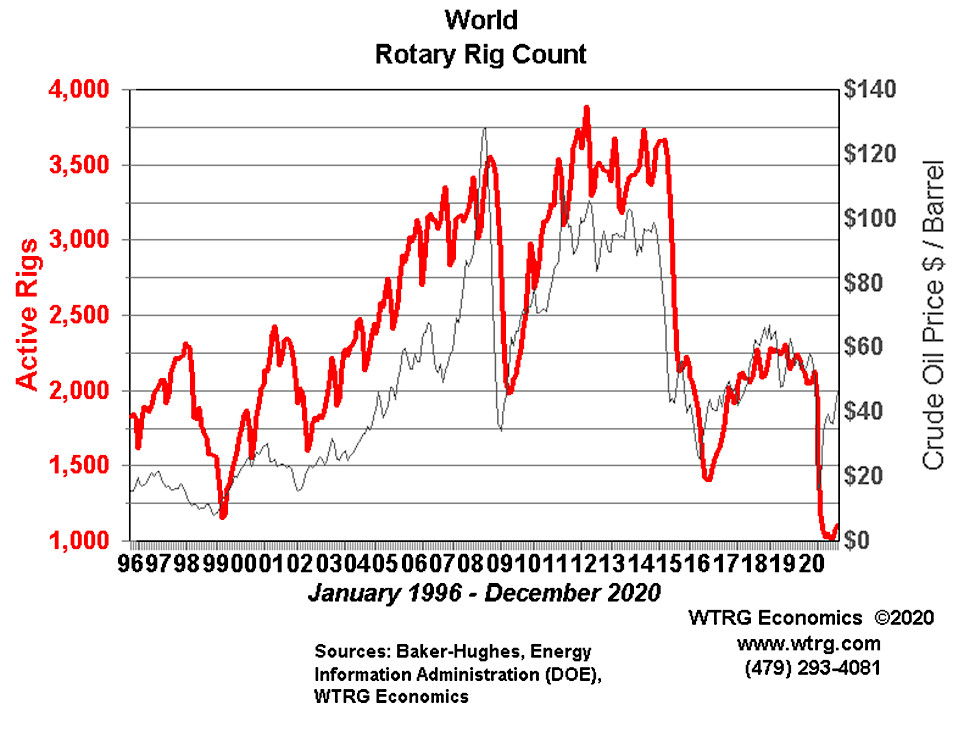
So why do energy prices continue to rise? In a nutshell … there is a lack of supply response to higher prices. Producers across the world are not increasing drilling yet. Worldwide, active rigs have fallen to a level half that of a year ago. The chart below shows the correlation between rig count and oil prices. Note that oil price rose in the last two months of last year, rig count did not. This trend has continued in 2021 with oil prices rising to $60 per barrel, but the world rig count stuck at 1183 as of the end of January. The last time Brent oil prices were at $60 in January of 2020, there were 2265 active rigs.


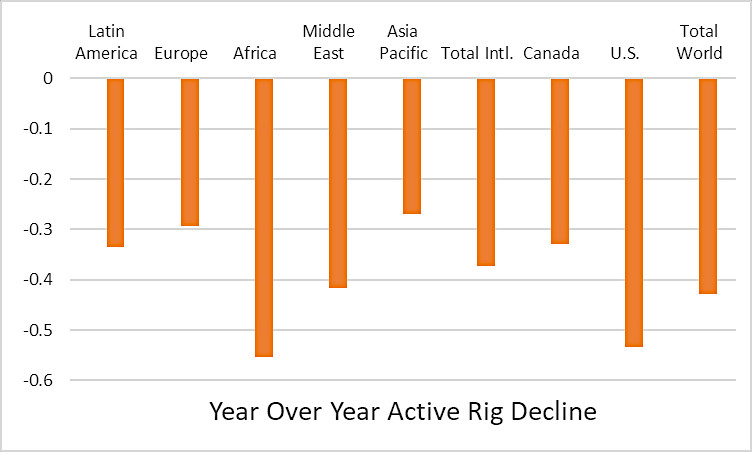
In total, world active rigs are 43% below January 2020 levels. The declines have been the sharpest in the United States (down 53%) and Africa (down 55%). Other regions such as Asia (down 27%), Europe (down 29%), and Canada (down 33%) have seen smaller declines. The Middle East, once again establishing its position as a price setter, reports a 42% year-over-year decline in active rigs, very much in line with the world’s average.


OPEC’s Hand in the Situation

An analysis of rig declines by region seems to suggest that OPEC’s overall strategy is working. Recall that OPEC, led by Saudi Arabia, flooded the market with oil in the spring allowing oil prices to fall sharply. West Texas Intermediate oil prices even dropped below zero temporarily as traders were caught with excess oil and no room to put the oil in storage. OPEC’s intent was manyfold. First, it wanted to punish Russia for not going along with production cuts and remind them of the potential impact on nonconformance. Second, it wanted to counter the rise in U.S. production coming from increased shale production. Technological advances have made U.S. shale production profitable at prices in the forties leading to the U.S. becoming a net exporter of oil. When oil prices fell last year, U.S. producers responded by cutting back drilling, as evidenced by the chart above.

Will Trend Continue

So why aren’t U.S. oil producers responding to higher oil prices by increasing drilling? Most likely, producers have been snake bitten by last year and wary of raising production only to be forced to halt production or shut-in production if oil prices fall. A second explanation may be that producers are first focusing on well completions from last year before ramping up drilling. If that is the case, we would expect to see drilling begin to rise as the inventory of well completions dries up.


Take-Away

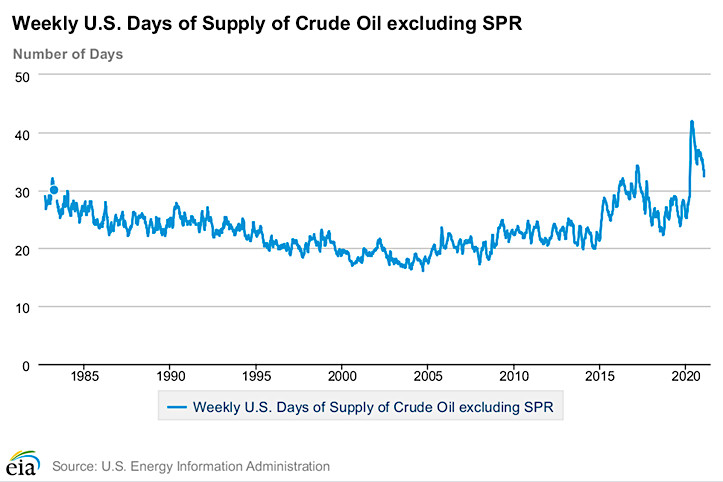
Whatever the reason for the current low rig count, the implication for oil prices is positive. There has not been a supply response to higher prices, and oil inventories are falling. The chart above shows that crude oil inventories rose sharply last March but have been falling in recent months. Inventories are now approaching pre-pandemic levels. Unless producers accelerate drilling, inventories may continue to fall as the global economy expands. The result could be that oil prices continue to rise even as we have crossed $60 per barrel.


Suggested Reading:

Will the US Continue to Subsidize Renewable Energy?

Industry Report – Energy Q4

What Should the Price Range be for Oil and Natural Gas

Stay up to date. Follow us:


Stay up to date. Follow us:

Sources:

U.S. Energy Information Administration

Baker Hughes Energy

Release – Golden Predator Mining (NTGSF)(GPY:CA) – Reports Final Drill Results from Brewery Creek Mine


Golden Predator Reports Final Drill Results from Brewery Creek Mine


Significant gold mineralization in all drill holes reaching target depth

Vancouver, BC, February 9, 2021: Golden Predator Mining Corp. (TSX.V:GPY, OTCQX:NTGSF) (the “Company”) today announces the results from the final 16 of 32 reverse circulation drill holes from the 2020 work program at its licensed 100%-owned Brewery Creek mine project ?located approximately 55 km by road from Dawson City, Yukon.

Drill program highlights include:

  • 19.81 m of 1.57 g/t gold from a depth of 85.34 m in drill hole RC20-2694;
  • 21.34 m of 1.31 g/t gold from a depth of 123.44 m in drill hole RC20-2702;
  • 21.34 m of 1.09 g/t gold from a depth of 80.77 m in drill hole RC20-2705;
  • 9.14 m of 1.41 g/t gold from a depth of 45.72 m in drill hole RC20-2706; and
  • 12.19 m of 0.55 g/t gold from a depth of 6.10 m and 16.76 m of 0.58 g/t gold from a depth of 62.48 in drill hole RC20-2708.

To view Brewery Creek project and drill location maps: https://www.goldenpredator.com/_resources/news/GPY-NR21-03-BCreek-2020-Drill-Results-Maps-FINAL.pdf

2020 Brewery Creek Exploration Program – Golden Infill Drilling

A total of 32 reverse circulation drill holes, totaling 3,706 m, were completed between the Golden and Lucky resource areas in the fall of 2020. The 2020 program was designed to infill within and around two fences of 2019 drilling that encountered mineralization along a 400 m gap where there had been no previous drilling between the Golden and Lucky resource areas. The objective was to establish sufficient drill density in this 400 m gap to be able to incorporate the Lucky resource into the greater Keg pit shell.

The gold assays for the remaining 16 drill holes of the program are reported in this release with significant thicknesses of gold mineralization present in 14 of the 16 of the drill holes. The two drill holes not intersecting mineralization were not completed to target depth. The collars of 8 of the drill holes are located outside of the current Golden resource area and the other 8 are located on the southwestern margin of the current Golden resource area.

Other significant mineralized intervals include 7.62 m of 2.68 g/t gold from a depth of 102.11 m in drill hole RC20-2700 and multiple intercepts in drill hole RC20-2707 including 9.14 m of 0.58 g/t gold from a depth of 42.67 m and 13.72 m of 0.57 g/t gold from a depth of 70.10 m.

Gold mineralization is controlled by fractures oriented sub-parallel to the main thrust fault and a series of high angle conjugate fractures developed within main shear zone. Composite mineralized intercepts thicknesses range from 6.10 m to 45.72 m with an average composite mineralized thickness of 26.05 m in the 11 drill holes that had full intersections across the mineralized zone. Mineralization encountered in these 16 holes consists of sulfide, transitional and lesser amounts of oxide material. Within the area of this drilling the eastern strike extension of the mineralized zone is not yet defined, and the zone remains open at depth down dip.

2020 Brewery Creek Exploration Program – Classic/Lone Star

Three reverse circulation drill holes, totaling 687 m, were completed in 2020 targeting newly defined extensions of the Classic/Lone Star porphyry-style mineralization. The drill holes were widely-spaced step-out holes drilled at significant distances from any existing drilling at the Classic and Lone Star areas. Two of the drill holes (RC20-2710 and RC20-2711) were located approximately 500 m from each other and 650 m southeast of the closest previous drilling within the Classic and Lone Star areas. No significant gold was intersected in either drill hole. The third drill hole (RC20-2712), located approximately 1,330 m to the east of the nearest previous drilling, tested a coincident aeromagnetic and radiometric anomaly indicating a structural zone along the margin of a biotite monzonite intrusive within an area of spotty gold and arsenic in soil geochemistry. This initial test was encouraging with gold intersected in two intervals of monzonite with 0.33 g/t gold over 1.52 m at a depth of 120.40 m and 0.27 g/t gold over 1.52 m at a depth of 131.06 within a 15.29 m zone of anomalous mineralization. Mineralization within the zone consists of pyrite with local arsenopyrite associated with chlorite and calcite alteration minerals.

Continuing exploration will develop extensions to the Classic and Lone Star area mineralization, a near surface bulk tonnage target that lies approximately 3 km south of the Brewery Creek Reserve Trend. Together with the Lone Star zone, the Classic zone demonstrates the discovery potential of the entire southern portion of the large Brewery Creek property where a large syenite intrusion hosts gold mineralization primarily in sheeted quartz/carbonate/pyrite veins and as fine-grained disseminations. Initial column leach tests have indicated that this intrusive hosted mineralization is leachable to at least a 200 m depth. This mineralization is clearly a separate younger mineralizing event not associated with the quartz monzonite, thrust fault hosted, mineralization historically exploited in the Reserve Trend which is the subject of the ongoing bankable feasibility study.

To view a complete table of results: https://www.goldenpredator.com/_resources/news/GPY-NR-21-03-BRC-DrillAssays-2020-20210128.pdf

2020 Exploration Drill Program

The 2020 Brewery Creek drill program built upon Golden Predator’s successful 2019 program that established continuity of mineralization within the licensed Reserve Trend between the eastern edge of the Canadian-Fosters-Kokanee-Golden pits (Keg pitshell) east to the Lucky pit. The 32 reverse circulation drill holes drilled in 2020 were designed to fill in and expand the gold resource between the eastern Golden zone and western Lucky zone. The targeted mineralization between these zones has been offset by a high-angle normal fault and was previously untested until 2019 when the zone was intersected with multiple drill holes.

Infill drilling within this 400 m gap between the eastern edge of the Fosters to Golden trend and the western edge of the Lucky zone is also to increase the density of drilling to convert Inferred resources to Indicated resources and confirm continuity of mineralization between the two deposits while testing for additional resources. The goal is to establish and confirm continuous mineralization along the Fosters-Canadian-Kokanee-Golden-Lucky zones for mine design now in progress as a part of the Brewery Creek Bankable Feasibility Study (BFS).

Brewery Creek Mine: Resources1

Materials on the heap leach pad were not included in the resource update. Mineral Resources estimates conducted within a pit shell developed at $2,000/oz gold with an internal cut-off grade calculated at $1,500/oz gold was used to report mineral resource inventories.

The resource estimate is based on a recovery model created from assay data, bottle and column leach test work and historic recovery analysis instead of a less accurate visual oxide-sulfide boundary developed from geologist drill logs. Sedimentary and intrusive rocks, which have distinct metallurgical characteristics, were estimated separately based on gold-grade distribution analysis. A supporting NI 43-101 Technical Report is filed on SEDAR at www.sedar.com.

Brewery Creek Mine Work Plan

The Brewery Creek Mine is a licensed brownfields heap leach gold mine that was operated by Viceroy Minerals Corporation from 1996 to 2002. Brewery Creek is authorized to restart mining activities as defined within the Quartz Mining License and Water License. The Company intends to resume mining and processing of licensed deposits when supported by an independent study that outlines technical and economic viability. The 180 km2 property is located 55 km east of Dawson City and is accessible year-round by paved and improved gravel roads. Significant infrastructure remains in place, allowing for a timely restart schedule under existing operating licenses.

A Bankable Feasibility Study (BFS) is being conducted by Kappes Cassiday & Associates of Reno, Nevada which will include a multi-year mine plan for the advancement of the Brewery Creek project. The BFS will include an inventory of the mineralized material remaining on the heap and mine planning (completed by Tetra Tech Inc of Golden, Colorado) for the resumption of the mining of material from leachable resources contained within the licensed area and reported in the Company’s Mineral Resource Estimate. The BFS will include all the key parameters involved in reconstructing or adding necessary infrastructure including a crushing facility, the Adsorption-Desorption-Recovery (“ADR”) plant and assay lab and an implementation schedule, sourcing, and economic cash flow model sufficiently detailed to move directly into procurement, development and construction if economically warranted. Any production decisions would be dependent on the outcome of a study demonstrating positive technical and economic viability.

Sampling Methodology, Quality Control and Assurance

Analyses for drill samples were performed by SGS Canada, Inc., ALS Canada and Bureau Veritas, Canada with sample preparation in Whitehorse, YT and assaying in Burnaby, North Vancouver and Vancouver, BC respectively. Drill samples were analyzed for gold using a 30 gram fire assay with atomic absorption finish (SGS-GO FAA30V10 method, ALS-Au AA-25 method and BV-FA430 method). Quality controls standards include standard reference material, certified blank and field duplicate samples in every sample dispatch.

The technical content of this news release has been reviewed and approved by Jeff Cary, CPG, a Qualified Person as defined by National Instrument 43-101 and a consultant to the Company.

About Golden Predator Mining Corp.

Golden Predator is advancing the past-producing Brewery Creek Mine towards a timely resumption of mining activities, under its Quartz Mining and Water Licenses, in Canada’s Yukon. With established resources grading over 1.0 g/t gold the Company is completing a Bankable Feasibility Study for the restart of heap leach operations. The Brewery Creek Mine project operates with a Socio Economic Accord with the Tr’ondëk Hwëch’in First Nation.

For additional information on Golden Predator Mining Corp.:
Janet Lee-Sheriff
Chief Executive Officer

(604) 260-8435
[email protected]
www.goldenpredator.com

Neither TSX Venture Exchange nor its Regulation Services Provider (as that term is defined in policies of the TSX Venture Exchange) accepts responsibility for the adequacy or accuracy of this release. No stock exchange, securities commission or other regulatory authority has approved or disapproved the information contained herein. This press release contains forward-looking information that involve various risks and uncertainties regarding future events. Such forward-looking information can include without limitation statements based on current expectations that the Brewery Creek will advance to an early production decision, or the extent of any additional mineral resource that could result from incorporating 2019 exploration drilling. Actual results and future events could differ materially from those anticipated in such information. These and all subsequent written and oral forward-looking information are based on estimates and opinions of management on the dates they are made and are expressly qualified in their entirety by this notice. Except as required by law, the Company assumes no obligation to update forward-looking information should circumstances or management’s estimates or opinions change.

1. The 2020 Mineral Resource Estimate was conducted in accordance with CIM guidelines and is reported in a NI 43-101 Technical Report which will be filed on SEDAR and the Company’s website within 45 days.

Source: Golden Predator Mining

Release – Chakana (CHKKF)(PERU:CA) – Intersects Highest Grade Interval To Date At Huancarama Soledad Project Peru


Chakana Copper Intersects Highest Grade Interval To Date 11m of 2.79 g/t Au, 4.04% Cu, and 330.8 g/t Ag (13.30 g/t Au-Eq) At Huancarama, Soledad Project, Peru


Within 93m of 1.63 g/t Au, 0.95% Cu, and 129.2 g/t Ag (4.77 g/t Au-Eq) from 117m

Vancouver, B.C., February 9, 2021 – Chakana Copper Corp. (Tsx-V: Peru; Otcqb: Chkkf; Fra: 1zx) (The “Company” Or “Chakana”), Is Pleased To Release Results For Two Additional Drill Holes With The Highest-Grade Intercepts Reported To Date From The Huancarama Breccia Complex, Within The Soledad Project In Ancash, Peru (Fig. 1). These Holes Complement The Initial Ten Holes Previously Published (See News Releases Dated January 12, 2021, And January 25, 202). Twenty-Two Hq Diamond Core Holes Have Been Completed Thus Far With Continued Success Expanding The Mineralized Breccia At Huancarama.

Mineralized intervals from two additional holes at Huancarama include:

* Cu_eq and Au_eq values were calculated using copper, gold, and silver. Metal prices utilized for the calculations are Cu – US$2.90/lb, Au – US$1,300/oz, and Ag – US$17/oz. No adjustments were made for recovery as the project is an early stage exploration project and metallurgical data to allow for estimation of recoveries are not yet available. The formulas utilized to calculate equivalent values are Cu-eq (%) = Cu% + (Au g/t * 0.6556) + (Ag g/t * 0.00857) and Au-eq (g/t) = Au g/t + (Cu% * 1.5296) + (Ag g/t * 0.01307).

Utilizing the same platform on the south side of the breccia complex that holes SDH20-161 and SDH20-162 were drilled from, holes SDH20-163 and SDH20-164 were oriented east-northeast across the breccia body outlined by the first 10 drill holes (Figures 2 and 3). Both holes intersected continuous mineralization across the breccia body. Hole SDH20-163 was oriented beneath the north edge of the outcropping H1 breccia and intersected 88.05m with 0.28 g/t Au, 0.32% Cu, and 30.2 g/t Ag (1.17 g/t Au-eq) starting at 61m. Hole SDH20-164, drilled beneath the southeast edge of the collapse zone, encountered 93m with 1.63 g/t Au, 0.95% Cu, and 129.2 g/t Ag (4.77 g/t Au-eq) from 117m depth, including 42m with 2.90 g/t Au, 1.41% Cu, and 182.3 g/t Ag (7.44 g/t Au-eq) from 124m. Examples of mineralized drill core from these holes are shown in Figure 4.

David Kelley, President and CEO commented, “these two holes demonstrate the successful continuation of the drilling at Huancarama, further defining a large mineralized breccia pipe. The H1 and H2 breccias exposed at surface coalesce at depth, forming a large coherent breccia pipe. We continue to see excellent grades, particularly in the central part of the breccia body below the collapse zone. Hole SDH20-164 exhibits spectacular mineralization with 11m of 2.79 g/t Au, 4.04% Cu, and 330.8 g/t Ag; and 4m of 2.61 g/t Au, 5.44% Cu, and 926.2 g/t Ag, within two separate intervals. The high-grade zones reported in previous drill holes correlate well with those reported in this hole and are open at depth. Drilling is ongoing at Huancarama and we look forward to reporting additional results soon.”

Huancarama Target Area and the Phase 3b Drill Program

The Huancarama Breccia Complex is located 300m south of and 400m above the deepest breccia intercept at Paloma. Within the complex there are five principal breccia bodies exposed at surface over approximately 200m horizontally (Fig. 5). There is a distinctive feature believed to be a collapse zone with dimensions of 50m by 30m. Unverified reports suggest that this may be due to small-scale mining. Two historic adits are in the complex, one trending north-northeast for 170m along the western side of H1 (Fig. 2), and a second shorter adit of 21m at H2. Surface sampling from the breccia bodies and channel sampling of the adits yielded strongly anomalous gold results (see news release dated November 19, 2019). In addition to several targets within the complex, numerous additional targets exist in the Huancarama and Paloma area.

Results reported here are part of the ongoing Phase 3b drill program, which is fully funded from the Company’s current treasury and is anticipated to see 15,000 metres completed. Phase 3b is testing a cluster of high-grade, gold-enriched tourmaline breccia pipe targets within the Paloma and Huancarama target areas. Thirty-two holes have now been reported from the Phase 3b program.

About Chakana Copper

Chakana Copper Corp is a Canadian-based minerals exploration company that is currently advancing the high-grade gold-copper-silver Soledad Project located in the Ancash region of Peru, a highly favorable mining jurisdiction with supportive communities. The Soledad Project consists of high-grade gold-copper-silver mineralization hosted in tourmaline breccia pipes. A total of 33,353 metres of drilling has been completed to-date, testing nine (9) of twenty-three (23) confirmed breccia pipes with more than 92 total targets. Chakana’s investors are uniquely positioned as the Soledad Project provides exposure to several metals including copper, gold, and silver. For more information on the Soledad project, please visit the website a www.chakanacopper.com.

Sampling and Analytical Procedures

Chakana follows rigorous sampling and analytical protocols that meet or exceed industry standards. Core samples are stored in a secured area until transport in batches to the ALS facility in Callao, Lima, Peru. Sample batches include certified reference materials, blank, and duplicate samples that are then processed under the control of ALS. All samples are analyzed using the ME-MS41 (ICP technique that provides a comprehensive multi-element overview of the rock geochemistry), while gold is analyzed by AA24 and GRA22 when values exceed 10 g/t by AA24. Over limit silver, copper, lead and zinc are analyzed using the OG-46 procedure. Soil samples are analyzed by 4-acid (ME-MS61) and for gold by Fire Assay on a 30g sample (Au-ICP21).

Results of previous drilling and additional information concerning the Project, including a technical report prepared in accordance with National Instrument 43-101, are made available on Chakana’s SEDAR profile at www.sedar.com.

Qualified Person

David Kelley, an officer and a director of Chakana, and a Qualified Person as defined by NI 43-101, reviewed and approved the technical information in this news release.

ON BEHALF OF THE BOARD
(signed) “David Kelley”
David Kelley
President and CEO

For further information contact:
Joanne Jobin, Investor Relations Officer
Phone: 647 964 0292
Email: [email protected]

Neither TSX Venture Exchange nor its Regulation Services Provider (as that term is defined in the policies of the Exchange) accepts responsibility for the adequacy or accuracy of this release.

Forward-looking Statement Advisory: This release may contain forward-looking statements. Forward-looking statements involve known and unknown risks, uncertainties, and other factors which may cause the actual results, performance, or achievements of Chakana to be materially different from any future results, performance, or achievements expressed or implied by the forward looking statements. Forward looking statements or information relates to, among other things, the interpretation of the nature of the mineralization at the Soledad copper-gold-silver project (the “Project”), the potential to expand the mineralization, and to develop and grow a resource within the Project, the planning for further exploration work, the ability to de-risk the potential exploration targets, and our belief in the potential for mineralization within unexplored parts of the Project. These forward-looking statements are based on management’s current expectations and beliefs but given the uncertainties, assumptions and risks, readers are cautioned not to place undue reliance on such forward- looking statements or information. The Company disclaims any obligation to update, or to publicly announce, any such statements, events or developments except as required by law.

Figure 1 – View looking north showing breccia pipes and occurrences within the northern Soledad cluster. Pipes that have been drilled in previous campaigns are shown in red. Targets shown in green are the focus on this 15,000m drill campaign. Other pipes and occurrences remain to be tested by drilling. Additional breccia pipes occur on the south half of the property and are not shown here.

Figure 2 – Map of the Huancarama Breccia Complex and drill hole lithology in holes completed to date. Red represents tourmaline breccia based on the first ten holes and lithology mapped in the underground tunnel. Black dotted outlines show surface expression of mapped breccias; white dashed line shows collapse zone. Location of section line for Figure 3 indicated.

Figure 3 – Section looking northwest highlighting the drill holes at Huancarama reported in this release. Light red 3D shape shows preliminary shape of breccia based on the first ten holes and lithology mapped in the underground tunnel.

Figure 4 – Core photos from Huancarama: SDH20-163 (83.3m) mosaic tourmaline breccia with partial clast replacement by chalcopyrite; SDH20- 163 (117.85m) tourmaline breccia with chalcopyrite and red sphalerite open space filling ; SDH20-164 (123.2 to 131.12m) – example of high-grade copper sulfide (chalcopyrite) clast replacement and sulfide-cemented breccia. Core diameter is 6.35cm (HQ) in all instances.

Figure 5 – Drone image looking northeast at the Huancarama Breccia Complex showing the five principal tourmaline breccia bodies exposed at surface (H1-H5), historic adit portal, and drill platforms. Note drill rig in center of image.

SOURCE: Chakana Copper

Newrange Gold (NRGOF)(NRG:CA) – Making Significant Progress on Two Fronts

Tuesday, February 09, 2021

Newrange Gold (NRGOF)(NRG:CA)
Making Significant Progress on Two Fronts

As of April 24, 2020, Noble Capital Markets research on Newrange Gold is published under ticker symbols (NRGOF and NRG:CA). The price target is in USD and based on ticker symbol NRGOF. Research reports dated prior to April 24, 2020 may not follow these guidelines and could account for a variance in the price target.

Newrange Gold Corp is an exploration stage company focused on acquiring and exploring exploration and evaluation assets in Colombia and the United States. The Company operates in a single reportable operating segment-the acquisition, exploration, and development of mineral properties. Some of the projects acquired by the company are Pamlico gold project in Nevada and Rocky mountain project in Colorado. The company also holds an interest in the Yarumalito property, El Dovio property and Anori property in Colombia.

Mark Reichman, Senior Research Analyst of Natural Resources, Noble Capital Markets, Inc.

Refer to the full report for the price target, fundamental analysis, and rating.

    Geophysical survey of the North Birch project. An induced polarization (IP) survey, which is expected to commence within 10 to 14 days, will help detect areas of sulphide enrichment and generate targets for diamond drilling at the company’s North Birch project in Ontario, Canada. The primary target is part of a folded iron formation. The 8-kilometer target horizon, which has never been drilled, extends 2 kilometers along strike into the high-grade Argosy Gold Mine which closed in 1952. There are multiple showings in the rocks to the south of the main target horizon. Management expects drilling could begin as early as April following identification of drill targets based on the survey results and receipt of drilling permits.

    H Lake option exercised.  Newrange recently exercised its option to acquire a 100% interest in the H Lake Property, which forms the western portion of North Birch. The H Lake property encompasses 1,550 hectares, or 3,830 acres, and covers a portion of the same folded iron formation as the Western Fold property. Together, the two properties encompass 3,850 hectares, or 9,514 acres, and cover the …


This Company Sponsored Research is provided by Noble Capital Markets, Inc., a FINRA and S.E.C. registered broker-dealer (B/D).

*Analyst certification and important disclosures included in the full report. NOTE: investment decisions should not be based upon the content of this research summary.  Proper due diligence is required before making any investment decision.