Release – Sierra Metals Inc. (SMT:CA)(SMTS) – Reports Q4-2020 Financial Results At Its Sociedad Minera Corona Subsidiary In Peru


Sierra Metals Reports Q4-2020 Financial Results At Its Sociedad Minera Corona Subsidiary In Peru


Consolidated Financial Results for Sierra Metals to Be Released on March 18, 2021

(All metal prices and amounts reported in USD)

TORONTO–(BUSINESS WIRE)– Sierra Metals Inc. (TSX:SMT, BVL:SMT, NYSE AMERICAN:SMTS) (“Sierra Metals” or the “Company”) announces the filing of Sociedad Minera Corona S.A.’s (“Corona”) unaudited Financial Statements and the Management Discussion and Analysis (“MD&A”) for the fourth quarter of 2020 (“Q4 2020”).

This press release features multimedia. View the full release here: https://www.businesswire.com/news/home/20210216005467/en/

The Company holds an 81.8% interest in Corona. All amounts are presented in US dollars unless otherwise stated and have not been adjusted for the 18.2% non-controlling interest.

Corona’s Highlights for the Three Months Ended December 31, 2020

  • Revenues of US$45.2 million vs. US$42.2 million in Q42019
  • Adjusted EBITDA of US$22.5 million vs. US$17.9 million in Q4 2019
  • Total tonnes processed decreased by 3% to 311,946 vs. 321,701 in Q4 2019
  • Net production revenue per tonne of ore milled increased by 8% to US$148.13
  • Cash cost per copper equivalent payable pound decreased by 1% at US$1.16 in Q4 2020
  • All-in sustaining cost (“AISC”) per copper equivalent payable increased 17% to US$2.47 in Q4 2020
  • Copper equivalent production of 18.4 million pounds vs. 23.1 million pounds in Q4 2019
  • US$65.0 million of cash and cash equivalents as at December 31, 2020
  • US$92.0 million of working capital as at December 31,2020

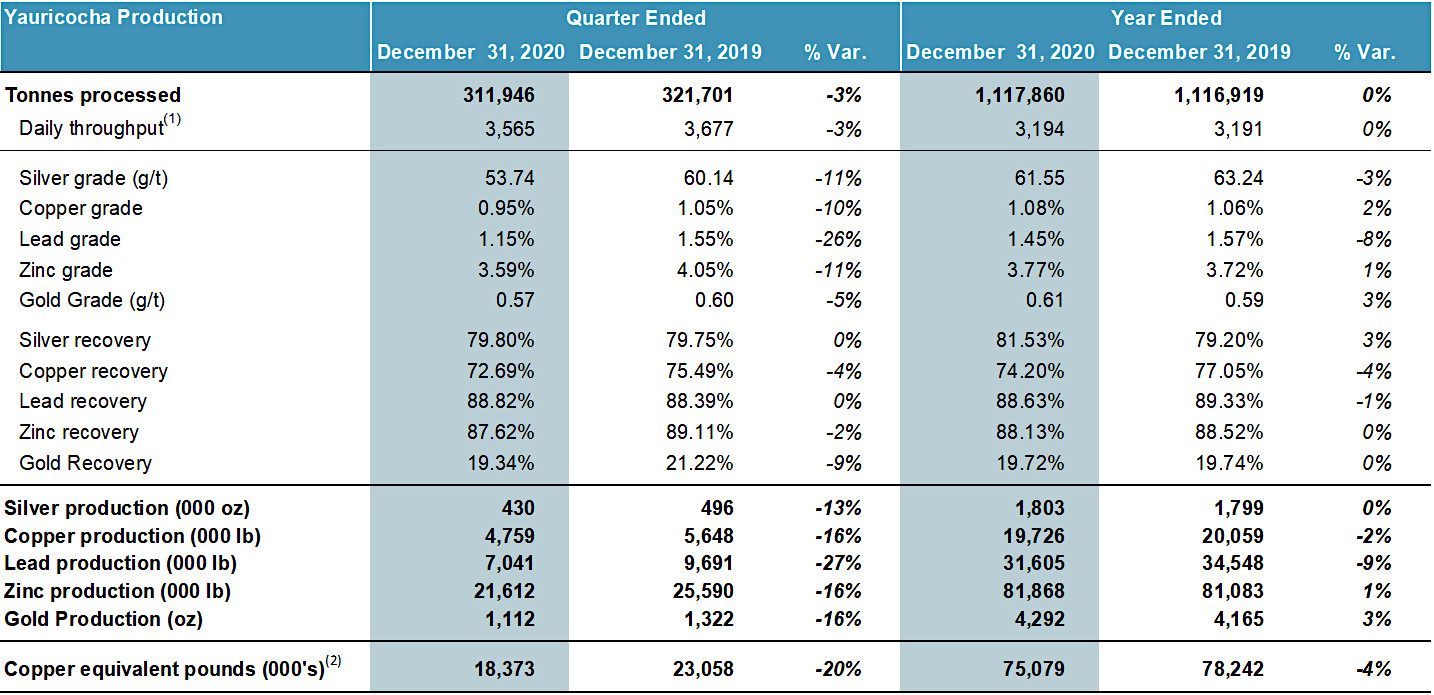
Annual throughput of 1,117,860 was in line with the 2019 annual production, despite the impact of COVID-19 related shutdowns faced in Q2 2020 and other COVID-19 related challenges throughout the year. Throughput for Q4 2020 decreased by 3% as compared to Q4 2019, as a result of operational downtimes and minor production disruptions. Copper and zinc equivalent metal production in Q4 2020 decreased by 20% and 14%, respectively, due to lower throughput and lower head grades. Additionally, lower workforce availability continued to impact mine development, leading to lower ore contribution from the high-grade cuerpos chicos zones. Year over year, copper equivalent production decreased 4% in 2020 compared to the prior year. During 2020, zinc and gold’s annual production increased 1% and 3%, respectively, while copper and lead annual production decreased by 2% and 9%. Silver production for 2020 was in line with the 2019 annual silver production.

Q4 2020 revenues increased by 7% compared to Q4 2019 as a result of higher metal prices realized. Annual revenues were 6% lower due to the impact of a 66% increase in the treatment and refining costs. Adjusted EBITDA increased by 25% and 4% during Q4 2020 and the year respectively compared to the same periods of 2019, as operating costs excluding COVID-19 costs were lower than the prior year.

Cash and cash equivalents increased by $30 million during the year due to a combined result of a 27% increase in operating cash flows and a decrease of 26% in cash used in investing activities, as some capital expenditures were deferred considering the uncertainties related to the impacts of COVID-19. Cash costs per copper equivalent payable pound for 2020 decreased by 10% due to lower operating costs per tonne. AISC per copper equivalent payable pound for 2020 increased 10% primarily due to a 66% increase in treatment and refining costs partially offset by lower cash costs.

Luis Marchese,CEO of Sierra Metals,commented, “I am pleased with Yauricocha’s performance in the fourth quarter of 2020, which saw increases in revenue and adjusted EBITDA compared to the same quarter in 2019. The Company also realized increased EBITDA but lower revenue on a year over year basis primarily due to lower incomes resulting from significant increases to the treatment and refining charges. Overall, the Company performed well and produced solid results, given the challenging year we had due to the effects of dealing with the COVID-19 pandemic. I want to thank all employees for their efforts to help the Company achieve these results.”

He continued, “Looking ahead, 2021 is an exciting time for the Company as we continue advancing important projects, operational improvements, and exploration at Yauricocha. We also look forward to receiving the necessary permits at Yauricocha to increase throughput by 20% to the 3,600 tonne per day level. Furthermore, we recently completed and published a Preliminary Economic Assessment at Yauricocha with favourable economics to examine increasing throughput to 5,500 tonnes per day starting in 2024. We look forward to releasing a Preliminary Feasibility Study in the coming months to support that expansion further.”

He concluded, “Corona continues to have a solid balance sheet and strong liquidity. Management remains optimistic that continued operational efficiencies can be obtained at the Yauricocha Mine as well as capitalizing on further operational and resource growth opportunities.”

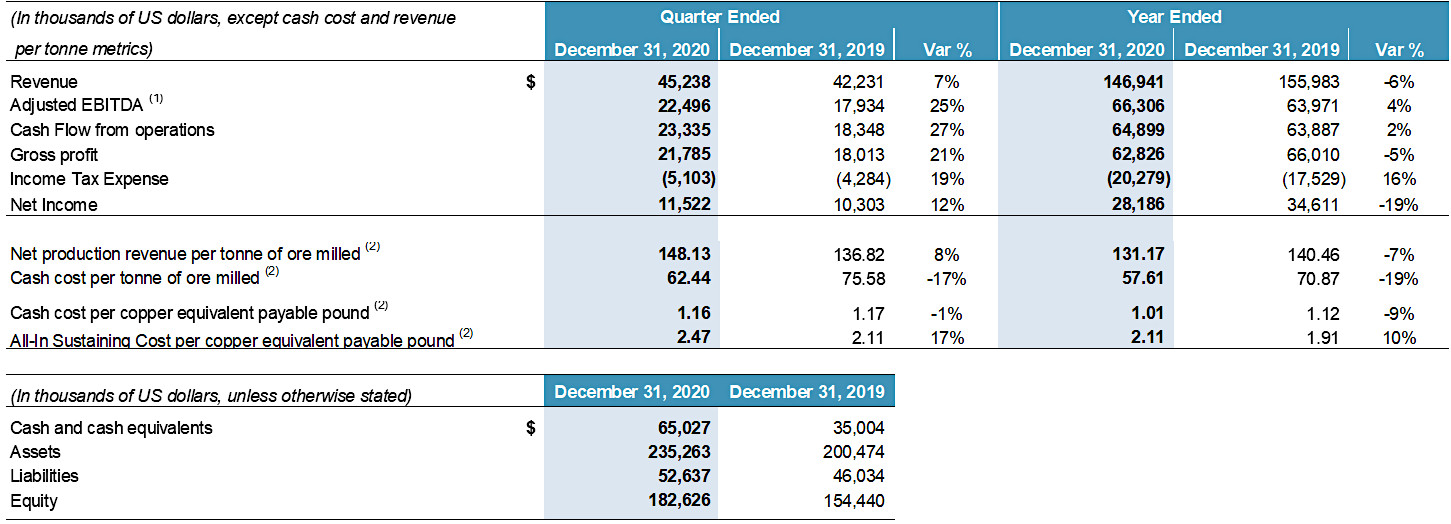
The following table displays selected financial information for the three months and year ended December 31, 2020:
1 Adjusted EBITDA includes adjustments for depletion and depreciation, interest expense and other financing costs, interest income, share-based compensation, Foreign Exchange (gain) loss and income taxes; see non-IFRS Performance Measures section of the Company’s MD&A.
2 All-In Sustaining Cost per copper equivalent pound sold are non-IFRS performance measures and include cost of sales, treatment and refining charges, sustaining capital expenditures, general and administrative expense, and selling expense, and exclude workers’ profit sharing, depreciation, and other non-cash provisions; Cash cost per copper equivalent pound sold, net production revenue per tonne of ore milled, and cash cost per tonne of ore milled are non- IFRS performance measures; see non-IFRS Performance Measures section of the Company’s MD&A.

Corona’s Financial Highlights for the Three Months and Year Ended December 31, 2020

  • Revenues of $45.2 million for Q4 2020 compared to $42.2 million in Q4 2019 and revenues of $146.9 million for the year ended December 31, 2020, compared to $156.0 million for the same period in 2018. The increase in revenues during Q4 2020 compared to Q4 2019 was primarily driven by higher realized prices for all metals except lead. Revenues were higher for the quarter despite significant increases in the treatment and refining charges and lower metal sales resulting from lower throughput and grades. Revenues for the year ended December 31, 2020, were 6% lower than the same period in 2019 due to the 66% increase in treatment and refining charges offset by the increase in the average realized sale price for gold (9%) and zinc (4%). Average realized prices in 2020 were higher for copper (3%), silver (26%) and gold (26%), but lower for zinc (10%) and lead (9%) as compared to the average realized prices in 2019.
  • Cash cost per copper equivalent pound sold at the Yauricocha Mine of $1.16 for Q4 2020 compared to $1.17 for Q4 2019; and $1.01 for the year ended December 31, 2020, compared to $1.12 for the same period in 2019. All-in sustaining cost (“AISC”) per copper equivalent pound sold of $2.47 for Q4 2020 compared to $2.11 for Q4 2019 and $2.11 for the year ended December 31, 2020, comparedto $1.91 for the same period in 2019. The increase in the AISC per copper equivalent payable pound for Q4 2020 and full year 2020 comparedto the same periods in 2019 was a combined result of higher treatment and refining charges and lower copper equivalent payable pounds sold.
  • Adjusted EBITDA of $22.5 million for Q4 2020 compared to $17.9 million for Q4 2019 and $66.3 million for the year ended December 31, 2020, comparedto $64.0 million for the same period in 2019.
  • Operating cash flows before movements in working capital was $23.3 million for Q4 2020, compared to US$18.3 million for Q4 2019, and $65.0 million for the year ended December 31, 2020, compared to $63.9 million for the same period in 2019. An increase in operating cash flows resulted from an increase in gross margins compared to 2019, mainly due to lower workforce and contractor costs.
  • Cash and cash equivalents of $65.0 million as at December 31, 2020, compared to $35.0 million as at December 31, 2018. The increase in cash and cash equivalents was driven largely by operating cash flows of $48.6 million (after movement in working capital) offset by capital expenditures of $19.2 million.
  • Net income of $11.5 million, or $0.32 per share for Q4 2019, compared to net income of $10.3 million, or $0.29 per share for Q4 2019. Net income of $28.2 million, or $0.78 per share, for the year ended December 31, 2020, compared to $34.6 million, or $0.96 per share, for the same period in 2019.

Corona’s Operational Highlights for the Three Months and Year Ended December 31, 2020

The following table displays the production results for the three months and year ended December 31, 2020, for further production details please refer the Company’s Q4 production press release dated January 18, 2021:
1 Daily throughput is calculated using 350 operating days for the year.
2 Copper equivalent pounds were calculated using the following realized prices: for Q4 2020 – $24.30/oz Ag, $3.32/lb Cu, $1.22/lb Zn, $0.89/lb Pb, $1,859/oz Au, for Q4 2019 – $17.42/oz Ag, $2.69/lb Cu, $1.07/lb Zn, $0.92/lb Pb, $1,506/oz Au, for full year 2020 – $20.59/oz Ag, $2.80/lb Cu, $1.03/lb Zn, $0.83/lb Pb, $1,771/oz Au, for full year 2019 – $16.29/oz Ag, $2.73/lb Cu, $/1.14lb Zn, $0.91/lb Pb, $1,404/oz Au.

Sierra Metals to release Q4/YE 2020 Financial Results on March 18, 2021

The Company will release Q4-2020 financial results on Thursday March 18, 2021, after the Market close. Senior Management will also host a webcast and conference call on Friday March 19, 2021, at 10:30am EDT. Details of the Conference Call and Webcast are as follows:

Via Webcast:

A live audio webcast of the meeting will be available on the Company’s website:

https://event.on24.com/wcc/r/2947459/6CFF80ECA94506BA22260486A6292C76

The webcast, along with presentation slides, will be archived for 180 days on www.sierrametals.com.

Via phone:

To register for this conference call, please use the link provided below. A confirmation will be sent through email, including dial-in details and unique conference call codes for entry after registering.

Registration is open throughout the live call; however, to ensure you are connected for the entire call, we suggest registering a day in advance or at minimum 10 minutes before the start of the call.

Conference Call Registration Link:

http://www.directeventreg.com/registration/event/4514269

Quality Control

All technical data contained in this news release has been reviewed and approved by:

Américo Zuzunaga, FAusIMM CP (Mining Engineer) and Vice President of Corporate Planning is a Qualified Person under National Instrument 43-101 – Standards of Disclosure for Mineral Projects.

Augusto Chung, FAusIMM CP (Metallurgist) and Vice President of Metallurgy and Projects to Sierra Metals is a Qualified Person under National Instrument 43-101 – Standards of Disclosure for Mineral Projects.

About Sierra Metals

Sierra Metals Inc. is a diversified Canadian mining company focused on the production and development of precious and base metals from its polymetallic Yauricocha Mine in Peru, and Bolivar and Cusi Mines in Mexico. The Company is focused on increasing production volume and growing mineral resources. Sierra Metals has recently had several new key discoveries and still has many more exciting brownfield exploration opportunities at all three Mines in Peru and Mexico that are within close proximity to the existing mines. Additionally, the Company also has large land packages at all three mines with several prospective regional targets providing longer-term exploration upside and mineral resource growth potential.

The Company’s Common Shares trade on the Bolsa de Valores de Lima and on the Toronto Stock Exchange under the symbol “SMT” and on the NYSE American Exchange under the symbol “SMTS”.

For further information regarding Sierra Metals, please visit www.sierrametals.com or contact:

Continue to Follow, Like and Watch our progress:

Web: www.sierrametals.com | Twitter: sierrametals | Facebook: SierraMetalsInc | LinkedIn: Sierra Metals Inc

Forward-Looking Statements

This press release contains “forward-looking information” and “forward-looking statements” within the meaning of Canadian and U.S. securities laws (collectively, “forward-looking information”). Forward-looking information includes, but is not limited to, statements with respect to the date of the 2020 Shareholders’ Meeting and the anticipated filing of the Compensation Disclosure. Any statements that express or involve discussions with respect to predictions, expectations, beliefs, plans, projections, objectives, assumptions or future events or performance (often, but not always, using words or phrases such as “expects”, “anticipates”, “plans”, “projects”, “estimates”, “assumes”, “intends”, “strategy”, “goals”, “objectives”, “potential” or variations thereof, or stating that certain actions, events or results “may”, “could”, “would”, “might” or “will” be taken, occur or be achieved, or the negative of any of these terms and similar expressions) are not statements of historical fact and may be forward-looking information.

Forward-looking information is subject to a variety of risks and uncertainties, which could cause actual events or results to differ from those reflected in the forward-looking information, including, without limitation, the risks described under the heading “Risk Factors” in the Company’s annual information form dated March 30, 2020 for its fiscal year ended December 31, 2019 and other risks identified in the Company’s filings with Canadian securities regulators and the United States Securities and Exchange Commission, which filings are available at www.sedar.com and www.sec.gov, respectively.

The risk factors referred to above are not an exhaustive list of the factors that may affect any of the Company’s forward-looking information. Forward-looking information includes statements about the future and is inherently uncertain, and the Company’s actual achievements or other future events or conditions may differ materially from those reflected in the forward-looking information due to a variety of risks, uncertainties and other factors. The Company’s statements containing forward-looking information are based on the beliefs, expectations and opinions of management on the date the statements are made, and the Company does not assume any obligation to update such forward-looking information if circumstances or management’s beliefs, expectations or opinions should change, other than as required by applicable law. For the reasons set forth above, one should not place undue reliance on forward-looking information.

Mike McAllister
Vice President, Investor Relations
Sierra Metals Inc.
Tel: +1 (416) 366-7777
Email: [email protected]

Luis Marchese
CEO

Sierra Metals Inc.
Tel: +1 (416) 366-7777

Source: Sierra Metals Inc.
Chakana Copper Corp (CHKKF)(PERU:CA) – Drilling Activity to Accelerate in 2021

Tuesday, February 16, 2021

Chakana Copper Corp (CHKKF)(PERU:CA)
Drilling Activity to Accelerate in 2021

Noble Capital Markets research on Chakana Copper Corp is published under ticker symbols CHKKF and PERU:CA. The price target is in USD and based on ticker symbol CHKKF. Chakana Copper Corp. is a Canada-based mineral exploration company currently advancing the gold-copper-silver Soledad Project near Aija, in the Ancash region of the Miocene mineral belt of Peru. The Soledad Project consists of high-grade gold-copper-silver mineralization hosted in tourmaline breccia pipes. The company’s shares are listed on the TSX Venture Exchange under the symbol “PERU” and trade over the counter under the ticker “CHKKF.”

Mark Reichman, Senior Research Analyst of Natural Resources, Noble Capital Markets, Inc.

Refer to the full report for the price target, fundamental analysis, and rating.

    Additional outstanding drill results. Chakana recently released results for two additional drill holes with the highest-grade intercepts reported to date from the Huancarama Breccia Complex. These are in addition to results from the initial ten holes previously released. Chakana will provide an update during the VID III virtual investor conference hosted by Follow the Money Investor Group and IR.INC Capital Markets Advisory on February 17th at 11:30 am ET. Investors may register here.

    Drilling program for calendar year 2021.  Based on the outstanding drill results thus far, Chakana’s board approved a calendar year 2021 drilling program that will entail 26,000 meters of drilling. Roughly 16,000 meters is expected to be dedicated for infill drilling on new discoveries, while 10,000 meters would be dedicated to scout drilling. This would bring the Phase 3b drilling program, which …


This Company Sponsored Research is provided by Noble Capital Markets, Inc., a FINRA and S.E.C. registered broker-dealer (B/D).

*Analyst certification and important disclosures included in the full report. NOTE: investment decisions should not be based upon the content of this research summary.  Proper due diligence is required before making any investment decision. 

Great Lakes Dredge & Dock (GLDD) – Quarterly Call Will Reinforce January NobleCon17 Appearance

Tuesday, February 16, 2021

Great Lakes Dredge & Dock (GLDD)
Quarterly Call Will Reinforce January NobleCon17 Appearance

Great Lakes Dredge & Dock Corp is a provider of dredging services in the United States. The company only’s operating segments is Dredging. Dredging involves the enhancement or preservation of navigability of waterways or the protection of shorelines through the removal or replenishment of soil, sand or rock. Its projects portfolio includes Coastal Restoration, Coastal Protection, Port expansion, and others.

Poe Fratt, Senior Research Analyst, Noble Capital Markets, Inc.

Refer to the full report for the price target, fundamental analysis, and rating.

    4Q2020 Results out tomorrow morning and call at 10am EST. Number is 877-377-7553 and ID is 4967097. Our 4Q2020 EBITDA estimate is $33.5 million with gross margin of 21.0%. We will be looking for color in the following areas: 2021 bid market outlook; Tone of bidding activity and visibility of projects; Impact of competition; Margin direction; Update on newbuild Hopper Barge One; Timing of FID and capex on newbuild Hopper Barge Two; Timing of FID and capex on newbuild rock dumper barge; Progress completing $75 million buyback program; Refinancing plan with bonds callable at par in May; and Timing and cost of corporate relocation to Houston.

    Quarter call should reinforce positive outlook offered in NobleCon17 presentation in January.  CEO Lasse Petterson and CFO Mark Marinko offered a solid case for GLDD in a presentation in late January. Go to Channelchek: https://www.channelchek.com/news-channel/NobleCon17_Rebroadcast for replay info …


This Company Sponsored Research is provided by Noble Capital Markets, Inc., a FINRA and S.E.C. registered broker-dealer (B/D).

*Analyst certification and important disclosures included in the full report. NOTE: investment decisions should not be based upon the content of this research summary.  Proper due diligence is required before making any investment decision. 

Ely Gold Royalties (ELYGF)(ELY:CA) – Ely Gold Reveals Rare Earths Potential of its El Campo Property in California

Tuesday, February 16, 2021

Ely Gold Royalties (ELYGF)(ELY:CA)
Ely Gold Reveals Rare Earths Potential of its El Campo Property in California

As of April 24, 2020, Noble Capital Markets research on Ely Gold Royalties is published under ticker symbols (ELYGF and ELY:CA). The price target is in USD and based on ticker symbol ELYGF. Research reports dated prior to April 24, 2020 may not follow these guidelines and could account for a variance in the price target. Ely Gold Royalties Inc is an emerging royalty company with producing and development assets focused in Nevada and the Western US. It offers shareholders a low-risk leverage to the current price of gold and low-cost access to long-term gold royalties.

Mark Reichman, Senior Research Analyst of Natural Resources, Noble Capital Markets, Inc.

Refer to the full report for the price target, fundamental analysis, and rating.

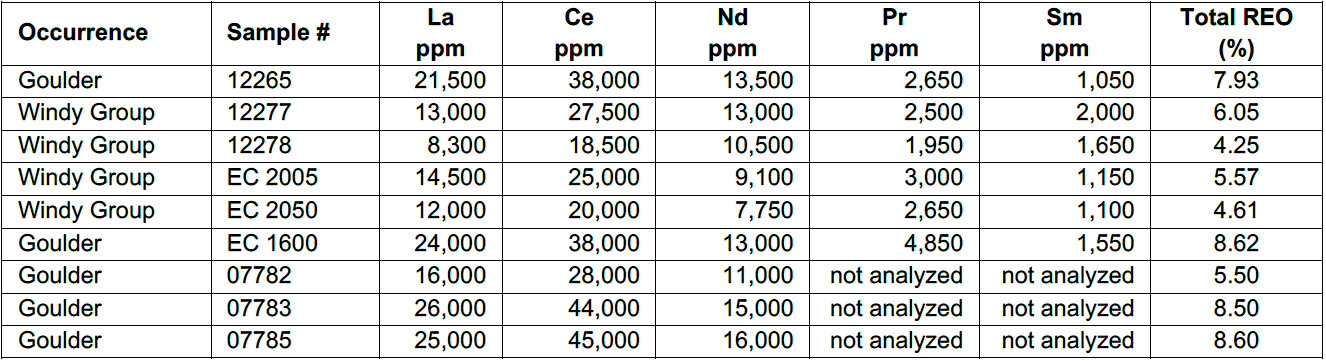
    Rare earths at El Campo. Ely Gold Royalties announced that nine assayed samples at its El Campo property in San Bernardino County, California returned up to 8.60% total rare earth oxides, including Cerium (Ce), Lanthanum (La), Samarium (Sm), and high value magnet metals Neodymium (Nd) and Praseodymium (Pr) which are used in electric vehicles and wind turbines. All nine of the samples returned rare earth oxide values of 4% or greater.

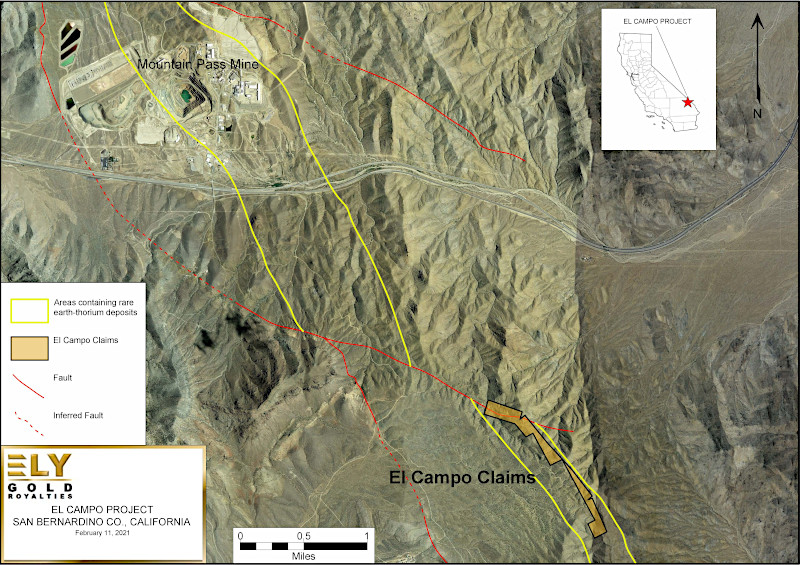
    Available for sale.  The El Campo property, which Ely Gold acquired through staking, encompasses five contiguous unpatented mining claims that are adjacent to mining claims held by MP Materials (NYSE: MP, Not Rated), the largest producer of rare earth materials in the United States, that encompass the Mountain Pass Mine. El Campo is currently in Ely Gold Royalties’ “Available for Sale” portfolio and …


This Company Sponsored Research is provided by Noble Capital Markets, Inc., a FINRA and S.E.C. registered broker-dealer (B/D).

*Analyst certification and important disclosures included in the full report. NOTE: investment decisions should not be based upon the content of this research summary.  Proper due diligence is required before making any investment decision. 

How did the Stock Market Perform Under Each President?


The Stock Market Measured in Four-Year Presidential Terms


The Presidents that President’s Day honors can all be said to have sacrificed quite a bit to serve their country. The role for most would be the epitome of a stressful job. Over time history judges them on their many accomplishments and becomes more tolerant of what was perceived as failings. Part of this Presidential history and measure of success are the statistics compiled during their time in office. Statistics are not necessarily the fairest measure of success with economic growth, the pressure to go to war, civil unrest, and all the other issues they are confronted with. After all, their office is only fractionally in control of anything. Still, there is some meaning in the data. Studying stock market history can better help us recognize trends should they begin to recur. With this in mind, let us look back at the citizens that we chose to sit in the oval office and review the returns of the S&P 500 under their watch.

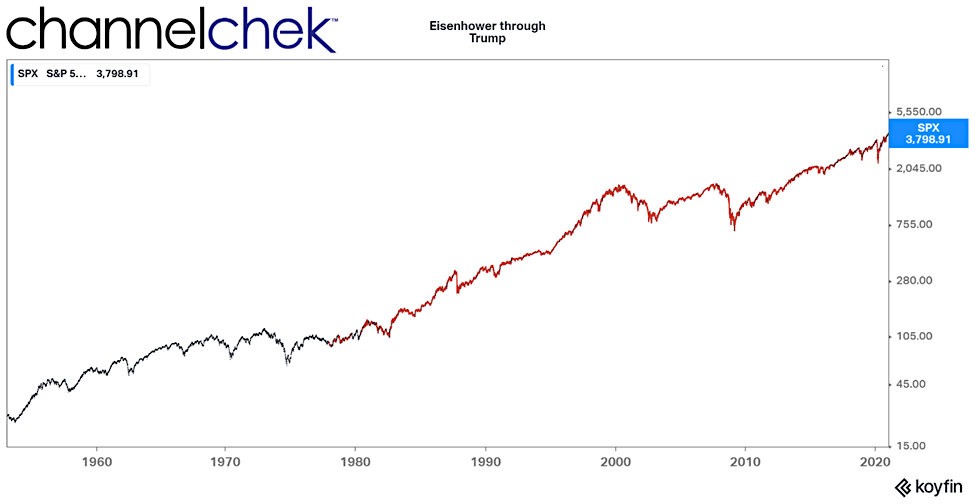
The S&P 500 began providing measurements to the public back in 1957, with data provided back to earlier in the decade. So our review begins in 1953, on the day President Eisenhower was inaugurated.


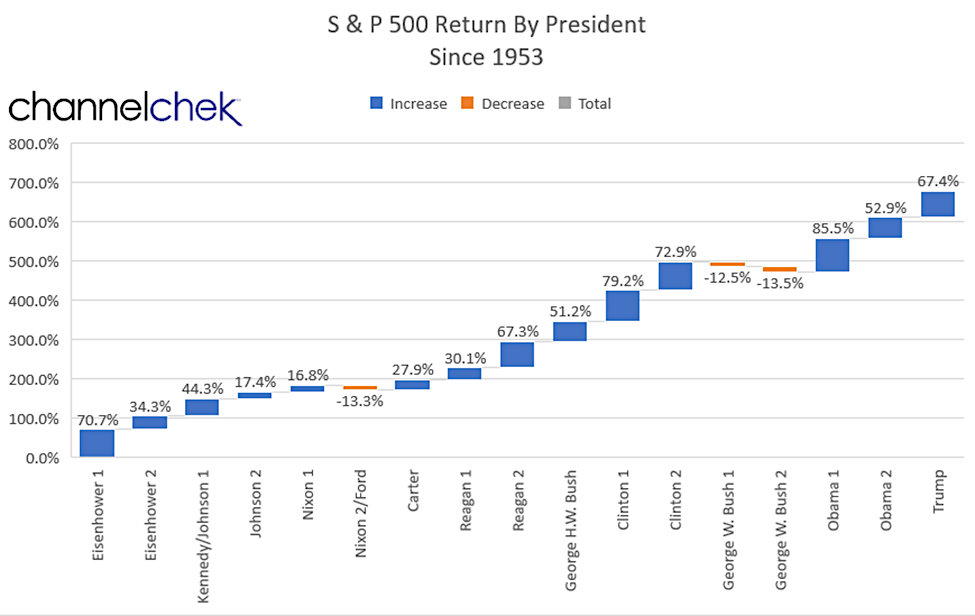
President Eisenhower (Ike) Served as President for two terms; during the first four-year term, investors saw the market shoot up by 70.7%. During the second term, investors were treated to an increase of 34.4%. This growth masks the three recessions Eisenhower faced during his two terms in office. The recessions of 1953 and 1958 were in large part tied to more restrictive monetary policy from the Federal Reserve, while another recession began in 1960 after the Fed had doubled interest rates over two years.


President Kennedy (Jack)   Inaugurated in 1961 and assassinated in November of 1963; the combined return during his time in office and Vice President Johnson’s completion of the second term was a 44.3% increase. Kennedy ran on the slogans “Getting America Moving Again” and “A Time For Greatness.” However, the economy remained sluggish, and unemployment remained high at 6.8% when he took office. The only bear market under his term is said to have been triggered by his doing battle with U.S. Steel over prices. Wall Street rarely approves of the government dictating what private companies can do.


President Johnson (LBJ) was sworn in following Kennedy’s assassination. During his reelection term, the country enjoyed a rise in the S&P 500 of 17.4%. When LBJ took office, he quickly passed tax cuts proposed by Kennedy.   There was a lot of speculation and probably overvaluation during his term.  Johnson held a “guns and butter” policy that held the notion the taxpayer could pay for both the Vietnam War, along with “Great Society” social programs.  


President Nixon (Dick) was in the oval office as the country experienced 16.8% growth during his first four years. He was reelected but resigned two and a half years into his second term.  Nixon remains one of the most “progressive” Presidents in U.S. history based on the use of government directly controlling business.  The economy experienced high unemployment and a high inflation rate (stagflation) along with sluggish growth during the ’70s. Because of this, in 1970, Nixon took the unusual step of using an executive order and imposed a freeze on wages and prices with hopes that declaring increasing prices illegal would help. A year later, he protected the faltering dollar’s value by taking the currency off the gold standard. The short-term result of the economic meddling was a stock market crash that halved the value of the S&P 500 between January 1973 and October 1974.


President Ford (Gerry) presided over the last two years of Nixon’s second term. He inherited many of the economic problems started by LBJ and compounded by Nixon’s actions. Stagflation continued, but the stock market began trending up again in 1975.


President Carter (Jimmy) The ‘70s were not a good time economically. Although the market rose 27.9%, The Feds easy money policies used to aid high employment resulted in skyrocketing prices. Under Carter, the country was handed the painful “medicine” it needed to regain health. The Fed tightened monetary policy and pushed interest rates all the way up to 20%. Interest-sensitive sectors saw sales plummet.  Industries, such as housing and cars, were crippled by the increase in interest rates to double-digits. However, the circumstance halted any pricing power (inflation). These steps helped lead to Carter’s failed reelection bid while also setting the stage for some of the better economic times during the next decade.


President Reagan (The Gipper) The first years of the new decade produced one of the longest recessions in the post-war period; that downturn served to break the vicious cycle of inflation. The U.S. came out of recession in November of 1982. Weary businesses then expected inflation to return, the steady hand of the Fed helped keep those risks at bay. Reagan, who had majored in economics, took the policy reins and implemented his version of supply-side economics (the theory that growth can be created by reduced taxes minimum lower regulations). During Reagan’s first term stocks moved up 30.1 % and continued another 67.3% during his second. The stage was set for the U.S. to lead economically for years to follow.


President Bush (Poppy) The Fed continued to have moderate growth and tame inflation as its goal and target. If given a choice of one over the other, keeping inflation down was their priority. Although the stock market rose 51.2% during Bush’s four years, the Fed had been applying the economic brake pedal by raising rates to counter inflation. The economy responded by slowing toward the end of Bush’s term.


President Clinton (Bubba) stepped in as positive economic conditions all converged. The markets rose 79.2% during his first term and 72.9% during his second four years. Inflation fell to less than 3%, and the U.S. experienced the first decade-long expansion in history. The peacetime economy freed up some of the brightest minds that might otherwise have found employment designing weaponry. Instead, they graduated college and created technology benefitting the masses and fostering productivity. These tech companies and the potential they held led the stock market to a record high. Fed Chairman Alan Greenspan dubbed the period of high growth and low inflation the “Goldilocks Economy” suggesting that it was a fairy tale existence. He also warned of “irrational exuberance.”


President Bush (Dubya) is the only President since 1953 to have a four-year term with a negative stock market return. He had two of them. Stocks fell 12.5% during his first term and 13.5% during his second. A speculative bubble had formed around tech and dot-com companies during the ‘90s which unwound during his time in office. Toward the end of Bush’s second term, with interest rates above 5%, the Fed began slashing rates dramatically. The low rates set the stage for a housing bubble.


President Obama (Barry) the great recession which began in the financial sector under Bush had already had the “kitchen sink” thrown at it in terms of stimulus characterized by massive monetary injections and unprecedented corporate bailouts.  The Fed kept its foot on the gas pedal, this caused U.S. debt levels to increase a massive $8.6 trillion. The lengthy debt-fueled expansion under Obama’s two terms also saw a surge in technological innovation, earnings, and extremely low-interest rates that left many investors no choice but to put their savings in the rising equities markets.


President Trump (The Donald)  The United States was already eight years into the longest economic recovery in history when President Trump was elected. The market jumped immediately after he won the 2016 election.  From the time he was inaugurated as the 45th President, it climbed another 67.4% (four years). Trump’s policies incentivized companies to repatriate back to the U.S. over one trillion in profits they were sheltering overseas from high U.S. taxes. Lower corporate taxes and more investible cash on U.S. soil pushed profits higher as the economy experienced some of its strongest numbers recorded. During the last year of his term, there was an intentional reduction in commerce as a reaction to a pandemic seeking to reduce the risk of workers infecting each other. Easy money and confidence in the future still provided for a double-digit year despite the pandemic.


Take-Away

The factors that move stocks within any period are many. They include; available financial capital, human capital, the global economic pace, taxes, natural disasters, war, national confidence, and prior economic momentum. The person sitting in the oval office can only influence a few of these. Often, that influence has a lag effect that has more impact years down the line. The above timeline includes over 70 years; with it, one can see how the policies of one presidency impacted the next. However, there is rarely a straight line of policy and result. Attributing one administration’s S&P 500 return to a prior administration is made even more cloudy by the market’s tendency to be forward-looking. The Federal Reserve Bank’s job is to maintain a sound banking system. The Fed reports to Congress and may have an agenda that conflicts with the executive branch in D.C..  The two could actually undermine the other. There are also immeasurables with great impact; these include trust. The forward-looking market doesn’t do well if it doesn’t trust that governmental policy won’t make unexpected changes that impact business and clouds investors ’ already faulty crystal ball. 

Paul Hoffman

Managing Editor, Channelchek


Suggested Reading:

The Limits of Government Tinkering

Workcations Add a New Class of  Traveler

Corporate Americas Fair Share of Taxes


Stay up to date. Follow us:


CoreCivic, Inc. (CXW) – Post Call Commentary and Updated Model

Friday, February 12, 2021

CoreCivic, Inc. (CXW)
Post Call Commentary and Updated Model

CoreCivic is a diversified government solutions company with the scale and experience needed to solve tough government challenges in flexible, cost-effective ways. We provide a broad range of solutions to government partners that serve the public good through corrections and detention management, a growing network of residential reentry centers to help address America’s recidivism crisis, and government real estate solutions. We are a publicly traded real estate investment trust and the nation’s largest owner of partnership correctional, detention and residential reentry facilities. We also believe we are the largest private owner of real estate used by U.S. government agencies. The Company has been a flexible and dependable partner for government for more than 35 years. Our employees are driven by a deep sense of service, high standards of professionalism and a responsibility to help government better the public good.

Joe Gomes, Senior Research Analyst, Noble Capital Markets, Inc.

Refer to the full report for the price target, fundamental analysis, and rating.

    Fourth Quarter Continuing a Trend. We view the fourth quarter as continuation a trend, one across the last three quarter’s of 2020. In spite of COVID, the large reduction in detainees, the reduction in normal operations of the court system, and other impacts, CoreCivic posted relatively flat revenue and sequential adjusted EPS growth. We believe this illustrates the strength of the Company’s operating model.

    Alabama, and More to Come?  We highlighted in yesterday’s note CoreCivic’s award to build and lease two facilities for the State of Alabama. On the call management indicated that Hawaii has begun exploring options for new facilities. Could this be the beginning of a trend? Some 290,000 inmates are housed in facilities that are over 50 years old, or at or past the end of their …


This Company Sponsored Research is provided by Noble Capital Markets, Inc., a FINRA and S.E.C. registered broker-dealer (B/D).

*Analyst certification and important disclosures included in the full report. NOTE: investment decisions should not be based upon the content of this research summary.  Proper due diligence is required before making any investment decision. 

The Business of Valentines Day


“The Biggest Valentine’s Day in its History”


Lifestyle adjustments made because of the pandemic have created winners and losers across many business types. On the whole, Internet retailers have benefitted; meanwhile, in-person retail stores, movies, and restaurants have all suffered. Businesses that typically look forward to St. Valentine’s as a high revenue-producing few weeks are experiencing a very different dynamic.

Commerce resulting from Valentine’s Day in the past has followed a similar pattern across the various ways that couples express their appreciation for the other. There had been a growing trend toward gifts being sent to the office rather than the home. This year fewer people are going to the office, so delivered gifts are more likely to arrive where people live. The holiday this year falls on a Sunday, in years when the romantic holiday fell on a Saturday or Sunday, gifts and flowers drew less business as couples would make it a date night. This year Valentine’s falls on a Sunday, and online retailers selling popular romantic gifts such as chocolate or flowers can expect to do better than they might otherwise as many parts of the country still discourage too many patrons at a public place.

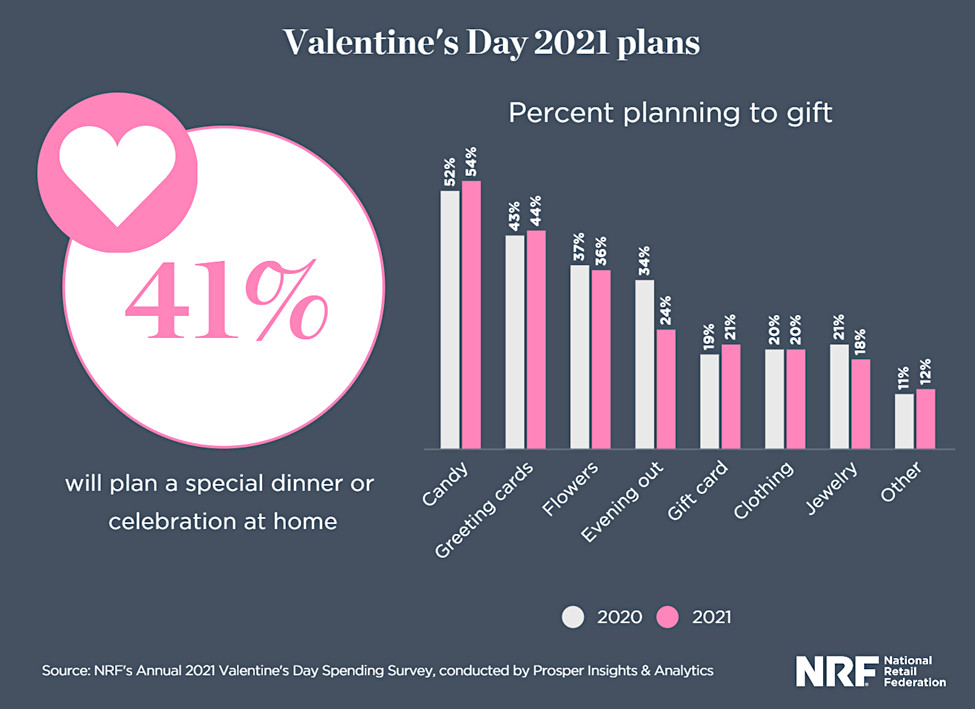
An annual survey released by The National Association of Retailers (NAR) found 52% of U.S. adults plan to celebrate Valentine’s Day 2021; it projects the spending to be $21.8 billion, down from $27 billion a year ago. Fewer than a quarter of consumers (24%) plan to spend an evening out, this is the least amount in the survey’s history. Many plan instead on having a special dinner at home instead.

The NRF survey shows an increase in sales of less expensive gifts and greeting cards


Source: National Retail Federation


Based on the circumstances, Chris McCann, CEO of 1-800-Flowers.com Inc. (FLWS), believes his company will enjoy the biggest Valentine’s Day in its history. McCann shared this with Forbes Magazine, “Coming off a record end-of-year holiday season, we see a continuation of the accelerated momentum that began for us back in 2018, but picked up even more during the pandemic.”

1-800-Flowers.com maintains their own data on Valentine’s Day, Channelchek shares this information each year for the benefit of our readers:

Most popular flowers ordered for Valentine’s Day.

    Roses, lilies, tulips, Gerbera daisies, orchids  

Most popular flower colors ordered. 

    Red, pink, hot pink, purple  

Estimated percentage of flowers (by color) that will be ordered in 2021. 

    Red: 55% 

    Pink (Shades of Pink): 35% 

    Purple: 10% (limited availability in season) 

What do the colors of roses mean?

    Red: I love you

    Pale Pink: I appreciate you

    Purple: I always knew you were the one

    Hot Pink: I’m grateful you’re in my life

What do the other popular flowers mean?

    Lilies: Purity and refined beauty 

    Tulips: Perfect love, charity and royalty

    Daisies: Innocence and joy

    Orchids: Love, fertility, thoughtfulness and charm

How many different types of roses does 1-800-Flowers.com offer?

    90

Total number of stems expected to sell in 2021? 

    22 million  

Number of roses expected to sell in 2021? 

    14 million

Most popular greeting card messages used at 1-800-Flowers.com

    Every year with you is sweeter than the last 

    Happy Valentine’s Day 

    I send a kiss inside the petals of each rose… 

    You take my breath away…today and every day 

    All my love 

    Love and kisses 

    I love you 

    How sweet it is to be loved by you 

    Love you 

Take-Away

Although the economy has not fully recovered, most online retailers have been in a position to benefit from the changed needs of shoppers across the country. The competition for celebrant’s dollars on Valentine’s Day along with Mother’s Day has always included going out versus a heartfelt gift. Although less money will be spent this year, online retail may have its best year as fewer people feel it wise to surround themselves with others in public places. A large percentage of those are choosing to show they care with a gift or a home cooked meal instead. 

Suggested Reading:

Valentines 2020 Article

College Scholarships for Esports Gamers

Investment of Excess Corporate Cash

Source:

1-(800)-FLOWERS

Valentine’s Day Kicks Off A Booming Year For Gifts, Predicts 1-800-Flowers CEO


Stay up to date. Follow us:


Stay up to date. Follow us:

Release – Ely Gold (ELYGF)(ELY:CA) – Acquires Heavy Rare Earth El Campo Project California


Ely Gold Royalties Acquires Heavy Rare Earth El Campo Project, California


Samples Return up to 8.60% Total Critical Rare Earth Oxides Located 3.2 Miles from MP Material’s Mountain Pass Mine

Vancouver, British Columbia, Canada, February 12, 2021. Ely Gold Royalties Inc. (TSX-V:ELY, OTCQX:ELYGF) (“Ely Gold” or the “Company”) is pleased to report nine assayed samples of total rare earth oxides (“REO”) at its El Campo Project (“El Campo”) located in San Bernardino County, California. El Campo encompasses five contiguous unpatented mining claims that are surrounded by mining claims held by MP Materials (NYSE: MP) which make up the Mountain Pass Mine Property (“Mountain Pass”). Mountain Pass is the only operating rare earth mine in the Western Hemisphere.. El Campo is located along strike and 3.2 miles southeast of Mountain Pass (see Figure #1). Ely Gold Acquired El Campo through staking.

Since acquiring El Campo, Ely Gold has collected and analyzed a total of nine bedrock samples which returned up to 8.60% total Rare Earth Oxides (“REO”), similar in grade to Mountain Pass ore. The REO mineralization is hosted by syenite and shokonite dikes. The mineralized zones sampled are carbonatite composed of calcite and or dolomite, barite and bastnasite and are up to 20 feet wide at surface.

El Campo’s REO content is made up of heavy rare earth elements Nd, Pr, La, Ce & Sm. The elevated higher-value elements, Neodymium-Praseodymium (“NdPr”) are important for producing permanent magnets used in electric vehicles and wind turbines while the Samarium (“Sm”) is important for defense applications such as drones and cruise missles. All nine of the samples, which returned REO values of 4% or greater, are summarized in the table below:

El Campo Project Sampling Program Highlights

Trey Wasser, President and CEO commented; “we are excited with the impressive grades from our initial sampling that suggest the potential to outline a high-grade rare earth deposit at our El Campo Project. The proximity to the high-grade Mountain Pass Mine, North America’s only operating rare earth mine, makes this a very exciting project. El Campo will be placed in our “properties available for sale” portfolio, The sale of El Campo will generate Ely Gold’s first rare earth royalty”..

Figure 1

Qualified Person

Stephen Kenwood, P. Geo, is director of the Company and a Qualified Person as defined by NI 43-101. Mr. Kenwood has reviewed and approved the technical information in this press release.

About Ely Gold Royalties Inc.

Ely Gold Royalties Inc. is a Nevada focused gold royalty company. Its current portfolio includes royalties at Jerritt Canyon, Goldstrike and Marigold, three of Nevada’s largest gold mines, as well as the Fenelon mine in Quebec, operated by Wallbridge Mining. The Company continues to actively seek opportunities to purchase producing or near-term producing royalties. Ely Gold also generates development royalties through property sales on projects that are located at or near producing mines. Management believes that due to the Company’s ability to locate and purchase third-party royalties, its strategy of organically creating royalties and its gold focus, Ely Gold offers shareholders a favourable leverage to gold prices and low-cost access to long-term gold royalties in safe mining jurisdictions.

On Behalf of the Board of Directors
Signed “Trey Wasser”
Trey Wasser, President & CEO

For further information, please contact:

Trey Wasser, President & CEO
[email protected]

972-803-3087

Joanne Jobin, Investor Relations Officer
[email protected]

647 964 0292

FORWARD-LOOKING CAUTIONS: This press release contains certain “forward-looking statements” within the meaning of Canadian securities legislation, including, but not limited to, statements regarding completion of the Transaction. Forwardlooking statements are statements that are not historical facts; they are generally, but not always, identified by the words “expects,” “plans,” “anticipates,” “believes,” “intends,” “estimates,” “projects,” “aims,” “potential,” “goal,” “objective,” “prospective,” and similar expressions, or that events or conditions “will,” “would,” “may,” “can,” “could” or “should” occur, or are those statements, which, by their nature, refer to future events. The Company cautions that forward-looking statements are based on the beliefs, estimates and opinions of the Company’s management on the date the statements are made and they involve a number of risks and uncertainties. Consequently, there can be no assurances that such statements will prove to be accurate and actual results and future events could differ materially from those anticipated in such statements. Except to the extent required by applicable securities laws and the policies of the TSX Venture Exchange, the Company undertakes no obligation to update these forward-looking statements if management’s beliefs, estimates or opinions, or other factors, should change. Factors that could cause future results to differ materially from those anticipated in these forward-looking statements include the Company’s inability to control whether the buy-down right will ever be exercised, and whether the right of first refusal will ever be triggered, uncertainty as to whether any mining will occur on the property covered by the Probe Royalty such that the Company will receive any payment therefrom, and the general risks and uncertainties relating to the mineral exploration, development and production business. The reader is urged to refer to the Company’s reports, publicly available through the Canadian Securities Administrators’ System for Electronic Document Analysis and Retrieval (SEDAR) at www.sedar.com for a more complete discussion of such risk factors and their potential effect.

Neither the TSX Venture Exchange nor its Regulation Services Provider accepts responsibility for the adequacy or accuracy of this release.

Source: Ely Gold Royalties

Eagle Bulk Shipping (EGLE) – Fleet Renewal Program Twists Toward Growth

Friday, February 12, 2021

Eagle Bulk Shipping (EGLE)
Fleet Renewal Program Twists Toward Growth

Eagle Bulk Shipping Inc. is a US-based drybulk owner-operator focused on the Supramax/Ultramax mid-size asset class, which ranges from 50,000 and 65,000 deadweight tons in size; these vessels are equipped with onboard cranes allowing for the self-loading and unloading of cargoes, a feature which distinguishes them from the larger classes of drybulk vessels and provides for greatly enhanced flexibility and versatility- both with respect to cargo diversity and port accessibility. The Company transports a broad range of major and minor bulk cargoes around the world, including coal, grain, ore, pet coke, cement, and fertilizer. Eagle operates out of three offices, Stamford (headquarters), Singapore, and Hamburg, and performs all aspects of vessel management in-house including: commercial, operational, technical, and strategic.

Poe Fratt, Senior Research Analyst, Noble Capital Markets, Inc.

Refer to the full report for the price target, fundamental analysis, and rating.

    Fleet renewal program takes a twist. Three 2011-built Supramaxes will be acquired for ~$30 million. This move represents a shift to growth after the sales of five older Supramaxes (average age of 18 years) since mid-2020. There is a neutral impact on the age profile and fuel consumption. The pro forma fleet will total 52 vessels with an average age below nine years.

    Thesis intact.  While the past two years were negatively impacted by extreme factors, the supply/demand fundamentals appear favorable and the year has started on a better-than-expected note. The order book and supply growth remain historically low due to rate volatility, regulatory uncertainty and declining capital availability, while demand should rebound on the back of global stimulus packages and …


This research is provided by Noble Capital Markets, Inc., a FINRA and S.E.C. registered broker-dealer (B/D).

*Analyst certification and important disclosures included in the full report. NOTE: investment decisions should not be based upon the content of this research summary.  Proper due diligence is required before making any investment decision. 

E.W. Scripps Company (SSP) – Insights On the Upcoming Quarter Raising Price Target

Friday, February 12, 2021

E.W. Scripps Company (SSP)
Insights On the Upcoming Quarter; Raising Price Target

The E.W. Scripps Co. (www.scripps.com) serves audiences and businesses through a growing portfolio of television, print and digital media brands. After approval of its acquisition of two Granite Broadcasting stations later this year, Scripps will own 21 local television stations as well as daily newspapers in 13 markets across the United States. It also runs an expanding collection of local and national digital journalism and information businesses including digital video news service Newsy. Scripps also produces television programming, runs an award-winning investigative reporting newsroom in Washington, D.C., and serves as the longtime steward of one of the nation’s largest, most successful and longest-running educational programs, Scripps National Spelling Bee. Founded in 1879, Scripps is focused on the stories of tomorrow.

Michael Kupinski, Director of Research, Noble Capital Markets, Inc.

Refer to the full report for the price target, fundamental analysis, and rating.

    Highlights from NobleCon 17.  Jason Combs, VP, Planning, Budgeting & Forecasting, and Carolyn Pione Micheli, VP, Communications & Investor Relations, provide current advertising insights at Noble’s 17th annual equity conference. A replay of the presentation and Q&A may be obtain by clicking here. Based on the presentation and Q&A, we have increased our Q4 revenue and cash flow estimates.

    Exceeds original Q4 guidance.  Management indicated that Q4 core advertising is better than its November guidance in both core advertising and in its National Media segment. Local core is better than its guidance of down mid teens and National Media exceeded its guidance of low double digit revenue growth. Revenue momentum continues into the first quarter …


This research is provided by Noble Capital Markets, Inc., a FINRA and S.E.C. registered broker-dealer (B/D).

*Analyst certification and important disclosures included in the full report. NOTE: investment decisions should not be based upon the content of this research summary.  Proper due diligence is required before making any investment decision. 

Scientists Now Better Understand Viral Mutations


MIT Researchers are Learning to “Speak the Language” of Viruses


Artificial intelligence, now used in machine language learning, is being put to use to study viral evolution in order to design effective vaccines. MIT researchers have conducted studies that have developed a powerful new computational tool for predicting the mutations that allow viruses to “escape” human immunity or vaccines. Predicting how a virus is going to behave should save countless lives each year. This is true whether it is a coronavirus, influenza, rhinovirus, or HIV. The challenge is being overcome by MIT with the help of the same software that teaches machines spoken language.

The behavior they have focused on is mutation, which viruses do slowly but progressively over time. This is why they tend to become resistant to previously effective vaccines. It is also why vaccines for influenza are “updated” annually, and an HIV vaccine has been so difficult to obtain. The MIT researchers have devised a new way to compute viral escape based on models that were originally developed to analyze and then teach language. The model has successfully predicted which sections of the viral surface are most prone to mutate in a way that enables the virus to escape discovery by the immune system. The language learning model can also identify portions of the viruses that are less likely to mutate. The sections that are least likely to change are the better targets for new vaccines.


Viral Escape

Viral escape is the process that allows viruses to evade the host’s immune systems (including antibodies induced by vaccines). It occurs when the genetic material of the virus is modified and the sequence of proteins altered.

Ongoing modification and synthesis of viral protein sequences are why vaccines quickly become obsolete and then require new study and redesign to be effective. The goal of scientists, including those studying viruses using language learning models, is to stay one step ahead of these parasites by focusing their attention on parts of the virus least likely to mutate.


About MIT’s Model

As mentioned earlier, the model developed and optimized at MIT is focused on observing the regions of the virus’s surface proteins and then forecasting which parts have the highest probability to mutate based on previous observations. Identifying these portions and their genetic “language” has allowed the researchers to calculate the best objectives of a new vaccine or modifications to those that already exist.


Different Viruses, Different Languages

Each virus mutates at a different rate. The seasonal flu virus spins off different versions rapidly (in less than a year), HIV mutates with a speed that has prevented an effective vaccine.  This is why these two virus types have the ability to escape the immune system with relative ease.  Reading the language of each virus, by following repeated patterns to know what it is telling us about itself, has allowed researchers to predict where the change may come about. The stable portion of the virus, once identified, becomes the center of research in cures and prevention.

In order to use viral language reading to model the gene expression and mutation processes of new virus surface proteins, scientists analyze pre-existing sequences of genes and observe temporal and spatial changes. After many observations, sophisticated models are used to create virtual simulations of the changes that could occur. The models used are based on language.

Language models have shown themselves to be powerful because they can learn the complex distributional structure and gain insight into function just from the sequence variation. The model learns from each occurrence, co-occurence, and sequence variation across data.


Blocking Escape

After training the model, the researchers put it to use to predict sequences of the coronavirus spike protein, HIV envelope protein, and influenza hemagglutinin (HA) protein for it to suggest where escape mutations would be less likely to be generated.

For the flu, the model suggested that the sequences least likely to mutate and produce viral escape were in the stalk of the HA protein. This matches the findings of recent studies that show antibodies that target the HA stalk can offer near-universal protection against any flu strain.

The coronaviruses’ forecast and analysis provided that a part of the spike protein referred to as the S2 subunit is least likely to produce escape mutations. As an aside, there is not enough data on the variant SARS-CoV-2 to determine how rapidly it mutates at this time.

In their studies of HIV, the scientists discovered that the V1-V2 hypervariable region of the protein has several possible escape mutations; this is consistent with previous findings. On the positive side, they also identified sequences that would have a lower probability for mutation, allowing immune system escape.

The Future of this Research

Mutations and “viral escape” remain the biggest challenge in the search for vaccines and viral treatments that remain effective year after year. Indications are the future of virus research, and the fight and prevention of the infections they produce lie in predicting and anticipating each virus’s behavior. The AI language learning models adapted to recognize the activity of viruses to determine future activity is novel and producing useful results. It’s expected that this new use of the technology will be a large contributor to facing the challenges of viral research.


Suggested Content:

Healthcare Panel Video, NobleCon17 (January 2021)

T1D Diabetes Video Panel Discussion (December 2020)

Interest Rates Impact on Investment Sectors


Sources:

Preventing Viral Escape

Algorithms to Study Language Can Predict Viral Mutations

Learning the Language of Viral Evolution and Escape

Stay up to date. Follow us:


Stay up to date. Follow us:

Ely Gold Royalties (ELYGF)(ELY:CA) – Increasing Its Stake in Nevada’s Hog Ranch Gold Project

Thursday, February 11, 2021

Ely Gold Royalties (ELYGF)(ELY:CA)
Increasing Its Stake in Nevada’s Hog Ranch Gold Project

As of April 24, 2020, Noble Capital Markets research on Ely Gold Royalties is published under ticker symbols (ELYGF and ELY:CA). The price target is in USD and based on ticker symbol ELYGF. Research reports dated prior to April 24, 2020 may not follow these guidelines and could account for a variance in the price target. Ely Gold Royalties Inc is an emerging royalty company with producing and development assets focused in Nevada and the Western US. It offers shareholders a low-risk leverage to the current price of gold and low-cost access to long-term gold royalties.

Mark Reichman, Senior Research Analyst of Natural Resources, Noble Capital Markets, Inc.

Refer to the full report for the price target, fundamental analysis, and rating.

    Increases royalty and lease interest in Hog Ranch. Ely Gold Royalties, through its Nevada Select Royalty subsidiary, executed a binding term sheet to acquire an additional 25% interest in its Hog Ranch Property in Washoe County, Nevada, roughly 270 kilometers north of Reno, from Platoro West incorporated. The additional interest in Hog Ranch will increase Ely’s net smelter returns royalty to 2.25% from 1.5% and its interest in the leased mining claims to 75.1% from 50.1%.

    Terms of the transaction.  The term sheet provides for cash consideration, paid by Ely Gold at closing, of US$275,000 and the issuance of 1,000,000 warrants exercisable at C$0.90. The agreement is subject to approval by the TSX Venture Exchange. Platoro West is owned by William Sheriff, a director of Ely Gold Royalties. Recall that Ely Gold acquired its current interest from Platoro West in June …


This Company Sponsored Research is provided by Noble Capital Markets, Inc., a FINRA and S.E.C. registered broker-dealer (B/D).

*Analyst certification and important disclosures included in the full report. NOTE: investment decisions should not be based upon the content of this research summary.  Proper due diligence is required before making any investment decision. 

CoreCivic, Inc. (CXW) – Solid Fourth Quarter Buried Under the Noise

Thursday, February 11, 2021

CoreCivic, Inc. (CXW)
Solid Fourth Quarter Buried Under the Noise

CoreCivic is a diversified government solutions company with the scale and experience needed to solve tough government challenges in flexible, cost-effective ways. We provide a broad range of solutions to government partners that serve the public good through corrections and detention management, a growing network of residential reentry centers to help address America’s recidivism crisis, and government real estate solutions. We are a publicly traded real estate investment trust and the nation’s largest owner of partnership correctional, detention and residential reentry facilities. We also believe we are the largest private owner of real estate used by U.S. government agencies. The Company has been a flexible and dependable partner for government for more than 35 years. Our employees are driven by a deep sense of service, high standards of professionalism and a responsibility to help government better the public good.

Joe Gomes, Senior Research Analyst, Noble Capital Markets, Inc.

Refer to the full report for the price target, fundamental analysis, and rating.

    4Q21 Results. For the fourth quarter CoreCivic reported revenue of $473.5 million, down from $497.8 million in the same period last year. Reported loss was $0.22 per share versus EPS of $0.35 last year. Adjusted EPS was $0.40 versus $0.36. FFO was $0.19 per share compared to $0.58 last year while NFFO was $0.63 per share in the fourth quarter of 2020 compared to $0.59 last year. We had projected revenue of $468.5 million, EPS of $0.23, FFO of $0.47, and NFFO of $0.50.

    What Was Behind The Noise? CoreCivic had $75.6 million of special items in the quarter.  These included $47.6 million of asset impairments as the Community segment goodwill was written off, $7.1 million in expenses associated with debt repayments and refinancing transactions, $2.8 million of COVID related expenses, and $17.9 million in losses from the sale of real estate assets …


This Company Sponsored Research is provided by Noble Capital Markets, Inc., a FINRA and S.E.C. registered broker-dealer (B/D).

*Analyst certification and important disclosures included in the full report. NOTE: investment decisions should not be based upon the content of this research summary.  Proper due diligence is required before making any investment decision.