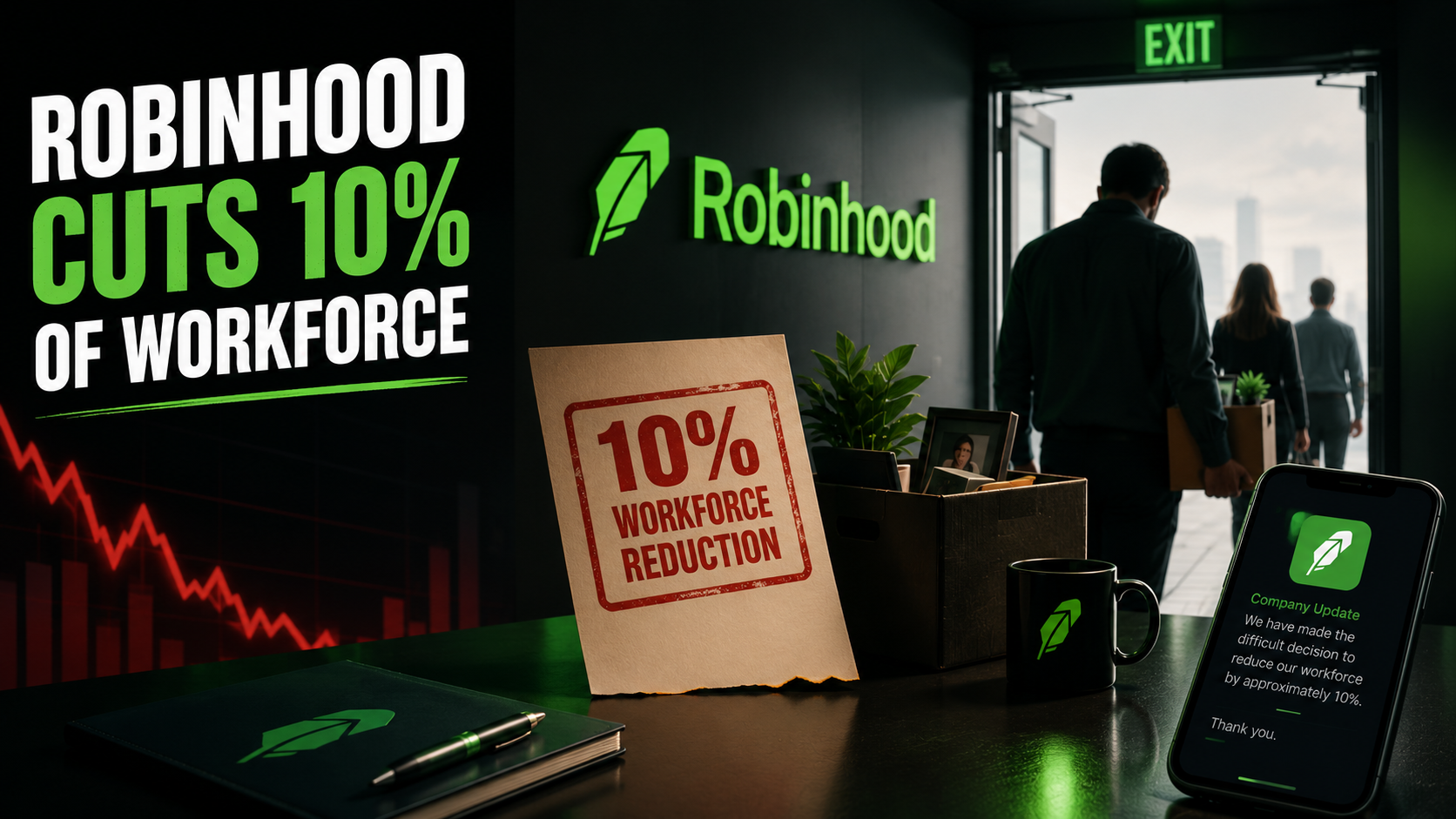
Robinhood announced Tuesday it will cut approximately 10% of its full-time workforce — roughly 290 jobs — as the commission-free trading platform moves to flatten its organizational structure and operate more efficiently. The stock slipped approximately 1.5% in early trading following the news. The reduction is the latest example of a broad corporate trend that has accelerated through 2026: companies across sectors are aggressively scrutinizing headcount and management layers, even when their underlying businesses are performing well.
The Robinhood cuts are notable precisely because the company is not in distress. Its prediction markets business, anchored by the Rothera exchange, accounted for approximately 10% of total revenue in the first quarter of 2026, and the platform has continued to expand its product offering across crypto, retirement accounts, and event-based trading. This is not a retrenchment driven by weakness. It is a deliberate move to reduce organizational layers and improve operating leverage.
The Pattern Across the Market
Robinhood is not operating in isolation. The “efficiency” wave has become one of the defining corporate themes of 2026. Earlier this year, Intuit announced it would cut roughly 17% of its workforce despite beating earnings estimates. Cisco laid off approximately 4,000 employees as part of an AI-focused restructuring. The common thread connecting these decisions is a recognition that artificial intelligence and automation are changing the calculus around how many people a company actually needs to operate at scale.
Executives across industries are increasingly arguing that flatter organizations with fewer management layers move faster, make decisions more efficiently, and deploy capital more effectively. In many cases, AI tools are explicitly cited as the enabler — automating functions that previously required dedicated headcount and allowing companies to maintain or grow output with smaller teams.
What It Means for Smaller Companies
For investors in the small and microcap space, the efficiency wave carries a dual implication worth thinking through carefully.
On one hand, the trend validates a structural shift that benefits smaller, leaner companies. A startup or small cap company that was always going to operate with a lean team is now competing in an environment where its larger rivals are voluntarily shrinking toward that same operating model. The structural cost advantage that large companies historically held through scale is being partially eroded as AI levels the operational playing field.
On the other hand, the broad-based nature of these workforce reductions is a signal worth monitoring for what it says about the labor market and consumer spending. When profitable companies across multiple sectors simultaneously decide they need fewer workers, it has downstream implications for the consumer-facing small caps whose revenue depends on employed consumers with discretionary income. The May jobs report was strong, but corporate efficiency decisions made today show up in employment data months later.
The efficiency wave is reshaping how companies of every size think about headcount, technology, and operating leverage. For smaller companies, it is simultaneously a competitive opportunity and a macro signal that deserves attention. Robinhood is healthy, growing, and cutting jobs anyway. That combination is the story of corporate America in 2026.