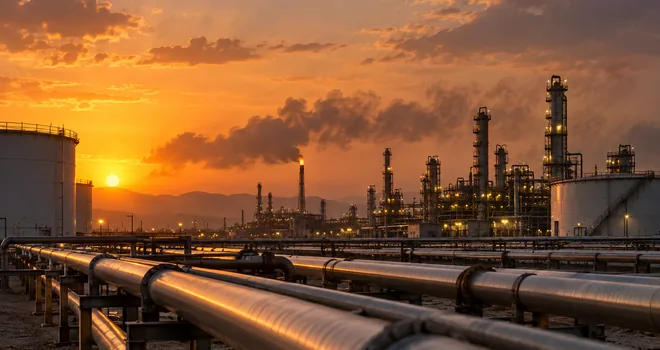
Oil prices moved back toward the psychologically important $100-per-barrel level Tuesday as escalating conflict across the Middle East raised fresh concerns about the security of global energy supplies. Brent crude briefly traded near $98 after Iran-aligned Houthi militants in Yemen attacked several energy facilities in Saudi Arabia, forcing temporary operational shutdowns at some sites.
The latest move extends a sharp rise in crude prices this month. Oil is now up more than 8% in September as markets respond to renewed U.S.-Iran hostilities, continued disruption around the Strait of Hormuz, and the growing possibility that additional energy infrastructure across the region could come under pressure.
The Saudi attacks matter not only because of the facilities involved, but because they broaden the geography of the conflict. Saudi Arabia has relied heavily on infrastructure outside the Persian Gulf to move oil while shipping through Hormuz remains constrained. Any sustained threat to facilities or transportation routes on the kingdom’s western side could weaken one of the principal alternatives available to keep crude flowing.
Two Critical Energy Routes Are Under Pressure
The Strait of Hormuz remains the central concern. Historically, roughly one-fifth of global petroleum liquids consumption has passed through the waterway, making it the world’s most important oil transit chokepoint. With traffic through Hormuz sharply reduced during the current conflict, producers have increasingly relied on pipelines and alternative export routes to move crude.
That has elevated the importance of the Red Sea and the Bab el-Mandeb Strait, the narrow passage connecting the Red Sea with the Gulf of Aden. Saudi Arabia’s East-West pipeline allows crude produced in the eastern part of the country to reach the Red Sea port of Yanbu without entering Hormuz, while other regional producers have also increased use of alternate routes.
The risk now is that pressure is building around both systems at once. Hormuz remains constrained, while Houthi attacks and renewed fighting in Yemen raise concerns around Saudi energy infrastructure and Red Sea shipping. The result is a narrower margin for error across one of the world’s most important energy-producing regions.
Why Prices Can Move Quickly
Oil markets do not wait for confirmed supply losses before reacting. Prices often move on the possibility that future supply could be disrupted, particularly when spare export capacity is limited and transportation alternatives are already being stretched.
That is especially true in the Middle East. Pipelines operated by Saudi Arabia and the United Arab Emirates can bypass Hormuz, but their combined capacity represents only a fraction of the oil that normally moves through the strait. Other barrels can be rerouted through the Red Sea or around Africa, but those alternatives typically add cost, distance and shipping time.
As a result, even attacks that do not immediately remove large volumes from the market can create a meaningful geopolitical risk premium. Traders are not only evaluating what has already been lost; they are pricing the possibility that additional production, refining capacity or shipping routes could be affected next.
Could Brent Break Above $100?
With Brent already approaching $100, that threshold is increasingly within reach. Goldman Sachs has suggested that prices could rise materially further if Persian Gulf supply remains below pre-conflict levels or if attacks on shipping and energy infrastructure intensify.
There is precedent for rapid price moves when key transit routes come under pressure. Brent climbed sharply earlier this summer as attacks on vessels and restrictions around Hormuz tightened available supply. Whether crude returns to those levels — or moves beyond them — will depend heavily on the duration of the conflict and whether the latest attacks lead to sustained production or export disruptions.
If Saudi operations normalize quickly and regional tensions ease, some of the geopolitical premium currently embedded in crude prices could reverse. If the conflict broadens, however, the supply outlook becomes considerably more difficult.
The Impact Extends Beyond Energy Markets
A sustained move toward or above $100 oil would have consequences well beyond producers and refiners. Higher crude prices filter through transportation, manufacturing, agriculture and consumer goods, making energy costs an important part of the inflation outlook.
That creates a more complicated backdrop for financial markets. Higher oil prices can benefit producers, drilling companies and other energy-linked businesses, but they can also raise operating costs for transportation-heavy industries and put additional pressure on consumers through gasoline, diesel and freight expenses.
For policymakers and investors, the concern is that an extended energy shock could reinforce inflation at a time when markets remain highly sensitive to interest-rate expectations.
What Investors Should Watch Next
The immediate focus will be on whether the Saudi facilities affected by Tuesday’s attacks return to full operation, but the larger issue is whether the geographic scope of the conflict continues to expand.
The global oil system has so far adapted to reduced traffic through Hormuz by shifting barrels through pipelines and alternative routes. That flexibility has helped prevent a much larger supply shock. But if those backup routes themselves become less reliable, the market’s ability to absorb disruption would weaken.
For investors, the key indicators now are tanker traffic through Hormuz and the Red Sea, the extent of damage to Saudi infrastructure, the pace of operational recovery, and whether attacks move closer to additional production, refining or export assets.
Crude remains available, but the cushion protecting global supply is getting thinner. That is why the move toward $100 oil may matter less as a round-number milestone than as a signal that markets are beginning to price in a broader regional energy-security problem.