SANTA MONICA, Calif.–(BUSINESS WIRE)– Entravision (NYSE: EVC), a leading global advertising solutions, media and technology company, today announced its participation in NobleCon19, Noble Capital Markets’ 19th Annual Emerging Growth Equity Conference, to be held December 3-5, 2023, in Boca Raton, FL. Chris Young, Chief Financial Officer and Treasurer, is scheduled to present on Monday, December 4th, 2023 at 11:30 a.m. ET and will participate in meetings with investors throughout the day.
The presentation will be webcast live over the Internet, and links to the live webcast and replay will be available on Entravision’s Investor Relations website at investor.entravision.com.
About Entravision Communications Corporation
Entravision is a global advertising solutions, media and technology company. Over the past three decades, we have strategically evolved into a digital powerhouse, expertly connecting brands to consumers in the U.S., Latin America, Europe, Asia and Africa. Our digital segment, the company’s largest by revenue, offers a full suite of end-to-end advertising services in 40 countries. We have commercial partnerships with Meta, X Corp. (formerly known as Twitter), TikTok, and Spotify, and marketers can use our Smadex and other platforms to deliver targeted advertising to audiences around the globe. In the U.S., we maintain a diversified portfolio of television and radio stations that target Hispanic audiences and complement our global digital services. Entravision remains the largest affiliate group of the Univision and UniMás television networks. Shares of Entravision Class A Common Stock trade on the NYSE under ticker: EVC. Learn more about our offerings at entravision.com or connect with us on LinkedIn and Facebook.
Christopher T. Young Chief Financial Officer Entravision 310-447-3870
Mortgage rates took a steep dive last week in the biggest one-week drop since September 2021. The average 30-year fixed mortgage rate decreased to 7.61% from 7.86% the week prior, according to the Mortgage Bankers Association (MBA).
This plunge in rates over the course of just one week sparked a 2.5% increase in total mortgage loan application volume. It was the first uptick in demand after four straight weeks of declines.
The drop in mortgage rates was driven by positive economic news. The Federal Reserve struck a dovish tone signaling slower future rate hikes. This was followed by monthly jobs data that came in under expectations pointing to cooling inflation.
What does the rate plunge mean for mortgage borrowers? Here are the key takeaways:
Refinancing Demand Rises But Still Lags 2021
The dip in rates led to a 2% bump in refinance application volume last week. This marks a turnaround after refinancing demand fell to a 22-year low in October when rates topped 7%.
But refinancing is still 7% lower than the same week last year. In 2021, rates hovered near 3%, fueling a refinancing boom. Today, most homeowners already refinanced at those historically low rates.
For context, 63% of mortgage borrowers are paying rates under 4%, according to Black Knight data. There is little incentive for these borrowers to refinance at today’s higher rates.
The bottom line is that lower rates are inviting more refinancing but volumes are still a fraction of the 2021 frenzy. Only borrowers with rates well above 7% stand to meaningfully benefit from a refi now.
Homebuying Demand Rebounds But Remains Suppressed
The positive rate movement also drove a 3% weekly gain in purchase mortgage applications. This suggests some home buyers are jumping at the chance to lock lower rates.
But purchase demand remains sharply lower than last year, down 20% from the same week in 2021. Sky high home prices are outweighing the lure of lower rates for many prospective buyers.
The median home sales price in September was $384,800, up 8.4% from 2021 according to the National Association of Realtors. Price gains are outpacing the rate relief.
The optimism was cemented on November 4 when the October jobs report showed the labor market is starting to cool. Employers added 261,000 jobs last month, below estimates of 300,000.
Slower job growth reduces inflation pressures, reinforcing the case for the Fed to temper rate hikes. This positive news for the economy caused mortgage rates to unravel.
What’s Ahead for Mortgage Rates?
Mortgage rates started this week slightly higher but remain volatile. The MBA noted there are fewer major economic events on the calendar this week that could substantially sway rates.
But Fed speakers may still influence rate expectations. Any renewed hawkish signals could nudge rates higher again. Rates are also very sensitive to inflation data hints.
For now, the overall trend for mortgage rates is bouncing within a range but remains comparatively high historically. Barring an unforeseen shock, major swings in either direction appear unlikely in the near term.
For many individuals, investing in the stock market is a pathway to financial growth and security. And while familiar large-cap names like Amazon, Apple and Microsoft may first come to mind when building a portfolio, small-cap stocks represent another promising segment of the market.
Today, we’ll take an in-depth look at the world of small-cap stocks and examine whether they can make a wise addition to your investment strategy. Whether you’re a seasoned investor looking to broaden your portfolio or someone new to stock market investing, this article will answer all your questions about what a small-cap stock is and much more.
Defining Small-Cap Stocks
First, let’s start with a quick definition – what exactly are small-cap stocks?
Small-cap stocks refer to companies that have a relatively small market capitalization, generally between $300 million and $2 billion. Market capitalization (or market cap) is calculated by multiplying the total number of company shares outstanding by the current market price per share.
So a company with 10 million shares trading at $20 per share would have a market cap of $200 million, landing it in the small-cap category.
In contrast, large-cap stocks like Apple, Microsoft, and Amazon are valued in the hundreds of billions. Small-cap stocks represent companies in earlier developmental stages with significant room for expansion ahead of them before reaching the scale of the market leaders. Some well-known examples of small-cap companies across different sectors are The ODP Corporation, Bassett Furniture, The Geo Group and Maple Gold Mines.
Small-cap stocks sit in the middle between micro-cap stocks (under $300 million market cap) and mid-cap stocks ($2 billion to $10 billion market cap). At the higher end are large-cap stocks (over $10 billion) and mega-cap stocks like Apple that exceed $200 billion in market value.
For many growth-oriented investors, small-cap stocks represent an opportunity to invest early in a company with potential for rapid expansion before they become household names. The early-stage status means small-cap companies have ample runway to grow their market share and establish themselves as industry leaders over time. With the right investments, small-cap stocks can deliver exponential returns compared to slow and steady large-cap stocks that have less growth potential ahead.
However, the smaller size and scale of these companies also leads to higher volatility and risk compared to large-caps with firmly entrenched market positions. We’ll explore these trade-offs more in the sections ahead.
Key Characteristics of Small-Cap Stocks
Now that we’ve defined what a small-cap stock is, let’s dive deeper into some of the typical characteristics of these types of companies:
Greater Growth Potential
With small-cap companies still in relatively early phases of their lifecycle, their products and services often have significant room for wider adoption and expansion. Small-cap stocks are laser focused on growing their market share rapidly during the critical early innings before competitors emerge. They pour capital into product development, sales and marketing, and geographic expansion while large-caps aim to protect and defend their existing turf.
Higher Volatility
With smaller financial resources and operational scale, small-cap stocks tend to be more vulnerable to market swings and changing economic conditions. As a result, their share prices can fluctuate wildly in short periods of time as sentiment shifts. On the other hand, large-cap stocks boast stability and steady, predictable growth.
Less Analyst Coverage
Wall Street banks and financial media outlets tend to devote the bulk of their research and coverage to large, established companies that dominate their industries. Meanwhile, small-cap stocks fly under the radar in comparison. This lack of attention results in opportunities for diligent individual investors to uncover small companies poised for growth before they gain widespread analyst and investor attention. This is where Channelchek comes in. Our market research is specific to small cap stocks and completely free as long as you join our community
Potential for Undervaluation
The limited analyst coverage and lack of institutional investor interest in small-cap stocks can at times lead to mispricing opportunities where the stocks trade at valuations that do not fully reflect their growth prospects and upside potential. Savvy investors can find hidden gems trading at deep discounts relative to their future earnings power. Of course, finding these diamonds in the rough requires rolling up your sleeves and digging into financial statements.
Liquidity Challenges
The total number of outstanding shares is far lower for small-cap companies versus large-caps, which leads to lighter trading volumes and thinner liquidity. This results in wider bid-ask spreads, premiums and heightened volatility when entering and exiting positions. Large-cap stocks benefit from abundant liquidity and tight spreads, allowing large trades to be executed seamlessly.
In summary, while small-cap stocks carry additional risk factors, their lower valuations, lack of analyst coverage and undiscovered status provide significant upside potential for enterprising investors willing to conduct their own due diligence.
The Pros and Cons of Small-Cap Stocks
Now that we understand the typical traits of small-caps relative to large-caps, let’s examine the key potential benefits and drawbacks of adding these types of companies to your investment portfolio:
Potential Benefits of Small-Cap Stocks
– Outsized Growth Potential – With the right stock picks, small-cap companies can deliver exponential returns over a relatively short timeframe that mature large-cap stocks simply cannot match. Just look at Amazon’s meteoric rise over the past decade when it was still a small-cap.
– Undervaluation Opportunities – Due to the lack of widespread analyst coverage, small-cap stocks can become underpriced or neglected relative to their growth prospects. Dedicated investors can find hidden gems trading at compelling valuations before market awareness builds.
– Portfolio Diversification – Because small-cap stocks behave differently than large-caps with lower correlation, adding small-cap exposure can improve the overall risk-adjusted return profile of a portfolio heavy in stable large-cap names.
– Inflation Hedge – During periods of rising inflation, small-cap stocks have historically outperformed as they are more nimble in passing on price increases to customers. Large-cap names are slower to react.
Potential Drawbacks of Small-Cap Stocks
– Higher Volatility – The amplified swings in small-cap share prices require mental fortitude during periods of market stress. Their risk profile means small-caps are better suited for those with higher risk tolerance.
– Liquidity Risk – The lower trading volumes inherent with small-caps necessitates close monitoring of bid-ask spreads and liquidity when entering or exiting a position. Sudden moves can lead to dislocation.
– Fewer Resources – Compared to the robust balance sheets of large-caps, small-cap companies have less financial flexibility and capital reserves which can leave them vulnerable during recessions.
– Lack of Institutional Coverage – Minimal Wall Street research coverage means individual investors must conduct their own due diligence. Those relying purely on analyst reports will be late to the party.
All in all, while small-cap stocks carry some additional risks and challenges, their return potential merits inclusion for at least a portion of growth-oriented investors’ portfolios.
Researching and Investing in Small-Caps
Here are some key factors for investors to weigh before adding small-cap exposure:
– Assess your personal risk tolerance – The inherent volatility of small-cap stocks means they are better suited for those investors with higher risk appetites and ability to withstand routine price swings. Make sure your temperament aligns.
– Consider investment timeframe – The long-term growth trajectories of small-caps make them ideal picks for investors with longer time horizons of at least 5-10 years rather than short-term trading mentality. Have patience.
– Conduct extensive due diligence – There’s far less third-party Wall Street research available on small-caps compared to large-caps. You’ll need to thoroughly comb through financial filings, growth prospects, competitive dynamics and management track records.
– Diversify across multiple small-caps – Build a basket of small-cap stocks across different sectors to smooth volatility and avoid concentration risk. Layer in large-cap and mid-cap holdings.
– Monitor liquidity trends – Keep an eye on trading volumes and bid-ask spreads of small-caps you own to ensure ample liquidity exists when entering and exiting positions. Liquidity shrinks rapidly during downturns.
Taking these elements into account allows you to make informed decisions before venturing into small-caps.
Investing Strategies for Small-Cap Stocks
If small-cap stocks fit your risk tolerance, goals and research diligence, here are some effective approaches:
– Seek out promising sectors – Target high-growth sectors like technology, healthcare and consumer discretionary where disruption potential is highest rather than diversified small-cap funds.
– Identify company-specific catalysts – Look for upcoming product launches, partnerships, FDA approvals or expansion plans that could serve as catalysts for a sharp rise in sales, earnings and sentiment.
– Take a long-term perspective – Tune out the noise and stick to your original investment thesis during temporary price swings. Have conviction in your small-cap picks.
– Utilize stop-loss orders – Use stop-loss orders to automatically sell positions if prices breach certain thresholds as a risk management tactic. Re-enter when volatility subsides.
– Reinvest dividends for compounding – Many small-caps pay dividends despite early-stage status. Reinvesting dividends turbocharges long-term total returns.
– Consider small-cap index funds – For diversification, consider cost-effective small-cap index funds from leading providers like Vanguard, Schwab and iShares.
– Limit overall allocation – Given the amplified risk, small-caps should likely account for no more than 10% of your total portfolio assets. Size positions accordingly.
With rigorous research and prudent strategy, small-cap stocks can boost returns for enterprising investors willing to accept the higher volatility profile.
The Bottom Line on Small-Cap Stocks
In the high-growth small-cap arena, there will inevitably be huge winners and unfortunate flameouts. But for risk-tolerant investors, the profit potential justifies the bumpy ride. By taking a selective approach, diversifying across multiple small-caps, and holding for long time horizons, much of the volatility smoothes outs while allowing winners time to fully capture market share.
While individual small-cap stocks require diligence, broad exposure can be gained cost-effectively through small-cap index funds and ETFs. Overall, small-cap stocks fill an important niche in balanced portfolios, providing a return boost that slow-changing large-caps cannot match. For investors willing to accept fluctuations in the pursuit of superior long-term returns, small-cap stocks warrant consideration.
Join the Channelchek community to keep up with the latest small-cap insights and start making informed investment decisions!
Internet & Digital Media Stocks Outperform – But Don’t Get Too Excited
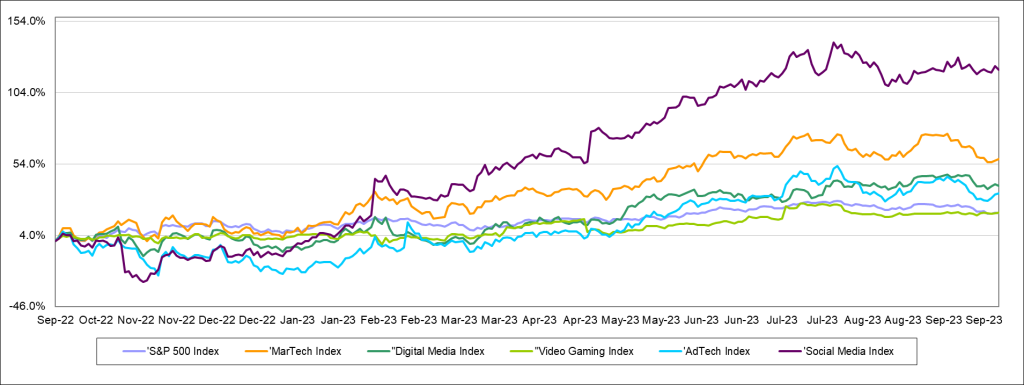
After increasing by 8% in the second quarter of 2023, the S&P 500 was unable to hold onto those gains in the third quarter. The S&P index decreased by 4% in the third quarter, a decline which we attribute to the market revising its interest rate expectations to one in which rates would remain “higher for longer”. Large cap stocks that weighed on the broad market index included tech stocks such as Apple (AAPL: -12%), Microsoft (MSFT: -7%) and Tesla (TSLA: -4%). Despite this small step backwards, the S&P 500 Index increased by 20% through the first nine months of the year.
Each of Noble’s Internet and Digital Media Indices, which are market cap weighted, outperformed the S&P 500 in the third quarter, but the double-digit gains from the previous quarter (2Q 2023) moderated significantly. Sectors that outperformed the S&P 500’s 4% increase include Noble’s Digital Media Index (+6%), Social Media Index (+4%), Gaming Index (+3%), Ad Tech Index (+1%) and MarTech Index (-3%). Despite these relatively positive results, the prevailing theme within each sector was that the largest cap stocks performed the best while smaller cap stocks across a variety of sectors struggled.
STOCK MARKET PERFORMANCE: INTERNET AND DIGITAL MEDIA
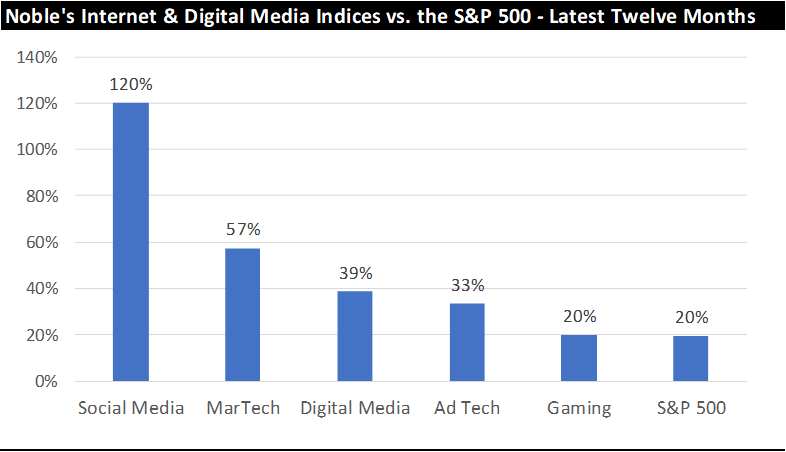
Perhaps more importantly, each of Noble’s Internet and Digital Media Indices have outperformed the S&P 500 over the latest twelve months. The S&P 500 Index has increased by 20% over the last year (through 9/30/2023), which trailed the performance of the each of Noble’s Internet and Digital Media Indices, as shown below:
Alphabet Powers Digital Media Index Higher Despite Broader-Based Sector Weakness
The best performing index during the quarter was the Noble’s Digital Media Index, but the sector’s “strong” performance is deceiving. Shares of Alphabet (a.k.a. Google: GOOGL) increased by 9% during the quarter, and the company size relative to its peers helps explain the vast majority of the sector’s performance. Google’s market cap is 8x larger than its next largest “peer” in Netflix, and it is 160 times that of the average market cap of its Digital Media peers. Google beat expectations across all metrics (revenue, EBITDA, free cash flow) and guided to improved profitability as it streamlines workflows. The company is also increasingly perceived as a beneficiary of AI. While Alphabet shares performed well, they mask the fact that shares of only 2 of the sector’s 12 stocks were up during the third quarter. The other Digital Media stock that performed well in the quarter was FUBO (FUBO), whose shares increased by 29% in 3Q 2023. Of the 10 other digital content providers in the sector, 7 of them posted double-digit stock price declines in the third quarter.
Large Cap Meta Powers the Social Media Index Higher
Shares in Meta Platforms (formerly Facebook) rose for the third straight quarter. Shares increased by 5% and were up 150% through the first nine months of the year. Meta shares increased by 8% at the start of the third quarter due to excitement around the launch of Threads, Meta’s answer to Twitter. Over 100 million people signed up for Threads within the first five days of its rollout and positions the company well for continued revenue growth once it begins to monetize this new opportunity.
As with the Digital Media Index, the in the Social Media Index masked underlying weakness across several smaller cap stocks. Of the 6 stocks in the Social Media Index, only Meta shares increased during the quarter. Several social media companies performed poorly during the quarter including Spark Networks (LOVL.Y: -59%), which filed to delist its shares, Nextdoor Holdings (KIND: -44%), which has struggled to reach profitability, and Snap (SNAP: -25%), which guided to revenue declines in 3Q 2023.
Video Gaming, Ad Tech and MarTech Indices Continue the Trend: “No Love” For Small Cap Stocks
As was the case in the Digital Media and Social Media sectors, the same trends held true in the other sectors: in general, large cap stocks outperformed small cap stocks. For example, Noble’s Video Gaming Index increased by 3% in the third quarter, driven by Activision Blizzard (ATVI: +11%), and to a lesser extent SciPlay Corp (SCP: +16%). However, 7 other stocks in the video gaming sector posted stock price declines in the third quarter. Larger cap names such as EA Sports (EA: -7%) and Take-Two Interactive (TTWO: -5%) posted mid-single digit stock price declines while every small cap video gaming stock posted double digit declines.
Noble’s Ad Tech Index increased by 1% during the quarter driven by shares of AppLovin (APP: +55%), and Taboola (TBLA: +22%). However, just 7 of the sector’s 20 stocks were up for the quarter, and 10 stocks in the sector posted double digit declines.
Finally, Noble’s MarTech Index decreased by 3% (the only index that declined during the quarter), with the sector’s largest companies, Adobe (ADBE: +4%) and Shopify (SHOP: -16%) posting mixed results. Outside of these mega-cap stocks, the theme of underlying weakness prevailed: only 5 of the 20 stocks in the sector posted stock price increases, while one was flat and the other 14 were down. Eleven of the 20 stocks in the MarTech sector posted double digit stock price declines.
3Q 2023 Internet and Digital Media M&A – A Significant Slowdown
According to Dealogic, which tracks global M&A, deal activity in North America decreased by 37% to 8,600 deals in the third quarter, however, the value of deals in North America increased by 34% to $375 billion. Dealogic noted that there was an increase in the number of scaled transactions (those with deal values in the $1 billion to $2 billion range), which increased to the highest level in 7 quarters. We did not see this phenomenon in Noble’s Internet & Digital Media sectors.
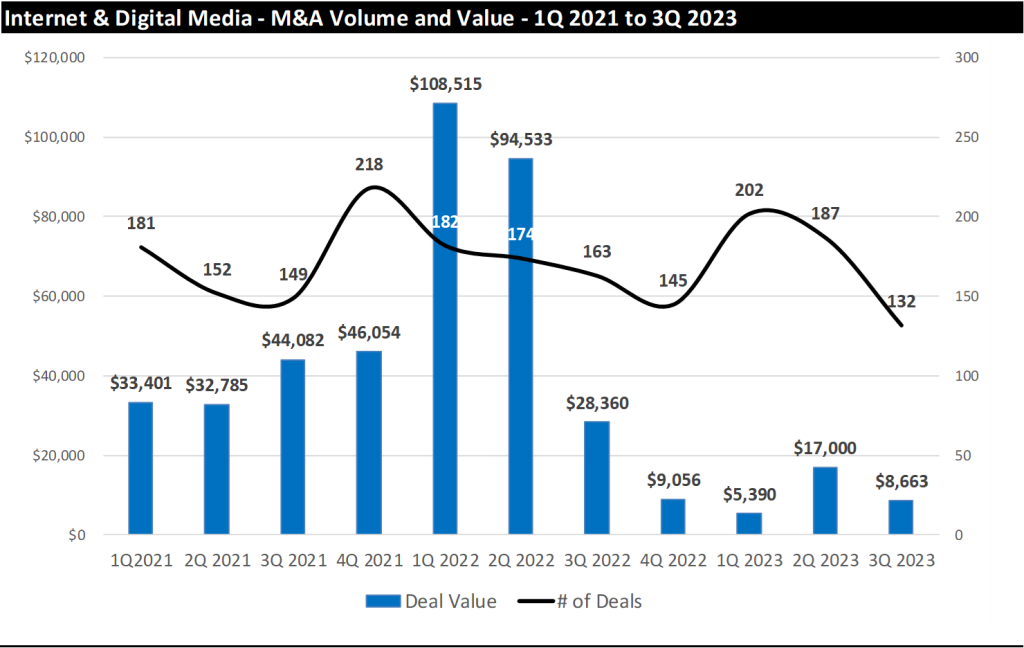
Based on our analysis, deal making in the Internet & Digital Media sectors in the third quarter of 2023 slowed rather dramatically. The total number of Internet & Digital Media deals we tracked in the quarter decreased by 29% sequentially to 132 deals in 3Q 2023 down from 169 deals in 2Q 2023. On a year-over-year basis, the total number of deals decreased by 22% to 132 deals in 3Q 2023 from 187 deals in the third 3Q 2022.
The decline in the number of deals was exceeded only by the decline in the dollar value of M&A deals. Announced M&A deal value fell sequentially by 50% to $8.7 billion in 3Q 2023 compared to $17.2 billion in announced deals in 2Q 2023. While total deal value of announced deals decreased significantly on a quarter-over-quarter basis, the decrease was even more pronounced on a year-over-year basis, as deal values decreased by 71% to $8.7 billion in deal value from $29.4 billion in 3Q 2022, as shown in the chart on the next page.
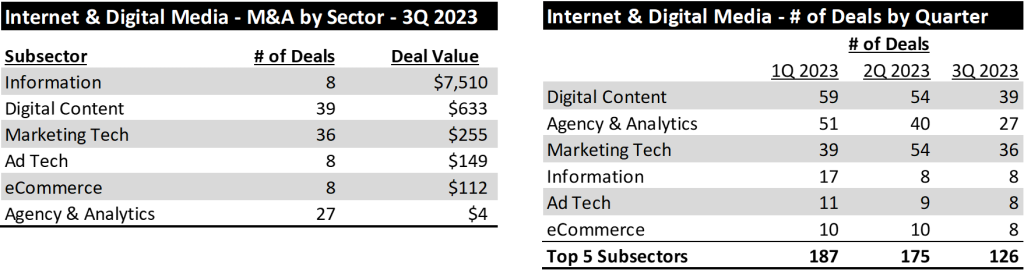
From a deal activity perspective, the most active sectors we tracked were Digital Content (39 deals), MarTech (36 deals) and Agency & Analytics (27 deals). From a dollar value perspective, Information Services led with $7.5 billion, followed by Digital Content with $633 million and MarTech with $255 million, as shown below (left).
As shown above (right), the number of transactions has fallen in each of the last two quarters. Across the top 5 subsectors of Internet and Digital Media, the number of transactions has fallen from 187 transactions in the first quarter to 126 transactions in the third quarter.
We attribute this decline to a variety of factors. First, an increase in interest rates has resulted in far fewer transactions in excess of $10 billion. With rates 300 basis points higher than at the start of the year, an incremental $10 billion in debt implies a $30 million per year increase in interest expense. These higher rates result in lower returns for acquirers. Second, we believe traditional lenders have become more cautious in providing the necessary capital to fund acquisitions. Some have pointed to commercial banks and their large exposure to commercial real estate as a reason for this more cautious view. Finally, for advertising-based businesses, there are some indications that brands are waiting longer before committing to or booking ad campaigns, which has reduced visibility and made financial forecasting more difficult.
Information and Video Gaming Deals Drive the Largest Transactions in 3Q 2023
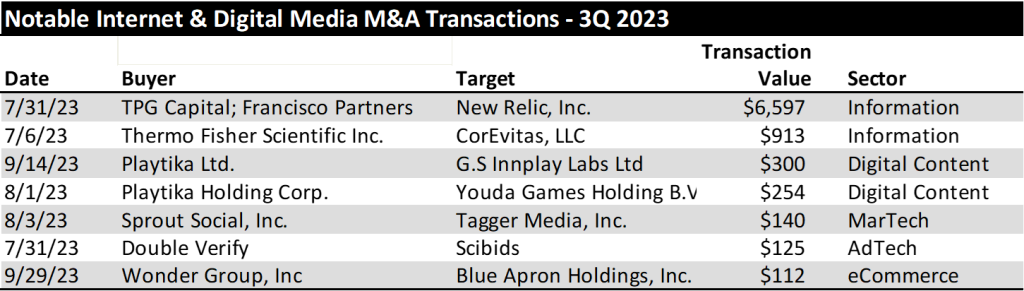
There were far fewer $100M+ transactions 3Q 2023. In the second quarter of 2023 there were 16 transactions in the Internet & Digital Media sector with transaction values greater than $100 million. In the third quarter, that amount slowed to less than half: just 7 transactions exceeded $100 million in purchase price. The Information Services sector accounted for the two largest transactions in the quarter, followed by Digital Content deals, in particular gaming deals. The list of M&A transactions that exceeded $100 million are shown in the chart below.
We believe the M&A market has slowed as corporations get accustomed to the prospect of higher rates for longer. One key driver of future M&A could come from distressed M&A dealmaking. Finally, another area of increased activity could come from U.S. corporations acquiring European companies where relatively weaker European currencies are making the valuations of European companies look more attractive.
TRADITIONAL MEDIA COMMENTARY
The following is an excerpt from a recent note by Noble’s Media Equity Research Analyst Michael Kupinski
Overview – The Case for Small Caps
Small cap investors have gone through a rough period. For the past several years, investors have anticipated an economic downturn. With these concerns, investors turned toward “safe haven,” large cap stocks, which typically have the ability to weather the economic headwinds and have enough trading volume should investors need to exit the position. Since 2018, small cap stocks have underperformed the general stock market, with annualized returns of just 3.7% as measured by the S&P 600 Small Cap Index versus the general market of 10.2% as measured by the S&P 500 Index. Another small cap index, the Russell 2000, increased a more modest 2.9% annually over the comparable period. The S&P 500 is larger cap, with the minimum market cap of $14.6 billion. The S&P 600 is smaller cap, a range of $850 million to $3.7 billion, with the Russell 2000 median market cap $950 million. Some of the even smaller cap stocks, those between $100 million to $850 million, have significantly underperformed the S&P 600. This is the first time that small caps underperformed a bullish period for all stocks since the 1940s. Notably, there is a sizable valuation disparity between the two classes, large and small cap, one of the largest in over 20 years.
Some of the small cap stocks we follow trade at a modest 2x Enterprise Value to EBITDA, compared with large cap valuations as high as 13x to 15x. By another measure, small cap stocks may be the only class trading below historic 25 year average to the median Enterprise Value to EBIT. Why the large valuation disparity? We believe that there is higher risk in the small cap stocks, especially given that some companies may not be cash flow positive, have capital needs, or have limited share float. But investors seem to have thrown the baby out with the bathwater. While those small cap stocks are on the more speculative end of the scale, many small cap stocks are growing revenues and cash flow, have capable balance sheets, and/or are cash flow positive. For attractive emerging growth companies, the trading activity will resolve itself over time. Some market strategists suggest that small cap stocks trade at the most undervalued in the market, as much as a 30% to 40% discount to fair value.
STOCK MARKET PERFORMANCE: TRADITIONAL MEDIA
Are we on the cusp of a small cap cycle? Some fund managers think so. Such a cycle could last 10 years or longer. In this report, we highlight a few of our small cap favorites in the Media sector, those include companies that have attractive growth characteristics, some with or without an improving economy, capable balance sheets, and limited capital needs. Our current favorites based on growth opportunity and stock valuation include: Direct Digital (DRCT), Entravision (EVC), E.W. Scripps (SSP), Gray Television (GTN), and Townsquare Media (TSQ).
Traditional Media Stock Price Performance
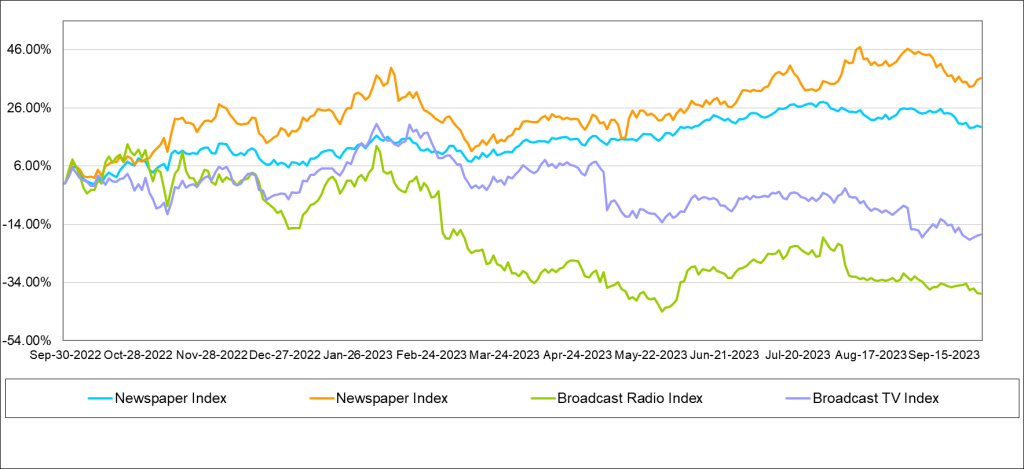
Virtually all traditional media stocks underperformed the general market in the past quarter and trailing 12 months, except for the Publishing group, as shown in the chart at the bottom of the previous page. In the latest quarter, Publishing stocks outperformed the general market, up 3% versus down 4% for the general market as measured by the S&P 500 Index. The average Publishing stock is up 7% over the past 12 months, with some of the larger cap publishing stocks up significantly more, over 20%. More details on the Publishing performance is in the Publishing section of this report. In the last quarter, the Radio stocks were the worst performing group, down on average 10%. In addition, the Radio stocks were the worst performing group in the third quarter as well, down an average of 13% for the quarter.
Broadcast Television
Have TV Stocks Been Discounted Too Much?
We believe that the economic headwinds of rising interest rates and inflation have begun to hit local advertising. Local advertising had been relatively stable, favorably influenced by a resurgence of auto advertising. Notably, local advertising fared much better than national advertising, which was down in the absence of political advertising. As we look toward the third quarter, local advertising appears to be weakening, but notably, national advertising appears to be doing much better, driven by an early influx of political advertising. While it was assumed that political would increase in the fourth quarter due to the run-off of the Republican presidential candidates, especially in early primary States, we believe that President Biden has recently stepped-up advertising, particularly to the Hispanic community. We have noticed Biden advertising even in Florida! So, what does this mean for media fundamentals?
It is difficult to predict where political dollars will be spent and not all political dollars will be spent evenly, geographically or by stations in a particular market. Furthermore, political dollars may be pulled back in a market should a particular candidate pull ahead in the polls. Political dollars were anticipated to be spent in early primary States, specifically for the Republican candidates. But the Biden money is a surprise. Biden appears to be spending early and in areas to solidify a key voting block, Hispanics. Of course, the Biden campaign may broaden its spending to other voting blocks as well. In our view, 2024 will be a banner year for political advertising given the large amount of political fundraising by the candidates and by Political Action Committees.
The prospect of weak local advertising, however, may cast a pall over the current expected strong revenue growth in 2024. Many analysts, including myself, expected that economic prospects would improve in 2024, which would have provided a favorable tailwind for a significant improvement in total TV advertising in 2024. Certainly, it is likely that the Fed may lower interest rates in 2024, potentially providing a boost to local advertising prospects, but that improvement may come late in the year. Overall, in spite of the weakening Local advertising environment, given the improving National advertising trends, overall TV advertising appears to have stabilized.
For now, we are cautiously optimistic about 2024, with the caveat that revenue growth may be somewhat tempered given the current weak local advertising trends. Nonetheless, we believe that we are nearing the trough for this economic cycle. Some companies, like E.W. Scripps, are in a favorable cycle for retransmission renewals. Retransmission revenues now account for a hefty 50% of Scripps’ total broadcast revenue. In Scripps’ case, 75% of its subscribers are under renewal, which it recently announced was completed. As such, the company reaffirmed guidance that retransmission revenue will increase 15% in 2024 and lead to a substantial increase in net retransmission revenue. We remain constructive on TV stocks, as high margin political advertising should boost balance sheets and improve stock valuations.
In the latest quarter, TV stocks underperformed the general market. The Noble TV Index decreased 13%, underperforming the 4% decline in the general market as measured by the S&P 500. The poor performance of the latest quarter adversely affected the trailing 12 month performance, bringing the Noble TV Index to a 18% decline for the trailing 12 months. Individual stocks performed more poorly, with only the shares of Fox Corporation registering a modest gain for the trailing 12 months of 3%. The Noble TV Index is market cap weighted, and, as such, Fox with a $15 billion market cap, carried the index. Outside of the relatively strong performance of this large cap stock, all of the TV stocks were down and down big, between 18% to 59% over the past 12 months.
We believe that investors have shied away from cyclicals, smaller cap stocks, and from companies with higher debt levels. This accounts for the poor performance of Gray Television (GTN) and E.W. Scripps (SSP), both of which have elevated debt leverage given recent acquisitions. Both were among the poorest performers for the latest quarter and for the trailing 12 months. GTN shares were down 12% in the third quarter and 38% for the last 12 months; the SSP shares down 40% and 58%, respectively.
We believe that the sell-off has been overdone, especially as the industry is expected to cycle toward an improved fundamental environment in 2024. As shown in the comp sheet on page 20, Broadcast TV stocks trade at a modest 5.3x Enterprise Value to our 2024 adj. EBITDA estimates, well below historic 20-year average trading multiples of 8x to 12x. We believe that the depressed valuations largely discount the prospect of an economic downturn and do not reflect the revenue and cash flow upside as we cycle into a political year. Given the steep valuation discount to historic levels, we believe that the stocks are 15% to 20% below levels where the stocks normally would be given a favorable political cycle. Our favorites in the TV space include: Entravision (EVC), one of the beneficiaries of the influx of political advertising to Hispanics; E.W. Scripps (SSP), a play on political, with the favorable fundamental tailwind of strong retransmission revenue growth; and, Gray Television (GTN), one of the leading political advertising plays.
Broadcast Radio
Shoring Up Balance Sheets
The Radio industry has struggled in the first half as National advertising weakened throughout the year. On average National advertising was down roughly 20% or more for many Radio broadcasters. Local held up relatively well, although down in the range of 3% to 5%. Fortunately, for many broadcasters, a push into digital, which grew in the first half, helped to stabilize total company revenues. As we look to the third and fourth quarters, we believe that Local advertising is weakening, expected to be down in the range of 5% to 7%, or more in some of the larger markets. For some, National advertising is improving, driven by political advertising. However, political is not evenly spread, so we anticipate that there will be a cautious outlook for many in the industry for the second half of the year.
For some in the industry, the challenged revenue environment has put a strain on managing cash flows to maintain hefty debt loads. We believe that debt leverage is among the top concerns for investors. Many of the poorest performing stocks in the quarter and for the trailing 12 months carry some of the highest debt leverage in the industry. The Noble Radio Index decreased a significant 14% in the latest quarter compared with a 4% decline for the general market. A look at the individual stock performance tells a more disappointing story. Shares of Salem Media declined 38% in the latest quarter, bringing 12-month performance to a 44% decline. Shares of iHeart Media declined 49% for the year.
Notably, Salem Media assuaged much of its liquidity concerns with recent asset sales. Such sales will bring in roughly $30 million, allowing it to fully pay off its $22 million revolver and have some flexibility with remaining cash on its balance sheet. We do not believe that investors have fully credited the significance of the recent asset sales.
One bright spot in the group was the shares of Townsquare Media (TSQ). While TSQ shares gave back a significant 27% in the third quarter, the shares are still up 20% over the past 12 months, among one of the best performing in the industry. We believe that the company’s initiation of a substantial dividend resonated with investors.
While the industry faces fundamental headwinds given the current economic challenges, we believe that most companies have made a shift toward faster growth, digital business models. In addition, we believe that Radio will see a lift from political advertising in 2024, although not to the extent that the TV industry will see. Nonetheless, we look for an improving advertising scenario in 2024, and as a result, we are constructive on the industry. One of our current favorites leads the industry in its Digital transition, Townsquare Media. As shown in the comp sheet on page 21, TSQ shares are among the cheapest in the industry, trading at 5.1x EV to our 2024 adj. EBITDA estimate, well below the average of 7.1x for the industry.
Publishing
Further Cost Cutting Will Cut Deep
Publishers are not likely to be spared from the weakening local advertising business, but publishers have a playbook on areas to cut expenses to manage cash flows. We believe that its Digital businesses should help offset some of the anticipated revenue declines on its print legacy business. We believe that the next round will cut deep into its legacy business, through the elimination of print days. Such a move likely will indicate further pressure on print revenues but would not proportionately decrease cash flow. Some print days have very little advertising and/or advertisers may shift some spending to other print days.
While many publishers would like to have a long runway for its cash flowing print business, such possible moves would accelerate the digital transition. Notably, with just some stabilization of revenues on the print side, many publishers have the potential to show total company revenue growth given benefit from digital revenue. With the prospect of strategies that may cut print days, we believe that total revenue growth may be pushed out to 2025.
Many of the Publishing stocks were written off long ago, but surprisingly, the Publishing stocks have been among the best stock performers in the latest quarter and for the trailing 12 months. The Noble Publishing Index increased a solid 36% in the trailing 12 months, outperforming the general market (as measured by the S&P 500) of 19% in the comparable time frame.
In the third quarter, Publishing stocks increased 4%, outperforming the S&P 500, which declined 4%. All of the publishers increased, with the exception of Lee Enterprises (LEE). Lee shares increased substantially a year earlier on takeover rumors. Since then, the shares have come back down to earth, while the rest of the industry moved higher. The stronger performers in the industry, however, were the larger cap companies, such as News Corp (NWSA) and The New York Times (NYT). In the latest quarter, the shares of The New York Times increased roughly 5% and the shares are up 27% for the trailing 12 months. The shares of Gannett increased a solid 9% in the latest quarter, as well.
As the Newspaper comp sheet on page 22 illustrates, there is a disparity among some of the larger, more diversified companies, like The New York Times and News Corporation. NYT shares trade at a hefty 15.7x EV to 2024 adj. EBITDA estimates, well above much of the pack currently trading in the 5x multiple range. We believe that this valuation gap should narrow, especially as many of the companies, like Lee and Gannett, have a burgeoning Digital business. While the industry faces secular challenges of its print business and there are economic headwinds in the very near term, we believe that companies like Lee Enterprises have the ability to manage cash flows and grow its digital businesses. Given the compelling stock valuation disparity, the shares of Lee Enterprises lead our list of favorites in the sector.
This newsletter was prepared and provided by Noble Capital Markets, Inc. For any questions and/or requests regarding this news letter, please contact Chris Ensley
DISCLAIMER
All statements or opinions contained herein that include the words “ we”,“ or “ are solely the responsibility of NOBLE Capital Markets, Inc and do not necessarily reflect statements or opinions expressed by any person or party affiliated with companies mentioned in this report Any opinions expressed herein are subject to change without notice All information provided herein is based on public and non public information believed to be accurate and reliable, but is not necessarily complete and cannot be guaranteed No judgment is hereby expressed or should be implied as to the suitability of any security described herein for any specific investor or any specific investment portfolio The decision to undertake any investment regarding the security mentioned herein should be made by each reader of this publication based on their own appraisal of the implications and risks of such decision This publication is intended for information purposes only and shall not constitute an offer to buy/ sell or the solicitation of an offer to buy/sell any security mentioned in this report, nor shall there be any sale of the security herein in any state or domicile in which said offer, solicitation or sale would be unlawful prior to registration or qualification under the securities laws of any such state or domicile This publication and all information, comments, statements or opinions contained or expressed herein are applicable only as of the date of this publication and subject to change without prior notice Past performance is not indicative of future results.
Please refer to the above PDF for a complete list of disclaimers pertaining to this newsletter.
OptimizeRx Corp. announced Thursday it will acquire Scottsdale-based Medicx Health for $95 million, expanding its platform reach to healthcare consumers.
The deal combines OptimizeRx’s solutions focused on healthcare providers (HCPs) with Medicx’s consumer-centric technologies. Together, the companies can engage over 2 million HCPs and a majority of U.S. healthcare consumers.
“Our acquisition of Medicx is expected to be a major business accelerator for us,” said OptimizeRx CEO Will Febbo.
For OptimizeRx, the acquisition enhances its digital health platform that helps life sciences companies educate and engage HCPs and patients. Medicx brings new omnichannel marketing and analytics capabilities aimed at consumers.
Reaching Healthcare’s Key Stakeholders
OptimizeRx’s lead solution is a digital point-of-care network enabling pharma marketing and engagement integrated within EHR and e-prescribing workflows. This allows drug makers to reach HCPs through digital touchpoints at the point of care.
Medicx has developed a Micro-Neighborhood® Targeting Platform using advanced identity resolution to reach healthcare consumers. Combining both solutions offers an end-to-end way for pharma companies to connect with HCPs and patients—healthcare’s two most important stakeholders.
“Coupling consumer and HCP marketing strategies is a natural next step for many of our customers,” said OptimizeRx Chief Commercial Officer Steve Silvestro.
Profitable Addition to Fuel Growth
The acquisition is expected to significantly benefit OptimizeRx’s growth and profitability. Medicx is a highly profitable company that will immediately add to revenue, EBITDA, and earnings per share.
On a combined basis, the deal will bring OptimizeRx’s revenue run-rate close to $100 million. Medicx also opens substantial new opportunities for customer penetration and cross-selling.
“I’m extremely proud of the leading patient-focused omnichannel platform the Medicx team has built,” said Medicx CEO Michael Weintraub. “Integrating with a leading HCP-focused enterprise provides numerous efficiencies.”
Weintraub added the combined platforms can now inform and educate patients and HCPs in a cohesive way no single company has done before.
Funded for Growth
OptimizeRx will pay $95 million in total consideration to acquire Medicx. The deal will be funded through OptimizeRx’s cash on hand, short-term investments, and a new $40 million credit facility from Blue Torch Capital.
Certain members of Medicx’s management will invest approximately $10.5 million of their proceeds into OptimizeRx common stock.
The acquisition is expected to close in Q4 2023. Medicx will operate as a subsidiary under its current management team.
Strong Quarterly Performance
In tandem with the acquisition announcement, OptimizeRx preannounced strong third quarter 2023 results.
The company expects Q3 revenue between $15.2-$15.5 million, ahead of consensus estimates. Non-GAAP net income is projected at $0.6-$1 million.
OptimizeRx saw accelerated organic growth in messaging driven by its recently enhanced Dynamic Audience Activation Platform.
The deal marks OptimizeRx’s largest acquisition to date as it leverages M&A to expand its platform. Medicx’s addition is expected to be immediately accretive while funding future growth.
Apple CEO Tim Cook raised eyebrows this week after disclosing the sale of over $88 million worth of company shares, his largest stock sale in over two years. While insider transactions are common, the considerable size and timing of Cook’s liquidation stokes fears amid a bearish environment for tech stocks.
Cook offloaded 511,000 Apple shares at prices between $171-173 per share according to regulatory filings. The sale equates to about 15% of his total vesting this year of over 3.4 million shares. However, it still reduces his exposure as he now holds around 3.28 million shares remaining.
The sale comes at a precarious time for Apple and the broader tech sector. After rallying strongly for most of 2022, the stock has declined nearly 20% from highs since peaking in late July. Concerns over slowing iPhone sales due to macro headwinds have plagued Apple lately.
With the economy potentially heading into recession and inflation hurting consumer budgets, investors have grown nervous over Apple’s prospects. The company also faces supply chain constraints impacting production capacity.
Cook choosing this period to materially reduce his Apple holdings could signal diminished confidence in near-term performance. Even scheduled sales through preset plans evoke questions on timing and motivation when executed amid market turbulence.
While Cook still maintains substantial skin in the game, the optics of a CEO offloading large share blocks matter. Apple also reports quarterly earnings at the end of this month, adding significance to the sale’s proximity.
Any hint of caution from Cook on the conference call risks further rattling shareholders. The considerable size of his stock sale suggests a more defensive posture than his typical modest liquidations.
The move follows similar trends of tech leaders diversifying holdings away from their own companies’ stocks. Meta’s Mark Zuckerberg sold off over $4 billion in shares in recent months. Amazon’s Jeff Bezos and Google’s founders have executed multi-billion dollar sales as well.
With valuations under pressure after a massive bull run, insiders seem intent on locking in gains. But it also betrays their lack of confidence in stock upside ahead. This compounds fears of slowing growth and execution challenges in the sector.
Cook’s sale in particular cuts deep given his influential leadership and long tenure at Apple. As a revered figure, actions speak loudly, and his uncharacteristic liquidation risks sending the wrong signal.
It may suggest that even entrenched tech stalwarts see limits to future gains amid rising macro uncertainty. The instinct to diversify out of FAANG names reinforces the sense that a pivot is underway.
For Apple specifically, Cook’s historic payday casts doubt ahead of the crucial holiday season. It may indicate softer demand for new iPhone models and other products as consumers tighten budgets.
With the stock down nearly 40% from highs, any wavering commitment from icons like Cook further spooks investors. For now, he retains substantial direct ownership, but the considerable cash-out still feels ill-timed given the challenges.
Cook’s sale exemplifies the broader pivot away from high-flying tech as economic conditions worsen. But his influential role means the signal cuts even deeper. Anxious Apple shareholders now await the next earnings results.
Immunome, a clinical-stage biotech developing novel antibody drugs for cancer, plans to merge with private peer Morphimmune in an all-stock deal. The combined company will unite complementary technology platforms with the goal of creating best-in-class targeted oncology therapies.
Morphimmune brings its proprietary Targeted Effector platform designed to selectively deliver anti-cancer payloads directly to tumor cells. Immunome contributes its human memory B cell interrogation platform that can identify novel antibodies against disease-associated antigens.
The merged entity, which will operate under the Immunome name, intends to submit 3 IND applications within 18 months after the transaction closes. The deal is expected to be completed by the end of 2023.
Leading the charge as new Immunome CEO will be current Morphimmune chief Clay Siegall, an industry veteran who previously founded and led Seattle Genetics for over two decades. Siegall built Seagen into a multi-billion cancer drug company on the back of its antibody-drug conjugate (ADC) technology.
His experience commercializing ADCs, which similarly target treatments directly to tumors, is highly relevant. Siegall called the merger “the first step in establishing a preeminent oncology company.”
The transaction will also bring in $125 million via a concurrent private placement from healthcare institutional investors. Participants include Enavate Sciences, EcoR1 Capital, Redmile Group, and Janus Henderson.
The fresh funding will support advancement of Immunome’s lead asset, a novel IL-38 targeting antibody. It originates from the company’s memory B cell interrogation platform, which sorts through patient blood samples to uncover new therapeutic candidates.
From Morphimmune, a potent TLR7 agonist and radioligand therapy are currently in preclinical testing. The TLR7 program stimulates the immune system against cancer cells when targeted via Morphimmune’s effector platform. The radioligand directly delivers cell-killing radiation.
Siegall highlighted the productive synergy between Morphimmune’s delivery technology and Immunome’s antibody generation engine. The combined company will be able to pursue a wider array of novel targets across multiple therapeutic modalities.
For investors, the merger and additional capital provide Immunome with a deeper pipeline and strengthened financial footing. The $125 million infusion should fund operations well into 2024 even with increased R&D activity.
The more diversified targeted therapy portfolio also helps mitigate risk, with programs based on different mechanisms of action. This provides more shots on goal for achieving clinical success and advancing partnership opportunities.
However, Immunome stock initially fell on news of the deal, indicating some investors were unimpressed by the initial progress made since its August 2020 IPO. The cash position was also becoming strained, likely necessitating the additional financing.
But the opportunity to start fresh under industry ace Siegall may give the story new appeal. His track record of building shareholder value and delivering oncology drugs could reinvigorate Immunome.
The merger puts all the pieces in place to become a fully integrated cancer therapy player. Immunome now has platform technology, industry expertise, development capabilities and a strengthened balance sheet.
Execution will be key, but Siegall’s involvement is about as good as it gets in terms of leadership. For long-term investors, Immunome may offer an intriguing backdoor into the vision of one of biotech’s most accomplished CEOs.
Noblecon19 is Noble Capital Markets’ 19th Annual Emerging Growth Equity Conference. This year, and for the first time, it will be held at Florida Atlantic University College of Business, Executive Education complex in Boca Raton, Florida. If a school environment comes to mind – wooden tables and hard chairs – you’re in for a huge surprise. This spectacular new 52,000 square foot building features the most technologically advanced presentation rooms on the North American Conference circuit with massive screens and tiered seating, all wired for worldwide broadcast. Oh, and the chairs are ergonomic memory foam.
Enough about the facilities (except to mention there are 800 free covered parking spots), it’s what will go on inside that is making NobleCon19 among the most anticipated events in South Florida this winter. Over 200 public company executive guest speakers (CEO, CFO, COO, that level), The 2023 NCAA Men’s Basketball Coach of the Year, Dusty May, on motivational team building. “The World is Hot” panel of experts covering everything from the global economy to the daunting influence of AI. And the 43rd President of the United States, George W. Bush. Only 46 people have ascended to that position, so that’s about as exclusive as it gets.
Let’s go back to those public company executives. The true stars of the show. Emerging growth companies are synonymous with innovation. They represent breakthroughs in science, technology, and medicine. Even though that breakthrough may be right around the corner, these are lesser known companies, so it’s a hands-on way to explore and discover what the future may hold, and you’re hearing it from the c-suites of the organizations. And if you’re looking for investments with exponential growth opportunity, NobleCon will certainly help begin your due diligence. If you’re looking for the next apple, this truly is your orchard.
The agenda offers a wide range of ways to meet these executives. Each company will have a formal presentation, an informal breakout, and one-on-one meetings arranged with qualified investors. The corridors will be filled with them so a little badge-watching can lead to some great dialogue. And then there’s “The After.” It’s a networking event (party) the evening after the first day of meetings. Noble has become known for The After, perhaps even legendary. This year it’s at the Privaira Aviation hangar at the Boca Raton Airport. The theme is a throwback to 1923 – It’s also the 19th NobleCon in ‘23. Here’s the billing for the event: “Mingle with munchies, music, magic, motors, and high-flying antics – a nostalgic extravaganza.“ Noble believes that the best bits of business are done in these more casual, fun environments, so to make sure that they are very well attended, they go, as they say, all out.
NobleCon is open for anyone to attend. So who should attend? Besides the obvious – institutional investors, brokers, equity analysts, RIAs, family offices – simply, anyone who has a love for business and wants to meet and mesh with the leaders of these emerging companies. The companies themselves help subsidize the lofty cost of hosting an event of this size and caliber, so the cost to attend all events is only $399. And until October 15, if you are a registered guest of Channelchek, (here’s the real exclusive part) it’s less than half at $149! This offer is limited to the first 250 attendees. To put that in perspective, a ticket for the best seat in the house for the George W. Bush fireside chat alone (moderated by Noble’s Director of Research, Michael Kupinski) is $350. If you’re looking for the ultimate adventure in capitalism, this is it!
NobleCon19 at Florida Atlantic University, College of Business, Executive Education
IF YOU REPRESENT A PUBLIC COMPANY AND WOULD LIKE TO BE CONSIDERED AS A PRESENTER AT NOBLECON19 CLICK HERE
Please note that lawyers, accountants, corporate consultants, investor relations, and other service providers do not qualify for the Channelchek discount.
The U.S. national debt surpassed $33 trillion for the first time ever this week, hitting $33.04 trillion according to the Treasury Department. This staggering sum exceeds the size of the entire U.S. economy and equals about $100,000 per citizen.
For investors, the ballooning national debt raises concerns about future tax hikes, inflation, and government spending cuts that could impact markets. While the debt level itself may seem abstract, its trajectory has real implications for portfolios.
Over 50% of the current national debt has accumulated since 2019. Massive pandemic stimulus programs, tax cuts, and a steep drop in tax revenues all blew up the deficit during Covid-19. Interest costs on the debt are also piling up.
Some level of deficit spending was needed to combat the economic crisis. But years of expanding deficits have brought total debt to the highest level since World War II as a share of GDP.
With debt now exceeding the size of the economy, there is greater risk of reduced economic output from crowd-out effects. High debt levels historically hamper GDP growth.
Economists worry that high debt will drive up borrowing costs for consumers and businesses as the government competes for limited capital. The Congressional Budget Office projects interest costs will soon become the largest government expenditure as rates rise.
Higher interest rates will consume more tax revenue just to pay interest, leaving less funding available for programs and services. Taxes may have to be raised to cover these costs.
Rising interest costs will also put more pressure on the Federal Reserve to keep rates low and monetize the debt through quantitative easing. This could further feed inflation.
If interest costs spiral, government debt could eventually reach unsustainable levels and require restructuring. But well before that, the debt overhang will influence policy and markets.
As debt concerns mount, investors may rotate to inflation hedges like gold and real estate. The likelihood of higher corporate and individual taxes could hit equity valuations and consumer spending.
But government spending cuts to social programs and defense would also ripple through the economy. Leaner budgets would provide fiscal headwinds reducing growth.
With debt limiting stimulus options, creative monetary policy would be needed in the next recession. More radical measures by the Fed could introduce volatility.
While the debt trajectory is troubling, a crisis is not imminent. Still, prudent investors should account for fiscal risks in their portfolio positioning and outlook. The ballooning national debt will shape policy and markets for years to come.
The following companies are confirmed for NobleCon19. Check back often, as new companies are added every week. Interested in presenting? Submit a request at the link above.
While it is no secret that there has been a migration of the finance and investment community out of New York and California, other than piecing together vehicle registrations to count people, there have been few hard numbers put on the firms and their AUM that have pulled out. This week, Bloomberg put hard numbers on the exodus, and it’s worse than most imagined. Looking at corporate filings back to the end of 2019, it found that more than 17,000 firms have moved. The two states have lost assets under management (AUM), within their borders, totaling more than $1 trillion.
This has also meant a lot of above average paying jobs, which saps tax revenue, and stresses state budgets. The commercial real estate markets in the two high-tax states have also taken a big hit as deep-pocketed tenants have packed up and left at a time when remote and hybrid work have already bled demand.
The Bloomberg piece makes clear that New York City remains the global center for asset management, but while New York is being slowly drained, it is “fueling a boom” down south. The article discusses the soaring Miami home prices and lifestyle improvements. In Dallas, the finance industry is expanding at a pace reminiscent of the 1980s oil bust. Charles Schwab moved to the area in 2020, and now Goldman Sachs and Wells Fargo are working to create office space to accommodate thousands of employees.
The moves continue to be inspired by costs and weather, and now face-to-face meetings are easier as the Dallas or Boca Raton associate is no longer an “out-of-towner”. The migration has dramatically increased the growth of professionals in the industry, in areas that previously had very few financial firms.
“The Sun Belt is continuing to change – no longer just a place of traditional industries like oil and gas, no longer just focused on tourism, of focusing on the retirement community,” Bloomberg quotes Amy Liu, interim President of the Brookings Institute, as saying.
From the beginning of 2020 through the end of the first quarter 2023, more than 370 investment companies decided to make a move. The companies represent 2.5% of the US total, and manage $2.7 trillion in assets. A high percentage was from the Northeast and the West Coast to Florida and Texas. But, North Carolina and Tennessee together grew by $600 billion in assets now managed within their borders. This is primarily from Alliance Bernstein moving out of New York and to Nashville, and Allspring Global Investment out of San Franciso and to Charlotte.
The AUM Migration by Region (Q1 2020 – Q1 2023)
Washington State saw three firms leave during this period, but the assets under management in the state dropped 19% as a result, as Fisher Investments was one of the three. Connecticut, a long-time suburb of the Big Apple is known for the hedge funds that have been headquartered there and enjoying lower taxes than in “the city.” The proximity to New York and the rising Connecticut taxes were traded by enough firms that Florida now has more assets under management than Connecticut.
Florida acquired the most assets from the migration from New York, Ark Investment Management, run by Cathie Wood, and Carl Icahn’s Icahn Capital Management were prominent names. Ken Griffin’s Citadel from Chicago is altering the South Florida skyline as it builds out offices, and DoubleLine moved from Los Angeles to Florida’s West Coast.
Smaller firms are on the move too. Whether they are following the sun, or the wealthy baby boomers, Palm Beach saw 37 investment advisors relocate, and Miami experienced an influx of 63 advisors.
The AUM in these new states is being enhanced by wealthy individuals also picking up and moving from their higher-tax residences. Tiger 21, a worldwide network of more than 1200 high net-worth investors, with assets over $150 billion, has grown its Florida chapter.
Take Away
The only thing that stays the same is change, as the saying goes. The pandemic brought on a lot of changes that most did not see coming. The migration out of places widely viewed as more difficult to live in because of costs, or year-round temperatures includes powerful financial firms. These firms are bringing in professionals who are accustomed to a certain way of conducting business. Until recently, the ability to do business this way did not fully exist in the areas where their firms have relocated – now it does.
What to Expect Out of This Year’s Jackson Hole Symposium
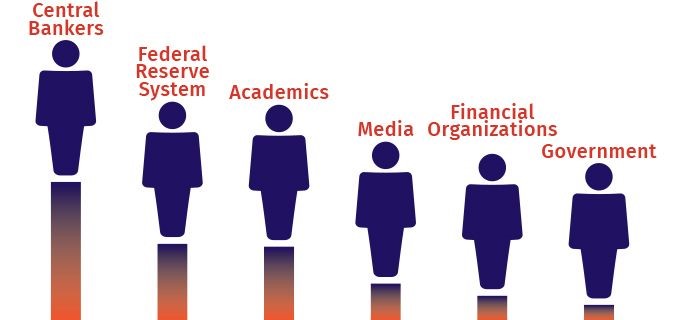
Since 1978, the Federal Reserve Bank of Kansas City has sponsored an annual event to discuss an important economic issue facing the U.S. and world economies. From 1982, the symposium has been hosted at the Jackson Lake Lodge at Grand Teton National Park, in Wyoming. The event brings together economists, financial market participants, academics, U.S. government representatives, and news media to discuss long-term policy issues of mutual concern. The 2023 Economic Policy Symposium. “Structural Shifts in the Global Economy,” will be held Aug. 24-26.
Those attending are selected based on each year’s topic with consideration for regional diversity, background, and industry. In a typical year, about 120 people attend.
The event features a collegiate feel with thoughtful discussion among the participants. The caliber and status of participants and the important topics being discussed draw substantial interest from the financial community in the symposium. Despite the interest in the annual event, The Jackson Hole event works best as a smaller open discussion, attendance at the event is limited.
Similarly, although the Federal Reserve District Bank receives numerous requests from media outlets worldwide, press attendance is also limited to a group that is selected to provide important transparency to the symposium, but not overwhelm or influence the proceedings. All symposium participants, including members of the press, pay a fee to attend. The fees are then used to recover event expenses.
Source: Federal Reserve, Kansas City, MO
What’s discussed?
The Kansas City Fed chooses the topic each year and asks experts to write papers on related subtopics. To date, more than 150 authors have presented papers on topics such as inflation, labor markets and international trade. All papers are available online.
Papers provided to the Bank in advance and presented at the annual economic policy symposium will be posted online at the time they are presented at the event. Other papers, such as conference comments, are posted as they become available. Additionally, transcripts of the proceedings are posted on the website as they become available, a process that generally takes a few months. Finally, the papers and transcripts are compiled into proceedings books which are both posted on the website and published in a volume that is available online or in print, free of charge.
Source: Federal Reserve, Kansas City, MO
Worldwide Representation
The goal of the Economic Policy Symposium when it began was to provide a vehicle for promoting public discussion and exchanging ideas. Throughout the event’s history in Jackson Hole, attendees from 70 countries have gathered to share their diverse perspectives and experiences.
Source: Federal Reserve, Kansas City, MO
This year’s theme will explore several significant, and potentially long-lasting, developments affecting the global economy. While the immediate disruption of the pandemic is fading, there likely will be long-lasting aftereffects for how economies are structured, both domestically and globally, as trade networks shift, and global financial flows react. Similarly, the policy response to the pandemic and its aftermath could have persistent effects as economies adjust to rapid shifts in the stance of monetary policy and a substantial increase in sovereign debt. The papers will share how these developments are likely to affect the context for growth and monetary policy in the coming decade.
The full agenda will be available at the start of the event on Thursday, Aug. 24 at 8 p.m. ET/6 p.m. MT. Federal Reserve Chair Jerome Powell’s remarks will be streamed on the Kansas City Fed’s YouTube channel, on Friday, Aug. 25 at 10:05 a.m. ET/8:05 a.m. MT. Papers and other materials will be posted on the Kansas City Fed’s website as they are presented during the event.
What Else
The markets seem to be expecting hawkish comments from the US Central Bank President on Friday at Jackson Hole. This is being priced in, as investors expect the Fed Chair may say something that spooks the bond market which naturally impacts stocks. There has been a lot of talk about how central banks globally should treat target inflation, all ears will be on that subject.
There are Many Reasons for a Reverse Split; All are Designed to Benefit Stakeholders
So far this quarter, there have been 59 reverse stock splits. These include industries as diverse as the apparel company Digital Brands Group (DBGI), which is consolidating its shares today, and Blue Apron (APRN), an e-commerce food prep provider, back on July 8th. In theory, this is a financial arrangement similar to asking for a $100 bill in exchange for five $20 dollar bills. But the reasons are more complicated and diverse. Understanding why a company you own, or are considering buying or shorting shares in, is consolidating ownership units can help you understand if the new shares are more likely to gain or lose value.
Background
As with the exchange of smaller denominated bills for larger ones, a reverse stock split is an action in which a company reduces its total outstanding shares while proportionally increasing the price per new share. It’s done by the company’s registrar by combining a certain number of existing shares into a single new share. For example, a 1-for-10 reverse stock split would result in every 10 shares of the company being converted into 1 new share.
From the shareholder side, their percentage ownership in the company remains unchanged; the value of that percentage will change as market forces revalue those shares.
Reasons for a Reverse Split
A corporate action such as a reverse split is not inexpensive for the company, so if it is conducting one, it must see a benefit. The primary reasons range from crisis management to an attempt to broaden the share’s appeal.
The category of crisis management includes working to prevent delisting from an exchange. The major stock exchanges have minimum share price requirements. If a company’s stock price falls below this minimum, it will be delisted from the exchange. Back in March, Bed Bath and Beyond went to shareholders asking for permission to do a reverse split in order to not be delisted for having a stock price lower than the Nasdaq threshold. The company was criticized as it showed that management did not have confidence that the price would rise on its own. At times when a company is approaching the minimum threshold for being listed on an exchange, they will look to do a reverse split, this can boost the per share price and prevent delisting.
In some cases there isn’t a crisis; management is simply managing perception in an effort to improve the stock’s image. This is because a stock that trades at a low price may be perceived as being risky or unpopular. A reverse stock split can give the appearance of a more valuable stock, which may attract more investors.
Conforming to the requirements of certain buyers, specifically institutional investors may also lead to a reverse split. Many institutional investors have minimum investment requirements. A reverse stock split can help to make a stock more attractive to these investors.
Bringing up the dollar price to simplify trading is another reason. A reverse stock split can make it easier to trade a stock, especially if the shares have a price below one dollar.
TheCaution Signs When a Company Undergoes a Reverse Split
There are certainly potential negatives to shareholders when a company has a reverse stock split. For example, a reverse stock split can decrease liquidity, making it less liquid; for example, it may be more difficult to buy or sell.
Some investors may view a reverse stock split as a negative signal about the company’s financial health; if the action isn’t expected to cure the ailment, it may serve to feed into a growing list of things investors don’t like about the company.
Shareholders could wind up owning a lesser portion of the company if the split results in fractional shares. For example, if the stock you own 97 shares in reverse 1 for 10. You’ll receive 9 shares and, most often, the cash equivalent of seven shares.
Ultimately, whether or not a reverse stock split is a good idea for a company depends on the specific circumstances. Investors should carefully consider the pros and cons before making a decision about whether or not to buy or sell a stock that has undergone or is being talked about as considering a reverse stock split. In most cases only board of director approval is required.
Opportunity for Investors?
The opportunities for investors after a reverse stock split depends on the reasons for the split. If the split is done to prevent delisting, it is likely that the stock price will increase in the short term. However, if the split is done for other reasons, such as to improve the stock’s image or to make it more attractive to institutional investors, the long-term impact on the stock price is uncertain. Remember, management presumably got board approval as they thought it was in the best interest of the company; as a shareholder, you are technically an owner and would reap any benefit of it turning out to be a good move.
Take Away
A reverse stock split means the number of shares owned will be reduced, but the ownership level will remain the same. The price per share will increase, but the market capitalization of the company will change little. The reverse stock split may have a negative impact on the liquidity of the stock. It may also be seen as a negative by some investors.
Overall, reverse stock splits are always conducted for with the best interest of the company onwers in mind. But the reasons for the move, and if it will be successful needs to be evaluated by stockholders.