Powell’s Talk at the Jacksonhole Symposium Won’t be Until Friday
The light economic calendar is likely to take a backseat to the annual Jackson Hole Symposium this week and the BRICS summit in Johannesburg, South Africa. In Jackson Hole, the overriding theme is “Structural Shifts in the Global Economy”. The annual meeting is intended to have an overriding academic tone, but the number of Fed policymakers involved allows the markets to listen for any meaningful interest rate bias. The expected focus is on remarks from those actually conducting monetary policy, US central bankers. Powell is scheduled to give his speech on the “Economic Outlook” at 10:05 ET on Friday. Meanwhile, 9,900 miles away, the BRICS group of major emerging economies – Brazil, Russia, India, China and South Africa – will hold its heads of state and government summit in Johannesburg from Aug. 22-24. South African President Cyril Ramaphosa, Chinese President Xi Jinping, Brazil’s President Luiz Inacio Lula da Silva and Indian Prime Minister Narendra Modi are expected to attend in person. Russian President Vladimir Putin will not attend in person, as there is an arrest warrant out related to the war in Ukraine. He is expected to attend virtually. The markets will be interested to see if the group expands by allowing other countries,also any news related to the New Development Bank (NDB) sometimes called the BRICS bank, and all around economic cooperation.
Stocks may also take their cue from interest rates and the longer end of the yield curve, which has begun adjusting with rising rates for longer-dated maturities.
Monday 8/21
• There is no key data being released and no expected talks or events with market implications.
Tuesday 8/22
• 7:30 AM ET, Richmond Fed President Thomas Barkin is scheduled to speak. Recent comments from Barkin have been hopeful. Barkin recently said the greater-than-expected easing in inflation in June may be an indication that the US economy can have a “soft landing,” returning to price stability without a damaging recession.
• 10:00 AM ET, the Existing Home Sales annual rate for July is to be at the same level as it was in June, 4.16 million. The National Association of Realtors has been citing a lack of available inventory for the slow pace of sales as existing homeowners are choosing to keep their lower mortgage rates.
• 2:30 PM ET, Chicago Fed President Austan Goolsbee is scheduled to speak. Goolsbee has made it clear he is on the fence as to whether tightening at the September meeting is warranted.
Wednesday 8/23
• 9:45 AM ET, Purchasing Managers Index (PMI) composite for services is expected to show that the number holds above 50 in July, as it has for the last six PMI releases. As for manufacturing, the consensus is 48.8, which would be down a bit from the 49 reported in June.
• 10:00 AM ET, New Home Sales in July, a month before mortgage rates began their recent spike, is expected to move higher to a 702,000 annual rate after slowing to 697,000 in June which, though lower than expected, was still the second highest rate in more than a year.
• 10:30 PM ET, EIA The Energy Information Administration (EIA) provides the Petroleum Status Report weekly with information on petroleum inventories in the US, whether produced in the US or abroad. The level of inventories helps determine prices for petroleum products.
• 8:30 AM ET, Durable Goods Orders are forecast to fall 4% for August after a 4.6% increase in July, pushed higher by aircraft orders. Ex-transportation orders are forecast to be up 0.2%, with core capital goods orders unchanged.
• 4:30 AM ET, The Fed’s Balance Sheet is expected to have decreased by $31.208 billion to $8.146 trillion for the seven day period ending August 23. This would be a $61.5 billion decline. Market participants and Fed watchers look to this weekly set of numbers to determine, among other things if the Fed is on track with its stated quantitative tightening (QT) plan.
Friday 8/25
• 10:00 AM ET, Consumer Sentiment is expected to end August at 71.2, unchanged from August’s mid-month flash with year-ahead inflation expectations also expected to be unchanged at 3.3%.
• 10:05 AM ET, US Federal Reserve Chairman is expected to give his address at Jackson Hole.
What Else
Have you attended an in-person roadshow organized by Noble Capital Markets? Noble has been reaching out to retail and institutional investors and holding these events designed for investors to meet management teams. Investors have been able to discover more about their companies, often enough to make an informed decision. The forum has been getting rave reviews from investors and company management teams. Use this link to see if a roadshow is scheduled near you.
MALVERN, Pa., Aug. 17, 2023 (GLOBE NEWSWIRE) — Baudax Bio, Inc. (the “Company” or “Baudax Bio”) (Nasdaq: BXRX), a biotechnology company focused on developing T cell receptor therapies utilizing human regulatory T cells, as well as a portfolio of clinical stage Neuromuscular Blocking Agents and an associated reversal agent, today announced that it has entered into definitive agreements for the purchase and sale of 2,006,544 shares of its common stock and 1,395,243 Series E pre-funded warrants at a purchase price of $0.56 per share of common stock (or $0.55 per prefunded warrant) in a registered direct offering priced at-the-market under Nasdaq rules. In addition, in a concurrent private placement, the Company will issue unregistered series A-7 common stock purchase warrants (the “warrants”) to purchase up to 3,401,787 shares of common stock. The warrants have an initial exercise price of $0.56 per share and are not exercisable until the shareholders of the Company approve the issuance of the underlying shares (the “Approval”). The warrants are exercisable for a period of five years commencing from the date the Approval is obtained. Additionally, the exercise price of the warrants will be adjusted upon the Company effecting a reverse stock split, if the post-reverse stock split exercise price of the warrants is higher than the lowest daily VWAP of the common stock during the five trading days following the reverse stock split (the “Adjustment”). If the Adjustment is applicable, the exercise price of the warrants will be reduced to the lowest daily VWAP of the common stock during the five trading days following such reverse stock split, and the number of shares issuable upon exercise of the warrants shall increase such that the aggregate exercise price payable as a result of such Adjustment shall be equal to the aggregate exercise price payable prior to such Adjustment. The closing of the registered direct offering and the concurrent private placement is expected to occur on or about August 21, 2023, subject to the satisfaction of customary closing conditions.
The gross proceeds from the offerings, before deducting offering expenses payable by the Company, are expected to be approximately $1.9 million. The Company intends to use the net proceeds from the offerings for pipeline development activities and general corporate purposes.
The shares of common stock, the prefunded warrants and the shares of common stock underlying the prefunded warrants described above (but not the series A-7 warrants issued in the concurrent private placement or the shares of common stock underlying such warrants) are being offered by the Company pursuant to a “shelf” registration statement on Form S-3 (File No. 333-253117) previously filed with the Securities and Exchange Commission (the “SEC”) and declared effective by the SEC on September 2, 2021. The offering in the registered direct offering of the shares of common stock, prefunded warrants and the shares of common stock issuable thereunder is made only by means of a prospectus, including a prospectus supplement, forming a part of the effective registration statement. A final prospectus supplement and accompanying prospectus relating to the registered direct offering will be filed with the SEC. Electronic copies of the final prospectus supplement and accompanying prospectus, when available, may be obtained on the SEC’s website at http://www.sec.gov.
The warrants described above are being issued in a concurrent private placement under Section 4(a)(2) of the Securities Act of 1933, as amended (the “Securities Act”), and, along with the shares of common stock underlying the warrants, have not been registered under the Securities Act, or applicable state securities laws. Accordingly, the warrants and underlying shares of common stock may not be offered or sold in the United States except pursuant to an effective registration statement or an applicable exemption from the registration requirements of the Securities Act and such applicable state securities laws.
In addition, on August 16, 2023, the Company also amended its series A-5 warrants to purchase 3,478,262 shares of the Company’s common stock (the “Series A-5 Warrants”) and series A-6 warrants to purchase 3,478,262 shares of the Company’s common stock (the “Series A-6 Warrants” and, collectively, the “Amended Warrants”) to (i) adjust the exercise price per share of common stock of the Amended Warrants to $0.56 per share of common stock, (ii) extend the expiration date of the Series A-5 Warrants to August 21, 2028 and (iii) extend the expiration date of the Series A-6 Warrants to February 21, 2025.
This press release shall not constitute an offer to sell or a solicitation of an offer to buy any of the securities described herein, nor shall there be any sale of these securities in any state or other jurisdiction in which such offer, solicitation or sale would be unlawful prior to the registration or qualification under the securities laws of any such state or other jurisdiction.
About Baudax Bio
Baudax Bio is a biotechnology company focused on developing T cell receptor (“TCR”) therapies utilizing human regulatory T cells (“Tregs”), as well as a portfolio of clinical stage Neuromuscular Blocking Agents (“NMBs”) and an associated reversal agent. Our TCR Treg programs primarily focus on immune modulating therapies for orphan diseases or complications associated with such diseases, as well as the treatment of autoimmune disorders. We believe that our TCR Treg programs have the potential to provide valuable therapeutic options to patients suffering from diseases for which there are limited treatment options and significant unmet need, as well as to prescribers and payers in these markets.
Forward Looking Statements
This press release contains forward-looking statements that involve risks and uncertainties. Such forward-looking statements reflect Baudax Bio’s expectations about its future performance and opportunities that involve substantial risks and uncertainties. When used herein, the words “anticipate,” “believe,” “estimate,” “may,” “upcoming,” “plan,” “target,” “goal,” “intend” and “expect” and similar expressions, as they relate to Baudax Bio or its management, are intended to identify such forward-looking statements. Forward-looking statements may include, without limitation, statements regarding market conditions, the closing of the offerings, the satisfaction of the closing conditions of the offerings, the approval of the warrants by the Company’s stockholders, and the use of net proceeds from the offerings. These forward-looking statements are based on information available to Baudax Bio as of the date of publication of this press release and are subject to a number of risks, uncertainties, and other factors that could cause Baudax Bio’s performance to differ materially from those expressed in, or implied by, these forward-looking statements. These risks and uncertainties include, among other things, whether Baudax Bio will be able to successfully integrate the TeraImmune operations; whether Baudax’s shareholders will approve the conversion of the Series X Non-Voting Convertible Preferred Stock; whether Baudax Bio’s cash resources will be sufficient to fund its continuing operations and the newly acquired TeraImmune operations, including the liabilities of TeraImmune incurred in connection with the completion of the transactions; risks related to market, economic and other conditions, Baudax Bio’s ability to advance its product candidate pipeline through pre-clinical studies and clinical trials, that interim results may not be indicative of final results in clinical trials, that earlier-stage trials may not be indicative of later-stage trials, the approvability of product candidates, Baudax Bio’s ability to raise future financing for continued development of its product candidates, Baudax Bio’s ability to pay its debt and to comply with the financial and other covenants under its credit facility, Baudax Bio’s ability to manage costs and execute on its operational and budget plans, Baudax Bio’s ability to achieve its financial goals; Baudax Bio’s ability to maintain listing on the Nasdaq Capital Market; and Baudax Bio’s ability to obtain, maintain and successfully enforce adequate patent and other intellectual property protection. These forward-looking statements should be considered together with the risks and uncertainties that may affect Baudax Bio’s business and future results included in Baudax Bio’s filings with the Securities and Exchange Commission at www.sec.gov. These forward-looking statements are based on information currently available to Baudax Bio, and Baudax Bio assumes no obligation to update any forward-looking statements except as required by applicable law.
Why Growth Companies May Take a Backseat for a While
Most everything runs in cycles; this is especially true for investment trends, investment styles, and investment performance or results. It looks like value investing has been making its long-awaited return to favor. This could be good news for investors that are frightened of the dizzying heights reached by tech’s top performers (the bigger they are, the harder they could fall) and provide an opportunity for those that know stock market history and expect it to repeat its time-tested performance attributes.
Value Versus Growth
It makes sense to quickly define value stocks and growth stocks as there are big differences, even though to the untrained, it may sound like we are talking about the same thing.
Growth stocks are stocks that are expected to outpace the overall market. These stocks are typically priced higher, using metrics we’ll discuss later, than value stocks because investors are willing to pay a premium for the expected future earnings growth. The definition can include large-cap companies still on a high growth trajectory like Apple (AAPL) or Tesla (TSLA), and small-cap companies such as AI company Soundhound (SOUN) or microcap companies like last quarter’s digital mining favorite Bit Digital (BTBT).
Value stocks are those trading for less than their intrinsic value. This means that for any one of a number of reasons, including momentum traders being distracted from value, the stock is priced below what the investor believes it should be worth. Put simply; value investors believe that they can identify stocks that are undervalued because they are not current “favorites” in the market. Large-cap examples could include well-established consumer goods company Proctor and Gamble (PG) as it is stable and growing, but not with great speed, or small-cap digital, television, and audio provider Entravision (EVC). Microcap companies may also be considered value stocks, take for example dry-bulk shipping company, Eurodry (EDRY). While the company has earnings and pays an above-average dividend, the nature of the business does not place its earnings expectations to become a multiple of its current business five or ten years from now.
Created by Channelchek
The Important History
Going back more than 40 years to the decade of the 1980s value stocks outperformed; the 1990s were led by growth opportunities. Then, in 2000, value investing beat growth for seven consecutive years. From there growth companies dominated through 2021. These are long cycles. In 2020, the year of ample stimulus money and Robinhood trading, growth seemed to have reached a crescendo and may have concluded its outperformance cycle with the strongest leg, beating value by more than 30 percentage points – the widest margin since at least 1927. Then, in 2021 value became the more dominant provider of performance. While trends are best seen in the rearview mirror, it appears that value investing has made and is continuing to make a comeback.
Last year, 2022, value beat growth by almost 25%, that is, using as a benchmark the S&P 500 Growth ETF (IVW) relative to the S&P 500 Value ETF (IVE). Both were down, but growth fell by 29.5% while value dipped by 5.4%.
Those that missed the growth stock go-go part of the cycle can only wish they could turn back time. Instead they must play the cards that are in their hands now. You can’t invest on yesterday’s circumstances. The question now is, has there been an ongoing shift to value, and how far can it go? Will it make up for the many underperforming years?
Are We in a Period of Value Outperformance?
One point already made is that markets and segments of the financial markets run in cycles. That actually lacks a clear definition. Surmising that over a long enough time period, the two will take turns outperforming with value more often, providing higher returns to investors lacks definition and traditional factors for one to outperform.
Over the last decade, low interest rates brought a lot of investors into the stock market. Most of those years investors were highly rewarded. Those with a greater risk tolerance did best which increased the risk appetite across the board. Growth, especially on the technology front, was rapid, during the pandemic. The demand for technology reached a peak and was met with investor cash as factors like stimulus checks, no commission trades, smartphone trading apps, and free time all converged at once. No wonder 2021 was so strong.
Consider this: The Price Earnings Ratio (P/E) of the Nasdaq 100 is 30.25, that is to say the average stock is priced at over 30 times annual earnings. The growth ETF IVW is at 23.5 times earnings. Meanwhile, the P/E of the value ETF IVE is only 20.6 times earnings. If earnings of past high flyers discontinue their growth trajectory either by increased costs such as interest rates or decreased sales partly prompted by the Fed injecting cash into the system, their growth may stall for some time. Investors will have to look for opportunity elsewhere, in other words, find value. The cheaper stocks (lower P/E) are where they have turned in the past, which keeps the two running in cycles.
Take Away
Value had a much better year than growth last year and seems to be in a position to make up for over a decade of lost ground to the riskier growth stocks. A portion of yesterday’s demand may have been met and likely borrowed from today’s demand for products involving communication and technology. For instance, Apple is expected to sell far fewer smartphones this year.
The year 2022 was a wake up call for those involved that became accustomed to making money each time they chased and bought an already expensive stock. These stocks now are competing with certificates of deposit rates at the local bank, and the idea that there is too wide of a gap between growth and value. For those that are long-term investors, they may look at history and decide that stocks, not fixed income, will provide the most return. Using a similar comparison, they may also expect that for growth and value to approach their normal relationship to each other, value will need a few years of significant outperformance or many years of mild outperformance. Either way, value investing is now the easier argument to make.
TORONTO, Aug. 16, 2023 (GLOBE NEWSWIRE) — Labrador Gold Corp. (TSX.V:LAB | OTCQX:NKOSF | FNR: 2N6) (“LabGold” or the “Company”) is pleased to announce results from recent prospecting along the highly prospective Appleton Fault Zone at its 100% owned Kingsway Project.
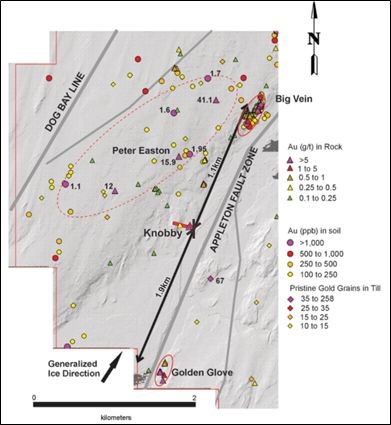
Recent prospecting between Big Vein and Golden Glove near the southern property boundary has located a new gold showing, the Knobby occurrence. Grab samples from quartz vein outcrops returned gold values from below detection (<5ppb) to 30.58 g/t including samples grading 0.4g/t, 2.7g/t and 29.19 g/t Au. Three parallel veins were observed and have been traced along an east-west strike for approximately 200 metres. Stibnite mineralization was observed associated with the quartz veining. This is the first indication of gold mineralization along the Appleton Fault Zone between Big Vein and Golden Glove, an area that has seen little work to date.
“Today’s results of high-grade, surface gold mineralization in quartz vein outcrops between Big Vein and Golden Glove is very encouraging for the prospectivity of this 3-kilometre section of the Appleton Fault Zone,” said Roger Moss, President and CEO of Labrador Gold Corp. “This is an area that we have prioritized for drilling in the latter part of this year once we complete an ongoing ground magnetic/VLF survey and receive the necessary permits. We are excited by the discovery of the Knobby occurrence which is reminiscent of our initial discovery of Big Vein by prospecting almost three years ago.”
Figure 1. Location of Knobby occurrence between Big Vein and Golden Glove.
Figure 2. Geochemical anomalies between Big Vein and Golden Glove.
Figure 3. Photos of Knobby Vein outcrop.
Prospecting is ongoing in the area of the Knobby occurrence and Groundtruth Exploration is currently completing a ground Mag/VLF survey extending from the southern property boundary to Big Vein. LabGold has submitted an application to drill up to 95 drill holes along this portion of the Appleton Fault Zone.
Upcoming Webinar
The Company is also pleased to announce that LabGold CEO, Roger Moss, will be presenting an exploration update on the Kingsway Project in a live webinar taking place on Wednesday, August 23rd at 12:00pm PT / 3:00pm ET. To register for the event please click the link below.
All rock samples are grab samples, which are selective samples and not necessarily representative of mineralization found on the property. Samples are securely stored prior to shipping to Eastern Analytical Laboratory in Springdale, Newfoundland for assay. Eastern Analytical is an ISO/IEC17025 accredited laboratory. Samples are routinely analyzed for gold by standard 30g fire assay with atomic absorption finish as well as by ICP-OES for an additional 34 elements. Samples containing visible gold are assayed by metallic screen/fire assay, as are any samples with fire assay results greater than 1g/t Au. The company submits blanks and certified reference standards at a rate of approximately 5% of the total samples in each batch.
Qualified Person
Roger Moss, PhD., P.Geo., President and CEO of LabGold, a Qualified Person in accordance with Canadian regulatory requirements as set out in NI 43-101, has read and approved the scientific and technical information that forms the basis for the disclosure contained in this release.
The Company gratefully acknowledges the Newfoundland and Labrador Ministry of Natural Resources’ Junior Exploration Assistance (JEA) Program for its financial support for exploration of the Kingsway property.
About Labrador Gold Labrador Gold is a Canadian based mineral exploration company focused on the acquisition and exploration of prospective gold projects in Eastern Canada.
Labrador Gold’s flagship property is the 100% owned Kingsway project in the Gander area of Newfoundland. The three licenses comprising the Kingsway project cover approximately 12km of the Appleton Fault Zone which is associated with numerous gold occurrences in the region. Infrastructure in the area is excellent located just 18km from the town of Gander with road access to the project, nearby electricity and abundant local water. LabGold is drilling a projected 100,000 metres targeting high-grade epizonal gold mineralization along the Appleton Fault Zone with encouraging results. The Company has approximately $12 million in working capital and is well funded to carry out the planned program.
The Hopedale property covers much of the Florence Lake greenstone belt that stretches over 60 km. The belt is typical of greenstone belts around the world but has been underexplored by comparison. Work to date by Labrador Gold show gold anomalies in rocks, soils and lake sediments over a 3 kilometre section of the northern portion of the Florence Lake greenstone belt in the vicinity of the known Thurber Dog gold showing where grab samples assayed up to 7.8g/t gold. In addition, anomalous gold in soil and lake sediment samples occur over approximately 40 km along the southern section of the greenstone belt. Labrador Gold now controls approximately 40km strike length of the Florence Lake Greenstone Belt.
The Company has 170,009,979 common shares issued and outstanding and trades on the TSX Venture Exchange under the symbol LAB.
For more information please contact: Roger Moss, President and CEO Tel: 416-704-8291
Or visit our website at: www.labradorgold.com
Twitter: @LabGoldCorp
Neither TSX Venture Exchange nor its Regulation Services Provider (as that term is defined in policies of the TSX Venture Exchange) accepts responsibility for the adequacy or accuracy of this release .
Forward-Looking Statements: This news release contains forward-looking statements that involve risks and uncertainties, which may cause actual results to differ materially from the statements made. When used in this document, the words “may”, “would”, “could”, “will”, “intend”, “plan”, “anticipate”, “believe”, “estimate”, “expect” and similar expressions are intended to identify forward-looking statements. Such statements reflect our current views with respect to future events and are subject to risks and uncertainties. Many factors could cause our actual results to differ materially from the statements made, including those factors discussed in filings made by us with the Canadian securities regulatory authorities. Should one or more of these risks and uncertainties, such as actual results of current exploration programs, the general risks associated with the mining industry, the price of gold and other metals, currency and interest rate fluctuations, increased competition and general economic and market factors, occur or should assumptions underlying the forward looking statements prove incorrect, actual results may vary materially from those described herein as intended, planned, anticipated, or expected. We do not intend and do not assume any obligation to update these forward-looking statements, except as required by law. Shareholders are cautioned not to put undue reliance on such forward-looking statements.
Image: US Treasury Secretary Janet Yellen in Las Vegas, Nevada, US, on Monday, Aug. 14, 2023.
China’s Economic slowdown is a “Risk Factor” for US, Says Treasury Secretary Yellen
A month after returning from her visit to China, U.S. Secretary of the Treasury Janet Yellen opened up about the interplay between the two countries’ economies, the risks the Chinese slowdown has on the U.S., and a side trip she took courtesy of ingesting magic mushrooms. Addressing growing concerns over the economic downturn in the world’s second-largest economy, and possible spillover effects to the U.S., the Treasurer was optimistic about her country’s path.
China and U.S.
Amidst the growing concerns surrounding China’s economic prospects, including a 5% devaluation of the yuan, and across-the-board weakening economic indicators, China now has the worst-performing currency in Asia after the yen.
Treasury Secretary Yellen, speaking in Las Vegas, seemed to be undoing some of the recent strong talk from U.S. President Biden at a fundraiser on August 11. Biden referred to China’s economic issues as a “ticking time bomb” and referred to Communist Party leaders as “bad folks.” The U.S. President expressed concerns about China’s slowed growth and elevated unemployment rate. She was speaking at a press conference following a speech in Las Vegas. Yellen referred to China’s economic woes as a “risk factor” for the US, a risk that she believes won’t significantly undermine the overall prospects of the American economy.
As Yellen touted the economic policy achievements of the Biden administration, she highlighted the resilient state of the US economy.
Risks to U.S.
In classic economist style, Yellen hedged her “low risk” comments by suggesting there is a possibility that while China’s slowdown will primarily impact its neighboring Asian nations, there will inevitably be some repercussions for the United States.
Yellen strongly emphasized uncertainty, “That said, I feel very good about US prospects overall. Let’s call that a risk, she said, signalling her measured optimism amidst the uncertainties linked to China’s economic trajectory. Yellen underscored the unexpectedly robust state of the U.S. labor market despite the Federal Reserve’s aggressive rate-hiking campaign – one of the most vigorous tightening efforts in decades.
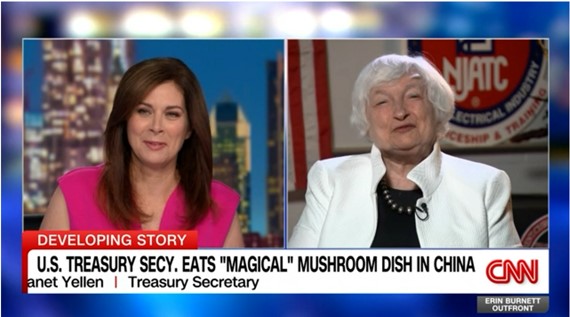
Janet Yellen spoke on CNN about her meal in China
Psychedelic Side Trip?
While in Beijing, Yellen made a bit of a stir both in China and in her home country for having been seen easting a psychedelic mushroom-based dish called Jian shou qing, or “see hand blue”, a fungi dish known for being hallucinogenic.
Yellen spoke about her experiences on CNN. She recognized the humor of the episode but said that the cooked food had no side effects.
Take Away
The U.S. economy is likely to be impacted by trade with the world’s second-largest economy. According to the U.S. Treasury Secretary, weakness in China will be somewhat contagious. She remains cautious but optimistic that the robust state of growth and employment in the U.S will serve to minimize negative effects.
Ark Invest Warns of a Deflationary Ripple that Could Spread Around the Globe
Pricing, whether it be of the stock market, private placements, or other alternative investments is impacted by investor demand, and demand is the result of differing views. Cathie Wood, the Ark Investment Management CEO, has held the view that the U.S. and global economies are close to a deflationary spiral. She pointed to more evidence this week, and sounded the alarm for the potential dire consequences of the Federal Reserve’s ongoing rate tightening measures. According to Wood, deflation tied to China and actions by the U.S. central bank could set off a chain reaction of deflation-induced economic slowdowns, not just within the United States but across international markets.
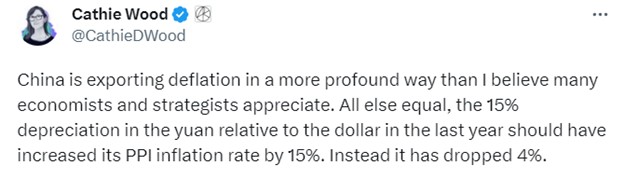
Ms. Wood, the 67-year-old market veteran, who falls in the category of celebrity investor, has many fans and followers. She shared her concerns in a string of posts on X, the platform formerly known as Twitter. Wood stated, “China is exporting deflation in a more profound way than I believe many economists and strategists appreciate.”
She explained that producer prices in China, the world’s second largest economy, were impacted by the U.S. dollar strengthening by 15% against the Chinese yuan, despite the devaluation adding around 15% to Chinese PPI, the Chinese reported a decline in the PPI inflation measure by 4%.
Wood expressed China is exporting deflation. She posted that, under normal circumstances, the 15% depreciation of the yuan against the dollar in 2022 should have led to a 15% increase in China’s annual producer inflation rate. Since it instead dropped 4%, In her math, this is creating near a 20% downdraft on prices of Chinese goods.
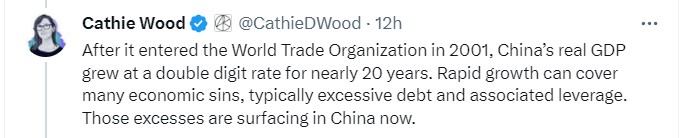
Turning her focus to China’s economic trajectory, Wood recounted the country’s impressive growth following its entry into the World Trade Organization in 2001. Over nearly two decades, China’s real GDP experienced a sustained double-digit expansion. However, Wood pointed out that rapid growth often conceals underlying economic vulnerabilities, including excessive debt and leverage. Her firm believes these vulnerabilities are now creating cracks in China’s economy.
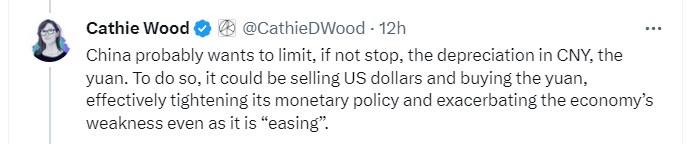
Wood suggested that China might attempt to halt the depreciation of the yuan. However, this would necessitate selling off U.S. dollars and acquiring yuan, which, in turn, tightens monetary policy and fuels the economy’s fragility, even amid efforts to stimulate it.
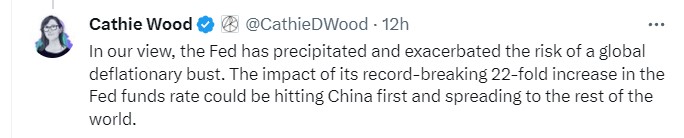
Ark Invest’s CEO posted, “The Fed has precipitated and exacerbated the risk of a global deflationary bust.” Drawing attention to the central bank’s remarkable 22-fold increase in the Fed funds rate, Wood warned that the repercussions of this move would first impact China and subsequently ripple through the rest of the world.
Recent economic data from China underscores the challenges it currently faces. Second-quarter GDP growth came in at 6.3%, falling short of the 7.3% projection by economists. Furthermore, new bank loans for July plummeted by 89% month-over-month, marking the lowest level since 2009, according to data from the People’s Bank of China.
The deflationary trend is evident in inflation figures as well. July inflation data showed both consumer and producer price inflation rates in negative territory.
Adding to the concerns, a trio of data released from the China National Bureau of Statistics revealed lackluster performance. Retail sales rose by a modest 2.5% year-over-year in July, well below the anticipated 4.5% increase. Industrial Production also lagged, with a 3.7% rise compared to the consensus estimate of 4.4%. Moreover, fixed asset investment figures raised further questions about the country’s economic health.
Take Away
There are certainly competing inflation forecasts opposing those coming out of Cathie Wood’s firm. However, her warnings do serve as a reminder, from a veteran in the asset management business, of the interconnectedness of global economies and the potential ramifications of central bank policy decisions. As markets continue to navigate the crosscurrents, attention remains on policymakers and economic indicators for signs of any change in trends.
How the Popularity of Parlay Betting is Helping the Major Players
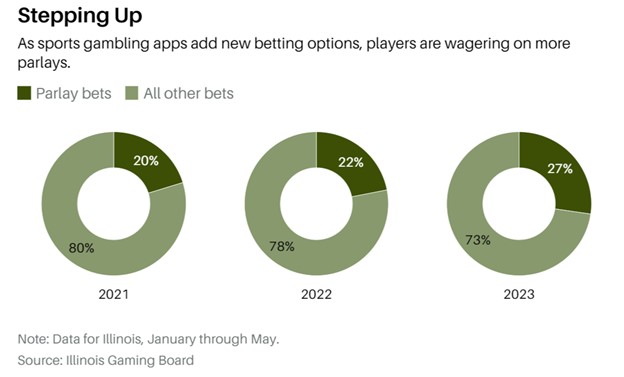
The business of gambling keeps growing as more types of wagers become popular and a friendlier legal environment encourages major players like DraftKings (DKNG) and FanDuel (PDYPF), as well as smaller online sites. A new online betting trend has been particularly profitable for companies who include it in their product line-up. Although specific financials remain undisclosed, parlay betting has dramatically added to the bottom line of some sportsbooks.
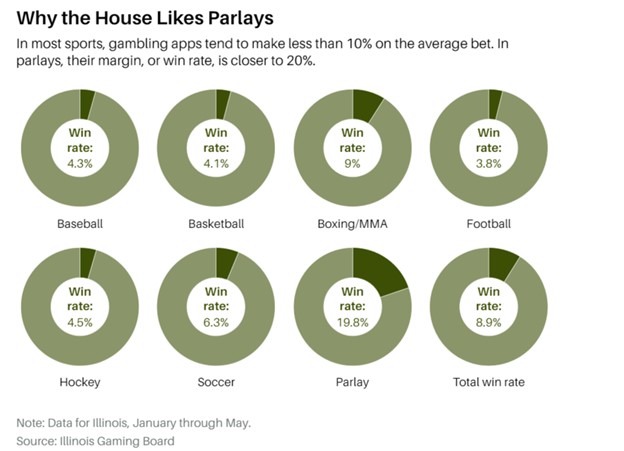
While not public, an analysis published in Barron’s of state gambling regulatory data shows the average amount the house keeps from the wagers is around 20% for parlay bets. This compares quite favorably to the 5% kept by conventional individual outcome wagers.
What is a Parlay Bet?
A parlay bet is a type of sports bet where you combine two or more individual bets into one single all-or-nothing bet. The payout for a parlay bet is much higher than for a single bet, but the probability of winning is much lower.
For example, let’s say you want to bet on the following three NFL games:
The Dallas Cowboys to beat the New York Giants
The Tampa Bay Buccaneers to beat the Philadelphia Eagles
The Miami Dolphins to beat the New York Jets
You could place three separate bets on these games, but you would only win a small amount of money if all three bets won. Instead, you could place a parlay bet on all three games. If you win the parlay bet, you will win a much larger amount.
The payout for a parlay bet is calculated by multiplying the odds of each individual bet together. So, if the odds of the Cowboys winning are 1.50, the odds of the Buccaneers winning are 2.00, and the odds of the Dolphins winning are 1.75, the odds of the parlay bet winning would be 1.50 x 2.00 x 1.75 = 5.25.
This means that if you bet $100 on the parlay bet, you would win $525 if all three bets won.
Gambling companies emphasize that parlays are no gimmick. The odds aren’t skewed in the company’s favor or anything shifty; rather, parlays introduce higher odds against bettors due to the cumulative impact of various outcomes. Betting on multiple events, even up to 10, compounds the odds of each event’s success. This is how the casinos’ 4% to 5% edge evolves into a substantial 20%.
Margins are Better for Companies
The increase in earnings from these bets has helped lift stock values much higher than the overall market.
The growing popularity of parlay bets has also served to increase the appetite in the U.S. for sports betting. In 2018 a Supreme Court’s ruling opened the doors for sports gambling, leaving the decision to legalize it to individual states. Since then, 38 states and Washington, D.C. have legalized sports betting, with online betting approved in 24 of them. The operators amassed a gross revenue of $7.5 billion in 2022, as per the American Gaming Association, and numerous analysts speculate that further state legalization and innovative trends such as parlays could propel the market up to $30 billion or more.
The big two, DraftKings and Flutter/FanDuel dominate the market after spending heavily for years on advertising. Their state-of-the-art technology and popular parlays have helped increase market share. The companies are now veering away from over-the-top marketing, as evidenced by the 49% dip in TV ad spending by online sports betting firms in Q2, and DraftKings’ 10% reduction in marketing expenditures in established markets during the latest quarter.
Regardless of market dominance, parlays are poised to proliferate due to their popularity and profitability. While Las Vegas has long capitalized on the attractiveness of quick riches, the advent of online companies’ represents a distinct shift in the dynamics. Unlike casinos that can’t dramatically boost their own profitability in games like blackjack, the digital platforms can reach the masses electronically and digitally.
As mentioned, this surge in parlays resonates with the penchant for sudden riches, and can be witnessed far beyond Las Vegas. The recent Mega-Millions $1.55 billion prize had players lined up in the summer heat to pay for an almost impossible chance of winning. Platforms like Robinhood appealed to the high-risk high-return nature of many and amassed more brokerage customers in a year than any other company in history.
Parlays effectively tap into and profit handsomely off the mentality of all-or-nothing large gains. A mere $10 parlay could translate into thousands in winnings, mirroring the “got to be in it to win it” feeling of the lottery. But here, the bettor can feel more in control.
Take Away
The overall stock market performance is reported each trading day in popular indexes, but there are individual sectors that rise, or fall separately and at a different pace than each index. Index funds and ETF buyers are beginning to realize that a portion of their portfolio invested in industries and companies that are showing more strength than the S&P, Dow, or Nasdaq indexes may allow for enhanced performance. Many keep the largest allocation in an indexed fund or ETF to still maintain the diversification that prompted the indexed fund investment to begin with.
This December hundreds of investors will be attending NobleCon19 in order to discover actionable ideas they can invest in. The investment conference is the place where both professional and self-directed market participants go to become familiar with less mainstream companies and management. You’re invited – go here for all the information you will need to join us in Florida later this year.
It Seems Likely that Grandma and Grandpa are Getting a Much Smaller Raise Next Year
In 2023, Social Security recipients received the highest COLA in more than 40 years, 8.7%. At the same time, the entire U.S., including those retired, was impacted by the highest annual inflation in over 40 years. The result is the increased pay impacted recipients differently. Those with a higher percentage of variable costs or expenses, especially where inflation was worst, such as rent, travel, or fuel did not benefit as much, if at all. Those with a greater percentage of fixed costs may have found themselves with more money at the end of each month.
Consumers in the U.S., including Social Security recipients, have not had their purchasing power eroded as much during the first seven months of 2023, as they experienced in 2022. Social Security cost of living adjustments (COLA) are based on a formula that will cause the increase paid next year to rise almost by a third of what it rose at the beginning of 2023.
While not yet official, the new forecast comes after the release of July’s Consumer Price Index (CPI), and is largely based on little change over the next 45 days.
How is a COLA Calculated?
Ignore for a moment the inflation rate percentages you see in the news headlines. The 12-month CPI is calculated by using the set cost of a basket of goods during the month, divided into the cost of the same basket a year earlier. SSA COLA is calculated by the average price of the basket July, August, and September, and dividing it by the average of these months a year earlier. The CPI used in this case is not the CPI-U (all urban consumers) typically reported in the news, but instead, CPI-W (Urban Wage Earners and Clerical Workers). CPI-W is calculated on a monthly basis by the Bureau of Labor Statistics. The most recent release was August 10, 2023.
COLA increases are rounded to the nearest tenth. The adjusted benefit payments are effective as of the first month of the new year.
What to Expect
Social Security recipients could see a 3% bump up next year, based on July’s CPI data, and the current stagnation in the level of inflation. A 3% COLA would raise an average monthly benefit of $1,789 by $53.70 and the maximum benefit by $136.65 per month.
Retired Americans who find Social Security a nice addition to 401(k) or 403(B) investment returns or ample pensions may find themselves with a few extra dollars to take road trips or treat themselves to dining out, or gifts for grandchildren. But investors looking for industries that may benefit from the fatter checks older Americans will receive may find that there is little difference in spending for the majority.
In its recent survey of retirees, the Senior Citizens League found that more than 66% of those that completed its survey have postponed dental care, including major services such as bridges, dentures, and implants. Another 43% said they have delayed optical exams or getting prescription eyeglasses. Almost one-third of survey participants said they have postponed getting medical care or filling prescriptions due to deductibles, out-of-pocket costs, and unexpected bills.
Persistent high prices aren’t the only challenge. Findings from the survey suggest more than one in five Social Security beneficiaries (23%) report they paid tax on a portion of their benefits for the first time this past tax season.
Take Away
When economic numbers are released, they are of interest to a expansive variety of economic stakeholders. This includes investors determining how new statistics will impact corporate earnings, economists deciding how it could impact the Fed’s next move, equity analysts reviewing their industry and companies in the sector, the young couple looking to furnish a new home, and those past their working years that are in general more vulnerable.
The CPI number from July and those that will be reported for August and September will have a noticeable impact on the high percentage of elderly in the U.S. come January 2024.
Q2 Revenue of $42.4 Million; Income from Operations of $5.0 Million; Adjusted EBITDA of $13.8 Million or 33% of revenue
Generated $2.7 Million of Operating Cash Flow
DENVER, Colo., Aug. 9, 2023 /CNW/ – Medicine Man Technologies, Inc., operating as Schwazze, (OTCQX: SHWZ) (NEO: SHWZ) (“Schwazze” or the “Company”), today announced financial and operational results for the second quarter ended June 30, 2023.
Second Quarter 2023 Summary
For the Three Months Ended
$ in Thousands USD
June 30, 2023
March 31, 2023
June 30, 2022
Revenue
$42,375
$40,001
$44,263
Gross Profit
$24,519
$23,033
$25,156
Income from Operations
$4,957
$5,650
$9,036
Adjusted EBITDA1
$13,814
$14,525
$15,021
Operating Cash Flow
$2,683
$(880)
$(13,486)
______________________________
1 Adjusted EBITDA represents earnings before interest, taxes, depreciation, and amortization, adjusted for other income, non-cash share-based compensation, one-time transaction related expenses, or other non-operating costs. The Company uses adjusted EBITDA as it believes it better explains the results of its core business.
Management Commentary
“We continued to execute on our ‘go deep’ retail strategy in the second quarter, demonstrated by our acquisitions of Everest Apothecary in New Mexico in June, as well as Standing Akimbo and Smokey’s in Colorado,” said Nirup Krishnamurthy, CEO of Schwazze. “Although it is early in the integration process and these stores have yet to ramp, in July we began to recognize synergies from bulk purchasing, introducing new product assortment, and leveraging best cultivation practices to improve yields, among other improvements. We expect to realize additional benefits as we further integrate our assets in the months ahead.
“The cannabis market environment in Colorado and New Mexico remains a challenge due to pricing pressure and license proliferation in key markets. However, we are beginning to see early signs of wholesale pricing stabilization in Colorado and are hyper-focused on customer acquisition and experience, while maintaining our brand standards and margin through targeted promotions for customers. Through these efforts, we increased market share in both Colorado and New Mexico, demonstrating the effectiveness of our operating playbook and acquisition strategy, as well as our ability to execute in a competitive environment.
“Looking ahead, we will continue to run a lean operation while implementing the Schwazze retail playbook across our markets to expand our customer base, increase labor and price optimization, and improve customer loyalty and brand penetration. We are well positioned to continue driving strong adjusted EBITDA margins and consistent cash flow generation in 2023.”
Recent Highlights
Completed the acquisition of Everest Apothecary in June, increasing the Company’s New Mexico operations to 32 dispensaries, four cultivation facilities, two manufacturing facilities and over 400 employees statewide.
Appointed Nirup Krishnamurthy as Chief Executive Officer.
Acquired two Colorado retail dispensaries from Smokey’s Cannabis Company.
Acquired Standing Akimbo, the largest medical cannabis dispensary in Colorado, and opened the Company’s first medical dispensary in Colorado Springs under the Standing Akimbo banner.
Ecommerce penetration in New Mexico and Colorado grew approximately 45% and 15%, respectively, compared to the first quarter of 2023 when the program was first launched.
Experienced 17% sequential growth of new customer loyalty members in the second quarter of 2023.
Second Quarter 2023 Financial Results
Total revenue in the second quarter of 2023 was $42.4 million compared to $44.3 million for the same quarter last year. The decrease was primarily due to lower wholesale revenue resulting from a 25% year-over-year decline in wholesale pricing and the proliferation of new licenses in key New Mexico markets, partially offset by growth from new stores compared to the prior year period.
Gross profit for the second quarter of 2023 was $24.5 million or 57.9% of total revenue, compared to $25.2 million or 56.8% of total revenue for the same quarter last year. The increase in gross margin was primarily driven by efficiency gains across retail, cultivation, and production, partially offset by the aforementioned wholesale pricing pressure.
Operating expenses for the second quarter of 2023 were $19.6 million compared to $16.1 million for the same quarter last year. The increase was primarily due to the four-wall SG&A increases associated with 27 additional stores in Colorado and New Mexico that are still ramping, as well as an increase in stock-based compensation. This was partially offset by efficiencies implemented throughout the Company’s operations.
Income from operations for the second quarter of 2023 was $5.0 million compared to $9.0 million in the same quarter last year. Net loss was $6.6 million compared to net income of $33.8 million for the second quarter of 2022, primarily driven by a $35.2 million change in the non-cash accounting revaluation of the derivative liability related to the Company’s convertible note.
Adjusted EBITDA for the second quarter of 2023 was $13.8 million or 32.6% of revenue, compared to $15.0 million or 33.9% of revenue for the same quarter last year. The decrease in adjusted EBITDA margin was primarily driven by lower revenue and higher SG&A associated with new stores that are still ramping, partially offset by improved gross margin.
As of June 30, 2023, cash and cash equivalents were $19.9 million compared to $38.9 million on December 31, 2022, while operating working capital increased by $5.8 million to $10.0 million during this period. Total debt as of June 30, 2023, was $155.4 million compared to $127.8 million on December 31, 2022.
Schwazze CFO Forrest Hoffmaster added, “In addition to our focus on top line growth, supply chain efficiencies and cash generation, we are capitalizing on our hyper-regional retail strategy with a series of cost optimization programs that are improving our cash position and margins. We have begun to see the benefit of these initiatives and expect to drive further improvements in the months ahead.”
Conference Call
The Company will conduct a conference call today, August 9, 2023, at 5:00 p.m. Eastern time to discuss its results for the second quarter ended June 30, 2023.
Schwazze management will host the conference call, followed by a question-and-answer period. Interested parties may submit questions to the Company prior to the call by emailing [email protected].
Date: Wednesday, August 9, 2023 Time: 5:00 p.m. Eastern time Toll-free dial-in number: (888) 664-6383 International dial-in number: (416) 764-8650 Conference ID: 70252888 Webcast: SHWZ Q2 2023 Earnings Call
The conference call will also be broadcast live and available for replay on the investor relations section of the Company’s website at https://ir.schwazze.com.
If you have any difficulty registering or connecting with the conference call, please contact Elevate IR at (720) 330-2829.
About Schwazze
Schwazze (OTCQX: SHWZ) (NEO: SHWZ) is building a premier vertically integrated regional cannabis company with assets in Colorado and New Mexico and will continue to take its operating system to other states where it can develop a differentiated regional leadership position. Schwazze is the parent company of a portfolio of leading cannabis businesses and brands spanning seed to sale.
Schwazze is anchored by a high-performance culture that combines customer-centric thinking and data science to test, measure, and drive decisions and outcomes. The Company’s leadership team has deep expertise in retailing, wholesaling, and building consumer brands at Fortune 500 companies as well as in the cannabis sector.
Medicine Man Technologies, Inc. was Schwazze’s former operating trade name. The corporate entity continues to be named Medicine Man Technologies, Inc. Schwazze derives its name from the pruning technique of a cannabis plant to enhance plant structure and promote healthy growth. To learn more about Schwazze, visit www.schwazze.com.
Forward-Looking Statements This press release contains “forward-looking statements.” Such statements may be preceded by the words “may,” “will,” “could,” “would,” “should,” “expect,” “intends,” “plans,” “strategy,” “prospects,” “anticipate,” “believe,” “approximately,” “estimate,” “predict,” “project,” “potential,” “continue,” “ongoing,” or the negative of these terms or other words of similar meaning in connection with a discussion of future events or future operating or financial performance, although the absence of these words does not necessarily mean that a statement is not forward-looking. Forward-looking statements are not guarantees of future events or performance, are based on certain assumptions, and are subject to various known and unknown risks and uncertainties, many of which are beyond the Company’s control and cannot be predicted or quantified. Consequently, actual events and results may differ materially from those expressed or implied by such forward-looking statements. Such risks and uncertainties include, without limitation, risks and uncertainties associated with (i) regulatory limitations on our products and services and the uncertainty in the application of federal, state, and local laws to our business, and any changes in such laws; (ii) our ability to manufacture our products and product candidates on a commercial scale on our own or in collaboration with third parties; (iii) our ability to identify, consummate, and integrate anticipated acquisitions; (iv) general industry and economic conditions; (v) our ability to access adequate capital upon terms and conditions that are acceptable to us; (vi) our ability to pay interest and principal on outstanding debt when due; (vii) volatility in credit and market conditions; (viii) the loss of one or more key executives or other key employees; and (ix) other risks and uncertainties related to the cannabis market and our business strategy. More detailed information about the Company and the risk factors that may affect the realization of forward-looking statements is set forth in the Company’s filings with the Securities and Exchange Commission (SEC), including the Company’s Annual Report on Form 10-K and its Quarterly Reports on Form 10-Q. Investors and security holders are urged to read these documents free of charge on the SEC’s website at http://www.sec.gov. The Company assumes no obligation to publicly update or revise its forward-looking statements as a result of new information, future events or otherwise except as required by law.
MEDICINE MAN TECHNOLOGIES, INC. CONDENSED CONSOLIDATED BALANCE SHEETS For the Periods Ended June 30, 2023 and December 31, 2022 Expressed in U.S. Dollars
June 30,
December 31,
2023
2022
(Unaudited)
(Audited)
ASSETS
Current Assets
Cash & Cash Equivalents
$
19,872,099
$
38,949,253
Accounts Receivable, net of Allowance for Doubtful Accounts
6,179,662
4,471,978
Inventory
33,821,282
22,554,182
Notes Receivable – Current, net
–
11,944
Marketable Securities, net of Unrealized Loss of $1,816 and Loss of $39,270, respectively
456,099
454,283
Prepaid Expenses & Other Current Assets
6,203,056
5,293,393
Total Current Assets
66,532,198
71,735,033
Non-Current Assets
Fixed Assets, net Accumulated Depreciation of $7,007,889 and $4,899,977, respectively
31,128,357
27,089,026
Investments
2,000,000
2,000,000
Goodwill
75,968,130
94,605,301
Intangible Assets, net Accumulated Amortization of $24,981,817 and $16,290,862, respectively
168,892,605
107,726,718
Note Receivable – Non-Current, net
1,313
–
Other Non-Current Assets
1,222,805
1,527,256
Operating Lease Right of Use Assets
23,213,504
18,199,399
Total Non-Current Assets
302,426,714
251,147,700
Total Assets
$
368,958,912
$
322,882,733
LIABILITIES & STOCKHOLDERS’ EQUITY
Current Liabilities
Accounts Payable
$
12,105,250
$
10,701,281
Accounts Payable – Related Party
6,073
22,380
Accrued Expenses
6,398,115
7,462,290
Derivative Liabilities
6,538,485
16,508,253
Lease Liabilities – Current
4,026,595
3,139,289
Current Portion of Long Term Debt
6,583,334
2,250,000
Income Taxes Payable
14,113,477
7,297,815
Total Current Liabilities
49,771,329
47,381,308
Non-Current Liabilities
Long Term Debt, net of Debt Discount & Issuance Costs
148,861,810
125,521,520
Lease Liabilities – Non-Current
22,096,232
17,314,464
Deferred Income Taxes, net
178,031
502,070
Total Non-Current Liabilities
171,136,073
143,338,054
Total Liabilities
$
220,907,402
$
190,719,362
Stockholders’ Equity
Preferred Stock, $0.001 Par Value. 10,000,000 Shares Authorized; 86,994 Shares Issued and
86,994 Shares Outstanding as of June 30, 2023 and 86,994 Shares Issued and 86,994 Shares
Outstanding as of December 31, 2022.
87
87
Common Stock, $0.001 Par Value. 250,000,000 Shares Authorized; 71,730,449 Shares Issued
and 70,590,451 Shares Outstanding as of June 30, 2023 and 56,352,545 Shares Issued and
55,212,547 Shares Outstanding as of December 31, 2022.
71,730
56,353
Additional Paid-In Capital
201,116,605
180,381,641
Accumulated Deficit
(51,103,785)
(46,241,583)
Common Stock Held in Treasury, at Cost, 920,150 Shares Held as of June 30, 2023 and 920,150
Shares Held as of December 31, 2022.
(2,033,127)
(2,033,127)
Total Stockholders’ Equity
148,051,510
132,163,371
Total Liabilities & Stockholders’ Equity
$
368,958,912
$
322,882,733
MEDICINE MAN TECHNOLOGIES, INC. CONDENSED CONSOLIDATED STATEMENTS OF COMPREHENSIVE INCOME AND (LOSS) For the Three and Six Months Ended June 30, 2023 and 2022 Expressed in U.S. Dollars
For the Three Months Ended
For the Six Months Ended
June 30,
June 30,
2023
2022
2023
2022
(Unaudited)
(Unaudited)
(Unaudited)
(Unaudited)
Operating Revenues
Retail
$
38,098,957
$
38,138,799
$
73,919,068
$
64,664,515
Wholesale
4,274,483
6,080,843
8,333,408
11,288,231
Other
1,660
43,750
123,560
88,200
Total Revenue
42,375,100
44,263,392
82,376,036
76,040,946
Total Cost of Goods & Services
17,856,050
19,106,944
34,824,320
39,946,995
Gross Profit
24,519,050
25,156,448
47,551,716
36,093,951
Operating Expenses
Selling, General and Administrative Expenses
8,838,936
6,666,044
19,054,847
13,521,755
Professional Services
487,860
1,516,544
1,675,224
4,101,016
Salaries
7,389,172
7,240,368
13,154,165
12,537,145
Stock Based Compensation
2,845,691
697,842
3,060,235
1,688,925
Total Operating Expenses
19,561,659
16,120,798
36,944,471
31,848,841
Income from Operations
4,957,391
9,035,650
10,607,245
4,245,110
Other Income (Expense)
Interest Expense, net
(7,890,439)
(7,489,205)
(15,636,294)
(14,791,459)
Unrealized Gain (Loss) on Derivative Liabilities
1,468,083
36,705,764
9,969,768
23,288,292
Other Loss
–
–
–
7
Unrealized Gain (Loss) on Investments
–
(5,264)
1,816
(13,813)
Total Other Income (Expense)
(6,422,356)
29,211,295
(5,664,710)
8,483,027
Pre-Tax Net Income (Loss)
(1,464,965)
38,246,945
4,942,535
12,728,137
Provision for Income Taxes
5,142,559
4,405,962
9,804,737
5,665,856
Net Income (Loss)
$
(6,607,524)
$
33,840,983
$
(4,862,202)
$
7,062,281
Less: Accumulated Preferred Stock Dividends for the Period
(2,353,883)
(1,766,575)
(4,383,277)
(3,510,019)
Net Income (Loss) Attributable to Common Stockholders
$
(8,961,407)
$
32,074,408
$
(9,245,479)
$
3,552,262
Earnings (Loss) per Share Attributable to Common Stockholders
Basic Earnings (Loss) per Share
$
(0.15)
$
0.65
$
(0.16)
$
0.07
Diluted Earnings (Loss) per Share
$
(0.15)
$
0.24
$
(0.16)
$
0.03
Weighted Average Number of Shares Outstanding – Basic
60,538,317
49,178,494
57,999,461
49,178,494
Weighted Average Number of Shares Outstanding – Diluted
60,538,317
133,481,667
57,999,461
133,481,667
Comprehensive Income (Loss)
$
(6,607,524)
$
33,840,983
$
(4,862,202)
$
7,062,281
MEDICINE MAN TECHNOLOGIES, INC. CONDENSED CONSOLIDATED STATEMENTS OF CASH FLOWS For the Six Months Ended June 30, 2023 and 2022 Expressed in U.S. Dollars
For the Six Months Ended
June 30,
2023
2022
(Unaudited)
(Unaudited)
Cash Flows from Operating Activities:
Net Income (Loss) for the Period
$
(4,862,202)
$
7,062,281
Adjustments to Reconcile Net Income (Loss) to Cash for Operating Activities
Depreciation & Amortization
10,826,289
1,553,817
Non-Cash Interest Expense
1,992,280
2,165,366
Non-Cash Lease Expense
3,316,171
4,705,059
Deferred Taxes
(324,039)
–
Change in Derivative Liabilities
(9,969,768)
(23,288,292)
Amortization of Debt Issuance Costs
843,025
843,025
Amortization of Debt Discount
4,088,319
3,590,017
(Gain) Loss on Investments, net
(1,816)
13,813
Stock Based Compensation
3,060,235
776,917
Changes in Operating Assets & Liabilities (net of Acquired Amounts):
Accounts Receivable
(923,614)
(1,689,914)
Inventory
(5,937,100)
3,924,172
Prepaid Expenses & Other Current Assets
(909,663)
(5,219,898)
Other Assets
304,451
(185,589)
Change in Operating Lease Liabilities
(2,661,202)
(8,873,051)
Accounts Payable & Other Liabilities
(3,853,458)
5,922,458
Income Taxes Payable
6,815,662
(1,163,770)
Net Cash Provided by (Used in) Operating Activities
1,803,570
(9,863,589)
Cash Flows from Investing Activities:
Collection of Notes Receivable
10,631
–
Cash Consideration for Acquisition of Business, net of Cash Acquired
(15,834,378)
(56,875,923)
Purchase of Fixed Assets
(4,704,093)
(7,076,116)
Purchase of Intangible Assets
–
(2,825)
Net Cash Provided by (Used in) Investing Activities
(20,527,840)
(63,954,864)
Cash Flows from Financing Activities:
Payment on Notes Payable
(750,000)
–
Proceeds from Issuance of Common Stock, net of Issuance Costs
397,116
1,280,660
Net Cash Provided by (Used in) Financing Activities
(352,884)
1,280,660
Net (Decrease) in Cash & Cash Equivalents
(19,077,154)
(72,537,793)
Cash & Cash Equivalents at Beginning of Period
38,949,253
106,400,216
Cash & Cash Equivalents at End of Period
$
19,872,099
$
33,862,423
Supplemental Disclosure of Cash Flow Information:
Cash Paid for Interest
$
10,931,090
$
9,004,575
MEDICINE MAN TECHNOLOGIES, INC. ADJUSTED EBITDA RECONCILIATION (NON-GAAP) For the Three and Six Months Ended June 30, 2023 and 2022 Expressed in U.S. Dollars
For the Three Months Ended
For the Six Months Ended
June 30,
June 30,
2023
2022
2023
2022
Net Income (Loss)
$
(6,607,524)
$
33,840,983
$
(4,862,202)
$
7,062,281
Interest Expense, net
7,890,439
7,489,205
15,636,294
14,791,459
Provision for Income Taxes
5,142,559
4,405,962
9,804,737
5,665,856
Other (Income) Expense, net of Interest Expense
(1,468,083)
(36,700,500)
(9,971,584)
(23,274,486)
Depreciation & Amortization
3,865,190
2,960,603
10,478,004
5,506,627
Earnings Before Interest, Taxes, Depreciation and
Amortization (EBITDA) (non-GAAP)
$
8,822,581
$
11,996,253
$
21,085,249
$
9,751,737
Non-Cash Stock Compensation
2,845,691
697,842
3,060,235
1,688,925
Deal Related Expenses
733,718
1,656,529
1,929,520
3,913,463
Capital Raise Related Expenses
–
41,312
35,068
605,632
Inventory Adjustment to Fair Market Value for
Purchase Accounting
–
246,613
–
6,507,047
Severance
185,681
44,537
304,117
49,102
Retention Program Expenses
115,000
–
395,632
–
Employee Relocation Expenses
26,468
332
52,175
19,110
Other Non-Recurring Items
1,085,005
338,050
1,477,028
334,632
Adjusted EBITDA (non-GAAP)
$
13,814,144
$
15,021,468
$
28,339,024
$
22,869,648
Revenue
42,375,100
44,263,392
82,376,036
76,040,946
Adjusted EBITDA Percent
32.6 %
33.9 %
34.4 %
30.1 %
MEDICINE MAN TECHNOLOGIES, INC. OPERATING WORKING CAPITAL RECONCILIATION (NON-GAAP) For the Periods Ended June 30, 2023 and December 31, 2022 Expressed in U.S. Dollars
For the Third Time This Year, Investors Get to Peak Behind the “Smart Money” Curtain
What’s smart money doing?
If retail investors weren’t always eager to know what hedge fund managers, corporate insiders, and others building positions in a stock have been doing, shows like CNBC’s Closing Bell, news sources like Investors Business Daily, and communities like Seeking Alpha would get far less attention. Next week, the most followed institutional investors are expected to make their quarter-end holdings public. This will usher in a lot of buzz around the surprise changes in holdings and even short positions in celebrity investor portfolios.
Popular SEC Filings
The most popular SEC filings from the supposed “smart money” that small investors look to for ideas are:
Form 13D – This is a filing that is required to be made by any person or group that acquires 5% or more of a company’s voting securities. The filing must disclose the person’s or group’s intentions with respect to the company, such as whether they plan to take control of the company or simply invest in it.
Investors may recall Elon Musk’s accumulation of Twitter shares was incorrectly filed on form 13-G which is for passive investors. He later had to amend his filing on 13D as his accumulation of shares was discovered to be predatory.
Form 4 – This is a filing that is required to be made by any officer, director, or 10% shareholder of a company when they buy or sell shares of the company’s stock. The filing must disclose the number of shares bought or sold, the price per share, and the date of the transaction.
This is the filing that the public used to discover that in 2021, Mark Zuckerberg sold Meta (META) shares (Facebook) almost daily for a total of $4.1 billion. The same year Jeff Bezos sold $8.8 billion worth of Amazon (AMZN) stock, mostly during the month of November.
Both of the filing types mentioned above are as needed, they don’t have a recurring season. However, another popular filing is form 13-F, these much anticipated filings occur four times each year.
Form 13F – This is a quarterly report that is required to be filed by institutional investment managers with at least $100 million in assets under management. The report discloses the manager’s equity and other public securities, including the number of shares held, the CUSIP number, and the market value.
Investors will pour over the quarter-end snapshot of the account and measure changes from the prior quarter, especially from investors like Warren Buffett, Bill Ackman, and Cathie Wood for insights. When Michael Burry filed his 13-F in mid May 2022, he had a position showing that he was short Apple (AAPL). Headlines erupted across news sources, and this certainly had an impact on the tech company’s stock price as other investors questioned its high valuation against any positions they may have had.
The Consistency of the 13-F
The SEC 13-F is a regular filing for large funds. Interested investors can generally mark their calendars for when a funds 13-F will be released. The SEC requires a quarterly report filed no later than 45 days from the calendar quarter’s ends. Most popular managers wait until the last minute, as they may not be so eager to share their funds positions any sooner than needed. This means that most 13-F filings are on February 15 (or before), May 15 (or before), August 15 (or before), and November 15 (or before). In 2023, August 15th is next Tuesday. During the second quarter of 2023 there seemed to have been significant sector rotation, and a reduction in short positions among large funds. This will make for above average interest.
Famous Investors that file a Form 13F
The legendary investor Warren Buffett is the CEO of Berkshire Hathaway. His company’s Form 13F filings are closely watched by investors around the world.
Warren Buffett, last filed a 13-F on May 15, 2023
Ray Dalio is the founder of Bridgewater Associates, one of the world’s largest hedge funds. His company’s Form 13F filings are also very popular with investors.
Ray Dalio, founder of Bridgewater Associates, last filed a 13-F on May 15, 2023
Michael Burry is the investor who famously bet against the housing market in the lead-up to the 2008 financial crisis. His company’s Form 13F filings are often seen as positions of a highly regarded contrarian.
Dr. Michael Burry, last filed a 13-F on May 15, 2023
Cathie Wood is the CEO of ARK Invest, a firm that invests in disruptive technologies. Her company’s Form 13F filings are often seen as a bellwether for the future of technology. Wood is always open and transparent about her funds holdings. This may explain why she is among the earliest filers after each quarter-end.
Cathie Wood, last filed a 13-F on July 10, 2023 for the second quarter ended June 31, 2023
Drawbacks to Using Form 13F
While Form 13F filings can be a valuable source of information for investors, it isn’t magic. And if it is going to weigh heavily as part of an investor’s selection process, some drawbacks should be considered.
The information is delayed: Form 13F filings are not real-time information. They are usually filed 45 days after the end of the quarter, so the information is already outdated by the time it is available to the public.
The information is not complete: Form 13F filings only disclose the top 10 holdings of each fund. This means that investors do not have a complete picture of the fund’s portfolio.
It is not always clear if a position is based on expectations for the one holding, or should be viewed in light of the full portfolio, balancing risk and potential reward. For example, an investment manager may be bullish on tech and long a tech megacap with a lower than average P/E ratio and as of the same filing, short a similar amount of a tech megacap with a higher P/E ratio. The fund manager may be bullish on both, and the nature of the positions may indicate an expectation that the P/E ratios are likely to move toward a similar ratio. If there is just a focus on one side (long or short), the investor may read the intentions or expectations wrong.
Take Away
As earnings season fades, the third week in August will provide a mountain of information on what institutional investors were doing during the second quarter. This is a great place to find ideas and understand any changes in flows.
Investors should be cautioned that this is only a June 30th snap shot, and these holdings may have changed days later.’
Equity Research Allows Investors to More Confidently Step Away from the Growing Index Valuations
Hedge Fund Managers Michael Burry and Bill Ackman have expressed deep concern over indexed funds for a years and for different reasons. Burry primarily fears a bubble growing, and Ackman agrees but also fears investors are giving away control to parties that may not have their best interests at heart. Both make understandable cases. Below we discuss the overall concerns and how an individual investor who shares their concerns may “hedge” their portfolio against these risks.
Michael Burry
“The bubble in passive investing through ETFs and index funds as well as the trend to very large size among asset managers has orphaned smaller value-type securities globally,” Michael Burry told Bloomberg News in August of 2019. “Orphaned” presumably refers to a lack of attention now paid to this market segment.
Burry’s concerns centered around the idea that the rise of passive investing could lead to distortions in the stock market. He believed that as more and more investors put their money into indexed funds, the valuations of the companies included in those indices might become disconnected from their underlying fundamentals as fund managers were required to own the index at the established weighting. In his view, this could create a bubble-like situation where certain stocks are overvalued due to indiscriminate buying driven by the popularity of index funds.
While many view this hedge fund manager, made most famous by the movie The Big Short, as a pessimist, it is easy to think of him as an optimist finding opportunity, even where there could be trouble.
As he discussed then, the rush into indexed funds has punished small cap value stocks. Burry also highlighted, “There is all this opportunity, but so few active managers.”
Bill Ackman
“We believe that it is axiomatic that while capital flows will drive market values in the short term, valuations will drive market values over the long term. As a result, large and growing inflows to index funds, coupled with their market-cap driven allocation policies, drive index component valuations upwards and reduce their potential long-term rates of return,” according to Bill Ackman in a statement which agrees with Burry’s thoughts. Bull Bill Ackman also sees another risk.
In a letter to shareholders earlier this year, the activist investor, and big boss at Pershing Square Capital, made the point that the passive funds not only follow indexes but encourage active managers to stay close to the index where investors pay for active management, but get index-like results because the fund company fears shareholder reaction if returns deviates sharply from the index benchmark.
More telling is Ackaman’s fear of proxy votes and other governance taken out the hands of the masses and bestowed on so few. Ackman believes that passive managers like Vanguard, BlackRock, and State Street hurt investors by concentrating corporate power in a small group of players “who get larger by the minute.” With 20% or more of fund flows headed to an indexed fund or ETF, Ackman wonders who will “look out for one another’s interests?”
Actively Managed and Self-Directed Investing
The Nasdaq 100 index just reorganized in order to lessen potential risks to being overweighted in a few stocks. Surrounding this event and through the years there has been no shortage of discussion around index bubbles and why some see indexes as an eventual train wreck:
“Is There an Index Fund Bubble?” (Bloomberg, September 4, 2019)
“The Index Fund Bubble Is Coming” (The Motley Fool, January 23, 2020)
“Is the Index Fund Bubble About to Burst?” (Investopedia, March 11, 2021)
“The Index Fund Bubble Is Real, and It’s Going to Burst” (MarketWatch, April 20, 2022)
“The Index Fund Bubble Is Even Bigger Than You Think” (Barron’s, May 23, 2023)
And there is also fear in the consolidation of power into the hands of a few fund companies that could impact all of us more subtly.
While index fund investing is growing in popularity and has been rewarding, investors can prepare by scaling down these investments and making their own selections, weighting their portfolio in a way that makes more sense in light of the risks to them. This could include seeking managed funds with a manager that has a good track record over the years, but it also may mean adding stocks that are not well represented in major indexes. Investors like to use Morningstar for fund selection, for stocks information including excellent research on what Burry termed “small-cap value stocks,” and other small and microcap offerings is likely found on Channelchek.
Informed Decision-Making: Equity research reports provide detailed analysis and insights about a company’s financial performance, industry trends, competitive landscape, and growth prospects. Investors may save weeks putting together enough information to believe they understand an opportunity enough to make a decision.
Valuation Insights: Research reports will include valuation models that estimate a company’s intrinsic value. This can help investors understand whether a stock is overvalued, undervalued, or fairly priced, guiding their buy, sell, or hold decisions. Some research will actually provide an analyst’s price target.
Risk Assessment: Equity research reports assess the risks associated with an investment. This could include factors like regulatory changes, industry volatility, management quality, and financial stability. Understanding these risks helps investors manage their portfolios effectively.
Industry and Market Trends: Research reports not only focus on individual companies but also provide insights into broader industry trends and market dynamics. Investors can gain a better understanding of how macroeconomic factors might impact their investments.
Company Performance Analysis: Detailed financial analysis in these reports helps investors understand a company’s revenue streams, profit margins, debt levels, and growth potential. This information is crucial for evaluating a company’s overall financial health.
Competitive Landscape: Equity research reports often compare a company’s performance to its competitors. This analysis helps investors gauge a company’s competitive position within its industry.
Long-Term Investment Strategy: Investors with a long-term perspective can benefit from equity research by identifying companies with strong growth potential, sustainable competitive advantages, and solid management teams.
Industry Diversification: Research reports can make it easier for investors to diversify holdings by defining the category the company is in and even highlighting opportunities in various sectors or industries.
News Interpretation: Equity research reports can provide context and interpretation for press releases and other news including, earnings releases, and developments related to the company. This helps investors understand the potential impact on the stock price.
Investor Growth: For novice investors, equity research reports can provide valuable insights into how professionals analyze stocks and make investment decisions, enhancing their investment knowledge over time.
It’s important to note that equity research reports are typically produced by financial analysts working for brokerage firms, investment banks, or independent research firms. Investors should exercise critical thinking and compare and contrast multiple sources of information.
Take Away
Credible professional investors make the case that the surging assets in index funds are leading to a bubble. There is also concern that control is taken out of the hands of individuals and placed in the hands of a few large companies whose corporate interests may not match individual investor interests.
Taking back control of the management of one’s portfolio may seem daunting, but quality equity research is a tool that can serve to help the selection process while at the same time increasing the self-directed investors’ understanding of what is important to watch. Channelchek is a no-cost platform leading the way in North America, providing company-sponsored research on small and microcap stocks.
Individual stock investors may also wish to consider attending NobleCon19, in December. This investment conference is widely recognized as the place investors go to discover small emerging companies that they may act upon through their traditional brokerage account. Discover more about about NobleCon19 here.
DLH delivers improved health and readiness solutions for federal programs through research, development, and innovative care processes. The Company’s experts in public health, performance evaluation, and health operations solve the complex problems faced by civilian and military customers alike, leveraging digital transformation, artificial intelligence, advanced analytics, cloud-based applications, telehealth systems, and more. With over 2,300 employees dedicated to the idea that “Your Mission is Our Passion,” DLH brings a unique combination of government sector experience, proven methodology, and unwavering commitment to public health to improve the lives of millions. For more information, visit www.DLHcorp.com.
Joe Gomes, Managing Director, Equity Research Analyst, Generalist , Noble Capital Markets, Inc.
Joshua Zoepfel, Research Associate, Noble Capital Markets, Inc.
Refer to the full report for the price target, fundamental analysis, and rating.
3Q Results. DLH posted revenue of $102.2 million from $66.4 million last year. Excluding FEMA (negative $5.1 million impact), revenue last year was $71.6 million. GRSi contributed $34.4 million towards revenue which indicates core business decreasing $3.8 million y-o-y. Net income for DLH was $1.7 million, or $0.12 per diluted share, compared to $4.9 million, or $0.34 per share, last year. EBITDA was at $11.4 million versus $9.0 million in the prior year. We had estimated revenue of $102 million, adjusted EBITDA of $11 million, and EPS of $0.10.
Other Key Indicators. DLH produced $15.0 million in operating cash in the quarter and had cash of $0.5 million and debt outstanding under its credit facilities of $195.8 million as of June 30, 2023. The Company paid off $8.4 million of debt from the previous quarter, and the Company lowered the range on its pace to reduce its total debt balance to between $185.0-$187 million from $185.0-$190 million by the end of this fiscal year.
Equity Research is available at no cost to Registered users of Channelchek. Not a Member? Click ‘Join’ to join the Channelchek Community. There is no cost to register, and we never collect credit card information.
This Company Sponsored Research is provided by Noble Capital Markets, Inc., a FINRA and S.E.C. registered broker-dealer (B/D).
*Analyst certification and important disclosures included in the full report. NOTE: investment decisions should not be based upon the content of this research summary. Proper due diligence is required before making any investment decision.
How Does Additional Equity Financing Affect Existing Shareholders?
Fitch Ratings was able to do for interest rates what the Federal Reserve has been looking to do for almost two years, increase them out along the yield curve. And this changes corporate finance in a way that impacts stock market investors. The ten-year US Treasury Note has gained nearly 0.25% since Monday July 31 as a result of the Fitch credit downgrade and big-name firms like Bank of America forecasting a soft landing. Some companies looking to grow through increased financing are now faced with either substantially increased borrowing costs or going to the equity markets and diluting shareholder value. How should shareholders look at share dilution considering today’s cost of money?
Equity Financing
Try to picture management of a company you are invested in that decides it needs funds to to either expand its operations, get out in front of competitors in new and growing markets, or even ease its financial burdens. Borrowing in the public markets, when possible, is much more expensive for a public company today. This is why investors can expect more equity financing, by management offering shares not in circulation of the company to investors under today’s conditions.
The problem with this is that there is an immediate mathematical reaction. For simplicity, imagine you’re a shareholder in a company with 10% ownership. Suddenly, the company issues more shares, raising the total number in circulation. This increase creates a phenomenon known as share dilution. It dilutes your ownership percentage and, consequently, the value of your existing shares. This dilution can spark unease among investors, potentially leading to sell-offs in excess of the dilution.
On the day the shares are made available, the impact is real, long term shareholders that trust management may think of it as smart growth financing, but those in the company for a short trade may never realize the benefits of the company’s investment in growth.
As a company issues new shares, its earnings-per-share (EPS) – a measure of profitability – often takes a hit. Consider a company with 10 million shares and an EPS of $0.20. If it issues 5 million more shares, the total becomes 15 million shares. Even if profits stay steady, EPS drops to $0.13 due to the increased share count.
This EPS dip isn’t taken lightly; it can be viewed as reflecting shifts in a company’s financial health, affecting investor perceptions and the stock price.
Stock Price Impact
An EPS drop from equity financing can initially dampen stock prices. Yet, it’s not a one-size-fits-all scenario. If a company uses the raised capital as an investment in the future by paying off debt or fueling strategic growth, a more positive outcome than not financing in this way can occur. Later, share prices might climb, reflecting optimism about the company’s future potential.
In contrast, if a struggling company resorts to equity financing as a last resort, stock prices might continue their downward trajectory, signaling financial instability.
Key Considerations
Deciding when to issue additional shares is a strategic move that companies carefully consider based on their financial needs, growth plans, market conditions, and investor sentiment. Here are some key factors that companies often take into account when making this decision:
Capital Requirements: Companies assess their current financial needs, including expansion plans, research and development, debt repayment, acquisitions, and working capital. If traditional financing options like bank loans or internal reserves are insufficient or less favorable, issuing additional shares might be considered.
Growth Opportunities: If a company identifies significant growth opportunities that require substantial capital infusion, issuing additional shares could be an effective way to fund those initiatives. This could involve entering new markets, launching new product lines, or investing in innovative technologies.
Market Conditions: Companies closely monitor the overall stock market conditions and investor sentiment. If the market is favorable and investor confidence is high, issuing new shares might be more likely to garner positive reception and minimize potential dilution concerns.
Debt Management: If a company aims to reduce its debt burden, it might issue new shares to raise capital for paying off loans or bonds. This can improve the company’s debt-to-equity ratio and overall financial stability.
Investor Demand: If there is strong demand from institutional investors or strategic partners to invest in the company, it might signal a good opportunity to issue additional shares. This can also boost the company’s credibility and valuation.
Valuation Considerations: Companies assess their current stock valuation and evaluate whether issuing new shares is likely to be accretive or dilutive to existing shareholders. If the company’s stock is trading at a relatively high valuation, issuing shares might be more attractive.
Investor Communication: Open and transparent communication with existing shareholders is vital. Companies often engage with their investor base to gauge their opinions on potential equity financing and address concerns.
Regulatory Considerations: The regulatory environment and legal requirements related to equity issuance need to be taken into account. Companies must comply with securities regulations and fulfill disclosure obligations.
Timing: Timing is an important ingredient. Companies aim to issue shares when market conditions are favorable and the company’s financial performance is strong. However, they must also balance this with their immediate needs and long-term goals.
Alternatives to Equity Financing: Companies explore other financing options, such as debt issuance, venture capital, private equity, or strategic partnerships. They compare these options to issuing additional shares and choose the one that aligns best with their goals.
Management’s Vision:The company’s management team plays a crucial role in the decision. They consider the company’s long-term vision, strategic goals, and the potential impact of issuing additional shares on the company’s future prospects.
The decision to issue additional shares involves management’s comprehensive evaluation of the company’s financial situation, growth prospects, market conditions, and investor sentiment. It’s a strategic move that requires careful analysis to balance the company’s short-term and long-term objectives while considering the potential impact on existing shareholders. Investors that trust management to do what is best are more comfortable with these financial decisions than those either distrusting or unfamiliar with affirms management.
Tesla as an Example
The case of Tesla (TSLA) exemplifies the nuances of equity financing. In February 2020, Tesla announced plans to issue 2.65 million equity shares. The funds were intended to enhance the company’s financial position and support various initiatives. While this move could have triggered concerns about share dilution, Tesla’s clear plan and CEO Elon Musk’s commitment to invest in these shares painted a positive picture.
Take Away
Additional equity financing is a complex decision for companies that could lead to different outcomes. Share dilution and EPS shifts can trigger investor reactions, impacting stock prices. However, a well-executed strategy can offer forward-looking investors a reason to be confident in their holdings or even a reason to increase their share number. Overall, understanding these dynamics is essential for investors and company stakeholders alike.