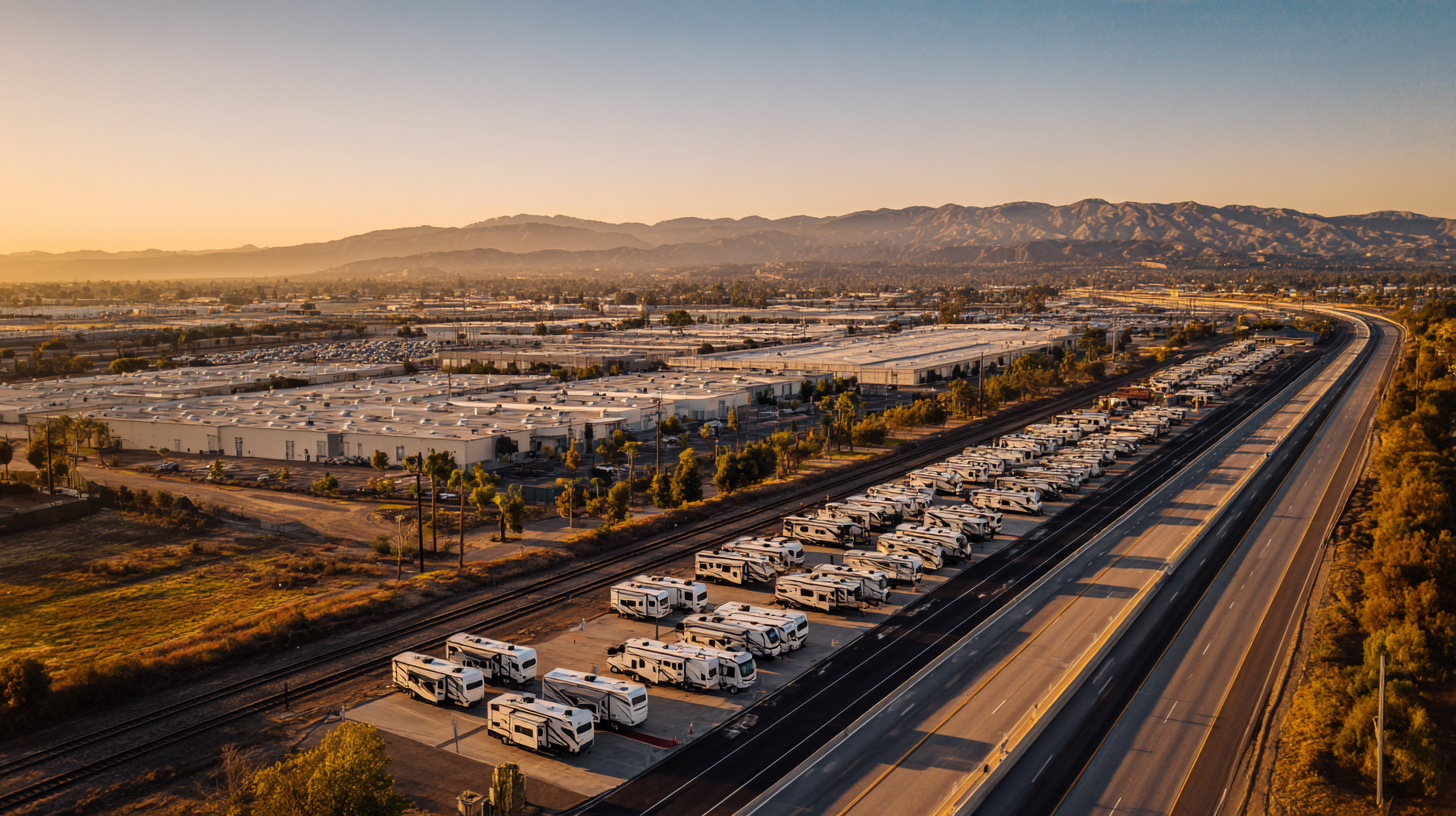
Two RV Industry Giants Are Circling a Merger That Would Redraw the Outdoor Recreation Supply Chain

Two of the most dominant component suppliers in the recreational vehicle and outdoor enthusiast markets may be on the verge of combining. Patrick Industries (NASDAQ: PATK) and LCI Industries (NYSE: LCII) — both headquartered in Elkhart, Indiana — confirmed on April 17 that they are in active discussions regarding a potential merger of equals. Bloomberg first reported the deal would be structured as an all-stock transaction.

The announcement, delivered via separate press releases after Friday’s market close, sent LCI’s trading volume to nearly 3.8 times its 20-day average — a clear signal that the market is treating this as a high-conviction event.

The strategic logic is straightforward. Patrick Industries, founded in 1959, manufactures and distributes component products for the RV, marine, powersports, and housing markets. The company operates more than 190 facilities across a portfolio of over 85 brands and employs more than 10,000 people. LCI Industries, through its Lippert Components subsidiary, is a global leader in engineered components for outdoor recreation and transportation markets, with over 140 manufacturing and distribution facilities across North America, Africa, and Europe.

These are not two fringe players. Together, they supply a substantial portion of the infrastructure that goes into RVs, marine vessels, and powersports units built across North America. A combined entity would carry significant scale advantages — from raw material procurement and logistics to technology investment and aftermarket distribution. As of April 17, Patrick carried a market cap of approximately $3.54 billion and LCI sat at roughly $3 billion. A successful all-stock merger would create an outdoor recreation supply chain player worth approximately $6.5 billion.

The timing is deliberate. The RV industry has been navigating a post-pandemic normalization cycle, with unit shipments softening from their 2021 highs. Consolidation at the supplier tier is a rational response — two companies with overlapping market footprints, shared OEM customers, and comparable operational infrastructure have more to gain together than competing independently. The potential synergies are tangible: combined purchasing power, reduced overhead duplication across facilities, stronger pricing leverage with customers, and a platform large enough to accelerate investment in connected vehicle and smart RV technology.

Historically, LCI has grown through bolt-on acquisitions of product lines and smaller businesses. A merger of equals with Patrick would represent a significant departure from that playbook — a transformational combination rather than incremental expansion. For Patrick, it would provide immediate global distribution reach through Lippert’s international footprint, something the company would otherwise take years to build organically.

There are still material unknowns. No definitive agreement has been signed. Both companies stated they will not comment further until a formal deal is announced or discussions are terminated. Regulatory review of a transaction this size would also be expected, given the combined company’s market share across several RV and marine component categories.

For investors in small and mid-cap industrials, this is a developing story with real consequences for the outdoor recreation supply chain. If Patrick and LCI formalize this combination, it would stand as one of the more significant sector realignments of 2026 — and a signal that the Elkhart manufacturing corridor is entering a new phase of consolidation.

No assurance of a transaction has been given. Watch for an 8-K filing or formal press release for the next material development.

Euroseas (ESEA) – Updating Estimates to Reflect EM KEA Time Charter Extension


Monday, April 20, 2026

Mark Reichman, Managing Director, Equity Research Analyst, Natural Resources, Noble Capital Markets, Inc.

Refer to the full report for the price target, fundamental analysis, and rating.

Time charter contract extension. Euroseas Ltd. executed a time charter contract extension for the EM Kea at a gross daily rate of $30,000 for a minimum period of 36 months to a maximum of 38 months, at the charterer’s option. The EM Kea is a 2007-built 3,100 twenty-foot equivalent unit (TEU) feeder container ship. The new charter will commence on July 14, 2026, in direct continuation of its present charter. The charter underscores the shortage of prompt tonnage, which, along with macroeconomic disruptions and uncertainty caused by the war in the Middle East, continues to sustain the firmness of the containership market.

Higher rate and improved charter coverage. The new time charter is an improvement over the previous contract rate of $19,000 per day and is expected to contribute EBITDA of $22.5 million during the minimum contracted period. The new time charter enhances charter coverage for 2025, 2026, and 2027 to approximately 91%, 76%, and 44%, respectively.


Get the Full Report

Equity Research is available at no cost to Registered users of Channelchek. Not a Member? Click ‘Join’ to join the Channelchek Community. There is no cost to register, and we never collect credit card information.

This Research is provided by Noble Capital Markets, Inc., a FINRA and S.E.C. registered broker-dealer (B/D).

*Analyst certification and important disclosures included in the full report. NOTE: investment decisions should not be based upon the content of this research summary. Proper due diligence is required before making any investment decision. 

Commercial Vehicle Group (CVGI) – Sale/Leaseback; Continuing Positive Class 8 Orders


Wednesday, April 15, 2026

Joe Gomes, CFA, Managing Director, Equity Research Analyst, Generalist , Noble Capital Markets, Inc.

Refer to the full report for the price target, fundamental analysis, and rating.

Sale/Leaseback. Commercial Vehicle Group has completed a sale-leaseback transaction for its manufacturing facility in Vonore, Tennessee, which generated $16 million in proceeds. The Company used the net proceeds from the transaction to prepay a portion of its existing term loan facility, thereby reducing the Company’s leverage profile.

Leverage. At the end of 2025, CVG had net debt of $73.1 million, representing a 4.1x net leverage ratio on 2025 adjusted EBITDA. CVG’s near-term focus remains on cash generation and lowering debt levels. Following this transaction, we believe CVG is even better positioned to drive future growth.


Get the Full Report

Equity Research is available at no cost to Registered users of Channelchek. Not a Member? Click ‘Join’ to join the Channelchek Community. There is no cost to register, and we never collect credit card information.

This Company Sponsored Research is provided by Noble Capital Markets, Inc., a FINRA and S.E.C. registered broker-dealer (B/D).

*Analyst certification and important disclosures included in the full report. NOTE: investment decisions should not be based upon the content of this research summary. Proper due diligence is required before making any investment decision. 

Capital Goods Orders Beat in February, But Middle East Conflict Puts March — and Small-Cap Shippers — on Watch

U.S. business investment showed unexpected resilience in February, but the window may be closing fast.

New orders for core capital goods — the government’s closely watched proxy for business spending — rose 0.6% in February, topping economist forecasts of a 0.4% gain and reversing a revised 0.4% decline in January. Shipments of those same goods climbed 0.9%, adding further evidence that equipment spending was gaining traction heading into the first quarter. The Commerce Department’s Census Bureau released the data Tuesday.

The numbers paint a picture of solid momentum — but one that was captured before the full weight of the U.S.-Israel war with Iran began reshaping the investment landscape. Oil prices have climbed, supply chains are tightening, and businesses that were leaning forward in February are now likely pulling back to reassess.

Orders Show Broad Strength — With One Glaring Exception

February’s gains were driven by solid increases across primary metals, fabricated metal products, and machinery, which jumped 1.5%. Motor vehicles and parts surged 3.1%. The broad picture was encouraging for domestic manufacturers.

The one glaring exception: commercial aircraft. Boeing reported just 21 civilian aircraft orders in February, down sharply from 107 in January — a 28.6% collapse in commercial aircraft orders that dragged overall durable goods orders down 1.4% for the month. Defense aircraft orders also fell 3.8%.

Durable goods as a category declined for the second consecutive month, though stripping out the volatile transportation segment, orders actually rose a healthy 0.8%.

Supply Chains Are Already Feeling the Pressure

Perhaps the most forward-looking signal in Tuesday’s data wasn’t in the orders figures at all — it was in what’s happening to delivery times. An Institute for Supply Management manufacturing survey released last week showed supplier delivery times stretching to a four-year high in March, a direct consequence of the geopolitical disruption rippling through global logistics networks.

That’s a number that matters deeply to companies like EuroDry (NASDAQ: EDRY) and Euroseas (NASDAQ: ESEA), both dry bulk operators that move iron ore, coal, grains, and other bulk commodities across ocean routes. Longer delivery windows mean more time at sea per cargo cycle, which can translate to tighter effective vessel supply and, in some market conditions, upward pressure on charter rates. EuroDry posted a strong Q4 2025 earnings beat in February and has expanded its forward charter book heading into 2026 — but the Iran conflict introduces a new variable around route disruption and fuel costs that management will need to navigate carefully.

For FreightCar America (NASDAQ: RAIL), the February machinery and motor vehicle data is directionally constructive. The company entered 2026 projecting growth, backed by a strong backlog and expanding margins. But if industrial order momentum stalls in March and April as businesses hit pause on capex decisions — as many economists now expect — railcar demand tied to manufacturing output could soften in the back half of the year.

The AI Wildcard

One consistent bright spot cutting through the uncertainty: artificial intelligence. Data center construction and the infrastructure buildout supporting AI workloads continue to drive demand for raw materials, electricity, and the bulk commodities that companies like EuroDry and Euroseas specialize in moving. That structural tailwind isn’t going away regardless of where energy prices settle.

February’s capital goods data was a genuine beat. The question now is whether it’s the last clean read for a while — or a foundation that holds even as the macro backdrop gets more complicated.

Commercial Vehicle Group (CVGI) – A CFO Transition


Thursday, April 02, 2026

Joe Gomes, CFA, Managing Director, Equity Research Analyst, Generalist , Noble Capital Markets, Inc.

Refer to the full report for the price target, fundamental analysis, and rating.

A Transition. Last night, Commercial Vehicle Group announced that Andy Cheung, Chief Financial Officer, will be resigning from his position effective April 15, 2026, to accept a position as Chief Financial Officer of a mid-cap publicly traded company. Angie O’Leary, currently Corporate Controller and Chief Accounting Officer, has been promoted to Interim Chief Financial Officer and will continue to serve as the Corporate Controller and Chief Accounting Officer. At this time, CVG does not intend to initiate a search process to identify a permanent CFO replacement.

Ms. O’Leary. Ms. O’Leary has served as the Company’s Senior Vice President, Corporate Controller, and Chief Accounting Officer since December 2020. Prior to joining the Company, Ms. O’Leary held several leadership roles at Vertiv Holdings Co. from May 2017 to December 2020, including Interim Corporate Controller. Earlier in her career, Ms. O’Leary held several roles at Deloitte & Touche LLP, beginning in January 2004, culminating in the role of Senior Manager – Audit, from August 2010 to May 2017.


Get the Full Report

Equity Research is available at no cost to Registered users of Channelchek. Not a Member? Click ‘Join’ to join the Channelchek Community. There is no cost to register, and we never collect credit card information.

This Company Sponsored Research is provided by Noble Capital Markets, Inc., a FINRA and S.E.C. registered broker-dealer (B/D).

*Analyst certification and important disclosures included in the full report. NOTE: investment decisions should not be based upon the content of this research summary. Proper due diligence is required before making any investment decision. 

The Pharma Tariff Playbook: How Drug Companies Can Navigate the Administration’s Latest Pricing Push

The Trump administration is preparing to impose tariffs of up to 100% on branded pharmaceutical drugs — but the details buried beneath that headline number tell a more nuanced story, one that comes with multiple off-ramps for companies willing to engage. According to a draft document obtained by CNBC, the proposal is not final, and the framework is structured less as a blanket penalty and more as a tiered system designed to reward companies that move quickly and strategically.

Understanding the structure matters more than reacting to the headline.

How the Framework Actually Works

Under the draft proposal, patented medications and their active pharmaceutical ingredients would face a 100% tariff — but that rate applies specifically to companies that have neither struck deals with the administration nor committed to onshoring US manufacturing. Companies that are actively moving production to the United States would face a significantly lower 20% rate, with a four-year runway before that escalates. Companies that have already executed pricing deals with the Department of Health and Human Services — or are currently in active negotiations — are exempt from additional tariffs entirely. Generic drugs face zero new tariffs under the proposal. Separate negotiated rates also exist for the EU, Japan, South Korea, Switzerland, and the UK through bilateral arrangements.

The architecture of this plan is deliberate. The 100% figure is the ceiling for the least cooperative scenario, not the baseline.

The Early Movers Are Already Protected

Since November, more than a dozen major drugmakers — including Eli Lilly, Pfizer, and Novo Nordisk — have signed agreements with the Trump administration under the “most favored nation” pricing policy, which ties US drug prices to lower international rates. Those deals came with a three-year tariff exemption, meaning the companies that read the room early are sitting out this round entirely. Lilly in particular has had an extraordinarily active week — closing a $6.3 billion acquisition of Centessa Pharmaceuticals and receiving FDA approval for its oral GLP-1 drug Foundayo — operating from a position of policy stability that its peers without deals don’t currently enjoy.

The Roadmap for Smaller Companies

For small and microcap biopharma companies, the key takeaway is that the exemption pathways are real and accessible. The administration has structured this to incentivize negotiation, not to punish innovation. Companies currently in active HHS discussions face no additional tariffs — which means initiating that conversation sooner rather than later is the most direct hedge available.

The generic drug exemption also provides meaningful relief for a significant portion of the smaller specialty pharma universe. And for companies earlier in their development cycle — clinical-stage biotechs without commercial products yet — the immediate operational impact is limited while the policy landscape continues to develop.

The onshoring incentive embedded in the framework also opens a longer-term strategic conversation. Federal policy is clearly moving toward rewarding domestic manufacturing investment, and companies that begin building that into their operational planning now will be better positioned competitively as the rules solidify.

The Bigger Picture

This proposal is part of a broader administration push to restructure how drugs are priced and where they are made in the United States. The direction of travel is clear even if the final details are not. For biopharma companies of every size, the companies that treat this as a strategic planning exercise rather than a political headline will be the ones best positioned when the policy finalizes.

The playbook exists. The question is who runs it first.

Release – Seanergy Maritime Announces Availability of its 2025 Annual Report on Form 20-F

The current image has no alternative text. The file name is: logo-scaled.png

Research News and Market Data on SHIP

April 01, 2026 09:15 ET  | Source: Seanergy Maritime Holdings Corp.

GLYFADA, Greece, April 01, 2026 (GLOBE NEWSWIRE) — Seanergy Maritime Holdings Corp. (the “Company” or “Seanergy”) (NASDAQ: SHIP) announced today that its Annual Report on Form 20-F for the fiscal year ended December 31, 2025 (the “Annual Report”) has been filed with U.S. Securities and Exchange Commission. The Annual Report may also be accessed through Seanergy’s website, www.seanergymaritime.com, at the “Investor Relations” section under “Financial Reports”.

About Seanergy Maritime Holdings Corp.

Seanergy Maritime Holdings Corp. is a prominent pure-play Capesize ship-owner publicly listed in the U.S. Seanergy provides marine dry bulk transportation services through a modern fleet of Capesize vessels. The Company owns or finance leases 20 vessels (2 Newcastlemax and 18 Capesize) with an average age of approximately 14.7 years and an aggregate cargo carrying capacity of approximately 3,633,861 dwt. Upon completion of the sales of the M/Vs Squireship, Dukeship, and the delivery of the newbuilding vessels, the Company is expected to own or finance lease 23 vessels (3 Newcastlemax and 20 Capesize), with an aggregate cargo carrying capacity of approximately 4,218,890 dwt.

The Company is incorporated in the Republic of the Marshall Islands and has executive offices in Glyfada, Greece. The Company’s common shares trade on the Nasdaq Capital Market under the symbol “SHIP”.

Please visit our company website at: www.seanergymaritime.com.

Forward-Looking Statements

This press release contains forward-looking statements (as defined in Section 27A of the Securities Act of 1933, as amended, and Section 21E of the Securities Exchange Act of 1934, as amended) concerning future events, including with respect to declaration of dividends, market trends and shareholder returns. Words such as “may”, “should”, “expects”, “intends”, “plans”, “believes”, “anticipates”, “hopes”, “estimates” and variations of such words and similar expressions are intended to identify forward-looking statements. These statements involve known and unknown risks and are based upon a number of assumptions and estimates, which are inherently subject to significant uncertainties and contingencies, many of which are beyond the control of the Company. Actual results differ materially from those expressed or implied by such forward-looking statements. Factors that could cause actual results to differ materially include, but are not limited to, the Company’s operating or financial results; the Company’s liquidity, including its ability to service its indebtedness; competitive factors in the market in which the Company operates; shipping industry trends, including charter rates, vessel values and factors affecting vessel supply and demand; future, pending or recent acquisitions and dispositions, business strategy, impacts of litigation, areas of possible expansion or contraction, and expected capital spending or operating expenses; risks associated with operations outside the United States; risks arising from trade disputes between the U.S. and China, including the re-imposition of reciprocal port fees; broader market impacts arising from trade disputes or war (or threatened war) or international hostilities, such as between the U.S. and Venezuela, Israel and Hamas or Iran, China and Taiwan and Russia and Ukraine; risks associated with the length and severity of pandemics; and other factors listed from time to time in the Company’s filings with the SEC, including its most recent annual report on Form 20-F. The Company’s filings can be obtained free of charge on the SEC’s website at www.sec.gov. Except to the extent required by law, the Company expressly disclaims any obligations or undertaking to release publicly any updates or revisions to any forward-looking statements contained herein to reflect any change in the Company’s expectations with respect thereto or any change in events, conditions or circumstances on which any statement is based.

For further information please contact:

Seanergy Investor Relations
Tel: +30 213 0181 522
E-mail: [email protected]

Capital Link, Inc.
Paul Lampoutis
230 Park Avenue Suite 1540
New York, NY 10169
Tel: (212) 661-7566
E-mail: [email protected]
FreightCar America (RAIL) – Updating Estimates; Rating Remains an Outperform


Monday, March 30, 2026

Mark Reichman, Managing Director, Equity Research Analyst, Natural Resources, Noble Capital Markets, Inc.

Hans Baldau, Associate Analyst, Noble Capital Markets, Inc.

Refer to the full report for the price target, fundamental analysis, and rating.

Updating estimates. We revised our FY 2026 estimates to reflect lower margins in the first and second quarters. While our full year revenue, EBITDA, and EPS estimates are unchanged, the quarterly allocations have shifted. We forecast first quarter revenue, EBITDA, and EPS of $86.0 million, $7.0 million, and $0.04, respectively, compared to our prior estimates of $89.0 million, $8.8 million, and $0.08. We have assumed growing Aftermarket segment revenue throughout the year. Our FY 2026 revenue, EBITDA, and EPS estimates remain $525.0 million, $44.5 million, and $0.54, respectively. 

Lowering 1H’ 2026 expectations. We think the first quarter of 2026 will reflect the fewest deliveries during the year, along with a less favorable product mix. Accordingly, we expect 2026 deliveries, revenue, and earnings to be weighted toward the second half of the year, supported by higher volumes, an improved product mix, and increased contributions from new builds and retrofit programs.


Get the Full Report

Equity Research is available at no cost to Registered users of Channelchek. Not a Member? Click ‘Join’ to join the Channelchek Community. There is no cost to register, and we never collect credit card information.

This Company Sponsored Research is provided by Noble Capital Markets, Inc., a FINRA and S.E.C. registered broker-dealer (B/D).

*Analyst certification and important disclosures included in the full report. NOTE: investment decisions should not be based upon the content of this research summary. Proper due diligence is required before making any investment decision. 

Sky Harbour Group (SKYH) – Delivery Pipeline Supports Revenue Growth Outlook


Friday, March 20, 2026

Patrick McCann, CFA, Research Analyst, Noble Capital Markets, Inc.

Michael Kupinski, Director of Research, Equity Research Analyst, Digital, Media & Technology , Noble Capital Markets, Inc.

Refer to the full report for the price target, fundamental analysis, and rating.

Q4 results. Sky Harbour reported Q4 revenue of $8.1 million and an adj. EBITDA loss of $1.0 million compared with our estimates of $8.6 million and a loss of $0.4 million, respectively. Notably, the company reached an adj. EBITDA breakeven on a run-rate exiting December.

Leasing trends. Management highlighted lease-up progress at Phoenix, Dallas, and Denver, with the former two ahead of expectations and Denver improving after a slower start. The company also emphasized growing use of pre-leasing, targeting roughly 50% of a campus leased by opening.


Get the Full Report

Equity Research is available at no cost to Registered users of Channelchek. Not a Member? Click ‘Join’ to join the Channelchek Community. There is no cost to register, and we never collect credit card information.

This Company Sponsored Research is provided by Noble Capital Markets, Inc., a FINRA and S.E.C. registered broker-dealer (B/D).

*Analyst certification and important disclosures included in the full report. NOTE: investment decisions should not be based upon the content of this research summary. Proper due diligence is required before making any investment decision. 

Euroseas (ESEA) – Diversification into Specialized High-Reefer Containerships


Friday, March 20, 2026

Mark Reichman, Managing Director, Equity Research Analyst, Natural Resources, Noble Capital Markets, Inc.

Hans Baldau, Associate Analyst, Noble Capital Markets, Inc.

Refer to the full report for the price target, fundamental analysis, and rating.

Two newbuilds. Euroseas announced contracts for the construction of two 2,800 TEU high-reefer containership newbuilds, with deliveries expected sequentially in the second and third quarters of 2028. The total acquisition price for each of the two newbuild vessels is $46.35 million, with financing expected to include a combination of debt and equity.

Strategic expansion. The vessels will be built to EEDI Phase 3 and IMO NOx Tier III standards and will be equipped with more than 1,000 reefer plugs, optimizing them for high-reefer-density trades. This enhances Euroseas’ exposure to growing refrigerated cargo demand. Importantly, the agreement includes options for up to four additional vessels of similar design, with either reefer or conventional configurations. In our view, this aligns with the company’s strategy of modernizing and diversifying its fleet, lowering the average age, and improving environmental efficiency.


Get the Full Report

Equity Research is available at no cost to Registered users of Channelchek. Not a Member? Click ‘Join’ to join the Channelchek Community. There is no cost to register, and we never collect credit card information.

This Research is provided by Noble Capital Markets, Inc., a FINRA and S.E.C. registered broker-dealer (B/D).

*Analyst certification and important disclosures included in the full report. NOTE: investment decisions should not be based upon the content of this research summary. Proper due diligence is required before making any investment decision. 

Allegiant and Sun Country Clear a Major Merger Hurdle

Allegiant Travel Company (NASDAQ: ALGT) and Sun Country Airlines (NASDAQ: SNCY) cleared a critical regulatory hurdle this morning, announcing the early termination of the Hart-Scott-Rodino antitrust waiting period — meaning the U.S. Department of Justice has signed off on Allegiant’s proposed acquisition of Sun Country without objection. The milestone moves one of the more strategically compelling small-cap airline consolidations in years meaningfully closer to the finish line.

The deal, originally announced in January 2026, is structured as a $1.5 billion cash-and-stock transaction that offered Sun Country shareholders a premium of nearly 20% over the stock’s last close before the announcement. With DOJ clearance now secured, the primary remaining conditions are approval from the U.S. Department of Transportation and a shareholder vote from both companies. Closing is targeted for the second or third quarter of 2026.

Both carriers occupy a niche that the major airlines have largely ignored — leisure travelers flying from small and mid-sized cities to vacation destinations. Allegiant, based in Las Vegas, has built its entire model around non-stop routes linking secondary markets to resort towns. Sun Country, operating out of Minneapolis, runs a hybrid model combining scheduled passenger service, charter operations, and an Amazon cargo business that generated record full-year revenue of $1.13 billion in 2025 — its fifth consecutive profitable year.

Together, the combined carrier would serve roughly 22 million annual customers, operate across nearly 175 cities, and cover more than 650 routes with a fleet of 195 aircraft. Neither airline competes heavily for the same routes, which likely explains why the DOJ review resolved quickly and without required divestitures — a favorable signal for deal certainty.

At the time of the deal announcement, Allegiant carried a market cap of approximately $1.37 billion and Sun Country traded below $700 million — both firmly in small-cap territory. This transaction is a reminder that some of the most structurally sound consolidation plays in the market are happening below the radar of mainstream financial media, which remains fixated on mega-cap M&A.

The leisure travel segment has proven more resilient than traditional scheduled carriers across multiple economic cycles. Consumers continue to prioritize experiences and affordable vacation travel, and both Allegiant and Sun Country have built disciplined, asset-light models well-suited to capitalize on that demand. Sun Country’s diversified revenue streams — cargo, charter, and scheduled service — add a layer of earnings stability to the combined entity that pure-play passenger carriers often lack.

The DOT’s interim exemption approval is the next significant milestone, followed by formal shareholder votes at both companies. Neither hurdle is considered unusually high risk at this stage, and most observers expect the transaction to close on schedule. Allegiant has flagged the combination as accretive to earnings power and expects meaningful cost synergies from consolidating operations, maintenance programs, and corporate overhead.

For small-cap investors tracking consolidation trends in the airline sector, the Allegiant-Sun Country merger is a case study in how smaller carriers are quietly reshaping the competitive landscape — one nonstop leisure route at a time.

Seanergy Maritime (SHIP) – Fleet Expansion Continues; Squireship Sale


Friday, March 13, 2026

Seanergy Maritime Holdings Corp. is a prominent pure-play Capesize shipping company listed in the U.S. capital markets. Seanergy provides marine dry bulk transportation services through a modern fleet of Capesize vessels. The Company’s operating fleet consists of 18 vessels (1 Newcastlemax and 17 Capesize) with an average age of approximately 13.4 years and an aggregate cargo carrying capacity of approximately 3,236,212 dwt. Upon completion of the delivery of the previously announced Capesize vessel acquisition, the Company’s operating fleet will consist of 19 vessels (1 Newcastlemax and 18 Capesize) with an aggregate cargo carrying capacity of approximately 3,417,608 dwt. The Company is incorporated in the Marshall Islands and has executive offices in Glyfada, Greece. The Company’s common shares trade on the Nasdaq Capital Market under the symbol “SHIP”.

Mark Reichman, Managing Director, Equity Research Analyst, Natural Resources, Noble Capital Markets, Inc.

Hans Baldau, Associate Analyst, Noble Capital Markets, Inc.

Refer to the full report for the price target, fundamental analysis, and rating.

Newbuild program expands to five vessels. Seanergy announced the acquisition of two Japanese newbuild scrubber-fitted 181,500 dwt Capesize vessels, expanding the total newbuild program to five vessels, including four Capesize vessels and one Newcastlemax, with a combined contract value of approximately $384 million. The first Japanese vessel is a direct purchase with delivery expected between Q2 and Q3 2027, while the second is structured as a 10-year bareboat-in contract with a Q1 2029 delivery and a purchase option beginning at year five. The combined cost of both Japanese vessels is approximately $158 million.

Sale of M/V Squireship. Seanergyagreed to sell the 2010-built, 170,018 dwt M/V Squireship  to a related party for $29.5 million with delivery expected between late April and early June 2026. The transaction is expected to generate net proceeds of approximately $13.5 million after debt repayment and produce an accounting gain of roughly $4 million. The sale is consistent with management’s capital recycling strategy, monetizing an older vessel at an attractive valuation while funding the newbuilding program and reducing average fleet age.


Get the Full Report

Equity Research is available at no cost to Registered users of Channelchek. Not a Member? Click ‘Join’ to join the Channelchek Community. There is no cost to register, and we never collect credit card information.

This Company Sponsored Research is provided by Noble Capital Markets, Inc., a FINRA and S.E.C. registered broker-dealer (B/D).

*Analyst certification and important disclosures included in the full report. NOTE: investment decisions should not be based upon the content of this research summary. Proper due diligence is required before making any investment decision. 

Release – Seanergy Maritime Announces the Acquisition of Two Japanese Capesize Newbuildings and Sale of Older Vessel; Provides Corporate Updates

Research News and Market Data on SHIP

Expansion of Newbuilding Program to Five Capesize and Newcastlemax Vessels Further Advances Fleet Renewal Strategy

March 12, 2026 08:45 ET  | Source: Seanergy Maritime Holdings Corp.


Share

GLYFADA, Greece, March 12, 2026 (GLOBE NEWSWIRE) — Seanergy Maritime Holdings Corp. (the “Company” or “Seanergy”) (NASDAQ: SHIP) announced today that it has agreed to acquire two scrubber-fitted 181,500 dwt Capesize vessels to be constructed at a first-class shipyard in Japan and has entered into an agreement for the sale of the 2010-built M/V Squireship.

The transactions expand the Company’s newbuilding program to five vessels (four Capesizes and one Newcastlemax) totaling approximately $384.0 million and underscore its disciplined fleet renewal strategy, which focuses on reallocating capital from older vessels into modern, fuel-efficient tonnage with attractive delivery positions.

Acquisition of Two Japanese Newbuilding Capesizes

The Company entered into an agreement with an unaffiliated third party in Japan for the acquisition of a 181,500 dwt scrubber fitted Capesize newbuilding vessel with prompt delivery, constructed at a first-class Japanese Shipyard. The delivery is expected between the second and the third quarter of 2027.

In addition, the Company has entered into a 10-year bareboat-in contract for a second 181,500 dwt scrubber fitted Capesize dry bulk vessel to be constructed by the same first-class Japanese shipyard with delivery expected in the first quarter of 2029. Seanergy has the option to acquire the vessel starting at the end of year five until the end of the charter period.

The combined acquisition cost of the above vessels is estimated at approximately $158 million, assuming the exercise of the option to acquire the second vessel at the end of the 10-year period and excluding interest payments under the bareboat scheme.

The Company believes that securing a prompt 2027 delivery position from a top-tier Japanese yard represents a highly attractive strategic opportunity, given the limited availability of near-term construction slots and the strong expected demand for modern Capesize tonnage over the near and medium-term. In addition, the structure associated with the second Japanese Capesize vessel, provides Seanergy with advantageous fleet renewal optionality while maintaining capital flexibility.

Sale of M/V Squireship

Seanergy has agreed to sell the M/V Squireship, a 2010-built Capesize vessel constructed in South Korea with a cargo capacity of 170,018 dwt, to United Maritime Corporation, a related party, for a purchase price of $29.5 million, with delivery expected between end April to beginning of June 2026.

The transaction is expected to generate net cash proceeds of approximately $13.5 million after repayment of the associated debt, supporting the Company’s ongoing newbuilding program, while reducing Seanergy’s average fleet age. The vessel sale is expected to result in an accounting profit of around $4 million, which will be recorded in Seanergy’s second quarter financial results.

The transaction allows the Company to monetize the Squireship at an attractive market valuation. Following delivery, Seanergy will continue to provide technical and commercial management services to the vessel, facilitating the continuation of the vessel’s existing commercial employment.

Stamatis Tsantanis, the Company’s Chairman & Chief Executive Officer, stated:

“These transactions represent another step in the disciplined renewal of our fleet. By monetizing an older vessel at an attractive valuation and reinvesting in high-quality Japanese newbuildings with favorable delivery positions, we continue to enhance the long-term earnings capacity and efficiency of our fleet.

“Including our newbuilding orders in China, we expect to take delivery of five high-quality vessels with a total contract value of approximately $384 million, including three deliveries in mid-2027, one in mid-2028 and one in early-2029. We believe vessels delivering between 2027 and 2029 will be well positioned to benefit from strong Capesize fundamentals, an aging fleet and constrained vessel supply.

“Our strategy remains clear: reallocate capital from older assets into modern Capesize tonnage, maintain balance sheet discipline, and position the Company to capture long-term market upside. At the same time, we remain firmly committed to our capital return policy and expect to continue delivering meaningful returns to our shareholders.”

Commercial Performance Update

Further to the Company’s previous commercial updates provided in the FY 2025 Earnings Release, Seanergy has secured fixed rates for approximately 45% of its available operating days for the period Q2–Q4 2026, at an average gross daily rate of $29,300. These fixtures enhance forward earnings visibility while preserving meaningful exposure to market upside.

Sphinx – Economou Litigation Update

The Supreme Court of the Republic of the Marshall Islands affirmed the dismissal of the lawsuit brought by Sphinx Investment Corp., an affiliate of George Economou, upholding the prior decision of the High Court of the Republic of the Marshall Islands. The ruling brings this matter to a final resolution.

About Seanergy Maritime Holdings Corp.

Seanergy Maritime Holdings Corp. is a prominent pure-play Capesize ship-owner publicly listed in the U.S. Seanergy provides marine dry bulk transportation services through a modern fleet of Capesize vessels. The Company owns or finance leases 20 vessels (2 Newcastlemax and 18 Capesize) with an average age of approximately 14.7 years and an aggregate cargo carrying capacity of approximately 3,633,861 dwt. Following the sale of the M/V Squireship and the delivery of the newbuilding vessels, the Company will own or finance lease 24 vessels (3 Newcastlemax and 21 Capesize), with an aggregate cargo carrying capacity of approximately 4,400,343 dwt.

The Company is incorporated in the Republic of the Marshall Islands and has executive offices in Glyfada, Greece. The Company’s common shares trade on the Nasdaq Capital Market under the symbol “SHIP”. Please visit our company website at: www.seanergymaritime.com.

Forward-Looking Statements

This press release contains forward-looking statements (as defined in Section 27A of the Securities Act of 1933, as amended, and Section 21E of the Securities Exchange Act of 1934, as amended) concerning future events, including with respect to declaration of dividends, market trends and shareholder returns. Words such as “may”, “should”, “expects”, “intends”, “plans”, “believes”, “anticipates”, “hopes”, “estimates” and variations of such words and similar expressions are intended to identify forward-looking statements. These statements involve known and unknown risks and are based upon a number of assumptions and estimates, which are inherently subject to significant uncertainties and contingencies, many of which are beyond the control of the Company. Actual results differ materially from those expressed or implied by such forward-looking statements. Factors that could cause actual results to differ materially include, but are not limited to, the Company’s operating or financial results; the Company’s liquidity, including its ability to service its indebtedness; competitive factors in the market in which the Company operates; shipping industry trends, including charter rates, vessel values and factors affecting vessel supply and demand; future, pending or recent acquisitions and dispositions, business strategy, impacts of litigation, areas of possible expansion or contraction, and expected capital spending or operating expenses; risks associated with operations outside the United States; risks arising from trade disputes between the U.S. and China, including the re-imposition of reciprocal port fees; broader market impacts arising from trade disputes or war (or threatened war) or international hostilities, such as between the U.S. and Venezuela, Israel and Hamas or Iran, China and Taiwan and Russia and Ukraine; risks associated with the length and severity of pandemics; and other factors listed from time to time in the Company’s filings with the SEC, including its most recent annual report on Form 20-F. The Company’s filings can be obtained free of charge on the SEC’s website at www.sec.gov. Except to the extent required by law, the Company expressly disclaims any obligations or undertaking to release publicly any updates or revisions to any forward-looking statements contained herein to reflect any change in the Company’s expectations with respect thereto or any change in events, conditions or circumstances on which any statement is based.

For further information please contact:

Seanergy Investor Relations
Tel: +30 213 0181 522
E-mail: [email protected]
Capital Link, Inc.
Paul Lampoutis
230 Park Avenue Suite 1536
New York, NY 10169
Tel: (212) 661-7566
E-mail: [email protected]