Offsetting portfolio capital gains by taking losses is permitted by the IRS. Within the tax guidelines, this generally occurs during the last month of the year as individuals and financial advisors strive to minimize money owed to the IRS. The stocks sold, naturally, are underperformers. This activity has a tendency to set the stage for a late December rally or a January rebound. This is especially true of the sectors or asset classes that were most sold. This is because portfolio managers often wish to keep a similar allocation, which translates to them then waiting 30 days or more before buying something that may be viewed as substantially similar.
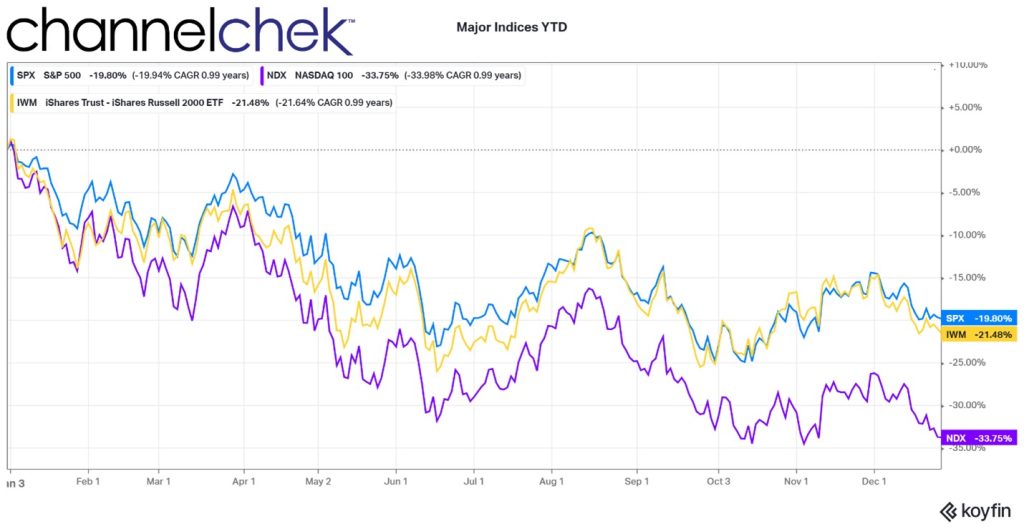
With the major indexes like the S&P 500, Nasdaq 100, and Small Cap S&P 600 all down double digits this year, there are stocks that are doing far worse than index averages – just as there are stocks doing far better. Of course, if you own an ETF, you have to treat it like it is one stock and cannot offset a good underlying individual company sold with an underperforming company. In this way, holders of individual company shares can benefit more because they will have more options. And may even find it easier to qualify for the additional $3,000 tax benefit the IRS allows.
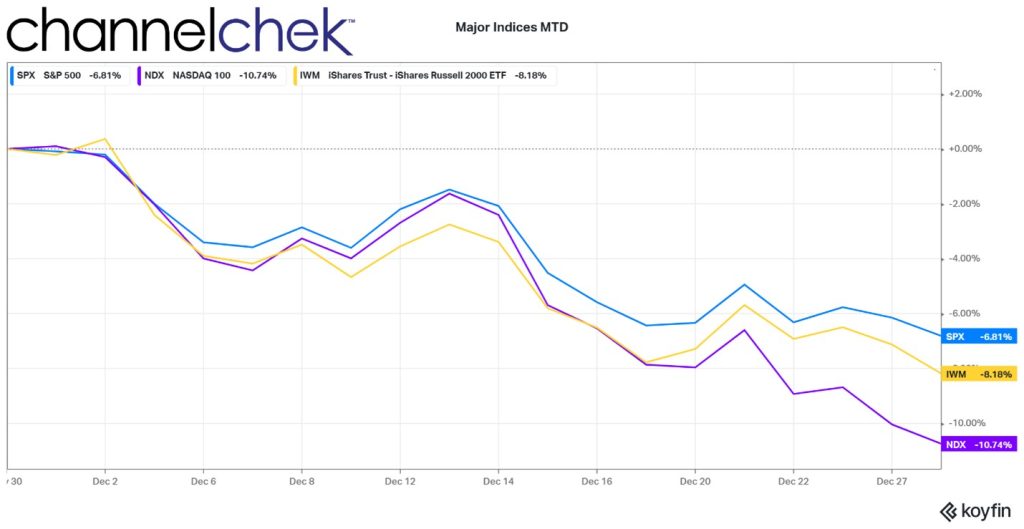
What happens after the 30-day period? Some investors try to get in, or back in, early with the notion that the most beaten-down stocks from 30 days earlier, could quickly bounce back hard for a time. This would all begin to occur following what could be perceived as the tax loss selling dip, (aged 30 days). The so-called Santa Rally is somewhat attributed to this, but that rally has not occurred during December 2022. The chart above shows a very weak December. So the buying may be postponed until early next year.
Without substantial buying this December, the first month or two of 2023 may bring buying as investors replace holdings for allocation purposes, plus any additional purchases used to bring the beaten-down sectors’ portfolio weightings up to whatever fits the investors’ strategy.
DoubleLine founder Jeffrey Gundlach told CNBC on Wednesday that risk assets will likely rally in January once retail investors finish tax-loss selling. Strategists at Evercore wrote on Nov. 30 that they were “buyers of stocks whose 2022 tax loss selling pressure will soon abate.”
Take Away
The main drivers of market moves next year are likely economic concerns such as inflation, recession, and monetary policy. But the potential for the most beaten down sectors this year, those that underperformed in December, may represent opportunity. The opportunity may not be long-lived, but for those involved in the markets, it is worth understanding why it may be occurring.
As the Bear Market Melts Down, Where Will the Grass Be Greenest?
Bear Markets and snowmen have one thing in common; they don’t last forever.
The entry point into an investment can have a huge impact on performance. Exits tend to be more critical when the stock has shown that it is not performing as planned. While this kind of exit may result in a loss, it allows the investor to preserve capital, liquid assets they can deploy if another good entry presents itself. The major stock market indices for 2022 are down 20% and more. Has this sell-off provided for performance-producing entry points in some stocks? Let’s look where we are as the countdown to 2023 has already begun.
About this Bear Market
Bear markets end – they always have. Pinpointing an exact bottom is not possible, so trying to be the first in for that great entry point may include a few false starts and some unhoped-for exits. The current slide in the stock market started around January 1, 2022. This was because some doubted whether inflation was transient at the time; by March, most understood the Fed was concerned that price increases were pervasive.
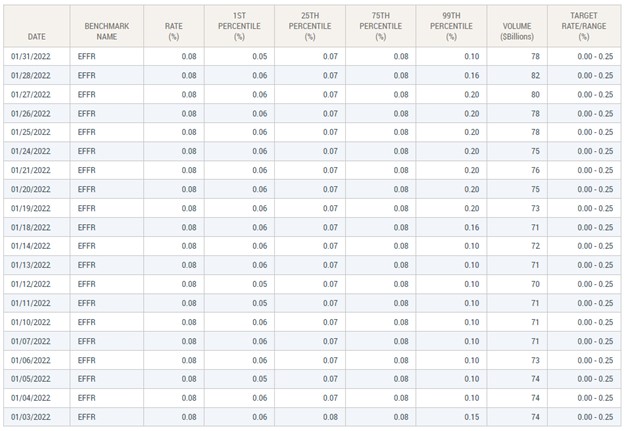
Fed Chair Powell, along with many Fed Presidents, began speaking hawkishly to not unduly surprise and unsettle markets as the central bank unwound the liquidity used in response to the novel coronavirus. What followed was unprecedented. Overnight lending rates went from an effective 0.08% to an effective 4.33% during the course of the year. This is more than 52 times the base lending rate at the start of the year. With these increases, no wonder the bear market continued.
Where Are We Now?
Expectations of overnight rate hikes in 2023 are for another 0.50%-0.75% increase leaving the target at, or just north of, 5%. This increase in the cost of money is small (.17 times) compared to the massive (52 times) rocking the markets in 2022.
So rate hikes are expected to be much lower as a percentage of current rates next year. And after the last FOMC meeting, markets have seemingly repriced lower with this expectation. If all goes as it is thought it will, the market is already priced for the worst. This is a bullish sign.
Put another way; most believe that with Fed funds beginning 2022 around zero, we’re likely much closer to the end of the Fed Funds tightening than to the beginning.
Inflation (CPI) for December won’t be reported until January 12, 2023. The latest CPI numbers show YoY up 7.1% in November, a slowing from 7.7% in October, which tapered from 8.2% the month before. The November reading of 7.1% taken by itself is a long way away from the Fed’s 2% target. But the trend in the CPI and PCE deflator also suggest the Fed is likely to monitor previous hikes to see if they will have the desired impact.
The Fed Has Been Transparent
The Fed lowered rates in line with what they promised during the pandemic. Then after some transient talk, they raised rates as they expressed they would in 2022. Following the December FOMC meeting, they suggested they were not at the end, but the voting members’ expectations for where they will settle is an average of 5.40%. The forward-looking stock market, if they believe the Fed will again do as promised, should recognize this is a much lower increase. It is perhaps near the time to begin to build on positions. This could be the entry point many investors have been waiting for.
Small Cap Phenomenon
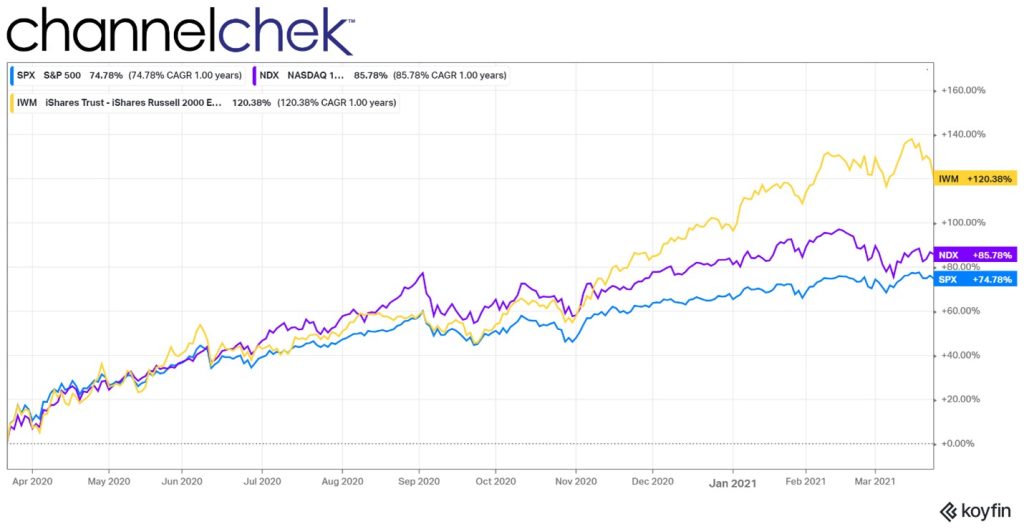
The chart below shows how much small cap stocks outperformed during the 12- months following the pandemic plunge. While small cap outperformance has been experienced during the past century of stocks’ post-sell-off periods, one only has to look back to the pandemic plunge to remember that it was small-caps (depicted below as IWM) that had been beaten down the most and by far outran the other major indices for the next year from the low of 2021.
Could this small cap phenomenon occur again after markets reach the bottom? Data demonstrates that small cap stocks tend to lead following a period of economic dislocation. One reason is US small caps have more of their business within the states and as a bonus, do well with a rising dollar. Current conditions suggest exploring smaller stocks. They have outperformed large caps following nearly every bear market of the last century. And today, the dollar has risen above its six-month high and is trending higher. While past movement comparisons don’t always include all the crosscurrents of the future, a strong argument could be made that a turnaround is near and small caps may again be the leaders by a wide margin.
Some Disclosure
Channelchek, the investment information platform you’re now reding has small cap stocks as its primary focus. The deep platform provides data on over 6000 stocks, with quality research updated regularly on many of them. Channelchek also provides videos and articles that may inspire informed stock selection. Stock selection, rather than just plowing investment dollars into an indexed ETF, may be preferable as indexed ETFs include sectors and stocks that may not be worthy of your portfolio.
Diversification across asset classes, sectors, and market capitalizations is considered prudent for long-term portfolios; individual allocations can be built on depending on where we are in the business and interest rate cycle. This includes an allocation to small cap equities, which perhaps should be expanded if the Fed is near the end of its tightening cycle. It could always be reduced later if the economy is deep into a growth cycle.
Take Away
Although we do not have a crystal ball to know exactly when the best entry point in any company stock is, if a century’s worth of data is any guide, the period following the end of a market downturn has been a good time to increase exposure to the small cap sector.
Register here for daily emails of research and ideas from Channelchek.
Investors Watching for a “Santa Rally” the Last Trading Week of 2022
Stocks in the US closed higher Friday after consumer inflation continued to ease modestly, and consumer expectations are for the trend to continue. This could set the stage for the week ahead as some expect the probability of a “Santa rally” as investors may begin using their dry powder to wave in some stocks that have gone down with the crowd but are historically cheap and showing value.
Stock markets in London, Toronto, Sydney, Hong Kong, and Johannesburg are closed. on Tuesday, December 27, since Boxing Day was already a holiday since Christmas fell on a Sunday.
The four-day trading week ahead includes the latest data on home prices with the S&P CoreLogic Case-Shiller National Home Price Index and Freddie Mac’s House Price Index (October). On Wednesday, the National Association of Realtors (NAR) will issue pending home sales figures (November). The strength of the manufacturing sector on Friday, with the Chicago Purchasing Managers’ Index (PMI) for December, has market-moving potential on the last trading day of the year.
Monday 12/26
Markets and Government Offices closed.
Tuesday 12/27
Stock markets in London, Toronto, Sydney, Hong Kong, and Johannesburg are closed.
8:30 AM ET, The US Goods Deficit (Census basis) is expected to narrow to $97.0 billion in November after deepening by more than $6 billion in October to $98.8 billion.
8:30 AM ET, Wholesale Inventories, where buildups have been lessening, are expected to rise 0.4 percent in the advance report for November.
9:00 AM ET, Case-Shiller Home Price Index, forecasters see the adjusted 20-city monthly rate falling 1.2 percent again in October after a decline of 1.2 percent in September for an unadjusted annual rate of 8.1 percent versus September’s 10.4 percent.
Wednesday 12/28
10:AM ET, Richmond Fed Manufacturing Index, the manufacturing composite is expected at minus 6, in December vs. minus 9 in November and minus 10 in October.
Thursday 12/29
8:30 AM ET, Jobless Claims for the December 29 week are expected to come in at 222,000 versus 216,000 in the prior week.
Friday 12/30
• 9:45 AM ET, The Chicago PMI is expected to bounce back in December to 41.0 versus November’s much weaker-than-expected 37.2.
The Bond markets are scheduled to close at 2 PM. Stocks have the benefit of a full trading day to close out 2022.
What Else
Replays of the Noble Capital Markets analysts’ discussions of companies they cover on Wall Street Wish List, are now available on Channelchek to help you create your own wish list for 2023. Find them here in Channelchek’s Video Content Library. And if you haven’t signed up for regular emails from Channelchek now is a good time to sign-up and see how helpful they are
Happy New Year from the entire content team at Channelchek!
The Difficult Reality of Rising Core and Super-Core Inflation
While many market participants are concerned about rate increases, they appear to be ignoring the largest risk: the potential for a massive liquidity drain in 2023.
Even though December is here, central banks’ balance sheets have hardly, if at all, decreased. Rather than real sales, a weaker currency and the price of the accumulated bonds account for the majority of the fall in the balance sheets of the major central banks.
In the context of governments deficits that are hardly declining and, in some cases, increasing, investors must take into account the danger of a significant reduction in the balance sheets of central banks. Both the quantitative tightening of central banks and the refinancing of government deficits, albeit at higher costs, will drain liquidity from the markets. This inevitably causes the global liquidity spectrum to contract far more than the headline amount.
Liquidity drains have a dividing effect in the same way that liquidity injections have an obvious multiplier effect in the transmission mechanism of monetary policy. A central bank’s balance sheet increased by one unit of currency in assets multiplies at least five times in the transmission mechanism. Do the calculations now on the way out, but keep in mind that government expenditure will be financed.
Our tendency is to take liquidity for granted. Due to the FOMO (fear of missing out) mentality, investors have increased their risk and added illiquid assets over the years of monetary expansion. In periods of monetary excess, multiple expansion and rising valuations are the norm.
Since we could always count on rising liquidity, when asset prices corrected over the past two decades, the best course of action was to “buy the dip” and double down. This was because central banks would keep growing their balance sheets and adding liquidity, saving us from almost any bad investment decision, and inflation would stay low.
Twenty years of a dangerous bet: monetary expansion without inflation. How do we handle a situation where central banks must cut at least $5 trillion off their balance sheets? Do not believe I am exaggerating; the $20 trillion bubble generated since 2008 cannot be solved with $5 trillion. A tightening of $5 trillion in US dollars is mild, even dovish. To return to pre-2020 levels, the Fed would need to decrease its balance sheet by that much on its own.
Keep in mind that the central banks of developed economies need to tighten monetary policy by $5 trillion, which is added to over $2.50 trillion in public deficit financing in the same countries.
The effects of contraction are difficult to forecast because traders for at least two generations have only experienced expansionary policies, but they are undoubtedly unpleasant. Liquidity is already dwindling in the riskiest sectors of the economy, from high yield to crypto assets. By 2023, when the tightening truly begins, it will probably have reached the supposedly safer assets.
In a recent interview, Bundesbank President Joachim Nagel said that the ECB will begin to reduce its balance sheet in 2023 and added that “a recession may be insufficient to get inflation back on target.” This suggests that the “anti-fragmentation tool” currently in use to mask risk in periphery bonds may begin to lose its placebo impact on sovereign assets. Additionally, the cost of equity and weighted average cost of capital increases as soon as sovereign bond spreads begin to rise.
Capital can only be made or destroyed; it never remains constant. And if central banks are to effectively fight inflation, capital destruction is unavoidable.
The prevalent bullish claim is that because central banks have learned from 2008, they will not dare to allow the market to crash. Although a correct analysis, it is not enough to justify market multiples. The fact that governments continue to finance themselves, which they will, is ultimately what counts to central banks. The crowding out effect of government spending over private sector credit access has never been a major concern for a central bank. Keep in mind that I am only estimating a $5 trillion unwind, which is quite generous given the excess produced between 2008 and 2021 and the magnitude of the balance sheet increase in 2020–21.
Central banks are also aware of the worst-case scenario, which is elevated inflation and a recession that could have a prolonged impact on citizens, with rising discontent and generalized impoverishment. They know they cannot keep inflation high just to satisfy market expectations of rising valuations. The same central banks that assert that the wealth effect multiplies positively are aware of the disastrous consequences of ignoring inflation. Back to the 1970s.
The “energy excuse” in inflation estimates will likely evaporate, and that will be the key test for central banks. The “supply chain excuse” has disappeared, the “temporary excuse” has gotten stale, and the “energy excuse” has lost some of its credibility since June. The unattractive reality of rising core and super-core inflation has been exposed by the recent commodity slump.
Central banks cannot accept sustained inflation because it means they would have failed in their mandate. Few can accurately foresee how quantitative tightening will affect asset prices and credit availability, even though it is necessary. What we know is that quantitative tightening, with a minimal decrease in central bank balance sheets, is expected to compress multiples and valuations of risky assets more than it has thus far. Given that capital destruction appears to be only getting started, the dividing effect is probably more than anticipated. And the real economy is always impacted by capital destruction
The Holiday Weeks Ahead are Likely to Include Lighter Trading Volumes
End-of-year window dressing occurs when mutual funds and other managed money sell their losing stocks before December 31 to avoid sitting in front of trustees early in the new year and having these stocks still listed as holdings. This often has the effect of concentrating end-of-year selling in stocks that are already the worst performers over the ending year. These same stocks are then favored early in the new year. Keep in mind some of this money may temporarily move to the fixed-income markets. Volume for the next two holiday weeks is typically lighter than usual.
Speaking of bad-performing stocks, FedEx reports earnings on Tuesday, December 20 (4:30). If you recall, they last reported on September 15 and missed expected earnings. That earnings call caused the stock to move from $204 to $161 during the following trading session. FedEx earnings will be of particular interest for this reason and because it’s an early indicator of this holiday shopping season.
It’s a light week for economic numbers; those that have the strongest possibility of moving markets occur on Wednesday’s Consumer Confidence and Friday’s Durable Goods data. Friday is a regular trading day for the stock exchanges, the bond markets enjoy an early 2 PM close.
Monday 12/19
• 10:00 AM ET, the Housing Market Index is expected to show a 34, according to Econoday’s consensus numbers. This would halt the downward spiral of this measure. Last month the reading was 33.
Tuesday 12/20
• 8:30 AM ET, Housing Starts and Permits are expected to be 1.4 million from the previous 1.425 million. Residential construction has been slowing and slowing significantly.
Wednesday 12/21
• 8:30 AM ET, The third-quarter current account deficit is expected to narrow to $225.0 versus the $251.1 billion reported in the second quarter. The current account is a quarterly measure of the U.S. international balance in goods and services trade as well as unilateral transfers.
• 10:00 AM ET, Consumer Confidence is expected to edge higher to a marginally less depressed 101.0 versus November’s 100.2. Trends in consumer attitudes and spending can be one of the most impactful influences on the stock market. This is because strong economic growth translates to healthy corporate profits and higher stock prices.
Thursday 12/22
• 8:30 AM ET, Gross Domestic Product (GDP) third estimate for the third quarter is not expected to change at all from the previous estimate of 2.9%. This is the final read from the third quarter, it indicates we were not in a recession and instead had better growth than the first two quarters.
Friday 12/23
• 8:30 AM ET, Forecasters expect Durable Goods Orders to fall 0.7 percent in November following a 1.1 percent rise in October. This is a true leading indicator as orders for durable goods show how active factories will be in the months to come as manufacturers fill those orders. The data not only provide insight to demand items such as refrigerators and cars but also business investments such as industrial machinery, electrical machinery, and computers. So it may also indicate how confident the industry is for a period into the future.
What Else
Were you able to watch the equity analysts from Noble Capital Markets discuss stocks within their areas of expertise on Wall Street Wish List aired last Thursday through Channelchek? A replay may become available this week for those that wish to rewatch or those that prefer to digest all the information in smaller bites. Those signed up for emails from Channelchek will be given a heads-up when this replay happens.
Happy Hanukkah, Merry Christmas, and peace to all from the entire content team at Channelchek!
Fed Chairman Powell is Being Ignored by the Markets – What Next?
Is Fed Chairman Powell getting the George Costanza treatment from the bond market? I asked myself this as I listened to the Chair double down on his hawkishness yesterday while at the same time watching the bond market yawn. Rates were effectively unchanged out in the periods. It reminded me of the Seinfeld episode where George tells his girlfriend, point blank, I’m breaking up with you.” She simply replies, “No.” Similar to George, Powell’s wishes are not being recognized by the market which would be hurt by them. Today mortgage rates dropped along with treasury yields, this all makes Powell’s job tricky.
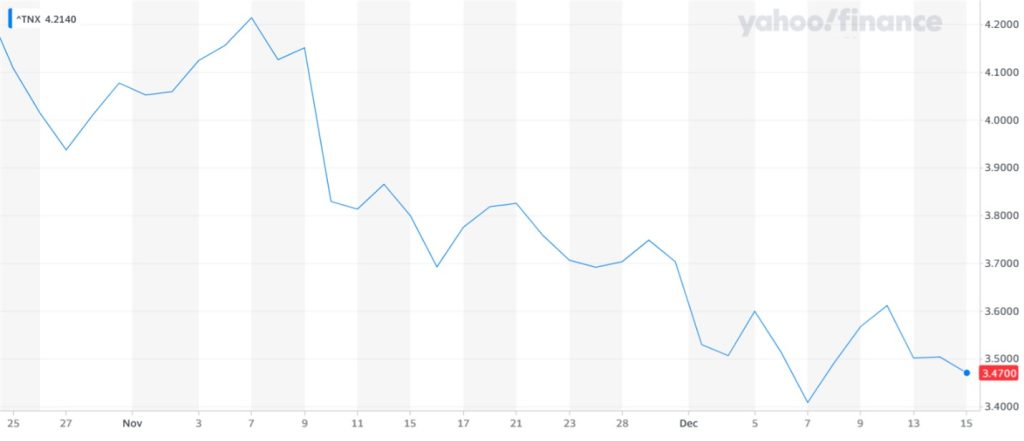
The FOMCs final episode of the 2022 season ended as expected with a 50 bp increase, and the Fed Chairman addressing reporters and trying to be taken seriously by the markets. Afterall, he can say he’s raising rates all he wants to slow growth, if lending rates don’t rise, the Fed doesn’t achieve its goal. Since October 24, the Fed has raised overnight rates 1.25%. As seen below in the chart, despite the increase from a 3% target to a 4.25% target (which is a 42% increase in bank lending rates), the ten year which is a benchmark for consumer lending rates, declined by 0.75% (which is an 18% decline).
Markets are forward looking. Currently they seem to be, more farsighted than usual. As Chairman Powell repeats after each increase that officials anticipate that “ongoing increases” in the Fed Funds rate will be “appropriate,” this would be expected by someone of Powell’s experience to cause the market to look toward rate increases and shift the yield curve higher. The Fed has done more than this. The official one-year-out Fed forecast is for the Fed funds rate to end 2023 at 5.1% and 4.1% for 2024. These were 4.6% and 3.9% previously. Mortgage rates today hit recent lows.
Meanwhile overnight interest rates this year have increased by 50 times from where they started (.08% to 4.00%). By comparison the benchmark Treasury was trading at 1.73% at the start of the year, so its level has gone up by two times.
But the current market has been so forward-looking in 2022, that each time the Fed puts on its hawkish face, the bond markets take it as more assurance that the U.S. will fall into a recession. They trade on the reassurance that the Fed will need to ease, and it effectively eases borrowing rates as benchmark yields decline. The bond and even stock markets expect the tightening to be transitory. They also only half listen to the Fed Chair because they know how wrong he was when he suggested inflation was transitory just one year ago.
CPI is also causing markets to be optimistic. Two consecutive consensus misses of inflation have led the participants to believe we are getting very close to the peak for interest rates, and rate cuts will soon be on the agenda. The Fed has been doing everything it can to change people’s minds.
The Fed’s View
While the market may be saying “no” and not allowing Powell to impose higher rates along the curve, the Fed certainly is going to keep trying. A 2% inflation target with inflation running approximately three times this won’t allow for an easing of policy. Even if overnight Fed Funds are so high that they are near historical norms.
For the Fed to accept what the market is pricing for, it will want to see substantial evidence that inflation is slowing. This will take more than just one or two months, where core inflation has come in less than the market was expecting. It isn’t an exact science to bring down inflation, but mathematically to get inflation to 2% YoY, over time, we need to see month-on-month readings averaging 0.17% MoM. We are not close, considering it is the core PCE deflator that the Fed pays the most attention to. In fact, the Fed just revised its inflation forecast upward because the core PCE deflator is likely to be stickier than core CPI. The revision has its core PCE estimate at 3.5% for the end of 2023 versus 3.1% previously, with 2024 revised up to 2.5% from 2.3%.
Take Away
What happens when monetary policy throws us huge increases in Fed Funds in seven out of its eight meetings, and late in the year, the interest rate markets decides, “No?”
It seems the Fed is working on its ability to jawbone rates higher. We saw this after the FOMC meeting with Powell doubling down on his rhetoric. We can expect more Fed addresses trying to move rates in a way that direct action concerning overnights has failed to accomplish. In the end, it’s the markets that set levels; if the bond market and stock market participants keep taking this hawkish language as recessionary, the hawkish stance could continue to backfire on the Fed.
Comments from Fed Chair Powell emphasized that the FOMC wants financial conditions to “reflect the policy restraint that we’re putting in place”. After all, inflation is indeed still running well above target, the jobs market and wage pressure remain hot, and activity data is pointing to a decent fourth-quarter GDP report after a healthy 2.9% growth rate in the third quarter. Will he succeed? If my memory serves me correctly, in the Seinfeld episode George wound up engaged to the woman he was breaking up with.
Everything You Always Wanted to Know About Equity Analysts* (*But Were Afraid to Ask)
Determining the potential of a company stock involves more time and perhaps more understanding than the average self-directed investor can provide. Fortunately, there are investment analysts that specialize in equities and spend their days staying current on the industry, individual companies, and the risks associated with the overall market. The investment world is becoming more transparent as the work of these well-educated professionals has become more accessible to DIY investors.
Just what is it that equity analysts do, and how do individual and professional investors benefit from their work?
The Value of Equity Analysts
Equity analysts have a deep understanding of company financials. This begins with formal education, as most true analysts have an accounting background that may include an MBA and, in many cases, the highly esteemed Chartered Financial Analyst (CFA) designation.
In addition to being able to read and pull data for analysis from financials, they understand the industries they cover. This is important because external trends up or down in input prices or competition will impact the whole sector, including the companies they cover. A macro view of what is impacting the industry is foundational to understanding a company within the industry.
For individual investment opportunities, the analysts’ focus is on the equity portion of the capital structure, but understanding debt levels and factors that could impact debt financing is critical to building an overall financial picture. Comparing the financial structure to company goals and initiatives provides information on how realistic they may or may not be based on internal factors.
Using data from the past and present, an analyst will build a model tailored to the specific company. These models are usually detailed spreadsheets with many interconnections between the various categories. The models generally include industry growth trends, the company’s own numbers (past, current, and projected scenarios), and then what-if scenarios. Financial models are a tool used to estimate the valuation of the company, how it changes under various scenarios, and then compare the business to its peers.
Shocking a forecast for different risks is important to assess the overall risk to the forecast.
The main risks impact different industries differently. For example, a healthcare company may be more or less immune to inflation, a mining operation could benefit from it, and a hospitality-based business could be hurt by it. Analysts assess the potential impacts of known risks and weigh them into their evaluation.
Primary Risks
The primary risks impacting any industry could be thought of as Business Risks, the challenges of a particular company’s circumstances. This could include the ability to hire talent, legal changes that could be impactful, natural resource availability, etc.
Market Risk or systemic risk is the idea that a sinking stock market will weigh on all stocks. While an analyst may choose top performers if the price target assigned was from an evaluation under average market growth of X%, an actual experience of negative Y% is a risk to the forecast.
Sovereign Risk has become a much bigger concern as trading partners like Russia, and China has shown us that politics and business policies can greatly impact U.S. trading partners. This risk tends to be greater among large international companies.
Foreign Exchange Risk. An analyst will review the impact of conversion back to the native currency and profit impacts. They may even project whether customers could be lost if the U.S. dollar becomes too costly.
Inflation Risk, what might the impact be on the company under various possible scenarios? A company with a large inventory may actually go through a beneficial period while prices are rising.
Interest Rate Risk is the real threat of inflation because it typically raises the cost of money. If the company is a large borrower and will be rolling maturing debt at new interest rate levels, the analyst will determine how this impacts operating costs and profit going forward.
Liquidity Risk. If a company’s stock is not well followed and trades sporadically, selling shares to raise capital may be severely hindered and, therefore, negatively impact the company’s ability to finance its business plan. What is interesting to note here is that analyst coverage of a company by itself has been shown to improve a stock’s liquidity. This is because more information about companies, even if not positive, helps investors understand the company, its risks, and its value.
Equity analysts benefit investors (retail and institutional) that are looking for information and an evaluation from a professional to weigh against their own evaluation. But they also benefit issuers as their stock may get less attention if there is minimal quality information available.
Direct Access to Management
Analysts essentially have a hotline to the covered company’s CEO and CFO to ask questions and get details of any change within the company or outside change that may impact results. Most investors don’t have this, so relying on analysts takes on even more importance.
Nuances Known to Analysts
The best reason to check the thoughts and forecasts of a seasoned analyst as part of your own due diligence is that every company has so many moving parts. A good analyst will be aware of what a DIY investor won’t know about the company. For example, the veteran analysts that provide research to Channelchek. On an ongoing basis, they have their finger on the pulse of the companies they cover.
There’s an opportunity you will want to take advantage of on Wednesday, December 15. You will meet online the Wall Street Analysts who are behind the research published on Channelchek. During this no-cost meeting, the veteran analysts have been asked to uncover what they are looking at, especially as it relates to companies they are bullish on.
This could be a great kickoff to organizing your portfolio for 2023 as these analysts cover the less talked about and perhaps the most overlooked stocks – stocks with great potential and “nuance” that you may have missed.
“Investors should not care whether the Fed pivots or not if they analyze investment opportunities based on fundamentals and not on monetary laughing gas,” writes economist Daniel Lacalle, PhD. In his latest article, published below. LaCalle takes on the journalists and economists that see market risk differently than himself. This is a thought-provoking read for anyone who has been living on a diet of mostly CNBC, and Yahoo Finance, as exposure to diverse market viewpoints is considered healthy. – Paul Hoffman, Channelchek
Obsessed Investors
In a recent Bloomberg article, a group of economists voiced their fears that the Federal Reserve’s inflation fight may create an unnecessarily deep downturn. However, the Federal Reserve does not create a downturn due to rate hikes; it creates the foundations of a crisis by unnecessarily lowering rates to negative territory and aggressively increasing its balance sheet. It is the malinvestment and excessive risk-taking fuelled by cheap money that lead to a recession.
Those same economists probably saw no risk in negative rates and massive money printing. It is profoundly concerning to see that experts who remained quiet as the world accumulated $17 trillion in negative yielding bonds and central banks’ balance sheets soared to more than $20 trillion now complain that rate hikes may create a debt crisis. The debt crisis, like all market imbalances, was created when central banks led investors to believe that a negative yielding bond was a worthwhile investment because the price would rise and compensate for the loss of yield. A good old bubble.
Multiple expansion has been an easy investment thesis. Earnings downgrades? No problem. Macro weakness? Who cares. Valuations soared simply because the quantity of money was rising faster than nominal GDP (gross domestic product). Printing money made investing in the most aggressive stocks and the riskiest bonds the most lucrative alternative. And that, my friends, is massive asset inflation. The Keynesian crowd repeated that this time would be different and consistently larger quantitative easing programs would not create inflation because it did not happen in the past. And it happened.
Inflation was already evident in assets all over the investment spectrum, but no one seemed to care. It was also evident in non-replicable goods and services. The FAO food price index already reached all-time highs in 2019 without any “supply chain disruption” excuse or blaming it on the Ukraine war. House prices, insurance, healthcare, education… The bubble of cheap money was clear everywhere.
Now many market participants want the Fed to pivot and stop hiking rates. Why? Because many want the easy multiple expansion carry trade back. The fact that investors see a Fed pivot as the main reason to buy tells you what an immensely perverse incentive monetary policy is and how poor the macro and earnings’ outlook are.
Earnings estimates have been falling for 2022 and 2023 all year. The latest S&P 500 earnings’ growth estimates published by Morgan Stanley show a modest 8 and 7 percent rise for this and next year respectively. Not bad? The pace of downgrades has not stopped, and the market is not even adjusting earnings to the downgrade in macroeconomic estimates. When I look at the details of these expectations, I am amazed to see widespread margin growth in 2023 and a backdrop of rising sales and low inflation. Excessively optimistic? I think so.
Few of us seem to realize a Fed pivot is a bad idea, and, in any case, it will not be enough to drive markets to a bull run again because inflationary pressures are stickier than what consensus would want. I find it an exercise in wishful thinking to read so many predictions of a rapid return to 2% inflation, even less, when history shows that once inflation rises above 5% in developed economies, it takes at least a decade to bring it down to 2%, according to Deutsche Bank. Even the OECD expects persistent inflation in 2023 against a backdrop of weakening growth.
Stagflation. That is the risk ahead, and a Fed pivot would do nothing to bring markets higher in that scenario. Stagflation periods have proven to be extremely poor for stocks and bonds, even worse when governments are unwilling to cut deficit spending, because the crowding out of the private sector works against a rapid recovery.
Current inflation expectations suggest the Fed will pivot in the first quarter of 2023. That is an awfully long time in the investment world if you want to bet on a V-shaped market recovery. Even worse, that pivot expectation is based on a surprisingly accelerated reduction in inflation. How can it happen when central banks’ balance sheets have barely moved in local currency, reverse repo liquidity injections reach trillion-dollar levels every month and money supply has barely corrected from the all-time highs of 2022? Many are betting on statistical bodies tweaking the calculation of CPI (consumer price index), and believe me, it will happen, but it will not disguise earnings and margin erosion.
To cut inflation drastically three things need to happen, and only one is not enough. 1) Hike rates. 2) Reduce the balance sheet of central banks meaningfully. 3) Stop deficit spending. This is unlikely to happen anytime soon.
Investors that see the Fed as too hawkish look at money supply growth and how it is falling, but they do not look at broad money accumulation and the insanity of the size of central banks’ balance sheets that have barely moved in local currency. By looking at money supply growth as a variable of tightness in monetary policy they may make the mistake of believing that the tightening cycle is over too soon.
Investors should not care whether the Fed pivots or not if they analyze investment opportunities based on fundamentals and not on monetary laughing gas. Betting on a Fed pivot by adding risk to cyclical and extremely risky assets may be an extremely dangerous position even if the Fed does revert its pace, because it would be ignoring the economic cycle and the earnings reality.
Central banks do not print growth. Governments do not boost productivity. However, both perpetuate inflation and have an incentive to increase debt. Adding these facts to our investment analysis may not guarantee high returns, but it will prevent enormous losses.
Arguments Can be Made for Rates Being Too Low and for Rates Being Too High
The Federal Reserve has raised the Fed Funds rate from an average of 0.08% in January 2022 to its current 4.05%, and a likely adjustment to 4.25% to 4.50% tomorrow. Inflation, as measured by CPI and even the Fed’s favorite, the PCE deflator, has been showing a decreasing rise in prices. So investors within all affected markets are asking, how much more will the Fed raise rates? Ignoring any suggestion that “this time it’s different,” I looked at US interest rates and inflation going back to 1962 and may have found enough consistency and historical norms to help determine what to expect now and why.
Are Increases Nearing an End?
I’ll start with the conclusion. The data suggests that the movement of market rates depends on whether higher current inflation is being caused by temporary or long-lived factors. The 10-year Treasury Note market believes current inflation is mostly temporary. This is shown by its yield, having touched 4.25% in late October, and then falling. The ten-year is now near 3.50%, despite the 0.75% increase in overnight rates implemented on November 2. If the combined wisdom of the Treasury market is reliable, this suggests FOMC rate increases are nearing an end. Perhaps one more smaller hike and then a wait-and-see period. The Fed would then monitor prices while past increases work their way through the economy.
Powell’s Concerns
At his last address on November 30th, Fed Chair Jay Powell indicated he’d rather go too far (with tightening) and then reignite the economy rather than err on the side of not doing enough and having a bigger problem. The markets and the media largely ignored this, but it’s important to know what the Fed Chair believes is prescient and is sharing publicly. Powell also said, “Given our progress in tightening policy, the timing of that moderation is far less significant than the questions of how much further we will need to raise rates to control inflation, and the length of time it will be necessary to hold policy at a restrictive level.” And then he said something very telling, Powell added, “It is likely that restoring price stability will require holding policy at a restrictive level for some time. History cautions strongly against prematurely loosening policy. We will stay the course until the job is done.”
Market Thinks Inflation is Temporary
But, the markets are overjoyed by the last two months of inflation data. Despite what the nations top central banker is saying. Markets may be right, but if they are wrong (bond and stock markets) spotting it early can help stave off losses. If inflation, which is lower than it had been, but not historically low, proves more permanent, for example, if employers continue to have to bid up the price of workers, and demand for goods causes commodity prices to rise, then the Fed will have paused too early. This will lead to a more difficult challenge for the Fed as compared to tightening too much. The data used in this article are from the Federal Reserve Economic Data (FRED) maintained by the Federal Reserve Bank of St. Louis.
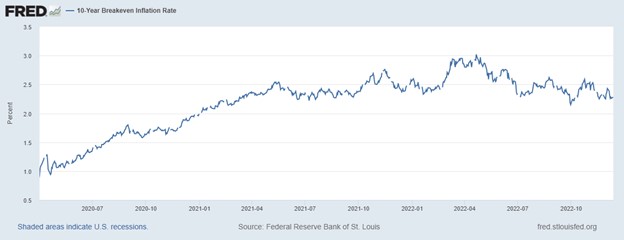
Actual and Expected Inflation
The St. Louis Federal Reserve publishes a market estimate of expected average inflation over the next ten years. It is derived from the 10-year Treasury constant maturity bond and 10-year Treasury inflation-indexed constant maturity bond. It was first published in 2003. Over 2003-2021, 10-year inflation expectation averaged 2.0%, the same as GDP deflator inflation. During the second quarter of 2022, the expected 10-year inflation was 2.7%, or less than 1.0 percentage point above its 2003-2021 average. In contrast, GDP deflator inflation was 7.6%. A significant wedge exists between current and expected inflation.
Source: St. Louis Fed
The breakeven inflation rate represents a measure of expected inflation derived from 10-Year Treasury Constant Maturity Securities (BC_10YEAR) and 10-Year Treasury Inflation-Indexed Constant Maturity Securities (TC_10YEAR). The latest value implies what market participants expect inflation to be in the next 10 years, on average.
Beginning with the end of the last recession on April 1, 2020, the Treasury bond data used in calculating interest rate spreads is obtained directly from the U.S. Treasury Department.
Take Away
The Market’s expectation of 10-year average inflation is dramatically different from current inflation, even at inflation’s new lower pace. This implies the market believes it to be temporary.
If the market’s expectation of inflation is accurate, there is an average difference between Fed Funds and the PCE deflator of 1.6% (since 1962). The last read on PCE was October 2022 at 6%. Reducing this by 1.6 would provide a Fed Funds level of 4.4%. This level is in line with historic averages and likely where we will be after the FOMC meeting wraps up on December 14. This comparatively high rate relative to where we began the year may be considered neutral.
Will the Fed stop at neutral? Are the markets right? Powell said he’d rather err on the side of going beyond what is needed, which suggests the Fed will continue some. As for the markets, being on the side of the markets is how you make money, but getting out before trouble arises is how you keep the money. Markets are not always accurate forecasters and since economic behavior and debt levels tend to adjust slowly, prudent portfolio management suggests it is wise to keep an eye out for today’s interest rates still being too low.
An Alternative View of Today’s Economy by Cathie Wood
Cathie Wood made the argument that investors comparing the current economic crosscurrents to the 1970s are developing forecasts based on the wrong data-set. Speaking at the Finimize Modern Investor Summit via video, the ARK Invest funds founder instead suggested the current economy and inputs are similar to a different period – she then made a case for her reasoning.
“If you go back to the 19-teens (1912-1922), then the period was very similar to the period we’re in today,” she said at the Investor Summit. That period featured a war, a pandemic (Spanish flu), and supply-chain problems. “It was the most prolific period for innovation in history,” she said, pointing to the disruptive impact of electricity, the telephone, and the car.
Wood explained that inflation went from 24% in June 1920 to -15% in June 2021. She made clear she isn’t forecasting deflation this severe; however, she is expecting year-over-year inflation to swing into negative territory, with prices going down. “What has happened during the last few years is going to flip, and we think that the market will flip back to a preference for growth stocks and our innovation strategy,” she said.
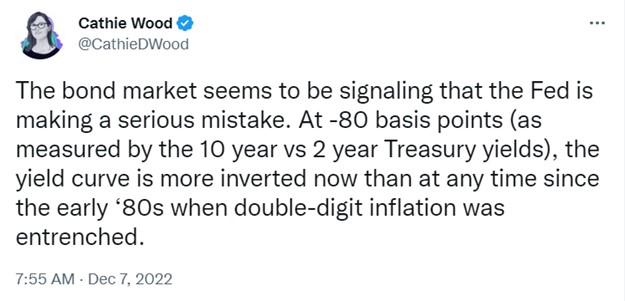
Wood also elaborated on a tweet she issued earlier about how deep the inversion was of the yield curve.
Twitter @CathieDWood
“That’s the bond market saying, ‘hello, Fed, are you watching?'” She said Federal Reserve Chair Jerome Powell is trying to be the reincarnation of Paul Volcker at a time when it’s not appropriate. “I think that’s a mistake because this is not a 15-year problem; it’s a 15-month one,” said Wood. She highlighted that commodity prices are tumbling, supply chains are improving, and companies are
Ark Invest funds have been positioned in a more concentrated waiting pattern while Wood waits for inflation dynamics to be supportive of innovation. She gave an example; the innovation fund, for instance, has been narrowed to 32 companies from 58, Wood said, as she highlighted that the firm has become less convinced China is supportive of innovation.
Take Away
It’s worth reviewing the differing opinions of several investors that have made above-average returns in their careers. While almost no one is always correct, there are many different right ways to make money in any market.
The Ark flagship fund is down 63% this year; in the past, Wood has indicated her funds’ time period to measure return is five years, not one. Perhaps investors with a longer holding period can garner useful ideas from her pounding the deflation drum, while investors with a shorter time horizon are concerned about inflation.
The Argument for Higher Oil Market Prices is Fairly Straightforward
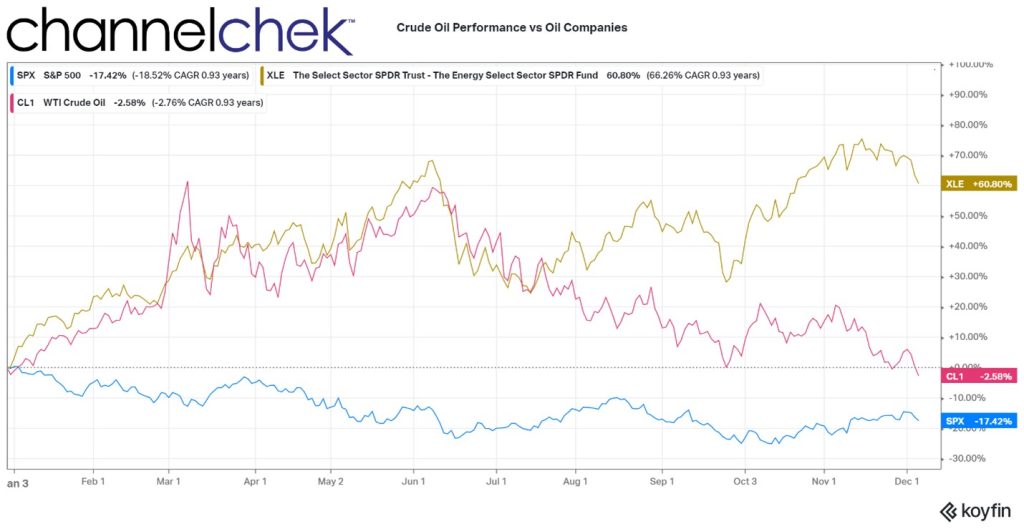
The price of oil is near its 2022 low. This lower per barrel cost is normal when the commodities market perceives the economy as slowing or that it will slow. What is surprising is that the price is near the low for the year when the Chinese are easing Covid restrictions and will soon be requiring more fuel; at the same time, a Russian oil cap, which is sure to bring less supply to the market, was just instituted this week. In the meantime, energy producers, up 60.8% on the year, are not sinking at the pace of oil prices.
Energy shares have been the big winners for 2022. And it is rare that they are flying solo, without the help of price increases of their underlying product. According to Bespoke Investment Group, last month marked the first time since 2006 that the S&P 500 energy sector has traded within 3% of a 12-month high while the price of West Texas Intermediate retreated more than 25% from its one-year peak..
The divergence has caught the attention of investors. Since drillers and miners tend to rise and fall with the prices of the commodities they produce, many expect the gap to narrow to its more historical norm. Most are looking for oil to rise rather than drillers to fall.
Pressures that could cause oil to rise include the EU winter season, the U.S. Strategic Reserves bumping up against depletion, OPEC+ keeping production quotas unchanged, and Western governments’ $60-a-barrel price cap on Russian crude. These, taken together, are expected to put upward pressure on per-barrel prices. The commodities market is not moving in accordance with these factors. Futures contracts for U.S. crude closed Monday 3.8% lower at $76.93 a barrel, its fourth-lowest settle of the year.
Working against the argument for higher crude prices is the expected slowing of world economies. The possibility of a recession in many global economies while central banks raise interest rates, is unknown. Any impact remains to be seen.
Robinhood’s One Percent Match Program is an Industry First – Can it Attract More Buy and Hold Users?
Robinhood (HOOD) has entered the IRA market and is offering a 1% match on each dollar contributed to a retirement account on its platform. For someone putting away $5,000 in a qualified account, the funds would also be credited with an additional $50. The thought on this new product is that this seemingly small amount could compound dramatically over the years into much more than the original incentive.
While Individual Retirement Accounts (Roth and Traditional) are standard brokerage offerings, Robinhood is a decidedly different animal than most. A high percentage of its 22.9 million users tend to view themselves as shorter-term traders or investors in highly speculative assets. This customer trait tends to buck the trend at other brokerage firms that see a higher percentage of assets parked in market-indexed ETFs instead of individual stocks. In one quarter of 2021, 26% of Robinhood’s revenue came from trading in Dogecoin, the cryptocurrency that started out as a goof on crypto.
Developing an account base with larger, more stable assets per account is important for the company’s development. Robinhood users generally hold less in their accounts than at other brokerage firms. Shortly before the company went public last year, the Financial Industry Regulatory Authority (FINRA) said in a report that the median Robinhood user had $240 in their account. A move toward longer-term savings that builds over time could help increase the average size. And it is important enough to the company that they decided they would compensate investors with the first-of-its-kind a matching program.
“We recognize that this is a pretty big moment for us as a company,” said Sam Nordstrom, an executive in product management at Robinhood. “Retirement is something that folks take very seriously, and we fully expect them to need to trust the institutions that help them save for retirement. So we’re looking to earn that trust over a period of time.”
What’s the IRA Match?
The Robinhood IRA Match provides an extra 1% paid by the brokerage firm. It’s not counted toward the account holders annual contribution limits and is typically available to invest immediately.
The IRA contribution limits for 2022 are $6,000 for people under age 50, which means they can earn up to $60 extra. For people age 50 and over, the limit is $7,000, which means they can earn up to $70 on top of their contributions.
Take Away
Developing a more diverse customer base by offering standard brokerage products has investment app Robinhood providing IRAs to its offerings on the platform.
In typical Robinhood style, they rolled out the offerings just before IRA season with a twist. And the twist may be just what it takes to earn new accounts and attract rollover assets from existing qualified money.
The Small Cap Effect Suggests Oversized Gains if You Weed Out Certain Stocks
According to a June 5th article in the Wall Street Journal, “small-cap stocks are priced for jumbo gains.” The Journal explains that small-caps have experienced lower average volatility than large-caps during periods of market stress. Examples are the 2013 “taper tantrum,” when investors turned bearish after the Federal Reserve said that it would reduce bond purchases; also the United Kingdom’s Brexit referendum in 2016; and the Covid-19 pandemic. This fact is counter-intuitive to what investors expect from what are considered the riskier securities.
The Journal reports that one prominent money manager predicts that the smaller companies will outshine large-caps by close to four percentage points a year over the next five years. They also report a large investment bank is even more bullish on small-caps for the coming decade.
What are Small-Caps?
Small-caps are most commonly defined as companies with lower-than-average market capitalizations. This is most often defined as between $300 million and $2 billion. However, the index that is often quoted to reflect small-cap stocks overall performance is the Russell 2000 Small-cap Index (RUT). The stocks represented in the RUT have a median market cap of $1 billion and the largest stands near $13 billion. Well outside of the range of the more common definition.
Small-Cap Effect
The small-cap effect was documented decades ago and demonstrates the propensity of small companies to produce higher average returns than companies over extended holding periods. The thought process includes the idea that small companies are riskier, so additional expected return is necessary to compensates investors for taking extra risk.
But the past decade has left the small caps with a lot of catching up to do. The large-company Russell 1000 (RUI) has beaten the small-company Russell 2000 by three points a year over the past decade, returning an average of 13.1%.
The lack of comparative performance is not because small-caps have been bad performers. Larger companies, particularly those at the very top, had a fantastic run during that decade. Now, there’s an ongoing debate over whether the small-cap effect is still valid, if it is, there is much catching up to do in terms of performance. Time will tell what direction and pace prices change moving forward. It is unknowable right now. What is knowable is that many small-caps are currently cheap.
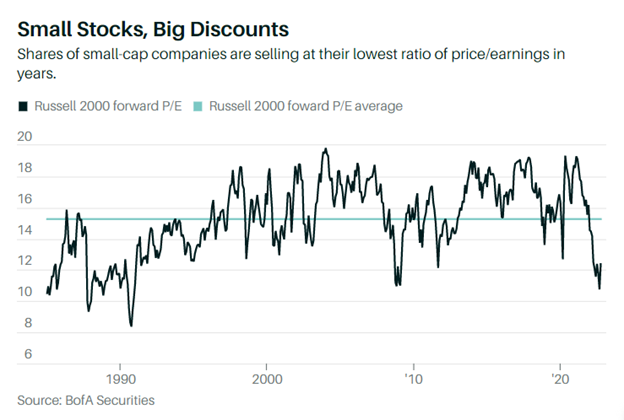
According to the Wall Street Journal, The Russell 2000 is flirting with 20 times earnings, a hair above its long-term average and certainly not deep value territory. But weed out the index’s unprofitable companies and statistical outliers, and the price/earnings ratio drops to about 12, versus a long-term average of 15.
This adjustment to the index make-up makes sense for two reasons. One is that 33% of Russell 2000 members today have negative earnings, up from 20% a decade ago, and at a record high. But there’s a bigger reason to exclude unprofitable companies when sizing up the Russell 2000: The adjusted P/E has been a better predictor of future returns than the unadjusted one, (based on a B of A analysis of data going back to 1985. Right now, the adjusted P/E has B of A to predicting 12% annual returns for small-caps over the coming decade. That’s five points more than it sees for large-caps. The analysts calculate that small-caps are 30% cheaper than large-caps now. This would be the biggest discount since the dot-com stock bubble more than two decades ago.
What do Equity Analysts Think?
On December 15th, 2022 – 9:00am EST there will be a rare opportunity to hear from analysts covering different sectors of the small-cap space.
At no cost for investors, the well-recognized veteran analysts will highlight how they set their price targets and market ratings. And the underlying fundamental reasons to consider an investment. As an attendee, you can get further involved by submitting your own questions. And learn which stocks the research analysts may favor.
This is the season to set your sites on maximizing returns in the coming year and the years that follow. This event is online and free, courtesy of Noble Capital Markets and Channelchek.
Get ahead of your investments in the coming year by attending this special event, learn how by going here now.