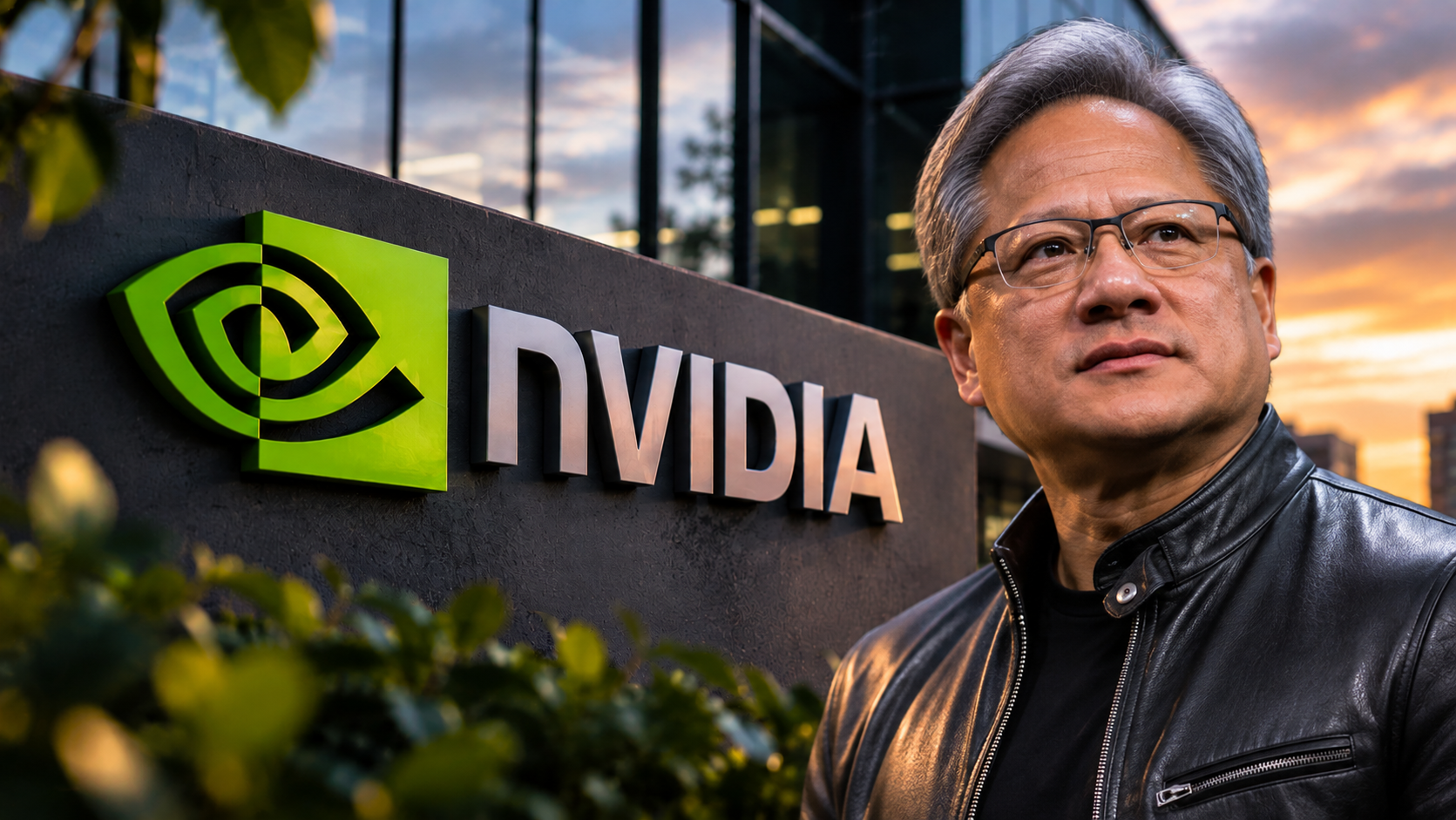
The investigation involving Nvidia CEO Jensen Huang is creating fresh uncertainty across the artificial intelligence industry, raising questions about whether leadership concerns at the world’s dominant AI chipmaker could influence investor confidence in semiconductor stocks and the broader technology market.
Nvidia (NASDAQ: NVDA) shares fell more than 5% Monday after the company announced an independent investigation into reports that Huang had been targeted by a foreign intelligence effort. The development comes at a sensitive time for AI-related stocks, which have already experienced significant volatility amid concerns about valuations, data-center spending, and future profitability.
Nvidia’s board announced the investigation Sunday following reports about Huang’s relationship with a businesswoman whom U.S. intelligence officials reportedly suspected of gathering information for China.
The company emphasized that it currently has no reason to believe Nvidia’s confidential information or national security was compromised. Huang has pledged to cooperate with the investigation, and the board has expressed confidence in his leadership.
China has rejected the espionage allegations.
For investors, the immediate concern extends beyond the personal controversy to Nvidia’s central role in the global artificial intelligence ecosystem.
Under Huang’s leadership, Nvidia has become a critical supplier of advanced processors used to train and operate AI models. Its technology supports massive investments in data centers, cloud computing, and enterprise AI infrastructure.
That position makes Nvidia an important indicator of sentiment across the semiconductor industry.
Companies including Advanced Micro Devices (AMD), Broadcom (AVGO), and Micron Technology (MU) operate in markets influenced by the same expansion in computing demand. Equipment manufacturers, networking providers, and data-center infrastructure businesses also depend on continued investment in AI capabilities.
However, Nvidia’s leadership investigation does not necessarily translate into weaker demand for AI technology.
The company’s customers continue to require substantial computing capacity, and there is currently no confirmed evidence that the investigation has disrupted Nvidia’s operations, product deliveries, or customer relationships.
In fact, several major Asian semiconductor suppliers, including Taiwan Semiconductor Manufacturing Company, Samsung Electronics, and SK Hynix, recovered Monday following last week’s technology selloff.
The distinction between company-specific uncertainty and broader industry fundamentals is particularly important for smaller technology investors.
Small-cap and microcap companies involved in specialized computing, power infrastructure, cooling systems, and enterprise technology services may benefit from continued AI investment even when larger semiconductor stocks experience volatility.
For example, Information Services Group (NASDAQ: III), a company covered by Noble Capital Markets, provides technology research and advisory services to enterprises evaluating digital transformation and technology investments. Although it is not directly involved in Nvidia’s investigation, its business illustrates how the broader technology spending cycle extends beyond semiconductor manufacturers.
Similarly, Bimergen Energy (NYSE American: BESS) operates in the battery energy storage market, an area relevant to growing electricity demand and infrastructure development. Its inclusion highlights the wider range of businesses that could participate in long-term investment associated with expanding computing capacity.
Nevertheless, smaller companies can be particularly vulnerable when investors become more cautious about technology spending.
Delays in data-center construction, tighter financing conditions, or reduced capital expenditures could affect businesses that depend on infrastructure projects and large corporate customers.
The investigation also introduces potential regulatory considerations. Nvidia’s advanced processors remain central to U.S. export restrictions involving China, and additional scrutiny could complicate the company’s international operations.
For now, the broader outlook for artificial intelligence remains tied to corporate investment, customer demand, and the ability of technology companies to generate returns from increasingly expensive infrastructure.
Nvidia’s upcoming earnings report will provide another opportunity to evaluate those fundamentals.
While the Jensen Huang investigation may create near-term volatility, investors will ultimately need to distinguish leadership-related uncertainty from the underlying growth prospects of the AI industry.
For small-cap investors, that distinction could be especially important as opportunities continue emerging across the technology supply chain.