The SEC’s Summary of Charges in New Online Stock Manipulation Fraud

Image Credit: Clem Onojeghuo (Pexels)

Social Media and Stock Message Boards Again Help Amplify Market Manipulators

There is an ongoing government investigation after the Securities and Exchange Commission (SEC) charged seven podcasters and social media influencers with stock market manipulation. The benefit to those charged totals near $114 million as they allegedly ran a pump while they were dumping scheme. According to the SEC, the charges are against eight Twitter users that also used stock trading message boards on Discord, and a podcast to promote specific stocks to “hundreds of thousands of followers.” Meanwhile, they are said to have quietly sold into the run-up they helped create in the stocks’ prices.

The fraud they are being charged with began at the dawn of the pandemic in January 2020 and involved participants from various locations, including defendants from Texas, California, New Jersey, and Florida.

The main podcaster named in the case (Knight) is suspected of and also charged in the illicit trading scheme as having used influence to promote the others as expert traders, according to the SEC. Among the most called upon stocks used in the alleged scheme were Gamestop (GME), and AMC Theaters (AMC) – two  darlings of newer investors that saw a rise in popularity beginning during the stimulus check, lockdown period in 2020. This period in market history helped usher in many brand new investors with time to listen to podcasts, follow social media posts, enjoy market-related memes, and benefit from a rising overall market.
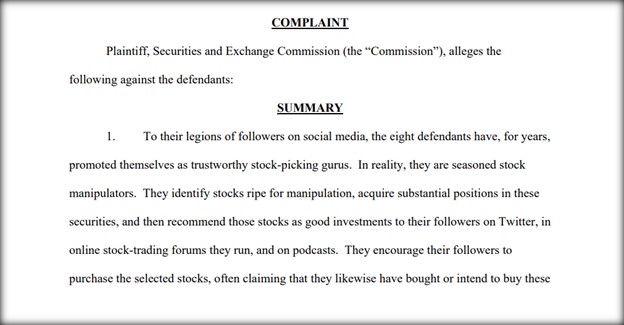
Source: SEC.gov

The criminal charges include conspiracy to commit securities fraud and, for several of the defendants, multiple counts of securities fraud. Each of the charges carries a maximum possible sentence of 25 years in prison. The Justice Department simultaneously filed separate criminal fraud charges against the defendants, the SEC said.

The SEC’s complaint calls for the US District Court for the Southern District of Texas to impose fines and to require that the defendants give up their allegedly ill-gotten gains, along with a ban on future misconduct.

The SEC’s Summary of the Scheme

From the SECs court filing:

The Defendants engaged in a long-running fraudulent scheme to manipulate

securities by publishing false and misleading information in online stock-trading forums, on

podcasts, and through their Twitter accounts. The Primary Defendants, aided and abetted by

Knight, engaged in a pattern of conduct, sometimes referred to as “scalping,” in which they

recommended the purchase of a particular stock without disclosing their intent to sell that stock.

They generally executed their scheme in three phases. First, one or more of the Primary

Defendants identified a security to manipulate (the “Selected Stock”) and purchased shares of

that particular security. By sharing the name of the Selected Stock among some or all of the

group, the Defendants provided each other with the opportunity to purchase shares at lower

prices prior to the manipulation. Next, they promoted the stock to their followers on podcasts

and/or social media platforms in order to generate demand and inflate the share price. Typically,

the Primary Defendants announced price targets, teased upcoming news about the company,

and/or stated their intention to buy shares or hold their current positions for longer periods.

Finally, after promoting the stock to their followers in these ways, the Primary Defendants sold

their shares into the demand generated by their recommendations. When the scheme succeeded,

the Primary Defendants were able to sell their shares at higher prices and make profits. In order

to cover up their scheme and continue perpetrating it, the Primary Defendants at various points

deleted old tweets and Discord chats, and lied to their followers about the reasons why particular

stock picks were followed by declines in the prices of those stocks, obscuring their own roles in

causing losses among their followers and other retail investors.

None of the Primary Defendants disclosed that they were either planning to sell,

or were actively selling, a Selected Stock while recommending that their followers buy it. Nor

did any of the Primary Defendants disclose that they were coordinating with each other to

manipulate the price and volume of trading in the stocks they were promoting. Moreover, the

Primary Defendants’ deception extended beyond their omissions and outright lies about their

intentions regarding, and views about, the securities they were promoting. For instance,

sometimes they peddled false or misleading news about particular stocks through social media or

podcast interviews. On some occasions, the Primary Defendants lied about losing money on a

particular stock when in reality they had profited handsomely, in order to generate trust among

their followers—trust that was necessary to perpetuate the scheme and ensure that their followers

would continue to purchase shares based on their future recommendations. Indeed, in private

chats and surreptitiously recorded conversations, they bragged and laughed about making profits

at the expense of their followers.

Defendants’ specific roles in the fraudulent scheme varied depending on the

timeframe and the specific security at issue. Typically, only a subset of the Primary Defendants

participated in the manipulation of a particular stock. Those Primary Defendants would agree on

a Selected Stock in which they would each establish a position (i.e., “load” or “load up” on the

stock). After loading up on the Selected Stock, most, if not all, of the Primary Defendants who

had established positions in that stock would recommend it to their followers. The Primary

Defendants often referred to “swinging” or taking a “swing” position in the stock, by which they

conveyed to their followers that they intended to hold onto the stock for at least a day and likely

longer. As the primary defendants involved in the deceptive heralding of a particular stock

often informed other defendants of their plans, those not directly promoting the stock could,

and many times did, take advantage of the advanced knowledge by purchasing the Selected Security, in

advance of the promotion, and selling the Selected Security at inflated prices that resulted from

the promotion. Over the course of the ongoing scheme, all of the primary defendants, aided and

abetted by Knight, engaged in this conduct, participating directly in scalping and other deceptive

conduct, and all of the Defendants profited from the knowledge that others were doing so.

The Primary Defendants deceptively promoted stocks through three channels:

stock-trading forums on Discord; podcasts; and Twitter.

Take Away

Fraud in the securities market is almost as old as the markets themselves. While the SEC exists to protect investors, the best person to protect oneself is yourself. When consuming investment advice, ask yourself how well you know where the advice is coming from. What is the persons background, for example, are they credentialed with a CFA or guided by the responsibilities that FINRA registrations enforce. Are they ranked by a third-party entity as to their stature?

The alleged pump and dump scheme being investigated and prosecuted by the SEC only exists because people tend to follow the crowd, after-all crowds seem safe. Successful long-term investing often involves more thought than following others into a trade. There are true stock analysts that can help investors sort through all the opportunities, but in the end, the individual investor still needs top ask if it makes sense, does it feel right, and it is likely to match investment goals.

On December 15, Channelchek along with veteran stock analysts, provided registered users of Channelchek their thoughts on a select few companies they cover. If you were not able to attend live, register for Channelchek emails (no cost) now to learn when these extremely insightful presentations will be available online. At a minimum, I promise one will immediately see the difference between a stock market social media influencer and how they make recommendations (tout stocks), and professional equity analysts that ignores hype and instead drills down to best assess the future prospects of a company. Sign up for Channelchek notifications here.

Paul Hofffman

Managing Editor, Channelchek

Sources
https://www.pacermonitor.com/view/O46ED3A/SECURITIES__EXCHANGE_COMMISION__txsdce-22-04306__0001.0.pdf?mcid=tGE3TEOA

https://www.sec.gov/news/press-release/2022-221

https://www.investor.gov/introduction-investing/investing-basics/role-sec#:~:text=The%20U.%20S.%20Securities%20and%20Exchange,Facilitate%20capital%20formation

How the Investment Playing Field Can Dramatically Change in November

Image Credit: The White House (Flickr)

The Mid-Term Elections are Just One of the SEC’s Concerns

The mid-term elections have the potential to alter the course of the markets. It’s easy to recognize how the possible outcomes can cause changes to the overall economy, including industry sectors, fuel prices, and perhaps even national debt levels. But, one area that is less obvious could also impact investors in a big way, regulation. As election day is now days away, many regulatory changes that have been in the works are quickly coming to a head, with the expectations there may be a change in priorities, power, and philosophy. The push to get things through in the coming days may still be undermined by the U.S. system. Here’s why.

The U.S. Government at Work

Federal regulators are in scramble-mode working to finalize proposed rules before what appears will be a change in the balance of power in the legislative branch. The possibility that there may be a Republican-controlled Congress or the expected idea that the democrats will lose control over one of the branches of Congress would soften their ability to institute their aggressive agendas. As the agencies refine their proposals, they also have to be mindful that it isn’t just the new Congress that will be evaluating new regulations. The Supreme Court has recently taken a heightened interest in agencies overstepping their charter, that interest is likely to continue.

It’s easy to see how Congress whose job it is to decide where money is spent, can dampen the agenda of the Department of Education (DOE), Internal Revenue Service (IRS), Food and Drug Administration (FDA), or Gary Gensler’s plans at the Securities and Exchange Commission (SEC). But, the Supreme Court is also more than a casual observer and has shown how willing it is to make sure everyone stays in their defined lanes. 

Recent SEC Initiatives

The SEC has a three-part mission that includes protecting investors, maintaining fair, orderly, and efficient markets, and facilitating capital formation. Under Gary Gensler, it has been working overtime to impact the changing marketplaces. The initiatives are considered by some to be beyond the scope of the SEC’s lawful mission.

Gensler, who was appointed by President Biden, has been extremely active. The former Chairman of the U.S. Commodities Futures Trading Commission (CFTC) and MIT economics professor is proposing or finalizing dozens of regulations. Some are minor alterations to existing rules, but many are complete redesigns of how they are handled now. This redesign may make it past an unenthusiastic Congress, as they have more pressing priorities, but they may experience an aggressive halt from the country’s Judicial branch.

Recent Supreme Court Actions

In June of 2022, the Supreme Court decided W. Virginia v. EPA. The decision struck down an EPA regulation fighting climate change. The decision was made based on the grounds that the rule violated the “major questions doctrine.” The Court had never used that term before, but it seemed evident that the court might use the term and intent of the phrase should it be called on to review other federal agencies and commissions.

The Court has the authority and now recent precedent to unwind regulation that goes beyond the original intent of Congress when an agency was created or any subsequent legal grants of authority. The 6-3 ruling against the EPA explained the Clean Air Act, designed for new power plant emissions, did not extend to existing plants requiring them to shift to wind or solar. It’s a nod by the Court to keep bureaucracies from growing beyond the express original legal reason for being. 

The ruling also is relevant in that it looked at Congress’s unwillingness to legislate and legitimize the way that the agency chose to regulate. One Justice in a concurring opinion wrote the decision was in part based on whether the agency was “intruding” in a traditional area of state law. 

How it Could Impact Investors

Under the major questions doctrine, several SEC efforts may become far more difficult.

One high-profile SEC goal involves environmental initiatives. Climate change activists have supported the SEC’s proposal to require companies to increase their disclosure of anticipated climate risks. But it would be difficult for the SEC to weigh its mission against this initiative and easily demonstrate that anyone has a great impact on the other (orderly markets, investor protection, capital formation). If environmental initiatives are to be carried out, they will need to be enacted by the representatives elected to legislate on behalf of citizens.

It is easy to see how priorities focusing more on fiscal restraint rather than environmental awareness could alter the investors playing field with a power change in the Capital building.

The so-called greening of Wall Street is just one example of how the elections will impact the coming year’s winners and losers in the stock market. Consider the SEC’s proposed rules for swaps, which are financial instruments that some investors use to speculate on securities. The SEC’s suggested rule would require public disclosure within a day of these transactions to the public. The proposed rule can be considered an unprecedented intervention in this multi-trillion-dollar market. The argument is strengthened by the reality that Congress could have authorized disclosure in the 2010 Dodd-Frank Act, but did not. The Supreme Court would be expected to rule on behalf of the laws as written.

Another SEC initiative also at risk is the proposed rule on “beneficial” ownership. Such a definition is important for a host of reporting obligations. The SEC is considering expanding what counts as ownership. But questions of ownership have long been a matter of state concern. Gorsuch may have something to say about the SEC’s effort to expand the definition. 

Another example is Kim Kardashian, who was ordered by the SEC to pay a fine for having touted a cryptocurrency on her Instagram account and the compensation she failed to disclose. The SEC has been in a battle with other financial overseers of the U.S. financial system to regulate and control digital currencies, which may or may not meet the definitions of a security or other language that legally created the commission.

Take Away

Regulatory agencies, including the SEC, are likely to have to contend with increased barriers with both the only branch of government that makes both laws and spends money and the branch that deciphers and enforces laws. Rather than argue if this is what should be, or if it slows down progress when wearing one’s investor hat,” investors may only want to consider what industries and what companies within those industries will be the winners and losers – then how does that fit into your overall portfolio strategy.

If you haven’t registered to receive equity research and thoughtful articles and videos from Channelchek, this is a good time to sign-up in preparation for the year-end and 2023. Click here for free registration.

Paul Hoffman

Managing Editor, Channelchek

Musk’s Attempt to Rein In the Securities and Exchange Commission

Image Credit:  Wired Photostream (Flickr)

Musk’s Lawyers Call SEC Agreement a “Government Imposed Muzzle”

Elon Musk has had enough of being gagged. It has been over four years since he tweeted to his 22 million Twitter followers that he could take Tesla private, at $420 per share (a substantial premium to its trading price at the time), and that funding for the transaction had been secured, adding the only remaining uncertainty was a shareholder vote. On September 27, 2018, the SEC charged Musk, CEO of Tesla Inc., with securities fraud for a series of false and misleading tweets about a potential transaction to take Tesla (TSLA) private. 

Part of the resolution with the Commission was that the CEO and chairman would not use Twitter and mention business without each tweet being vetted by a lawyer. Apparently, the provision restricting open communication with followers is difficult for Elon, who is quite active on the social media microblog platform. The easier part is the $40 million in cash that was part of the settlement ($20mm Musk, $20mm Tesla), and his resignation as Chairman of the Board.

In a brief filed with the 2nd U.S. Circuit Court of Appeals in Manhattan, on the fourth anniversary of the SEC’s charges, Musk’s lawyers called the pre-approval mandate a “government-imposed muzzle” that inhibited and chilled his lawful speech on a broad range of topics. The brief also said the requirement imposed by the SEC violated the U.S. Constitution and undermined public policy by running “contrary to the American principles of free speech and open debate.”

The SEC is expected to respond by filing its own brief with the appeals court.

Elon had filed an appeal previously to terminate the settlement agreement he had as CEO of Tesla with the SEC. That request was denied in April of this year. The denial was awkward as Mr. Musk was moving forward to acquire Twitter for $44 billion.

When on November 6, 2021 Musk asked Twitter followers whether he should sell 10% of his Tesla stake to cover tax bills on stock options, the SEC opened a probe and subpoenaed documents related to his compliance with the earlier settlement.

It’s time to rein in the SEC, according to the filing by Musk’s attorneys. It said the ruling is keeping Musk under “constant threat” as the Commission might reject his view as to which tweets require pre-approval from legal staff.

“Under the shadow of the consent decree, the SEC has increasingly surveilled, policed, and attempted to curb Mr. Musk’s protected speech that does not touch upon the federal securities laws,” the lawyers wrote.

In other events related to Twitter and the Tesla founder, Twitter has sued Musk to complete his purchase of the company. A nonjury trial is scheduled for October 17 in Delaware Chancery Court.

Paul Hoffman Managing Editor, Channelchek

Sources

https://www.sec.gov/news/press-release/2018-219

https://www.sec.gov/news/press-release/2018-226

https://www.reuters.com/legal/elon-musk-seeks-narrow-sec-consent-decree-end-pre-approval-tweets-2022-09-28/

https://www.politico.com/news/2022/04/27/judge-rejects-elon-musks-motion-sec-consent-decree-tweets-00028341

Zero-Commission Brokers are Not in the Clear Yet, Says SEC

Image Credit: Karlis Dambrans (Flickr)

Gary Gensler Backs off on Payment-For-Order-Flow, But Promises Something More Comprehensive

The Securities and Exchange Commission (SEC) chairman has softened his harsh talk against the brokerage practice of payment-for-order-flow (PFOF). While securities brokers and investors in the industry breathed a sigh of relief with the news that the practice won’t be banned, firms like Robinhood (HOOD), Etrade (ETFC), and Charles Schwab (SCHW) may have something else to worry about.

About PFOF

There are harsh critics of the practice of PFOF, and there are strong advocates. Proponents of the model say it provides investors more liquidity, while those that oppose the practice question if retail traders are getting the best price.

In a nutshell, what this compensation system does is when investors place trades for stocks, ETFs, and options, the broker uses market makers to execute the order. To compete for price and execution, market makers in the securities offer rebates back to retail brokers. The rebates add to the broker’s profit, which is in part what allows for “free trades.” Additionally, the net cost per share to the investor is often still below most other methods readily available to them.

PFOF provides a significant revenue stream for retail brokers that offer zero-commission trading. Stocks of these brokerage firms have been under downward pressure with the uncertainty of whether the practice that is banned in other countries would be banned in the U.S. The news that it won’t be banned is seen as positive by those in the online broker industry.

New Direction for PFOF

After harping on the idea of banning PFOF, SEC officials (as reported by Bloomberg) have indicated that a ban is no longer being considered. That has been followed by their promise that other changes to the execution mechanism are on the way.

While the final SEC plans for payment-for-order-flow are not known, it is expected that they will allow these brokers to conduct business, and it is not expected to be more profitable for the brokers – most expect it to make it more difficult to maintain current earnings. The Commission is, if nothing else, expected to propose changes that could affect the complicated system of the rebates designed to increase market makers’ trading volume. Additionally, the regulator is weighing a plan to force brokers to disclose more about how much trading with them costs compared with benchmarks, a metric known as price improvement. The metric would allow customers to be able to compare one firm to another.

The SEC may also better clarify requirements for brokerages on what is “best execution” of stock transactions. The scope of the overhaul by the SEC remains to be seen.

The SEC is expected to introduce its plan in the coming months, according to Bloomberg. The plan is likely to make the system more transparent and more competitive and to include regulations lowering access fees that exchanges charge the brokers to execute trades.

Paul Hoffman Managing Editor, Channelchek

Sources

https://www.bloomberg.com/news/articles/2022-09-22/sec-poised-to-let-wall-street-keep-payment-for-order-flow-deals?srnd=premium&leadSource=uverify%20wall

https://seekingalpha.com/article/4447377-how-does-robinhood-make-money?https://www.usfunds.com/resource/decision-to-switch-ethereum-to-proof-of-stake-may-have-been-based-on-misleading-energy-fud/?