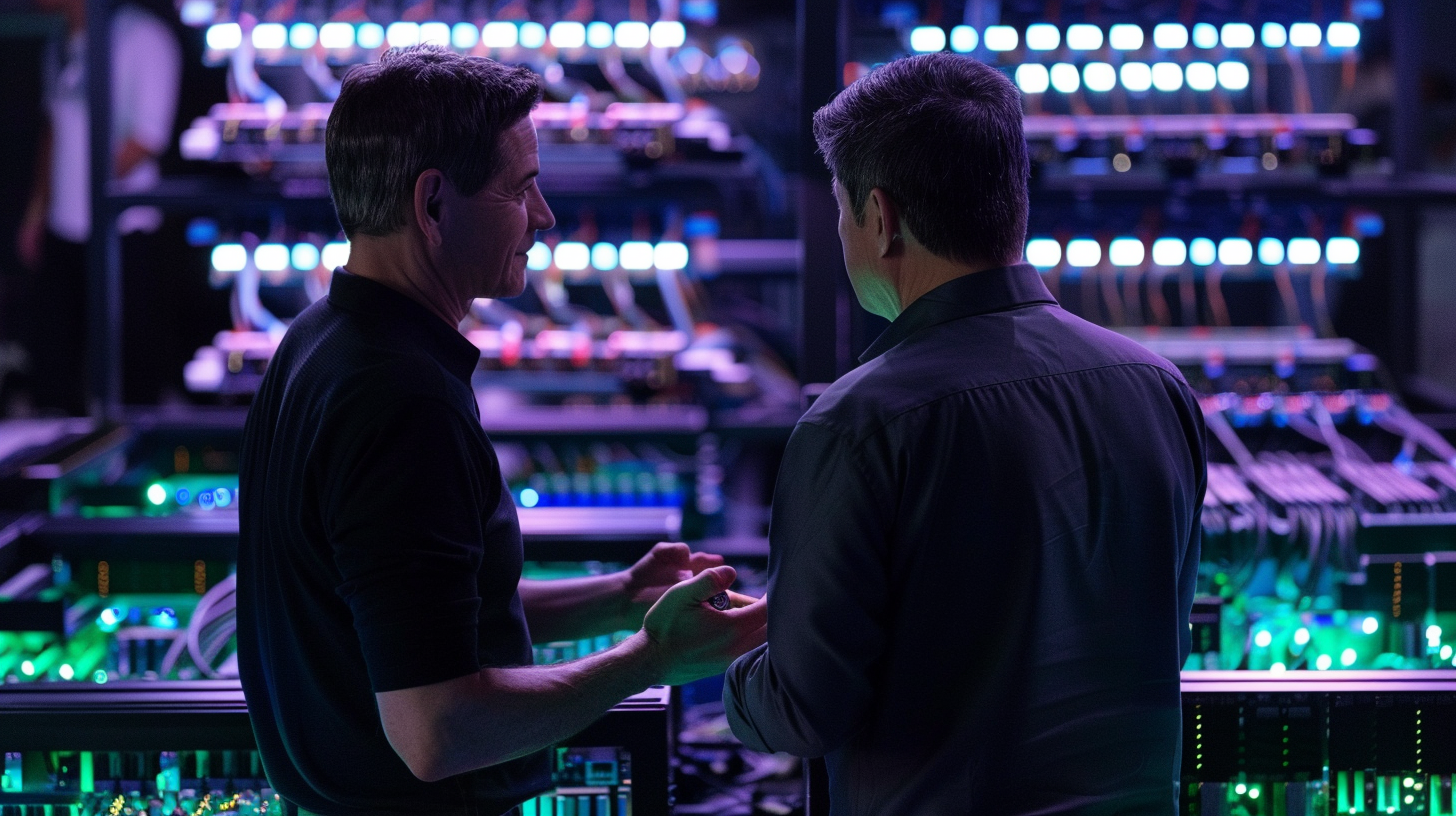
AI Supremacy: Nvidia Reigns as ChatGPT 4.0 Intensifies the Chip Wars

The release of ChatGPT 4.0 by Anthropic has sent shockwaves through the tech world, with the AI model boasting unprecedented “human-level performance” across professional exams like the bar exam, SAT reading, and SAT math tests. As generative AI pioneers like OpenAI double down, one company has emerged as the indispensable force – Nvidia.

Nvidia’s cutting-edge GPUs provided the colossal computing power to train ChatGPT 4.0, which OpenAI hails as a seminal leap showcasing “more reliable, creative” intelligence than prior versions. The startup, backed by billions from Microsoft, turned to Microsoft Azure’s Nvidia-accelerated infrastructure to create what it calls the “largest” language model yet.

This scaling up of ever-larger foundational models at staggering financial costs is widely seen as key to recent AI breakthroughs. And Nvidia has established itself as the premier supplier of the high-performance parallelized hardware and software stack underpinning this generative AI revolution.

Major tech titans like Google, Microsoft, Meta, and Amazon are all tapping Nvidia’s specialized AI acceleration capabilities. At Google’s latest conference, CEO Sundar Pichai highlighted their “longstanding Nvidia partnership”, with Google Cloud adopting Nvidia’s forthcoming Blackwell GPUs in 2025. Microsoft is expected to unveil Nvidia-powered AI advancements at its Build event this week.

The AI chip wars are white-hot as legacy CPU makers desperately try dislodging Nvidia’s pole position. However, the chipmaker’s first-mover innovations like its ubiquitous CUDA platform have cemented its technological lead. Nvidia’s co-founder and CEO Jensen Huang encapsulated this preeminence, proudly declaring Nvidia brought “the most advanced” chips for OpenAI’s milestone AI demo.

With the AI accelerator market projected to swell into the hundreds of billions, Nvidia is squarely at the center of an infrastructure arms race. Hyperscalers are spending billions building out global AI-optimized data centers, with Meta alone deploying 350,000 Nvidia GPUs. Each breakthrough like GPT-4.0’s human-level exam performance reinforces Nvidia’s mission-critical role.

For investors, Nvidia’s lofty valuation and triple-digit stock gains are underpinned by blistering financial performance riding the generative AI wave. With transformative, open-domain AI models like GPT-4.0 being commercialized, Nvidia’s high-margin GPU cycles will remain in insatiable demand at the vanguard of the AI big bang.

Competitive headwinds will persist, but Nvidia has executed flawlessly to become the catalyzing force powering the most remarkable AI achievements today. As GPT-4.0 showcases tantalizing human-level abilities, Nvidia’s unbridled prowess in the AI chip arena shows no signs of waning.

Want small cap opportunities delivered straight to your inbox?

Channelchek’s free newsletter will give you exclusive access to our expert research, news, and insights to help you make informed investment decisions.

Get Instant Access

Apple’s AI Ambitions Could Involve Major Partnerships

Apple is actively exploring partnerships with tech giants like Google and OpenAI as it accelerates its artificial intelligence efforts, according to a recent report from Bloomberg. The iPhone maker is said to be in “active negotiations” with Google to integrate the search giant’s Gemini generative AI into future Apple products and services.

The potential deal would give Apple access to Google’s advanced AI capabilities, allowing it to rapidly implement features like AI-powered text and image generation into offerings like iOS, Siri, and its productivity apps. Bloomberg reports that Apple has also considered integrating OpenAI’s viral ChatGPT model, highlighting the company’s willingness to leverage external AI expertise.

This openness to AI partnerships represents a strategic shift for the traditionally vertically integrated Apple. CEO Tim Cook confirmed earlier this year that the company is devoting “tremendous time and effort” to generative AI, with plans to release AI-powered features to consumers “later this year” with iOS 18. However, Apple’s in-house AI development efforts are reportedly lagging rivals.

While Apple employees have been testing an internal AI assistant called “Apple GPT,” the company’s generative AI tech is described as less capable than that of Microsoft, Google, and others. A partnership would allow Apple to utilize cutting-edge cloud AI while its own large language model, codenamed “Ajax,” continues development.

For Google, scoring an AI integration deal with its chief mobile rival would be a coup – expanding its AI’s reach to over 2 billion active iPhones globally. It could also strengthen Google’s position amid intensifying regulatory scrutiny over its lucrative deals making Google Search the default on Apple devices.

The two tech titans already have an $18 billion annual agreement in place for Google to be the preloaded search engine on iPhones and iPads. Adding AI services could make this partnership even more lucrative and harder for regulators to disentangle.

However, the deal risks being perceived as an admission from Apple that its AI capabilities lag behind Google’s, at least for now. Apple prides itself on cutting-edge silicon and integrated hardware/software experiences. Relying on Google’s AI could undermine its position as an innovation leader.

Apple may aim to provide on-device AI through its own models, while tapping Google’s cloud AI for more intensive generative tasks like text prompts or image creation. It’s already taken this hybrid approach with other services like Maps and web search.

Another complicating factor is Apple’s historical stance on privacy and protecting user data. Integrating Google’s AI could raise concerns about data sharing and usage policies that differ from Apple’s privacy-centric approach.

While the negotiations underscore Apple’s AI ambitions, many details remain unclear – including potential branding, business terms, technical implementation, or whether a deal will even be reached. Bloomberg reports any announcement is unlikely before Apple’s Worldwide Developers Conference in June.

As the AI Arms race intensifies, Apple is evidently willing to consider previously unorthodox partnerships and concessions to avoid falling behind rivals in this revolutionary technological domain. How it balances AI capabilities with its core principles and ultimately delivers its AI-powered user experiences will be crucial to maintaining its industry-leading device ecosystem.

OpenAI CEO Sam Altman Seeks Multi-Trillion Investment for AI Chip Development

OpenAI CEO Sam Altman is reportedly seeking multi-trillion dollar investments to transform the semiconductor industry and accelerate AI chip development according to sources cited in a recent Wall Street Journal article. The ambitious plan would involve raising between $5 to $7 trillion to overhaul global chip fabrication and production capabilities focused on advanced AI processors.

If secured, this would represent the largest private investment for AI research and development in history. Altman believes increased access to specialized AI hardware is crucial for companies like OpenAI to build the next generation of artificial intelligence systems.

The massive capital infusion would allow a dramatic scaling up of AI chip manufacturing output. This aims to alleviate supply bottlenecks for chips used to power AI models and applications which are currently dominated by Nvidia GPUs.

Altman has been open about the need for expanded “AI infrastructure” including more chip foundries, data centers, and energy capacity. Developing a robust supply chain for AI hardware is seen as vital for national and corporate competitiveness in artificial intelligence in the coming years.

OpenAI has not confirmed the rumored multi-trillion dollar amount. However, Altman is currently meeting with investors globally, especially in the Middle East. The government of the United Arab Emirates is already onboard with the project.

By reducing reliance on any single vendor like Nvidia, OpenAI hopes to foster a more decentralized AI chip ecosystem if enough capital can be deployed to expand production capacity exponentially. This ambitious initiative points to a future where specialized AI processors could become as abundant and critical as microchips are today.

The semiconductor industry may need to prepare for major disruptions if OpenAI succeeds in directing unprecedented investment towards AI infrastructure. While Altman’s tactics have drawn criticism in the past, he has demonstrated determination to position OpenAI at the forefront of the AI chip race.

Altman ruffled some feathers previously by making personal investments in AI chip startups like Rain Neuromorphics while leading OpenAI. This led to accusations of conflict of interest which contributed to Altman’s temporary removal as CEO of OpenAI in November 2023.

Since returning as CEO, Altman has been working diligently to put OpenAI in the driver’s seat of the AI chip race. With billions or even trillions in new capital, OpenAI would have the funds to dominate R&D and exponentially increase chip production for the AI systems of tomorrow.

If realized, this plan could significantly shift the balance of power in artificial intelligence towards companies and nations that control the means of production of AI hardware. The winners of the AI era may be determined by who can mobilize the resources and infrastructure to take chip development to the next level.

Microsoft Scores AI Talent by Hiring OpenAI’s Sam Altman

Microsoft emerged victorious in the artificial intelligence talent wars by hiring ousted OpenAI CEO Sam Altman and other key staff from the pioneering startup. This coup ensures Microsoft retains exclusive access to OpenAI’s groundbreaking AI technology for its cloud and Office products.

OpenAI has been a strategic partner for Microsoft since 2019, when the software giant invested $1 billion in the nonprofit research lab. However, the surprise leadership shakeup at OpenAI late last week had sparked fears that Microsoft could lose its AI edge to hungry rivals.

Hiring Altman and other top OpenAI researchers nullifies this threat. Altman will lead a new Microsoft research group developing advanced AI. Joining him from OpenAI are co-founder Greg Brockman and key staff like Szymon Sidor.

This star-studded team will provide Microsoft with a huge boost in the race against Google, Amazon and Apple to dominate artificial intelligence. Microsoft’s share price rose 1.5% on Monday on the news, adding nearly $30 billion to its valuation.

The poaching also prevents Altman from jumping ship to competitors, according to analysts. “If Microsoft lost Altman, he could have gone to Amazon, Google, Apple, or a host of other tech companies,” said analyst Dan Ives of Wedbush Securities. “Instead he is safely in Microsoft’s HQ now.”

OpenAI Turmoil Prompted Microsoft’s Bold Move

The impetus for Microsoft’s talent grab was OpenAI’s messy leadership shakeup last week. Altman and other executives were reportedly forced out by OpenAI board chair.

The nonprofit recently created a for-profit subsidiary to commercialize its research. This entity was prepping for a share sale at an $86 billion valuation that would financially reward employees. But with Altman’s ouster, these lucrative payouts are now in jeopardy.

This uncertainty likely prompted top OpenAI staff to leap to the stability of Microsoft. Analysts believe more employees could follow as doubts grow about OpenAI’s direction under Emmett Shear.

Microsoft’s infrastructure and resources also make it an attractive home. The tech giant can provide the enormous computing power needed to develop ever-larger AI models. OpenAI’s latest system, GPT-3, required 285,000 CPU cores and 10,000 GPUs to train.

By housing OpenAI’s brightest minds, Microsoft aims to supercharge its AI capabilities across consumer and enterprise products.

The Rise of AI and Competition in the Cloud

Artificial intelligence is transforming the technology landscape. AI powers everything from search engines and digital assistants to facial recognition and self-driving cars.

Tech giants are racing to lead this AI revolution, as it promises to reshape industries and create trillion-dollar markets. This battle spans hardware, software and talent acquisition.

Microsoft trails category leader Google in consumer AI, but leads in enterprise applications. Meanwhile, Amazon dominates the cloud infrastructure underpinning AI development.

Cloud computing and AI are symbiotic technologies. The hyperscale data centers operated by Azure, AWS and Google Cloud provide the computational muscle for AI training. These clouds also allow companies to access AI tools on-demand.

This has sparked intense competition between the “Big 3” cloud providers. AWS currently has 33% market share versus 21% for Azure and 10% for Google Cloud. But Microsoft is quickly gaining ground.

Hiring Altman could significantly advance Microsoft’s position. His team can create exclusive AI capabilities that serve as a differentiator for Azure versus alternatives.

Microsoft’s Prospects in AI and the Stock Market

Microsoft’s big OpenAI poach turbocharged its already strong prospects in artificial intelligence. With Altman on board, Microsoft is better positioned than any rival to lead the next wave of AI innovation.

This coup should aid Microsoft’s fast-growing cloud business. New AI tools could help Microsoft chip away at AWS’s dominance while holding off Google Cloud.

If Microsoft extends its edge in enterprise AI, that would further boost revenue and earnings. This helps explain Wall Street’s positive reaction lifting Microsoft’s stock 1.5% and adding $30 billion in market value.

The success of cloud and AI has fueled Microsoft’s transformation from a stagnant also-ran to a Wall Street darling. Its stock has nearly tripled since early 2020 as earnings rapidly appreciate thanks to its cloud and subscription-based revenue.

Microsoft stock trades at a reasonable forward P/E of 25 and offers a dividend yield around 1%. If Microsoft keeps leveraging AI to expand its cloud business, its stock could have much further to run.

Hiring Altman and deploying OpenAI’s technology across Microsoft’s vast resources places a momentous technology advantage within the company’s grasp. Realizing this potential would be a major coup for Satya Nadella as CEO. With OpenAI’s crown jewels now safely in house, Microsoft’s tech lead looks more secure than ever.

The Convergence of AI and Cryptocurrency, OpenAI’s Big Project

Worldcoin Crypto Project Launched by OpenAI’s Sam Altman

In a revolutionary move, OpenAI CEO Sam Altman began rolling out Worldcoin on July 24. The cryptocurrency project aims to reinvent the way the world identifies living, breathing humans compared to AI bots. The core offering of Worldcoin is its innovative World ID, often described as a “digital passport” that serves as proof of a person’s human identity. But that is just the beginning of the project goals.

To obtain a World ID, users must undergo an in-person iris scan using Worldcoin’s revolutionary ‘orb.’ This silver ball, about the size of a bowling ball, ensures the legitimacy of the individual’s identity, subsequently creating the unique World ID.

The brains behind this revolutionary project are the San Francisco and Berlin-based organization, Tools for Humanity. During its beta phase, the project amassed an impressive 2 million users, and with the official launch on Monday, Worldcoin is rapidly expanding its ‘orbing’ operations to 35 cities across 20 countries.

In select countries, early adopters will be rewarded with Worldcoin’s own cryptocurrency token, WLD. This incentive has already driven WLD’s price to soar after the announcement. On Binance, the world’s largest, WLD reached a peak price of $5.29 and continued to trade at $2.49 (from an initial starting price of $0.15) as of 11:00 AM ET. Notably, the trading volume on Binance has reached a staggering $25.1 million.

The Role of Blockchain

Blockchains play a crucial role in this project, as they securely store World IDs while preserving user privacy and preventing any single entity from controlling or shutting down the system, according to co-founder Alex Blania.

One key application of World IDs is its ability to distinguish between real individuals and AI bots in the age of generative AI chatbots like ChatGPT, which are  adept at mimicking human language. By leveraging World IDs, online platforms can effectively combat the infiltration of AI bots into human interactions.

Economic Implications of AI

Altman emphasized the economic implications of AI, stating that people will be profoundly impacted by AI’s capabilities. “People will be supercharged by AI, which will have massive economic implications,” he said.

One interesting example of what Altman believes AI can eventually provide is universal basic income (UBI), a social benefits program aimed at providing financial support to every individual. According to Altman, as AI gradually takes over many human tasks, UBI can play a vital role in mitigating income inequality. Since World IDs are exclusive to genuine human beings, they can act as a safeguard against fraud in UBI distributions.

Though Altman acknowledged that a world with widespread UBI is likely in the distant future and the logistics of such a system are still unclear, he believes that Worldcoin paves the way for experiments and solutions to tackle this societal challenge.

The launch of Worldcoin marks a significant step in the convergence of cryptocurrency and AI technologies, with potential far-reaching effects on how we identify ourselves and interact in the digital age. As the project gains momentum, financial market professionals should closely monitor the developments surrounding Worldcoin and its impact on the future of money.

Paul Hoffman

Managing Editor, Channelchek

Sources

https://worldcoin.org/cofounder-letter

https://www.theblock.co/post/219541/sam-altmans-worldcoin-unveils-world-id-protocol-and-sdk?utm_source=basicrss&utm_medium=rss

https://www.reuters.com/technology/openais-sam-altman-launches-worldcoin-crypto-project-2023-07-24/