An Investor List of the Industries that Can be Improved With Blockchain Technology

Blockchain Beyond Cryptocurrency: The Potential of Distributed Ledger Technology

Does blockchain have a future beyond crypto? Since its beginning as the underlying technology for Bitcoin (BTC) and later other cryptocurrencies, blockchain has been the necessary, behind-the-scenes, engine that allow these fintech currencies to function. Dogecoin (DOGE), Ethereum (ETH), and even the 18 G20 countries developing a central bank digital currency (CBDC) need blockchain to exist.  

But what non-finance industries are being impacted or will be disrupted by blockchain? It is not with exaggeration to say blockchain has the power to revolutionize various industries and redefine everyday transactions, manage data, and establish trust. Long-term investing requires knowledge of current trends and where the future may take them. Below we explore many of the possibilities of blockchain aside from cryptocurrency and delve into its promising future.

What is Blockchain?

At its core, blockchain is a decentralized (no single control) and immutable (unable to be changed) ledger that records activity across multiple computers. This distributed character replaces the need for institutional intermediaries to ensure transparency, security, and efficiency. A person or an entity can function, even across borders directly, without the need for a middleman. Verification of activity is recorded and remains a part of a blockchain ledger.

Uses beyond cryptocurrency, or the speculative investment that crypto and non-fungible tokens (NFT) have become, include health care, finance, voting, real estate titles, and smart communities.

Health Care

The HIPAA Privacy Rule sets national standards to protect individuals’ medical records and other identifiable health information. It applies to health plans, healthcare clearinghouses, and healthcare providers that conduct certain medical transactions electronically. The purpose is to keep data ownership from improperly being passed and to maintain privacy in the industry. Current centralized systems are not able to meet the many needs of patients, health service providers, insurance companies, and governmental agencies. Blockchain technology enables a decentralized system for access control of medical records where all stakeholders’ interests are protected.

Blockchain systems not only allow healthcare service providers to securely share patients’ medical records but patients may also track who has accessed their records and determine who is authorized to do so. If blockchain-driven, all transactions can become transparent to the patient.

And blockchain-powered interoperability can enable the seamless sharing of medical data between healthcare organizations, improving patient care, research, and drug development.

Supply Chain Management

Complex global supply chains involve numerous stakeholders, some sending, others receiving, and others verifying the source of food or products. Verifying the authenticity and improving traceability of products can be a challenging task. Blockchain’s ability to create an immutable record of every transaction and movement along the supply chain enables transparency and accountability. A company will be able to securely track the origin, manufacturing process, and movement of goods. Consumers can be equipped with verified information, among other benefits, this will increase trust and reduce the risk of receiving counterfeit products.

Storing information regarding movement on a blockchain improves integrity, accountability and traceability. For example, IBM’s Food Trust uses a blockchain system to track food items from the field to retailers. The participants in the food supply chain record transactions in the shared blockchain, which simplifies keeping track.

Entertainment Products

As technology has allowed greater reproduction and distribution, including music and art, blockchain may provide creators with more control over their work. The whole entertainment industry may undergo a significant transformation with blockchain technology. Artists can tokenize their efforts, creating a digital certificate of ownership that can be bought, sold, and shared on blockchain platforms. This will enable artists to have tight control over their intellectual property, receive fair compensation, and even establish a direct connection with their followers. Beyond ownership infringement, blockchain can facilitate transparent royalty distribution, this could ensure that artists receive their rightful earnings without an intermediary and the cost that comes with anyone getting in the middle of a transaction.

The Energy Sector

Blockchain is likely to play a transformative role in all forms of energy. As renewable energy sources continue their trend, blockchain can enable peer-to-peer energy trading. Individuals and organizations will be able to directly exchange surplus energy with those expecting an energy deficit. This could create a decentralized energy market.

Smart contracts executed on the blockchain can automatically verify and settle transactions, ensuring transparency. This democratization of energy, if broadly implemented, could accelerate the adoption of sustainable practices, provide energy where needed, and reduce waste.

Governments

While the government is often the intermediary that the blockchain makes less needed or unneeded, recognizing the potential of blockchain to enhance transparency and efficiency in public services may become its greatest use. Land registries, taxation, voting systems, and identity certainty can all be improved through blockchain’s tracking and tamper-resistant design. Immutable records of land ownership can reduce disputes and increase trust in property transactions. Digital identities stored on a blockchain can streamline processes such as passport verification and border control, making them more secure and efficient. Blockchain-based voting systems have the potential to eliminate voter fraud, ensuring fair and transparent elections.

Potential

Much of what is described above has either barely been implemented or has not been put to use. This is a period in any technological advancement when most long-term investors would like to be involved. Efficiencies and improved products are poised to help the industries mentioned, and pure blockchain companies, large and small, can benefit from developing uses for their technology.

Despite its potential, blockchain technology still faces challenges. Scalability, energy consumption, and regulatory frameworks require further development and refinement. However, ongoing research and collaborations among businesses, academia, industry, and policymakers are actively finding avenues around these concerns, driving the maturation of blockchain technology.

Take Away

Blockchain is still in its infancy, and industries are just becoming aware of its power to help them. As the paradigm shifts, it could become a technology businesses could not imagine doing without. Blockchain’s decentralized, transparent, and secure nature makes it a powerful tool for revolutionizing healthcare, supply chain management, entertainment, governing, and energy sectors. As the technology evolves, we can expect innovative use and widespread adoption of blockchain that serves to elevate trust, efficiency, and transparency. And maybe the now-developed cryptocurrencies will survive within these changes.

Paul Hoffman

Managing Editor, Channelchek

Sources

https://www.investopedia.com/tech/forget-bitcoin-blockchain-future/

https://www.hhs.gov/hipaa/for-professionals/privacy/index.html

https://www.ibm.com/products/supply-chain-intelligence-suite/food-trust

https://www.investopedia.com/10-biggest-blockchain-companies-5213784

What You Should Know About the Canton Network Blockchain Announcement

The “Who’s Who” of Tech and Finance Join Forces in Blockchain Collaboration

A new partnership between financial giants, tech behemoths, media monsters, and leaders in digitization just announced plans to launch what they call Canton. What is Canton? In a press release dated May 9, The Canton Network says it is “the industry’s first privacy-enabled interoperable blockchain network designed for institutional assets and built to responsibly unlock the potential of synchronized financial markets.” What does that mean? We’ll take it one piece at a time below.

The announcement describes the Canton Network as building toward being an interoperable blockchain with privacy features designed for the institutional asset management industry. It aims to allow “previously siloed” financial assets to be able to synchronize, making it possible to interconnect diverse financial markets.

The list of partners is a “Who’s Who” list of companies that are considered among the best in their individual specialties.

Canton Participants include, in alphabetical order:

3Homes, ASX, BNP Paribas, Broadridge, Capgemini, Cboe Global Markets, Cumberland, Deloitte, Deutsche Börse Group, Digital Asset, The Digital Dollar Project, DRW, Eleox, EquiLend, FinClear, Gambyl, Goldman Sachs, IntellectEU, Liberty City Ventures, Microsoft, Moody’s, Paxos, Right Pedal LendOS, S&P Global, SBI Digital Asset Holdings, Umbrage, Versana, VERT Capital, Xpansiv, and Zinnia.

The announcement proclaims that The Canton Network will provide “a decentralized infrastructure that connects independent applications built with Daml, Digital Asset’s smart-contract language.” The result will be “a ‘network of networks’, allowing previously siloed systems in financial markets to interoperate with the appropriate governance, privacy, permissioning and controls required for highly regulated industries.”

 The Canton Network intends to enable financial institutions to experience a safer and reconciliation-free environment where assets, data, and cash can synchronize freely across applications. The end product will be opportunities for financial institutions to offer new innovative products to their clients while enhancing their efficiency and risk management.

An example provided by Canton is asset registers and cash payment systems which are distinct and siloed systems in today’s markets. With the new Canton Network, a digital bond and a digital payment can be composed across two separate applications into a single transaction, guaranteeing simultaneous exchange without operational risk. Similarly, a digital asset could be used in a collateralized financial transaction via connection to a repo or leveraged loan application.

Bloomberg calls the new venture “a collaborative effort that could be crucial to ledger technology in the finance market.” In addition, the group is striving to integrate “disparate institution applications,” which could have a positive impact on the entire industry.

The press release expalained that until Canton, smart contract blockchain networks have not achieved meaningful adoption among financial institutions and other enterprises because of three significant shortfalls:

  • The lack of privacy and control over data: other chains have shortcomings around privacy that prevent the use of the technology by multiple regulated participants on the same network. There are currently no other blockchains that can offer data protection or control at any layer of its network.
  • Other blockchains have had to accept trade-offs between control and interoperability: other chains require operators to forfeit their full control of applications by using a shared pool of validators to gain interoperability.
  • The inability to scale: with applications competing for global network resources and the inherent capacity limitations caused by how public blockchains operate, achieving the scale and performance financial institutions need remains challenging.

The Canton Network expects to remove these obstacles by balancing the decentralization of a network with the privacy and controls needed to operate within a sound regulatory environment.

The network expects to raise the bar on safety and soundness in blockchain financial interactions by enabling network users to safeguard permissions, exposure, and interactions across Canton, to comply with security, regulatory and legal requirements.

The network can connect innovative blockchain solutions in market today, such as Deutsche Börse Group’s D7 post-trade platform and Goldman Sachs’ GS DAP™, while retaining privacy and permissioning. As more Daml-built applications go into production this year and beyond, the number of connections on the Canton Network are expected to grow exponentially. For example, one application’s monthly notional traded exceeds the most active crypto token volumes.

Canton Network participants will begin testing interoperability capabilities across a range of applications and use cases in July.

The network will bring together blockchain applications built with Daml, the smart-contract language devised by Digital Asset. The team-up is the result of years of blockchain research and development by the tech and finance industry’s giants that are involved.

Paul Hoffman

Managing Editor, Channelchek

Sources

https://www.businesswire.com/news/home/20230509005497/en/New-Global-Blockchain-Network-of-Networks-for-Financial-Market-Participants-and-Institutional-Assets

https://www.bloomberg.com/press-releases/2023-05-09/new-global-blockchain-network-of-networks-for-financial-market-participants-and-institutional-assets

Blockchain and Web 3 Communities Get More Visibility Into Their Networks

Image Credit: Dejan Krsmanovic (Flickr)

Helping Blockchain Communities Fix Bugs

Zach Winn | MIT News Office

If the crypto enthusiasts are right, the next decade will see billions of people begin using applications built off distributed, user-owned blockchains. The new paradigm has been dubbed Web 3. But Web 3 still has some significant challenges to overcome if it’s going to replace the digital world as we know it.

Blockchain networks, for instance, are going to need an efficient way of detecting and resolving performance problems. Current analytics tools are built for companies to monitor their websites and apps. Such services need only be designed for one user. In the decentralized world of the blockchains, however, the users are the owners, turning the traditional model of maintenance and bug fixes on its head.

The company Metrika, founded by an MIT alumnus, has developed a suite of tools to help the distributed communities of the blockchain world monitor and improve their networks. The company allows users to create alerts, access reports, and view real-time community dashboards that visualize network performance, problems, and trends over time.

“Metrika is a community-based monitoring and collaboration platform,” founder and CEO Nikos Andrikogiannopoulos SM ’06, MBA ’11 says. “We’re making [blockchain network] telemetry a public good for everyone. These applications are holding billions of dollars in assets, so it’s unimaginable that we wouldn’t have service assurance and deep visibility of what is happening in real-time.”

Metrika is currently providing services for popular blockchain protocols including Ethereum, Algorand, Flow, and Solana. The company plans to expand that list as other networks grow in popularity in hopes of enabling the much-hyped shift to Web 3.

“Our vision at Metrika is to become a critical layer of the Web 3 world,” Andrikogiannopoulos says. “Ten years from now, kids will be interacting with assets on their mobile phone. The idea of a bank account will be foreign to them. There will be no corner banks. The whole idea of finance will not go through physical stores and bank accounts — you’ll have assets on every application you use. In that world, where everything is happening on a blockchain, how can Metrika help provide the observability, reliability, and visibility of the blockchain network?”

Bouncing Ideas Off MIT

Andrikogiannopoulos first came to MIT as a graduate student in 2004 and he likes to say he never really left. To this day he lives in Cambridge with his wife, who works at MIT, and returns to campus often.

After earning his second MIT degree, an MBA from the Sloan School of Management, Andrikogiannopoulos began a telecommunications consulting job. During lunch breaks, he’d return to MIT to work with the Venture Mentoring Services (VMS), where entrepreneurs from the MIT community can connect with mentors and receive advice. While kicking around telecommunications startup ideas, a VMS mentor connected him to internet entrepreneur Rubin Gruber, who suggested he explore the blockchain space instead.

It was mid 2018 — what many remember as the “crypto winter” for the lull in blockchain hype and the corresponding crash of crypto prices. But Andrikogiannopoulos began researching the industry and networking with people in the blockchain space, including an MIT alumnus working at the blockchain company Algorand, which was founded by Silvio Micali, the Ford Foundation Professor of Engineering at MIT.

A few months after their initial talk, Andrikogiannopoulos returned to Gruber’s office and told him blockchains were lacking monitoring and operational intelligence.

The problem stems from the decentralized structure of blockchains. Each user operates as a node in the system by creating, receiving, and moving data through their server. When users encounter a problem, they need to figure out if the problem lies within their node or involves the network as a whole.

“They might go on Twitter and Discord and ask other users what they’re experiencing,” Andrikogiannopoulos says. “They’re trying to triangulate the problem, and it takes several hours for them to figure out the issue, coordinate a response, and resolve it.”

To build Metrika, Andrikogiannopoulos set up open-source nodes across the globe that pull data from the nodes and networks, then aggregate those data into easy-to-understand reports and other tools.

“We act as public infrastructure, so users get visibility through dashboards, alerting, and reports, and then we add collaboration tools on top of that,” Andrikogiannopoulos explains.

By 2019, Metrika had begun detecting problems with node performance, staking, network latency, and errors like blocks not being produced at the right rate. Andrikogiannopoulos showed his progress to employees at Algorand, who expressed interest, so he continued building out Metrika’s suite of tools.

“You can see the idea of Metrika bounced across the entire MIT ecosystem,” Andrikogiannopoulos says. “It’s crucial when you start companies that you have these kinds of insight and resource-rich environments like MIT, where you can iterate on your ideas and find team members to join you.”

Enabling Web 3

Blockchains are no longer a niche technology. Around the world, companies in finance and logistics, as well gamers and other creatives, are adopting the technology.

“The blockchain world up to today has been a large experiment,” Andrikogiannopoulos says. “A lot of this infrastructure just hasn’t been built. But Bitcoin proved this can work outside of the traditional finance world, and Ethereum is bringing it to another level with applications, smart contracts, and by creating essentially a decentralized, smart computer. We think about enabling that world we see coming.”

As Metrika continues building out solutions to monitor blockchains, it also wants to offer services for the many applications being built on top of that infrastructure.

“In the future, if a blockchain transaction doesn’t go through and you’re Goldman Sachs or JP Morgan, you need to know why that transaction didn’t go through and what happened,” Andrikogiannopoulos says. “Or if you’re an application playing a game or buying assets and the transactions are lagging, you need to understand why the user experience is being impacted. In Web 3 these things are every important because of the scale and the flow of value we’re talking about.”

For Nikos, improving blockchain performance is not just about optimizing networks. It’s also about helping to usher in the world of open finance and open applications that Web 3 promises.

“We’ve reached 17 hours of outage on blockchain networks in some cases, but what’s even more important to me is not the outages themselves, but the infrastructure needed to avoid them as the industry continues maturing,” Nikos says. “These problems can compromise trust as we’re onboarding users into the Web 3 world. Metrika’s mission is to enable a compelling Web 3 ecosystem.”

Uses for Blockchain Beyond Crypto are Growing

Christian Bucad (Flickr)

Why Blockchain Could Mean Fewer Hassles for Students and Workers Proving their Credentials

Microcredentials — attestations of proficiency in a specific skill or knowledge base that are certified by an authority — can provide evidence of a person’s skills to employers.

While microcredentials are becoming more popular, the concept is hardly new: A driver’s license or the St. John Ambulance certificate could be considered as microcredentials, attesting respectively to a person’s driving skill or their competency in administering first aid.

Blockchain technology is appropriate for microcredential implementation. Blockchain can best be described as a digital ledger that records information that can be shared among a community of users. Bitcoin and other crypto-currencies are the best-known examples of blockchain, but blockchain has uses beyond financial transactions.

Student records stored in blockchain for security limit access only to legitimate users, such as institutional administrators and potential employers selected by students or job seekers. Traditionally, institutions own and control certifications like degrees, but that could shift with “digital degrees” and microcredentials that rely on blockchain.

Verifying Accomplishments

Besides providing effective security and privacy for users, blockchain can also facilitate the maintenance and dissemination of the credentials, while ensuring that access is readily available for students under their control.

Because of its immutability, blockchain can be used to attest to and verify students’ accomplishments. This is important for students seeking to have their credits recognized, whether because they are studying to obtain new professional accreditation, studying in multiple institutions or because they are moving for study or employment.

Blockchain is distributed, meaning that multiple copies of the same information are stored on different computers. So, blockchain is not controlled by any central authority and the “blocks” in the “chain,” linked chronologically, are shared in a P2P (peer-to-peer) network, which can be accessed from any node or point on the network.

These blocks are immutable, as any change to the original leaves the first iteration intact and accessible.

When students or job seekers want to have credits transferred between institutions, gatekeepers — for example, post-secondary institutions or employers — typically insist on receiving copies of diplomas and degrees directly from each institution. As more students gain credentials from multiple institutions, this process becomes increasingly untenable.

Students need to control this process and blockchain can provide a solution.

Securely Validates Learning

In 2019, McMaster University announced it was awarding “digital degrees” using blockchain to Faculty of Engineering students after the university implemented microcredentials using blockchain to securely validate students’ learning.

Some post-secondary institutions are implementing pilot projects with eCampus Ontario and industry partners to award microcredentials using blockchain.

Microcredentials are now offered by post-secondary institutions, sometimes in partnership with corporations to target labor market needs. These may come in the form of “digital badges.” Digital badges are easily verifiable testaments to when, where and how skills have been mastered. Metadata in digital badges allows viewers to click on the badge to learn things like criteria for earning the badge, the date it was issued or when it expires.

Maintaining Privacy of Data

Certification by blockchain begins when a trusted institution issues the microcredential and creates a blockchain. The student then sends a public key password to the institution, requesting a transcript be sent to a potential employer.

The institution then adds a block onto the blockchain and sends the micro-credential, which is verified and forwarded to the potential employer. The learners can keep private keys to their credentials in an offline digital wallet.

Maintaining the privacy of the data is essential. With blockchain, the ownership of the microcredential rests with the individual, not the institution.

Blockchain supports more control for students and has the capability of further democratizing education. It empowers students to maintain control of their now-secure credentials and allows them to be confident their acquired skills and knowledge will be valued.

Potential Concerns

However, there are some ethical and logistical concerns. Right now, when a person seeks to transfer credits through traditional channels, they can choose which documents or certifications to share with employers: mistakes or aspects of one’s past credentials and experience deemed less salient or undesirable can be addressed or ignored.

But blockchain is immutable and this immutability can cause its own problems when mistakes cannot be erased.

Students cannot omit blocks from the chain that they do not feel are appropriate or that could damage their reputation. So, how can they create different narratives for diverse purposes or highlight and/or hide different experiences? What happens if someone wants or needs to start anew? Is there a right to forget?

What if a student loses their key? The New York Times reports that lost passwords have locked millionaires out of their bitcoin fortunes. Will students and workers fare any better when it comes to academic and professional records? Who will respond to these problems within institutions?

These are questions post-secondary institutions and our society at large will increasingly need to navigate.

This article was republished with permission from The Conversation, a news site dedicated to sharing ideas from academic experts. It represents the research-based findings and thoughts of Rory McGreal, Professor and UNESCO/ICDE Chair in Open Educational Resources, Athabasca University.

Planned Changes for a Greener Blockchain Leaves Uncertainties

Image Credit: Edwin Chewin (Flickr)

The Ethereum Merge Could Kick Off a Transformation in Crypto’s Battered Reputation

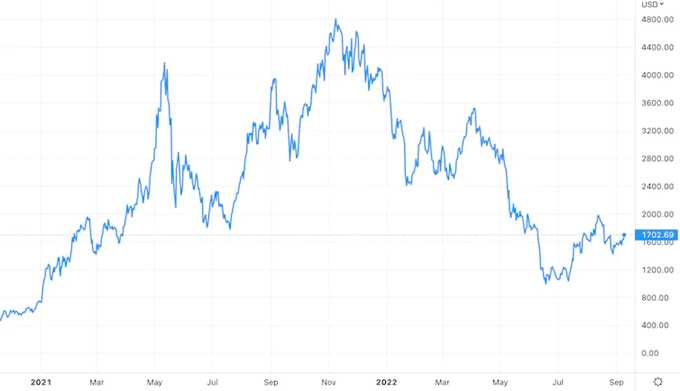
Cryptocurrencies might still be a very long way from their highs of 2021, but some of the major ones have staged some decent recoveries in the past couple of months. Notably ether (ETH), the second largest cryptocurrency after bitcoin, is trading at almost $US1,700 (£1,463) at the time of writing, having dropped as low as $US876 in mid-June.

Ether, which was created by Canadian/Russian programmer Vitalik Buterin, is the cryptocurrency used for transactions on Ethereum, the leading platform on which developers can applications using blockchain technology.

Blockchains are online ledgers that run without been controlled by any single company. Much of these applications revolve around smart contracts, which are automated contracts that remove the need for intermediaries such as lawyers and are seen as having huge potential for the future.

Ether Price ($US)

Source: Trading View

One of the main catalysts for ether’s rebound has been the Ethereum merge, a huge project to change the way the underlying blockchain operates. Where transactions on Ethereum are currently validated using an energy-intensive system known as proof-of-work (PoW), in which lots of very powerful computers compete to solve complex mathematical puzzles, from around September 15 it will shift to a new system known as proof of stake (PoS).

PoS basically means that transactions on the blockchain will be validated not by all these computations but by a network of investors whose commitment is demonstrated by the fact that they own at least 32 ether (yours for about $US54,000).

The idea is that this gives them an economic incentive to enhance the security of the network, and are therefore very unlikely to try and sabotage it. Whereas bitcoin transactions all depend on PoW, lots of newer cryptocurrencies use PoS, including Ethereum rivals such as Solana and Cardano.

Going Green

When the Ethereum merge takes place, power consumption on the blockchain will be reduced by 99%. Since it is currently the most used blockchain in terms of transactions, this will save a huge amount of electricity each year, corresponding to Chile’s power consumption.

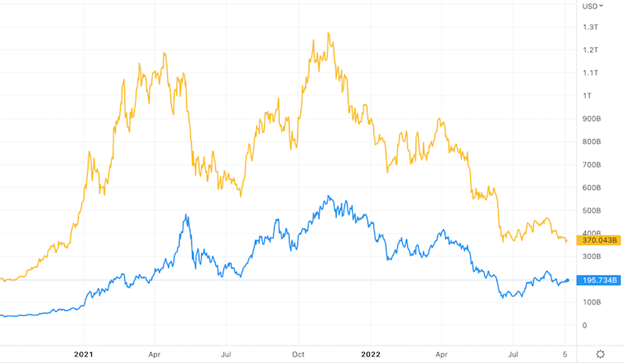
As a result of the merge, some analysts expect ether to overtake bitcoin as the leading crypto in terms of the total value of all the coins (in crypto circles this is referred to as the “flippening”). Ether is currently worth just over US$204 billion, while bitcoin is worth US$396 billion.

Bitcoin vs Ether

Bitcoin = yellow, Ether = blue. Trading View

Until now, cryptocurrencies and bitcoin in particular have suffered from a bad reputation. Bitcoin was initially conceived with the egalitarian goal of allowing investors access to a financial system with no need for banks and with money that isn’t controlled by countries. It has been championed for its ability to enable billions of people without bank accounts to transact online, and to facilitate things like microfinance and ultra-cheap cross-border trading.

Yet bitcoin has come to be associated with environmental degradation and criminal activities. The mainstream media has endlessly linked the leading cryptocurrency – and by extension the whole space – with money laundering, online drug dealing, Ponzi schemes and exchange hacking.

Netflix documentaries have further reinforced this negative public image. Recent scandals in the crypto world, such as the fall of Ethereum rival Luna and the bankruptcy of Celsius and other crypto lenders, have not helped either.

One major consequence has been that major financial institutions like investment banks and pension funds have been cautious of ploughing money into this space, despite the leap forward in technology that blockchains represent.

But if the most widely adopted crypto platform successfully shifts to PoW in the coming days, many believe that this will overcome the biggest institutional objection and see much more money flowing into the space (there are already early signs, such as Fidelity’s new crypto fund for retail investors). This is likely to accelerate the global regulatory framework that would minimise undesirable activities.

By closing down the environmental objections to crypto, other advantages to ether are likely to come to the fore. The merge will offer a return to investors in the form of rewards in exchange for locking up their money for a period of time (“staking”).

Although you need to stake 32 ether to become one of the network’s validators, numerous companies have set up systems to enable smaller investors to pool their money so that they can participate. For example, Binance, the world’s largest crypto exchange, offers investors 6% annual percentage yield for pooled staking on ether.

Staking will therefore create a win-win situation with guaranteed returns and a very liquid system that makes it easy for people to move their money in and out of ether. This will further enhance the appeal of ether and PoS cryptos in general.

This could help to accentuate other positives around crypto, another of which is humanitarian donations. When Russia invaded Ukraine, for instance, the Ukrainian government called for donations in bitcoin and ether to support its efforts against invaders. This quickly attracted substantial amounts of money.

Tonga was similarly successful with a campaign after its volcanic eruption earlier this year. By being able to cross borders easily and cheaply, cryptocurrencies are the ideal vehicle for international donations.

Lingering Uncertainties

All that said, it is uncertain how the Ethereum blockchain will function after the merge in terms of transaction speeds and costs. One major problem with Ethereum in the past has been that transactions have been ludicrously expensive, sometimes running to thousands of US dollars at peak times in 2021.

The developers of the Ethereum Foundation do not expect the merge to make a big difference in these respects (currently “gas” fees are averaging between $US1 and $US4 per transaction depending on which platform you are using). Much more important is likely to be another shift in ethereum’s journey to “Ethereum 2.0” known as sharding, which is due to happen in 2023.

We will also have to wait and see how smooth the merge is. Synchronisation and update bugs could see problems such as validators disconnected from the blockchain. Negative stories like these could see investors staying away for fear of instability. But on the whole, while the merge will not be a miraculous event, it could help improve the image of cryptocurrencies and attract institutional and retail investors. At a time when sustainable investing is increasingly high priority, the ether merge and its attractive returns have the potential to put ether at the top of the list.

This article was republished  with permission from The Conversation, a news site dedicated to sharing ideas from academic experts. It represents the research-based findings and thoughts of Jean-Philippe Serbera, Senior Lecturer in Banking And Financial Markets, Sheffield Hallam University.