Release – Harte Hanks Grows Annual Revenue, Increases Profitability and Ends 2022 with Strengthened Balance Sheet

Research News and Market Data on HHS

Company Expects Continued Revenue and EBITDA Growth in 2023

CHELMSFORD, MA / ACCESSWIRE / March 7, 2023 / Harte Hanks, Inc. (NASDAQ:HHS), a leading global customer experience company focused on bringing companies closer to customers for 100 years, today announced financial results for the fourth quarter and full-year period ended December 31, 2022. The results include one month of contribution from the acquisition of InsideOut Solutions in 2022, with no contribution in 2021. In addition, the results reflect the impact of the repurchase of all the Company’s outstanding Series A Convertible Preferred Shares (the “Preferred Shares”) from Wipro, LLC, the sole holder of the Preferred Shares, for a cash payment of $9.9 million, equal to the liquidation value, and 100,000 shares of Harte Hanks common stock.

Harte Hanks CEO, Brian Linscott, commented: “This was an important year for Harte Hanks, with results that reflect the successful culmination of our restructuring and the emergence of sustainable, profitable growth based on a differentiated offering and solid relationships with our top-tier customers. Our improved financial results have enabled us to materially strengthen our balance sheet. We have streamlined our capital structure by eliminating our debt and redeeming our preferred shares, thereby eliminating the dilutive effect of preferred shares going forward. Simultaneously, our pension liability was reduced by nearly $15 million, positioning us to commence the process to transfer one of our qualified pensions to a third party.”

“We have proven our operating leverage and earnings power with continued growth. Our 6% full-year revenue growth translated to a near doubling of operating income and a 75% increase in EBITDA,” concluded Linscott. “Demand for our solutions continues to grow, offsetting headwinds from the culmination of pandemic-related projects. We anticipate continued revenue and EBITDA growth for the full year of 2023, even though our first quarter results will include modest revenue growth and lower EBITDA on a year-over-year basis as result of an abnormally strong comparison period in 2022 driven by revenue mix.”

Fourth Quarter Financial Highlights

  • Revenues increased by 5.4% to $54.8 million, compared to $52.0 million in the same period in the prior year. Revenue for the fourth quarter of 2022 included approximately $1 million in revenue from InsideOut Solutions, acquired on December 1, 2022, with no contribution in the prior-year.
  • Fulfillment & Logistics Services grew 34.4%, offsetting decreases of 6.8% in Marketing Services and 12.9% in Customer Care. Customer Care decreases were largely related to the completion of pandemic-related projects.
  • Operating income of $3.4 million, compared to operating income of $2.9 million in the same period in the prior year, an increase of 19.8%.
  • Net income of $21.8 million, inclusive of a one-time $19.8 million tax benefit due to release of valuation allowance due to the expectation of sustained profitability, and $1.4 million in other expenses mainly related to pension expense and foreign currency loss. This compared to net income of $1.8 million in the same period in the prior year, which included income tax expense of $271,000.
  • Diluted EPS was $2.70 for the fourth quarter of 2022 vs. $0.20 for the same period in the prior year. The tax benefit accounted for approximately $2.62 of the current-period earnings per share.
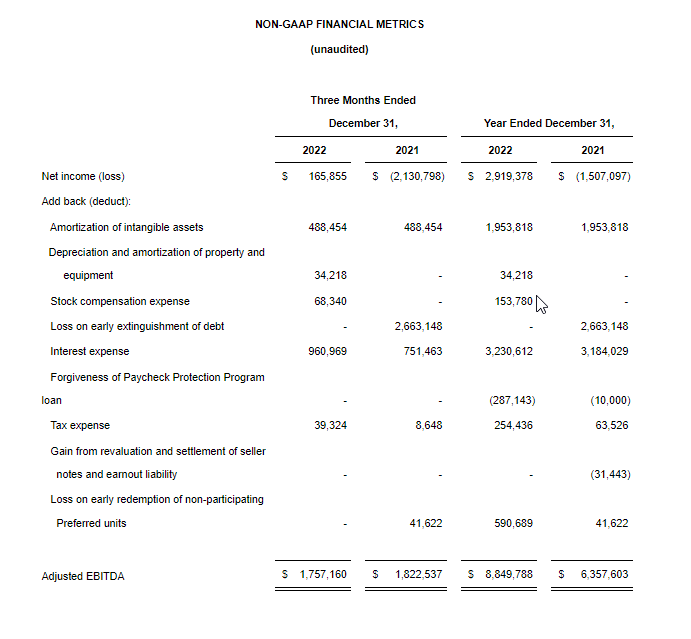
  • EBITDA was $4.4 million compared to $3.5 million in the same period in the prior year.[1]

[1] EBITDA is a non-GAAP financial measure. See “Supplemental Non-GAAP Financial Measures” below. EBITDA is also the Company’s measure of segment profitability.

Full-Year Financial Highlights

  • Revenues increased by 6.0% to $206.3 million, compared to $194.6 million in the prior year.
  • Fulfillment & Logistics Services grew 35.6%, offsetting declines in Marketing Services of 6.1% and Customer Care of 10.0%.
  • Operating income of $15.1 million, compared to operating income of $7.6 million last year, an increase of 97.8%.
  • Net income of $36.8 million, compared to net income of $15.0 million, last year. The 2022 results included a $19.8 million tax benefit due to release of valuation allowance due to the expectation of sustained profitability, while the 2021 results included a one-time gain of $10.0 million related to the extinguishment of the Company’s PPP loan.
  • Earnings per diluted share of $4.75 compared to $1.76 per diluted share last year.
  • EBITDA 1was $17.8 million compared to $10.2 million last year.1

Segment Highlights

  • Customer Care, $16.7 million in revenue, 30% of total – Revenue decreased by 12.9%, or $2.5 million, from the prior year quarter, and year-over-year EBITDA increased by 24.4% to $3.2 million from $2.6 million. Decrease in revenue was driven by sunsetting of pandemic-related projects, but continuous improvement in retention and reduction in labor costs drove the EBITDA increase. New business wins for the quarter included:
    • A community-based health plan company selected Harte Hanks to support its members with plan related customer support. The company selected Harte Hanks to provide extended support hours for its members while maintaining its CMS 5-star rating. Harte Hanks has consistently delivered high CMS ratings for its clients through its rigorous training and certification process for employees and systems.
    • A global beverage company expanded services with Harte Hanks by extending its Customer Care solution to additional markets. The expansion allows our client to benefit from our lower cost facilities in the Philippines, while improving its customer experience with faster and easier access for support.
  • Fulfillment & Logistics Services, $24.5 million in revenue, 45% of total – Revenue increased by 34.4%, or $6.3 million, compared to the prior year quarter; and year-over-year EBITDA improved 5.9% to $2.3 million from $2.1 million. New business wins for the quarter included:
    • A growing international investment firm with approximately $30 billion of assets under management selected Harte Hanks to provide digital print and premium item fulfillment services to its brokers. Our financial services sector experience and streamlined onboarding to support a rapid pivot from a competitor were key differentiators in the selection process.
    • A leading branding company selected Harte Hanks Fulfillment to manage the production, kitting, and distribution of 250,000 makeup kits for a Fortune 200 retail partner. This partnership continues to lead to new value-added product fulfillment opportunities, unlocked by our investment in flexible, automated production lines.
  • Marketing Services, $13.6 million in revenue, 25% of total – Revenue decreased by 6.8% compared to the prior year quarterand year-over-year EBITDA decreased 18.4% to $2.1 million from $2.6 million. Decrease in revenue was driven by a reduction of Direct Mail work for clients. New business wins for the quarter included:
    • A leading premium brand retailer of Kitchen, Bath and Outdoor products selected Harte Hanks to design and execute a series of lead generation programs. Harte Hanks was chosen based on our extensive experience in retail strategy and ability to deliver a full suite of creative, data, analytics and campaign execution.
    • A leading global technology manufacturer expanded our successful B2B demand generation program into South America by utilizing Harte Hanks Audience Finder product to identify buyers with intent.

Consolidated Fourth Quarter 2022 Results

Fourth quarter revenues were $54.8 million, up 5.4% from $52.0 million in the fourth quarter of 2021. The Company’s Fulfillment & Logistics Services segment grew, more than offsetting declines in Marketing Services and Customer Care.

Fourth quarter operating income was $3.4 million, compared to operating income of $2.9 million in the fourth quarter of 2021. The improvement resulted from the elimination of restructuring expense and higher revenues.

Net income for the quarter was $21.8 million inclusive of $19.8 million tax benefit and $1.4 million in expenses related to pension and currency loss on intercompany receivables, compared to net income of $1.8 million in the fourth quarter last year. The Company recorded an income tax benefit of $19.8 million, or approximately $2.62 per diluted share, in the fourth quarter of 2022, compared to an expense of $271,000 in the fourth quarter of 2021. The tax benefit in the fourth quarter of 2022 was mainly related to the release of the majority of valuation allowances due to the improved profitability of the company. Income attributable to common stockholders for the fourth quarter was $20.4 million, or $2.81 per basic and $2.70 per diluted share (based on 7.6 million weighted average diluted shares outstanding), compared to net income attributable to common shareholders of $1.4 million, or $0.20 per basic and diluted share (based on 7.3 million weighted average diluted shares outstanding) during the prior year fourth quarter. Income attributable to common stockholders was reduced by a $1.4 million one-time loss on redemption of Preferred Stock.

Full-Year 2022 Results

Revenues for 2022 were $206.3 million, up 6.0% from $194.6 million last year. Operating income was $15.1 million, compared to operating income of $7.6 million last year. Net income for the year was $36.8 million (inclusive of a $19.8 million tax benefit due to release of valuation allowance due to the expectation of sustained profitability), compared to net income of $15.0 million (inclusive of a $10.0 million gain related to the forgiveness of the Company’s PPP loan), last year. Income attributable to common stockholders for the year was $35.4 million, or $4.98 per basic share and $4.75 per fully diluted share, compared to net income attributable to common shareholders of $12.6 million, or $1.85 per basic share and $1.76 per fully diluted share.

Balance Sheet and Liquidity

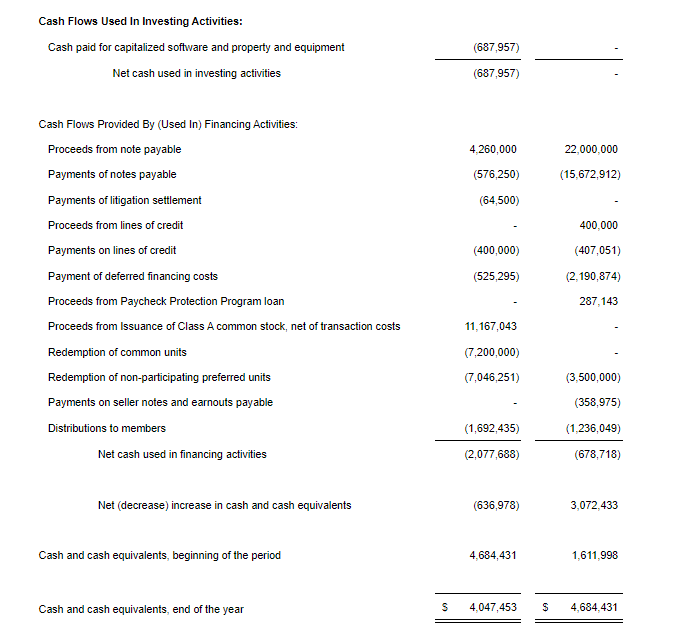
Harte Hanks ended the year with $10.4 million in cash, cash equivalents and restricted cash, compared to $15.1 million at December 31, 2021. At December 31, 2022, the Company had nothing drawn on its line of credit, and $37.8 million in outstanding long-term pension liability. On December 31, 2021, the Company had no short-term debt, $5 million in long-term debt and $52.5 million in outstanding long-term pension liability.

During 2022, Harte Hanks has decreased outstanding debt by $5 million and redeemed its preferred shares for $9.9 million.

The company anticipates receiving a Federal income tax refund related to a net operating loss (NOL) carryback claim of $5.3 million which will further enhance liquidity.

Conference Call Information

The Company will host a conference call and live webcast to discuss these results on Tuesday, March 7, 2023 at 4:30 p.m. EST. Interested parties may access the webcast at https://investors.hartehanks.com/events or may access the conference call by dialing (877) 545-0523 in the United States or (973) 528-0016 from outside the U.S. and using access code 471821.

A replay of the call can also be accessed via phone through March 21, 2023 by dialing (877) 481-4010 from the U.S., or (919) 882-2331 from outside the U.S. The conference call replay passcode is 47696.

About Harte Hanks:

Harte Hanks (NASDAQ:HHS) is a leading global customer experience company whose mission is to partner with clients to provide them with CX strategy, data-driven analytics and actionable insights combined with seamless program execution to better understand, attract and engage their customers.

Using its unparalleled resources and award-winning talent in the areas of Customer Care, Fulfillment and Logistics, and Marketing Services, Harte Hanks has a proven track record of driving results for some of the world’s premier brands, including Bank of America, GlaxoSmithKline, Unilever, Pfizer, HBOMax, Volvo, Ford, FedEx, Midea, Sony and IBM among others. Headquartered in Chelmsford, Massachusetts, Harte Hanks has over 2,500 employees in offices across the Americas, Europe, and Asia Pacific.

For more information, visit hartehanks.com

As used herein, “Harte Hanks” or “the Company” refers to Harte Hanks, Inc. and/or its applicable operating subsidiaries, as the context may require. Harte Hanks’ logo and name are trademarks of Harte Hanks.

Cautionary Note Regarding Forward-Looking Statements:

Our press release and related earnings conference call contain “forward-looking statements” within the meaning of U.S. federal securities laws. All such statements are qualified by this cautionary note, provided pursuant to the safe harbor provisions of Section 27A of the Securities Act of 1933 and Section 21E of the Securities Exchange Act of 1934. Statements other than historical facts are forward-looking and may be identified by words such as “may,” “will,” “expects,” “believes,” “anticipates,” “plans,” “estimates,” “seeks,” “could,” “intends,” or words of similar meaning. These forward-looking statements are based on current information, expectations and estimates and involve risks, uncertainties, assumptions and other factors that are difficult to predict and that could cause actual results to vary materially from what is expressed in or indicated by the forward-looking statements. In that event, our business, financial condition, results of operations or liquidity could be materially adversely affected and investors in our securities could lose part or all of their investments. These risks, uncertainties, assumptions and other factors include: (a) local, national and international economic and business conditions, including (i) the outbreak of diseases, such as the COVID-19 coronavirus, which has curtailed travel to and from certain countries and geographic regions, created supply chain disruption and shortages, disrupted business operations and reduced consumer spending, (ii) market conditions that may adversely impact marketing expenditures, (iii) the impact of the Russia/Ukraine conflict on the global economy and our business, including impacts from related sanctions and export controls and (iv) the impact of economic environments and competitive pressures on the financial condition, marketing expenditures and activities of our clients and prospects; (b) the demand for our products and services by clients and prospective clients, including (i) the willingness of existing clients to maintain or increase their spending on products and services that are or remain profitable for us, and (ii) our ability to predict changes in client needs and preferences; (c) economic and other business factors that impact the industry verticals we serve, including competition and consolidation of current and prospective clients, vendors and partners in these verticals; (d) our ability to manage and timely adjust our facilities, capacity, workforce and cost structure to effectively serve our clients; (e) our ability to improve our processes and to provide new products and services in a timely and cost-effective manner though development, license, partnership or acquisition; (f) our ability to protect our facilities against security breaches and other interruptions and to protect sensitive personal information of our clients and their customers; (g) our ability to respond to increasing concern, regulation and legal action over consumer privacy issues, including changing requirements for collection, processing and use of information; (h) the impact of privacy and other regulations, including restrictions on unsolicited marketing communications and other consumer protection laws; (i) fluctuations in fuel prices, paper prices, postal rates and postal delivery schedules; (j) the number of shares, if any, that we may repurchase in connection with our repurchase program; (k) unanticipated developments regarding litigation or other contingent liabilities; (l) our ability to complete anticipated divestitures and reorganizations, including cost-saving initiatives; (m) our ability to realize the expected tax refunds; and (n) other factors discussed from time to time in our filings with the Securities and Exchange Commission, including under “Item 1A. Risk Factors” in our Annual Report on Form 10-K for the year ended December 31, 2021 which was filed on March 21, 2022. The forward-looking statements in this press release and our related earnings conference call are made only as of the date hereof, and we undertake no obligation to update publicly any forward-looking statement, even if new information becomes available or other events occur in the future.

Supplemental Non-GAAP Financial Measures:

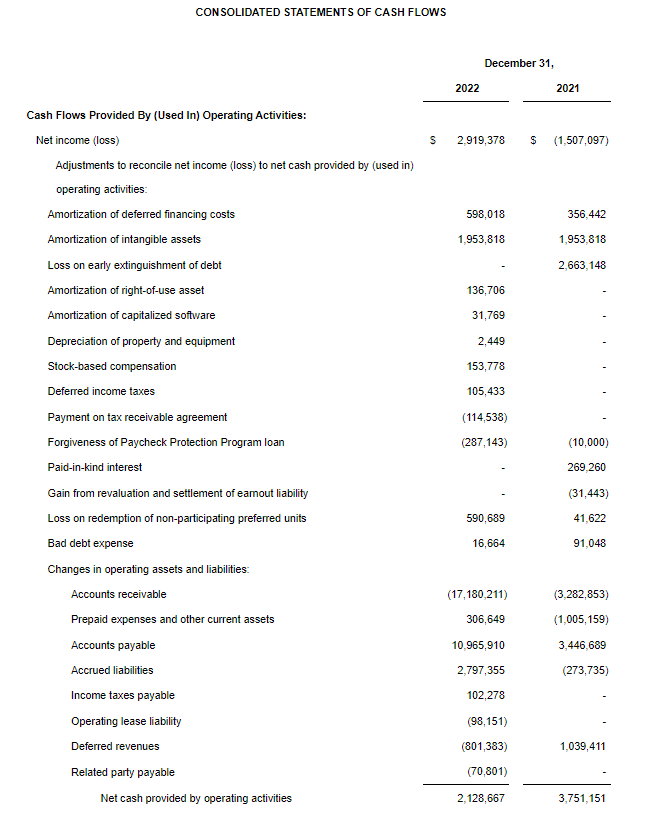
The Company reports its financial results in accordance with generally accepted accounting principles (“GAAP”). However, the Company may use certain non-GAAP measures of financial performance in order to provide investors with a better understanding of operating results and underlying trends to assess the Company’s performance and liquidity in this press release and our related earnings conference call. We have presented herein a reconciliation of these measures to the most directly comparable GAAP financial measure.

The Company presents the non-GAAP financial measure “Adjusted Operating Income (Loss)” as a measure useful to both management and investors in their analysis of the Company’s financial results because it facilitates a period-to-period comparison of Operating Revenue and Operating Income (Loss) by excluding restructuring expense, impairment expense and stock-based compensation. The most directly comparable measure for this non-GAAP financial measure is Operating Income (Loss).

The Company presents the non-GAAP financial measure “EBITDA” as a supplemental measure of operating performance in order to provide an improved understanding of underlying performance trends. The Company defines “Adjusted EBITDA” as earnings before interest expense net, income tax expense (benefit) and depreciation expense. The most directly comparable measure for EBITDA is Net Income (Loss). We believe EBITDA is an important performance metric because it facilitates the analysis of our results, exclusive of certain non-cash items, including items which do not directly correlate to our business operations; however, we urge investors to review the reconciliation of non-GAAP EBITDA to the comparable GAAP Net Income (Loss), which is included in this press release, and not to rely on any single financial measure to evaluate the Company’s financial performance.

The use of non-GAAP measures do not serve as a substitute and should not be construed as a substitute for GAAP performance but should provide supplemental information concerning our performance that our investors and we find useful. The Company evaluates its operating performance based on several measures, including this non-GAAP financial measures. The Company believes that the presentation of this non-GAAP financial measures in this press release and earnings conference call presentations are useful supplemental financial measures of operating performance for investors because they facilitate investors’ ability to evaluate the operational strength of the Company’s business. However, there are limitations to the use of this non-GAAP measures, including that they may not be calculated the same by other companies in our industry limiting their use as a tool to compare results. Any supplemental non-GAAP financial measures referred to herein are not calculated in accordance with GAAP and they should not be considered in isolation or as substitutes for the most comparable GAAP financial measures.

EBITDA is the Company’s measure of segment profitability.

Investor Relations Contact:

Rob Fink or Tom Baumann
646.809.4048 / 646.349.6641
FNK IR
[email protected]

Source: Harte Hanks, Inc.

View source version on accesswire.com:
https://www.accesswire.com/742474/Harte-Hanks-Grows-Annual-Revenue-Increases-Profitability-and-Ends-2022-with-Strengthened-Balance-Sheet

Release – Entravision Schedules Fourth Quarter and Full Year 2022 Earnings Release And Conference Call

Research News and Market Data on EVC

03/07/2023

SANTA MONICA, Calif.–(BUSINESS WIRE)– Entravision (NYSE: EVC), a leading global advertising solutions, media and technology company, announced that it will release its fourth quarter and full year 2022 financial results after market close on Thursday, March 9, 2023. The Company will host a conference call that day at 5:00 p.m. Eastern Time to discuss the fourth quarter and full year 2022 results.

To access the conference call, please dial (844) 836-8739 (U.S.) or (412) 317-5440 (International) ten minutes prior to the start time. The call will also be available via live webcast on the investor relations portion of the Company’s website located at www.entravision.com.

If you cannot listen to the conference call at its scheduled time, there will be a replay available through Thursday, March 23, 2023 which can be accessed by dialing (844) 512-2921 (U.S.) or (412) 317-6671 (International) and entering the passcode 10176187. The webcast will also be archived on the Company’s website.

About Entravision

Entravision is a leading global advertising, media and ad-tech solutions company connecting brands to consumers by representing top platforms and publishers. Our dynamic portfolio includes digital, television and audio offerings. Digital, our largest revenue segment, is comprised of four business units: our digital sales representation business; Smadex, our programmatic ad purchasing platform; our branding and mobile performance solutions business; and our digital audio business. Through our digital sales representation business, we connect global media companies such as Meta, Twitter, TikTok and Spotify with advertisers in primarily emerging growth markets worldwide. Smadex is our mobile-first demand side platform, enabling advertisers to execute performance campaigns using machine learning. We also offer a branding and mobile performance solutions business, which provides managed services to advertisers looking to connect with global consumers, primarily on mobile devices, and our digital audio business provides digital audio advertising solutions for advertisers in the Americas. In addition to digital, Entravision has 49 television stations and is the largest affiliate group of the Univision and UniMás television networks. Entravision also manages 45 primarily Spanish-language radio stations that feature nationally recognized, Emmy award-winning talent. Shares of Entravision Class A Common Stock trade on the NYSE under ticker: EVC. Learn more about our offerings at entravision.com or connect with us on LinkedIn and Facebook.

For more information, please contact:

Christopher T. Young
Interim Chief Executive Officer
Entravision
310-447-3870

Kimberly Esterkin
Addo Investor Relations
310-829-5400
[email protected]

Source: Entravision

Big Tech Trying to Act More Like Nimble Smaller Companies

Image Credit: Book Catalog (Flickr)

Why Meta’s Embrace of a ‘Flat’ Management Structure May Not Lead to the Innovation and Efficiency Mark Zuckerberg Seeks

Big Tech, under pressure from dwindling profits and falling stock prices, is seeking some of that old startup magic.

Meta, the parent of Facebook, recently became the latest of the industry’s dominant players to lay off thousands of employees, particularly middle managers, in an effort to return to a flatter, more nimble organization – a structure more typical when a company is very young or very small.

Meta CEO Mark Zuckerberg joins Elon Musk and other business leaders in betting that eliminating layers of management will boost profits. But is flatter better? Will getting rid of managers improve organizational efficiency and the bottom line?

This article was republished with permission from The Conversation, a news site dedicated to sharing ideas from academic experts. It represents the research-based findings and thoughts ofAmber Stephenson, Associate Professor of Management and Director of Healthcare Management Programs, Clarkson University.

As someone who has studied and taught organization theory as well as leadership and organizational behavior for nearly a decade, I think it’s not that simple.

Resilient Bureaucracies

Since the 1800s, management scholars have sought to understand how organizational structure influences productivity. Most early scholars focused on bureaucratic models that promised managerial authority, rational decision-making and efficiency, impartiality and fairness toward employees.

These centralized bureaucratic structures still reign supreme today. Most of us have likely worked in such organizations, with a boss at the top and clearly defined layers of management below. Rigid, written rules and policies dictate how work is done.

Research shows that some hierarchy correlates with commercial success – even in startups – because adding just one level of management helps prevent directionless exploration of ideas and damaging conflicts among staff. Bureaucracies, in their pure form, are viewed as the most efficient way to organize complex companies; they are reliable and predictable.

While adept at solving routine problems, such as coordinating work and executing plans, hierarchies do less well adapting to rapid changes, such as increased competition, shifting consumer tastes or new government regulations.

Bureaucratic hierarchies can stifle the development of employees and limit entrepreneurial initiative. They are slow and inept at tackling complex problems beyond the routine.

Moreover, they are thought to be very costly. Management scholars Gary Hamel and Michele Zanini estimated in 2016 that waste, rigidity and resistance to change in bureaucratic structures cost the U.S. economy US$3 trillion in lost output a year. That is the equivalent of about 17% of all goods and services produced by the U.S. economy at the time of the study.

Even with the mounting criticisms, bureaucratic structures have shown resilience over time. “The formal managerial hierarchy in modern organizations is as persistent as are calls for its replacement,” Harvard scholars Michael Lee and Amy Edmondson wrote in 2017.

Fascinatingly Flat

Flat structures, on the other hand, aim to decentralize authority by reducing or eliminating hierarchy. The structure is harnessed to flexibility and agility rather than efficiency, which is why flat organizations adapt better to dynamic and changing environments.

Flat structures vary. Online retailer Zappos, for example, adopted one of the most extreme versions of the flat structure – known as holacracy – when it eliminated all managers in 2014. Computer game company Valve has a president but no formal managerial structure, leaving employees free to work on projects they choose.

Other companies, such as Gore Tex maker W. L. Gore & Associates and film-streaming service Netflix, have instituted structures that empower employees with wide-reaching autonomy but still allow for some degree of management.

In general, flat structures rely on constant communication, decentralized decision-making and the self-motivation of employees. As a result, flat structures are associated with innovation, creativity, speed, resilience and improved employee morale.

The promises of going flat are understandably enticing, but flat organizations are tricky to get right.

The list of companies succeeding with flat structures is noticeably short. Besides the companies mentioned above, the list typically includes social media marketing organization Buffer, online publisher Medium and tomato processing and packing company Morning Star Tomatoes.

Other organizations that attempted flatter structures have encountered conflicts between staff, ambiguity around job roles and the emergence of unofficial hierarchies – which undermines the whole point of going flat. They eventually reverted back to hierarchical structures.

“While people may lament the proliferation of red tape,” management scholars Pedro Monteiro and Paul Adler explain, “in the next breath, many complain that ‘there ought to be a rule.’”

Even Zappos, often cited as the case study for flat organizations, has slowly added back managers in recent years.

Right Tool

In many ways, flat organizations require even stronger management than hierarchical ones.

When managers are removed, the span of control for those remaining increases. Corporate leaders must delegate – and track – tasks across greater numbers of employees and constantly communicate with workers.

Careful planning is needed to determine how work is organized, information shared, conflicts resolved and employees compensated, hired and reviewed. It is not surprising that as companies grow, the complexity of bigger organizations poses barriers to flat models.

In the end, organizational structure is a tool. History shows that business and economic conditions determine which type of structure works for an organization at any given time.

All organizations navigate the trade-off between stability and flexibility. While a hospital system facing extensive regulations and patient safety protocols may require a stable and consistent hierarchy, an online game developer in a competitive environment may need an organizational structure that’s more nimble so it can adapt to changes quickly.

Business and economic conditions are changing for Big Tech, as digital advertising declines, new competitors surface and emerging technologies demand risky investments. Meta’s corporate flattening is one response.

As Zuckerberg noted when explaining recent changes, “Our management theme for 2023 is the ‘Year of Efficiency,’ and we’re focused on becoming a stronger and more nimble organization.”

But context matters. So does planning. All the evidence I’ve seen indicates that embracing flatness by cutting middle management will not, by itself, do much to make a company more efficient.

Release – Direct Digital Holdings to Report Fourth Quarter & Full-Year 2022 Financial Results

Research News and Market Data on DRCT

March 02, 2023 9:00am EST

HOUSTON, March 2, 2023 /PRNewswire/ — Direct Digital Holdings, Inc. (Nasdaq: DRCT) (“Direct Digital Holdings” or the “Company”), a leading advertising and marketing technology platform operating through its companies Colossus Media, LLC (“Colossus SSP”), Huddled Masses LLC (“Huddled Masses”) and Orange142, LLC (“Orange142”), today announced that the Company will report financial results for the fourth quarter and fiscal year ended December 31, 2022 on Thursday, March 23, 2023 after the U.S. stock market closes. Management will host a conference call and webcast on the same day at 5:00 PM ET to discuss the results.

The live webcast and replay can be accessed at https://ir.directdigitalholdings.com/.

About Direct Digital Holdings
Direct Digital Holdings (Nasdaq: DRCT), owner of operating companies Colossus SSP, Huddled Masses, and Orange 142, brings state-of-the-art sell- and buy-side advertising platforms together under one umbrella company. Direct Digital Holdings’ sell-side platform, Colossus SSP, offers advertisers of all sizes extensive reach within general market and multicultural media properties. The company’s subsidiaries Huddled Masses and Orange142 deliver significant ROI for middle market advertisers by providing data-optimized programmatic solutions at scale for businesses in sectors that range from energy to healthcare to travel to financial services. Direct Digital Holdings’ sell- and buy-side solutions manage approximately 90,000 clients monthly, generating over 100 billion impressions per month across display, CTV, in-app and other media channels. Direct Digital Holdings is the ninth black-owned company to go public in the U.S and was named a top minority-owned business by The Houston Business Journal.

View original content to download multimedia:https://www.prnewswire.com/news-releases/direct-digital-holdings-to-report-fourth-quarter–full-year-2022-financial-results-301760260.html

SOURCE Direct Digital Holdings

Released March 2, 2023

Release – Direct Digital Holdings to Participate in 35th Annual Roth Conference

Research News and Market Data on DRCT

March 01, 2023 9:00am EST

HOUSTON, March 1, 2023 /PRNewswire/ — Direct Digital Holdings, Inc. (Nasdaq: DRCT) (“Direct Digital Holdings” or the “Company”), a leading advertising and marketing technology platform operating through its companies Colossus Media, LLC (“Colossus SSP”), Huddled Masses LLC (“Huddled Masses”) and Orange142, LLC (“Orange142”), today announced that the Company will be participating in  the 35th Annual Roth Conference scheduled for March 12-14, 2023 at The Ritz Carlton, Laguna Niguel in Dana Point, California.

Mark D. Walker, Chairman & Chief Executive Officer of Direct Digital Holdings, Keith Smith, President of Direct Digital Holdings, and Susan Echard, Chief Financial Officer of Direct Digital Holdings, will be attending on behalf of the Company and available for meetings during the conference.

Mark D. Walker will participate in a fireside chat with Darren Aftahi, Managing Director and Senior Research Analyst, at 12:30 PM-12:55 PM PT on Tuesday, March 14, 2023.

Keith Smith will participate on an IPO Readiness panel discussion hosted by James O’Grady, Partner, Lowenstein Sandler LLP, at 10:00 AM-10:55 AM PT on Tuesday, March 14, 2023.

For more information, or to schedule a meeting with management, please reach out to your Roth MKM representative.

About Direct Digital Holdings
Direct Digital Holdings (Nasdaq: DRCT), owner of operating companies Colossus SSP, Huddled Masses, and Orange 142, brings state-of-the-art sell- and buy-side advertising platforms together under one umbrella company. Direct Digital Holdings’ sell-side platform, Colossus SSP, offers advertisers of all sizes extensive reach within general market and multicultural media properties. The company’s subsidiaries Huddled Masses and Orange142 deliver significant ROI for middle market advertisers by providing data-optimized programmatic solutions at scale for businesses in sectors that range from energy to healthcare to travel to financial services. Direct Digital Holdings’ sell- and buy-side solutions manage approximately 90,000 clients monthly, generating over 100 billion impressions per month across display, video, CTV, in-app and other media channels. Direct Digital Holdings is the ninth black-owned company to go public in the U.S and was named a top minority-owned business by The Houston Business Journal.  

View original content to download multimedia:https://www.prnewswire.com/news-releases/direct-digital-holdings-to-participate-in-35th-annual-roth-conference-301759498.html

SOURCE Direct Digital Holdings

Release – Harte Hanks to Report Fourth Quarter and Full-Year Results on March 7, 2023

Research News and Market Data on HHS

CHELMSFORD, MA / ACCESSWIRE / February 21, 2023 / Harte Hanks, Inc. (NASDAQ:HHS), a leading global customer experience company focused on bringing companies closer to customers for nearly 100 years, announced today that the company will release financial results for the fourth quarter and full year period ended December 31, 2022 on Tuesday, March 7, 2023 after the close of the market.

The Company will host a conference call and live webcast to discuss these results on Tuesday, March 7, 2023 at 4:30 p.m. EST. Interested parties may access the webcast at https://investors.hartehanks.com/events or may access the conference call by dialing (877) 545-0523 in the United States or (973) 528-0016 from outside the U.S. and using access code 471821.

A replay of the call can also be accessed via phone through March 21, 2023 by dialing (877) 481-4010 from the U.S., or (919) 882-2331 from outside the U.S. The conference call replay passcode is 47696.

About Harte Hanks:

Harte Hanks (NASDAQ:HHS) is a leading global customer experience company whose mission is to partner with clients to provide them with CX strategy, data-driven analytics and actionable insights combined with seamless program execution to better understand, attract and engage their customers.

Using its unparalleled resources and award-winning talent in the areas of Customer Care, Fulfillment and Logistics, and Marketing Services, Harte Hanks has a proven track record of driving results for some of the world’s premier brands, including Bank of America, GlaxoSmithKline, Unilever, Pfizer, HBOMax, Volvo, Ford, FedEx, Midea, Sony and IBM among others. Headquartered in Chelmsford, Massachusetts, Harte Hanks has over 2,500 employees in offices across the Americas, Europe, and Asia Pacific.

For more information, visit hartehanks.com

As used herein, “Harte Hanks” or “the Company” refers to Harte Hanks, Inc. and/or its applicable operating subsidiaries, as the context may require. Harte Hanks’ logo and name are trademarks of Harte Hanks.

Investor Relations Contact:

Rob Fink or Tom Baumann
646.809.4048 / 646.349.6641
FNK IR
[email protected]

SOURCE: Harte Hanks, Inc.

You can view this article online using the following link: https://www.accesswire.com/740021/Harte-Hanks-to-Report-Fourth-Quarter-and-Full-Year-Results-on-March-7-2023

Release – Direct Digital Holdings Announces New $5 Million Revolving Credit Facility with Silicon Valley Bank

Research, News and Market Data on DRCT

February 21, 2023 9:00am EST

HOUSTON, Feb. 21, 2023 /PRNewswire/ — Direct Digital Holdings, Inc. (Nasdaq: DRCT) (“Direct Digital Holdings” or the “Company”), a leading advertising and marketing technology platform operating through its companies Colossus Media, LLC (“Colossus SSP”), Huddled Masses LLC (“Huddled Masses”) and Orange142, LLC (“Orange142”), is pleased to announce its entry into the $5 million revolving credit facility with Silicon Valley Bank, as filed with the SEC on a Form 8-K on January 11, 2023. 

In addition to the principal amount of $5 million, Direct Digital Holdings has access to an additional $2.5 million incremental revolving facility, subject to the lender’s consent, which may increase the aggregate principal amount of the credit facility to $7.5 million. Loans under the credit facility mature on September 30, 2024.

Mark D. Walker, Chairman & Chief Executive Officer of Direct Digital Holdings, commented, “We are very pleased to announce this new credit facility which improves our near-term liquidity position, continues to diversify our access to non-dilutive capital and helps us meet our fluctuating working capital needs. We are also thrilled to work together with Silicon Valley Bank to help us grow our business and optimize our capital structure.”

“Direct Digital Holdings is a key leader in providing state-of-the-art advertising solutions and platforms,” said Dax Williamson, Managing Director with Silicon Valley Bank. “We are excited to provide this latest credit facility as we support their continued growth and success.”

About Direct Digital Holdings
Direct Digital Holdings (Nasdaq: DRCT), owner of operating companies Colossus SSP, Huddled Masses, and Orange 142, brings state-of-the-art sell- and buy-side advertising platforms together under one umbrella company. Direct Digital Holdings’ sell-side platform, Colossus SSP, offers advertisers of all sizes extensive reach within general market and multicultural media properties. The company’s subsidiaries Huddled Masses and Orange142 deliver significant ROI for middle market advertisers by providing data-optimized programmatic solutions at scale for businesses in sectors that range from energy to healthcare to travel to financial services. Direct Digital Holdings’ sell- and buy-side solutions manage approximately 90,000 clients monthly, generating over 100 billion impressions per month across display, CTV, in-app and other media channels. Direct Digital Holdings is the ninth black-owned company to go public in the U.S and was named a top minority-owned business by The Houston Business Journal.

About Silicon Valley Bank
Silicon Valley Bank, the bank of the world’s most innovative companies and investors, provides commercial banking services, expertise and insights to the technology, life science and healthcare, private equity, venture capital and premium wine industries. Silicon Valley Bank operates in centers of innovation around the world and is one of SVB’s core businesses with SVB Capital, SVB Private and SVB Securities. With global commercial banking services, Silicon Valley Bank helps address the unique needs of its dynamic, fast-growing, innovative clients. Learn more at svb.com.

Silicon Valley Bank is a member of the FDIC and the Federal Reserve System. Silicon Valley Bank is the California bank subsidiary of SVB Financial Group (SVB) (Nasdaq: SIVB). SVB Financial Group is the holding company for all business units and groups. © 2022 SVB Financial Group. All rights reserved. SVB, SVB FINANCIAL GROUP, SILICON VALLEY BANK, SVB SECURITIES, SVB PRIVATE, SVB CAPITAL and the chevron device are trademarks of SVB Financial Group, used under license. [SIVB-C]

Forward Looking Statements
This press release may contain forward-looking statements within the meaning of federal securities laws, including the Private Securities Litigation Reform Act of 1995, Section 27A of the Securities Act of 1933, as amended, and Section 21E of the Securities Exchange Act of 1934, as amended, and which are subject to certain risks, trends and uncertainties.

As used below, “we,” “us,” and “our” refer to Direct Digital Holdings. We use words such as “could,” “would,” “may,” “might,” “will,” “expect,” “likely,” “believe,” “continue,” “anticipate,” “estimate,” “intend,” “plan,” “project” and other similar expressions to identify forward-looking statements, but not all forward-looking statements include these words. All statements contained in this release that do not relate to matters of historical fact should be considered forward-looking statements. All of our forward-looking statements involve estimates and uncertainties that could cause actual results to differ materially from those expressed in or implied by the forward-looking statements. Our forward-looking statements are based on assumptions that we have made in light of our industry experience and our perceptions of historical trends, current conditions, expected future developments and other factors we believe are appropriate under the circumstances. Although we believe that these forward-looking statements are based on reasonable assumptions, many factors could affect our actual operating and financial performance and cause our performance to differ materially from the performance expressed in or implied by the forward-looking statements, including, but not limited to: our dependence on the overall demand for advertising, which could be influenced by economic downturns; any slow-down or unanticipated development in the market for programmatic advertising campaigns; the effects of health epidemics, such as the ongoing global COVID-19 pandemic; operational and performance issues with our platform, whether real or perceived, including a failure to respond to technological changes or to upgrade our technology systems; any significant inadvertent disclosure or breach of confidential and/or personal information we hold, or of the security of our or our customers’, suppliers’ or other partners’ computer systems; any unavailability or non-performance of the non-proprietary technology, software, products and services that we use; unfavorable publicity and negative public perception about our industry, particularly concerns regarding data privacy and security relating to our industry’s technology and practices, and any perceived failure to comply with laws and industry self-regulation; restrictions on the use of third-party “cookies,” mobile device IDs or other tracking technologies, which could diminish our platform’s effectiveness; any inability to compete in our intensely competitive market; any significant fluctuations caused by our high customer concentration; any violation of legal and regulatory requirements or any misconduct by our employees, subcontractors, agents or business partners; any strain on our resources, diversion of our management’s attention or impact on our ability to attract and retain qualified board members as a result of being a public company; our dependence, as a holding company, of receiving distributions from Direct Digital Holdings, LLC to pay our taxes, expenses and dividends; and other factors and assumptions discussed in the “Risk Factors,” “Management’s Discussion and Analysis of Financial Conditions and Results of Operations” and other sections of our filings with the SEC that we make from time to time. Should one or more of these risks or uncertainties materialize or should any of these assumptions prove to be incorrect, our actual operating and financial performance may vary in material respects from the performance projected in these forward-looking statements. Further, any forward-looking statement speaks only as of the date on which it is made, and except as required by law, we undertake no obligation to update any forward-looking statement contained in this release to reflect events or circumstances after the date on which it is made or to reflect the occurrence of anticipated or unanticipated events or circumstances, and we claim the protection of the safe harbor for forward-looking statements contained in the Private Securities Litigation Reform Act of 1995.

View original content to download multimedia:https://www.prnewswire.com/news-releases/direct-digital-holdings-announces-new-5-million-revolving-credit-facility-with-silicon-valley-bank-301751722.html

SOURCE Direct Digital Holdings

Released February 21, 2023

Release – Brands Are Missing Out On Revenue And Market Share Growth By Not Engaging Effectively With Diverse Communities & Media Properties, According To Research From Direct Digital Holdings

Research News and Market Data on DRCT

February 14, 2023 9:00am EST

Nearly 90% of Diverse / Multicultural Consumers Report Taking Positive Action as a Result of a Marketer Purposefully Investing in Their Communities, Including Switching Brands

Majority Cite More Favorable Feelings About Brands That Advertise in Diverse / Multicultural Media; 4 in 10 More Likely to Notice Ads on Those Properties Compared with Mainstream Media

HOUSTON, Feb. 14, 2023 /PRNewswire/ — Direct Digital Holdings, Inc. (Nasdaq: DRCT) (“Direct Digital Holdings” or the “Company”), a leading advertising and marketing technology platform operating through its companies Colossus Media, LLC (“Colossus SSP”), Huddled Masses LLC (“Huddled Masses”) and Orange142, LLC (“Orange142”), today released a new whitepaper, Dollars & DEI: Multicultural Consumers’ Insights on Brands’ Media Buying and Marketing Practices. The findings reveal that brands, at a time of economic uncertainty, are currently missing out on significant revenue and market share growth opportunities – and jeopardizing future growth – due to a lack of appropriate and purposeful focus on the Black, Hispanic / Latin, AAPI and LGBTQIA+ communities.

The whitepaper centers on exclusive research, commissioned by Direct Digital Holdings and conducted by Horowitz Research. An in-depth survey, the results spotlight the perspectives of diverse / multicultural consumers, a group that comprises two-fifths of the American consumer market, yet has not had proportionate attention from the advertising business. 

The research tapped 1,342 U.S. adults 18+ from the Black, Hispanic / Latin, AAPI and LGBTQIA+ communities to share their attitudes and behaviors in light of the marketing world’s scattershot diversity efforts.

According to the findings, almost 90 percent of diverse / multicultural consumers report taking action because of a company investing in their community, including telling others about the brand, sharing their support on social media – or even switching to a brand, away from a competitor that does not invest in their community.

Other takeaways have major implications and offer guidance to brands, including:

  • 8 out of 10 diverse consumers said they feel more positively about brands that live up to promises to make a concerted effort of support to their communities, and alternatively, 8 in 10 say they feel negatively about brands that don’t live up to their promises.
  • The large majority of diverse consumers, about 8 in 10, feel more positively about brands that advertise in targeted diverse/multicultural media.
  • Nearly 7 out of 10 said that purposely investing ad dollars with media that is owned or focused on their respective communities strongly demonstrates support.
  • 4 out of 10 of respondents said they notice ads more when they appear on targeted diverse / multicultural media channels versus mainstream media.

In addition, while ad spending was found to be one of the most impactful ways for marketers to demonstrate a commitment to these audiences, creating ads and content that are inclusive of diverse communities was cited as another strong demonstration of support. To put the findings into sharper focus, both came out ahead of simply sharing social posts.

“Given this compelling data for a growing U.S. economic market segment, there should be no more reason for brands to move slowly in diversifying their media allocations,” said Mark D. Walker, CEO and Co-Founder of Direct Digital Holdings, who penned the introduction to the whitepaper. “If we put aside all the rhetoric and platitudes, this is an industry that has always been and should still be about reaching customers and driving revenue.”

Alongside the survey findings, the paper includes insights from brand leaders from HP, McDonald’s and Visa; media and marketing agency executives from Mediahub Worldwide and One50One; publishers of diverse properties such as Black Enterprise, Glitter Magazine, ODK Media, NGL Collective and Pink Media; the architect behind the new DEI trade group BRIDGE; the chairman and CEO of MediaLink; and the head of Colossus SSP.

“Siloing multicultural and diverse audiences into a separate line item in marketing plans needs to be a thing of the past,” added Alejandro Clabiorne, EVP, Executive Director, New York, Mediahub Worldwide. “This whitepaper not only makes clear that these groups are critical to marketers’ bottom lines, but also provides the types of insights that will show brands how to effectively reach and resonate with these prospective customers, building traction and brand loyalty that can fuel growth.”

“The research demonstrates that across the board, diverse and multicultural consumers recognize, appreciate and have the disposable income to spend on brands that target their communities either through authentic ad messages or media,” said Lashawnda Goffin, CEO, Colossus SSP, the sell-side technology company within Direct Digital Holdings. “Brands that have intentionally and sincerely engaged with these audiences have seen the benefit – and those looking to grow their customer base need to follow suit.”

“Making the right consumer connections is about to take on factorial proportions and while values and outlook may hold groups of targets together, beliefs and aspirations will splinter them, requiring, as the research confirms, much deeper considerations for message tone, creative and of course media placement,” said Sheryl Daija, Founder and CEO, BRIDGE. “It’s time for our industry to move from DEI as a philosophy to inclusion as a core business practice and growth driver.”

To download the whitepaper: Dollars & DEI: Multicultural Consumers’ Insights on Brands’ Media Buying and Marketing Practices, go to https://directdigitalholdings.com/whitepaper.

Methodology
This study included qualitative and quantitative research conducted by Horowitz Research (www.horowitzresearch.com). The online surveys were conducted September – December 2022 among 1,342 U.S. adults 18+, including over 300 respondents each from the Black, Hispanic / Latin, AAPI and LGBTQIA+ communities.

About Direct Digital Holdings
Direct Digital Holdings (Nasdaq: DRCT), owner of operating companies Colossus SSP, Huddled Masses and Orange 142, brings state-of-the-art sell- and buy-side advertising platforms together under one umbrella company. Direct Digital Holdings’ sell-side platform, Colossus SSP, offers advertisers of all sizes extensive reach within general market and multicultural media properties. The company’s subsidiaries Huddled Masses and Orange142 deliver significant ROI for middle market advertisers by providing data-optimized programmatic solutions at scale for businesses in sectors that range from energy to healthcare to travel to financial services. Direct Digital Holdings’ sell- and buy-side solutions manage approximately 90,000 clients monthly, generating over 100 billion impressions per month across display, CTV, in-app, and other media channels. Direct Digital Holdings is the ninth Black-owned company to go public in the U.S and was named a top minority-owned business by The Houston Business Journal.

Forward-Looking Statements
This press release may contain forward-looking statements within the meaning of federal securities laws, including the Private Securities Litigation Reform Act of 1995, Section 27A of the Securities Act of 1933, as amended, and Section 21E of the Securities Exchange Act of 1934, as amended, and which are subject to certain risks, trends and uncertainties.

As used below, “we,” “us,” and “our” refer to Direct Digital Holdings. We use words such as “could,” “would,” “may,” “might,” “will,” “expect,” “likely,” “believe,” “continue,” “anticipate,” “estimate,” “intend,” “plan,” “project” and other similar expressions to identify forward-looking statements, but not all forward-looking statements include these words. All statements contained in this release that do not relate to matters of historical fact should be considered forward-looking statements.

All of our forward-looking statements involve estimates and uncertainties that could cause actual results to differ materially from those expressed in or implied by the forward-looking statements. Our forward-looking statements are based on assumptions that we have made in light of our industry experience and our perceptions of historical trends, current conditions, expected future developments and other factors we believe are appropriate under the circumstances. Although we believe that these forward-looking statements are based on reasonable assumptions, many factors could affect our actual operating and financial performance and cause our performance to differ materially from the performance expressed in or implied by the forward-looking statements, including, but not limited to: our dependence on the overall demand for advertising, which could be influenced by economic downturns; any slow-down or unanticipated development in the market for programmatic advertising campaigns; the effects of health epidemics, such as the ongoing global COVID-19 pandemic; operational and performance issues with our platform, whether real or perceived, including a failure to respond to technological changes or to upgrade our technology systems; any significant inadvertent disclosure or breach of confidential and/or personal information we hold, or of the security of our or our customers’, suppliers’ or other partners’ computer systems; any unavailability or non-performance of the non-proprietary technology, software, products and services that we use; unfavorable publicity and negative public perception about our industry, particularly concerns regarding data privacy and security relating to our industry’s technology and practices, and any perceived failure to comply with laws and industry self-regulation; restrictions on the use of third-party “cookies,” mobile device IDs or other tracking technologies, which could diminish our platform’s effectiveness; any inability to compete in our intensely competitive market; any significant fluctuations caused by our high customer concentration; any violation of legal and regulatory requirements or any misconduct by our employees, subcontractors, agents or business partners; any strain on our resources, diversion of our management’s attention or impact on our ability to attract and retain qualified board members as a result of being a public company; our dependence, as a holding company, of receiving distributions from Direct Digital Holdings, LLC to pay our taxes, expenses and dividends; and other factors and assumptions discussed in the “Risk Factors,” “Management’s Discussion and Analysis of Financial Conditions and Results of Operations” and other sections of our filings with the SEC that we make from time to time. Should one or more of these risks or uncertainties materialize or should any of these assumptions prove to be incorrect, our actual operating and financial performance may vary in material respects from the performance projected in these forward-looking statements. Further, any forward-looking statement speaks only as of the date on which it is made, and except as required by law, we undertake no obligation to update any forward-looking statement contained in this release to reflect events or circumstances after the date on which it is made or to reflect the occurrence of anticipated or unanticipated events or circumstances, and we claim the protection of the safe harbor for forward-looking statements contained in the Private Securities Litigation Reform Act of 1995.

Cision View original content to download multimedia:https://www.prnewswire.com/news-releases/brands-are-missing-out-on-revenue-and-market-share-growth-by-not-engaging-effectively-with-diverse-communities–media-properties-according-to-research-from-direct-digital-holdings-301745969.html

SOURCE Direct Digital Holdings

Released February 14, 2023

Investors in Sports Betting May Prove to be the Real Superbowl Winners

Image Credit: Focal Foto (Flickr)

The Lucky Stars Seem to Have Aligned for Online Gambling Companies

Public companies involved in sports betting may find their shareholders are the real winners. Between the increased number of states that have legalized sports betting over recent years, the enhanced betting opportunities, and the nature of the Superbowl win, luck seems to have weighed heavily on the side of these businesses. It will take time for the actual numbers to be reported. Just last year FanDuel became the first sportsbook to be profitable, it will report again in March. DraftKings, BetMGM, and Caesars, have yet to turn a profit in sports betting.

Superbowl Win Favors Companies

Close to 60% of bets were for the Philadelphia Eagles to be the outright winner of the game, according to FanDuel. FanDuel is the largest online sportsbook operator in the U.S. The less-expected 38-35 win for the Kansas City Chiefs over the Philadelphia Eagles at the Super Bowl will mean less wagered money will have to be distributed to customers. The team that was considered the underdog, having come out ahead, should add revenue to the bottom line of gambling companies.

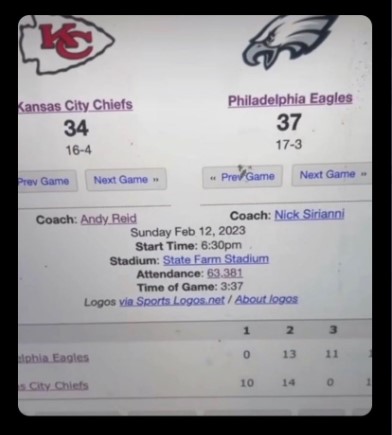
The reason, of course, is companies like DraftKings and FanDuel will not have to pay out on many of the most popular bets, including widespread predictions for a 37-34 victory for the Eagles after online speculation over a ‘leaked script’ for the game.

Other Popular Bets

Before Sunday’s kick-off, Twitter and other social media conversations referred to the “leaked script.” An image was being shared that showed the Eagles winning 37-34. The image had millions of impressions on Twitter across all the shares.

Various Twitter Posts Highlighted this Image Pre-Game

Bettors could also wager on who may come out as the most valuable player. The Chiefs tight end Travis Kelce was the most selected based on bets for this honor, according to FanDuel. Instead, the MVP award was won by Chiefs quarterback Patrick Mahomes.

During a heavy betting period, there was an issue with Caesars Entertainment subsidiary William Hill US. This issue was affecting users in Nevada by preventing them from logging in on Sunday. Frustrated users took to social media outlets to complain of their difficulties during the game. The company tweeted that it was still in the process of settling all Super Bowl wagers after the game on Sunday.

Take Away

Online sports gambling is experiencing dramatic growth. Each year more states allow the practice within their borders. At the same time, technology allows betting on slices of the game, even on in-play situations never before available. With both FanDuel and DraftKings advertising to the large Superbowl audience, the practice of gambling online on sports is becoming more and more understood and common place. The 2023 Superbowl may have helped the bottom line of these companies. That will be seen when the numbers for this quarter are released. Investors are paying attention as it would seem that there is plenty of room for further growth.

Paul Hoffman

Managing Editor, Channelchek

About the Quickening Growth Spiral in Revenue of Pro Football

Image Credit: Peter T. (Flickr)

The Business of Football, How the NFL Makes Money

There’s a lot of money being made through the business of professional sports leagues. The NBA, MLB, NHL, all have very profitable business models, and although the businesses are all similar, the NFL leads the other U.S. based leagues in generating revenue. The once tax-exempt entity has a dual business structure with multiple layers of income that continues to expand. Below we cover the multiple ways the NFL, and the months-long drive of more than 30 teams to the Superbowl, ring the register.

In 2015, the National Football League forfeited its tax-exempt status with the IRS. The league had benefitted from the unique status beginning in 1942. The decision was based in part on mounting criticism over its rapidly growing earnings streams.

These streams largely come from the 32 teams that make up the NFL, thirty-one of the ball clubs are privately owned, while just one, the Green Bay Packers, continues to operate under a non-profit public corporation status. The clubs all form a trade association through which funds are directed back to the NFL board, some find their way distributed back to the teams.

This form of entertainment rakes in money on many fronts. In-person attendance, TV viewers, different forms of wagering, and advertising dollars all feed into overall league revenue after costs such as salaries that can $50 million annually.

Tickets to the Super Bowl 2023 event between the Kansas City Chiefs and the Philadelphia Eagles are averaging about $10,000. The higher end seats are in the $40,000 range, about the same as a Tesla Model S.

Tax Exemption of Teams

The team with tax-exempt status is exempt from paying all or some of federal income taxes. This status had been maintained by all NFL teams from 1945 through 2015.

The NFL voluntarily opted to give up its tax-exempt status in 2015 and began paying taxes. Some contend this change avoids further negative public outcry. It seems the economic benefits were not as significant as the public relations disadvantages.

 Business Structure

The league separates its income streams into local and national categories. On the national side, the NFL negotiates national merchandise, licensing, and television contracts. The 32 teams receive equal shares of this money, regardless of individual team performance.

Local income is generated through concession sales, ticket sales, and corporate sponsors. This doesn’t nearly cover the cost of fielding a professional football team. Using the Green Bay Packers as a benchmark, the team had expenses totaling $410 million in its fiscal year 2021. Most of this number was attributable to player salaries, with the remainder used for stadium maintenance, advertising, and team and administration expenses.

 How Teams Make Money

The majority of any NFL team’s revenue comes from TV arrangements. Ticket revenues, licensing, merchandising agreements, and endorsement deals are additional income sources.

Revenue of All National Football League Teams from 2001 to 2021 (in billion U.S. dollars)

Data Source: Statista


Televised Rights and Deals – The Super Bowl is among the most watched television events in America each year. The regular games broadcast on Sundays, Mondays, and Thursdays throughout the regular season will consistently have the best TV ratings. This is why media corporations pay an above average amount for the right to broadcast them.

The traditional television industry now competes with other video-based programming, all pulling the attention of those seeking entertainment. The NFL audience and draw are not in decline. NFL teams still generate massive local and even international revenue through TV contracts. The individual clubs receive significant amounts from television providers thanks to multibillion-dollar contracts, and there are even more television viewers and broadcasts of games than other programs on set.

Image Credit: Karen (Flickr)

Tickets and Vendor Rental – Far below the rapidly increasing money from TV deals, ticket sales are a large source of income for individual teams. NFL games often sell out, with an estimated average ticket price of $151 and a stadium capacity of roughly 70,000. It’s a nice add-on to broadcast viewership.

NFL teams can also use their stadiums to hold non-football activities, like concerts within local restrictions.  

The cash flow on the rental of space to vendors to sell food and drinks at games are also significant in a stadium with 70,000 fans as a captive audience.

Image Credit: RaymondClarkeImages (Flickr)

Official Sponsorships – Corporate sponsors pay NFL teams to put their logos on products, TV transitions, player jerseys, etc. The franchise rights to NFL grounds naming of stadiums are extremely desirable among corporate advertisers.

The naming right to So-Fi Stadium in LA, home of the Los Angeles Rams, is in the neighborhood of $30 million annually, and similar rights to Allegiant Stadium in Las Vegas is estimated at between $20 and $25 million annually.

Gambling Franchises – Some NFL teams take advantage of this method by opening betting platforms in their stadiums, collaborating with well-known casinos, creating online sports betting websites, and other strategies. This is an area of rapid expansion as sports betting becomes legalized across the US and technology provides opportunities for betting on fragments of the game in addition to the more traditional methods. Incremental income from these growing arrangements has expanded income opportunities among teams.

Image Credit: Karen (Flickr)

Costs

Overall, like any business, the NFL will undoubtedly explore all the opportunities for meaningful income that present itself. Of course the overall income is best measured net of expenditures that include marketing, cost of athletes and other entertainers, management, upkeep, and renovations.  

Take Away

One of the most financially successful professional sports leagues in the US and across the globe is the NFL. Most of the teams’ revenues are generated from broadcasting and licensing deals. The growth in revenue, with the exception of one year during the pandemic curbs, has been accelerating. Technology has brought new methods to gamble on sports, along with some friendly gaming legislation across the nation. This is additive to the bottom line.

It appears that the trend, which has survived some public relations setbacks, isn’t going to continue as Americans tend to spend many hours during the winter months immersed in the sport of football.

Paul Hoffman

Managing Editor, Channelchek

Twitter Data Will Now Cost its Users

Image Credit: The Conversation (February 8, 2023)

Twitter’s New Data Fees Leave Scientists Scrambling for Funding – or Cutting Research

Twitter is ending free access to its application programming interface, or API. An API serves as a software “middleman” allowing two applications to talk to each other. An API is an accessible way to collect and share data within and across organizations. For example, researchers at universities unaffiliated with Twitter can collect tweets and other data from Twitter through their API.

Starting Feb. 9, 2023, those wanting access to Twitter’s API will have to pay. The company is looking for ways to increase revenue to reverse its financial slide, and Elon Musk claimed that the API has been abused by scammers. This cost is likely to hinder the research community that relies on the Twitter API as a data source.

The Twitter API launched in 2006, allowing those outside of Twitter access to tweets and corresponding metadata, information about each tweet such as who sent it and when and how many people liked and retweeted it. Tweets and metadata can be used to understand topics of conversation and how those conversations are “liked” and shared on the platform and by whom.

This article was republished with permission from The Conversation, a news site dedicated to sharing ideas from academic experts. It represents the research-based findings and thoughts of, Jon-Patrick Allem, Assistant Professor of Research in Population and Public Health Sciences, University of Southern California.

As a scientist and director of a research lab focused on collecting and analyzing posts from social media platforms, I have relied on the Twitter API to collect tweets pertinent to public health for over a decade. My team has collected more than 80 million observations over the past decade, publishing dozens of papers on topics from adolescents’ use of e-cigarettes to misinformation about COVID-19.

Twitter has announced that it will allow bots that it deems provide beneficial content to continue unpaid access to the API, and that the company will offer a “paid basic tier,” but it’s unclear whether those will be helpful to researchers.

Blocking Out and Narrowing Down

Twitter is a social media platform that hosts interesting conversations across a variety of topics. As a result of free access to the Twitter API, researchers have followed these conversations to try to better understand public attitudes and behaviors. I’ve treated Twitter as a massive focus group where observations – tweets – can be collected in near real time at relatively low cost.

The Twitter API has allowed me and other researchers to study topics of importance to society. Fees are likely to narrow the field of researchers who can conduct this work, and narrow the scope of some projects that can continue. The Coalition for Independent Technology Research issued a statement calling on Twitter to maintain free access to its API for researchers. Charging for access to the API “will disrupt critical projects from thousands of journalists, academics and civil society actors worldwide who study some of the most important issues impacting our societies today,” the coalition wrote.

@SMLabTO (Twitter)

The financial burden will not affect all academics equally. Some scientists are positioned to cover research costs as they arise in the course of a study, even unexpected or unanticipated costs. In particular, scientists at large research-heavy institutions with grant budgets in the millions of dollars are likely to be able to cover this kind of charge.

However, many researchers will be unable to cover the as yet unspecified costs of the paid service because they work on fixed or limited budgets. For example, doctoral students who rely on the Twitter API for data for their dissertations may not have additional funding to cover this charge. Charging for access to the Twitter API will ultimately reduce the number of participants working to understand the world around us.

The terms of Twitter’s paid service will require me and other researchers to narrow the scope of our work, as pricing limits will make it too expensive to continue to collect as much data as we would like. As the amount of data requested goes up, the cost goes up.

We will be forced to forgo data collection on some topic areas. For example, we collect a lot of tobacco-related conversations, and people talk about tobacco by referencing the behavior – smoking or vaping – and also by referencing a product, like JUUL or Puff Bar. I add as many terms as I can think of to cast a wide net. If I’m going to be charged per word, it will force me to rethink how wide a net I cast. This will ultimately reduce our understanding of issues important to society.

Difficult Adjustments

Costs aside, many academic institutions are likely to have a difficult time adapting to these changes. For example, most universities are slow-moving bureaucracies with a lot of red tape. To enter into a financial relationship or complete a small purchase may take weeks or months. In the face of the impending Twitter API change, this will likely delay data collection and potential knowledge.

Unfortunately, everyone relying on the Twitter API for data was given little more than a week’s notice of the impending change. This short period has researchers scrambling as we try to prepare our data infrastructures for the changes ahead and make decisions about which topics to continue studying and which topics to abandon.

If the research community fails to properly prepare, scientists are likely to face gaps in data collection that will reduce the quality of our research. And in the end that means a loss of knowledge for the world.

Release – Direct Digital Holdings to Ring Nasdaq Closing Bell on Tuesday, February 14, 2023 to Celebrate One-Year Anniversary of Public Listing

Research News and Market Data on DRCT

February 06, 2023 9:00am EST

HOUSTON, Feb. 6, 2023 /PRNewswire/ — Direct Digital Holdings, Inc. (Nasdaq: DRCT) (“Direct Digital Holdings” or the “Company”), a leading advertising and marketing technology platform operating through its companies Colossus Media, LLC (“Colossus SSP”), Huddled Masses LLC (“Huddled Masses”) and Orange142, LLC (“Orange142”), today announced that the Company will ring the Nasdaq closing bell on Tuesday, February 14, 2023, in celebration of one year since the Company listed on The Nasdaq Capital Market under ticker “DRCT”.

Company attendees at the closing bell ceremony include:

  • Mark D. Walker, Chairman, Co-Founder & Chief Executive Officer
  • Keith Smith, Director, Co-Founder & President
  • Susan Echard, Chief Financial Officer
  • Anu Pillai, Chief Technology Officer
  • Maria Vilchez Lowrey, Chief Growth Officer
  • Kristie MacDonald, Chief Executive Officer, Huddled Masses
  • Lashawnda Goffin, Chief Executive Officer, Colossus SSP
  • Doug Mankiewicz, Chief Executive Officer, Orange142
  • Tonie Leatherberry, Director, Direct Digital Holdings
  • Richard Cohen, Director, Direct Digital Holdings
  • Misty Locke, Director, Direct Digital Holdings

The live broadcast will start at 3:45 PM Eastern Time on February 14, 2023 from the Nasdaq MarketSite Tower in New York City, New York. Please tune in to the broadcast by visiting www.nasdaq.com/marketsite/bell-ringing-ceremony.

Mark D. Walker commented on the occasion, stating, “As the ninth black-owned company to go public in the U.S., we are thrilled to be recognized by Nasdaq and thankful for the opportunity to ring the closing bell. To us, this ceremony will commemorate a year of tremendous growth and success since we first went public in February of 2022. We remain committed to delivering high-quality, technology-led digital advertising solutions to our clients and are excited for the further growth that access to the public markets allows us.”

About Direct Digital Holdings

Direct Digital Holdings (Nasdaq: DRCT), owner of operating companies Colossus SSP, Huddled Masses, and Orange 142, brings state-of-the-art sell- and buy-side advertising platforms together under one umbrella company. Direct Digital Holdings’ sell-side platform, Colossus SSP, offers advertisers of all sizes extensive reach within general market and multicultural media properties. The company’s subsidiaries Huddled Masses and Orange142 deliver significant ROI for middle market advertisers by providing data-optimized programmatic solutions at scale for businesses in sectors that range from energy to healthcare to travel to financial services. Direct Digital Holdings’ sell- and buy-side solutions manage approximately 90,000 clients monthly, generating over 100 billion impressions per month across display, video, CTV, in-app and other media channels. Direct Digital Holdings is the ninth black-owned company to go public in the U.S and was named a top minority-owned business by The Houston Business Journal.

Forward Looking Statements

This press release may contain forward-looking statements within the meaning of federal securities laws, including the Private Securities Litigation Reform Act of 1995, Section 27A of the Securities Act of 1933, as amended, and Section 21E of the Securities Exchange Act of 1934, as amended, and which are subject to certain risks, trends and uncertainties.

As used below, “we,” “us,” and “our” refer to Direct Digital Holdings. We use words such as “could,” “would,” “may,” “might,” “will,” “expect,” “likely,” “believe,” “continue,” “anticipate,” “estimate,” “intend,” “plan,” “project” and other similar expressions to identify forward-looking statements, but not all forward-looking statements include these words. All statements contained in this release that do not relate to matters of historical fact should be considered forward-looking statements.

All of our forward-looking statements involve estimates and uncertainties that could cause actual results to differ materially from those expressed in or implied by the forward-looking statements. Our forward-looking statements are based on assumptions that we have made in light of our industry experience and our perceptions of historical trends, current conditions, expected future developments and other factors we believe are appropriate under the circumstances. Although we believe that these forward-looking statements are based on reasonable assumptions, many factors could affect our actual operating and financial performance and cause our performance to differ materially from the performance expressed in or implied by the forward-looking statements, including, but not limited to: our dependence on the overall demand for advertising, which could be influenced by economic downturns; any slow-down or unanticipated development in the market for programmatic advertising campaigns; the effects of health epidemics, such as the ongoing global COVID-19 pandemic; operational and performance issues with our platform, whether real or perceived, including a failure to respond to technological changes or to upgrade our technology systems; any significant inadvertent disclosure or breach of confidential and/or personal information we hold, or of the security of our or our customers’, suppliers’ or other partners’ computer systems; any unavailability or non-performance of the non-proprietary technology, software, products and services that we use; unfavorable publicity and negative public perception about our industry, particularly concerns regarding data privacy and security relating to our industry’s technology and practices, and any perceived failure to comply with laws and industry self-regulation; restrictions on the use of third-party “cookies,” mobile device IDs or other tracking technologies, which could diminish our platform’s effectiveness; any inability to compete in our intensely competitive market; any significant fluctuations caused by our high customer concentration; any violation of legal and regulatory requirements or any misconduct by our employees, subcontractors, agents or business partners; any strain on our resources, diversion of our management’s attention or impact on our ability to attract and retain qualified board members as a result of being a public company; our dependence, as a holding company, of receiving distributions from Direct Digital Holdings, LLC to pay our taxes, expenses and dividends; and other factors and assumptions discussed in the “Risk Factors,” “Management’s Discussion and Analysis of Financial Conditions and Results of Operations” and other sections of our filings with the SEC that we make from time to time. Should one or more of these risks or uncertainties materialize or should any of these assumptions prove to be incorrect, our actual operating and financial performance may vary in material respects from the performance projected in these forward-looking statements. Further, any forward-looking statement speaks only as of the date on which it is made, and except as required by law, we undertake no obligation to update any forward-looking statement contained in this release to reflect events or circumstances after the date on which it is made or to reflect the occurrence of anticipated or unanticipated events or circumstances, and we claim the protection of the safe harbor for forward-looking statements contained in the Private Securities Litigation Reform Act of 1995.

Cision View original content to download multimedia:https://www.prnewswire.com/news-releases/direct-digital-holdings-to-ring-nasdaq-closing-bell-on-tuesday-february-14-2023-to-celebrate-one-year-anniversary-of-public-listing-301739353.html

SOURCE Direct Digital Holdings

Released February 6, 2023

Release – Harte Hanks Chosen by Luxury Brand PIRCH to Lead New Direct Marketing Campaigns

Research News and Market Data on HHS

CHELMSFORD, MA / ACCESSWIRE / January 31, 2023 / Harte Hanks, Inc. (HHS), a leading global customer experience company, today announced it is working with leading kitchen, bath, and outdoor retailer PIRCH on a series of lead generation and integrated direct marketing initiatives in Southern California.

Harte Hanks will provide PIRCH with a series of targeted communications to reach and engage shoppers at key moments in the home remodeling journey.

Harte Hanks first identified potential PIRCH customers using strategic demographics surrounding the company’s target luxury audience. Armed with this data, direct mail formats will be tested to determine a continuous marketing cadence.

“Nobody knows direct marketing like Harte Hanks,” noted Gene Hodges, VP Marketing, PIRCH. I have worked with them for many years including my time at The Home Depot and Bed, Bath & Beyond. Their expertise in strategy, customer profiling, creative, fulfillment and analytics is unrivaled. Partnering with them means we can launch our campaigns in record time with a team that will guide us through the entire process.”

Janel Harris, Managing Director, Harte Hanks Marketing Services added “PIRCH sets the standard for exceptional customer experience. We’re honored to provide them with turnkey services to help them identify, reach, and secure new customers as they turn dream-home projects into reality.”

About PIRCH:

Founded in 2009, PIRCH is a privately held fixture and appliance retailer for kitchen, bath and outdoor products based in San Diego, CA. The company operates seven Southern California showrooms and provides kitchen, bath, and outdoor design and installation from the world’s most coveted brands.PIRCH stores are experiential showrooms that allow consumers to explore appliances, plumbing fixtures, and hardware in lifestyle displays and envision how they would look and feel in their homes. Learn more at pirch.com.

About Harte Hanks:

Harte Hanks (Nasdaq:HHS) is a leading global customer experience company that partners with clients to provide them with CX strategy, data-driven analytics and actionable insights combined with seamless program execution to better understand, attract and engage their customers.

Using its resources and talent in the areas of Customer Care, Fulfillment, Logistics, and Marketing Services, Harte Hanks has driven results for some of the world’s premier brands, including Bank of America, GlaxoSmithKline, Unilever, Pfizer, HBOMax, Volvo, Ford, FedEx, Midea, Sony and IBM. Headquartered in Chelmsford, Massachusetts, Harte Hanks has over 2,500 employees in offices across the Americas, Europe, and Asia Pacific. For more information, visit hartehanks.com.

For media inquiries, contact Jennifer London at [email protected].

SOURCE: Harte Hanks, Inc.


View source version on accesswire.com:
https://www.accesswire.com/737119/Harte-Hanks-Chosen-by-Luxury-Brand-PIRCH-to-Lead-New-Direct-Marketing-Campaigns