Investors Take Interest in MAIA Biotechnology as FDA Clears Path for Cancer Drug Trial

Shares of MAIA Biotechnology were trading higher Tuesday after the company announced that the FDA has cleared its application to test its experimental cancer therapy THIO in patients in the United States.

MAIA Biotech is developing THIO as a novel immunotherapy approach for advanced non-small cell lung cancer (NSCLC). With FDA clearance of its Investigational New Drug (IND) application, the company can now include U.S. cancer patients in its ongoing mid-stage trial evaluating THIO’s safety and efficacy.

This regulatory win is driving investor enthusiasm and higher trading volume for MAIA stock today.

About MAIA Biotech and THIO

MAIA Biotech is a clinical-stage immunotherapy company aiming to improve cancer treatment by targeting telomeres. Telomeres play an important role in cancer cell survival and resistance to standard therapies.

The company’s lead therapy THIO represents a first-in-class telomere-targeting agent for NSCLC. Early preclinical research indicates THIO can induce cancer cell death and stimulate anti-tumor immune responses.

MAIA is positioning THIO as a second or third line of treatment for NSCLC patients who have stopped responding to initial immunotherapy. The company sees THIO’s novel approach as a way to improve outcomes in this hard-to-treat population.

Phase 2 Trial Details

THIO is currently being tested in a Phase 2 clinical trial involving sites across Europe, Asia Pacific, and now with FDA clearance, the United States.

The trial is evaluating THIO in combination with the PD-1 checkpoint inhibitor Libtayo in advanced NSCLC patients. Researchers want to see if giving THIO first to “prime” the immune system, followed by Libtayo, can enhance and prolong the immune response against cancer cells.

The primary goal is assessing THIO’s safety and antitumor activity based on overall response rates. Secondary goals include evaluating biomarkers and overall survival. The trial expects to enroll approximately 90 patients total.

Next Steps for MAIA

While still early stage, the FDA clearance represents an important milestone for MAIA as it works to expand THIO’s potential reach. Being able to include U.S. sites should support faster enrollment and generate data from a larger, more diverse patient population.

Positive Phase 2 results would support advancing to a pivotal Phase 3 study, which the company hopes could lead to regulatory approval. MAIA sees a multi-billion dollar market opportunity in later-line NSCLC treatment.

The company is also exploring THIO’s potential in other cancer types like melanoma, prostate cancer, and multiple myeloma.

Why Investors are Excited

FDA clearance of THIO’s IND removes a key regulatory hurdle for MAIA. Being able to test the therapy in the major U.S. market is critical for the smaller biotech company.

Today’s stock move reflects investors’ increased confidence in THIO’s outlook and MAIA’s ability to execute on development plans. If the Phase 2 trial goes well, it would further validate THIO’s novel approach and cancer-fighting potential.

While still highly speculative given the early stage, MAIA represents an intriguing immunotherapy play for investors interested in emerging approaches for hard-to-treat cancers. The company’s focus on telomere biology and unique combination strategy with Libtayo differentiate it from other biotechs.

MAIA stock could continue to be volatile in the months ahead as Phase 2 data approaches. But the FDA clearance has put a spotlight on this previously lesser known name. For investors open to some risk, MAIA may be a cancer immunotherapy stock to have on the radar.

Take a look at more research on MAIA Biotechnology by Noble Capital Markets Senior Research Analyst Robert LeBoyer.

The $8 Billion Trial of Fallen Crypto Titan Sam Bankman-Fried Begins

The criminal trial of Sam Bankman-Fried, the disgraced founder of bankrupt crypto exchange FTX, kicks off on Tuesday in New York. Bankman-Fried faces seven charges related to allegedly misusing billions in customer funds to cover losses at his hedge fund, Alameda Research. If convicted on all counts, he could face over 100 years in prison.

The charges include wire fraud, conspiracy to commit wire fraud, securities fraud, conspiracy to commit money laundering, and conspiracy to commit bank fraud. Prosecutors claim Bankman-Fried orchestrated “one of the biggest financial frauds in American history” by funneling customer deposits from FTX to Alameda to cover bad bets.

Up to $8 billion in customer money has allegedly gone missing. The government’s star witnesses will likely be former Alameda CEO Caroline Ellison and FTX co-founder Gary Wang, both of whom have pleaded guilty to charges and are cooperating.

The trial is anticipated to last 6 weeks. Jury selection begins Tuesday morning. Bankman-Fried has pleaded not guilty, and his defense may argue he was following lawyer guidance and unaware his actions were illegal. A second trial on additional charges is set for March 2024.

The Rise and Fall of Sam Bankman-Fried

Bankman-Fried first made his name in 2017 exploiting arbitrage opportunities in bitcoin prices across exchanges. He launched trading firm Alameda Research to capitalize on these trades. Alameda’s success led to the 2019 founding of FTX, which offered innovative crypto trading products.

Bankman-Fried amassed a $26 billion personal fortune at one point. He became a major political donor and crypto’s poster child. But in 2022, as crypto prices crashed, his empire crumbled. Regulators allege Bankman-Fried secretly used FTX customer deposits to cover Alameda’s losses from the start.

Though FTX claimed to have robust risk management, it had little record-keeping. Alameda lost $3.7 billion despite claims it was profitable. It used FTX customer funds and overvalued FTT tokens as collateral for billions in loans. Lenders issued margin calls in 2022, but Alameda lacked assets to cover debts.

The Collapse and Charges

When FTX’s reliance on customer funds was exposed, customers raced to withdraw. But FTX didn’t have their money. Bankman-Fried tried unsuccessfully to find investors for a bailout. He claimed publicly that assets were fine, but privately admitted billions were missing. FTX paused withdrawals, and Bankman-Fried turned to rival Binance for a takeover.

But the deal fell through as the extent of missing funds and mismanagement was revealed. Bankman-Fried resigned, and FTX filed bankruptcy on November 11, 2022. The DOJ arrested Bankman-Fried in the Bahamas in December on fraud and money laundering charges. Prosecutors allege he knowingly misled investors and misused billions in customer deposits from the very start.

Billions Remain Missing

While FTX’s bankruptcy team has recovered over $7 billion so far, billions more in customer funds remain unaccounted for. Bankman-Fried was previously hailed as an effective altruist who touted crypto’s potential for good. But regulators say greed and deception drove FTX from the beginning. The human toll of lost life savings won’t be fully known for some time.

Bankman-Fried now faces the prospect of spending most of his life in prison. The outcome of the trial could shape crypto regulation going forward. But the damage to retail investors and confidence in the industry has already been done. Crypto may never fully shed the stain of FTX’s epic collapse.

Bond Market Signals Recession Warning As Yields Invert

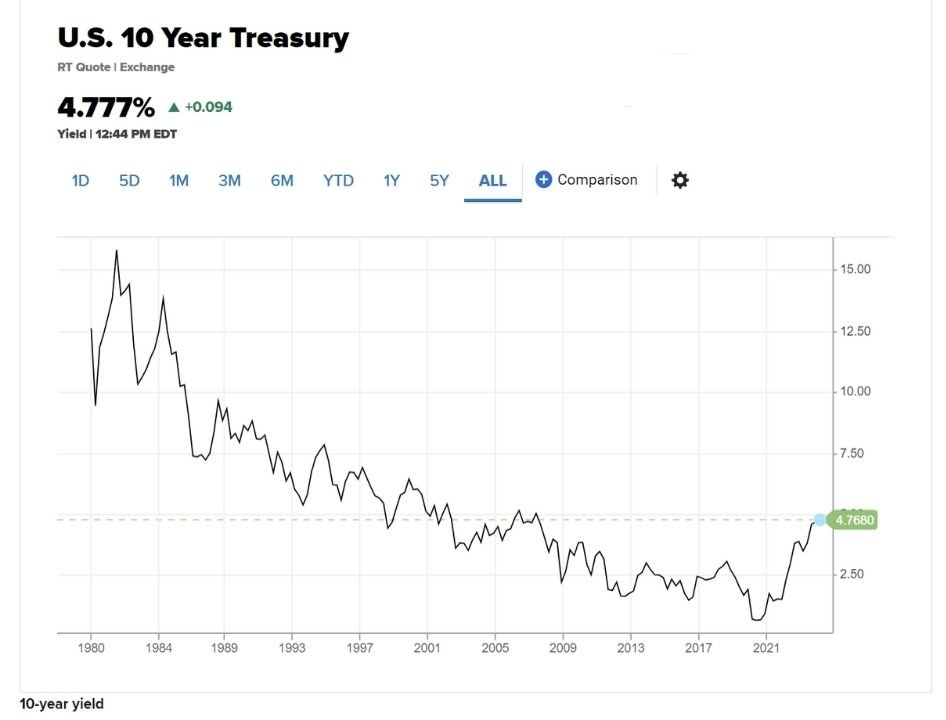
The bond market is sounding alarm bells about the economic outlook. The yield on the 2-year Treasury briefly exceeded the 10-year yield this week for the first time since 2019. Known as a yield curve inversion, this phenomenon historically signals a recession could be on the horizon.

While not a guarantee, yield curve inversions have preceded every recession over the past 50 years. Here is what is happening in the bond market and what it could mean for investors.

Why Did Yields Invert?

Yields on short-term bonds like 2-year Treasuries tend to track the Federal Reserve’s policy rate. With the Fed aggressively hiking rates to combat inflation, short-term yields have been rising quickly.

Meanwhile, long-term yields like the 10-year are influenced by investors’ growth and inflation expectations. As optimism over the economy’s trajectory wanes, investors have been driving down long-term yields.

This dynamic inversion, where short-term rates exceed longer-duration ones, reflects mounting concerns that the Fed’s rate hikes will severely slow economic activity. Markets increasingly fear rates may cause a hard landing into recession.

Image credit: Cnbc.com

Growth and Inflation Concerns Intensify

The yield curve has flashed the most negative signal since the lead up to the pandemic recession. This suggests investors see a lack of catalysts for growth on the horizon even as inflation remains stubbornly high.

Ongoing supply chain problems, the war in Ukraine putting pressure on food and energy prices, and fears of a housing market slowdown are all weighing on outlooks. There is a sense the Fed lacks effective tools to bring down inflation without crushing the economy.

Meanwhile, key economic indicators like manufacturing surveys have weakened significantly. This points to activity already slowing ahead of when rate hikes would take full effect.

Implications for Investors

The risks of a recession are rising. Yield curve inversions have foreshadowed every recession since the 1950s. However, they have also sometimes occurred 1-2 years before downturns start.

This suggests investors should prepare for choppiness, but not panic. Rotating toward more defensive stocks like healthcare and consumer staples can help portfolios better weather volatility. At the same time, cyclical sectors like tech and industrials could face more pressure.

In fixed income, short-term bonds may offer opportunities as the Fed potentially cuts rates during a downturn. But credit-sensitive sectors like high-yield bonds and leveraged loans could struggle if defaults rise.

While uncertainty abounds, the inverted yield curve highlights the delicate balancing act ahead for the Fed and concerns over still-high inflation. Investors will be closely watching upcoming data for signs of how quickly the economy is slowing. For now, caution and safe-haven assets look to be in favor as recession worries cast a long shadow.

Biotech Poised for a Powerful Comeback

After a fallow period, signs point to the biotech sector regaining its prior momentum. Several factors indicate a pending return to rapid growth and prolific innovation for biotech companies. This prospective resurgence could replicate the boom years of the 1980s and 1990s.

The first driver is scientific advancements that open new possibilities. CRISPR gene editing has revolutionized biotech, allowing cheaper and easier manipulation of genetic code. This enables creation of novel treatments and cures previously out of reach. Other breakthroughs like mRNA vaccines have proven the ability to rapidly develop radically new therapeutic approaches.

Vast amounts of genomic data generated in recent decades have also unlocked new understandings of biologically rooted diseases. By identifying key genetic drivers, drug targets can be validated to produce higher success rates in clinical trials. Failed drug candidates have historically been a major drag on biotech.

Substantial investment capital is also lining up behind biotech again after the sector fell out of favor. While biotech IPOs dropped sharply in 2022, venture funding actually rose to its second highest level ever at $32 billion. Investor appetite remains strong, especially for companies with promising new platforms.

Large cash piles among pharmaceutical giants could further bolster biotech. Big pharma companies have routinely turned to buying biotech firms to fill product pipelines. With major players like Pfizer and Merck holding over $25 billion in deployable cash reserves, expect more dealmaking ahead.

Take a look at several emerging growth biotech companies by looking at Noble Capital Market’s Senior Research Analyst Robert LeBoyer’s coverage list.

Regulatory incentives additionally sweeten the proposition of getting back into biotech. The FDA is actively supporting development in areas like gene therapy, rare diseases, and certain cancers through its pilot programs and priority reviews. This guidance can derisk investments.

The maturing ecosystem around biotech also fuels its potential rebound. Experienced veteran executives can now be tapped to steer startups. Clustering in hubs like Boston and San Francisco persists to provide concentration of talent, capital, and resources.

While risks like high failure rates remain, the ingredients are aligning for biotech’s next generation. Comparisons to the internet boom of the late 1990s resonate, with biotech representing a similar pivotal platform shift. The world’s demographics also underpin demand for new therapies – aging populations in developed nations will drive need.

This fertile environment parallels periods that produced prior biotech booms. In the late 1970s and 80s, the industry arose virtually from scratch around pioneering companies like Genentech and Amgen. The advent of genetic engineering allowed creation of the first biologic drugs.

Another surge came through the 90s as enabling technologies like high throughput screening scaled up the drug discovery process. The mapping of the human genome unleashed another wave of possibilities.

Today’s scientific advances pose an even greater leap, allowing drug development and treatment paradigms hardly imaginable just decades ago. The bounds of human understanding keep expanding.

The stars are aligning for biotech 2.0, an evolution building on past successes but catalyzed by new potentials. It promises to usher in an era of curative therapies, genomic precision, and accelerated innovation. The post-pandemic landscape offers the ideal springboard for this biotech revival.

With therapeutic bottlenecks getting cleared, investor interest rekindling, and confidence restored, expect biotech to reclaim its prior growth trajectory. The lessons of past booms were well learned, leaving companies better positioned to capitalize. Weapons to fight disease grow more powerful by the month.

The public expects and demands new treatments for pressing needs, from cancer to neurological conditions. Demographics favor biotech’s prospects as populations age. An energized ecosystem stands ready to nourish exciting science from lab to market.

The pieces are in place for biotech liftoff. As science unlocks new horizons, investor insight aligns with public health demands, fueling momentum. Biotech’s foundational role in driving modern medical progress is poised to only accelerate. The cycle of innovation spins up again.

Crisis Averted: Government Stays Open

By averting a government shutdown, Congress has avoided rocking both the economy and financial markets. Shutting down federal operations would have created widespread uncertainty and turbulence. Instead, the move offers stability and continuity as the economy faces broader headwinds.

With virtually all government functions continuing normal operations, economic data releases, services, and programs will not face disruptions. Past shutdowns caused delays in economic reports, processing visa and loan applications, releasing small business aid, and more. These disruptions introduce friction that can dampen economic momentum.

Federal employees will continue receiving paychecks rather than facing furloughs. The last major shutdown in 2018-2019 resulted in 380,000 workers being furloughed. With over 2 million federal employees nationwide, even a partial shutdown can reduce economic activity from lost wages.

Government contractors also avoid financial duress from suspended contracts and payments. Many contractors faced cash flow crises during the 2018 shutdown as the government stopped paychecks. Reduced revenues directly hit company bottom lines.

Consumer and business confidence are likely to be maintained without the dysfunction of a funding gap. Surveys showed confidence dropped during past shutdowns as uncertainty rose. Lower confidence can make households and businesses reduce spending and investment, slowing growth.

The tourism industry does not have to contend with closing national parks, museums and monuments. The 2013 shutdown caused sites like the Statue of Liberty to close, resulting in lost revenue for vendors, hotels, and airlines. These impacts radiate through the economy.

Markets also benefit from reduced policy uncertainty. The 2011 debt ceiling showdown and 2018-2019 shutdown both introduced volatility as deadlines approached. Equities fell sharply in the final weeks of the 2018 impasse. While shutdowns alone don’t determine market trends, they contribute an unnecessary headwind.

With recent stock volatility driven by inflation and recession concerns, averting a shutdown provides one less factor to potentially spook markets. Traders never like surprises, and shutdowns heighten unpredictability.

On a sector basis, federal contractors and businesses leveraged to consumer spending stand to benefit most from the avoided disruption. Aerospace and defense firms like Lockheed Martin and Northrop Grumman rely heavily on federal budgets. Consumer discretionary retailers and restaurants avoid lost sales from furloughed workers tightening budgets.

While shutdowns impose only marginal economic impact when brief, longer impasses can impose meaningful fiscal drags. The 16-day 2013 shutdown shaved 0.3% from that quarter’s GDP growth. The longer the stalemate, the greater the economic fallout.

Overall, with myriad headwinds already facing the economy in inflation, rising rates, and recession risks, avoiding a shutdown removes one variable from the equation. While defaulting on the national debt would produce far graver consequences, shutdowns still introduce unnecessary turbulence.

By staving off even a short-term shutdown, Congress helps maintain economic and market stability at a time it’s especially needed. This provides a breather after policy uncertainty spiked leading up to the shutdown deadline. While myriad challenges remain, at least this box has been checked, for now.

Student Loan Payments Resume

After nearly 3 years of reprieve, student loan payments are set to restart on October 1, 2023. However, the landscape looks much different thanks to sweeping changes made by the Biden administration. These alterations have made student debt more manageable and offered routes to accelerated payoff or even forgiveness that didn’t exist before.

The impact could extend beyond individual borrowers to provide a boost to the overall economy. With less income eaten up by student loan payments, borrowers will have more spending power. That additional discretionary income circulating through the economy acts as a stimulus.

Perhaps the most impactful change was the elimination of interest capitalization in most cases. This is the process where unpaid interest gets added to the loan balance, causing it to balloon. Now, interest no longer capitalizes when borrowers exit forbearance, leave income-driven repayment plans, or have other status changes. Only when exiting deferment on unsubsidized loans does interest get added to principal. This prevents balances from spiraling out of control.

Biden has also dramatically expanded access to forgiveness. Over 3 million borrowers have already had loans discharged through revamps of programs like Public Service Loan Forgiveness and income-driven repayment. The former saw its complex rules simplified, while the latter had payment counts adjusted and forbearance periods now qualifying for credit. These tweaks pushed many over the line into immediate forgiveness.

Even borrowers who don’t qualify for these programs have an easier time discharging loans through bankruptcy. New guidelines tell government lawyers not to oppose bankruptcy discharge requests that meet certain criteria laid out in a 15-page form. This makes the previously rare “undue hardship” determination more accessible.

The administration also implemented a 1-year “on ramp” where missed payments don’t negatively impact credit or trigger default. This grace period offers struggling borrowers a clean slate before consequences kick in again.

Those able to resume payments may even benefit from today’s high interest rates. Federal student loans have fixed low rates, so borrowers can pay them down faster by investing in treasury notes earning far higher returns. Inflation likewise reduces the real burden of student debt over time.

While these changes have brought tangible individual relief, broadly reducing the student debt burden could also provide a macroeconomic boost. Money freed up in household budgets gets spent elsewhere, circulating through and stimulating the economy.

The Biden administration still wants to enact broad student debt cancellation for this very reason. After the Supreme Court blocked its forgiveness plan, the Department of Education launched “negotiated rulemaking” to find another path. This bureaucratic process involving public committees aims to deliver a new cancellation proposal in late 2024.

Until then, the reshaped student loan landscape gives borrowers breathing room. The structural changes determine whether student debt remains a crushing burden or becomes manageable.

With interest capitalization curbed and expanded opportunities for discharge, balances can actually shrink instead of endlessly growing. The credit safeguards offer wiggle room to get finances in order before consequences hit. And the door to forgiveness has been opened wider than ever before.

Of course, these alterations won’t instantly solve every borrower’s problems. But they provide avenues for relief that didn’t exist previously. And more importantly, they signal a philosophical shift that student debt shouldn’t ruin lives or constrain futures.

There’s still work to be done, like making income-driven repayment more accessible and adding guardrails to limit excessive debt. But the momentum is towards a system that helps borrowers succeed rather than burying them in interest and unpayable balances.

So while student loan repayment is resuming, borrowers can take heart that it’s restarting under a fairer set of rules. The old grind of watching debt balloon while relief remained elusive has thankfully been left behind. With a potential wider economic stimulus, these changes could benefit more than just student borrowers.

Instacart Founder Exits With $1.1 Billion Fortune After IPO

Apoorva Mehta’s path to becoming a billionaire was paved with determination and grit. The 37-year-old founder of grocery delivery app Instacart debuted his company on the public market this week, earning a personal net worth of $1.1 billion.

Mehta’s road to success was not straightforward. After quitting his job as a supply chain engineer at Amazon in 2010, Mehta attempted to launch over 20 startups in San Francisco, all of which failed. “I wanted to become an entrepreneur. I didn’t know what my idea was going to be,” Mehta told CNBC.

Undeterred by his string of failures, Mehta found inspiration from his own empty refrigerator and launched Instacart in 2012 to disrupt the grocery delivery industry. Instacart struggled at first, with Mehta even missing Y Combinator’s application deadline. But he managed to impress the famed accelerator’s partners by personally delivering beer to their office using his new app. With Y Combinator’s backing and $2.3 million in early funding, Instacart began spreading beyond San Francisco.

In just over a decade, Mehta has grown Instacart into a grocery delivery behemoth operating in over 14,000 cities across North America. The company has facilitated the delivery of over 900 million grocery orders and 20 billion items since its founding. Instacart now delivers groceries from over 80,000 stores, including major chains like Kroger, Costco, and Wegmans.

With Instacart’s successful IPO and $8.8 billion valuation, Mehta is transitioning from his role as executive chairman. His 11-year journey founding and leading Instacart has earned him billionaire status, proving that persistence and vision can turn startup failures into phenomenal success.

Mehta’s determination to solve a personal need despite multiple failed attempts speaks to his perseverance and self-belief. “Being an entrepreneur is about solving problems,” Mehta told Forbes India. “If you are solving problems, you are doing something meaningful.”

This tireless problem-solving ethic kept Mehta persevering through over 20 doomed startups before finding his billion-dollar idea. “I wanted to build something that really moved the needle,” Mehta told Entrepreneur. “Part of the reason I kept trying was because I wasn’t succeeding.”

Now valued at nearly $9 billion, Instacart succeeded in moving the needle for online grocery delivery in a massive way. “I’m most excited about the impact we can have on the grocery industry,” Mehta told Forbes of his goals looking forward.

As Mehta departs his executive chairman role, his grocery delivery empire promises to change how people access fresh food for years to come. Under new CEO Fidji Simo, formally of Facebook, Instacart is poised for continued innovation and growth.

Mehta’s journey underscores how entrepreneurs should not measure success purely in financial terms. “It’s about solving problems, inventing things and making an impact – not for the sake of making money but because it’s a challenge,” Mehta told Entrepreneur India. For him, impact and problem solving are the true markers of success.

After over 20 failures, Mehta never gave up on his goal of building something meaningful. His unflagging determination and vision turned a simple grocery delivery app into a multibillion-dollar public company. Mehta’s inspiring rise from failed startups to billionaire success shows how persistence and grit can overcome early stumbles to eventually change an entire industry.

An Exclusive In-Person Event for Channelchekers: NobleCon19, December 3-5, Boca Raton, Florida

Noblecon19 is Noble Capital Markets’ 19th Annual Emerging Growth Equity Conference. This year, and for the first time, it will be held at Florida Atlantic University College of Business, Executive Education complex in Boca Raton, Florida. If a school environment comes to mind – wooden tables and hard chairs – you’re in for a huge surprise. This spectacular new 52,000 square foot building features the most technologically advanced presentation rooms on the North American Conference circuit with massive screens and tiered seating, all wired for worldwide broadcast. Oh, and the chairs are ergonomic memory foam.

Enough about the facilities (except to mention there are 800 free covered parking spots), it’s what will go on inside that is making NobleCon19 among the most anticipated events in South Florida this winter. Over 200 public company executive guest speakers (CEO, CFO, COO, that level), The 2023 NCAA Men’s Basketball Coach of the Year, Dusty May, on motivational team building. “The World is Hot” panel of experts covering everything from the global economy to the daunting influence of AI. And the 43rd President of the United States, George W. Bush. Only 46 people have ascended to that position, so that’s about as exclusive as it gets.

Let’s go back to those public company executives. The true stars of the show. Emerging growth companies are synonymous with innovation. They represent breakthroughs in science, technology, and medicine. Even though that breakthrough may be right around the corner, these are lesser known companies, so it’s a hands-on way to explore and discover what the future may hold, and you’re hearing it from the c-suites of the organizations. And if you’re looking for investments with exponential growth opportunity, NobleCon will certainly help begin your due diligence. If you’re looking for the next apple, this truly is your orchard.

The agenda offers a wide range of ways to meet these executives. Each company will have a formal presentation, an informal breakout, and one-on-one meetings arranged with qualified investors. The corridors will be filled with them so a little badge-watching can lead to some great dialogue. And then there’s “The After.” It’s a networking event (party) the evening after the first day of meetings. Noble has become known for The After, perhaps even legendary. This year it’s at the Privaira Aviation hangar at the Boca Raton Airport. The theme is a throwback to 1923 – It’s also the 19th NobleCon in ‘23. Here’s the billing for the event: “Mingle with munchies, music, magic, motors, and high-flying antics – a nostalgic extravaganza.“ Noble believes that the best bits of business are done in these more casual, fun environments, so to make sure that they are very well attended, they go, as they say, all out.

NobleCon is open for anyone to attend. So who should attend? Besides the obvious – institutional investors, brokers, equity analysts, RIAs, family offices – simply, anyone who has a love for business and wants to meet and mesh with the leaders of these emerging companies. The companies themselves help subsidize the lofty cost of hosting an event of this size and caliber, so the cost to attend all events is only $399. And until October 15, if you are a registered guest of Channelchek, (here’s the real exclusive part) it’s less than half at $149! This offer is limited to the first 250 attendees. To put that in perspective, a ticket for the best seat in the house for the George W. Bush fireside chat alone (moderated by Noble’s Director of Research, Michael Kupinski) is $350. If you’re looking for the ultimate adventure in capitalism, this is it!

NobleCon19 at Florida Atlantic University, College of Business, Executive Education

December 3-5, 2023, Boca Raton, FL | www.nobleCon19.com

INVESTORS REGISTER HERE   
ENTER DISCOUNT CODE: CCMEMBERDISC

IF YOU REPRESENT A PUBLIC COMPANY AND WOULD LIKE TO BE CONSIDERED AS A PRESENTER AT NOBLECON19 CLICK HERE

Please note that lawyers, accountants, corporate consultants, investor relations, and other service providers do not qualify for the Channelchek discount.

NobleCon19 Sponsors

Learn More: Seeking Alpha  |  Privaira  |  AON  |  The Money Channel

Learn More: The Nuvo Group  |  FAU  |  Boca Raton  |  Investor Brand Network  |  SLS
Harter Secrest & Emery  |  Marcum  |  GreenbergTraurig  |  Lowenstein Sandler  |  StoneX
Dickinson Wright

Learn More: CFA Society South Florida  |  Palm Beach Hedge Fund Association 
 Boca Magazine | Delray Magazine | South Florida Stock & Bond Club
Nasdaq | Miami Finance Forum | Nelson Mullins

DoorDash Ditches NYSE for Nasdaq in Major Stock Exchange Switch

Food delivery app DoorDash announced it will transfer its stock exchange listing from the New York Stock Exchange to the Nasdaq. The company will begin trading on the Nasdaq Global Select Market under the ticker ‘DASH’ starting September 27, 2023.

This represents a high-profile switch that exemplifies the fierce competition between the NYSE and Nasdaq to attract Silicon Valley tech listings. It also reflects shifting sentiments around brand associations and target investor bases.

DoorDash first went public on the NYSE in December 2020 at a valuation of nearly $60 billion. At the time, the NYSE provided the prestige and validation desired by the promising young startup.

However, DoorDash has since grown into an industry titan boasting a market cap of over $30 billion. As a maturing technology company, Nasdaq’s brand image and investor mix provide better positioning.

Tony Xu, co-founder and CEO of DoorDash, emphasized the benefits of the Nasdaq in the company’s announcement. “We believe DoorDash will benefit from Nasdaq’s track record of being at the forefront of technology and progress,” he said.

Nasdaq has built a reputation as the go-to exchange for Silicon Valley tech firms and growth stocks. Big name residents include Apple, Microsoft, Amazon, Tesla, Alphabet, and Facebook parent company Meta.

The exchange is also home to leading next-gen companies like Zoom, DocuSign, Crowdstrike, Datadog, and Snowflake. This creates an environment tailor-made for high-growth tech outfits.

Meanwhile, the NYSE leans toward stalwart blue chip companies including Coca Cola, Walmart, Visa, Walt Disney, McDonald’s, and JPMorgan Chase. The historic exchange tends to attract mature businesses and financial institutions.

Another factor likely influencing DoorDash is the investor makeup across the competing exchanges. Nasdaq generally appeals more to growth-oriented funds and active traders. The NYSE caters slightly more to institutional investors like pension funds, endowments, and passive index funds.

DoorDash’s switch follows ride sharing pioneer Lyft’s jump from Nasdaq to the NYSE exactly one year ago. Like DoorDash, Lyft desired a brand halo as it evolved past its early startup days.

“It’s a signal of us being mature, of us continuing to build a lasting company,” said Lyft co-founder John Zimmer at the time of the company’s NYSE listing.

Jared Carmel, managing partner at Manhattan Venture Partners, believes these exchange transfers reflect the “changing identities of the companies.”

As startups develop into multi-billion dollar giants, they evaluate whether their founding exchange still aligns with their needs and desired perceptions. Brand association and shareholder registration are becoming as important as operational capabilities for listings.

High-flying growth stocks like DoorDash also consider indexes, as the Nasdaq 100 often provides greater visibility and buying power from passive funds tracking the benchmark. Prominent inclusion in those indexes requires trading on Nasdaq.

Whether mature blue chips or emerging Silicon Valley darlings, the rivalry between Nasdaq and NYSE will continue heating up as each exchange vies to attract and retain brand name public companies. With lucrative listing fees on the line, exchanges will evolve branding, services, and capabilities to better cater to their target customers.

The DoorDash switcheroo exemplifies the changing perspectives and motivations influencing exchange selection. As companies lifecycles and personas transform, they reevaluate decisions made during those frenetic early IPO days.

Chesapeake Utilities to Acquire Florida City Gas in $923 Million Deal

Chesapeake Utilities Corporation announced Monday that it has entered into an agreement to acquire Florida City Gas (FCG) from NextEra Energy for $923 million in cash. The acquisition will significantly expand Chesapeake’s presence in the growing Florida energy market.

FCG is the eighth largest natural gas local distribution company in Florida, serving around 120,000 residential and commercial customers across eight counties. Its infrastructure includes approximately 3,800 miles of distribution pipelines and 80 miles of transmission pipelines.

According to Jeff Householder, President and CEO of Chesapeake Utilities, natural gas demand in Florida continues to rise as consumers and businesses seek reliable, domestic, and affordable energy. With this acquisition, Chesapeake aims to capitalize on the robust growth opportunities across the state.

“This acquisition will more than double our natural gas business in Florida, one of the fastest growing states in the nation,” said Householder. “We see significant potential to continue pursuing long-term earnings growth.”

The deal is expected to close by the end of the fourth quarter of 2023, subject to regulatory approvals. Once completed, FCG will become a wholly owned subsidiary of Chesapeake Utilities.

Chesapeake has a strong track record of successfully integrating acquisitions to drive growth, as seen in its purchase of Florida Public Utilities in 2009. The company believes it can optimize FCG’s operations and execute on additional investments in gas distribution, transmission, and other energy platforms.

To finance the deal, Chesapeake plans to utilize a mix of equity and long-term debt to maintain balance sheet strength. The company has also obtained committed financing from Barclays.

Chesapeake has extended its earnings guidance through 2028 based on the increased scale and opportunities from FCG. It expects earnings per share growth of approximately 8% through 2028. The company also increased its 5-year capital expenditure guidance to $1.5-$1.8 billion.

The FCG acquisition demonstrates Chesapeake’s strategy of consolidating natural gas assets and positioning itself for growth in key geographies. As energy markets evolve, strategic deals allow companies like Chesapeake to enhance their competitive position.

Mortgage Rates Hit 23-Year High

Mortgage rates crossed the 7% threshold this past week, as the 30-year fixed rate hit 7.31% according to Freddie Mac data. This marks the highest level for mortgage rates since late 2000.

The implications extend far beyond the housing market alone. The sharp rise in rates stands to impact the stock market, economic growth, and investor sentiment through various channels.

For stock investors, higher mortgage rates pose risks of slower economic growth and falling profits for rate-sensitive sectors. Housing is a major component of GDP, so a pullback in home sales and construction activity would diminish economic output.

Slower home sales also mean less revenue for homebuilders, real estate brokers, mortgage lenders, and home furnishing retailers. With housing accounting for 15-18% of economic activity, associated industries make up a sizable chunk of the stock market.

A housing slowdown would likely hit sectors such as homebuilders, building materials, home improvement retailers, and home furnishing companies the hardest. Financial stocks could also face challenges as mortgage origination and refinancing drop off.

Broader economic weakness resulting from reduced consumer spending power would likely spillover to impact earnings across a wide swath of companies and market sectors. Investors may rotate to more defensive stocks if growth concerns escalate.

Higher rates also signal tightening financial conditions, which historically leads to increased stock market volatility and investor unease. Between inflation cutting into incomes and higher debt servicing costs, consumers have less discretionary income to sustain spending.

Reduced consumer spending has a knock-on effect of slowing economic growth. If rate hikes intended to fight inflation go too far, it raises the specter of an economic contraction or recession down the line.

For bond investors, rising rates eat into prices of existing fixed income securities. Bonds become less attractive compared to newly issued debt paying higher yields. Investors may need to explore options like floating rate bonds and shorter duration to mitigate rate impacts.

Rate-sensitive assets that did well in recent years as rates fell may come under pressure. Real estate, utilities, long-duration bonds, and growth stocks with high valuations are more negatively affected by rising rate environments.

Meanwhile, cash becomes comparatively more attractive as yields on savings accounts and money market funds tick higher. Investors may turn to cash while awaiting clarity on inflation and rates.

The Fed has emphasized its commitment to bringing inflation down even as growth takes a hit. That points to further rate hikes ahead, meaning mortgage rates likely have room to climb higher still.

Whether the Fed can orchestrate a soft landing remains to be seen. But until rate hikes moderate, investors should brace for market volatility and economic uncertainty.

Rising mortgage rates provide yet another reason for investors to ensure their portfolios are properly diversified. Maintaining some allocation to defensive stocks and income plays can help smooth out risk during periods of higher volatility.

While outlooks call for slower growth, staying invested with a long-term perspective is typically better than market timing. Patience and prudent risk management will be virtues for investors in navigating markets in the year ahead.

Uranium Prices Hit 12-Year High on Rising Demand

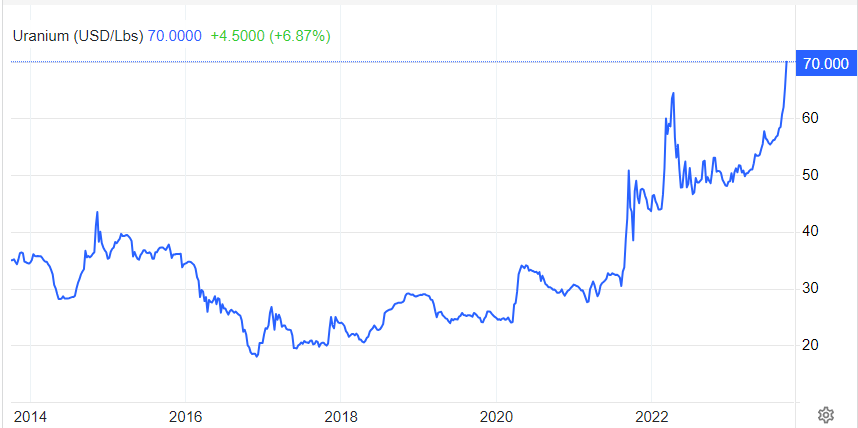
Uranium prices have hit their highest level in 12 years, reaching around $70 per pound in recent trading. This marks a major rally for the nuclear fuel, as prices were languishing below $30 per pound just a couple years ago. The uranium market has seen renewed interest from investors and utilities lately, driving the huge spike in prices.

Image Credit: Trading Economics

Uranium is a key material used in nuclear power generation. It is the fuel inside nuclear reactors that undergoes fission to release massive amounts of energy. Uranium is mined from the ground, then processed and enriched before being fabricated into fuel rods for insertion into reactors. Nuclear power plants require a steady supply of uranium fuel to continue operating.

There are several factors behind the big jump in uranium prices recently. A major one is increased demand, as more nuclear reactors are being built around the world. China in particular has been rapidly expanding its nuclear energy capabilities. More reactors coming online globally means more demand for uranium fuel. Supply has also been constrained lately, with pandemic-related disruptions slowing some uranium mining operations. This demand/supply imbalance has helped drive uranium prices markedly higher.

The surge in uranium prices is great news for uranium mining companies and producers. Major players in the global uranium market like Cameco, Kazatomprom, and Energy Fuels stand to benefit greatly from elevated prices. Their profitability increases significantly when uranium prices rise. These companies have seen their stock prices jump this year in tandem with the uranium price rally. Many uranium stocks are up 50% or more year-to-date.

According to Noble Capital Markets Senior Research Analyst Michael Heim, “There has been an imbalance between domestic uranium supply and demand over the last 15 years as consumers (electric utilities) purchased cheap uranium from foreign nations such as Kazakhstan under short-term contracts. Domestic producers curtailed production with spot prices below production costs. With prices now near $70 per pound and electric utilities increasingly willing to sign longer-term contracts, domestic uranium companies like Energy Fuels are able to restart operations.”

Take a moment to take a look at Energy Fuels Inc., a leading U.S.-based uranium mining company, supplying major nuclear utilites.

The hot uranium market also has implications for the broader stock market. The S&P 500 energy sector has been one of the top performing segments this year. Rising uranium prices provide an added catalyst, as nuclear energy becomes relatively more cost competitive. Utility companies running nuclear power plants also benefit from lower relative fuel costs. This can enhance their profitability and lead to upside in the utilities sector.

Overall, the big rebound in uranium prices reflects growing global demand for nuclear power. New reactor projects and increased focus on energy security are driving uranium back to multi-year highs. This should provide a boost to uranium producers and related stocks going forward. Nuclear power appears poised for increased utilization in the years ahead, which points to a strong fundamental outlook for uranium prices. As long as demand keeps rising faster than supply, uranium seems likely to maintain its bull run.

Alfasigma Makes Big Bet on Liver Disease With $1.25 Billion Intercept Buyout

Italian pharma Alfasigma is expanding its gastroenterology portfolio in a major way with the proposed $1.25 billion acquisition of Intercept Pharmaceuticals. The all-cash deal provides Alfasigma with Intercept’s leading drug Ocaliva and a strengthened pipeline in progressive liver diseases.

Alfasigma will pay $19 per share to acquire Intercept, representing an 82% premium over Intercept’s share price before the deal announcement. The purchase price reflects a big bet on Ocaliva’s growth prospects and Intercept’s broader capabilities in rare liver conditions.

Ocaliva is the key asset Alfasigma gains from the deal. It’s the only FDA approved second-line treatment for primary biliary cholangitis (PBC), a progressive autoimmune disorder that damages the bile ducts in the liver. Ocaliva hit $152 million in sales over the first half of 2023 alone, underscoring its rapid growth trajectory.

Beyond Ocaliva, Alfasigma also adds Intercept’s emerging pipeline of novel therapies for PBC and other liver diseases. The crown jewel is a promising fixed-dose combination regimen that could transform the PBC treatment paradigm.

Take a look at Noble Capital Markets Senior Life Sciences Analyst Robert LeBoyer’s coverage universe.

The deal dramatically expands Alfasigma’s presence in the high-value U.S. pharma market. Previously focused primarily on the Italian market, the Intercept acquisition gives Alfasigma an anchor asset and commercial team in the U.S.

Strategically, the move aligns with Alfasigma’s vision to build up its gastroenterology and hepatology business. CEO Francesco Balestrieri highlighted Intercept’s compelling strategic fit with Alfasigma’s focus in these therapeutic areas.

Expect Alfasigma to invest heavily to maximize Ocaliva’s potential. The company sees major commercial expansion opportunities to extend Ocaliva’s reach across PBC patient populations. Alfasigma also gains Intercept’s seasoned specialty sales force to drive prescription growth.

With Intercept operating as a wholly-owned subsidiary once the buyout closes, Alfasigma is well-positioned to become a global force in progressive liver diseases. The deal enhances Alfasigma’s standing as an emerging player in the U.S. pharma market.

Look for Alfasigma to continue seeking acquisition targets to accelerate its growth. The company has the financial firepower to pursue additional deals that build up its portfolio. If the Intercept acquisition is any indication, Alfasigma has appetite for bold, transformative M&A.

The proposed buyout still requires regulatory and shareholder approval. But with a massive 82% premium offered, Intercept shareholders are likely to approve the $19 per share deal price. Expect Alfasigma to move rapidly to complete the acquisition by the end of 2023.