
The webcasts from NobleConXV are now available.
Author: Admin
Developer
Research – Trovagene (TROV) – Funding for trial

Friday, February 1, 2019
Trovagene Inc. (TROV)
PoC Capital Agreement to Fund Colorectal Cancer Trial
Ahu Demir, Ph.D., Biotechnology Research Analyst, Noble Capital Markets, Inc.
RATING: OUTPERFORM
Research – KeyW (KEYW) – NobleCon15 Highlights

Friday, February 1, 2019
The KEYW Holding Corporation (KEYW)
NobleCon15 Highlights Attractive Risk/Reward .
Joe Gomes, Senior Research Analyst, Noble Capital Markets, Inc.
RATING: OUTPERFORM
Research – Comtech (CMTL) – Management upbeat at NobleCon15

Friday, February 1, 2019
Comtech (CMTL)
Management Upbeat at NobleCon 15.
Joe Gomes, Senior Research Analyst, Noble Capital Markets, Inc.
RATING: OUTPERFORM
Research – 1-800-Flowers.com (FLWS) – Management raises guidance

Friday, February 1, 2019
1-800-Flowers.com, Inc (FLWS)
Coming up roses.
1-800 Flowers.com Inc
is a United-States-based provider of gourmet food & gift baskets, consumer
floral, and BloomNet wire service. Gourmet food & gift baskets and consumer
floral jointly account for the majority of the company’s total revenue. The
company provides a broad range of merchandise, including fresh flowers,
premium, fruits, popcorn, specialty treats, cookies and baked gifts, premium
chocolates, confectionery, gift baskets, premium English muffins, steaks and
chops, and others.
Michael Kupinski, Senior Research Analyst, Noble Capital Markets, Inc.
Refer to full report for rating.
- Over delivers quarter. The fiscal second quarter revenues of $571.3 million beat our $552 million estimate and adjusted EBITDA was higher expected ($103.1 million versus our $96.1 million estimate). The standout, for a second straight quarter, was BloomNet, its wire service business, which increased revenues 15% and a strong 7.3% increase in adj. EBITDA.
- Raised full year guidance. Management raised its fiscal year end 2019 full year guidance from a range of $1209.5 million to $1232.6 million in revenues to $1232.6 million to $1244.1 million in revenues. And, it raised adjusted EBITDA guidance from a range of $77 million to $80 million to a range of $80.0 million to $82.0 million, with E…
GO TO FULL REPORT
Get full report on Channelchek desktop.
*Analyst
certification and important disclosures included in full report.
NOTE: investment decisions should not be based upon the content of
this research summary. Proper due diligence is required before
making any investment decision.
News – The Great Wall of America

Building the Big Beautiful Wall
(Note: all the sources
listed in the “Balanced” section)
Shortly after the presidential election, construction companies began a fierce competition to win the contract to build Trump’s “big, beautiful wall” that was promised during his presidential campaign. Out of the many competitors there were only six contractors who were selected to present prototypes to the Border Patrol for testing. Now, as the border wall controversy has forced our government into a partial shutdown these wall construction contractors wait powerlessly as the contract of a lifetime hangs in the balance.
News – Is OPEC still king of oil?

Does OPEC still set oil prices?
(Note: all the sources
listed in the “Balanced” section)
It is well known that energy production in North America has grown in recent years in response to advances in technology. In fact, some energy leaders are now projecting that North America will be a net exporter of energy by the year 2020. North America’s gain means a decreased importance for Saudi Arabia and other OPEC countries. Currently, OPEC supplies 40% of the world’s oil and announced changes in production volumes have an immediate effect on oil prices. But, does OPEC still have enough influence to set pricing by controlling production output? A strong OPEC able to set prices would mean higher energy prices and that would be bullish for all energy producers. A weak OPEC could mean lower prices and a bearish signal for owners of energy stocks. 1, 2
News – End of an Era: Sears Struggles to Survive

What Is in the Future for Sears and for Retailing?
(Note: all the sources listed in the “Balanced”
section)
Last fall was a study in contrasts
in the retailing world. Amazon (AMZN) garnered a trillion-dollar market cap in
September and Sears filed for bankruptcy protection the following month. Many
observers tied the fortunes of each company to each other.
Amazon clearly has thrived. But,
Sears problems stemmed even before Amazon, in fact, over the past five decades.
The steady decline in brand loyalty in retailing and the advent of increased
competition in big box retailing, played more significant role despite the
common perception that Amazon was the Sears’ kryptonite. Amazon was only the
latest, and possibly last, competitive threat and problem for Sears.
As the top retailer from 1950 to
1990, Sears’ past success and size made it a significant target for smaller, startup
retailers. Sears did not adjust to the competitive factors that it faced with
Walmart and Home Depot. Other missteps include: the failed diversification efforts
into financial services (Coldwell Bankers and Dean Witter), the sale of the
Discover credit card franchise, the cancellation of its mail order catalog
business and lack of transition to the internet, and the use of debt leverage.
These mistakes limited the ability to right the ship and effectively respond to
changing consumer shopping habits. Furthermore, a hedge fund manager, Eddie
Lampert, with limited retailing experience, has been in control since 2005.
Walmart’s CEO Doug McMillon said on
CNBC when Sears was on the verge of bankruptcy last October, “You see the rise
and fall of Sears and others …it’s just a reminder that this can happen to us,
too.” McMillon stated that he keeps a chart of the top 10 retailers in the US
by decade to remind him. Sears was the leader through 1990, but steadily fell
to 10 by 2010 and off the list several years ago.
Over the past decade, a merger
with Kmart and high financial leverage have forced cost cutting moves and left
many stores in a state of disrepair. Lampert also focused almost exclusively on
e-commerce and allowed the stores to atrophy. Even though an e-commerce
strategy helped stabilize same store sales, it has proven difficult to thrive
with a shrink to grow mentality. The e-commerce strategy was forward thinking
and adopted many tools, like dynamic pricing, but Sears underappreciated the
negative impact on e-commerce of a smaller store footprint and poorly
maintained stores. Ironically, Amazon moved away from a pure e-commerce
strategy with the acquisition of Whole Foods Markets in mid-2017 and is rumored
to be contemplating buying some of the former Sears and Kmart stores to expand
its “bricks” presence.
Where does Sears go
from here? Mr. Lampert, the largest shareholder, was, as expected, the lone
bidder at an auction earlier this week. Subsequently, his bid was sweetened to
more than $5.2 billion from $4.4 billion. Mr. Lampert’s bid for Sears possibly keeps
it as a “going concern.” If approved by the Bankruptcy Court, the plan would
keep up to 425 store locations open and possibly save close to 25,000 jobs. The
bid avoids a Chapter 7 liquidation that would have resulted in the sales of
real estate, inventory, intellectual property and other assets to satisfy
creditors, including suppliers. Will the plan work? Time will tell, but it
might be too late for Sears to regain the brand loyalty required to survive in
the Amazon Era.
News – Buybacks: Who benefits?

Why Corporate
Share Repurchases Are Brewing Controversy
(Note:
all the sources listed in the “Balanced” section)
Proponents
of tax cuts that went into effect in 2018 argued it would make corporations
more competitive and stimulate higher wages for employees and increase capital
investment. Critics suggested the cuts
would benefit the wealthy with savings directed toward increasing executive
compensation tied to stock performance and returning capital to shareholders in
the form of higher dividends and share repurchases. With a surge in corporate stock repurchase announcements
in 2018, buybacks could attract more attention, particularly from Democratic
lawmakers who took control of the House in January.
Industry Report – Media – Promising 2019 Expected

Tuesday, November 06, 2018
Media Industry Report
Quarterly Newsletter: A better 2019 expected..
Michael Kupinski, DOR, Senior Research Analyst, Noble Capital Markets, Inc.
News – Robinhood: Could it steal customers from the banks?

Robinhood turns personal finance upside down – again
(Note: all the sources listed in the “Balanced” section)
Robinhood shocked both regulators and the financial industry when the stock-trading app announced in December that it would offer a no-fee checking and savings accounts that will pay a whopping 3% in interest. This will press traditional banks to compete given the current average U.S. savings account rate is 0.09%.
Robinhood first sent a shock to the brokerage system by allowing online investors to buy stocks, ETFs, options, and cryptocurrencies all free of commission in 2015. With its latest move, Robinhood could turn the financial industry on its head once again.
News – Holiday Havoc: Why December turned into a tough time for investors

Holiday Havoc: Why December turned into a tough time for investors
{Note: all the sources listed
in the “Balanced” section}
December has become a roller coaster for investors. They’ve seen the VIX (CBOE Volatility Index) rose over 47% between December 17th to December 24th. That’s on top of concerns over trade tensions between the United States and China, tightening financial conditions, a worsening outlook for corporate earnings growth in 2019, and the possibility the yield curve is inverting, which is widely seen as a potential harbinger of recession, all have combined to create the market’s greatest fear: Uncertainty.
As of Thursday’s market close, the Dow Jones Industrial Average was down 14% from its peak in October, and all other U.S. stock markets are now in, or near, bear territory.
News – The Fed raised its rates, now what?
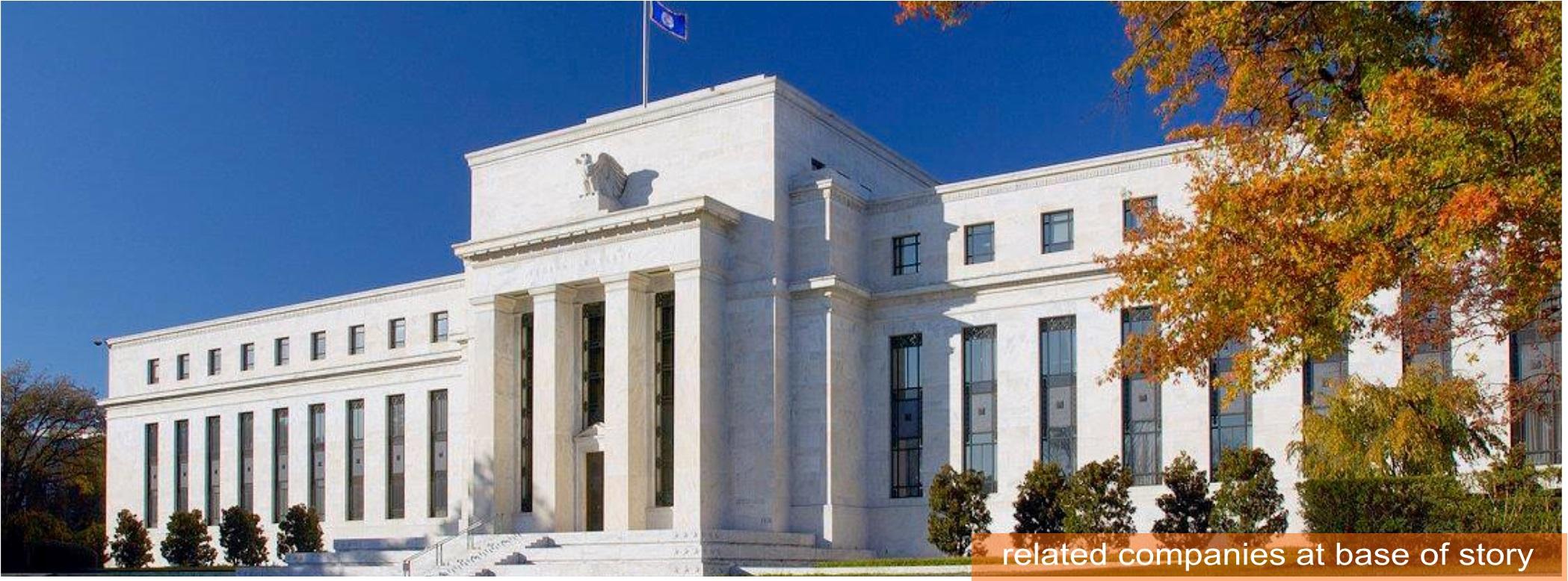
The Fed raised its rates, now what?
(Note: all the sources listed in the “Balanced” section)
In December, 2018, the Federal Reserve raised its benchmark Federal Fund rates 0.25% to a targeted level of 2.25-2.50%. The increase marks the ninth time it’s raised rates since 2015 and the fourth time in 2018. The Fed took a slightly more dovish approach indicating that it now expects two additional rate hikes in 2019, down from three, and described a neutral level to be 2.8%, which is down from 3.0%.
Although the rate increase was largely expected, the Dow closed more than 350 points in the red after the afternoon announcement. The rate increase is being criticized by many political and economic pundits. So, is the Fed being overly cautious in raising rates, or are rate increases needed to prevent the economy from overheating?