Research – Orion Group Holdings (ORN) – Managing Through Uncertainty

Wednesday, April 8, 2020

Orion Group Holdings (ORN)

Managing Through Uncertainty

Orion Group Holdings, based in Houston, Texas, is a specialty construction company within the Marine and Industrial Construction sectors, with operations focused in the continental United States and Caribbean. Revenue is split roughly 50/50 between a Marine Construction segment that provides marine facility, pipeline and structural construction services and a Commercial Concrete segment that provides turnkey concrete services in the light commercial and structural construction markets.

Poe Fratt, Senior Research Analyst, Noble Capital Markets, Inc.

Refer to the full report for the price target, fundamental analysis, and rating.

    Increasing risks to existing projects, but work goes on. We are watching moves to curb the spread of the Coronavirus in Seattle, and signs show that work on the Terminal 5 upgrade and the Fairview Avenue North bridge replacement continues. Preventative measures have been implemented, like worker health screening, extra cleaning onsite and encouraging social distancing practices, like limiting use of break rooms and car pools. The steep downdraft in crude oil prices also creates some risk on the pacing of construction in major Texas markets, but limited changes seen so far. The cruise industry turmoil reinforces our view that the cruise port project in George Town has slipped into next year and possibly will not ever move forward due to local opposition.

    Announced YTD 2020 awards total $111 million. Concrete awards total $40 million and Marine awards total $71 million, including two awards for $24 million in mid-March. The awards are similar in size and are a positive sign given the sharp drop in crude oil prices. Added awards are likely since other low bids pending awards from…


    Click here to get the full report.

This Company Sponsored Research is provided by Noble Capital Markets, Inc., a FINRA and S.E.C. registered broker-dealer (B/D).

*Analyst
certification and important disclosures included in the full report. 
NOTE: investment decisions should not be based upon the content of
this research summary.  Proper due diligence is required before
making any investment decision.
 

The Case for Silver

Is Opportunity Being Signaled by the Price Spread of Precious Metals?

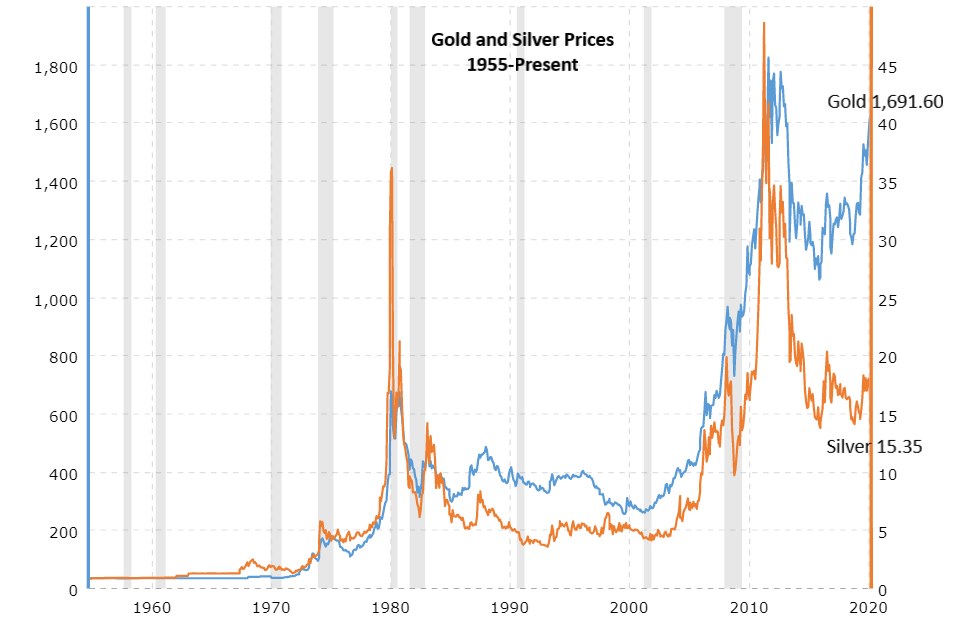
The quiet tug-of-war between supply and demand in the silver market may be worth investors’ attention. With the largest economies of the world suddenly operating at a small fraction of capacity, industrial demand for silver is low, and inventories are higher than needed. At the same time, the quantity of new silver production is low. The recent rise of gold prices would typically suggest that silver prices should also rise. That has not happened yet.  

Silver
Demand

About half of all silver production is used to supply industrial applications. The remainder is split between jewelry, investment, and coin creation. Today demand for jewelry is paltry, the economy is on lockdown, most stores are closed, and people are not going out where they would first add to their jewelry collection. As an industrial metal, silver is used in solder, car windshields, electrical contacts, touch screens, water purification, and solar panels. Any demand from these industries is also running well below the normal pace and is not likely to change soon.

The bulk of today’s interest for silver is from investors. There is some increased interest in silver and gold because of their safe-haven reputations. These two precious metals have been accepted as a store of value longer than any other unit of exchange. They both tend to track each other over time and, as hard currencies, both outperform paper currency relative to inflation.

If demand for silver is going to rise during the pandemic, it will likely be the result of those looking for its hard-currency, safety attributes. We are in a period of rapid asset price declines and potential currency devaluation as a result of aggressive liquidity measures used by the U.S. and others. Historically, this is when silver demand spikes upward.

Silver
Supply

According to The World Silver Survey – 2019, 74% of all new silver is unearthed from non-silver producers.  For example, a large copper deposit might also contain silver. The company will separate this additional metal and use it to generate additional mining revenue. In only 26% of mining operations is the white metal specifically targeted. Instead, it is an extra from semi-precious and base metal mining.

Since the bulk of silver that gets processed each year is mainly dependent on what other miners seperate, if those mines slow or stop production, for any reason, the amount of silver that is found also stops. Mines all over the world have stopped or slowed production in response to the coronavirus outbreak.

New supply of silver coming to market is almost at a standstill.

A close up of a map

Description automatically generated

Source: Macrotrends

Gold Silver Ratio

In a quarterly report on the mining industry (April 6, 2020), Noble Capital Markets Senior Research Analyst, Mark Reichman wrote: “In our view, a combination of fiscal and monetary stimulus, rising U.S. government deficits, debt and lower-for-longer interest rates are supportive of gold prices. While silver is increasingly viewed as an industrial metal, we think its wide discount to gold as a monetary metal will narrow.”  Today, when expressed as how much silver does it take to purchase the same value of gold, the current cost is 110 ounces of silver to each ounce of gold. As the chart above indicates, that is extremely wide by historical standards.

Although demand for silver as an industrial metal has slowed, the supply has also stalled. Increased demand may arise from the wide price differential between the two most common hard currency options. This increased demand could narrow the gap between gold and silver by putting upward pressure on silver prices. Looking forward, shorter-term demand may rise as a result of gold prices. Longer-term it could rise as a result of infrastructure stimulus.

Additional Thoughts

Today’s front page headlines are filled with disease, proposed cures and death tolls which are drowning out other stories. News dominating the financial markets displays the dramatic swings of stock prices and the magnitude of financial recovery packages. Its times such as these that focused investors could do well to look beyond what they are being bombarded with.  It is by discovering opportunities others overlook early on where rewards are greatest. Avoiding distraction is a skill, if you have not registered for access to Channelchek’s research and reports ,(no cost), now would be an ideal time.

Suggested Reading:

Paper Gold, Physical Gold, and Miners

Minerals Industry Report – Metals
& Mining: 2020-1Q Review and Outlook

Minerals Industry Report – What Is Going on With Gold?


Sources:

Minerals Industry Report – Metals
& Mining: 2020-1Q Review and Outlook

World Silver Survey – 2019

The Chemistry of Gold

Macrotrends.net Gold v. Silver

Silver: A New and Major Threat to
Supply

Silver – Statistics and Facts

The Many Uses of Silver

Should Economic Aid Target Businesses or Individuals and Families?

Economic Aid Programs – A Gargantuan Experiment with only Modest Expectations

The coronavirus has had a devastating impact on the U.S. economy as companies have all but shut down to promote social distancing guidelines and government-mandated “stay-at-home” orders.  According to an article in the Wall Street Journal, at least one quarter of the U.S. economy has gone idle due to the coronavirus pandemic.  In March, U.S. employers shed 701,000 jobs: the worst month for job losses since the 2007-2009 recession.  The employment picture may get a lot worse depending on how long it takes to contain the virus and re-open the economy.  Including $350 billion for small business payroll protection grants, President Trump signed into law a $2 trillion stimulus package that includes sending checks directly to individuals and families, a major expansion of unemployment benefits, funds for hospitals and health care providers, financial assistance for small businesses and $500 billion in loans for businesses.  Additionally, the Federal Reserve cut the federal funds rate to a target of 0 to ¼ percent and pledged to use its “full range of authorities to provide powerful support for the flow of credit to American families and businesses.”  However, many are concerned that without proper oversight, the money may end up in the wrong hands or be used improperly.  After all, it seems that a stimulus bill would be most effective if it provided businesses with the incentive and funds to maintain payrolls through the duration of the crisis so workers could be made whole and have jobs to return to once the crisis has passed.  Will the government’s efforts at providing fiscal and monetary stimulus be effective?

Bulls:

The stimulus package is appropriately sized.  In an interview on CBS’s “Face the Nation,” James Bullard, the President of the Federal Reserve Bank of St. Louis stated that the $2 trillion stimulus package signed by President Trump was “well-sized for the situation.”  However, he thought that getting it to the right people represented a challenge.

Avoiding the appearance of corporate bailouts.  Rather then bailing out corporations, Congress appears to have taken a more direct approach to helping families and individuals.  For example, under the recently passed stimulus package, if a person lost their job as a result of COVID-19 and they qualify for unemployment insurance payments, they may be eligible for an additional $600 per week through state unemployment.  Additionally, taxpayers who filed a tax return in 2019 or 2018 will also receive a one-time check from the IRS subject to certain requirements and may also receive $500 for each qualifying child claimed as a dependent.

Keeping some dry powder.  While Congress and the Federal Reserve acted swiftly, it likely makes sense to adjust financial aid in response to evolving needs.  On April 3, House Speaker Nancy Pelosi told CNBC that she is calling for another bill to expand the provisions in the $2 trillion package Congress passed and wants to extend the provisions in the $2 trillion coronavirus relief package and is pushing for more small business loan funding, additional direct payments to individuals and the extension of enhanced unemployment insurance.  

Bears:

Employers are already reducing payrolls and furloughing
workers.
 Despite significant fiscal and monetary stimulus, companies are reducing payrolls and furloughing workers.  While the stimulus package provides direct aid to individuals, it doesn’t replace the security of employment.

Implementation problems.  Already implementation challenges have arisen from large banks’ initial reluctance to participate in federally backed small business lending programs to individuals having trouble receiving economic aid in a timely fashion due to bureaucratic red tape.  Efforts need to be clearly communicated and resources marshalled to deliver benefits in a timely manner.

A matter of approach.  While the Federal Reserve and Congress have responded to the pandemic’s severe economic consequences, some question the method for saving the economy and maintaining employment.  During PBS NEWSHOUR on April 3, David Brooks of the New York Times stated that in Europe, the emphasis has been on providing funds to businesses on the condition that they maintain their payrolls so people don’t face the insecurity of unemployment and may return to their jobs.  In the U.S., the approach has been more individualistic by providing direct payments to individuals, up to $1,200, and unemployment insurance, along with a backstop measure which is $350 billion for businesses.  In Brook’s opinion, economic aid to businesses should be increased so payrolls can be protected.  

Balanced:

The coronavirus pandemic is taking a devastating toll on the U.S. economy and workforce.  Government and federal agencies are responding.  While some may question the amount of economic aid needed or the most effective method of delivery, the answer is likely unknowable at this point.  Therefore, a flexible approach is needed and one that encompasses the needs of businesses and individuals.  While Congress’ stimulus package is likely a first step, economic aid may need to be expanded over time.  A bipartisan approach with adequate oversight may help ensure a program that is sufficient in scope and effectiveness. 

Sources:

State
Shutdowns Have Taken at Least a Quarter of U.S. Economy Offline
, The Wall Street Journal, Josh Mitchell, April 5, 2020.

White
House, Senate Reach Deal on $2 Trillion Stimulus Package
, The Hill, Alexander Bolton and Jordain Carney, March 25, 2020.

Why
the Trump Administration Won’t Be Able to Make the Stimulus Work
, Politico, Joshua Zeitz, April 4, 2020.

Top
Federal Reserve Official: Further Coronavirus Stimulus Bill May Not Be Needed
, The Hill, Rebecca Klar, April 5, 2020.

‘It’s
Not Enough’ – Pelosi Wants More Small Business Loans, Direct Payments and
Unemployment Benefits
, CNBC, Jacob Pramuk, April 3, 2020.

Analysis-U.S.
Stimulus Package is Biggest Ever, but May Not be Big Enough
, Reuters, Lawrence Delevingne and Howard Schneider, March 30, 2020.

Big
U.S. Banks Start Accepting Small Business Aid Requests
, Reuters, Imani Moise and Elizabeth Dilts Marshall, Reuters, April 3, 2020.

Shields
& Brooks
, PBS NEWSHOUR, Judy Woodward and David Brooks, April 3, 2020.

Research inplay oil ipoof models updated for lower oil price assumptions

Tuesday, April 7, 2020

InPlay Oil (IPOOF)

Models updated for lower oil price assumptions

InPlay Oil is a junior oil and gas exploration and production company with operations in Alberta focused on light oil production. The company operates long-lived, low-decline properties with drilling development and enhanced oil recovery potential as well as undeveloped lands with exploration possibilities. The common shares of InPlay trade on the Toronto Stock Exchange under the symbol IPO and the OTCQZ Exchange under the symbol IPOOF.

Michael Heim, Senior Research Analyst, Noble Capital Markets, Inc.

Refer to the full report for the price target, fundamental analysis, and rating.

    We have updated our models to reflect 2019 results and lower oil price assumptions. Our models have been adjusted to reflect full 2019 operating and financial data. In addition, we have lowered our 2020 WTI oil price assumption ($30 from $40) and our long-term oil price assumption ($50 from $60) to reflect current market conditions. Our modeling still assumes a rebound in oil prices, although not at the speed and magnitude previously expected.

    We are lowering our earnings, cash flow and price objective forecasts. In response lower prices, we have decreased our 2020 EBITDA forecast to break even from C$15 million, our earnings estimate to ($0.35) from ($0.25) and our price objective to $0.75 from $1.00 per share. We now assume all drilling will be halted after the end of the first quarter and that production in 2020 will not grow…


    Click here to get the full report.

This Company Sponsored Research is provided by Noble Capital Markets, Inc., a FINRA and S.E.C. registered broker-dealer (B/D).

*Analyst
certification and important disclosures included in the full report. 
NOTE: investment decisions should not be based upon the content of
this research summary.  Proper due diligence is required before
making any investment decision.
 

Research corecivic cxw withdraws guidance- how safe is the dividend

Tuesday, April 7, 2020

CoreCivic (CXW)

Withdraws Guidance. How Safe is the Dividend?

CoreCivic is a diversified government solutions company with the scale and experience needed to solve tough government challenges in flexible, cost-effective ways. We provide a broad range of solutions to government partners that serve the public good through corrections and detention management, a growing network of residential reentry centers to help address America’s recidivism crisis, and government real estate solutions. We are a publicly traded real estate investment trust and the nation’s largest owner of partnership correctional, detention and residential reentry facilities. We also believe we are the largest private owner of real estate used by U.S. government agencies. The Company has been a flexible and dependable partner for government for more than 35 years. Our employees are driven by a deep sense of service, high standards of professionalism and a responsibility to help government better the public good.

Joe Gomes, Senior Research Analyst, Noble Capital Markets, Inc.

Refer to the full report for the price target, fundamental analysis, and rating.

    Withdraws Guidance. Last week, CoreCivic withdrew its 2020 guidance due to the coronavirus impact, although the Company confirmed its 1Q20 guidance. We believe the most significant impact has been on ICE detainees and questions revolving around when or if the normal seasonal spike in detainees occurs this year. ICE accounted for 29% of revenue in 2019.

    What If Matrix. Given all the uncertainty due to the virus, we performed a “What If” scenario for 2020. With 1Q20 confirmed, we basically are looking at the last 3 quarters. We assumed scenarios where revenue declined by $90 million, and operating and…


Click to get the full report.

This Company Sponsored Research is provided by Noble Capital Markets, Inc., a FINRA and S.E.C. registered broker-dealer (B/D).

*Analyst
certification and important disclosures included in the full report. 
NOTE: investment decisions should not be based upon the content of
this research summary.  Proper due diligence is required before
making any investment decision.
 

Research – CoreCivic (CXW) – Withdraws Guidance. How Safe is the Dividend?

Tuesday, April 7, 2020

CoreCivic (CXW)

Withdraws Guidance. How Safe is the Dividend?

CoreCivic is a diversified government solutions company with the scale and experience needed to solve tough government challenges in flexible, cost-effective ways. We provide a broad range of solutions to government partners that serve the public good through corrections and detention management, a growing network of residential reentry centers to help address America’s recidivism crisis, and government real estate solutions. We are a publicly traded real estate investment trust and the nation’s largest owner of partnership correctional, detention and residential reentry facilities. We also believe we are the largest private owner of real estate used by U.S. government agencies. The Company has been a flexible and dependable partner for government for more than 35 years. Our employees are driven by a deep sense of service, high standards of professionalism and a responsibility to help government better the public good.

Joe Gomes, Senior Research Analyst, Noble Capital Markets, Inc.

Refer to the full report for the price target, fundamental analysis, and rating.

    Withdraws Guidance. Last week, CoreCivic withdrew its 2020 guidance due to the coronavirus impact, although the Company confirmed its 1Q20 guidance. We believe the most significant impact has been on ICE detainees and questions revolving around when or if the normal seasonal spike in detainees occurs this year. ICE accounted for 29% of revenue in 2019.

    What If Matrix. Given all the uncertainty due to the virus, we performed a “What If” scenario for 2020. With 1Q20 confirmed, we basically are looking at the last 3 quarters. We assumed scenarios where revenue declined by $90 million, and operating and…


Click to get the full report.

This Company Sponsored Research is provided by Noble Capital Markets, Inc., a FINRA and S.E.C. registered broker-dealer (B/D).

*Analyst
certification and important disclosures included in the full report. 
NOTE: investment decisions should not be based upon the content of
this research summary.  Proper due diligence is required before
making any investment decision.
 

Research – InPlay Oil (IPOOF) – Models updated for lower oil price assumptions

Tuesday, April 7, 2020

InPlay Oil (IPOOF)

Models updated for lower oil price assumptions

InPlay Oil is a junior oil and gas exploration and production company with operations in Alberta focused on light oil production. The company operates long-lived, low-decline properties with drilling development and enhanced oil recovery potential as well as undeveloped lands with exploration possibilities. The common shares of InPlay trade on the Toronto Stock Exchange under the symbol IPO and the OTCQZ Exchange under the symbol IPOOF.

Michael Heim, Senior Research Analyst, Noble Capital Markets, Inc.

Refer to the full report for the price target, fundamental analysis, and rating.

    We have updated our models to reflect 2019 results and lower oil price assumptions. Our models have been adjusted to reflect full 2019 operating and financial data. In addition, we have lowered our 2020 WTI oil price assumption ($30 from $40) and our long-term oil price assumption ($50 from $60) to reflect current market conditions. Our modeling still assumes a rebound in oil prices, although not at the speed and magnitude previously expected.

    We are lowering our earnings, cash flow and price objective forecasts. In response lower prices, we have decreased our 2020 EBITDA forecast to break even from C$15 million, our earnings estimate to ($0.35) from ($0.25) and our price objective to $0.75 from $1.00 per share. We now assume all drilling will be halted after the end of the first quarter and that production in 2020 will not grow…


    Click here to get the full report.

This Company Sponsored Research is provided by Noble Capital Markets, Inc., a FINRA and S.E.C. registered broker-dealer (B/D).

*Analyst
certification and important disclosures included in the full report. 
NOTE: investment decisions should not be based upon the content of
this research summary.  Proper due diligence is required before
making any investment decision.
 

Industry report metals mining 2020 1q review and outlook

Monday, April 6, 2020

Minerals Industry Report

Metals & Mining: 2020-1Q Review and Outlook

Mark Reichman, Senior Research Analyst, Noble Capital Markets, Inc.

Listen To The Analyst

Refer to end of report for Analyst Certification & Disclosures

  • Mining stocks underperformed.  During the first quarter of 2020, mining companies (as measured by the XME) fell 44.9% compared to 20.0% for the broader market as measured by the S&P 500 index. The VanEck Vectors Gold Miners (GDX) and Junior Gold Miners (GDXJ) ETFs were down 21.3% and 33.5%, respectively.
  • Favorable precious metals outlook. In our view, a combination of fiscal and monetary stimulus, rising U.S. government deficits, debt and lower-for-longer interest rates are supportive of gold prices. While silver is increasingly viewed as an industrial metal, we think its wide discount to gold as a monetary metal will narrow.
  • Base metals story improves longer term. Due to the outlook for slower economic growth both in the United States and globally, the short-term outlook for base metals is uninspiring. Longer-term, we think the outlook is more favorable, particularly for copper, which should benefit from growing demand related to electric vehicle and other industrial applications.
  • Mining stocks offer diversification benefits. In our view, mining stocks are an attractive way to gain exposure to metals given their leverage to strengthening metals prices. Precious metals equities may provide a hedge against volatility in the equity markets and diversification benefits.
Metals & Mining: 2020-1Q Review and Outlook

During the first quarter of 2020, mining companies (as measured by the XME) fell 44.9% compared to 20.0% for the broader market as measured by the S&P 500 index. The VanEck Vectors Gold Miners (GDX) and Junior Gold Miners (GDXJ) ETFs were down 21.3% and 33.5%, respectively. During the first quarter, gold futures prices increased 4.4%, while silver futures prices declined 21.1%. With respect to base metals, copper, lead and zinc futures prices were down 20.9%, 9.0% and 16.2%, respectively. Concerns about economic growth, compounded by the impact of the coronavirus, negatively impacted the demand and price outlook for base metals. The broad market sell-off in March also weighed on gold, normally perceived as a safe haven, as investors sold positions to raise cash, deleverage and/or offset other losses.

In our view, a combination of fiscal and monetary stimulus, rising U.S. government deficits, debt and lower-for-longer interest rates are supportive of gold prices. Investors typically buy gold as a store of value and with interest rates expected to remain low for the foreseeable future and negative-yielding debt in some countries, investors may increase their exposure to precious metals. Additionally, while stimulus is required to mitigate the coronavirus’ negative impact on global economies, it could lead to inflationary pressures down the road. Increasing government deficits and debt could act as a drag on economic growth, support lower interest rates and eventually weaken the U.S. dollar.

Growing silver demand for use in solar panels, electronics and medical applications gives silver versatility as both a monetary and industrial metal. Silver’s role as an industrial metal may explain why the historical gold-to-silver price ratio has widened during the past few years. However, we expect investment demand for silver to increase as investors consider the wide discount between the two metals and silver’s upside potential. Silver generally lags gold during periods of rising demand for precious metals. Silver prices could also benefit from tighter supplies. A significant source of silver production is as a by-product of base metals production. If demand for base metals slows and production declines, the supply of silver could be negatively impacted. Additionally, current silver prices provide producers with little incentive to expand production capacity.

Due to the outlook for slower economic growth both in the United States and globally, the short-term outlook for base metals is uninspiring. Longer-term, we think the outlook is favorable, particularly for copper, which should benefit from growing demand related to electric vehicle and other industrial applications. We note that for copper, the International Copper Study Group (ICSG) recently released preliminary data for December 2019. The data indicates that world mine production declined by 0.7% in 2019. World refined production was down 0.6%, while the world refined copper balance for 2019 indicated a deficit of 340,000 tonnes. Investor interest in base metals-oriented companies could grow as the market begins to assess longer-term supply/demand and pricing trends for metals such as copper.

Metals & Mining | Apr 06, 2020

GENERAL DISCLAIMERS

All statements or opinions contained herein that include the words “we”, “us”, or “our” are solely the responsibility of Noble Capital Markets, Inc.(“Noble”) and do not necessarily reflect statements or opinions expressed by any person or party affiliated with the company mentioned in this report. Any opinions expressed herein are subject to change without notice. All information provided herein is based on public and non-public information believed to be accurate and reliable, but is not necessarily complete and cannot be guaranteed. No judgment is hereby expressed or should be implied as to the suitability of any security described herein for any specific investor or any specific investment portfolio. The decision to undertake any investment regarding the security mentioned herein should be made by each reader of this publication based on its own appraisal of the implications and risks of such decision.

This publication is intended for information purposes only and shall not constitute an offer to buy/sell or the solicitation of an offer to buy/sell any security mentioned in this report, nor shall there be any sale of the security herein in any state or domicile in which said offer, solicitation or sale would be unlawful prior to registration or qualification under the securities laws of any such state or domicile. This publication and all information, comments, statements or opinions contained or expressed herein are applicable only as of the date of this publication and subject to change without prior notice. Past performance is not indicative of future results. Noble accepts no liability for loss arising from the use of the material in this report, except that this exclusion of liability does not apply to the extent that such liability arises under specific statutes or regulations applicable to Noble. This report is not to be relied upon as a substitute for the exercising of independent judgement. Noble may have published, and may in the future publish, other research reports that are inconsistent with, and reach different conclusions from, the information provided in this report. Noble is under no obligation to bring to the attention of any recipient of this report, any past or future reports. Investors should only consider this report as single factor in making an investment decision.

IMPORTANT DISCLOSURES

This publication is confidential for the information of the addressee only and may not be reproduced in whole or in part, copies circulated, or discussed to another party, without the written consent of Noble Capital Markets, Inc. (“Noble”). Noble seeks to update its research as appropriate, but may be unable to do so based upon various regulatory constraints. Research reports are not published at regular intervals; publication times and dates are based upon the analyst’s judgement. Noble professionals including traders, salespeople and investment bankers may provide written or oral market commentary, or discuss trading strategies to Noble clients and the Noble proprietary trading desk that reflect opinions that are contrary to the opinions expressed in this research report.
The majority of companies that Noble follows are emerging growth companies. Securities in these companies involve a higher degree of risk and more volatility than the securities of more established companies. The securities discussed in Noble research reports may not be suitable for some investors and as such, investors must take extra care and make their own determination of the appropriateness of an investment based upon risk tolerance, investment objectives and financial status.

Company Specific Disclosures

The following disclosures relate to relationships between Noble and the company (the “Company”) covered by the Noble Research Division and referred to in this research report.
Noble is not a market maker in any of the companies mentioned in this report. Noble intends to seek compensation for investment banking services and non-investment banking services (securities and non-securities related) with any or all of the companies mentioned in this report within the next 3 months

ANALYST CREDENTIALS, PROFESSIONAL DESIGNATIONS, AND EXPERIENCE

Senior Equity Analyst focusing on Basic Materials & Mining. 20 years of experience in equity research. BA in Business Administration from Westminster College. MBA with a Finance concentration from the University of Missouri. MA in International Affairs from Washington University in St. Louis.
Named WSJ ‘Best on the Street’ Analyst and Forbes/StarMine’s “Best Brokerage Analyst.”
FINRA licenses 7, 24, 63, 87

WARNING

This report is intended to provide general securities advice, and does not purport to make any recommendation that any securities transaction is appropriate for any recipient particular investment objectives, financial situation or particular needs. Prior to making any investment decision, recipients should assess, or seek advice from their advisors, on whether any relevant part of this report is appropriate to their individual circumstances. If a recipient was referred to Noble Capital Markets, Inc. by an investment advisor, that advisor may receive a benefit in respect of
transactions effected on the recipients behalf, details of which will be available on request in regard to a transaction that involves a personalized securities recommendation. Additional risks associated with the security mentioned in this report that might impede achievement of the target can be found in its initial report issued by Noble Capital Markets, Inc. This report may not be reproduced, distributed or published for any purpose unless authorized by Noble Capital Markets, Inc.

RESEARCH ANALYST CERTIFICATION

Independence Of View
All views expressed in this report accurately reflect my personal views about the subject securities or issuers.

Receipt of Compensation
No part of my compensation was, is, or will be directly or indirectly related to any specific recommendations or views expressed in the public appearance and/or research report.

Ownership and Material Conflicts of Interest
Neither I nor anybody in my household has a financial interest in the securities of the subject company or any other company mentioned in this report.

NOBLE RATINGS DEFINITIONS
% OF SECURITIES COVERED
% IB CLIENTS
Outperform: potential return is >15% above the current price
93%
46%
Market Perform: potential return is -15% to 15% of the current price
7%
6%
Underperform: potential return is >15% below the current price
0%
0%

NOTE: On August 20, 2018, Noble Capital Markets, Inc. changed the terminology of its ratings (as shown above) from “Buy” to “Outperform”, from “Hold” to “Market Perform” and from “Sell” to “Underperform.” The percentage relationships, as compared to current price (definitions), have remained the same. Additional information is available upon request. Any recipient of this report that wishes further information regarding the subject company or the disclosure information mentioned herein, should contact Noble Capital Markets, Inc. by mail or phone.

Noble Capital Markets, Inc.
225 NE Mizner Blvd. Suite 150
Boca Raton, FL 33432
561-994-1191

Noble Capital Markets, Inc. is a FINRA (Financial Industry Regulatory Authority) registered broker/dealer.
Noble Capital Markets, Inc. is an MSRB (Municipal Securities Rulemaking Board) registered broker/dealer.
Member – SIPC (Securities Investor Protection Corporation)

Report ID: 11369
Metals & Mining | Apr 06, 2020

Industry Report – Metals & Mining: 2020-1Q Review and Outlook

Monday, April 6, 2020

Minerals Industry Report

Metals & Mining: 2020-1Q Review and Outlook

Mark Reichman, Senior Research Analyst, Noble Capital Markets, Inc.

Listen To The Analyst

Refer to end of report for Analyst Certification & Disclosures

  • Mining stocks underperformed.  During the first quarter of 2020, mining companies (as measured by the XME) fell 44.9% compared to 20.0% for the broader market as measured by the S&P 500 index. The VanEck Vectors Gold Miners (GDX) and Junior Gold Miners (GDXJ) ETFs were down 21.3% and 33.5%, respectively.
  • Favorable precious metals outlook. In our view, a combination of fiscal and monetary stimulus, rising U.S. government deficits, debt and lower-for-longer interest rates are supportive of gold prices. While silver is increasingly viewed as an industrial metal, we think its wide discount to gold as a monetary metal will narrow.
  • Base metals story improves longer term. Due to the outlook for slower economic growth both in the United States and globally, the short-term outlook for base metals is uninspiring. Longer-term, we think the outlook is more favorable, particularly for copper, which should benefit from growing demand related to electric vehicle and other industrial applications.
  • Mining stocks offer diversification benefits. In our view, mining stocks are an attractive way to gain exposure to metals given their leverage to strengthening metals prices. Precious metals equities may provide a hedge against volatility in the equity markets and diversification benefits.
Metals & Mining: 2020-1Q Review and Outlook

During the first quarter of 2020, mining companies (as measured by the XME) fell 44.9% compared to 20.0% for the broader market as measured by the S&P 500 index. The VanEck Vectors Gold Miners (GDX) and Junior Gold Miners (GDXJ) ETFs were down 21.3% and 33.5%, respectively. During the first quarter, gold futures prices increased 4.4%, while silver futures prices declined 21.1%. With respect to base metals, copper, lead and zinc futures prices were down 20.9%, 9.0% and 16.2%, respectively. Concerns about economic growth, compounded by the impact of the coronavirus, negatively impacted the demand and price outlook for base metals. The broad market sell-off in March also weighed on gold, normally perceived as a safe haven, as investors sold positions to raise cash, deleverage and/or offset other losses.

In our view, a combination of fiscal and monetary stimulus, rising U.S. government deficits, debt and lower-for-longer interest rates are supportive of gold prices. Investors typically buy gold as a store of value and with interest rates expected to remain low for the foreseeable future and negative-yielding debt in some countries, investors may increase their exposure to precious metals. Additionally, while stimulus is required to mitigate the coronavirus’ negative impact on global economies, it could lead to inflationary pressures down the road. Increasing government deficits and debt could act as a drag on economic growth, support lower interest rates and eventually weaken the U.S. dollar.

Growing silver demand for use in solar panels, electronics and medical applications gives silver versatility as both a monetary and industrial metal. Silver’s role as an industrial metal may explain why the historical gold-to-silver price ratio has widened during the past few years. However, we expect investment demand for silver to increase as investors consider the wide discount between the two metals and silver’s upside potential. Silver generally lags gold during periods of rising demand for precious metals. Silver prices could also benefit from tighter supplies. A significant source of silver production is as a by-product of base metals production. If demand for base metals slows and production declines, the supply of silver could be negatively impacted. Additionally, current silver prices provide producers with little incentive to expand production capacity.

Due to the outlook for slower economic growth both in the United States and globally, the short-term outlook for base metals is uninspiring. Longer-term, we think the outlook is favorable, particularly for copper, which should benefit from growing demand related to electric vehicle and other industrial applications. We note that for copper, the International Copper Study Group (ICSG) recently released preliminary data for December 2019. The data indicates that world mine production declined by 0.7% in 2019. World refined production was down 0.6%, while the world refined copper balance for 2019 indicated a deficit of 340,000 tonnes. Investor interest in base metals-oriented companies could grow as the market begins to assess longer-term supply/demand and pricing trends for metals such as copper.

Metals & Mining | Apr 06, 2020

GENERAL DISCLAIMERS

All statements or opinions contained herein that include the words “we”, “us”, or “our” are solely the responsibility of Noble Capital Markets, Inc.(“Noble”) and do not necessarily reflect statements or opinions expressed by any person or party affiliated with the company mentioned in this report. Any opinions expressed herein are subject to change without notice. All information provided herein is based on public and non-public information believed to be accurate and reliable, but is not necessarily complete and cannot be guaranteed. No judgment is hereby expressed or should be implied as to the suitability of any security described herein for any specific investor or any specific investment portfolio. The decision to undertake any investment regarding the security mentioned herein should be made by each reader of this publication based on its own appraisal of the implications and risks of such decision.

This publication is intended for information purposes only and shall not constitute an offer to buy/sell or the solicitation of an offer to buy/sell any security mentioned in this report, nor shall there be any sale of the security herein in any state or domicile in which said offer, solicitation or sale would be unlawful prior to registration or qualification under the securities laws of any such state or domicile. This publication and all information, comments, statements or opinions contained or expressed herein are applicable only as of the date of this publication and subject to change without prior notice. Past performance is not indicative of future results. Noble accepts no liability for loss arising from the use of the material in this report, except that this exclusion of liability does not apply to the extent that such liability arises under specific statutes or regulations applicable to Noble. This report is not to be relied upon as a substitute for the exercising of independent judgement. Noble may have published, and may in the future publish, other research reports that are inconsistent with, and reach different conclusions from, the information provided in this report. Noble is under no obligation to bring to the attention of any recipient of this report, any past or future reports. Investors should only consider this report as single factor in making an investment decision.

IMPORTANT DISCLOSURES

This publication is confidential for the information of the addressee only and may not be reproduced in whole or in part, copies circulated, or discussed to another party, without the written consent of Noble Capital Markets, Inc. (“Noble”). Noble seeks to update its research as appropriate, but may be unable to do so based upon various regulatory constraints. Research reports are not published at regular intervals; publication times and dates are based upon the analyst’s judgement. Noble professionals including traders, salespeople and investment bankers may provide written or oral market commentary, or discuss trading strategies to Noble clients and the Noble proprietary trading desk that reflect opinions that are contrary to the opinions expressed in this research report.
The majority of companies that Noble follows are emerging growth companies. Securities in these companies involve a higher degree of risk and more volatility than the securities of more established companies. The securities discussed in Noble research reports may not be suitable for some investors and as such, investors must take extra care and make their own determination of the appropriateness of an investment based upon risk tolerance, investment objectives and financial status.

Company Specific Disclosures

The following disclosures relate to relationships between Noble and the company (the “Company”) covered by the Noble Research Division and referred to in this research report.
Noble is not a market maker in any of the companies mentioned in this report. Noble intends to seek compensation for investment banking services and non-investment banking services (securities and non-securities related) with any or all of the companies mentioned in this report within the next 3 months

ANALYST CREDENTIALS, PROFESSIONAL DESIGNATIONS, AND EXPERIENCE

Senior Equity Analyst focusing on Basic Materials & Mining. 20 years of experience in equity research. BA in Business Administration from Westminster College. MBA with a Finance concentration from the University of Missouri. MA in International Affairs from Washington University in St. Louis.
Named WSJ ‘Best on the Street’ Analyst and Forbes/StarMine’s “Best Brokerage Analyst.”
FINRA licenses 7, 24, 63, 87

WARNING

This report is intended to provide general securities advice, and does not purport to make any recommendation that any securities transaction is appropriate for any recipient particular investment objectives, financial situation or particular needs. Prior to making any investment decision, recipients should assess, or seek advice from their advisors, on whether any relevant part of this report is appropriate to their individual circumstances. If a recipient was referred to Noble Capital Markets, Inc. by an investment advisor, that advisor may receive a benefit in respect of
transactions effected on the recipients behalf, details of which will be available on request in regard to a transaction that involves a personalized securities recommendation. Additional risks associated with the security mentioned in this report that might impede achievement of the target can be found in its initial report issued by Noble Capital Markets, Inc. This report may not be reproduced, distributed or published for any purpose unless authorized by Noble Capital Markets, Inc.

RESEARCH ANALYST CERTIFICATION

Independence Of View
All views expressed in this report accurately reflect my personal views about the subject securities or issuers.

Receipt of Compensation
No part of my compensation was, is, or will be directly or indirectly related to any specific recommendations or views expressed in the public appearance and/or research report.

Ownership and Material Conflicts of Interest
Neither I nor anybody in my household has a financial interest in the securities of the subject company or any other company mentioned in this report.

NOBLE RATINGS DEFINITIONS
% OF SECURITIES COVERED
% IB CLIENTS
Outperform: potential return is >15% above the current price
93%
46%
Market Perform: potential return is -15% to 15% of the current price
7%
6%
Underperform: potential return is >15% below the current price
0%
0%

NOTE: On August 20, 2018, Noble Capital Markets, Inc. changed the terminology of its ratings (as shown above) from “Buy” to “Outperform”, from “Hold” to “Market Perform” and from “Sell” to “Underperform.” The percentage relationships, as compared to current price (definitions), have remained the same. Additional information is available upon request. Any recipient of this report that wishes further information regarding the subject company or the disclosure information mentioned herein, should contact Noble Capital Markets, Inc. by mail or phone.

Noble Capital Markets, Inc.
225 NE Mizner Blvd. Suite 150
Boca Raton, FL 33432
561-994-1191

Noble Capital Markets, Inc. is a FINRA (Financial Industry Regulatory Authority) registered broker/dealer.
Noble Capital Markets, Inc. is an MSRB (Municipal Securities Rulemaking Board) registered broker/dealer.
Member – SIPC (Securities Investor Protection Corporation)

Report ID: 11369
Metals & Mining | Apr 06, 2020

Research newrange gold corp nrg ca all the right moves

Friday, April 3, 2020

Newrange Gold Corp (NRG:CA)

All the Right Moves

Newrange Gold Corp is an exploration stage company focused on acquiring and exploring exploration and evaluation assets in Colombia and the United States. The Company operates in a single reportable operating segment-the acquisition, exploration, and development of mineral properties. Some of the projects acquired by the company are Pamlico gold project in Nevada and Rocky mountain project in Colorado. The company also holds an interest in the Yarumalito property, El Dovio property and Anori property in Colombia.

Mark Reichman, Senior Research Analyst of Natural Resources, Noble Capital Markets, Inc.

Refer to the full report for the price target, fundamental analysis, and rating.

    Newrange reports third quarter 2020 financial results. Newrange Gold generated a loss of C$207,054, or (C$0.00), compared to a loss of C$653,580, or (C$0.01) per share, during the prior year period. We had projected a loss of C$618,213, or ($0.01) per share. The variance to our estimate was due, in part, to an unrealized gain on marketable securities in the amount of C$612,076. The company ended the January quarter with a cash balance of C$1,035,747, compared to our forecast of C$868,276. Marketable securities amounted to C$1,813,659.

    Updating estimates. We are narrowing our FY2020 loss estimates to C$1,484,051, or (C$0.01) per share compared to prior loss estimates of C$1,927,726, or (C$0.02) per share. Our full year EPS estimate is unchanged. We do not assume future unrealized gains and/or losses on marketable securities. Based on the ending cash balance and the potential for sales of marketable securities, the potential exercise of warrants and…


    Click here to get the full report.

This Company Sponsored Research is provided by Noble Capital Markets, Inc., a FINRA and S.E.C. registered broker-dealer (B/D).

*Analyst
certification and important disclosures included in the full report. 
NOTE: investment decisions should not be based upon the content of
this research summary.  Proper due diligence is required before
making any investment decision.
 

Where Investors Found Double-Digit Growth in Q1

Where Investors Found Double-Digit Growth in the First Quarter

(Note: companies that
could be impacted by the content of this article are listed at the base of the
story [desktop version]. This article uses third-party references to provide a
bullish, bearish, and balanced point of view; sources are listed after the
Balanced section.)

“People who succeed in the stock market also accept periodic losses, setbacks, and unexpected occurrences. Calamitous drops do not scare them out of the game.”- Peter Lynch

Twenty years ago today, the above quote was first published (April 3, 2000). The book, One Up On Wall Street: How To Use What
You Already Know To Make Money In The Market,
was written by Peter Lynch. Lynch’s renowned credibility comes from having been the fund manager of the best performing mutual fund, Fidelity Magellan from 1977-1990. The wisdom and thought processes in these sentences and throughout his common-sense book written to help self-directed investors are as useful today as they were 20-years ago.

Size and the Impact on Price Moves

This best-seller also speaks of this reality, “Big companies have small moves, small companies have big moves.” This is true, but be warned, it is true on both the upside and the downside. During the first quarter of 2020, the performance for all major stock market indexes was down. This, of course, was exacerbated by the manmade slowdown in response to an unexpected deadly disease. When comparing Q1 2020 results of an index that aggregates large company performance versus an index that contains smaller companies this “big moves” reality, proves itself.  

The S&P 500, which is a market-cap-weighted index of the 500 largest U.S. publicly traded companies, was down 20% over the quarter. The S&P 600 which is a benchmark for small-cap companies was down 32.94% during the same period. This shows that the downmarket caused a larger move of the small-cap index of almost 13%. Mr. Lynch was correct.

Maintaining the same logic, among the gainers of the small-cap companies listed in the S&P 600, there should be greater gains than in the S&P 500 large-cap index. This expectation held true as well.

Supporting Data

While an investment in the top three performers in the small-cap index grew; 76.98%, 56.90%, and 55.75%, the best performer in the S&P 500 had growth of only 30.04%. The return places this large-cap top-performer eighth if it were measured among the S&P 600 companies. In fact, there is a total of 15 small-cap companies that rewarded holders with double-digit returns for the period. The large-cap index had only nine. So, Lynch’s advice holds true on both the winners and losers within the indices when measuring the magnitude of the gains and losses. This also demonstrates that investors looking for a better return (regardless of capitalization) have more potential selecting stocks, not buying an entire index. The largest opportunities for oversized gains and the largest returns Q1 were in small-cap stocks.  

S&P 600 Small-Cap
Index

The S&P 600 is a benchmark
index for small-cap stock defined as $450 million to $2.10 billion. This range
prevents overlap with the S&P 500.

Small-Cap 10%-Plus Gainers

The heightened awareness of the growing pandemic during the period certainly influenced company results. Almost all of the 15 stocks returning over 10%, included companies that stand to benefit from either an increased need for their product or service or speculation that they may benefit greatly. The industry categories of the big winners included: health, communications, internet, and one company that manufactures guns and ammunition. Many of the companies straddled two of these industries which could have added to their appeal. Examples of these include an online health information provider, an online pet pharmaceutical company, one of the telecommunications companies has a large wireless division, while the other has IT services and provides entertainment. The common thread, as one might expect, is that companies that are seeing more demand for their products (and can deliver) got investor attention.

S&P 500 Large Cap Index

The
S&P 500, is a stock market index that measures the stock performance of 500
large companies listed on stock exchanges in the United States.

Large-Cap 10%-Plus Gainers

As mentioned, the large-cap stocks have far fewer double-digit gainers compared to the small-cap companies, and the best performed less than half as well. Their business lines are similar to what was experienced in the smaller companies.  They include products or services where one might expect to see a sales uptick during the stay-at-home and wait-for-a-cure environment that we find ourselves in. This gainers also includes a “pure-play” in disinfectant products and containers, while another is a “pure-play” in-home entertainment.

As the quarterly earnings reports are made available, we will likely find most of these companies have experienced significantly higher dollar increases in revenue than the better performing small-cap winners. This shouldn’t equate to higher stock prices. As a percent of revenue, large-cap companies have a much higher growth hurdle. This is because with their larger size and market share it is harder to have a more impactful increase. Another reason large-caps don’t move as aggressively is that they are usually more diversified. Large companies often have many more business lines, this causes them to be less likely to experience explosive growth across all products. This also makes them more difficult for investors to understand. Two of the largest gainers in the large-cap index (a home entertainment company and home disinfectant giant) experienced their moves because their business concentration is both in demand and at the same time easily understood.

What to do in Q2

When the economy is business-as-usual and there is little disruption, the market is most efficiently priced. Finding value or finding the next big mover is much more difficult. Alternatively, when business is changing rapidly, opportunity exists for those paying attention and also have the confidence to act.

“Invest in what you know” is another quote attributed to Peter Lynch. He described this as meaning, “Use your specialized knowledge to home in on stocks you can analyze, study them and then decide if they’re worth owning.” We’re now in the second quarter, within each of our newly disrupted lives we are seeing many changes.  Some of what we’re seeing and doing will hold and become the new norm. Most should revert to what we had before. This creates opportunity with both the “new norm”  and with depressed businesses recovering to provide investors with above-average growth. 

Think about what will stick and what will change back after the pandemic is over. Weigh this alongside what you know and are seeing. For example, we’re seeing large quantities of stimulus which won’t be mopped up soon. When the crisis is over who will continue to prosper with the excess liquidity? Another obvious example is government spending on infrastructure, will it help government contractors to prosper.  Then ask, who are the smaller providers that will gain the most? Is there reason to believe the oil production deal between the Saudis and the Russians will fall apart? When the pandemic subsides, demand for oil will increase, how big is the current glut and how long does it usually take to turn the spigot back on? These are just examples of how to start. To get informed answers to your questions there are places to uncover expert unbiased analysis. Channelchek is one source that provides research by a team of fiercely unbiased veteran analysts. It’s a no-cost tool that covers many of the most CoVID-19 impacted sectors.

Peter Lynch once lamented, “People buy a stock and they know nothing about it,” he continued “That’s gambling and it’s not good.” During the second quarter of 2020, opportunities may be at their peak, develop your industry and company hypothesis, then research.

Registered users of Channelchek have free and unlimited access to small-cap research and industry reports. If you have not yet registered, you’re missing insights that could lead you to better portfolio performance. Register
now, it’s easy.

Paul Hoffman

Managing Editor


Suggested Reading:

Do
Market Scare Provide Uncommon Opportunity?

Exposure to these Sectors Could
Enhance Risk-Adjusted Return During the Recovery

Introduction to Channelchek


Sources:

One Up On Wall
Street, Peter Lynch (April 3, 2000)

Peter Lynch on
Volatility

S&P 600

Bloomberg

Should Equity Markets Close for the Pandemic?

Sorry We’re Open – Pros & Cons of Closing Equity Markets

Any Face-to-face discussion has been rare for me the past couple of weeks. But, my conversations with many people that have passed through my life, is at an all-time high. Last Sunday I received a Facebook message, with an attached article, from an intern who had worked for me years back. Advay was a sharp kid when I met him, he had a healthy sense of humor and an amazing capacity for statistics. His grasp of numbers always came in handy when we’d discuss baseball, less helpful when I’d assign him a project. Over time, he’s done quite well for himself as a mutual fund manager.

The last time I heard from Advay was when his son was born, that was four years ago, so we haven’t been in touch. The article he forwarded to me was from Bloomberg. It mildly suggested that the stock markets should be closed until the economy gets its grip. His own message, along with the article read, “This needs to happen now!”

I hadn’t given much thought to the markets closing for the pandemic. At my core, I’m a free-market believer that trusts there is a danger when markets of any kind are manipulated or the rules are otherwise changed. In my mind, to restrict trading would cause less certainty and more panic selling. I know I’m not alone in my thinking. Some expect that even the whisper that a market closure might happen could spark a total route. On Oct. 19, 1987—the day of the “Black Monday” market crash, the SEC chairman, David Ruder told reporters that trading might be halted. He never did follow through and pull the plug on trading, but having mentioned it, probably caused deeper panic selling.  He regretted even suggesting it. Ruder, years later said that closing markets is a mistake, “You could actually be causing more chaos by trying to close the U.S. markets down,” Ruder said.

Some Argue That Open Is Best

Before responding to my old intern’s IM on Facebook, I decided I’d learn a little more about the current discussion on the topic. I found, on the side of the debate to keep the markets open are key decision-makers like Treasury Secretary Mnuchin who said, “We think it is in the best interest to keep the markets open,” He said this at a meeting of the Financial Stability Oversight Council, which includes the heads of the Treasury, Federal Reserve, and the Securities and Exchange Commission.  The Trump Administration is even more resolute. They have continually vowed to keep the stock market open.  Terrence Duffy, chairman and chief executive officer the CME Group Inc., told The Wall Street Journal in an interview. “I think it’s a horrible idea. You could actually be causing more chaos by trying to close the U.S. markets down.” The Nasdaq head of North American Markets, Tal Cohen has said, “The markets are functioning well,” he added, “The direction of stock prices is another question.” Representatives from the New York Stock Exchange,  have also said they are committed to keeping their exchanges open.

Some Argue That Closed Is Best

Among those that think it best if the exchanges close to let the market catch its breath during the pandemic are Senator Manchin of W. VA who told MSNBC “Maybe close a day or two…Calm the waters if you will.”

Some in the financial industry agree. Although not a majority, Executives from some of the world’s largest asset managers told the Bank of England’s governor in a call earlier this month that they believe the markets should close for two weeks.

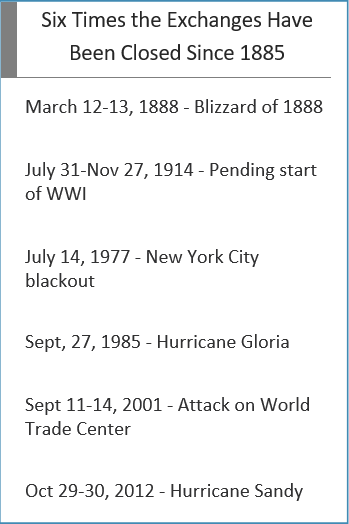
Closing the stock market has been done before. In 1888 it closed for two days for a blizzard, in 1914, the NYSE closed for about four months when World War I broke out, stock exchanges also closed for more than a week in March 1933 when President Franklin D. Roosevelt declared a bank holiday to stop financial panic,  again in 1985 after hurricane Gloria, then in 2001 after the World Trade Center attack, and then for two days in 2012 after hurricane Sandy.

Unsupported image type.

These are Emotional Times

I decided to respond to Advay by first understanding that he personally may be down quite a bit in the market. This could impact one’s thinking (and one’s mood). I also kept away from politics or my laissez-faire philosophies related to this wealth depleting (hopefully temporary) selloff. Lastly, I decided to call him rather than write. I wanted him to know from the tone of my voice that I was not against him personally, but instead may differ in my thoughts on the merits of closing equity markets.

I also dug a bit into my own thinking, then called him. I asked about his son and his wife and the delay of the baseball season. Then after a brief polite conversation, I explained that companies need access to capital and individuals need access to their investments. Neither can do this well with the markets closed. To limit either would further worsen the challenges both people and corporations are feeling. It isn’t about greed at all, it’s about having more options.


Paul Hoffman

Managing Editor


Suggested Reading:

Where Investors Found Double-Digit
Growth in Q1

Unemployment, how high can it go

Is there a gold lining among the
clouds?


Sources:  

Close the
Markets? Data and Psychology Say Maybe

Venues
may close. Trading should remain open

Authorities are being pressured to close markets

Some Top Asset
Managers Argue Financial Markets Should Close

U.S. Rebuffs
Calls to Close Stock Market

Research – Newrange Gold Corp (NRG:CA) – All the Right Moves

Friday, April 3, 2020

Newrange Gold Corp (NRG:CA)

All the Right Moves

Newrange Gold Corp is an exploration stage company focused on acquiring and exploring exploration and evaluation assets in Colombia and the United States. The Company operates in a single reportable operating segment-the acquisition, exploration, and development of mineral properties. Some of the projects acquired by the company are Pamlico gold project in Nevada and Rocky mountain project in Colorado. The company also holds an interest in the Yarumalito property, El Dovio property and Anori property in Colombia.

Mark Reichman, Senior Research Analyst of Natural Resources, Noble Capital Markets, Inc.

Refer to the full report for the price target, fundamental analysis, and rating.

    Newrange reports third quarter 2020 financial results. Newrange Gold generated a loss of C$207,054, or (C$0.00), compared to a loss of C$653,580, or (C$0.01) per share, during the prior year period. We had projected a loss of C$618,213, or ($0.01) per share. The variance to our estimate was due, in part, to an unrealized gain on marketable securities in the amount of C$612,076. The company ended the January quarter with a cash balance of C$1,035,747, compared to our forecast of C$868,276. Marketable securities amounted to C$1,813,659.

    Updating estimates. We are narrowing our FY2020 loss estimates to C$1,484,051, or (C$0.01) per share compared to prior loss estimates of C$1,927,726, or (C$0.02) per share. Our full year EPS estimate is unchanged. We do not assume future unrealized gains and/or losses on marketable securities. Based on the ending cash balance and the potential for sales of marketable securities, the potential exercise of warrants and…


    Click here to get the full report.

This Company Sponsored Research is provided by Noble Capital Markets, Inc., a FINRA and S.E.C. registered broker-dealer (B/D).

*Analyst
certification and important disclosures included in the full report. 
NOTE: investment decisions should not be based upon the content of
this research summary.  Proper due diligence is required before
making any investment decision.