QuickChek – February 26, 2021


Ocugen up 18% in late-day trading

Brazil’s Health Ministry on Thursday signed a contract to purchase 20 million doses of Covaxin, the COVID-19 vaccine made by India’s Bharat Biotech. Ocugen recently finalized an agreement with Bharat to co-develop Bharat’s Covid-19 vaccine for the United States market.

Research, News & Market Data on Ocugen

Watch recent presentation from NobleCon17


Xtant Medical Announces Closing of $20 million Private Placement

Xtant Medical Holdings, Inc. announced the closing of its $20 million private placement to a single healthcare-focused institutional investor. The Company sold 8,888,890 common shares and warrants to purchase 6,666,668 common shares at a combined purchase price of $2.25 per share.

News & Market Data on Xtant Medical


Lixte Biotechnology to Present Its Anti-Cancer Therapy Enhancer LB-100

Lixte Biotechnology Holdings, Inc. announced it will present Its Anti-Cancer Therapy Enhancer LB-100 at the Virtual H.C. Wainwright Global Life Sciences Conference being held March 9-10, 2021.

News & Market Data on Lixte Biotechnology


Stay up to date. Follow us:


Stay up to date. Follow us:

The Correlation Between Stocks and Unemployment


Why Elevated Unemployment isn’t Hurting Stocks


Trends in unemployment and the coinciding trend in stock market valuation have run counter to each other over the years. It is not a 100% negative correlation as stock market strength, and weakness tends to also follow other measures. These could include disposable income, consumer optimism, debt levels, and other factors. The other related measures don’t always track each other, so one factor normally takes precedence. Often, it’s whichever indicator the market decides to give more weight to in any time period — when they’re headed in different directions, the market obviously can’t move with them all.  But, unemployment as a contra-indicator of overall market direction is very strong.

It was reported yesterday by the BLS that Jobless claims declined by 111,000 from the previous week to a seasonally adjusted 730,000. This is the lowest in over two months and the sharpest one-week decline since August. The direction seems positive, but prior to last March, unemployment benefits had never (notice no time period in “never”) topped 700,000. The percentage unemployed in April 2020 reached 14.7% which is the highest rate since the Great Depression.

How Important is the Rate of Unemployment?

Direction matters to the market more than any absolute number. Market participants want to know if something is getter better or worse than yesterday, not a year ago, or even 90 years ago.

The most recent relationship coincides with a weakened job market that has not grown since the 2020 election.  Hiring has averaged only 29,000 a month from November through January. Numbers can be deceiving as well. Although the headline unemployment rate reported was 6.3% in January, a broader measure that incorporates those that may have become exasperated and discontinued their job search, borders on 10%.  So the picture is improving but not good by many standards.

All told, 19 million people were receiving unemployment aid as of Feb. 6, up from 18.3 million the previous week. About three-quarters of those recipients are receiving checks from federal benefit programs, including programs that provide jobless aid beyond the 26 weeks provided for in most states.

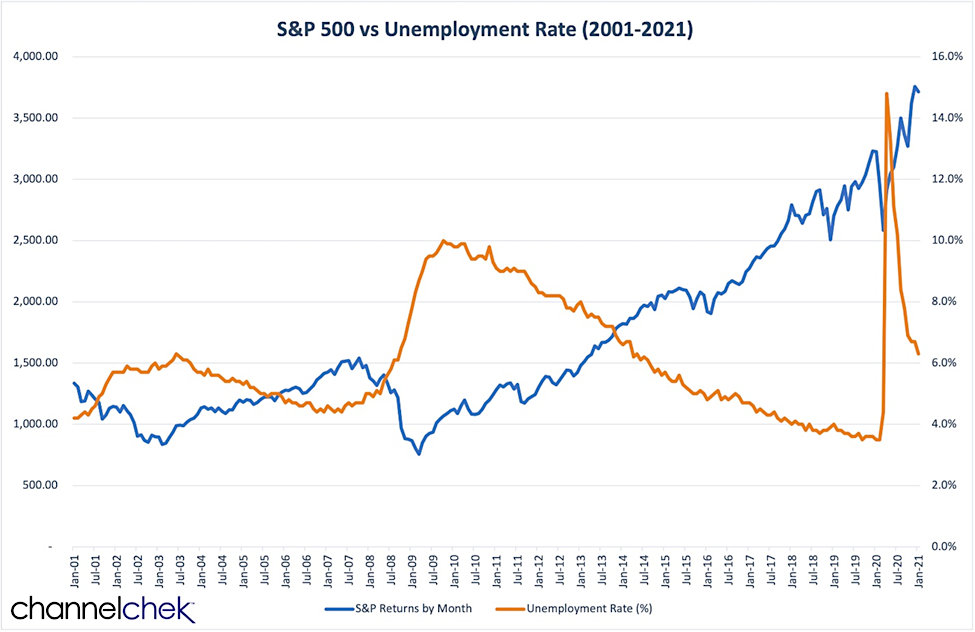
A Look at the S&P 500 Versus Unemployment  over the past 20-years (Orange line is Unemployment
as reported by the BLS)


Last week’s drop in applications was concentrated in two states, California and Ohio, where they fell by a combined 96,000. Ohio officials had said earlier this month that a surge in new applications was driven in part by a jump in potentially fraudulent claims. That now appears to have faded. Other factors outside the norm that may have impacted the numbers are the winter storms and power grid problems in Texas during the week. It’s difficult to factor out that “noise” and there is always a certain level of noise including natural disasters, fraudulent claims, temporary industry shutdowns, etc.

It helps to see the way unemployment and the market (measured by the S&P 500) track in order to visualize if we have deviated from an established pattern. Obviously, a pattern that is easy to get your head around, when a lot of people are out of jobs and the economy isn’t very promising, stocks sink. And when the unemployment rate drops because payroll numbers have risen, stocks rise. Keep reading, so you know just how closely correlated the two are. 

Look at that chart above; the two lines are almost perfect inverses to each other, until the coronavirus spike last Spring. They cross during large economic shifts such as the dot-com bubble around Y2k, again at the 2008-2009 financial crisis, ad in 2014 as the unemployment rate perked up to pre-recession lows, stocks climbed to new highs. Last year the two lines raced in opposite directions when the decision was made to reduce the number of people headed to a job every day.  Since the economic shutdown, the unemployment rate has been reduced by more than half after reaching 14.7% last April. As for stocks, they have risen about 70%, from the late March 2020 bottom. The market improved some before the jobless rate fell; this is likely in anticipation of the improvement. A decrease in those unemployed was presumed to be easy to anticipate as a turn in the economy was presumed to be hinged on medical approvals in the works.

Take-Away

It is not irrational to understand why stocks are near their all-time highs while unemployment is near their numerical highs. As long as the unemployment rate continues to fall, history suggests stocks will continue to rise. The weekly employment numbers contain information worth paying attention to under any economic conditions.

Do you expect a year from now, the U.S. unemployment rate will be lower than today?  Factor that into your stock market forecast. What actually happens remains to be seen. Over the past 20 years, the unemployment-stock market correlation has held a reliable inverse relationship. Is the market still ahead of itself in predicting further improvement in stocks? As always, we can only look at stats from the past, never the future.


Suggested Reading:

What Stocks do You Buy When the Dollar Goes Down?

How Did the Stock Market Perform Under Each President?

Managing Investment Portfolio Risk


Sources:

Unemployment Insurance Weekly Claims

Stay up to date. Follow us:


Stay up to date. Follow us:

Gray Television Inc. (GTN) Outlook A Solid Start To The Year

Friday, February 26, 2021

Gray Television Inc. (GTN)
Outlook: A Solid Start To The Year

Gray Television, Inc. operates as a television broadcast company in the United States. As of April 6, 2010, it operated 36 television stations in 30 markets, including 17 affiliated with CBS Inc.; 10 affiliated with the National Broadcasting Company, Inc.; 8 affiliated with the American Broadcasting Company (ABC); and 1 affiliated with FOX Entertainment Group, Inc. (FOX). The company also operated 39 digital second channels comprising 1 affiliated with ABC, 4 affiliated with FOX, 7 affiliated with CW Network, LLC, 18 affiliated with Twentieth Television, Inc., 2 affiliated with Universal Sports Network, and 7 local news/weather channels. Gray Television, Inc. was founded in 1897 and is headquartered in Atlanta, Georgia.

Michael Kupinski, Director of Research, Noble Capital Markets, Inc.

Refer to the full report for the price target, fundamental analysis, and rating.

    Q4 results outperform. Revenues exceeded expectations, with the variance driven by better Political and Core advertising. Q4 revenues of $792 million was better than our $734 million estimate. Adjusted EBITDA was $404 million, much stronger than our $341 million estimate. Political advertising was $245 million in the quarter, well above our $217 million estimate. Coincidently, the quarter had more Political advertising than the entire year of 2018 at $235 million.

    Q1 guidance better than expected.  Total core revenues appear stronger than we expected, with guidance of 0% to 2% growth to approximately $253 million, significantly better than our $220 million estimate. Retransmission revenue was better than expected as well, with guidance of $245 million, better than our $230 million estimate. In spite of higher expenses, adjusted EBITDA is expected to be a …


This research is provided by Noble Capital Markets, Inc., a FINRA and S.E.C. registered broker-dealer (B/D).

*Analyst certification and important disclosures included in the full report. NOTE: investment decisions should not be based upon the content of this research summary.  Proper due diligence is required before making any investment decision. 

Ely Gold Royalties (ELYGF)(ELY:CA) – Cimarron Option Agreement with Crestview Holds Promise

Thursday, February 25, 2021

Ely Gold Royalties (ELYGF)(ELY:CA)
Cimarron Option Agreement with Crestview Holds Promise

As of April 24, 2020, Noble Capital Markets research on Ely Gold Royalties is published under ticker symbols (ELYGF and ELY:CA). The price target is in USD and based on ticker symbol ELYGF. Research reports dated prior to April 24, 2020 may not follow these guidelines and could account for a variance in the price target. Ely Gold Royalties Inc is an emerging royalty company with producing and development assets focused in Nevada and the Western US. It offers shareholders a low-risk leverage to the current price of gold and low-cost access to long-term gold royalties.

Mark Reichman, Senior Research Analyst of Natural Resources, Noble Capital Markets, Inc.

Refer to the full report for the price target, fundamental analysis, and rating.

    Option agreement to sell Cimarron. Ely Gold Royalties, through its Nevada Select subsidiary, executed an option agreement giving Crestview Exploration Inc. (CSE: CRS) the option to purchase the Cimarron Property located ~30 kilometers north of Tonopah, Nevada for US$200 thousand and a 2.5% smelter return (NSR) royalty.

    Terms of the transaction.  In addition to the NSR, Ely Gold will receive a total of US$200 thousand in the following installments: 1) initial payment of $25,000, 2) $35,000 on the first anniversary, 3) $50,000 on the second anniversary, 4) $45,000 on the third anniversary, and 5) $45,000 on the fourth anniversary …


This Company Sponsored Research is provided by Noble Capital Markets, Inc., a FINRA and S.E.C. registered broker-dealer (B/D).

*Analyst certification and important disclosures included in the full report. NOTE: investment decisions should not be based upon the content of this research summary.  Proper due diligence is required before making any investment decision. 

Onconova Therapeutics Inc. (ONTX) – Positive Trajectory, Raising Price Target

Thursday, February 25, 2021

Onconova Therapeutics Inc. (ONTX)
Positive Trajectory, Raising Price Target

Onconova Therapeutics Inc is a clinical-stage biopharmaceutical company operating in the US. It focuses on discovering and developing novel small molecule product candidates primarily to treat cancer. The company has created a library of targeted agents designed to work against cellular pathways important to cancer cells. Its product candidates are Single-agent IV rigosertib, Oral rigosertib + azacitidine, IV Briciclib, Recilisib, and ON 123300. The key product candidate Rigosertib is a small molecule which blocks cellular signaling by targeting RAS effector pathways.

Ahu Demir, Ph. D., Biotechnology Research Analyst, Noble Capital Markets, Inc.

Refer to the full report for the price target, fundamental analysis, and rating.

    Onconova regained compliance and will continue listing on Nasdaq. The compliance was attributed to the minimum bid price requirement of Nasdaq Listing Rule 5550(a)(2), as the Company’s common stock had a closing price of at least $1.00 per share for a minimum 10 consecutive business days.

    Recent financial deals.  The company raised equity in two public offerings in Q1 2021, $8.7 million public offering (19,550,562 shares of its common stock at a purchase price of $0.445 per share) in January 2021 and $25 million common stock at a public offering price of $1.00 per share in February 2021. With those, the company has approximately $50 mm cash and cash equivalent over 235 mm shares …


This Company Sponsored Research is provided by Noble Capital Markets, Inc., a FINRA and S.E.C. registered broker-dealer (B/D).

*Analyst certification and important disclosures included in the full report. NOTE: investment decisions should not be based upon the content of this research summary.  Proper due diligence is required before making any investment decision. 

Palladium One Mining Inc. (NKORF)(PDM:CA) – Momentum Builds in 2021

Thursday, February 25, 2021

Palladium One Mining Inc. (NKORF)(PDM:CA)
Momentum Builds in 2021

Palladium One Mining Inc is a palladium dominant, PGE, nickel, copper exploration and development company. Its assets consist of the Lantinen Koillismaa and Kostonjarvi PGE-Cu-Ni projects, located in north-central Finland and the Tyko Ni-Cu-PGE and Disraeli PGE-Ni-Cu properties in Ontario, Canada. LK is targeting disseminated sulphide along 38 kilometers of favorable basal contact. The KS project is targeting massive sulphide within a 20,000-hectare land package covering a regional scale gravity and magnetic geophysical anomaly. Tyko is a 13,000-hectare project targeting disseminated and massive sulphide in a highly metamorphosed Archean terrain. Disraeli is a 2,500-hectare project targeting PGE-rich disseminated and massive sulphide in a highly productive Proterozoic mid-continent rift.

Mark Reichman, Senior Research Analyst of Natural Resources, Noble Capital Markets, Inc.

Refer to the full report for the price target, fundamental analysis, and rating.

    Financing closed. Palladium One closed a $15 million financing that included: 1) 43.1 million units at a price of $0.29 per unit for proceeds of $12,499,000, 2) 1.5 million units issued on a flow-through (FT) basis at a price of $0.34 per unit for proceeds of $510,000, and 3) 5.0 million units issued on a charity flow-through basis at a price of $0.40 per unit for proceeds of $2,000,000. Proceeds will be used for exploration at the company’s projects in Finland and Canada. Post-offering, basic and fully diluted shares outstanding are 233 million and 278 million, respectively.

    Flagship LK Project update.  In November 2020, the company began its 17,500-meter Phase II drilling program at its palladium-dominant Lantinen Koillismaa (LK) project in Finland. The company completed 7,500 meters though mid-February in the Greater Kaukua area, of which 7,000 meters focused on Kaukua South. We think the company will begin releasing assay results shortly. The drill has been moved to …


This Company Sponsored Research is provided by Noble Capital Markets, Inc., a FINRA and S.E.C. registered broker-dealer (B/D).

*Analyst certification and important disclosures included in the full report. NOTE: investment decisions should not be based upon the content of this research summary.  Proper due diligence is required before making any investment decision. 

Release – Gray Television (GTN) – Reports Record Operating Results


Gray Reports Record Operating Results


ATLANTA, Feb. 25, 2021 (GLOBE NEWSWIRE) — Gray Television, Inc. (“Gray,” “we,” “us” or “our”) (NYSE: GTN) today announced financial results for the fourth quarter ended December 31, 2020. Despite the impact of the novel coronavirus and its disease (collectively, “COVID-19”) on economic activity, our strong political revenues, prudent cost management, strategic sales initiatives and training, and focused management at every level during the last three quarters of 2020, and especially the fourth quarter of 2020, resulted in record operating results for the fourth quarter and the full-year. Key financial results are as follows:

  • Our revenue for the fourth quarter of 2020 was $792 million, an increase of $213 million, or 37%, from the fourth quarter of 2019. The primary components of revenue were combined local and national broadcast advertising revenue of $284 million, political advertising revenue of $245 million and retransmission revenue of $217 million
  • Net income attributable to common stockholders for the fourth quarter of 2020 was $211 million, or $2.22 per fully diluted share, increasing $130 million, or 160% from the fourth quarter of 2019.
  • Broadcast Cash Flow for the fourth quarter of 2020, was $424 million increasing $195 million, or 85%, from the fourth quarter of 2019. Our Adjusted EBITDA for the fourth quarter of 2020 was $404 million, increasing $189 million, or 88%, from the fourth quarter of 2019.
  • In the fourth quarter of 2020, our combined local and national broadcast revenue, excluding political revenue (“Total Core Revenue”), decreased by approximately 8% compared to the fourth quarter of 2019, much of which can be attributed to historically strong political displacement in a large number of markets. In light of returning advertiser demand, the year-over-year declines in Total Core Revenue continued their improvement through the fourth quarter of 2020 as follows: October declined 22%, largely impacted by political displacement, November declined less than 1% and December declined by 2%.
  • As of December 31, 2020, our total leverage ratio, as defined in our senior credit facility, was 3.95 times on a trailing eightquarter basis, netting our total cash balance of $773 million and giving effect to all Transaction Related Expenses (as defined below). We have not drawn any amounts from our revolving credit facility, and, as a result, we are not subject to any maintenance covenants in our credit facilities at this time.
  • During the fourth quarter of 2020, we repurchased 972,706 shares of our common stock at an average price of $16.44 per share, including commissions, for a total cost of approximately $16 million. During 2020, we repurchased 5.5 million shares of our common stock on the open market at an average price of $13.80 per share, including commissions, for a total cost of $75 million. We have not repurchased any shares since the close of the fourth quarter. Currently, we have 88,223,962 common shares and 7,214,838 Class A common shares outstanding. Our total capacity under our share repurchase programs is currently $204 million
  • On February 1, 2021, we announced an agreement to acquire all of the outstanding shares of Quincy Media, Inc. for $925 million in cash. Upon completion, and net of divestitures required to meet regulatory requirements, we will own television stations serving 102 television markets that collectively reach over 25 % of US television households, including number-one ranked television stations in 77 markets and the first and/or second ranked television station in 93 markets according to Comscore’s average all-day ratings for calendar year 2020. This transaction is expected to close following receipt of regulatory and other approvals in the second or third quarter of 2021. We expect that the transaction will be immediately accretive to our free cash flow, including expected year-one annualized synergies of approximately $23 million.

Read the full report at: https://graytv.gcs-web.com/node/17986/pdf

Source: Gray Television

QuickChek – February 25, 2021


Palladium One Closes $15 Million Bought Deal Financing

See today’s analyst report for Palladium One Mining.

Research, News & Market Data on Palladium One Mining


Watch recent virtual road show replay


Gray Reports Record Operating Results

Gray Television, Inc. announced financial results for the fourth quarter ended December 31, 2020.

Research, News & Market Data on Gray Television


Watch Gray Television C-Suite interview


eSports Entertainment Group up over 20% in early trading

Citron Research today suggested GME buying GMBL, which may have caught the attention of already active reddit traders.

Research, News & Market Data on Esports Entertainment


Watch recent presentation from NobleCon17

Stay up to date. Follow us:


Stay up to date. Follow us:

Release – CoreCivic (CXW) – Expects Contract with the United States Marshals Service Will Not be Renewed


CoreCivic Expects the Contract with the United States Marshals Service at the Northeast Ohio Correctional Center Will Not be Renewed


BRENTWOOD, Tenn., Feb. 25, 2021 (GLOBE NEWSWIRE) — CoreCivic, Inc. (NYSE: CXW) (the Company) announced today that, effective March 1, 2021, it has entered into a 90-day contract extension with the United States Marshals Service (“USMS”) at the Company’s 2,016-bed Northeast Ohio Correctional Center. The USMS has notified the Company that it does not anticipate extending the contract following the 90-day extension.

While the Company is not currently aware of alternative locations where the USMS can house the approximately 800 federal detainees currently located at the Northeast Ohio facility, President Biden recently issued an executive order directing the Department of Justice not to renew contracts with privately operated criminal detention facilities.

About CoreCivic

The Company is a diversified government solutions company with the scale and experience needed to solve tough government challenges in flexible, cost-effective ways. We provide a broad range of solutions to government partners that serve the public good through corrections and detention management, a network of residential reentry centers to help address America’s recidivism crisis, and government real estate solutions. We are the nation’s largest owner of partnership correctional, detention and residential reentry facilities, and believe we are the largest private owner of real estate used by U.S. government agencies. The Company has been a flexible and dependable partner for government for more than 35 years. Our employees are driven by a deep sense of service, high standards of professionalism and a responsibility to help government better the public good. Learn more at www.corecivic.com.

Forward-Looking Statements

This press release contains statements as to our beliefs and expectations of the outcome of future events that are “forward-looking” statements within the meaning of Section 21E of the Securities Exchange Act of 1934, as amended, and the Private Securities Litigation Reform Act of 1995. These forward-looking statements are subject to risks and uncertainties that could cause actual results to differ materially from the statements made. These include, but are not limited to, the risks and uncertainties associated with: (i) changes in government policy (including the DOJ not renewing contracts as a result of the EO), legislation and regulations that affect utilization of the private sector for corrections, detention, and residential reentry services, in general, or our business, in particular, including, but not limited to, the continued utilization of our correctional and detention facilities by the federal government, and the impact of any changes to immigration reform and sentencing laws (our company does not, under longstanding policy, lobby for or against policies or legislation that would determine the basis for, or duration of, an individual’s incarceration or detention); (ii) our ability to obtain and maintain correctional, detention, and residential reentry facility management contracts because of reasons including, but not limited to, sufficient governmental appropriations, contract compliance, negative publicity and effects of inmate disturbances; (iii) changes in the privatization of the corrections and detention industry, the acceptance of our services, the timing of the opening of new facilities and the commencement of new management contracts (including the extent and pace at which new contracts are utilized), as well as our ability to utilize available beds; (iv) general economic and market conditions, including, but not limited to, the impact governmental budgets can have on our contract renewals and renegotiations, per diem rates, and occupancy; (v) fluctuations in our operating results because of, among other things, changes in occupancy levels, competition, contract renegotiations or terminations, increases in costs of operations, fluctuations in interest rates and risks of operations; (vi) the duration of the federal government’s denial of entry at the United States southern border to asylum-seekers and anyone crossing the southern border without proper documentation or authority in an effort to contain the spread of COVID-19; (vii) government and staff responses to staff or residents testing positive for COVID-19 within public and private correctional, detention and reentry facilities, including the facilities we operate; (viii) the location and duration of shelter in place orders and other restrictions associated with COVID-19 that disrupt the criminal justice system, along with government policies on prosecutions and newly ordered legal restrictions that affect the number of people placed in correctional, detention, and reentry facilities; (ix) whether revoking our REIT election, effective January 1, 2021, and our revised capital allocation strategy can be implemented in a cost effective manner that provides the expected benefits, including facilitating our planned debt reduction initiative and planned return of capital to shareholders; (x) our ability to identify and consummate the sale of additional non-core assets at attractive prices; (xi) our ability to successfully identify and consummate future development and acquisition opportunities and our ability to successfully integrate the operations of our completed acquisitions and realize projected returns resulting therefrom; (xii) increases in costs to develop or expand real estate properties that exceed original estimates, or the inability to complete such projects on schedule as a result of various factors, many of which are beyond our control, such as the effects of, and delays caused by, COVID-19, weather, the availability of labor and materials, labor conditions, delays in obtaining legal approvals, unforeseen engineering, archeological or environmental problems, and cost inflation, resulting in increased construction costs; (xiii) our ability to identify and initiate service opportunities that were unavailable under our former REIT structure; (xiv) our ability to have met and maintained qualification for taxation as a REIT for the years we elected REIT status; and (xv) the availability of debt and equity financing on terms that are favorable to us, or at all. Other factors that could cause operating and financial results to differ are described in the filings we make from time to time with the Securities and Exchange Commission.

CoreCivic takes no responsibility for updating the information contained in this press release following the date hereof to reflect events or circumstances occurring after the date hereof or the occurrence of unanticipated events or for any changes or modifications made to this press release or the information contained herein by any third-parties, including, but not limited to, any wire or internet services.

Contact:

Investors: Cameron Hopewell
Managing Director, Investor Relations
(615) 263-3024

Financial Media: David Gutierrez
Dresner Corporate Services
(312) 780-7204

SOURCE: CoreCivic

Would T+1 Settlement Prevent Margin Calls?


Are Meme Stocks Improving Flawed Markets?


Investors and traders that get trade ideas from social media and other non-traditional sources are often ridiculed by the more established players. The unpredictability of the much-maligned “stonk” jockeys has been disruptive to the previous market rhythms, patterns that had been more easily capitalized on by Wall Street veterans. But, like most disrupted industries, the “new normal” can be better than the old. One of the outcomes of the increase in the volume of these stocks by those using popular trading apps is that weaknesses have been uncovered in the industry. There are hearings now being held at the highest level in Washington and steps put in place at government and quasi-government institutions to manage some uncovered risks to the system.

Improvements are in the Pipeline

The brokerage industry had a problem it didn’t know about. The problem was uncovered in late January as a series of large margin calls were issued amid the unavailability of a handful of stocks that money managers held significant short positions in (significant versus outstanding shares). An announcement this week from the Depository Trust Clearing Corp. (DTCC) recognizes that there is a problem and plans to reduce the risk of the problem occurring in the future.

DTCC is a subsidiary of Depository Trust Company (DTC) which is the “mother-ship” of all clearing agencies. DTCC’s central securities depository provides settlement services for virtually all equity, corporate and municipal debt trades and money market instruments in the U.S. They’re registered with the SEC, a member of the Federal Reserve System, and a limited-purpose trust company under New York State banking law. Just as the Federal Reserve Bank is the central bank for banks, DTCC is the central clearing company for clearinghouses.

This central clearing company which provides settlement services for most electronic delivered securities in the U.S., just proposed halving the time it takes from a stocks purchase to delivery into your account. Changing the standard from two-day settlement to one-day (T+2 to T+1) has been moved up on the DTCC priority list. The impetus was the GameStop margin and settlement isssues that caused brokerages like Robinhood to restrict trading, this has led to Congressional hearings and a class action lawsuit.

DTCC, outlined what a T+1, settlement period, would entail and include for the securities transaction industry. They’re looking for a two-year rollout of the plan as implementation presents technical and logistical challenges.

The Real Difference

The current T+2 time-frame to settle transactions has been in place since 2017, when it was shortened from T+3 for stocks. The goal of the industry has been to minimize the time to settlement. The longer the period, the greater the likelihood that one of those involved in a transaction might default on its contractual obligation.

A discussion posted on the DTCC website addressed what the benefits are to reducing the settlement time. Murray Pozmanter, head of clearing agency services and global business operations at DTCC shared his thoughts on the issue. “The time to settlement equals counterparty risk, which can become elevated during market shocks. It can also lead to the need for higher margin requirements, which are critical to protecting the financial system and investors against a firm default,” said Mr. Pozmanter. “We have been working collaboratively with a wide cross-section of the industry to build support for further shortening the current settlement cycle over the past year, and we have outlined a plan to increase these efforts to forge consensus on setting a firm date and approach to achieve T+1,” he promised.

In addition to counterparty risk, there is a very real cost to tied up cash for each day settlement is extended. The DTCC said an average of $13.4 billion is held in margin every day to manage risk in the trading system. They believe that the needed margin could potentially be reduced by 41% if they moved to T+1 settlement.


Take-Away

The CEO of Robinhood, Vlad Tenev has blamed the two-day trade settlement for some of the clearinghouse issues that he says caused restricted trading in $GME, $AMC and other tickers. Robinhood raised $3.4 billion in about 72 hours to strengthen its balance sheet to reduce trading restrictions during the crisis.

There has been a class-action lawsuit filed and others being organized naming Robinhood as the defendant. In testimony to the House Financial Services Committee on the matter, Tenev said, “The existing two-day period to settle trades exposes investors and the industry to unnecessary risk and is ripe for change.”

The change to reduce this risk seems to now be on its way. The underlying problem was brought to light by the unique style of many app and social media-driven traders. Steps are now being taken to reduce the chances of it occurring to others.


Suggested Reading:

Technology Confounds Wall Street Pros

Financial Markets Lift Household Wealth to Record Levels

COVid,
Sex, and the Business Cycle


Sources:

Advancing Together: Leading the Industry to Accelerated Settlement,

Project Ion

Robinhood Raises $3.4 Billion 


Stay up to date. Follow us:


Onconova Therapeutics Inc. (ONTX) – Positive Trajectory Raising Price Target

Thursday, February 25, 2021

Onconova Therapeutics Inc. (ONTX)
Positive Trajectory, Raising Price Target

Onconova Therapeutics Inc is a clinical-stage biopharmaceutical company operating in the US. It focuses on discovering and developing novel small molecule product candidates primarily to treat cancer. The company has created a library of targeted agents designed to work against cellular pathways important to cancer cells. Its product candidates are Single-agent IV rigosertib, Oral rigosertib + azacitidine, IV Briciclib, Recilisib, and ON 123300. The key product candidate Rigosertib is a small molecule which blocks cellular signaling by targeting RAS effector pathways.

Ahu Demir, Ph. D., Biotechnology Research Analyst, Noble Capital Markets, Inc.

Refer to the full report for the price target, fundamental analysis, and rating.

    Onconova regained compliance and will continue listing on Nasdaq. The compliance was attributed to the minimum bid price requirement of Nasdaq Listing Rule 5550(a)(2), as the Company’s common stock had a closing price of at least $1.00 per share for a minimum 10 consecutive business days.

    Recent financial deals.  The company raised equity in two public offerings in Q1 2021, $8.7 million public offering (19,550,562 shares of its common stock at a purchase price of $0.445 per share) in January 2021 and $25 million common stock at a public offering price of $1.00 per share in February 2021. With those, the company has approximately $50 mm cash and cash equivalent over 235 mm shares …


This Company Sponsored Research is provided by Noble Capital Markets, Inc., a FINRA and S.E.C. registered broker-dealer (B/D).

*Analyst certification and important disclosures included in the full report. NOTE: investment decisions should not be based upon the content of this research summary.  Proper due diligence is required before making any investment decision. 

Release – Comtech Telecommunications (CMTL) – Awarded Fast Tracking Ground Station Antenna System Contract from NASA


Comtech Telecommunications Corp. Awarded Fast Tracking Ground Station Antenna System Contract from NASA Glenn Research Center


MELVILLE, N.Y.–(BUSINESS WIRE)–Feb. 24, 2021– February 24, 2021–Comtech Telecommunications Corp. (NASDAQ: CMTL) announced today, that during its second quarter of fiscal year 2021, its Mission-Critical Technologies group’s Space & Component Technology Division, which is part of Comtech’s Government Solutions segment, was awarded a contract from NASA’s Glenn Research Center for a Ka/S-band antenna system and radome to be installed at its new Aerospace Communications Facility in Cleveland, OH, supporting high bandwidth space and aeronautics communications research.

“This competitive award of our advanced multi-band full-motion X/Y antenna system is a testament to our cutting-edge ground system solutions meeting our customers’ most challenging requirements,” said Fred Kornberg, Chairman of the Board and Chief Executive Officer of Comtech Telecommunications Corp. “We are proud to support NASA Glenn Research and NASA’s space exploration and aeronautics missions.”

For over 40 years, Comtech’s Space & Component Technology (“SCT”) division, located in Cypress, California, has specialized in the supply of high reliability microelectronics, supplying EEE parts for use in satellite, launch vehicle and manned space applications. Combining longstanding resources in Cypress, with new locations in Plano, Texas and Hampshire, United Kingdom, SCT also provides services encompassing all aspects of ground station life cycle management to include requirements definition and analysis, design, development and integration of turnkey systems from antenna to data processing, civil works and construction, station installation and verification, operations and maintenance, and decommissioning at end of life. A full line of satellite tracking antennas from 30cm to 13m, as well as RF feeds, radomes and carbon fiber reflectors, all for LEO, MEO and GEO orbits, are also supplied to customers worldwide. For more information, visit www.comtechspace.com.

The Mission-Critical Technologies group is focused on ensuring its customers are able to successfully carry out their mission, whether that be communicating in an austere environment on land or at sea, launching or tracking a satellite, or protecting the cyber security posture of their network.

Comtech Telecommunications Corp. designs, develops, produces, and markets innovative products, systems and services for advanced communications solutions. The Company sells products to a diverse customer base in the global commercial and government communications markets.

Certain information in this press release contains statements that are forward-looking in nature and involve certain significant risks and uncertainties. Actual results could differ materially from such forward-looking information. The Company’s Securities and Exchange Commission filings identify many such risks and uncertainties. Any forward-looking information in this press release is qualified in its entirety by the risks and uncertainties described in such Securities and Exchange Commission filings.

Media Contact:
Michael D. Porcelain, President and Chief Operating Officer
631-962-7000

[email protected]

Source: Comtech Telecommunications Corp.

Release – electroCore (ECOR) – Non-Invasive Vagus Nerve Stimulation Enters New Stage of COVID-19 Research


Non-Invasive Vagus Nerve Stimulation (nVNS) Enters New Stage of COVID-19 Research


electroCore, Inc. (Nasdaq: ECOR), a commercial-stage bioelectronic medicine company and the Hospital Clínico Universitario de Valencia in Spain, announced the completion of patient enrollment in SAVIOR-1, or “Prospective, Randomized, Controlled Study to Evaluate the Effect of Non-Invasive Electrical Vagus Nerve Stimulation on Respiratory Symptoms due to COVID-19.” This study was supported in part by electroCore. Closing enrollment for this study is an important step to better understanding the clinical benefit of non-invasive vagus nerve stimulation (nVNS) and how it can help patients suffering from COVID-19 respiratory distress.

“Vagus nerve stimulation offers potential promise for the medical and scientific community studying COVID-19 as an effective treatment to assist with respiratory function,” says the principal investigator of the Savior study, Dr. Carlos Tornero, Head of the Department of Anesthesiology, Resuscitation and Pain Therapeutics of the Hospital Clínico Universitario de Valencia, Spain. “We look forward to studying the clinical benefit of nVNS in COVID-19 patients suffering from respiratory distress.”

Identifying novel therapies to treat COVID-19 respiratory symptoms remains top of mind in the medical community. In fact, the most downloaded 2020 article in the Journal of Neuromodulation was The Use of Non?invasive Vagus Nerve Stimulation to Treat Respiratory Symptoms Associated With COVID?19: A Theoretical Hypothesis and Early Clinical Experience. “The concept and article’s popularity not only suggests interest in nVNS and its role in treating breathing difficulties seen in COVID-19 patients, but also emphasizes the medical community is still looking for answers that can help address various COVID-19 symptoms,” says Peter S. Staats, MD, Chief Medical Officer of electroCore. “gammaCore SapphireTM CV (nVNS) is unique in it’s ability to be used early in the course of disease, at home or in a health care setting. Research should be focused on identifying novel therapies with strong clinical rationale that can be used throughout the course of disease.”

gammaCore SapphireTM CV (nVNS) received Emergency Use Authorization from the FDA in July of 2020 to treat patients with known or suspected COVID-19 who are experiencing exacerbation of asthma-related dyspnea and reduced airflow.

“Because the virus is novel we began with almost no information whatsoever. Mobilizing COVID-19 survivors to support all medical, scientific and academic research is part of Survivor Corps’s fundamental mission,” according to Diana Berrent, founder of Survivor Corps, a grassroots group of over 150,000 COVID-19 survivors, the largest in the world, that has become a hub for facilitating medical and scientific research on the Coronavirus. “We applaud all research conducted to study potential treatments that could bring relief to those who are suffering.”

“We eagerly await the results of SAVIOR-1 as the outcome will increase our knowledge regarding potential treatments for respiratory symptoms associated with COVID-19 that hospitals, healthcare professionals, and patients struggle to treat and endure,” says Dr. Staats.

About electroCore, Inc.

electroCore, Inc. is a commercial stage bioelectronic medicine company dedicated to improving patient outcomes through its platform non-invasive vagus nerve stimulation therapy initially focused on the treatment of multiple conditions in neurology. The company’s current indications are the preventative treatment of cluster headache and migraine and acute treatment of migraine and episodic cluster headache.

For more information, visit www.electrocore.com.

About gammaCore TM

gammaCore TM (nVNS) is the first non-invasive, hand-held medical therapy applied at the neck as an adjunctive therapy to treat migraine and cluster headache through the utilization of a mild electrical stimulation to the vagus nerve that passes through the skin. Designed as a portable, easy-to-use technology, gammaCore can be self-administered by patients, as needed, without the potential side effects associated with commonly prescribed drugs. When placed on a patient’s neck over the vagus nerve, gammaCore stimulates the nerve’s afferent fibers, which may lead to a reduction of pain in patients.

gammaCore is FDA cleared in the United States for adjunctive use for the preventive treatment of cluster headache in adult patients, the acute treatment of pain associated with episodic cluster headache in adult patients, and the acute and preventive treatment of migraine in adolescent (ages 12 and older) and adult patients. gammaCore is CE-marked in the European Union for the acute and/or prophylactic treatment of primary headache (Migraine, Cluster Headache, Trigeminal Autonomic Cephalalgias and Hemicrania Continua) and Medication Overuse Headache in adults.

  • gammaCore is contraindicated for patients with:
    • An active implantable medical device, such as a pacemaker, hearing aid implant, or any implanted electronic device
    • A metallic device, such as a stent, bone plate, or bone screw, implanted at or near the neck
    • An open wound, rash, infection, swelling, cut, sore, drug patch, or surgical scar(s) on the neck at the treatment location
  • Safety and efficacy of gammaCore have not been evaluated in the following patients:
    • Patients diagnosed with narrowing of the arteries (carotid atherosclerosis)
    • Patients who have had surgery to cut the vagus nerve in the neck (cervical vagotomy)
    • Pediatric patients (younger than 12 years)
    • Pregnant women
    • Patients with clinically significant hypertension, hypotension, bradycardia, or tachycardia

In the United States, the FDA has not cleared gammaCore for the treatment of pneumonia and/or respiratory disorders, such as COVID-19-associated acute respiratory stress disorder. Refer to the gammaCore Instructions for Use for all important warnings and precautions before using or prescribing this product.

The U.S. FDA has cleared the gammaCore Sapphire CV device under an emergency use authorization for acute use at home or in a healthcare setting to treat adult patients with known or suspected COVID-19 who are experiencing an exacerbation of asthma-related dyspnea and reduced airflow, and for whom approved pharmacologic therapies are not tolerated or provide insufficient symptom relief as assessed by their healthcare provider, using noninvasive vagus nerve stimulation (nVNS) on either side of the patient’s neck.

gammaCore Sapphire CV has not been cleared or approved for acute use in the home or healthcare setting to treat adult patients with known or suspected COVID-19 who are experiencing an exacerbation of asthma-related dyspnea and reduced airflow, and for whom approved pharmacologic therapies are not tolerated or provide insufficient symptom relief as assessed by their healthcare provider, using noninvasive vagus nerve stimulation (nVNS) on either side of the patient’s neck during pandemic Coronavirus Disease 2019 (COVID-19).

gammaCore Sapphire CV has been authorized only for the duration of the statement that circumstances exist that warrant authorization of the emergency use of medical devices under section 564(b)(1) of the Act, 21 U.S.C. § 360bbbb-3(b)(1), until the authorization is terminated or revoked.

More information can be found at:

Letter of authorization: https://www.fda.gov/media/139967/download
Fact sheet for healthcare workers: https://www.fda.gov/media/139968/download
Patient information sheet: https://www.fda.gov/media/139969/download
Instructions for use of gammaCore https://www.fda.gov/media/139970/download

Forward-Looking Statements

This press release and other written and oral statements made by representatives of electroCore may contain forward-looking statements within the meaning of the Private Securities Litigation Reform Act of 1995. Such forward-looking statements include, but are not limited to, statements about electroCore’s business prospects and clinical and product development plans; its pipeline or potential markets for its technologies; the timing, outcome and impact of regulatory, clinical and commercial developments; the business, operating or financial impact of such studies; the commercial potential of nVNS generally and gammaCore in particular in the UK and other statements that are not historical in nature, particularly those that utilize terminology such as “anticipates,” “will,” “expects,” “believes,” “intends,” other words of similar meaning, derivations of such words and the use of future dates. Actual results could differ from those projected in any forward-looking statements due to numerous factors. Such factors include, among others, the ability to raise the additional funding needed to continue to pursue electroCore’s business and product development plans, the inherent uncertainties associated with developing new products or technologies, the ability to commercialize gammaCore™, the potential impact and effects of COVID-19 on the business of electroCore, electroCore’s results of operations and financial performance, and any measures electroCore has and may take in response to COVID-19 and any expectations electroCore may have with respect thereto, competition in the industry in which electroCore operates and overall market conditions. Any forward-looking statements are made as of the date of this press release, and electroCore assumes no obligation to update the forward-looking statements or to update the reasons why actual results could differ from those projected in the forward-looking statements, except as required by law. Investors should consult all of the information set forth herein and should also refer to the risk factor disclosure set forth in the reports and other documents electroCore files with the SEC available at www.sec.gov.

Investors:
Hans Vitzthum
LifeSci Advisors
617-430-7578

[email protected]

Media Contact:
Jackie Dorsky
electroCore

973-290-0097

[email protected]

SOURCE: electroCore