Telomeres and New Findings on Cancer Mortality

Image Credit: Steve Jurvetson (Flickr)

How Cancer Cells can Become Immortal – New Research Finds a Mutated Gene that Helps Melanoma Defeat the Normal Limits on Repeated Replication

A defining characteristic of cancer cells is their immortality. Usually, normal cells are limited in the number of times they can divide before they stop growing. Cancer cells, however, can overcome this limitation to form tumors and bypass “mortality” by continuing to replicate.

Telomeres play an essential role in determining how many times a cell can divide. These repetitive sequences of DNA are located at the ends of chromosomes, structures that contain genetic information. In normal cells, continued rounds of replication shorten telomeres until they become so short that they eventually trigger the cell to stop replicating. In contrast, tumor cells can maintain the lengths of their telomeres by activating an enzyme called telomerase that rebuilds telomeres during each replication.

Telomeres are protective caps at the ends of chromosomes

Telomerase is encoded by a gene called TERT, one of the most frequently mutated genes in cancer. TERT mutations cause cells to make a little too much telomerase and are thought to help cancer cells keep their telomeres long even though they replicate at high rates. Melanoma, an aggressive form of skin cancer, is highly dependent on telomerase to grow, and three-quarters of all melanomas acquire mutations in telomerase. These same TERT mutations also occur across other cancer types.

Unexpectedly, researchers found that TERT mutations could only partially explain the longevity of telomeres in melanoma. While TERT mutations did indeed extend the life span of cells, they did not make them immortal. That meant there must be something else that helps telomerase allow cells to grow uncontrollably. But what that “second hit” might be has been unclear.

This article was republished with permission from The Conversation, a news site dedicated to sharing ideas from academic experts. It represents the research-based findings and thoughts of Pattra Chun-On Ph.D. Candidate in Environmental and Occupational Health, University of Pittsburgh Health Sciences and Jonathan Alder Assistant Professor of Medicine, University of Pittsburgh Health Sciences.

We are researchers who study the role telomeres play in human health and diseases like cancer in the Alder Lab at the University of Pittsburgh. While investigating the ways that tumors maintain their telomeres, we and our colleagues found another piece to the puzzle: another telomere-associated gene in melanoma.

Cell Immortality Gets a Boost

Our team focused on melanoma because this type of cancer is linked to people with long telomeres. We examined DNA sequencing data from hundreds of melanomas, looking for mutations in genes related to telomere length.

We identified a cluster of mutations in a gene called TPP1. This gene codes for one of the six proteins that form a molecular complex called shelterin that coats and protects telomeres. Even more interesting is the fact that TPP1 is known to activate telomerase. Identifying the TPP1 gene’s connection to cancer telomeres was, in a way, obvious. After all, it was more than a decade ago that researchers showed that TPP1 would increase telomerase activity.

We tested whether having an excess of TPP1 could make cells immortal. When we introduced just TPP1 proteins into cells, there was no change in cell mortality or telomere length. But when we introduced TERT and TPP1 proteins at the same time, we found that they worked synergistically to cause significant telomere lengthening.

To confirm our hypothesis, we then inserted TPP1 mutations into melanoma cells using CRISPR-Cas9 genome editing. We saw an increase in the amount of TPP1 protein the cells made, and a subsequent increase in telomerase activity. Finally, we returned to the DNA sequencing data and found that 5% of all melanomas have a mutation in both TERT and TPP1. While this is still a significant proportion of melanomas, there are likely other factors that contribute to telomere maintenance in this cancer.

Our findings imply that TPP1 is likely one of the missing puzzle pieces that boost telomerase’s capacity to maintain telomeres and support tumor growth and immortality.

Making Cancer Mortal

Knowing that cancer use these genes in their replication and growth means that researchers could also block them and potentially stop telomeres from lengthening and make cancer cells mortal. This discovery not only gives scientists another potential avenue for cancer treatment but also draws attention to an underappreciated class of mutations outside the traditional boundaries of genes that can play a role in cancer diagnostics.

Oil Market Drivers Attract Historic Bullish Positions

Image Credit: Kurayba (Flickr)

Factors Still Point to Higher Oil Prices and Sizeable Bets on Crude

There are many factors impacting why traditional energy prices and producers may have a hurricane-force tailwind heading into the holidays and next year.

A boost in demand for oil is expected as China just announced that it is lowering its quarantine requirements for visitors from outside the country. But Chinese Covid policies aren’t the only impetus pushing up oil demand – around the globe, there are supply challenges that are playing out. Oil hasn’t risen above $100 a barrel since early Summer, some traders are speculating it will rise above $200 in the coming months. Here’s why.

China

In addition to the announcement that the CPR was cutting the required quarantine period for the country (to five days from seven, with three days of home isolation), the required PCR test hurdle is being lowered as well. And airlines no longer run the risk of being suspended if the travelers they bring in that test positive is five or more.

Europe

The European Union has agreed to stop all oil imports from Russia on Dec. 5. The plan is to cap the prices at which EU nations would buy oil from Russia, that price is expected to be near $60 per barrel. Russia has reacted by increasing exports to Asia, but the price cap is expected to reduce its exports and lower total supply by up to one million barrels per day.

United States

Back in May, the U.S. took the drastic step of increasing available supply by selling oil from the U.S. Strategic Petroleum Reserve at a rate of nearly one million barrels per day starting in May. The increased supply has kept oil prices down. But the sales are unsustainable and expected to be reduced. Congress has allowed another sale of 26 million barrels that are expected to carry through to October 2023. This is a much slower pace of oil releases from the reserves. Plus, the reserves will need to be replenished.

After the Congressionally approved release, the reserve will be down to 348 million barrels, this is half the quantity compared to January of this year —the lowest since 1983. Congress has said that the reserve must stay above 252.4 million barrels, and the incoming Congress is expected to be more conservative when it comes to using these strategic assets to control prices.

Production growth overall in the U.S. has stalled after having increased through most of the year. Government data show that U.S. production dropped to 11.9 million barrels per day last week, this is tied for the lowest level in several months. Supplies of products such as diesel and heating oil in the U.S. are at multiyear lows. So there is not abundant supply should a weather-related or some other fuel-demanding crisis surface.

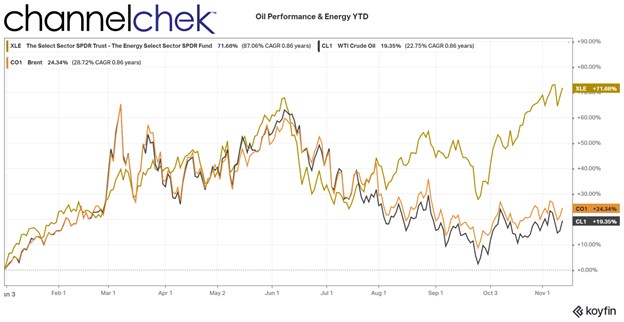
Source: Koyfin

Prices

Oil is now trading between $92 and $93 a barrel. It had reached a high above $130 in March, shortly after the war began, and hasn’t seen the $100 a barrel level since late June.

Trading this week showed significant flows into an options contract that speculates that $200 per barrel may be in store. The most actively traded Brent crude options contract on Thursday was an option to buy Brent at $200 in March 2023. This was the most active oil contract of the day.

How significant is this bullish activity surrounding oil prices? The ratio of bullish to bearish bets in the options market is wider than at any time in recorded history, according to Bloomberg. Oil options traders are positioned more aggressively than ever before.

Take Away

Oil demand could rise soon in China as travel restrictions are lessened. Elsewhere in the world, oil demand is expected to increase as supplies remain the same or decrease. Demand remained elevated globally despite slower economies.

With supply likely to drop and demand ramping up, $200 by the third week in March is one price expectation for a record number of trades transacted at recently. More than doubling in a few months sounds unthinkable, but the massive trades were transacted by experienced institutional traders.

Paul Hoffman

Managing Editor, Channelchek

To Sell or Not to Sell (Your Stocks)

Image Credit: QuoteInspector.com (Flickr)

Advice is Plentiful on When to Buy Stocks, But When Should You Sell?

During the fourth quarter of 2022, stocks have climbed dramatically. The Russell 2000 small cap index is up double-digits in percentage, and the S&P 500 is approaching a ten percent increase. This is a welcome run-up over such a short period of time. The sudden move has investors, some of whom still hold paper losses, asking themselves, do I sell now, do I add to my positions, or should I sit tight and wait?

Information on when to buy into a position is abundant. Advice on when to decide your assets are better off elsewhere is much less available. There is just less demand from readers on the topic.

Selling Considerations

First off, one does need to consider their financial plan. Is this money that is needed within the next few months, or can the value of the position or positions change without much impact on future plans? Also, is there a better use for the proceeds? If the position one is holding is still the best use of funds, then the answer, net of any emotions, may be to hold.And emotions can make for bad decisions.

Some investors that were about to pull the trigger on the sale of a position weeks ago when stocks were falling may find their position has regained much of the loss, but now they are back in greedy mode, hoping for more, despite being able to get more.

Let’s take a level-headed look at the factors involved in making the decision regarding selling.

Opportunity Cost

One fundamental question should ask themselves regularly is, do I think the risk-reward of each position and all positions taken together are best for the portfolio? If not, depending on tax consequences, if it’s determined that other opportunities might perform better, then it should be of little concern if the stock is up or down from where it was purchased. In fact, depending on what kind of investor you are, it may make sense to lighten up with the plan to re-evaluate if prices fall again.

One way to get a handle on this is to determine, does the stock underperform in a rising market. Does it fall at a faster pace than the market when the market is falling? The answers to these questions can help identify if the position should be cut loose and may be replaced by a better performer.

Moving Averages

Investors can look to moving averages for a hint as to whether the position might be overbought or oversold. Which moving average you use should be based on the expected holding period and also what works best for the stock you are reviewing. For a seldom traded portfolio with longer-term positions, its common to use a 200-day moving average, but depending on the stock’s past performance, the investor may wish to overlay different averages to guide their thoughts on whether the stock might give back recent gains and fall back in line with past performance.

Time Horizon

Many investors skip the step of determining the expected holding period before a purchase of an investment. This is like leaving for a trip without any directions to get you started. If you didn’t do this before your purchase, do it now. Ask, when do you think this will pay-off, what is the anticipated pay-off, and how do I identify if something has changed and the holding period should change? Investors with a long-term time horizon could find that over the years, they can avoid missing the up periods if they don’t get too intent on missing down periods. If your holdings closely follow the S&P 500 index, it may be down 18% this year, but last year it was up nearly 27%, and that could be a compounded increase from the 16% it was up the prior year.

If instead, your holding period is short, you may know within weeks, days, or minutes if you met your goal or if it is not playing out as expected. At that point, if you would not enter the position (whether you made money or not), getting out may be wise. Smart traders know that if they don’t stick to their plan, even if rewarded, they might be reinforcing a bad behavior that will cost them down the road.

Other Considerations

A large percentage of portfolios managed by self-directed investors are qualified accounts; that is, they are tax-deferred, so any gain does not cost the account holder until funds are taken from the account. This largely takes the tax impact question out of the decision to sell or not. However, if it is a taxable portfolio, it’s important to consider whether the tax consequences and the sale are still worthwhile. In some cases selling at a loss may even help offset gains in some other area of the portfolio owner’s financial condition.  

It’s wise to consult a tax professional to review your specific financial and tax situation before selling a stock or investment for tax purposes.

If you have made a mistake and purchased the wrong ticker, it isn’t likely the shares fit your parameters and the best time to sell is usually immediately.

Change in Ownership

Sometimes it may make sense to sell a company if it has been acquired or merges with another company. Often before an event like this, the stock price rises well above the overall market movement. The question once again is, is this the best use of one’s investible assets? The new fundamentals and cost-saving synergies between the two companies may place it in a more competitive or more profitable position, in this case, not taking the sudden profit could pay off long term.  

Selling a Portion

Did the stock you are holding just shoot up 5%-10%, and you think it is likely to back-off but don’t want to miss out if the euphoria surrounding it continues? Why not make selling a portion, perhaps with the idea that you will re-enter for that portion if the price does drop? In this way, you stand the chance of capturing some of the original run-up, and while you may miss further upward momentum, you have left yourself the opportunity of buying the shares back at a lower price from which they were sold.

Take Away

The decision on whether or not to sell an investment should be held up against the plan you had when you purchased it. Far too many investors make sensible plans entering a trade, but once in and it is either rising or falling, a less sensible side often takes over. Fear and greed are powerful emotions that can undo a good strategy.

Paul Hoffman

Managing Editor, Channelchek

Sources

https://www.thestreet.com/dictionary/m/moving-average

https://www.thestreet.com/retirement-daily/your-money/consider-tax-loss-harvesting

https://www.bankrate.com/investing/when-to-sell-stock/

How Investors Really Feel About ESG Initiatives

Image Credit: Fauxels (Pexels)

How Investors Really Feel About ESG Initiatives

When a person invests in a mutual fund, ETF, or other managed asset pool that owns stocks, they are usually relinquishing a right to the fund manager. This is the right to vote as a shareholder on one’s own behalf. Shares held in the fund or trust are instead voted by the fund manager.  Are the managers voting in a way the participants in the pooled assets would prefer? Does the environmental, social, and governance (ESG) vote on by fund managers meet their average client’s own leaning for their investment fund shares?

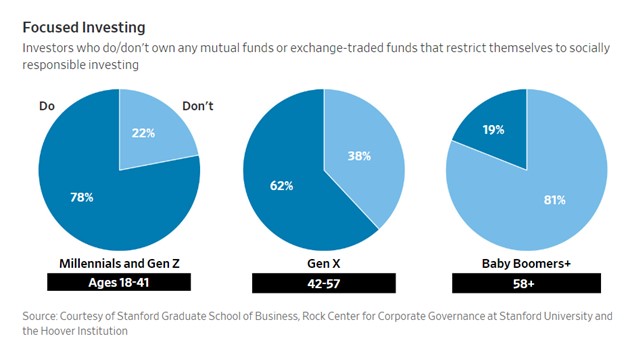
There is newly reported results of a research survey by Stanford University. The survey’s goal was assessing individual investors’ views about ESG investing. The authors surveyed 2,470 investors in the summer of 2022, with accounts ranging from $10,000 to more than $500,000. The survey found that investors’ tolerance or support for ESG measures, including a willingness to have poorer returns, varied by their age, current wealth, as well as the specific ESG issue.

Looking at Return vs. Alternative Objectives

Investors closest to retirement age, 58 years old and over, were the least likely to support ESG objectives. Those farthest from retirement age, 18 to 41 were the most likely. The data showed more than one-third of the younger investors said they would be willing to lose 11% to 15% of their retirement savings to encourage companies to have gender and racial diversity mirroring the general population. Of the more experienced older grouping, only 3% said they would risk or be willing to lose that amount for an ESG priority. A full 66% of the older investors said they were unwilling to lose any money to support ESG principles.

“Older investors want fund managers to generate financial returns to support their spending needs during retirement and don’t have a lot of time to recoup big losses,” says David Larcker, a professor at Stanford’s Graduate School of Business and one of the researchers.

The survey further confirmed that those where a loss was less troubling were more inclined to support and allow a large firm like Blackrock to decide what to support. The results showed wealthier young investors tended to be the largest group of ESG positive investors. For example, young investors with at least $250,000 under management said on average that they would be willing to lose about 14% of their retirement savings to have companies reduce carbon emissions to net zero by 2050. Alternatively, young investors with savings of less than $50,000 they would be willing to lose 6% on average to accomplish that goal.

Not all ESG initiatives rank the same for investors. Those surveyed held a higher level of support for those involving environmental issues. Social issues came next, and they were concerned  the least about governance.

Vote Preferences

The investors surveyed also said they wanted the investment managers’ vote to reflect their own individual personal views related to ESG initiatives. In a related inquiry, 79% of the survey’s respondents with money at BlackRock managed assets said they approved of the firm’s use of its voting power to promote diversity on corporate boards.

Fully reflecting their clients’ views on ESG initiatives would be a high hurdle for investment managers, given the range of investors’ positions on so many issues. One potentiality is Investment managers could split their votes to weight individual investors’ views, Prof. Larcker says. For instance, that could mean voting 70% of their shares in a company in favor of a specific ESG proposal and 30% of their shares against the proposal.

Return Expectations

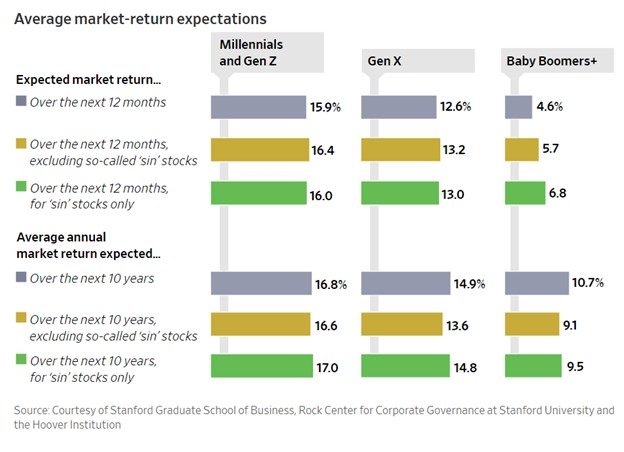
The older, more experienced respondents also had a significantly different view of expectations of return on investments.

Investment managers may want to provide data to try to improve fund participants’ understanding of the extent to which they have increased their risk to support the plans of an ESG-managed fund. Prof. Larcker suggests this could entail making it clear how returns of voting choices differed financially and from an ESG perspective, he says: “Did a vote improve or hurt the company’s financial performance in the short or long term? Was there a tangible effect on the environment or on employee diversity?”

“Fund managers need to acknowledge that there is likely to be some trade-off between ESG and financial returns,” he says, “and that trade-off may matter to individual investors.”

Take Away

Investing for the social good is not a new concept. The latest incarnation, ESG, has gained much more traction than the socially responsible investing initiatives of the past. The performance data, both financial and goal satisfaction, are difficult to measure. The survey done this past summer demonstrates the differences between demographic groups, a difference of expectations, and the weight of importance of, say, environmental issues over others.

As ESG-based investments evolve, Channelchek will keep you up to date on how others are looking at this category, what is new within the category, and other news that can keep you aware of the changing face of ESG. Sign up for Channelchek emails and information here.

Paul Hoffman

Managing Editor, Channelchek

Sources

https://www.gsb.stanford.edu/faculty-research/publications/2022-survey-investors-retirement-savings-esg

https://www.gsb.stanford.edu/sites/default/files/publication/pdfs/survey-investors-retirement-savings-esg.pdf

https://www.wsj.com/articles/esg-initiatives-investors-survey-11666975292?mod=hp_user_preferences_pos4#cxrecs_s

Big Techs Changing Fortunes, Will they Turn Around?

Image Credit: Tracy LeBlanc (Pexels)

Why Meta’s Share Price Collapse is Good News for the Future of Social Media

Facebook may not be the original social media platform, but it has stood the test of time – until recently. Meta, the company that owns Facebook, Instagram, and WhatsApp, saw its value plummet by around $80 billion (£69 billion) in just one day at the end of October after its third-quarter profits halved amid the global slowdown. Meta is now valued at around $270 billion compared with more than $1 trillion last year.

Several issues have caused investors to turn away from the social media giant, including falling advertising revenue, a conflict with Apple over its app store charging policy, and competition for younger audiences from newer platforms such as TikTok.

Meta’s chief executive Mark Zuckerberg has also used his majority control to double down on his ambitions for the “metaverse”, a virtual reality project on which he has already spent more than $100 billion – with questionable results, according to the initial investor and media reaction. Zuckerberg has promised even more investment in the metaverse next year.

It’s tempting to describe this spending spree as a billionaire’s “insane fantasy”, but there is a simpler explanation. As dominant platforms compete for a limited amount of advertising revenue, regulation – particularly when it differs between countries or regions – has created space for more competitors. This is good news for new social media companies, but it also means that the only way Meta is likely to be able to keep its dominant position is by placing a massive bet on the technology of the future. Zuckerberg believes that means the metaverse, but this remains to be seen.

Tech’s Changing Fortunes

Even with its recent troubles, Meta owns the largest social network in the world. Those recent results that caused investors to flee in their droves still showed total revenues of $27 billion and profits of $4.4 billion.

To maintain its position as the market leader in the past, Meta has typically bought its most promising competitors as early as possible. Integrating these newly acquired startups into the company’s ecosystem helped to maximize advertising revenue and preclude competition.

Research shows that digital markets are typically dominated by a single firm, but also that these firms tend to be much more specialized than the major companies of the past. Meta is only active in social media and makes money almost exclusively by selling advertising.

Attempts by such firms to expand into other areas typically fail – know anyone with a Facebook phone? And while you may not remember Google’s attempt at social media, iPhone users are probably at least aware of Apple’s maps app.

So Facebook relies on consumers using devices produced by other tech companies to make money. But as global social media advertising revenue slows down, this is becoming more difficult. Apple has begun charging Meta for the revenue it makes from iPhone users, for example. And research shows that, when two companies compete to make money from the same captive source, their successive markups not only push prices higher for consumers but also keep profits lower for both firms.

Global Domination Fail

Meta’s strategy has, until recently, allowed it to rule social media in western markets – but not in China, a country of more than 300 million social media users. Since 2009, Facebook has been blocked by the country’s “great firewall”, the largest and most sophisticated system of censorship in the world.

Reported attempts to adapt Facebook to suit Chinese government media control have never been successful. And so, Chinese company ByteDance was able to launch a news platform called Toutiao in 2012 without having to compete with a dominant social network. In 2016, ByteDance launched Douyin, a social media platform for publishing short videos, which was subsequently released to the rest of the world in 2018 as TikTok.

Despite not being profitable, ByteDance’s market capitalization is now estimated at around $300 billion – versus Meta’s current £270 billion valuation. It is also popular among younger users, that tend to be much more avid social media users.

Meta cannot simply buy TikTok: it is too big, not publicly traded and under tight control by the Chinese government. Zuckerberg’s firm has instead tried to compete by launching similar features on Instagram. Ironically, the only large market where this strategy is really working is India, a country that banned TikTok in 2021 due to a military conflict with China.

Fair Competition

At the same time that TikTok has been expanding beyond Meta’s reach, western regulators have also started to examine the impact of the lack of competition in digital markets on innovation. While research shows that the winner-take-all nature of highly innovative markets is typically good for consumers, this is only true when all companies get a fair chance to become dominant.

In addition to recent rulings against tech company dominance by its highest court, the European Union also recently introduced the Digital Markets Act. This outlaws many practices used by dominant firms to preserve their status in a market.

This article was republished with permission from The Conversation, a news site dedicated to sharing ideas from academic experts. It represents the research-based findings and thoughts of Renaud Foucart, Senior Lecturer in Economics, Lancaster University Management School, Lancaster University.

Is the Coming Political Gridlock Good for Specific Market Sectors?

Image Credit: Kelly Bell (Flickr)

A Return to Gridlock in Washington Could be Healthy for Stocks

Political gridlock has historically been associated with higher stock market prices. So, while staunch supporters of either political party did not become overjoyed by the Election Day outcome, those invested in stocks may wind up better off. With President Biden (D) in the Executive branch, and at least the House of Representatives in the legislative branch holding a Republican majority, a split government is assured. This is true no matter the final outcome of the Senate races. A split government, with its accompanying gridlock, has been accompanied by positive long-term stock market performance.

A Smoother Road

The battles in Washington may take on a more heated tone with a split government, for investors, the gridlock scenario eliminates a lot of uncertainty. In the inflationary period we are in, a government with less ability to institute spending plans, and a reduced ability to change tax rates in an effort to pay for spending, is far less of a concern to market participants – less change will be enacted.

For businesses, there is more visibility to plan, budget, and implement plans to build their business. A split government should lead toward fewer dramatic changes or government intervention that bolsters one technology or product over another. With a lower risk of playing field changing legislation, tax change, or regulations, businesses are more likely to spend and invest as the risk of change is lower.

Historically, stocks have tended to do better under a divided government when a Democrat is in the White House. The average one-year S&P 500 returns have been 13% in a Republican-held Congress under a Democratic president and 14% when the Congress is split. This compares with 10% when Democrats controlled the White House and Congress.

Under the current situation, less spending on Build Back Better initiatives and a lower likelihood of passage of more plans like The Inflation Reduction Act help reduce spending and stimulus, which may allow the Federal Reserve to end its tightening cycle sooner.

The increase in Republicans could bring more attention to several stock market areas, such as biotech and pharmaceuticals. Their increased presence lowers prospects for price controls on prescription drugs. Big tech stocks could benefit from less of a threat to regulate the industry.

Some Choppiness Ahead

In 2011 the credit rating agency Standard & Poor’s downgraded the U.S. credit rating over the long gridlock battle that delayed increasing the Federal Debt ceiling. A possible downgrade, or “credit watch” category, could lead to an increase in rates, not just in U.S. government debt but all loans tied to these benchmark rates.

The enhanced power of Republicans could also slow infrastructure outlays, particularly the momentum in spending that has lifted so many alternative fuel stocks. Incentive plans and grants funded through borrowing and taxation have grown dramatically with both the executive and legislative branches under single-party control, those sectors that were expecting the pace to continue may find growth prospects slowing. Marijuana legalization on the Federal level may also be less of a priority now among lawmakers.

Stocks Post Mid-Terms Track Record

The S&P 500 has recorded a gain in each 12-month period after the mid-terms since World War Two. The markets have been clobbered with declining values since 2022 began; perhaps this is the turning point where the unfairly beaten-down sectors and companies begin to make up for lost ground.

Take Away

The election outcome wasn’t overly satisfying for either party but may lead to stronger stock market performance. Also, just getting past the mid-term elections without regard for the outcome has a stellar record of gains. If history is any indicator, a repeat of what the markets have experienced in the past, along with a slight shifting of those more positioned to take advantage of changes, should put investors in a positive mood as we approach year-end and enter 2023.

Paul Hoffman

Managing Editor, Channelchek

Sources

https://www.reuters.com/markets/us/futures-steady-midterm-results-roll-2022-11-09/

https://m.economictimes.com/markets/stocks/news/investors-prepare-for-government-gridlock-as-republicans-seen-gaining-in-u-s-midterms/amp_articleshow/95393951.cms

https://www.fidelity.com/news/article/default/202211082056RTRSNEWSCOMBINED_L1N3242PI_1

Choices Presented to Voters on Ballots are Presented to Investors as Opportunities

Image Credit: Joe Shlabotnik (Flickr)

The Consequences of this Year’s Voting Should Create Opportunity for Investors

Once inconceivable in most voting districts throughout the U.S., ballots across the country this year will ask voters to decide on gambling measures, drug laws, and extra taxes based on defined demographics. While this is of interest to investors as it shows how trends are forming or continuing and can point to more potential for growth. Of the 130 ballot measures being decided upon on Tuesday, many will alter spending patterns and bolster industries.

What’s Being Decided Upon

Each year a number of states, including Maryland and Arkansas, are asking voters to decide upon legalizing recreational marijuana. Fully five states could move toward ending the use of involuntary prison labor. Nebraska and Nevada are asking voters if they should increase the minimum wage statewide. Gambling, firearms, and immigration are also the subject of state-level referendums.

A proposition in California would legalize online sports betting in that large potential market. Gaming companies, including DraftKings (DKNG) and FanDuel (DUEL) have poured nearly $160 million into the measure. It is not expected to pass, if it does, the news may cause a rally in these and other online gambling companies. Over $375 million has been spent by supporters and those against this measure.

Also being decided by California’s voters is a proposition that would raise taxes on personal incomes of $2 million or more. The revenue would be set aside to fund the state’s electric-vehicle production and help prevent wildfires. This is a very contentious measure that pit many from the same political party against each other.

In general environmental groups and companies perceived to benefit from a quicker evolving EV infrastructure support the “yes” campaign. Governor Newsom, and the California Teachers Association, a powerful state union, have joined business groups to oppose the measure, saying it would benefit a select number of large corporations as they transition to electric vehicles.

Recreational weed in Maryland? The pollsters seem to think it stands a good chance of passing. There are four other states (Arkansas, Missouri, North Dakota and South Dakota) where recreational cannabis is also on the ballot, those outcomes won’t be known until after the votes are counted.

To date, 19 states and the District of Columbia have legalized the adult recreational use of marijuana. Colorado could become the second state behind Oregon to legalize the personal use of psilocybin, the active ingredient in psychedelic mushrooms and other plant-based hallucinogens.

Massachusetts voters get to decide if they raise their income taxes by 4% if they have personal incomes of $1 million or more. This would leave the total rate for that bracket to 9%. Should this pass and bring in additional funds, they are earmarked for education and transportation.

Voters in five states will weigh whether to explicitly outlaw involuntary servitude as part of the punishment for a crime. Alabama, Louisiana, Oregon, Tennessee, and Vermont will all consider these questions on the topic; there is a growing movement to change the 13th Amendment so it no longer allows slavery as a form of criminal punishment. This could potentially benefit the industry in these states.

On immigration, Ohio voters are considering whether to ban all local governments from allowing noncitizens to vote. San Francisco and New York have passed laws allowing noncitizens to vote for local offices and ballot measures. These face legal challenges.

Elsewhere, ballot measures will ask voters whether to extend certain benefits to immigrants in the country illegally, including the ability to obtain a driver’s license in Massachusetts and pay in-state college tuition in Arizona.

Take Away

They say elections have consequences. As various states elect to adopt or deny changes in the running of their state, investors may be able to position themselves to benefit from trends, changes, and additional funds being made available.

Paul Hoffman

Managing Editor, Channelchek

Sources

https://www.wlwt.com/article/election-results-2022-ohio-kentucky-indiana-senate-governor/41781051

https://www.wsj.com/articles/midterm-elections-2022-results-ballot-measures-referenda-11667864143

https://www.wcvb.com/article/voter-information-massachusetts-election-2022-midterm/41890411

https://www.cnbc.com/2022/11/04/draftkings-shares-tumble-after-monthly-users-fall-short-of-estimates.html

Are Trump-Related Media SPAC Investors in for More Surprises?

Image Credit: Trump White House Archive (Public Domain)

The Wild Ride of Digital World Acquisition Corp. Has Mostly Been Positive

You never know what kind of surprise you may eventually end up with when purchasing a Special Purpose Acquisition Corp (SPAC). Digital World Acquisition Corp. (DWAC) is the perfect example of how a SPAC can provide a wild ride for those that were originally involved in the IPO and those that have since been involved in the stock of the “blank check company.”  Before plans to merge with Truth Media, a subsidiary of Trump Media Group, it started out as most SPACs do, with a $10 a share price and a description of what an appropriate target would look like, and credentials of managing a financial company.

Most Recent

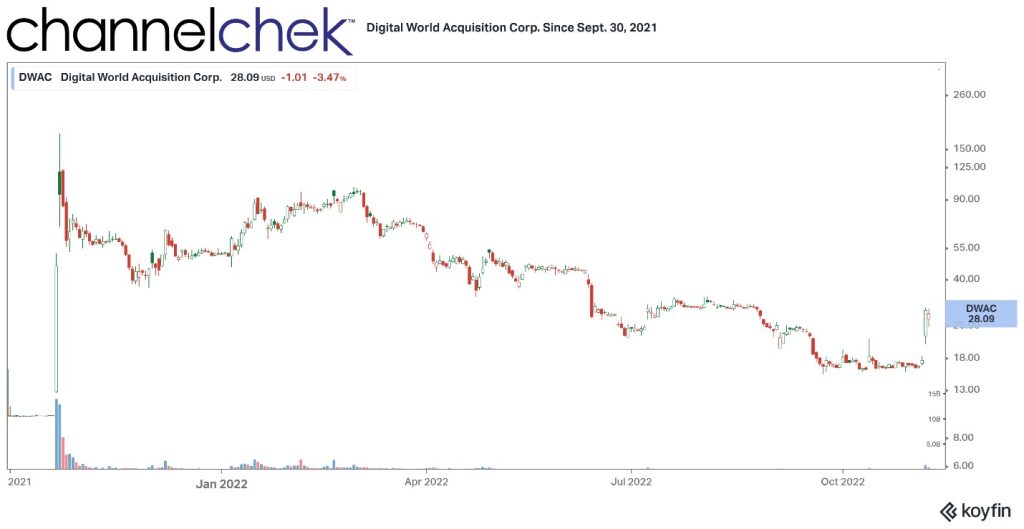
News impacting social media competitors to Truth Social and information involving the former President’s stature have historically driven prices of the acquiring company in a sporadic fashion. On Monday, DWAC took off by 66.5% to $29.10 during the trading day. On the prior trading day it had already risen 7% to $17.48. The impetus for this was news that Donald J. Trump was making plans to announce his candidacy as a Republican hopeful in the 2024 election.

The strong updraft of the DWAC price came the day before the US Election Day when political power struggles are at the forefront of most investors’ minds. It also occurred on the same day the former President announced plans to make a “Big” announcement next week.

Last week the SPAC shares rose after management delayed a shareholder vote — for the sixth time — on whether to approve a year extension to complete its merger with Trump Media and Technology Group. The shareholders meeting is now set for Nov. 22. DWAC’s deadline to complete its merger with Trump’s company had originally been in early September. However, the SPAC has said an SEC investigation of the merger deal delayed progress.

Source: Koyfin

Highlights of DWAC Price Action

October 2021 –  The chart above shows the upward SPAC spike (1,650%) as it became known in late October of its intent to merge with Trump’s fledgling social media venture. A retail trading frenzy had sent prices of the Trump media-linked SPAC, Digital World Acquisition Corp., ripping up an incredible 1,650% in just two days.

The stock reached a peak of $175, within two days and closed the week up 845% from an unusual amount of enthusiasm from retail interest.

News reports at the time highlighted the company had no fundamentals to speak of and te action was purely speculation and momentum.

Digital World Acquisition Corp. ended on the Friday at $94.20 after closing Wednesday at $9.96.

December 2021 –The stock traded off after the initial enthusiasm, especially after the media company fell short of its plan to have a beta version of Truth Social in November. It then caught fire later during the first week of December 2021. The impetus here was an announcement that the former President was raising $1 billion (mostly from family offices and hedge funds) to support the company’s projects.      

Federal regulators cast a dark cloud over the deal, beginning the second week of December. The SEC was overall looking at tax and accounting of all SPACs, this had the potential to impact DWAC. Additionally, FINRA requested information to investigate whether than were any improper communications between Trump Media and Digital World.

Image Credit: Trump White House Archive (Public Domain)

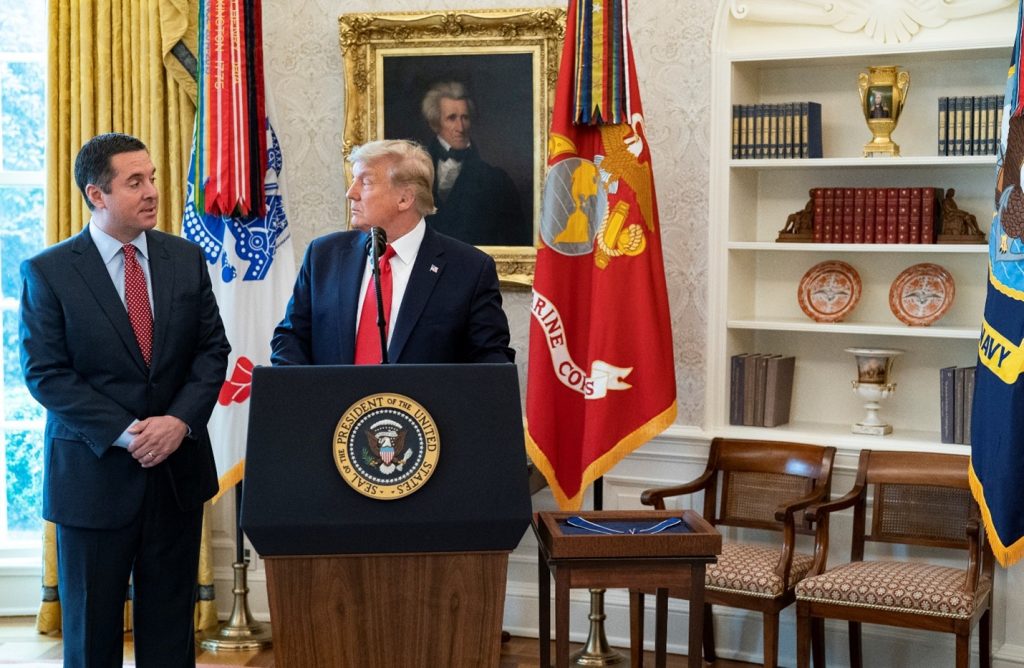
Moving forward that December, a new CEO of Truth Social was appointed. This was a former representative to the House, Devin Nunes from California.

January 2022 – On the 7th of January, the stock rose 20%, up 505% from the day the plans to merge was announced. The stock’s market cap was also up by the same percentage at $2.24 billion.

Plans were made to launch the social platform on February 21st. The company had been still sitting at lofty heights on faith, not an actual product.

In late January, the SPAC experienced its largest one-day jump of the year (to date), a 21% increase on no new information. There was, however speculation that the stock’s rally may have been connected to a Trump rally the still politically active Trump held in his home state.

As shown on the chart above, momentum for the stock was again building after a January 6 announcement of the launch date, the stock climbed 71%. Phunware (PHUN), the designer of the platform, was up 25%.

February 2022 – The Trump social media platform becomes available in the app store in late February and the price of DWAC increases 28% pre-market open. Institutional investors gain a new respect for the power of self-directed retail investors and the power they hold. Prices in February are sitting at a 750% increase from the day the SPAC merger was announced.

April 2022 – Two private investors bail on Truth Social, and shares of Digital World drop following a negative (30%) March. The share value has now declined 70% from its all-time high. Adding to the drag on values, new SPAC rules from the SEC cast even more doubt on the ability to bring the deal to a close.

June 2022 – Since the beginning of the year, the stock’s value dropped 47%. The SEC began expanding its inquiry into the proposed merger, having subpoenaed the company for more information on the deal. Investors think the deal will likely be delayed, perhaps even torpedoed.

July 2022 – Elon Musk made good on a Tweet to offer to buy Twitter. His intent was to “free the bird” and allow open discourse, in other words, turn it into what Trump envisioned for Truth Social. Both Trump and Musk have fans and foes, so the drama picked up when Elon suggested openly Trump ought to “hang up his hat and sail into the sunset.”

Prices of DWAC originally declined but then found their footing as expectations of Elon Musk successfully buying the huge competitor of Truth Social waned.

August 2022 –Digital World says it isn’t sure whether they are the right vehicle to take Truth Social public. And it wants to keep financials under wraps until it can decide. The SEC allows an automatic five-day extension.

It’s the regulatory and legal obstacles DWAC’s been faced with since announcing the merger that could have caused them to look for the surrender flag. The two entities were subjected to a federal criminal probe that caused every single one of the SPAC’s board members to receive a subpoena after already warning that any investigations would jeopardize the deal. Shares were down 73% since October.

November 2022 – The momentum that may have been responsible for the original run-up over a year earlier again surfaces as it is rumored that the ex-President with a massive amount of loyal followers will be running to be re-elected. “In a very, very, very short period of time, you’re going to be very happy,” former president Donald Trump told attendees at a rally on November 5.

Trump Media’s merger with DWAC still faces many legal and financial hurdles that have resulted in at least $138m in investment being pulled. Trump will post on Truth Social exclusively for 8 hours before posting elsewhere. He has been widely followed on the social platforms he has been part of, so whether investors support the potential candidacy, they’re almost certain it’ll drive traffic to the app.

Take Away           

One never knows what target companies a SPAC may unearth, if any, as a suitor for its acquisition plans. For investors that jump into the unknown early, before a SPAC announces any plans, their downside is somewhat limited as their investments are held in escrow as the target is procured. Should a deal be struck, they get to decide if they wish to stay involved. If, after two years, the SPAC fails to close on a target, investors still holding shares receive the original purchase price (usually $10), fewer expenses, plus interest. Considering how volatile other investments have been, this effectively puts a floor in to protect against the downside for investors near the $10 level.

Paul Hoffman

Managing Editor, Channelchek

Sources

https://www.theverge.com/2021/12/6/22821450/devin-nunes-ceo-tmtg-spac-dwac-truth-social-media

https://www.cbsnews.com/news/trump-announcement-november-15-mar-a-lago/

https://www.tradingview.com/symbols/NASDAQ-DWAC/history-timeline/#trump-spac-goes-soaring-2021-10-15

https://www.reuters.com/markets/us/exclusive-trumps-social-media-venture-seeks-1-billion-raise-sources-2021-12-01/

www.investors.com/dwac

Inflammation as a Cause of Disease

Image Credit: Marco Verch (Flickr)

What is Inflammation? Two Immunologists Explain How the Body Responds to Everything from Stings to Vaccination and Why it Sometimes Goes Wrong

When your body fights off an infection, you develop a fever. If you have arthritis, your joints will hurt. If a bee stings your hand, your hand will swell up and become stiff. These are all manifestations of inflammation occurring in the body.

We are two immunologists who study how the immune system reacts during infections, vaccination and autoimmune diseases where the body starts attacking itself.

This article was republished with permission from The Conversation, a news site dedicated to sharing ideas from academic experts. It represents the research-based findings and thoughts of Prakash Nagarkatti, Professor of Pathology, Microbiology and Immunology, University of South Carolina and Mitzi Nagarkatti Professor of Pathology, Microbiology and Immunology, University of South Carolina

While inflammation is commonly associated with the pain of an injury or the many diseases it can cause, it is an important part of the normal immune response. The problems arise when this normally helpful function overreacts or overstays its welcome.

What is Inflammation?

Generally speaking, the term inflammation refers to all activities of the immune system that occur where the body is trying to fight off potential or real infections, clear toxic molecules or recover from physical injury. There are five classic physical signs of acute inflammation: heat, pain, redness, swelling and loss of function. Low-grade inflammation might not even produce noticeable symptoms, but the underlying cellular process is the same.

Take a bee sting, for example. The immune system is like a military unit with a wide range of tools in its arsenal. After sensing the toxins, bacteria and physical damage from the sting, the immune system deploys various types of immune cells to the site of the sting. These include T cells, B cells, macrophages and neutrophils, among other cells.

The B cells produce antibodies. Those antibodies can kill any bacteria in the wound and neutralize toxins from the sting. Macrophages and neutrophils engulf bacteria and destroy them. T cells don’t produce antibodies, but kill any virus-infected cell to prevent viral spread.

Additionally, these immune cells produce hundreds of types of molecules called cytokines – otherwise known as mediators – that help fight threats and repair harm to the body. But just like in a military attack, inflammation comes with collateral damage.

The mediators that help kill bacteria also kill some healthy cells. Other similar mediating molecules cause blood vessels to leak, leading to accumulation of fluid and influx of more immune cells.

This collateral damage is the reason you develop swelling, redness and pain around a bee sting or after getting a flu shot. Once the immune system clears an infection or foreign invader – whether the toxin in a bee sting or a chemical from the environment – different parts of the inflammatory response take over and help repair the damaged tissue.

After a few days, your body will neutralize the poison from the sting, eliminate any bacteria that got inside and heal any tissue that was harmed.

Asthma is caused by inflammation that leads to swelling and a narrowing of airways in the lungs, as seen in the right cutaway in this image. BruceBlaus/Wikimedia Commons, CC BY-SA

Inflammation as a Cause of Disease

Inflammation is a double-edged sword. It is critical for fighting infections and repairing damaged tissue, but when inflammation occurs for the wrong reasons or becomes chronic, the damage it causes can be harmful.

Allergies, for example, develop when the immune system mistakenly recognizes innocuous substances – like peanuts or pollen – as dangerous. The harm can be minor, like itchy skin, or dangerous if someone’s throat closes up.

Chronic inflammation damages tissues over time and can lead to many noninfectious clinical disorders, including cardiovascular diseases, neurodegenerative disorders, obesity, diabetes and some types of cancers.

The immune system can sometimes mistake one’s own organs and tissues for invaders, leading to inflammation throughout the body or in specific areas. This self-targeted inflammation is what causes the symptoms of autoimmune diseases such as lupus and arthritis.

Another cause of chronic inflammation that researchers like us are currently studying is defects in the mechanisms that curtail inflammation after the body clears an infection.

While inflammation mostly plays out at a cellular level in the body, it is far from a simple mechanism that happens in isolation. Stress, diet and nutrition, as well as genetic and environmental factors, have all been shown to regulate inflammation in some way.

There is still a lot to be learned about what leads to harmful forms of inflammation, but a healthy diet and avoiding stress can go a long way toward helping maintain the delicate balance between a strong immune response and harmful chronic inflammation.

Powerball Growing Prize Money is Linked to Fed Tightening

Why the Future Value of the Lottery’s Grand Prize is Significantly Higher than Last Year

There is a link between the current $1.9 billion Powerball prize money and Federal Reserve Chair Jerome Powell – and it is inflating the prize money.

A new billionaire was not minted over the weekend, at least not because of winning the enormous Powerball jackpot prize. So the weekend prize money, plus a small fortune more, is up for grabs at 10:59 PM Monday, November 7. The headline prize money, in this case, $1.9 billion, is the future value of the cash award, which, according to Powerball.com, is $929.1 million. The larger, almost two billion amount, would not have been nearly as large last year. Its sum is much bigger because the Fed has been jacking up interest rates.

To drill down a bit more, the prize calculation uses the 30-year U.S. Treasury bond interest rate to determine the annuity paid to the winner based on the cash lump sum award. The present value of that number, even if on par with a cash award a year ago, would pay a substantially larger annuity. And it is the annuity that is the advertised prize, which draws more and more players as it grows. The more players, the higher the present value or cash prize.

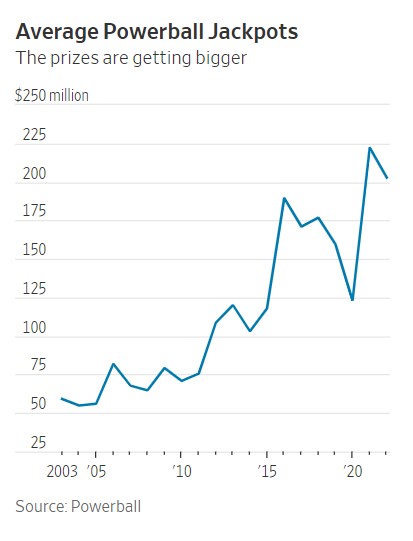
A year ago (November 8, 2021), the 30-year US Treasury bond had a yield of 1.90%. This was used to calculate the headline prize amount. Today, the same term Treasury is yielding 4.27%. This yield impact is roughly reflected in the average prizes over the years.

The Numbers Boiled Down Further

Of all ticket sales, 34% of Powerball ticket sales fund the grand prize. Another 16% fund the lower-tier prizes. (The remaining 50% goes to various state programs, operating costs, and retailer commissions.) If a winner chooses the lump sum payout, they receive the 34%. If instead, the winner chooses the jackpot in annual payments over 30 years, the prize money is invested in a portfolio of bonds.

The last time a winner chose an annuity was in 2014.

Economists who have researched lotteries have learned that once jackpots near the $500 million mark, non-regular lottery players are more likely to take a chance. The $500 million or more mark is where the media begins to make “lottery fever” a news event worth reporting on. The added publicity then feeds more money into the pot.  

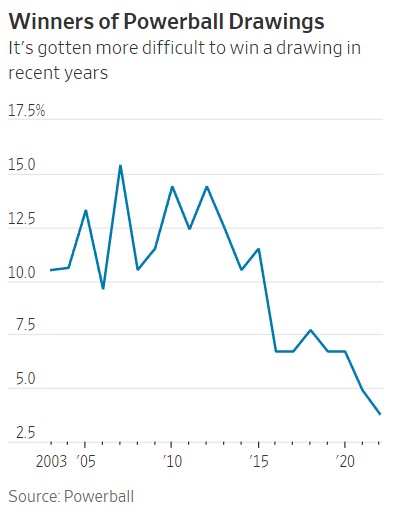
The prize pools are also growing because the games of chance have become statistically more difficult to take the top prize. In 2015, Powerball increased the cost of the ticket and altered the game to make it easier for players to win smaller prizes while reducing the odds of winning the headline prize.

Only 3.8% of drawings so far this year had had a winner, down from roughly 11% in 2014, the last full year before the change went into effect.

This is why the five times in the U.S. where $1 billion has been surpassed have all been recent. They include the biggest one, a $1.58 billion prize from Powerball in 2016, followed by a $1.53 billion Mega Millions jackpot in 2018 and this week’s $1.5 billion Powerball prize.

Lottery tickets also tend to become more popular during economic downturns and when people become more money conscious.

Even though the odds of winning Powerball are 1 in 292.2 million, players will take a shot and buy a ticket to have the fantasy.  If the prize money continues to reach over $500 million on a regular basis, it may work against the program as those who don’t normally play won’t feel it is a special event.

Good luck to those of you holding a ticket.

Paul Hoffman

Managing Editor, Channelchek

Sources:

www.powerball.com

https://www.wsj.com/articles/powerball-jackpot-lottery-federal-reserve-interest-rates-ticket-sales-11667479535?mod=hp_lead_pos12

The Week Ahead – Inflation Data Worries and Election Outcome

Federal Reserve President Speeches With Elections and CPI to Shape the Week’s Trading

Yes, the stock markets are open on Veterans Day (Friday). But bond trading, which the stock market has been more keenly focused on this year, will be taking the day off along with other U.S. government services. Equity traders can get a sense of interest rate sentiment on Friday by turning to the Chicago Board of Options and viewing tickers ZF=F (5 yr. USTN), ZN=F (10 yr. USTN), ZB=F (30 yr. USTB).

All markets are open on Election Day, and the outcome, as measured by House seats and Senate seats distributed among the major political parties, has the potential to be market-moving.

It’s a quiet week for economic numbers, except for Thursday, when the CPI report is released. This has the potential of changing those calling for a 50 bp hike at the next meeting to up their expectations or those still forecasting 75bp to lower their call. Certainly, the Fed governors will be watching this and all measures of inflation up to the December 14-15 meeting. There are a number of Fed governors speaking this week; this could alter the tone; however, the next meeting is far out into the future.

Election Day.

Monday 11/7

  • 3:00 PM ET the amount of consumer installment credit for September, including credit cards, auto loan, and student loans outstanding, indicate current consumer spending and borrowing patterns. The markets tend to ignore this number as we are already in November and this report measures September
  • 3:40  PM ET, the Federal Reserve Bank Presidents Mester (Cleveland) and Collins (Boston), will be speaking. Both are considered fairly hawkish.
  • 6:00 PM ET, the Federal Reserve Bank President Harkey (Philadelphia) will be speaking.

Tuesday 11/8

  • Election Day.
  • Meet the Management; Noble Capital Markets hosts Management of Entravision Communications (EVC) in West Palm Beach, FL. This is a no-cost-to-attend, in-person breakfast meeting with investors. If interested, click here.
  • Meet the Management, Noble Capital Markets hosts Management of Entravision Communications (EVC) in Boca Raton, FL. This is a no-cost-to-attend, in-person lunch meeting with investors. If interested, click here.

Wednesday 11/9

  • It can be expected that the newswires will be filled with Election Day outcomes and market-moving conjecture.
  • 7:00 AM ET Mortgage Applications. The Mortgage Bankers Association (MBA) creates a statistic from several mortgage loan indexes. The Mortgage Applications index measures applications at mortgage lenders. It’s considered a leading indicator and is especially important for single-family home sales and housing construction. Both are considered foundational in a strong economy.
  • 10 Year Treasury Note Auction is held in the middle of each month and settles on or around the 15th (depending on weekends). The yield is a benchmark for 30-year mortgages and has recently been noted by investment markets because it has been trading at a yield lower than shorter maturities. This inversion of the yield curve has some market players suggesting a recession is expected in the future. Any surprises at the auction will reverberate through the stock market.
  • 10:30 AM ET, EIA Petroleum Status Report.
  • 11:00 AM ET, Federal Reserve President Barkin  (Philadelphia) speaks.
  • Meet the Management; Noble Capital Markets hosts Management of Entravision Communications (EVC) in Winter Park, FL. This is a no-cost-to-attend, in-person breakfast meeting with investors. If interested, click here.
  • Meet the Management; Noble Capital Markets hosts Management of Entravision Communications (EVC) in Orlando, FL. This is a no-cost-to-attend, in-person lunch meeting with investors. If interested, click here.

Thursday 11/10

  • 8:30 AM ET, U.S. Consumer Price Index (CPI) is the inflation indicator most widely broadcast. With inflation being a primary focus, this will be the big number coming out this week. The number represents a basket of goods considered typical for an urban consumer and is taken as the change in the cost of that basket of goods. A percentage is derived from the change. CPI is also reported with food and energy removed as it is considered that other non-economic factors influence these prices. The September report indicated CPI rose 0.4% for the month and 8.2% YOY. Expectations are for an increase to 0.7% for October and a YOY rate of 8.0%.
  • 8:30 AM ET U.S. Jobless Claims which represent the prior week’s employment are expected to have increased to 221,000 from 217,000. From jobless claims, investors can gain a sense of how tight or how loose the job market is. If wage inflation takes hold, interest rates will likely rise, and bond and stock prices will fall. Remember, the lower the number of unemployment claims, the stronger the job market, and vice versa.
  • 10:30 AM ET, EIA Natural Gas Status Report.

Friday 11/11

  • Veterans Day, the stock market is one, the futures markets are open, and the bond market and other U.S. government-related offices are closed.
  • 10 AM ET Consumer Sentiment, November (preliminary). This barometer, reported by the University of Michigan,  questions households each month on their assessment of current conditions and expectations of future conditions. This “preliminary” release is for the month of November and is expected to have fallen to 59.6 versus 59.9 last month.

What Else

It is a light week for economic releases and Fed governor addresses, but the election outcome and CPI have the potential to whip markets around.

We’re entering the holiday shopping season when there will be a number of measures that investors focus on that will give a hint as to how strong the consumer is in the current economy.

Paul Hoffman

Managing Editor, Channelchek

Sources

https://www.federalreserve.gov/newsevents/calendar.htm

http://global-premium.econoday.com/byweek.asp?cust=global-premium

https://www.channelchek.com/news-channel/noble_on_the_road___noble_capital_markets_in_person_roadshow_series

https://www.econoday.com

The New Effort to Re-Anchor the US Dollar to US Gold Stock

US Sailors, Coastal Riverine Group, Restoring Command Anchor with Gold Paint, Credit: US Pacific Fleet (Flickr)

Can the Dollar Once Again Be Anchored by Gold? One Congressman Believes It Can

On October 7, 2022, US congressman Alex Mooney (a Republican from West Virginia) introduced a bill (the Gold Standard Restoration Act, H.R. 9157) that stipulates that the US dollar must be backed by physical gold owned by the US Treasury. The initiative clearly indicates that the increasingly inflationary US dollar is triggering efforts to get better money.

It should be noted that there have already been many legislative changes to make precious metals more attractive as a means of payment in recent years: in many US states, the value-added and capital gains taxes on gold and silver, but also on platinum and palladium, have been abolished. Mr. Mooney’s proposal is divided into three sections.

The first section of the bill establishes the need for a return to a gold-backed US dollar. For example, it is said that the US dollar—or more precisely, the bill refers to “Federal Reserve Notes”—that is, banknotes issued by the US Federal Reserve (Fed)—has lost its purchasing power on a massive scale in the past: Since 2000, it has dropped by 30 percent, and since 1913 by 97 percent. The bill also argues that with an inflation target of 2 percent, the Fed will not preserve the purchasing power of the US dollar but will have it halved after just thirty-five years. Moreover, the bill points out that it is in the interest of US citizens and firms to have a “stable US dollar.” The bill highlights that the inflationary US dollar has been eroding the industrial base of the US economy, enriching the owners of financial assets, while endangering workers’ jobs, wages, and savings.

The second section of the bill describes in more detail the technical process for re-anchoring the US dollar to the US official gold stock. It states that (1) the US secretary of the Treasury must define the US dollar banknotes using a fixed fine gold weight thirty days after the law goes into effect, based on the closing price of the gold on that day. The Fed must (2) ensure that the US banknotes are redeemable for physical gold at the designated rate at the Fed. (3) If the banks of the Fed system fail to comply with peoples’ exchange requests, the exchange must be made by the US Treasury, and in return, the Treasury takes the Fed’s bank assets as collateral.

The third section specifies how a “fair” gold price in US dollar can develop in an orderly manner within thirty days after the bill has taken effect. To this end, (1) the US Treasury and the Fed must publish all of their gold holdings, disclosing all purchases, sales, swaps, leases, and all other gold transactions that have taken place since the “temporary” suspension of the redeemability of the US dollar into gold on August 15, 1971, under the Bretton Woods Agreement of 1944. In addition, (2) the US Treasury and the Fed must publicly disclose all gold redemptions and transfers in the 10 years preceding the “temporary” suspension of the US dollar’s gold redemption obligation on August 15, 1971.

What to Make of This?

The bill’s core is the idea of re-anchoring the US dollar to physical gold based on a fair gold price freely determined in the market. (By the way, this is an idea put forward by the economist Ludwig von Mises (1881–1973) in the early 1950s.) In this context, the bill refers to US banknotes. However, banknotes only comprise a (fractional) part of the total US dollar money supply. But since US bank deposits can be redeemed (at least in principle) in US banknotes, not only US dollar cash (coins and notes) could be exchanged for gold, but also the money supply M1 or M2 as fixed and savings deposits could be exchanged for sight deposits, and sight deposits, in turn, could be withdrawn in cash by customers, and the banknotes could then be exchanged for gold at the Fed.

As of August 2022, the stock of US cash (“currency in circulation”) amounted to $2,276.3 billion. Assuming that the official physical gold holdings of the US Treasury amount to 261.5 million troy ounces, and the market expected US cash to be backed by the official US gold stock, a gold price of about $8,700 per troy ounce would result. This would correspond to a 418 percent increase compared to the current gold price of $1,680. If, however, the market were to expect the entire US money supply M2 to be covered by the official US gold stock, then the price of gold would move toward $83,000 per troy ounce—an increase of 4.840 percent compared to the current gold price. Needless to say, such an appreciation of gold has far-reaching consequences.

All goods prices in US dollars can be expected to rise (perhaps to the extent that the price of gold has risen). After all, the purchasing power of the owners of gold has increased significantly. Therefore, they can be expected to use their increased purchasing power to buy other goods (such as consumer goods, but also stocks, houses, etc.). If this happens, the prices of these goods in US dollar terms will be pushed up—and thus, the initial purchasing power gain that the gold dollar holders have enjoyed by being tied to the increased gold price will melt away again. Moreover, if US banks were willing to accept additional gold from the public in exchange for issuing new US dollar, reanchoring the US dollar in gold would increase the upward price effect.

A re-anchoring of the US dollar in the US official gold stock will result in a far-reaching redistribution of income and wealth. In fact, it would be fatal for the outstanding US dollar debt: US dollar goods prices would rise, caused by a rise in the US dollar gold price at which the US dollar is redeemable for physical gold, thereby eroding the US dollar’s purchasing power. In the foreign exchange markets, the US dollar would probably appreciate drastically against those currencies that are not backed by gold and against currencies which are backed by gold, not as fine compared to the fineness of the gold backing of the US dollar. The purchasing power of the US dollar abroad would increase sharply, while the US export economy would suffer. US goods would become correspondingly expensive abroad, while foreign companies gain high price competitiveness in the US market.

Once the US dollar is re-anchored in gold, today’s chronic inflation will end; monetary policy–induced boom-and-bust cycles will come to an end; the world will become more peaceful because financing a war in a gold-backed monetary system will be very expensive, and the general public will most likely not want to bear its costs. However, there is still room for improvement. A “Gold Standard Restoration Act” will deserve unconditional support if and when it paves the way toward a truly “free market for money.” A free market in money means that you and I have the freedom to choose the kind of money we believe serves our purposes best; and that people are free to offer their fellow human beings a good that they voluntarily choose to use as money.

In a truly free market, people will choose the good they want to use as money. Most importantly, in a truly free market in money, the state (as we know it today) loses its influence on money and money production altogether. In fact, the state (and the special interest groups that exploit the state) no longer determine which kind of gold (coins and bars, cast or minted) can be used as money; the state is no longer active in the minting business and cannot monopolize it anymore; there is no longer a state-controlled central bank to intervene in the credit and money markets and influence market interest rates. That said, let us hope that the Gold Standard Restoration Act proposed by Mr. Mooney will pave the way to reforming the US dollar currency system—and that it will eventually move us toward a truly free market in money.

About the Author

Dr. Thorsten Polleit is the Chief Economist of Degussa and an Honorary Professor at the University of Bayreuth. He also acts as an investment advisor.

Why the Bullish Behavior of the Past May Return

Philippe Petit walks Tightrope between buildings one and two of WTC, Manhattan, 1974 – Robert.Dearie (Flickr)

Analyst Team Point Out Asset Classes that Slingshotted in the 1970s

While the traditional fine print usually says, “past performance is no guarantee of future results,’ we all know trading decisions, whether the stocks are to be held for seconds, or decades, are based on probabilities. And market probabilities are rooted in past performance. What does past performance tell us about the chances that the markets can survive high inflation and low growth? Well, if the stagflation of the 70s repeats, there may be a small section of the markets to keep a solid footing.

Michael Hartnett is the chief investment strategist at Bank of America/Merrill Lynch. Hartnett sees in our current economy the ingredients in the macroeconomic picture that lead to the difficult economic combination of high inflation and low growth. His team, in their Flow Show note on Friday, wrote:  “Inflation and stagnation was ‘unanticipated in 2022…hence $35 trillion collapse in asset valuations; but relative returns in 2022 have very much mirrored asset returns in 1973/74, and the 70s remain our asset allocation analog for 2020s.”

 If the conditions of the 1970s are being mirrored and we are creating a foundation similar to 1973/74, Hartnett and team have a list of assets that could springboard off the stagflation cycle.

The assets with potential include taking long positions in small-caps, value, commodities, resources, volatility, and emerging markets. The group also highlights the short positions that worked well in the 1970s, the note indicates these are larger stocks, bonds, growth, and technology.

Why Small-Caps

As it applies to the smaller companies, the note points out that stagflation persisted through the late 1970s, but the inflation shock had ended by 1973/74, when the small-cap asset class “entered one of the great bull markets of all-time.” The Hartnett team sees small-caps set to keep outperforming in the “coming years of stagflation.”

The current year-to-date status has the Russell 2000 small-cap stock market index (measured by iShares ETF) down 19.8% in 2022. At the same time, the Dow Industrials are down 11%, S&P 500 lost 21%, and the Nasdaq Composite gave back 33%.

The current state of the Fed and Chairman Powell is they continue to be adamant about tightening, Powell said he’d prefer to overdo withdrawing stimulus than do too little. He also knows that until the market believes this, his tightening efforts will have a lower impact.

The BofA team isn’t helping market expectations as they noted, despite Powell’s clear signal that the Fed isn’t ready to declare even a slight victory from its raising rates; the analyst team says, don’t give up on that pivot.

After tightening interest rates through 1973/74 amid inflation and oil shocks, the central bank first cut in July 1975 as growth turned negative, Hartnett points out. A sustained pivot began in December of that year, and importantly, the unemployment rate surged from 5.6% and 6.6% that same month.

The “following 12 months, the S&P 500 rose 31%. The note suggests the lesson learned is that job losses when they occur, will be the catalyst for a 2023 pivot,” said Hartnett and the team.

We’re not there yet. Today’s economic release on jobs showed the U.S. added a stronger-than-expected 261,000 jobs during October. This is a slower pace than the prior month’s 315,000 job gains but still shows the Fed can comfortably notch rates up more and continue reducing its balance sheet.

Take Away              

The team of analysts at BofA/Merrill Lynch, reporting to Michael Hartnett, drew conclusions from the stagflation and financial markets’ performance of the 1970s. They shared their thoughts in a research note with investors. Looking at past performance, their expectation is that the Fed will pivot away from aggressively raising rates when it begins to negatively impact job creation. At this point, many markets will have already reacted to inflation expectations and would then react to a more accommodative monetary policy.

The asset sectors to avoid or short are larger stocks, bonds, growth, and technology. The preferred sectors that, in past situations, have done well are small-caps, value, commodities, resources, volatility, and emerging markets.

Be sure to sign-up at no cost for small and microcap company research sent to you each day by Channelchek.

Paul Hoffman

Managing Editor, Channelchek

Source

https://www.morningstar.com/news/marketwatch/20221104397/the-next-big-thing-is-small-get-ready-for-some-bullish-history-to-repeat-with-these-stocks-says-bofa-analysts