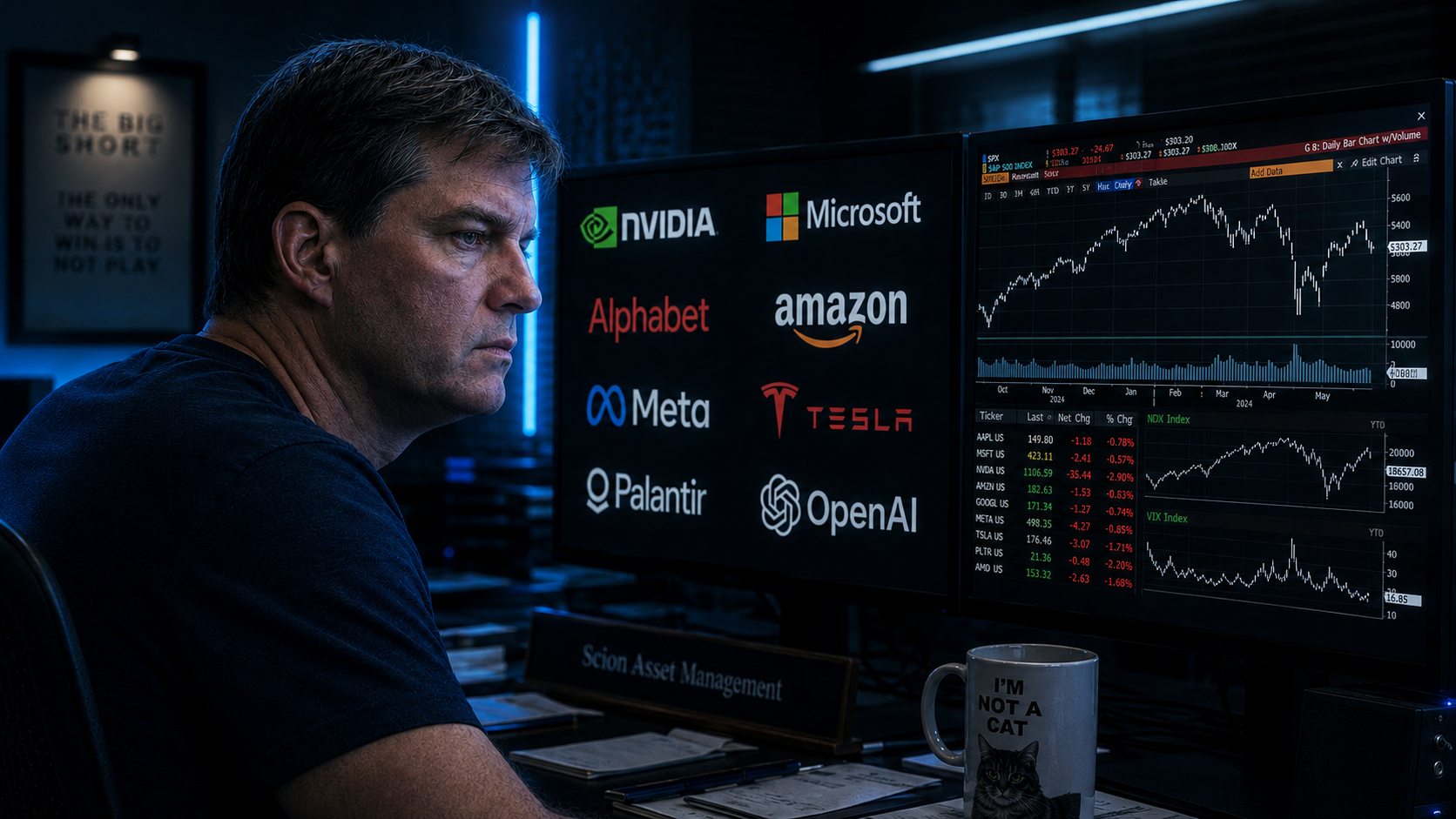
Michael Burry, the investor whose prediction of the 2008 housing crash inspired The Big Short, is once again warning that markets have detached from fundamentals. Throughout 2026, Burry has taken bearish positions against several high-profile AI-related technology names, arguing that investor enthusiasm has pushed valuations in that corner of the market well beyond what the underlying businesses justify.
In a recent post, Burry described the current environment as reminiscent of the final months of the 1999 to 2000 dot-com bubble, arguing that markets have become fixated on a single narrative to the exclusion of nearly everything else. He observed that stocks are no longer moving based on employment data or consumer sentiment, but simply because they have been rising, driven by what he called a two-letter thesis that everyone believes they understand.
A Pattern He Has Seen Before
Burry’s more interesting point, buried beneath the crash warning, is about where he believes the opportunity actually lies. He compared the current setup to the period immediately following the dot-com collapse, when he spent his time patiently acquiring established companies that the market had abandoned entirely in its rush toward speculative technology names. His argument is that the same dynamic is playing out today: capital has become so singularly focused on AI that companies with solid fundamentals outside that narrow theme are being overlooked and mispriced.
That framing is worth taking seriously independent of whether a crash actually materializes. Burry has also been candid about the limits of his own track record. He acknowledged mistakenly calling a Bitcoin crash in 2021 that never happened on the timeline he predicted, and he has been characterized by critics as a repeat false alarm. At the same time, he points to real calls that did play out, including the 2008 housing crash, the 2019 to 2020 period disrupted by COVID, the 2021 meme stock unwind, and the 2023 regional bank stress event.
He Is Not Alone in the Concern
Burry’s warning does not exist in isolation. Legendary investor Paul Tudor Jones told CNBC in May that current conditions feel similar to 1999, though he expects the rally could continue for another year or two before any significant correction. Jones specifically flagged concern about how far valuations could stretch if the market extends further from here, noting that a large enough move would push stock market value as a share of GDP to levels never seen before.
That relationship, known as the Buffett Indicator, remains at historically elevated levels today, reinforcing the view that US equities are expensive relative to the size of the underlying economy. As both Burry and market historians note, expensive markets can remain expensive for a long time before any correction arrives, which is precisely what makes timing a crash so difficult even for investors who share the underlying concern.
What It Means for Small Cap Investors
For investors in the sub-$2 billion market cap space, Burry’s core observation carries a genuinely relevant signal, independent of whether his crash timing proves correct. If capital concentration in a narrow group of AI-related names has pushed valuations to unsustainable levels, the companies most likely to be overlooked and mispriced in that environment are exactly the smaller, fundamentally sound businesses operating outside the AI narrative entirely.
That is consistent with a theme that has defined 2026. The Russell 2000 posted its best first half in 35 years while trading at a historically wide valuation discount to large caps, and market breadth has been expanding as capital gradually rotates beyond a handful of dominant technology names. Whether or not the broader market experiences the kind of correction Burry is warning about, his underlying thesis, that patient investors willing to look past the crowded trade can find genuine value in overlooked companies, is one small cap investors have effectively been living for the better part of this year.