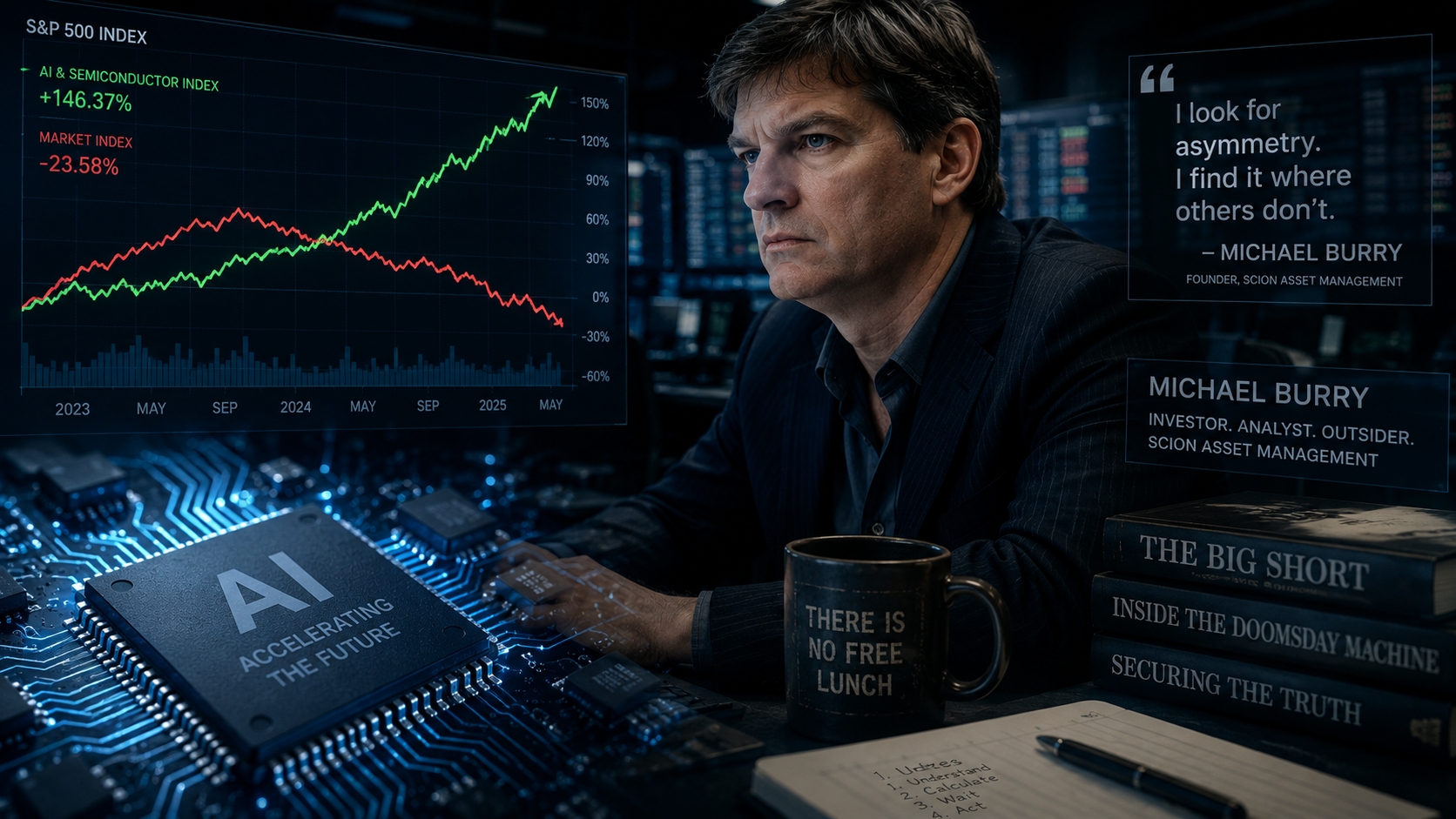
Michael Burry just shorted one of the best-performing stocks in the market, and the reasoning behind it is worth understanding whether you own semiconductor stocks or not.
The Scion Asset Management founder disclosed a new short position in Micron Technology (NASDAQ: MU) in a Substack post on July 2, entering at $1,051.87 per share. The stock dropped roughly 5.5% on the news, closing at $975.56. Burry also holds existing short positions in Nvidia, Applied Materials, and the iShares Semiconductor ETF (SOXX), and has said publicly that AI-related chip stocks could see a 30% correction from here.
Burry’s argument centers on one word: cyclicality. “Micron defines cyclical like no other,” he wrote, and he backed it up with numbers that are hard to wave away. The stock has suffered 34 drawdowns of more than 30% over the past 42 years. Its median return on invested capital sits at just 4%. Median return on equity comes in at 7%, which Burry called “frankly terrible.” Free cash flow has gone negative in 48% of quarters historically. And right now, Micron is trading further above its 200-day moving average than at any point since 1984, a stretch that includes the dot-com bubble. Burry dismissed the high-bandwidth memory business fueling the current rally as “just another in a very long series” of Micron products rather than a durable competitive edge.
It’s a compelling case built on four decades of history. The problem is that Micron’s most recent quarter does not look like the start of a downturn. For the period ending May 2026, the company posted $41.5 billion in revenue, up 345.7% year over year, with gross margin expanding to 84.6% from 37.7% a year earlier. On the June 24 earnings call, Chief Business Officer Sumit Sadana said customer demand for memory chips remains “well above our ability to supply” across nearly every product category through 2028. Long-term supply contracts, some running five years with prepayments attached, now account for at least half of the company’s revenue. That is not the profile of a business quietly cracking under the weight of a boom-and-bust cycle. It looks like a company locking in demand years in advance.
So which read is right? The piece of Burry’s argument that deserves the most attention isn’t the historical volatility data, it’s what he pointed to as the actual catalyst. South Korea recently announced mega semiconductor projects worth at least 1.35 trillion won, roughly $880 billion, including new fabrication plants from Samsung and SK Hynix. Burry called this “the beginning of the end.” Samsung, SK Hynix, and Micron together control close to 90% of the global DRAM market. When two of the three dominant players start committing hundreds of billions of dollars to new capacity, the pricing power that has driven this year’s memory rally typically doesn’t last forever. Supply eventually catches up to demand, and when it does in this industry, it tends to overshoot.
That dynamic is becoming more real by the day. SK Hynix debuted its U.S. listing today, raising approximately $28 billion in fresh capital, much of which is aimed squarely at expanding memory production capacity. Meanwhile, insiders at Micron have sold $124.9 million worth of shares over the past three months, a detail that doesn’t prove anything on its own but is worth filing away.
None of this settles the debate, and it shouldn’t. Micron is not a small or micro-cap company, but the memory supply chain it sits atop runs through dozens of smaller public names in testing, packaging, specialty materials, and thermal management, all of which trade on the same underlying cycle. When one of the most recognizable short sellers in the market publicly challenges the sustainability of an AI-driven supercycle in the exact stock that anchors that supply chain, the ripple effects extend well past Micron’s own share price. Investors holding exposure anywhere in the memory ecosystem now have a credible bear case sitting alongside the bull case, and the coming quarters, particularly how HBM pricing holds up against the wave of new South Korean capacity, will likely determine who was right.