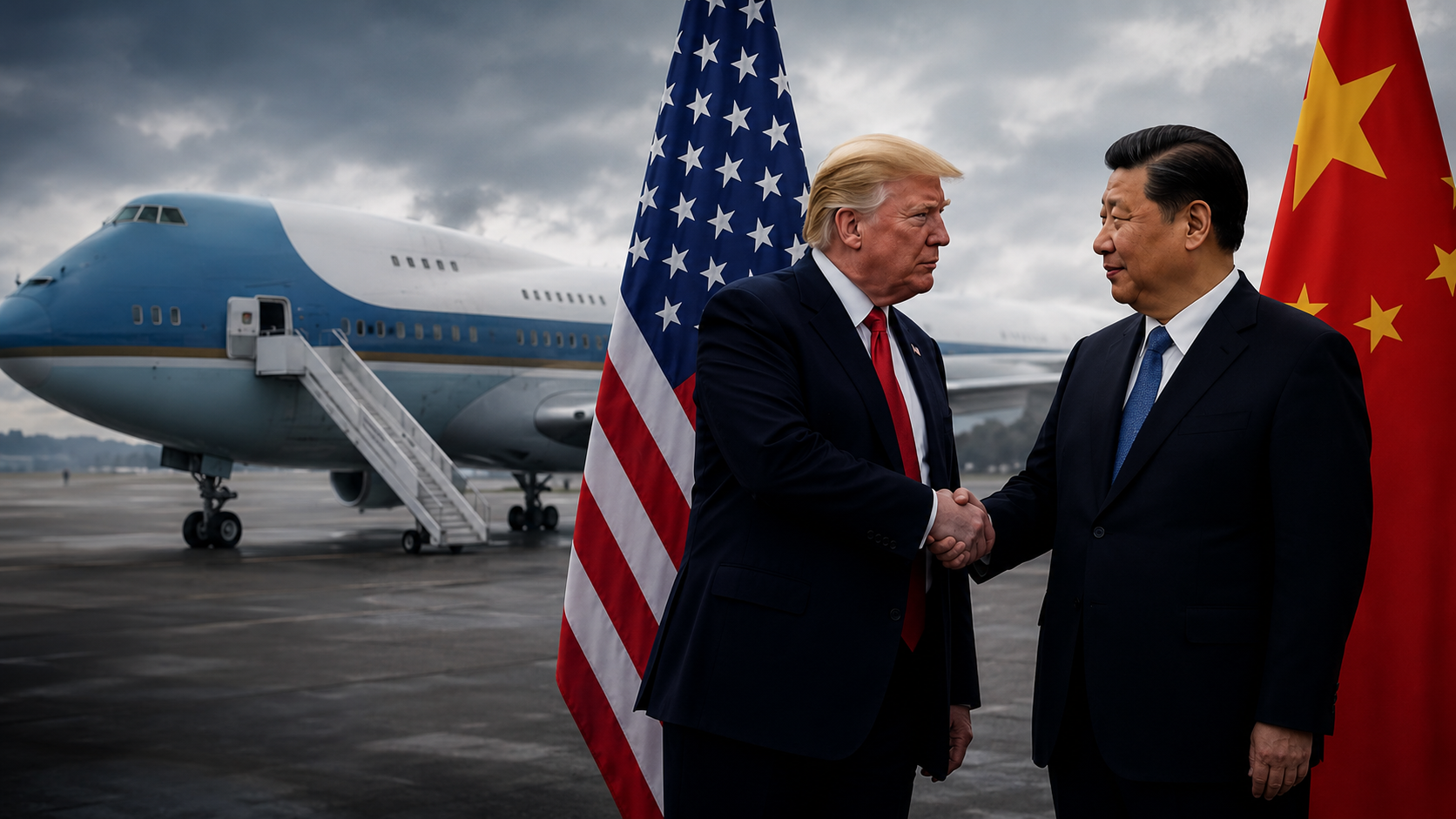
President Trump departed Beijing Friday after a two-day summit with Chinese President Xi Jinping, accompanied by 16 of America’s top executives and a list of commitments that both sides characterized as productive. The problem for markets: no formal agreements were signed, no tariff frameworks were finalized, and the rally that sent the Dow above 50,000 on Thursday is now partially reversing as investors digest the gap between the summit’s tone and its tangible output.
The Dow fell more than 400 points Friday morning. The Nasdaq dropped over 1.5%. The Russell 2000 — the benchmark most closely tied to small cap performance — fell 1.63%, giving back a meaningful portion of this week’s gains.
What Was Agreed — and What Wasn’t
The summit produced several headline-generating commitments. China agreed to purchase American oil, which sent crude prices higher Friday. Both sides called for improved bilateral ties and established new boards for economic and AI oversight. Xi reportedly told assembled US CEOs — including Nvidia’s Jensen Huang, Tesla’s Elon Musk, and Apple’s Tim Cook — that China’s door would open wider to American business.
But the specifics that markets were hoping for — a meaningful reduction in tariff rates, a structured technology trade framework, or concrete steps toward resolving the broader trade imbalance — did not materialize before Trump’s departure. The president described the conversations as “fantastic” and said “a lot of different problems” had been resolved, but produced no documentation to back those claims before leaving Beijing.
Why Small Caps Feel This More Acutely
Large multinational corporations have the geographic diversification and financial flexibility to weather prolonged trade uncertainty. Small and microcap companies largely do not. Many domestic manufacturers in the sub-$2 billion market cap space have been operating under tariff-driven cost pressures for months, pricing in relief that has yet to arrive.
Supply chain uncertainty — particularly for companies sourcing components or raw materials with any China exposure — remains unresolved. Until a formal tariff reduction framework is in place, small manufacturers, consumer goods companies, and technology hardware assemblers face the same input cost environment they have been navigating all year.
The Russell 2000’s outsized Friday decline relative to the large-cap indices reflects this reality. Small caps had priced in optimism. The summit delivered goodwill, not policy.
The Longer Game
The establishment of bilateral boards for economic and AI oversight is worth monitoring. If those structures produce actionable outcomes over the coming months, they could serve as a foundation for more substantive trade normalization — which would disproportionately benefit smaller, domestically focused companies that have been most exposed to the tariff environment.
The China oil purchase commitment, if executed at scale, creates a real demand catalyst for American energy producers, a sector where small and microcap names are well represented.
For now, though, the summit’s most honest takeaway is this: the relationship is warmer, the dialogue is open, and the hard work of deal-making remains unfinished. Markets that rallied on the promise are now recalibrating to the reality. Small cap investors should be watching the Russell 2000 closely in the sessions ahead — it will be among the first to signal whether this pullback is a pause or the beginning of a broader reversal.